REVIEW 2 major objections 5 minor 85 references
Who's Tracking Sensitive Domains?
T0 review · 2 major / 5 minor · reviewed 2026-08-14 · deepseek-v4-flash
Pith's one-line read Sensitive websites are tracked by mainstream ad companies, with median 10 trackers on health sites.
desk verdict The paper has real evidence that sensitive domains are tracked by mainstream ad-tech, but its headline tracker counts are inflated by counting every third-party domain, including font and CDN hosts, as a tracker. read the letter →
The pith
A machine-rendered reading of the paper's core claim, the machinery that carries it, and where it could break.
The reading
What carries the argument
The argument is carried by three linked instruments: (1) a sensitive-domain classifier trained on hand-filtered subcategories of Curlie.org (the human-edited Open Directory successor), using TF-IDF features over webpage text plus meta tags, which reaches about 85.66% accuracy and can detect sensitive domains in unlabeled lists like Alexa TopK; (2) a Puppeteer-based crawler that renders pages, scrolls to trigger lazy-loaded requests, and waits after window.onload to capture recursive third-party inclusion chains up to nine levels deep; and (3) an inclusion-chain construction that maps each request to its initiator and hop level, letting the authors distinguish direct inclusions (0 hops, where the tracker certainly knows the first-party domain) from indirect ones, and a keyword-based cookie-synchronization detector that recognizes ID-passing URL arguments between third-party domains.
What would settle it
Re-run the same crawl pipeline but classify each third-party domain against a tracker list (e.g., EasyList/EasyPrivacy or a manually audited tracker domain list) and compare the median counts; if the filtered medians drop to near zero for sensitive categories while remaining high for TopK, the paper's central quantitative claim would be refuted.
Extended reading notes
Core claim
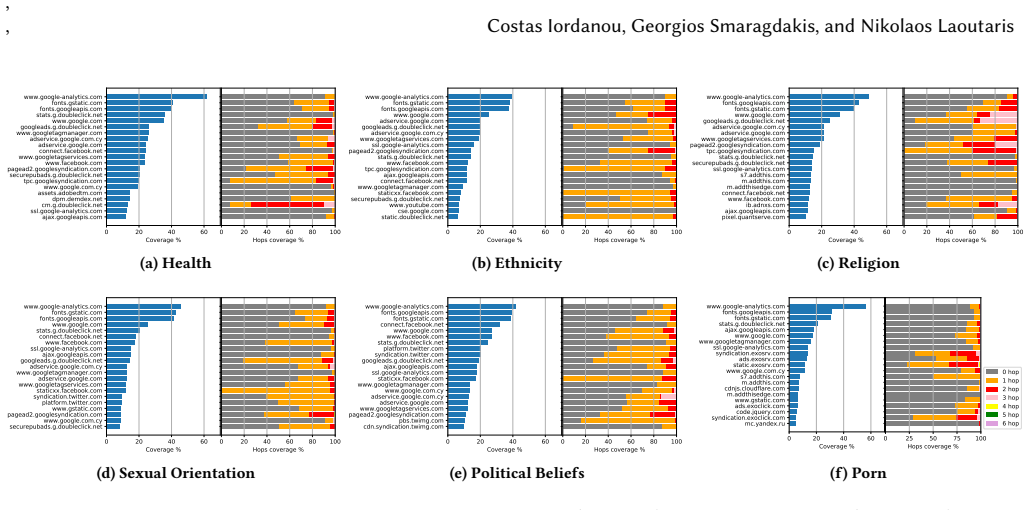
The central claim is that sensitive domains are tracked by third parties, though less intensely than mainstream domains. Using five GDPR-listed sensitive categories (Health, Ethnicity, Religion, Sexual Orientation, Political Beliefs) plus Porn, the authors report median third-party counts of 10 for Health, 7 for Political Beliefs, 6 for Sexual Orientation, 5 for Religion, 5 for Ethnicity, and 7 for Porn, versus 17 for a TopK baseline. The top trackers on sensitive sites are the same mainstream advertising and analytics services that dominate the wider web, with google-analytics.com present on at least 40% of sensitive sites in every category. Beyond those, the authors identify niche trackers that are absent from non-sensitive sites but present on specific sensitive categories, several of which advertise their ability to target health, political, or adult audiences. They also detect cookie synchronization between mainstream and niche trackers, finding that 26.87% of health websites host at least one synchronized pair, and that in Health and Political Beliefs roughly 12.8% and 11.7% of synchronization pairs involve niche trackers. The authors conclude that in most cases the tracker is deliberately included by the sensitive site owner, so the mainstream tracker is aware of its presence on the sensitive domain.
Load-bearing premise
The paper assumes that every third-party domain observed during page rendering is a tracker, because it intentionally filters nothing; if many of those domains are font hosts, CDNs, or code libraries that do not track users, the reported median tracker counts overstate tracking intensity.
Editorial extensions
If this is right
- If the paper is right, a visit to a cancer forum, a gay dating site, or a niche political blog routinely leaks to mainstream advertising companies that the visitor was there, and the leakage is not accidental: the site owner usually included the tracker deliberately.
- The tracker census implies that data-protection enforcement cannot rely on the naive hope that sensitive sites are too small or too marginal to attract trackers; even low-coverage niche trackers appear on up to 14% of sites within a sensitive category.
- Because cookie synchronization links niche trackers (which may have observed users on sensitive domains) to mainstream trackers (which often hold personal identifiers), the paper implies that the mainstream tracker can enrich its profile with sensitive-visit information without itself appearing on the sensitive site.
- The classifier itself is a reusable instrument: the authors argue it can be retargeted to arbitrary sensitive or non-sensitive categories in roughly five minutes of manual effort, enabling proactive monitoring and compliance audits at scale.
Reading between the lines
- The headline tracker counts deliberately count every third-party domain, including font CDNs, JavaScript libraries, and other infrastructure; a refined tracker-only list would likely lower the medians, though the qualitative finding that mainstream advertising trackers are present would probably survive.
- The paper's own logic suggests a testable regulatory lever: sensitive-domain owners could be offered advertising programs that refuse admission to sensitive categories, and the authors' classifier could mechanically audit whether such exclusion is honored.
- The cookie-synchronization result implies a concrete data-flow concern that the paper does not fully quantify: even if a niche tracker holds no personal identifiers, synchronization with a PII-holding mainstream tracker can attach a pseudonymous identity to a history of sensitive visits.
- The methodology could be extended to measure tracking after GDPR enforcement actions, comparing tracker presence on sensitive domains before and after regulatory changes to estimate deterrence effects.
Signed reviews
Editorial analysis
A structured set of objections, weighed in public.
Referee Report
Summary. The paper investigates which third parties track visitors to websites in GDPR-sensitive categories (Health, Ethnicity, Religion, Sexual Orientation, Political Beliefs, plus Porn). It first builds a classifier that labels sensitive domains using manually filtered Curlie categories as training data, reaching 85.66% accuracy with content and metadata features. It then uses a headless-browser crawler that renders roughly 30k sensitive domains and records all third-party requests, including recursive inclusions. Headline findings are that sensitive sites are tracked less intensely than popular TopK sites (median unique third-party domains: 10 for Health, 7 for Political Beliefs, 6 for Sexual Orientation, versus 17 for TopK), that the same mainstream trackers dominate, that some niche trackers specialize by category, and that mainstream and niche trackers exchange data via cookie synchronization. The paper concludes that sensitive domains are tracked to an alarmingly high degree, with direct inclusion by site owners implying tracker awareness.
Significance. If the results hold, the paper contributes a useful large-scale measurement of third-party presence on sensitive domains, a lightweight methodology for building sensitive-domain classifiers from Curlie, and one of the first looks at cookie synchronization between mainstream and niche trackers on such sites. The study's strengths include a fresh crawl rather than reuse of existing measurements, explicit documentation of the inclusion-chain construction, and an effort to verify niche trackers by manual inspection of their self-descriptions. The core qualitative finding -- that mainstream advertising trackers such as Google Analytics, DoubleClick, and Facebook appear on sensitive sites with high coverage -- is credible and important. However, the headline numerical claims about the number of trackers are weakened by the operationally unrestricted definition of a tracker, which counts CDN, font, and library hosts as trackers. The paper deserves publication after the quantitative claims are made robust to that concern.
major comments (2)
- [Section 4.4, Table 6] The central quantitative claim is the median number of trackers (10 for Health, 7 for Political Beliefs, 6 for Sexual Orientation, presented in the abstract and Section 1.3). Section 4.1 defines trackers as all third-party domains observed during rendering, choosing to include all third-party domains without filtering, and asserts without quantification that most are indeed trackers. The paper's own top-20 lists show that fonts.googleapis.com, fonts.gstatic.com, ajax.googleapis.com, cdnjs.cloudflare.com, and code.jquery.com appear in multiple categories. These are CDN, font, and library hosts, not tracking services in the usual sense, so counting them as trackers inflates the headline medians. The qualitative conclusion that mainstream tracking services are present on sensitive sites would likely survive re-analysis, but the specific numbers labeled 'number of third party trackers' are not supported as stated. Please re-run the analysis using a tracker filter list (e.g., EasyList/EasyPrivacy or an equivalent) or, at minimum, provide a sensitivity analysis that excludes CDN/font/library hosts, and report both the filtered and unfiltered results.
- [Section 4.4, Table 6] The niche-tracker analysis is presented as evidence that some trackers specialize in sensitive categories. The method excludes domains whose coverage on other categories exceeds a threshold q, but q is set to different values per category (1.0% to 5.5%) without a stated justification or sensitivity analysis over q. Several listed domains are plausible niche trackers (e.g., medtargetsystem.com, nationbuilder.com), and the manual verification is a good step. However, as written the table is suggestive rather than demonstrative; please add robustness checks across a range of q values or include a statistical test comparing within-category coverage against the baseline, so the claim of category-specialized trackers is not an artifact of the chosen thresholds.
minor comments (5)
- [Section 4.1] The word 'described' is misspelled as 'descriped' in the sentence about filter lists and methodologies.
- [Figure 5] The figure caption and text refer to 'a.discuscdn.com' and 'disquiscdn', while the text elsewhere uses 'disqus.com'; the names should be made consistent and correct.
- [Section 1.2] The last sentence of the Contributions paragraph is garbled: 'for the benefit of other researchers and' is an incomplete fragment that should be rewritten or removed.
- [Section 3.2.1] The phrase 'Each raw of the confusion matrix' should be 'Each row of the confusion matrix'.
- [Section 5.2] The sentence 'In total, we have 62 keyword' should be '62 keywords', and the keyword list is described only by examples; consider providing the complete list or a pointer to it.
Circularity Check
No circularity: tracking counts are fresh measurements, the classifier is held-out evaluated, and self-citations are background; the all-third-party tracker definition is a validity caveat, not a circular derivation.
full rationale
The paper's derivation chain is measurement-plus-classification, not a fitted prediction. The sensitive-domain classifier (Section 2) is trained on Curlie-labeled pages and evaluated on held-out data (Section 3.2, confusion matrices; Section 3.4, manual confirmation of 134/186 true positives), so its accuracy is not derived from the tracking results. The tracking findings (Sections 4.2–4.4) are fresh crawl observations from the same Curlie-labeled domains, not outputs of the classifier or fitted parameters. Self-citations [17,41] appear only as background/related work or, in Section 4.1, as an example of filter-list methods that the paper explicitly does not use ("we choose to include all third party domains in our dataset without any filtering"); hence they are not load-bearing. The CSync result is cross-checked against the independent study [60] (Section 5.3: 1.58% vs 1.47% of HTTP requests), which is external support. The one notable caveat is construct validity: because Section 4.1 counts all third-party domains as candidate trackers, the headline medians (10/7/6 in Section 1.3) may include CDN/font/library hosts such as fonts.googleapis.com and cdnjs.cloudflare.com, which appear in the paper's own top-20 lists (Figures 6–7). That could inflate the numeric medians, but it is a measurement-definition limitation, not a circular step: the numbers are observed third-party-domain counts, and calling them "trackers" is an unvalidated operationalization, not a fitted parameter or a quantity derived from the conclusion. The qualitative conclusion (Google/Facebook advertising trackers have high coverage on sensitive sites) is independently visible in the same data. No uniqueness theorem, ansatz, or fitted-parameter rename is imported from the authors' prior work, so the central claims do not reduce to their inputs.
Assumptions & free parameters
free parameters (3)
- Per-category niche-tracker coverage threshold q =
Health q=1.0%, Ethnicity q=5.5%, Religion q=2.5%, Sexual Orientation q=3.5%, Political Beliefs q=1.0%, Porn q=2.0%
- Classifier prediction probability threshold =
0.63
- Number of classifier features =
3,000
assumptions (5)
- domain assumption Curlie's human-edited category labels are accurate enough to serve as ground truth for sensitive domains.
- ad hoc to paper Every third-party domain observed during rendering is a tracker.
- ad hoc to paper A 0-hop (direct) inclusion implies the first-party site intentionally included the tracker.
- domain assumption The manually selected Curlie subcategories cover the GDPR-sensitive categories as intended.
- domain assumption The crawler's rendering behavior (scrolling plus one-minute post-load wait) approximates a real user's exposure to third-party and lazy-loaded requests.
Cite this review
Pith. "Pith review of Who's Tracking Sensitive Domains?." pith.science (2026). https://pith.science/paper/V3S756W4
@misc{pith2026190802261,
  author       = {Pith},
  title        = {Pith review of: Who's Tracking Sensitive Domains?},
  year         = {2026},
  howpublished = {\url{https://pith.science/paper/V3S756W4}},
  note         = {Machine review of arXiv:1908.02261}
}
read the original abstract
We turn our attention to the elephant in the room of data protection, which is none other than the simple and obvious question: "Who's tracking sensitive domains?". Despite a fast-growing amount of work on more complex facets of the interplay between privacy and the business models of the Web, the obvious question of who collects data on domains where most people would prefer not be seen, has received rather limited attention. First, we develop a methodology for automatically annotating websites that belong to a sensitive category, e.g. as defined by the General Data Protection Regulation (GDPR). Then, we extract the third party tracking services included directly, or via recursive inclusions, by the above mentioned sites. Having analyzed around 30k sensitive domains, we show that such domains are tracked, albeit less intensely than the mainstream ones. Looking in detail at the tracking services operating on them, we find well known names, as well as some less known ones, including some specializing on specific sensitive categories.
Figures


Figures from the paper (4 more)



Reference graph
Works this paper leans on
-
[1]
In ACM CCS (2013)
A/c.sc/a.sc/r.sc, G., J/u.sc/a.sc/r.sc/e.sc/z.sc, M., N/i.sc/k.sc/i.sc/f.sc/o.sc/r.sc/a.sc/k.sc/i.sc/s.sc, N., D/i.sc/a.sc/z.sc, C., G¨/u.sc/r.sc/s.sc/e.sc/s.sc, S., P/i.sc/e.sc/s.sc/s.sc/e.sc/n.sc/s.sc, F., /a.sc/n.sc/d.sc P/r.sc/e.sc/n.sc/e.sc/e.sc/l.sc, B.FPDetective: Dusting the Web for Fingerprinters. In ACM CCS (2013)
2013
-
[2]
B., O/g.sc/u.sc/n.sc/t.sc/o.sc/y.sc/e.sc, J
A/d.sc/e.sc/t.sc/u.sc/n.sc/j.sc/i.sc, A. B., O/g.sc/u.sc/n.sc/t.sc/o.sc/y.sc/e.sc, J. P., F/e.sc/n.sc/w.sc/a.sc, O. D., /a.sc/n.sc/d.sc A/k.sc/a.sc/n.sc/d.sc/e.sc, N. O. Web Document Classi/f_ication Using Nave Bayes.Advances in Mathe- matics and Computer Science 29 (2018)
2018
-
[3]
In USENIX Security (2010)
A/g.sc/g.sc/a.sc/r.sc/w.sc/a.sc/l.sc, G., B/u.sc/r.sc/s.sc/z.sc/t.sc/e.sc/i.sc/n.sc, E., J/a.sc/c.sc/k.sc/s.sc/o.sc/n.sc, C., /a.sc/n.sc/d.sc B/o.sc/n.sc/e.sc/h.sc, D.An Anal- ysis of Private Browsing Modes in Modern Browsers. In USENIX Security (2010)
2010
-
[4]
Alexa /T_he top 500 sites on the web
A/l.sc/e.sc/x.sc/a.sc./c.sc/o.sc/m.sc. Alexa /T_he top 500 sites on the web. h/t_tps://www.alexa. com/topsites, 2019
2019
-
[5]
Alexa top websites by category
A/l.sc/e.sc/x.sc/a.sc./c.sc/o.sc/m.sc. Alexa top websites by category. h/t_tps://www.alexa.com/ topsites/category, 2019
2019
-
[6]
M., K/w.sc/a.sc/k.sc, H., /a.sc/n.sc/d.sc O/l.sc/i.sc/v.sc/e.sc/r.sc, N
A/m.sc/a.sc/t.sc/r.sc/i.sc/a.sc/i.sc/n.sc, X., L/a.sc/t.sc/h.sc/i.sc/a.sc, N., P/u.sc/j.sc/o.sc/l.sc, J. M., K/w.sc/a.sc/k.sc, H., /a.sc/n.sc/d.sc O/l.sc/i.sc/v.sc/e.sc/r.sc, N. /T_he Wisdom of the Few: A Collaborative Filtering Approach Based on Expert Opinions from the Web. In ACM SIGIR (2009)
work page 2009
-
[7]
A/r.sc/s.sc/h.sc/a.sc/d.sc, S., K/h.sc/a.sc/r.sc/r.sc/a.sc/z.sc, A., /a.sc/n.sc/d.sc R/o.sc/b.sc/e.sc/r.sc/t.sc/s.sc/o.sc/n.sc, W.Include me out: In- browser detection of malicious third-party content inclusions. In Proc. of Intl. Conf. on Financial Cryptography (2017)
work page 2017
-
[8]
B/a.sc/l.sc/e.sc/b.sc/a.sc/k.sc/o.sc, R., L/e.sc´/o.sc/n.sc, P. G., S/h.sc/a.sc/y.sc, R., U/r.sc, B., W /a.sc/n.sc/g.sc, Y., /a.sc/n.sc/d.sc C/r.sc/a.sc/n.sc/o.sc/r.sc, L. F. Measuring the Effectiveness of Privacy Tools for Limiting Behavioral Advertising. In W2SP Workshop (2012)
work page 2012
Show all 85 references
-
[9]
In IFIP Networking (2017)
B/a.sc/n.sc/g.sc/e.sc/r.sc/a.sc, P., /a.sc/n.sc/d.sc G/o.sc/r.sc/i.sc/n.sc/s.sc/k.sc/y.sc, S.Ads versus Regular Contents: Dis- secting the Web Hosting Ecosystem. In IFIP Networking (2017)
2017
-
[10]
M., A/r.sc/s.sc/h.sc/a.sc/d.sc, S., K/i.sc/r.sc/d.sc/a.sc, E., R/o.sc/b.sc/e.sc/r.sc/t.sc/s.sc/o.sc/n.sc, W., /a.sc/n.sc/d.sc W/i.sc/l.sc/s.sc/o.sc/n.sc, C
B/a.sc/s.sc/h.sc/i.sc/r.sc, A. M., A/r.sc/s.sc/h.sc/a.sc/d.sc, S., K/i.sc/r.sc/d.sc/a.sc, E., R/o.sc/b.sc/e.sc/r.sc/t.sc/s.sc/o.sc/n.sc, W., /a.sc/n.sc/d.sc W/i.sc/l.sc/s.sc/o.sc/n.sc, C. How Tracking Companies Circumvented Ad Blockers Using Web- Sockets. In ACM IMC (2018)
2018
-
[11]
B/a.sc/s.sc/h.sc/i.sc/r.sc, M. A., A/r.sc/s.sc/h.sc/a.sc/d.sc, S., R/o.sc/b.sc/e.sc/r.sc/t.sc/s.sc/o.sc/n.sc, W., /a.sc/n.sc/d.sc W/i.sc/l.sc/s.sc/o.sc/n.sc, C.Tracing Information Flows Between Ad Exchanges Using Retargeted Ads. In USENIX Security (2016)
2016
-
[12]
A., /a.sc/n.sc/d.sc W/i.sc/l.sc/s.sc/o.sc/n.sc, C.Diffusion of User Tracking Data in the Online Advertising Ecosystem
B/a.sc/s.sc/h.sc/i.sc/r.sc, M. A., /a.sc/n.sc/d.sc W/i.sc/l.sc/s.sc/o.sc/n.sc, C.Diffusion of User Tracking Data in the Online Advertising Ecosystem. In PETS 2018 (2018)
2018
-
[13]
V., Z/h.sc/a.sc/o.sc, J., L/i.sc/b.sc/e.sc/r.sc/t.sc, T., /a.sc/n.sc/d.sc S/h.sc/a.sc/d.sc/b.sc/o.sc/l.sc/t.sc, N
B/i.sc/n.sc/n.sc/s.sc, R., L/y.sc/n.sc/g.sc/s.sc, U., K/l.sc/e.sc/e.sc/k.sc, M. V., Z/h.sc/a.sc/o.sc, J., L/i.sc/b.sc/e.sc/r.sc/t.sc, T., /a.sc/n.sc/d.sc S/h.sc/a.sc/d.sc/b.sc/o.sc/l.sc/t.sc, N. /T_hird Party Tracking in the Mobile Ecosystem. InWebSci (2018)
2018
-
[14]
In IMC (2011)
B/u.sc/t.sc/k.sc/i.sc/e.sc/w.sc/i.sc/c.sc/z.sc, M., M/a.sc/d.sc/h.sc/y.sc/a.sc/s.sc/t.sc/h.sc/a.sc, H., /a.sc/n.sc/d.sc S/e.sc/k.sc/a.sc/r.sc, V.Understanding Website Complexity: Measurements, Metrics, and Implications. In IMC (2011)
2011
-
[15]
V., /a.sc/n.sc/d.sc S/e.sc/k.sc/a.sc/r.sc, V.Characterizing Web Page Complexity and Its Impact
B/u.sc/t.sc/k.sc/i.sc/e.sc/w.sc/i.sc/c.sc/z.sc, M., M/a.sc/d.sc/h.sc/y.sc/a.sc/s.sc/t.sc/h.sc/a.sc, H. V., /a.sc/n.sc/d.sc S/e.sc/k.sc/a.sc/r.sc, V.Characterizing Web Page Complexity and Its Impact. IEEE/ACM Trans. Networking 22, 3 (2014)
2014
-
[16]
A.Combining Link-based and Content-based Methods for Web Document Classi/f_ication
C/a.sc/l.sc/a.sc/d.sc/o.sc, P., C/r.sc/i.sc/s.sc/t.sc/o.sc, M., M/o.sc/u.sc/r.sc/a.sc, E., Z/i.sc/v.sc/i.sc/a.sc/n.sc/i.sc, N., R/i.sc/b.sc/e.sc/i.sc/r.sc/o.sc/hyphen.scN/e.sc/t.sc/o.sc, B., /a.sc/n.sc/d.sc G/o.sc/n.sc/c.sc ¸/a.sc/l.sc/v.sc/e.sc/s.sc, M. A.Combining Link-based...
2003
-
[17]
C/a.sc/r.sc/r.sc/a.sc/s.sc/c.sc/o.sc/s.sc/a.sc, J. M., M/i.sc/k.sc/i.sc/a.sc/n.sc/s.sc, J., C/u.sc/e.sc/v.sc/a.sc/s.sc, R., E/r.sc/r.sc/a.sc/m.sc/i.sc/l.sc/l.sc/i.sc, V., /a.sc/n.sc/d.sc L/a.sc/o.sc/u.sc/t.sc/a.sc/r.sc/i.sc/s.sc, N.I Always Fell Like Somebody’s Watching Me. Me...
2015
-
[18]
In NDSS (2014)
C/a.sc/s.sc/t.sc/e.sc/l.sc/l.sc/u.sc/c.sc/c.sc/i.sc/a.sc, C., O/l.sc/e.sc/j.sc/n.sc/i.sc/k.sc, L., /a.sc/n.sc/d.sc M/i.sc/n.sc/h.sc/hyphen.scD/u.sc/n.sc/g.sc, T.Selling Off Privacy at Auction. In NDSS (2014)
2014
-
[19]
V.Fast and accurate text classi/f_ication via multiple linear discriminant projections./T_he VLDB Journal 12 (2003)
C/h.sc/a.sc/k.sc/r.sc/a.sc/b.sc/a.sc/r.sc/t.sc/i.sc, S., R/o.sc/y.sc, S., /a.sc/n.sc/d.sc S/o.sc/u.sc/n.sc/d.sc/a.sc/l.sc/g.sc/e.sc/k.sc/a.sc/r.sc, M. V.Fast and accurate text classi/f_ication via multiple linear discriminant projections./T_he VLDB Journal 12 (2003)
2003
-
[20]
C/h.sc/e.sc/n.sc, R./hyphen.scC., /a.sc/n.sc/d.sc H/s.sc/i.sc/e.sc/h.sc, C./hyphen.scH.Web page classi/f_ication based on a support vector machine using a weighted vote schema.Expert Systems with Applications 31 (2006)
2006
-
[21]
JCM 10 (2015)
C/h.sc/e.sc/n.sc, Y., Z/h.sc/e.sc/n.sc/g.sc, A., J/i.sc/n.sc/g.sc, S., /a.sc/n.sc/d.sc H/u.sc/a.sc/n.sc/g.sc, Q.Optimization of waiting time in complex RIA by combined pseudo-hierarchical-lazy-loading algorithm. JCM 10 (2015)
2015
-
[22]
L., /a.sc/n.sc/d.sc N/g.sc, H
C/h.sc/i.sc/e.sc/u.sc, H. L., /a.sc/n.sc/d.sc N/g.sc, H. T.A Maximum Entropy Approach to Infor- mation Extraction from Semi-structured and Free Text. In Proc. of the Eighteenth National Conference on Arti/f_icial Intelligence(2002)
2002
-
[23]
Curlie - the largest human-edited directory of the Web
C/u.sc/r.sc/l.sc/i.sc/e.sc./o.sc/r.sc/g.sc. Curlie - the largest human-edited directory of the Web. h/t_tps://curlie.org/, 2019
2019
-
[24]
D/e.sc/n.sc/o.sc/y.sc/e.sc/r.sc, L., /a.sc/n.sc/d.sc P, G.Bayesian Network Model for Semi-structured Document Classi/f_ication.Information Processing and Management 40 (2004)
2004
-
[25]
DMOZ - /T_he largest, most comprehensive human- edited directory of the Web
D/m.sc/o.sc/z.sc/hyphen.sc/o.sc/d.sc/p.sc./o.sc/r.sc/g.sc. DMOZ - /T_he largest, most comprehensive human- edited directory of the Web. h/t_tp://dmoz-odp.org/, 2019
2019
-
[26]
D/o.sc/m.sc/i.sc/n.sc/g.sc/o.sc/s.sc, P., /a.sc/n.sc/d.sc P/a.sc/z.sc/z.sc/a.sc/n.sc/i.sc, M.On the Optimality of the Simple Bayesian Classi/f_ier under Zero-One Loss.Machine Learning 29 (1997)
1997
-
[27]
Electronic Notes in /T_heoretical Computer Science 157(2006)
E/s.sc/t.sc/r.sc/u.sc/c.sc/h.sc, V., F/e.sc/r.sc/r.sc/i.sc, C., H/e.sc/r.sc/n.sc/n.sc/d.sc/e.sc/z.sc/hyphen.scO/r.sc/a.sc/l.sc/l.sc/o.sc, J., /a.sc/n.sc/d.sc R/a.sc/m.sc/r.sc/e.sc/z.sc/hyphen.sc /Q_u.sc/i.sc/n.sc/t.sc/a.sc/n.sc/a.sc, M.Web Categorisation Using Distance-Based D...
2006
-
[28]
Data protection in the EU, /T_he General Data Protection Regulation (GDPR); Regulation (EU) 2016/679
E/u.sc/r.sc/o.sc/p.sc/e.sc/a.sc/n.sc C/o.sc/m.sc/m.sc/i.sc/s.sc/s.sc/i.sc/o.sc/n.sc. Data protection in the EU, /T_he General Data Protection Regulation (GDPR); Regulation (EU) 2016/679. h/t_tps: //ec.europa.eu/info/law/law-topic/data-protection/, 2018
2016
-
[29]
Data protection: Gdpr in numbers
E/u.sc/r.sc/o.sc/p.sc/e.sc/a.sc/n.sc C/o.sc/m.sc/m.sc/i.sc/s.sc/s.sc/i.sc/o.sc/n.sc. Data protection: Gdpr in numbers. h/t_tps: //ec.europa.eu/justice/smedataprotect/index en.htm, 2019
2019
-
[30]
/T_he independent, comprehensive directory of 1,404 /f_ilter and host lists for advertisements, trackers, malware, and annoy- ances
F/i.sc/l.sc/t.sc/e.sc/r.scL/i.sc/s.sc/t.sc/s.sc./c.sc/o.sc/m.sc. /T_he independent, comprehensive directory of 1,404 /f_ilter and host lists for advertisements, trackers, malware, and annoy- ances. h/t_tps:///f_ilterlists.com/, 2019
2019
-
[31]
Tracking the pixels: Detecting web trackers via analyzing invisible pixels
F/o.sc/u.sc/a.sc/d.sc, I., B/i.sc/e.sc/l.sc/o.sc/v.sc/a.sc, N., L/e.sc/g.sc/o.sc/u.sc/t.sc, A., /a.sc/n.sc/d.sc S/a.sc/r.sc/a.sc/f.sc/i.sc/j.sc/a.sc/n.sc/o.sc/v.sc/i.sc/c.sc/hyphen.scD/j.sc/u.sc/k.sc/i.sc/c.sc, N. Tracking the pixels: Detecting web trackers via analyzing invis...
2018 arXiv
-
[32]
arXiv:1506.04103, 2015
F/r.sc/u.sc/c.sc/h.sc/t.sc/e.sc/r.sc, N., M/i.sc/a.sc/o.sc, H., S/t.sc/e.sc/v.sc/e.sc/n.sc/s.sc/o.sc/n.sc, S., /a.sc/n.sc/d.sc B/a.sc/l.sc/e.sc/b.sc/a.sc/k.sc/o.sc, R.Variations in Tracking in Relation to Geographic Location. arXiv:1506.04103, 2015
2015 arXiv
-
[33]
In WPES (2014)
G/a.sc/o.sc, X., Y /a.sc/n.sc/g.sc, Y., F/u.sc, H., L/i.sc/n.sc/d.sc/q.sc/v.sc/i.sc/s.sc/t.sc, J., /a.sc/n.sc/d.sc W /a.sc/n.sc/g.sc, Y.Private Brows- ing: An Inquiry on Usability and Privacy Protection. In WPES (2014)
2014
-
[34]
G/e.sc/r.sc/v.sc/a.sc/i.sc/s.sc, A., F/i.sc/l.sc/i.sc/o.sc/s.sc, A., L/e.sc/n.sc/d.sc/e.sc/r.sc/s.sc, V., /a.sc/n.sc/d.sc C/a.sc/p.sc/k.sc/u.sc/n.sc, S./Q_uantifying Web Adblocker Privacy
-
[35]
Google Ads - About Display Planner
G/o.sc/o.sc/g.sc/l.sc/e.sc. Google Ads - About Display Planner. h/t_tps://support.google. com/google-ads/answer/3056432?hl=en, 2019
2019
-
[36]
Google Chrome Web Browser
G/o.sc/o.sc/g.sc/l.sc/e.sc. Google Chrome Web Browser. h/t_tps://www.google.com/ chrome/, 2019
2019
-
[37]
Puppeteer - A Node library which provides a high-level API to control Chrome
G/o.sc/o.sc/g.sc/l.sc/e.sc. Puppeteer - A Node library which provides a high-level API to control Chrome. h/t_tps://developers.google.com/web/tools/puppeteer/, 2019
2019
-
[38]
G/r.sc/e.sc/e.sc/n.sc/g.sc/a.sc/r.sc/d.sc, S.Weighing the Impact of GDPR. Comm. of the ACM 61 , 11 (2018)
2018
-
[39]
H/a.sc/n.sc, E., K/a.sc/r.sc/y.sc/p.sc/i.sc/s.sc, G., /a.sc/n.sc/d.sc K/u.sc/m.sc/a.sc/r.sc, V.Text categorization using weight adjusted k-nearest neighbor classi/f_ication. InProc. of the 5th Paci/f_ic- Asia Conference on Knowledge Discovery and Data Mining (2001)
2001
-
[40]
Y.Document Clas- si/f_ication Using Information /T_heory And A Fast Back-Propagation Neural Network
H/o.sc/w.sc/a.sc/r.sc/d.sc, L., L/i.sc/a.sc/m.sc, P., Y/e.sc/v.sc/g.sc/e.sc/n.sc, B., /a.sc/n.sc/d.sc S/i.sc/m.sc/o.sc/n.sc, X. Y.Document Clas- si/f_ication Using Information /T_heory And A Fast Back-Propagation Neural Network. Intelligent Automation and So/f_t Computing 16(2010)
2010
-
[41]
In ACM IMC (2018)
I/o.sc/r.sc/d.sc/a.sc/n.sc/o.sc/u.sc, C., S/m.sc/a.sc/r.sc/a.sc/g.sc/d.sc/a.sc/k.sc/i.sc/s.sc, G., P/o.sc/e.sc/s.sc/e.sc, I., /a.sc/n.sc/d.sc L/a.sc/o.sc/u.sc/t.sc/a.sc/r.sc/i.sc/s.sc, N.Tracing Cross Border Web Tracking. In ACM IMC (2018)
2018
-
[42]
R/e.sc/n.sc /a.sc/n.sc/d.sc A
J. R/e.sc/n.sc /a.sc/n.sc/d.sc A. R/a.sc/o.sc /a.sc/n.sc/d.sc M. L/i.sc/n.sc/d.sc/o.sc/r.sc/f.sc/e.sc/r.sc /a.sc/n.sc/d.sc A. L/e.sc/g.sc/o.sc/u.sc/t.sc /a.sc/n.sc/d.sc D. C/h.sc/o.sc/f.sc/f.sc/n.sc/e.sc/s.sc. ReCon: Revealing and Controlling PII Leaks in Mobile Network Traffic....
2016
-
[43]
K/a.sc/l.sc/m.sc/a.sc/n.sc, L.New European Data Privacy and Cyber Security Laws: One Year Later. Comm. of the ACM 62 , 4 (2019)
2019
-
[44]
InACM SIGIR (2012)
K/o.sc, Y.A Study of Term Weighting Schemes Using Class Information for Text Classi/f_ication. InACM SIGIR (2012)
2012
-
[45]
K/o.sc/w.sc/s.sc/a.sc/r.sc/i.sc, K., M/e.sc/i.sc/m.sc/a.sc/n.sc/d.sc/i.sc, K. J., H/e.sc/i.sc/d.sc/a.sc/r.sc/y.sc/s.sc/a.sc/f.sc/a.sc, M., M/e.sc/n.sc/d.sc/u.sc, S., B/a.sc/r.sc/n.sc/e.sc/s.sc, L., /a.sc/n.sc/d.sc B/r.sc/o.sc/w.sc/n.sc, D.Text Classi/f_ication Algorithms: A Su...
2019
-
[46]
Imperial Journal of Interdisciplinary Research 3 (2016)
K/r.sc/i.sc/s.sc/h.sc/n.sc/a.sc/v.sc/e.sc/n.sc/i.sc, G., /a.sc/n.sc/d.sc S/u.sc/d.sc/h.sc/a.sc, T.Nave Bayes Text Classi/f_ication /f_i/question_exclam A Comparison of Event Models. Imperial Journal of Interdisciplinary Research 3 (2016)
2016
-
[47]
K/w.sc/o.sc/n.sc, O., /a.sc/n.sc/d.sc J/o.sc/n.sc/g.sc/hyphen.scH/y.sc/e.sc/o.sc/k.sc, L.Text categorization based on k-nearest neighbor approach for Web site classi/f_ication.Information Processing and Management 39 (2003). 15 , ,
2003
-
[48]
Proceed- ings of the IEEE 106 , 11 (2018)
L/a.sc/o.sc/u.sc/t.sc/a.sc/r.sc/i.sc/s.sc, N.Data transparency: Concerns and prospects. Proceed- ings of the IEEE 106 , 11 (2018)
2018
-
[49]
L/e.sc/r.sc/n.sc/e.sc/r.sc, A., S/i.sc/m.sc/p.sc/s.sc/o.sc/n.sc, A. K., K/o.sc/h.sc/n.sc/o.sc, T., /a.sc/n.sc/d.sc R/o.sc/e.sc/s.sc/n.sc/e.sc/r.sc, F.Internet Jones and the Raiders of the Lost Trackers: An Archaeological Study of Web Tracking from 1996 to 2016. In USENIX Secur...
2016
-
[50]
In ACM IMC (2016)
L/e.sc/u.sc/n.sc/g.sc, C., R/e.sc/n.sc, J., C/h.sc/o.sc/f.sc/f.sc/n.sc/e.sc/s.sc, D., /a.sc/n.sc/d.sc W/i.sc/l.sc/s.sc/o.sc/n.sc, C.Should You Use the App for /T_hat?: Comparing the Privacy Implications of App- and Web-based Online Services. In ACM IMC (2016)
2016
-
[51]
International Journal of Advanced Research in Computer and Communication Engineering 4 (2015)
M/a.sc/h.sc/e.sc/s.sc/h.sc, K., S/a.sc/r.sc/o.sc/j.sc/a.sc, D., P/r.sc/a.sc/s.sc/h.sc/a.sc/n.sc/t.sc, G., /a.sc/n.sc/d.sc N/i.sc/r.sc/a.sc/n.sc/j.sc/a.sc/h.sc, C.Text mining approach to classify technical research documents using nave- bayes. International Journal of Advanced ...
2015
-
[52]
Neurocomputing 70 (2007)
M/a.sc/n.sc/e.sc/v.sc/i.sc/t.sc/z.sc, L., /a.sc/n.sc/d.sc Y/o.sc/u.sc/s.sc/e.sc/f.sc, M.One-class document classi/f_ication via Neural Networks. Neurocomputing 70 (2007)
2007
-
[53]
In SOUPS (2018)
M/a.sc/t.sc/h.sc/u.sc/r.sc, A., V/i.sc/t.sc/a.sc/k.sc, J., N/a.sc/r.sc/a.sc/y.sc/a.sc/n.sc/a.sc/n.sc, A., /a.sc/n.sc/d.sc C/h.sc/e.sc/t.sc/t.sc/y.sc, M.Characteriz- ing the use of browser-based blocking extensions to prevent online tracking. In SOUPS (2018)
2018
-
[54]
R., /a.sc/n.sc/d.sc M/i.sc/t.sc/c.sc/h.sc/e.sc/l.sc/l.sc, J
M/a.sc/y.sc/e.sc/r.sc, J. R., /a.sc/n.sc/d.sc M/i.sc/t.sc/c.sc/h.sc/e.sc/l.sc/l.sc, J. C./T_hird-Party Web Tracking: Policy and Technology. In IEEE Symposium on Security and Privacy (2012)
2012
-
[55]
InACM CIKM (2018)
M/e.sc/n.sc/g.sc, Y., S/h.sc/e.sc/n.sc, J., Z/h.sc/a.sc/n.sc/g.sc, C., /a.sc/n.sc/d.sc H/a.sc/n.sc, J.Weakly-Supervised Neural Text Classi/f_ication. InACM CIKM (2018)
2018
-
[56]
Node.js - A JavaScript runtime built on Chrome’s V8 JavaScript engine
/n.sc/o.sc/d.sc/e.sc/j.sc/s.sc./o.sc/r.sc/g.sc. Node.js - A JavaScript runtime built on Chrome’s V8 JavaScript engine. h/t_tps://nodejs.org/, 2019
2019
-
[57]
Aus- tralian Privacy Principles guidelines; Australian Privacy Principle 5 – Noti/f_ication of the collection of personal information
O/f.sc/f.sc/i.sc/c.sc/e.sc /o.sc/f.sc /t.sc/h.sc/e.sc A/u.sc/s.sc/t.sc/r.sc/a.sc/l.sc/i.sc/a.sc/n.sc I/n.sc/f.sc/o.sc/r.sc/m.sc/a.sc/t.sc/i.sc/o.sc/n.sc C/o.sc/m.sc/m.sc/i.sc/s.sc/s.sc/i.sc/o.sc/n.sc/e.sc/r.sc. Aus- tralian Privacy Principles guidelines; Australian Privacy Pri...
2018
-
[58]
Amended Act on /T_he Personal Information Protection and Electronic Documents Act
O/f.sc/f.sc/i.sc/c.sc/e.sc /o.sc/f.sc /t.sc/h.sc/e.sc P/r.sc/i.sc/v.sc/a.sc/c.sc/y.sc C/o.sc/m.sc/m.sc/i.sc/s.sc/s.sc/i.sc/o.sc/n.sc/e.sc/r.sc /o.sc/f.sc C/a.sc/n.sc/a.sc/d.sc/a.sc. Amended Act on /T_he Personal Information Protection and Electronic Documents Act. h/t_tps://ww...
2018
-
[59]
MSc the- sis, Computer Science, Brandeis University, h/t_tps://github.com/ kahliloppenheimer/Web-page-classi/f_ication/blob/master/paper.pdf, 2015
O/p.sc/p.sc/e.sc/n.sc/h.sc/e.sc/i.sc/m.sc/e.sc/r.sc, K.Topical web-page classi/f_ication. MSc the- sis, Computer Science, Brandeis University, h/t_tps://github.com/ kahliloppenheimer/Web-page-classi/f_ication/blob/master/paper.pdf, 2015
2015
-
[60]
P.Cookie Synchronization: Everything You Always Wanted to Know But Were Afraid to Ask
P/a.sc/p.sc/a.sc/d.sc/o.sc/p.sc/o.sc/u.sc/l.sc/o.sc/s.sc, P., K/o.sc/u.sc/r.sc/t.sc/e.sc/l.sc/l.sc/i.sc/s.sc, N., /a.sc/n.sc/d.sc M/a.sc/r.sc/k.sc/a.sc/t.sc/o.sc/s.sc, E. P.Cookie Synchronization: Everything You Always Wanted to Know But Were Afraid to Ask. In WWW (2019)
2019
-
[61]
Amended Act on the Protection of Personal Information
P/e.sc/r.sc/s.sc/o.sc/n.sc/a.sc/l.sc I/n.sc/f.sc/o.sc/r.sc/m.sc/a.sc/t.sc/i.sc/o.sc/n.sc P/r.sc/o.sc/t.sc/e.sc/c.sc/t.sc/i.sc/o.sc/n.sc C/o.sc/m.sc/m.sc/i.sc/s.sc/s.sc/i.sc/o.sc/n.sc, J/a.sc/p.sc/a.sc/n.sc. Amended Act on the Protection of Personal Information. h/t_tps://www.p...
2017
-
[62]
In IMC (2015)
P/u.sc/j.sc/o.sc/l.sc, E., H/o.sc/h.sc/l.sc/f.sc/e.sc/l.sc/d.sc, O., /a.sc/n.sc/d.sc F/e.sc/l.sc/d.sc/m.sc/a.sc/n.sc/n.sc, A.Annoyed Users: Ads and Ad-Block Usage in the Wild. In IMC (2015)
2015
-
[63]
In NDSS (2018)
R/a.sc/z.sc/a.sc/g.sc/h.sc/p.sc/a.sc/n.sc/a.sc/h.sc, A., N/i.sc/t.sc/h.sc/y.sc/a.sc/n.sc/a.sc/n.sc/d.sc, R., V/a.sc/l.sc/l.sc/i.sc/n.sc/a.sc/hyphen.scR/o.sc/d.sc/r.sc/i.sc/g.sc/u.sc/e.sc/z.sc, N., S/u.sc/n.sc/hyphen.sc /d.sc/a.sc/r.sc/e.sc/s.sc/a.sc/n.sc, S., A/l.sc/l.sc/m.sc/...
2018
-
[64]
R/e.sc/y.sc/e.sc/s.sc, I., W/i.sc/j.sc/e.sc/s.sc/e.sc/k.sc/e.sc/r.sc/a.sc, P., R/e.sc/a.sc/r.sc/d.sc/o.sc/n.sc, J., E/l.sc/a.sc/z.sc/a.sc/r.sc/i.sc, A., R/a.sc/z.sc/a.sc/g.sc/h.sc/p.sc/a.sc/n.sc/a.sc/h.sc, A., V /a.sc/l.sc/l.sc/i.sc/n.sc/a.sc/hyphen.scR/o.sc/d.sc/r.sc/i.sc/g.s...
-
[65]
In NSDI (2012)
R/o.sc/e.sc/s.sc/n.sc/e.sc/r.sc, F., K/o.sc/h.sc/n.sc/o.sc, T., /a.sc/n.sc/d.sc W/e.sc/t.sc/h.sc/e.sc/r.sc/a.sc/l.sc/l.sc, D.Detecting and defending against third-party tracking on the web. In NSDI (2012)
2012
-
[66]
Information Processing and Management 24 (1988)
S/a.sc/l.sc/t.sc/o.sc/n.sc, G., /a.sc/n.sc/d.sc B/u.sc/c.sc/k.sc/l.sc/e.sc/y.sc, C.Term-weighting approaches in automatic text retrieval. Information Processing and Management 24 (1988)
1988
-
[67]
S/c.sc/h.sc/e.sc/i.sc/t.sc/l.sc/e.sc, Q., H/o.sc/h.sc/l.sc/f.sc/e.sc/l.sc/d.sc, O., G/a.sc/m.sc/b.sc/a.sc, J., J/e.sc/l.sc/t.sc/e.sc/n.sc, J., Z/i.sc/m.sc/m.sc/e.sc/r.sc/m.sc/a.sc/n.sc/n.sc, T., S/t.sc/r.sc/o.sc/w.sc/e.sc/s.sc, S. D., /a.sc/n.sc/d.sc V /a.sc/l.sc/l.sc/i.sc/n.s...
2018
-
[68]
SimilarWeb - Top sites ranking for all categories in the world
S/i.sc/m.sc/i.sc/l.sc/a.sc/r.sc/w.sc/e.sc/b.sc./c.sc/o.sc/m.sc. SimilarWeb - Top sites ranking for all categories in the world. h/t_tps://www.similarweb.com/top-websites, 2019
2019
-
[69]
PoPETs (2016)
S/t.sc/a.sc/r.sc/o.sc/v.sc, O., G/i.sc/l.sc/l.sc, P., /a.sc/n.sc/d.sc N/i.sc/k.sc/i.sc/f.sc/o.sc/r.sc/a.sc/k.sc/i.sc/s.sc, N.Are You Sure You Want to Contact Us? /Q_uantifying the Leakage of PII via Website Contact Forms. PoPETs (2016)
2016
-
[70]
In Engineering Secure So/f_tware and Systems(2018)
S/t.sc/a.sc/r.sc/o.sc/v.sc, O., /a.sc/n.sc/d.sc N/i.sc/k.sc/i.sc/f.sc/o.sc/r.sc/a.sc/k.sc/i.sc/s.sc, N.Privacymeter: Designing and devel- oping a privacy-preserving browser extension. In Engineering Secure So/f_tware and Systems(2018)
2018
-
[71]
California Consumer Privacy Act – Assem- bly Bill No
S/t.sc/a.sc/t.sc/e.sc /o.sc/f.sc C/a.sc/l.sc/i.sc/f.sc/o.sc/r.sc/n.sc/i.sc/a.sc. California Consumer Privacy Act – Assem- bly Bill No. 375. h/t_tps://leginfo.legislature.ca.gov/faces/billTextClient. xhtml?bill id=201720180AB375, 2018
2018
-
[72]
In ACM CCS (2016)
S/t.sc/e.sc/v.sc/e.sc/n.sc, E., /a.sc/n.sc/d.sc N/a.sc/r.sc/a.sc/y.sc/a.sc/n.sc/a.sc/n.sc, A.Online Tracking: A 1-million-site Measurement and Analysis. In ACM CCS (2016)
2016
-
[73]
S/u.sc/n.sc, A., L/i.sc/m.sc, E./hyphen.scP., /a.sc/n.sc/d.sc N/g.sc, W./hyphen.scK.Web Classi/f_ication Using Support Vector Machine. In Proc. of the 4th International Workshop on Web Information and Data Management (2002)
2002
-
[74]
Protection of pri- vacy regulations (data security) 5777-2017
T/h.sc/e.sc P/r.sc/i.sc/v.sc/a.sc/c.sc/y.sc P/r.sc/o.sc/t.sc/e.sc/c.sc/t.sc/i.sc/o.sc/n.sc A/u.sc/t.sc/h.sc/o.sc/r.sc/i.sc/t.sc/y.sc /o.sc/f.sc I/s.sc/r.sc/a.sc/e.sc/l.sc. Protection of pri- vacy regulations (data security) 5777-2017. h/t_tps://www.gov.il/en/ Departments/legal...
2017
-
[75]
T/i.sc/a.sc/n.sc, Y., H/u.sc/a.sc/n.sc/g.sc, T., G/a.sc/o.sc, W., C/h.sc/e.sc/n.sc/g.sc, J., /a.sc/n.sc/d.sc K/a.sc/n.sc/g.sc, P.Two-phase Web site classi/f_ication based on hidden Markov tree models. InProc. IEEE/WIC International Conference on Web Intelligence (2003)
2003
-
[76]
L., I/p.sc, W
T/i.sc/n.sc/g.sc, S. L., I/p.sc, W. H., /a.sc/n.sc/d.sc T/s.sc/a.sc/n.sc/g.sc, A. H. C.Is nave bayes a good classi/f_ier for document classi/f_ication?International Journal of So/f_tware Engineering and Its Applications 5 (2011)
2011
-
[77]
In ACM IMC (2012)
V /a.sc/l.sc/l.sc/i.sc/n.sc/a.sc/hyphen.scR/o.sc/d.sc/r.sc/i.sc/g.sc/u.sc/e.sc/z.sc, N., S/h.sc/a.sc/h.sc, J., F/i.sc/n.sc/a.sc/m.sc/o.sc/r.sc/e.sc, A., G/r.sc/u.sc/n.sc/e.sc/n.sc/b.sc/e.sc/r.sc/g.sc/e.sc/r.sc, Y., P/a.sc/p.sc/a.sc/g.sc/i.sc/a.sc/n.sc/n.sc/a.sc/k.sc/i.sc, K., ...
2012
-
[78]
J., K/i.sc/l.sc/m.sc/e.sc/r.sc, E
W /a.sc/l.sc/l.sc/s.sc, R. J., K/i.sc/l.sc/m.sc/e.sc/r.sc, E. D., L/a.sc/g.sc/e.sc/m.sc/a.sc/n.sc, N., /a.sc/n.sc/d.sc M/c.scD/a.sc/n.sc/i.sc/e.sc/l.sc, P. D.Mea- suring the Impact and Perception of Acceptable Advertisements. In ACM IMC (2015)
2015
-
[79]
W/a.sc/n.sc/g.sc, F., W/a.sc/n.sc/g.sc, Q., F/e.sc/i.sc/p.sc/i.sc/n.sc/g.sc, N., W/e.sc/i.sc/z.sc/h.sc/o.sc/n.sc/g.sc, Y., /a.sc/n.sc/d.sc R/o.sc/n.sc/g.sc, W.Ef- /f_icient tree classi/f_iers for large scale datasets.Neurocomputing 284 (2018)
2018
-
[80]
E., /a.sc/n.sc/d.sc T/a.sc/t.sc/a.sc/r.sc, C.Understanding what they do with what they know
W/i.sc/l.sc/l.sc/s.sc, C. E., /a.sc/n.sc/d.sc T/a.sc/t.sc/a.sc/r.sc, C.Understanding what they do with what they know. In WPES (2012)
2012
-
[81]
Same origin policy
W/o.sc/r.sc/l.sc/d.sc W/i.sc/d.sc/e.sc W/e.sc/b.sc C/o.sc/n.sc/s.sc/o.sc/r.sc/t.sc/i.sc/u.sc/m.sc (W3C). Same origin policy. h/t_tps: //www.w3.org/Security/wiki/Same Origin Policy, 2018
2018
-
[82]
In WWW (2018)
W/u.sc, Y., G/u.sc/p.sc/t.sc/a.sc, P., W/e.sc/i.sc, M., A/c.sc/a.sc/r.sc, Y., F/a.sc/h.sc/l.sc, S., /a.sc/n.sc/d.sc U/r.sc, B.Your Secrets Are Safe: How Browsers’ Explanations Impact Misconceptions About Private Browsing Mode. In WWW (2018)
2018
-
[83]
Y /a.sc/o.sc /a.sc/n.sc/d.sc Z
Y. Y /a.sc/o.sc /a.sc/n.sc/d.sc Z. X/i.sc/a.sc/o.sc /a.sc/n.sc/d.sc B. W /a.sc/n.sc/g.sc /a.sc/n.sc/d.sc B. V/i.sc/s.sc/w.sc/a.sc/n.sc/a.sc/t.sc/h.sc /a.sc/n.sc/d.sc H. Z/h.sc/e.sc/n.sc/g.sc /a.sc/n.sc/d.sc B. Y. Z/h.sc/a.sc/o.sc. Complexity vs. Performance: Empirical Analysis...
2017
-
[84]
M.Tracking the Trackers
Y/u.sc, Z., M/a.sc/c.sc/b.sc/e.sc/t.sc/h.sc, S., M/o.sc/d.sc/i.sc, K., /a.sc/n.sc/d.sc P/u.sc/j.sc/o.sc/l.sc, J. M.Tracking the Trackers. In WWW (2016)
2016
-
[85]
S.Web Taxonomy Integration Using Support Vector Machines
Z/h.sc/a.sc/n.sc/g.sc, D., /a.sc/n.sc/d.sc L/e.sc/e.sc, W. S.Web Taxonomy Integration Using Support Vector Machines. In WWW (2004)
2004
Reviewed August 14, 2026 · model on record in the stance chip above.
Discussion (0). Continue with ORCID to comment.