REVIEW 4 major objections 5 minor 19 references
Triplet Based Embedding Distance and Similarity Learning for Text-independent Speaker Verification
T0 review · 4 major / 5 minor · reviewed 2026-08-14 · deepseek-v4-flash
Pith's one-line read The paper claims that adding triplet distance training and an embedding similarity measurement network to an x-vector speaker-verification system reduces both equal error rate and detection cost on the SRE16 test set.
desk verdict Reasonable joint-training recipe for x-vector embeddings, but the abstract's paired 9% EER/DCF improvement is not supported by any single configuration in Table II. read the letter →
The pith
A machine-rendered reading of the paper's core claim, the machinery that carries it, and where it could break.
The reading
What carries the argument
The carrier of the argument is the combined loss $L_{\text{total}} = \alpha L_{\text{x-vector}} + \beta L_{\text{triplet}} + \gamma L_{\text{similarity}}$ applied to the x-vector embedding layer the paper calls embedding A. The triplet term enforces Euclidean distance structure on embeddings, requiring the anchor-to-positive distance to stay below the anchor-to-negative distance by at least margin $a=0.8$; the similarity network, built from two bidirectional LSTM layers followed by two fully connected layers, takes the concatenation of two embeddings and outputs a same-speaker probability. These two terms are the mechanisms that translate test-time scoring into training constraints, and the weights $\beta$ and $\gamma$ control the trade-off between EER and DCF.
What would settle it
Train the baseline and the joint-training systems several times with different random seeds and evaluate on a development partition that was never used to choose $\beta$ and $\gamma$; if the EER and DCF differences between the baseline and the joint systems are no larger than the spread across training runs, the claimed 9% reduction is not established. A trial-level bootstrap of the SRE16 scores would also reveal whether the differences in the reported table exceed sampling uncertainty.
Extended reading notes
Core claim
The paper claims that the mismatch between training and evaluation in the x-vector system—softmax speaker classification during training versus embedding scoring at test time—can be narrowed by constraining the embedding layer directly. It trains with $L_{\text{total}} = \alpha L_{\text{x-vector}} + \beta L_{\text{triplet}} + \gamma L_{\text{similarity}}$, where the triplet term is $\|f(x^a)-f(x^p)\|_2^2 - \|f(x^a)-f(x^n)\|_2^2 + a$ with margin $a=0.8$, and the similarity term is two-class cross-entropy on concatenated embedding pairs. On the pooled SRE16 results, the reported numbers move from 8.65% EER and 0.679 DCF for the baseline to 7.86% EER for the joint configuration with $\beta=0.3$, $\gamma=0.1$ and to 0.617 DCF for the configuration with $\beta=0.1$, $\gamma=0.3$; the abstract summarises the gain as a 9% reduction in both metrics.
Load-bearing premise
The single load-bearing premise is that the reported error-rate and detection-cost differences reflect stable training improvements rather than chance: the loss weights were selected from the test-set results themselves, each configuration was trained once, and no confidence intervals or repeated runs are reported.
Editorial extensions
If this is right
- If the reported gains are real, a speaker-verification system can be improved purely at training time, leaving the evaluation pipeline of embedding extraction and PLDA scoring unchanged.
- Triplet distance and similarity training are complementary: the distance term mainly lowers EER and the similarity term mainly lowers DCF, so jointly trained systems can be tuned between the two metrics by adjusting $\beta$ and $\gamma$.
- The constraints work best when applied to embedding A rather than embedding B, so architecture design can concentrate auxiliary losses on the embedding layer that verification scoring will use.
- Score fusion of the triplet-trained and similarity-trained systems gives the best pooled numbers in the paper (7.27% EER, 0.618 DCF), indicating that the two models do not make exactly the same errors.
Reading between the lines
- The paper's headline '9% reduction' combines the best EER gain (System 6) and the best DCF gain (System 5) from different weight settings, so a single deployed configuration would likely show a smaller improvement on at least one metric.
- If the result is stable, the same recipe should transfer to other end-to-end verification networks, because both extra losses are defined directly on embeddings rather than on the x-vector architecture.
- A natural testable extension is to constrain both embedding layers or to make the similarity network symmetric, which could remove the need for separate EER-friendly and DCF-friendly weight settings.
- The observed sensitivity of EER and DCF to $\beta$ and $\gamma$ suggests that these weights could be tuned at deployment time to match a specific application's false-alarm cost.
Signed reviews
Editorial analysis
A structured set of objections, weighed in public.
Referee Report
Summary. The paper proposes two auxiliary training objectives for the x-vector text-independent speaker verification system: a triplet Euclidean-distance loss applied to the embedding layer and an embedding similarity measurement network that classifies whether two concatenated embeddings belong to the same speaker. These are jointly trained with the standard softmax classification loss, and the paper reports EER and DCF16 on the NIST SRE16 evaluation set, claiming a 9% reduction in both EER and DCF compared with the x-vector baseline. The experiments compare single-loss, joint-training, and score-fusion configurations, along with PLDA back-end scoring.
Significance. If the reported gains are reliable, adding triplet distance and similarity losses to x-vector training could be a simple and useful recipe for speaker verification. The paper uses a standard benchmark (SRE16), includes both EER and the official DCF16 metric, and provides ablations and fusion experiments. The contribution is incremental rather than conceptual, and the main novel claim is currently weakened by evaluation-validity problems: all numbers are single runs, the loss weights appear to be tuned on the evaluation set itself, and the abstract's paired 9% reduction is not directly supported by the joint-training rows in Table II.
major comments (4)
- [Abstract; Section IV-C, Table II] The abstract's paired claim of a 9% reduction in both EER and DCF is not supported by any joint-training configuration in Table II. Relative to the System 2 pooled x-vector baseline (EER 8.65%, DCF16 0.679), System 5 (β=0.1, γ=0.3) reduces DCF16 by 9.1% to 0.617 but reduces EER by only 6.7% to 8.07%, while System 6 (β=0.3, γ=0.1) reduces EER by 9.1% to 7.86% but leaves DCF16 essentially unchanged at 0.681. System 10 reaches at least 9% improvement on both metrics, but it is a Bosaris score fusion of separately trained Systems 3 and 4, not the jointly trained three-loss network described in the abstract. Please report the EER and DCF reductions separately for the jointly trained configurations, or add a joint configuration that actually achieves the paired claim.
- [Section IV-C and Eq. (5)] The hyperparameters β and γ appear to have been selected by inspecting the SRE16 evaluation-set metrics themselves. The text states that "we can adjust the EER and DCF by finetune the hyperparameters beta and gamma," and Table II presents two different (β, γ) settings without any indication of a separate development set or validation protocol. Because SRE16 is the same test set used to report the final numbers, tuning on it constitutes selection pressure and can inflate the apparent gains. Specify how β and γ were chosen, and either tune them on a held-out development set or use nested cross-validation, reporting results for a prespecified configuration.
- [Section IV-C, Table II] All systems are evaluated with a single training run, and no confidence intervals, repeated-run statistics, or trial-level bootstraps are provided. The claimed relative improvements are on the order of 6–9% for EER and DCF, which is small enough that run-to-run variance in DNN training could change the conclusions. For key systems (at minimum Systems 2, 5, and 6), report means and standard deviations over multiple runs, or provide bootstrap confidence intervals over the evaluation trials.
- [Eq. (1)] The multi-class cross-entropy loss is not written correctly. As printed, L_multi-class = -Σ_i [ exp(...)/Σ_j exp(...) ] is the negative sum of softmax probabilities without the logarithm and without the correct per-example normalization; its gradient is not the standard cross-entropy gradient. Add the missing -log(·) (or write -Σ_i log softmax(...)) and clarify whether the sum is over training examples M.
minor comments (5)
- [Abstract and Section I] The phrase "triplet cause the training stage" should be "triplet because the training stage" or similar; there are also several typos, notably "V erification" in the title and "independment" in Section V.
- [Section III-A, Eq. (3)] The symbol a is used both for the triplet margin and as an index of the anchor embedding; this makes Eq. (3) confusing and should be clarified.
- [Section IV-C, System 7] The "l2-norm" variant is not defined in the paper. State whether it refers to l2-normalizing the embeddings before the losses or to embedding normalization after training, and specify where the normalization is applied.
- [Section III-B] The description says that batch normalization and ReLU are applied after every hidden layer of the similarity network, but it is unclear whether batch normalization is applied to the recurrent BLSTM outputs or only to the feed-forward layers. Please clarify.
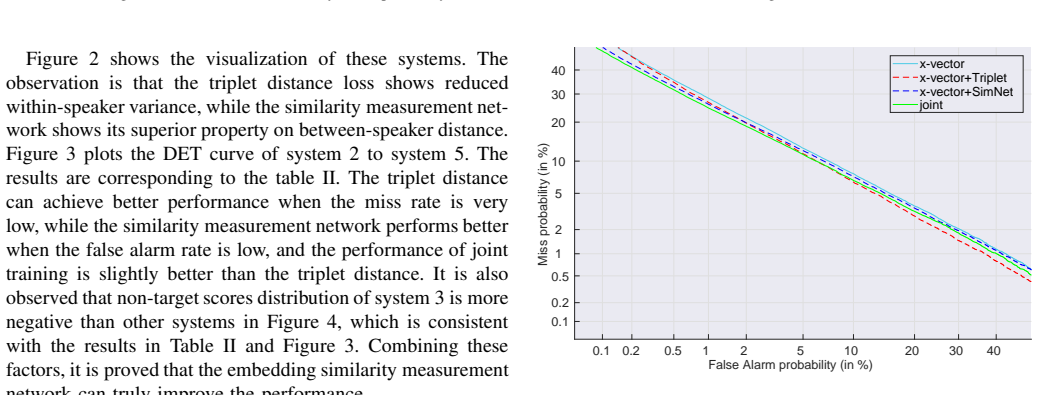
- [Figure 2] The t-SNE panels have unlabeled axes and different coordinate ranges across panels; annotate both axes and use comparable axis ranges so the visual comparison of within-speaker and between-speaker variance is meaningful.
Circularity Check
No circularity: the paper reports measured EER/DCF against the external SRE16 benchmark, and no claimed derivation reduces to its own inputs.
full rationale
The paper is an empirical systems paper. Its central claims are comparative measurements of EER and DCF16 on the NIST SRE16 evaluation set, against the x-vector and i-vector baselines, which are external systems. The proposed losses (triplet distance and embedding similarity network) are defined independently of the evaluation metric and are trained on separate corpora, not fitted to the SRE16 labels. No equation in the paper defines the reported EER/DCF reduction in terms of the loss weights or the network outputs; the table reports measured outcomes. The paper does not invoke a uniqueness theorem or rely on a load-bearing self-citation chain. The only cited prior work is standard external literature (x-vector, i-vector, FaceNet, etc.). The choice of hyperparameters beta and gamma, and the observation that they can be adjusted to trade off EER and DCF, raises a possible evaluation-selection validity concern because the test set may have influenced the reported operating point, but this is not circularity in the definitional sense: the reported numbers are not equal to the fitted parameters by construction. Likewise, the abstract's paired 9% claim is not fully supported by Table II, but that is a correctness/verifiability issue, not a circular-derivation issue. Under the hard rules requiring a specific reduction of a derived result to its inputs, no circular step can be exhibited, so the circularity score is 0.
Assumptions & free parameters
free parameters (4)
- triplet margin a =
0.8
- joint loss weight beta =
0.1 or 0.3 (two reported settings)
- joint loss weight gamma =
0.3 or 0.1 (two reported settings)
- similarity network hidden sizes =
1024 BLSTM nodes, 512 FC nodes
assumptions (5)
- domain assumption The Kaldi SRE16 recipe's data augmentation and training configuration produce a valid x-vector baseline.
- domain assumption Euclidean distance on embedding A is a useful surrogate for the cosine/PLDA scoring used in evaluation.
- domain assumption The similarity network's binary same/different speaker labels are a sufficient training signal for the verification task.
- domain assumption Single-run evaluation on SRE16 without error bars is treated as exact measurement.
- domain assumption The training corpora and augmentation resemble the SRE16 evaluation domains well enough for transfer.
Cite this review
Pith. "Pith review of Triplet Based Embedding Distance and Similarity Learning for Text-independent Speaker Verification." pith.science (2026). https://pith.science/paper/3MKAOLAU
@misc{pith2026190802283,
  author       = {Pith},
  title        = {Pith review of: Triplet Based Embedding Distance and Similarity Learning for Text-independent Speaker Verification},
  year         = {2026},
  howpublished = {\url{https://pith.science/paper/3MKAOLAU}},
  note         = {Machine review of arXiv:1908.02283}
}
read the original abstract
Speaker embeddings become growing popular in the text-independent speaker verification task. In this paper, we propose two improvements during the training stage. The improvements are both based on triplet cause the training stage and the evaluation stage of the baseline x-vector system focus on different aims. Firstly, we introduce triplet loss for optimizing the Euclidean distances between embeddings while minimizing the multi-class cross entropy loss. Secondly, we design an embedding similarity measurement network for controlling the similarity between the two selected embeddings. We further jointly train the two new methods with the original network and achieve state-of-the-art. The multi-task training synergies are shown with a 9% reduction equal error rate (EER) and detected cost function (DCF) on the 2016 NIST Speaker Recognition Evaluation (SRE) Test Set.
Figures


Figures from the paper (1 more)
Reference graph
Works this paper leans on
-
[1]
Front- end factor analysis for speaker verification,
N. Dehak, P . J. Kenny, R. Dehak, P . Dumouchel, and P . Ouell et, “Front- end factor analysis for speaker verification,” IEEE Transactions on Audio, Speech, and Language Processing , vol. 19, no. 4, pp. 788–798, 2010
work page 2010
-
[2]
Deep neural networks for small footprint text- dependent speaker verification,
E. V ariani, X. Lei, E. McDermott, I. L. Moreno, and J. Gonz alez- Dominguez, “Deep neural networks for small footprint text- dependent speaker verification,” in 2014 IEEE International Conference on Acous- tics, Speech and Signal Processing (ICASSP) . IEEE, 2014, pp. 4052– 4056
work page 2014
-
[3]
X- vectors: Robust dnn embeddings for speaker recognition,
D. Snyder, D. Garcia-Romero, G. Sell, D. Povey, and S. Khu danpur, “X- vectors: Robust dnn embeddings for speaker recognition,” i n 2018 IEEE International Conference on Acoustics, Speech and Signal P rocessing (ICASSP). IEEE, 2018, pp. 5329–5333
work page 2018
-
[4]
Self-atten tive speaker embeddings for text-independent speaker verificat ion,
Y . Zhu, T. Ko, D. Snyder, B. Mak, and D. Povey, “Self-atten tive speaker embeddings for text-independent speaker verificat ion,” in Proc. Interspeech, vol. 2018, 2018, pp. 3573–3577
work page 2018
-
[5]
Attentive statistics pooling for deep speaker embedding,
K. Okabe, T. Koshinaka, and K. Shinoda, “Attentive statistics pooling for deep speaker embedding,” in Proc. Interspeech 2018 , 2018, pp. 2252–2256. [Online]. Available: http://dx.doi.org/10.21437/Interspeech.2018-993
-
[6]
USTCSpeech System for VOiCES from a Distance Challenge 2019
L. Y ou, B. Gu, and W. Guo, “Ustcspeech system for voices fr om a distance challenge 2019,” arXiv preprint arXiv:1903.12428 , 2019
work page Pith review arXiv 2019
-
[7]
Facenet: A unified embed- ding for face recognition and clustering,
F. Schroff, D. Kalenichenko, and J. Philbin, “Facenet: A unified embed- ding for face recognition and clustering,” in Proceedings of the IEEE conference on computer vision and pattern recognition , 2015, pp. 815– 823
2015
-
[8]
End-to-end text-independent speaker veri- fication with triplet loss on short utterances
C. Zhang and K. Koishida, “End-to-end text-independent speaker veri- fication with triplet loss on short utterances.” in Interspeech, 2017, pp. 1487–1491
2017
Show all 19 references
-
[9]
Tristounet: triplet loss for speaker turn em bedding,
H. Bredin, “Tristounet: triplet loss for speaker turn em bedding,” in 2017 IEEE international conference on acoustics, speech an d signal processing (ICASSP) . IEEE, 2017, pp. 5430–5434
2017
-
[10]
Text-independ ent speaker verification based on triplet convolutional neural network embeddings,
C. Zhang, K. Koishida, and J. H. Hansen, “Text-independ ent speaker verification based on triplet convolutional neural network embeddings,” IEEE/ACM Transactions on Audio, Speech and Language Proces sing (TASLP), vol. 26, no. 9, pp. 1633–1644, 2018
2018
-
[11]
Deep speaker: an end-to-end neural speaker embe dding system,
C. Li, X. Ma, B. Jiang, X. Li, X. Zhang, X. Liu, Y . Cao, A. Ka nnan, and Z. Zhu, “Deep speaker: an end-to-end neural speaker embe dding system,” arXiv preprint arXiv:1705.02304 , 2017
2017 arXiv
-
[12]
Triplet loss based cosine similarity metric learning for t ext-independent speaker recognition,
S. Novoselov, V . Shchemelinin, A. Shulipa, A. Kozlov, a nd I. Kremnev, “Triplet loss based cosine similarity metric learning for t ext-independent speaker recognition,” Proc. Interspeech 2018 , pp. 2242–2246, 2018
2018
-
[13]
Generalized end-to-end loss for speaker verification,
L. Wan, Q. Wang, A. Papir, and I. L. Moreno, “Generalized end-to-end loss for speaker verification,” in 2018 IEEE International Conference on Acoustics, Speech and Signal Processing (ICASSP) . IEEE, 2018, pp. 4879–4883
2018
-
[14]
Learning discriminative features for speaker identification and verification,
S. Y adav and A. Rai, “Learning discriminative features for speaker identification and verification,” in Proc. In- terspeech 2018 , 2018, pp. 2237–2241. [Online]. Available: http://dx.doi.org/10.21437/Interspeech.2018-1015
2018 doi
-
[15]
Improving language understanding by generative pre-training
A. Radford, K. Narasimhan, T. Salimans, and I. Sutskeve r, “Improving language understanding by generative pre-training.”
-
[16]
Bert: Pre-training of deep bidirectional transformers for language understan ding,
J. Devlin, M.-W. Chang, K. Lee, and K. Toutanova, “Bert: Pre-training of deep bidirectional transformers for language understan ding,” arXiv preprint arXiv:1810.04805, 2018
2018 arXiv
-
[17]
Deep neural network embeddings for text-independent speaker ve rification
D. Snyder, D. Garcia-Romero, D. Povey, and S. Khudanpur , “Deep neural network embeddings for text-independent speaker ve rification.” in Interspeech, 2017, pp. 999–1003
2017
-
[18]
The kaldi speech recognition toolkit,
D. Povey, A. Ghoshal, G. Boulianne, L. Burget, O. Glembe k, N. Goel, M. Hannemann, P . Motlicek, Y . Qian, P . Schwarz et al. , “The kaldi speech recognition toolkit,” IEEE Signal Processing Socie ty, Tech. Rep., 2011
2011
-
[19]
The bosaris toolkit: Th eory, algorithms and code for surviving the new dcf,
N. Br¨ ummer and E. De Villiers, “The bosaris toolkit: Th eory, algorithms and code for surviving the new dcf,” arXiv preprint arXiv:1304.2865 , 2013. This figure "score_plot.png" is available in "png" format from: http://arxiv.org/ps/1908.02283v1
2013 arXiv
Reviewed August 14, 2026 · model on record in the stance chip above.
Discussion (0). Continue with ORCID to comment.