REVIEW 4 major objections 6 minor 1 cited by
DNNSurv: Deep Neural Networks for Survival Analysis Using Pseudo Values
T0 review · 4 major / 6 minor · reviewed 2026-08-14 · deepseek-v4-flash
Pith's one-line read DNNSurv turns censored survival analysis into an ordinary regression problem using jackknife pseudo probabilities.
desk verdict A useful and simple deep survival method built on pseudo-observations, worth serious review—but the train/test handling of pseudo-values needs checking before the reported gains are trusted. read the letter →
The pith
A machine-rendered reading of the paper's core claim, the machinery that carries it, and where it could break.
The reading
What carries the argument
The central object is the jackknife pseudo conditional survival probability, $\hat{S}_{ij}(t_{j+1} \mid R_j) = R_j \hat{S}(t_{j+1} \mid R_j) - (R_j - 1)\hat{S}_{-i}(t_{j+1} \mid R_j)$, where $\hat{S}$ is the Kaplan-Meier estimator on the at-risk set $R_j$ and $\hat{S}_{-i}$ is the same estimator with subject $i$ removed. This quantity is used as a quantitative response for each interval, so a conventional fully connected network with sigmoid output and squared-error loss can be trained without a bespoke likelihood. The discrete-time framework lets the network predict conditional survival probabilities directly, and multiplying them yields marginal survival probabilities; an IPCW version of the pseudo values is introduced for covariate-dependent censoring.
What would settle it
Compute, under independent censoring, the empirical correlation between a subject's pseudo conditional probabilities in adjacent intervals across many simulated datasets; if the correlations are substantially nonzero, the conditional-independence claim that justifies the simple loss fails. Alternatively, compare DNNSurv's predicted conditional probabilities against a correctly specified discrete-time survival model on data with strong within-subject dependence, and check whether calibration or coverage degrades.
Extended reading notes
Core claim
By using pseudo conditional survival probabilities computed from leave-one-out Kaplan-Meier estimates within discrete time intervals, the paper reduces a complex survival analysis to a standard regression problem. Each subject contributes one pseudo conditional probability per interval in which they remain at risk; the network maps covariates plus interval indicators to the conditional survival probability, and marginal survival probabilities are recovered by multiplying conditional probabilities across intervals. DNNSurv therefore avoids the PH assumption and outputs survival probabilities directly, and the paper reports that it outperforms PH-based neural network models when the PH assumption is violated while staying competitive when it holds. For covariate-dependent censoring, replacing the KM estimator with an inverse-probability-of-censoring weighted estimator is proposed to remove bias.
Load-bearing premise
The load-bearing premise is that the pseudo conditional survival probabilities for different intervals behave as conditionally independent responses, so that training a network with plain squared-error loss is statistically justified; the paper asserts this but does not prove it, and the overlapping Kaplan-Meier estimates make the independence questionable.
Editorial extensions
If this is right
- Any standard deep regression network can be applied to survival data without designing a custom loss for censoring.
- The method produces conditional and marginal survival probabilities directly, instead of hazard ratios or prognostic indices.
- Predictions remain competitive with or better than PH-based deep models when the proportional-hazards assumption is violated.
- The number and placement of follow-up intervals is a tunable modeling choice, with results reported to be fairly robust to coarser interval grids.
- When censoring depends on covariates, IPCW pseudo values reduce bias relative to ordinary pseudo values.
Reading between the lines
- Editorial inference: if the pseudo conditional probabilities are not actually independent across intervals, the squared-error loss is a heuristic rather than a fully justified likelihood, though the empirical results may still stand.
- Editorial inference: the same pseudo-value transformation could be plugged into any flexible regression learner, not only deep networks, potentially extending the approach to gradient-boosted trees or Gaussian processes.
- Editorial inference: because pseudo values can fall outside [0,1], squeezing them through a sigmoid output may warp the target; a direct comparison with identity output or bounded loss could clarify whether this matters.
- Editorial inference: a natural testable extension is to apply DNNSurv to competing-risk settings, where pseudo values of cumulative incidence functions already have established theory.
Signed reviews
Editorial analysis
A structured set of objections, weighed in public.
Referee Report
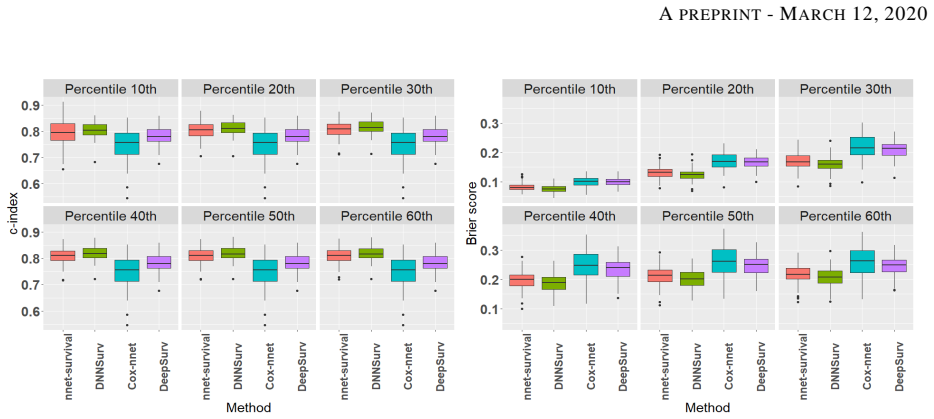
Summary. The paper proposes DNNSurv, a two-step deep learning method for survival analysis. In the first step, each subject's observed survival time (censored or not) is transformed into a series of jackknife pseudo conditional survival probabilities at a set of discrete time intervals, computed from Kaplan-Meier or IPCW Kaplan-Meier estimates. In the second step, these pseudo probabilities are used as quantitative responses in a standard feedforward neural network with squared-error loss, with time-interval indicators and covariates as inputs; marginal survival probabilities are obtained by multiplying predicted conditional probabilities. The method is compared with Cox-nnet, DeepSurv, nnet-survival, and a standard Cox model in simulations under an AFT model with 20-60% censoring, in a simulation with covariate-dependent censoring, and on three real datasets (CHS, MESA, SRTR). The central claim is that the pseudo-value construction reduces survival analysis to standard regression, avoiding special censoring-aware loss functions, and that DNNSurv performs competitively or better than existing deep survival models, especially when proportional hazards is violated.
Significance. If the central claim holds, the paper offers a practically attractive simplification: deep survival modeling with a conventional loss function, direct output of survival probabilities, no PH assumption, and a theoretically motivated treatment of censoring via pseudo-observations. The manuscript includes an IPCW extension for covariate-dependent censoring, simulation studies with a flexible data-generating process, and publicly available source code, which are concrete strengths. However, the theoretical transfer from pseudo-value GEE theory to flexible deep regression is not established, and the evaluation protocol has a potential leakage problem that directly affects the reported superiority. The real-data comparisons lack uncertainty quantification and omit Brier scores. These issues are fixable but currently leave the central claim only partially supported.
major comments (4)
- [Sections 2.2, 3.3, and 4] The manuscript does not specify whether pseudo conditional probabilities are recomputed within each training split before fitting DNNSurv. Equations (1)-(2) define pseudo-values using KM estimates over 'all n subjects' or 'all patients still at-risk'; the simulation (Section 3.3) and real-data sections (Section 4) then split subjects into 75% training and 25% test sets. If pseudo-values are computed once on the full sample, test subjects' survival and censoring times enter the KM estimates used to construct training responses, so test outcomes leak into the training targets through the jackknife estimator. This would inflate the reported test performance, particularly the SRTR c-index advantage in Table 3. The authors must clarify the exact protocol, and if pseudo-values are not recomputed from the training set alone, the evaluation should be redone with a leak-free protocol.
- [Section 2.2, paragraph 4] The assertion that 'our pseudo probabilities are conditionally independent and we do not need to consider the within-subject correlation' is not proven and is doubtful: pseudo conditional probabilities for successive intervals of the same subject are computed from overlapping risk sets and from KM estimators that share subjects, so the jackknife pseudo-values are generally correlated across intervals. This claim is load-bearing because it justifies using a plain squared-error loss instead of a GEE-type or otherwise correlation-aware loss. The authors should either provide a rigorous asymptotic argument, replace the claim with a more defensible justification, or report an empirical check (e.g., comparing squared-error loss with a loss that accounts for within-subject correlation).
- [Section 4, Table 3] The real-data results report only averaged c-index values over 10 random splits, without standard errors, confidence intervals, or paired tests, while the text states that DNNSurv and nnet-survival had 'significantly better' performance than the PH-based models in SRTR. No significance test is described or referenced. Additionally, the statement that 'All models had the same Brier scores, so those results are not presented here' is implausible as written: Brier scores are continuous, model-specific quantities, and exact equality across all five models would require explanation. The authors should report Brier scores (as in the simulation sections) with measures of variability, or justify their omission, and support any significance claims with appropriate tests.
- [Sections 2.1-2.3 and 5] The theoretical support cited for pseudo-observations (Andersen et al. 2003; Klein and Andersen 2005) concerns regression coefficients in GEE models fitted to pseudo-values, typically with a correctly specified link and estimating equations. The paper instead uses pseudo-values as targets in a flexible deep neural network trained with squared-error loss, and does not establish that consistency or calibration of the pseudo-value approach carries over to the DNN estimator, especially given that pseudo-values can fall outside [0,1] (acknowledged in Section 2.2) while the final sigmoid layer constrains predictions to [0,1]. This gap weakens the claim that the method is 'theoretically justified' relative to ad-hoc censoring handling; the authors should explicitly delineate which properties are proven, which are assumed, and which are supported only by the simulations.
minor comments (6)
- [Section 2.2, Table 1] The example in Table 1 shows a pseudo probability of -0.014, outside [0,1], while the network's final sigmoid layer restricts predictions to [0,1]; the manuscript would benefit from a brief discussion of this target-prediction mismatch and its implications for training.
- [Section 3.4, last paragraph] There is a typo: 'DDNSurv' and 'DDNSurv_ipcw' should be 'DNNSurv' and 'DNNSurv_ipcw' in the list of applied neural network models.
- [Section 2.6] The name 'nnet-survvial' is misspelled; it should be 'nnet-survival'.
- [Section 4, SRTR paragraph] The text lists 'four time points: 1 day, 1 month, 6 months, 8 months and 1 year,' which is five time points; please correct the count or the list.
- [Section 3.1] The c-index description cites Harrell et al. (1996); for right-censored data with time-dependent predictions, a reference to Uno's c-index or an explicit statement of how censored observations are handled in the c-index computation would improve reproducibility.
- [Section 2.2] The term 'conditionally independent' is used without a formal definition or citation; since this is central to the loss-function justification, a precise definition or reference to a regularity condition is needed.
Circularity Check
No significant circularity in DNNSurv derivation; pseudo-values are external targets, and no prediction reduces to a fitted parameter.
full rationale
DNNSurv's derivation chain is self-contained. Equation (2) defines jackknife pseudo conditional survival probabilities from Kaplan-Meier estimates of the observed censored/uncensored survival times, and Equation (3) replaces the KM estimator with an IPCW estimator when censoring depends on covariates. These pseudo-values are external regression targets: the network is trained to predict them from covariates and time indicators using squared error, and Section 2.4 defines the marginal survival curve as the product of predicted conditional probabilities. No step defines the pseudo-values in terms of the network output, and no parameter fitted to the evaluation metric is presented as a prediction. The IPCW Cox censoring model is a nuisance adjustment only, not a source of the survival prediction. There are no load-bearing self-citations; the pseudo-observation theory is cited to external references [10-13,15]. The skeptic's concern that pseudo-values may have been computed on the full dataset before the 75/25 split is a potential data-leakage issue, not a circularity: even under that implementation, the predicted probabilities are not equal by construction to the training targets; the issue is evaluation independence. Thus the circularity score is 0.
Assumptions & free parameters
free parameters (4)
- Number of time intervals J =
6 in simulations; 15 for CHS, 2 for MESA, 5 for SRTR
- Time grid (interval boundaries) =
10th to 60th percentiles in AFT simulations; annual in CHS; 3 and 5 years in MESA; 1 day to 1 year in SRTR
- Network hyperparameters =
Selected by random grid search with 5-fold CV on training data
- IPCW censoring model (Cox) =
In CHS, four variables significantly associated with censoring
assumptions (4)
- standard math Kaplan-Meier estimator is approximately unbiased under independent censoring
- domain assumption Pseudo-observation regression estimators are approximately consistent for parametric regression models
- ad hoc to paper The pseudo conditional probabilities are conditionally independent across time intervals within a subject
- domain assumption Survival and censoring times are independent (or, for IPCW, censoring model is correctly specified)
Cite this review
Pith. "Pith review of DNNSurv: Deep Neural Networks for Survival Analysis Using Pseudo Values." pith.science (2026). https://pith.science/paper/CESAI2OK
@misc{pith2026190802337,
  author       = {Pith},
  title        = {Pith review of: DNNSurv: Deep Neural Networks for Survival Analysis Using Pseudo Values},
  year         = {2026},
  howpublished = {\url{https://pith.science/paper/CESAI2OK}},
  note         = {Machine review of arXiv:1908.02337}
}
read the original abstract
There has been increasing interest in modelling survival data using deep learning methods in medical research. Current approaches have focused on designing special cost functions to handle censored survival data. We propose a very different method with two steps. In the first step, we transform each subject's survival time into a series of jackknife pseudo conditional survival probabilities and then use these pseudo probabilities as a quantitative response variable in the deep neural network model. By using the pseudo values, we reduce a complex survival analysis to a standard regression problem, which greatly simplifies the neural network construction. Our two-step approach is simple, yet very flexible in making risk predictions for survival data, which is very appealing from the practice point of view. The source code is freely available at http://github.com/lilizhaoUM/DNNSurv.
Figures


Forward citations
Cited by 1 Pith paper
-
Survival Analysis as Imprecise Classification with Trainable Kernels
The authors present iSurvM, iSurvQ, and iSurvJ, nonparametric survival models that treat censored event times as imprecise interval labels and learn attention weights with kernel regression.
Reference graph
Works this paper leans on
-
[1]
E. Martinsson. WTTE-RNN: Weibull time to event recurrent neural network. Master’s thesis, University of Gothenburg, Sweden, 2016
work page 2016
-
[2]
J. L. Katzman, U. Shaham, A. Cloninger, J. Bates, T. Jiang, and Y . Kluger. Deepsurv: personalized treatment recommender system using a cox proportional hazards deep neural network. BMC medical research methodology, 18:24, 2018
work page 2018
- [3]
-
[4]
Deep convolutional neural network for survival analysis with pathological images
Jiawen Yao Xinliang Zhu and Junzhou Huang. Deep convolutional neural network for survival analysis with pathological images. IEEE International Conference on Bioinformatics and Biomedicine (BIBM), 2016
work page 2016
-
[5]
Gensheimer and Balasubramanian Narasimhan
Michael F. Gensheimer and Balasubramanian Narasimhan. A scalable discrete-time survival model for neural networks. PeerJ, 7:e6257, 2019
work page 2019
-
[6]
Deep neural networks for survival analysis based on a multi-task framework
Stephane Fotso. Deep neural networks for survival analysis based on a multi-task framework. arXiv, 2018
work page 2018
-
[7]
C. Lee, W. R. Zame, J. Yoon, and M. van der Schaar. Deephit: A deep learning approach to survival analysis with competing risks. AAAI, 2018
work page 2018
-
[8]
M. Luck, T. Sylvain, H. Cardinal, A. Lodi, and Y . Bengio. Deep learning for patient-specific kidney graft survival analysis. arXiv, 2017
work page 2017
Show all 30 references
-
[9]
RNN-SURV: A deep recurrent model for survival analysis
Eleonora Giunchiglia, Anton Nemchenko, and Mihaela van der Schaar. RNN-SURV: A deep recurrent model for survival analysis. International Conference on Artificial Neural Networks, 90:15–27, 2018
2018
-
[10]
P. K. Andersen, J. P. Klein, and S. Rosthøj. Generalised linear models for correlated pseudo-observations, with applications to multistate models. Biometrika, 90:15–27, 2003
2003
-
[11]
J. P. Klein and P. K. Andersen. Regression modeling of competing risks data based on pseudovalues of the cumulative incidence function. SIM, 61:223–229, 2005
2005
-
[12]
K Andersen and J
P. K Andersen and J. P. Klein. Regression analysis for multistate models based on a pseudo-value approach, with applications to bone marrow transplantation studies. SIM, 34:3–16, 2007. 13 A PREPRINT - MARCH 12, 2020
2007
-
[13]
K Andersen and M
P. K Andersen and M. P. Perme. Pseudo-observations in survival analysis.Statistical Methods in Medical Research, 19:71–99, 2010
2010
-
[14]
P. K. Andersen, ø. Borgan, R. D. Gill, and N. Keiding. Statistical models based on counting processes. Springer- Verlay, New York, 1993
1993
-
[15]
John P Klein, Mette Gerster, P. K. Andersen, Sergey Tarima, and Maja Pohar Perme. SAS and R functions to compute pseudo-values for censored data regression. Comput Methods Programs Biomed., 89:289–300, 2008
2008
-
[16]
François Chollet et al. Keras. https://keras.io, 2015
2015
-
[17]
Martín Abadi, Ashish Agarwal, Paul Barham, Eugene Brevdo, Zhifeng Chen, Craig Citro, Greg S. Corrado, Andy Davis, Jeffrey Dean, Matthieu Devin, Sanjay Ghemawat, Ian Goodfellow, Andrew Harp, Geoffrey Irving, Michael Isard, Yangqing Jia, Rafal Jozefowicz, Lukasz Kaiser, Manjunat...
2015
-
[18]
Gerds, and Per Kragh Andersen
Nadine Binder, Thomas A. Gerds, and Per Kragh Andersen. Pseudo-observations for competing risks with covariate dependent censoring. Lifetime Data Anal., 20:303–315, 2014
2014
-
[19]
Restricted mean models for transplant benefit and urgency
Fang Xiang and Susan Murray. Restricted mean models for transplant benefit and urgency. Statistics in Medicine, 6:561–76, 2012
2012
-
[20]
The accelerated failure time model: a useful alternative to the cox regression model in survival analysis
Lee-Jen Wei. The accelerated failure time model: a useful alternative to the cox regression model in survival analysis. Statistics in medicine, 11(14-15):1871–1879, 1992
1992
-
[21]
Harrell, Kerry L
Frank E. Harrell, Kerry L. Lee, and Daniel B. Mark. Tutorial in biostatistics: multivariable prognostic models: issues in developing models, evaluating assumptions and adequacy, and measuring and reducing errors. Statistics in Medicine, 15:361–387, 1996
1996
-
[22]
K Andersen and M
P. K Andersen and M. P. Perme. Consistent estimation of the expected brier score in general survival models with right-censored event times. Biometrical Journal, 48:1029–1040, 2006
2006
-
[23]
Random search for hyper-parameter optimization
James Bergstra and Yoshua Bengio. Random search for hyper-parameter optimization. Journal of Machine Learning Research, 13(Feb):281–305, 2012
2012
-
[24]
Srivastava, G
N. Srivastava, G. E. Hinton, A. Krizhevsky, I. Sutskever, and R. Salakhutdinov. Dropout: a simple way to prevent neural networks from overfitting. Journal of Machine Learning Research, 15(1):1929–1958, 2014
1929
-
[25]
Greedy function approximation: a gradient boosting machine
Jerome H Friedman. Greedy function approximation: a gradient boosting machine. Annals of statistics, pages 1189–1232, 2001
2001
-
[26]
Individualized treatment effects with censored data via fully nonparametric bayesian accelerated failure time models
Nicholas C Henderson, Thomas A Louis, Gary L Rosner, and Ravi Varadhan. Individualized treatment effects with censored data via fully nonparametric bayesian accelerated failure time models. arXiv, 2017. 14 A PREPRINT - MARCH 12, 2020
2017
-
[27]
Recruitment of adults 65 years and older as participants in the cardiovascular health study
Grethe S.Tell DrPhilos, Linda P.Fried, BonnieHermanson, Teri A.Manolio, Anne B.Newman, and Nemat O.Borhani3. Recruitment of adults 65 years and older as participants in the cardiovascular health study. Annals of Epidemiology, 3:358–366, 1993
1993
-
[28]
D. E. Bild, D. A. Bluemke, G. L. Burke, R. Detrano, A. V . Diez Roux, A. R. Folsom, P. Greenland, D. R. Jacob, R. Kronmal, K. Liu, J. C. Nelson, D. O’Leary, M. F. Saad, S. Shea, M. Szklo, and R. P. Tracy. Multi-ethnic study of atherosclerosis: objectives and design. Am J Epide...
2002
-
[29]
Schaubel
Kevin He, Valarie Ashby, and Douglas E. Schaubel. Evaluating center-specific long-term outcomes through differences in mean survival time: Analysis of national kidney transplant data. Stat Med., 38:1957–1967, 2019
1957
-
[30]
D. R. Cox, S. Kotz, and N. L. Johnson. Regression Models and Life-Tables. Springer-Verlay, New York, 1992. 15
1992
Reviewed August 14, 2026 · model on record in the stance chip above.
Discussion (0). Continue with ORCID to comment.