REVIEW 4 major objections 6 minor 64 references
Survival Analysis as Imprecise Classification with Trainable Kernels
T0 review · 4 major / 6 minor · reviewed 2026-08-07 · deepseek-v4-flash
Pith's one-line read The paper claims that survival analysis can be reframed as an imprecise classification problem over time intervals, encoding censored events as interval-valued probabilities and using trainable attention kernels, and that the resulting…
desk verdict A plausible new estimator family for nonparametric survival analysis, but the headline empirical claim is contradicted by the paper's own tables and needs proper benchmarking before being taken seriously. read the letter →
The pith
A machine-rendered reading of the paper's core claim, the machinery that carries it, and where it could break.
The reading
What carries the argument
The central object is the interval-valued probability vector $\pi^{(i)}$ over $T$ time intervals: a one-hot vector for uncensored examples and a vector with entries free in $[0,1]$ after the censoring interval for censored examples. The mechanism that carries the argument is a trainable Nadaraya-Watson weighting $p_k(x_0)=\sum_i a_{0,i}(w)\pi^{(i)}_k$, with attention masks preventing self-attention and dot-product or Gaussian kernels providing the weights. Training is driven by likelihood-style losses, and for iSurvJ the loss combines negative log-likelihood with entropy regularization on the learned interval probabilities. To avoid zero gradients from the self-attention mask when all uncensored event times are unique, the paper replaces the exact interval probability with a sum over $2k+1$ neighboring intervals, treating $k$ as a hyperparameter.
What would settle it
Train iSurvJ on a real dataset with tied uncensored event times, such as the BLCD or Rossi data, using the exact-interval loss (Eq. (28), $k=0$) instead of the windowed surrogate (Eq. (29)); if the C-index and integrated Brier score stay competitive with $k>0$, the paper's rationale for the surrogate collapses and the reported comparisons are partly driven by the modified target rather than by the imprecise representation. A more direct check: on a dataset with few ties, compare models trained with Eq. (28) and Eq. (29) and see whether the accuracy gap the paper attributes to the method disappears.
Extended reading notes
Core claim
The paper's central claim is that right-censored survival data can be encoded as imprecise multi-label classification: an uncensored event contributes a one-hot probability vector over time intervals, while a censored observation contributes the set of all probability vectors whose mass on intervals after the censoring time is free in $[0,1]$. Predictions are formed by the attention-weighted sum $p_k(x_0)=\sum_{i=1}^N a_{0,i}(w)\pi^{(i)}_k$, where the weights come from dot-product attention or a trainable Gaussian kernel. Three training strategies are proposed: averaging likelihood losses over random draws from the censored distributions (iSurvM), averaging only the worst quantile of those draws (iSurvQ), and jointly optimizing the interval probabilities and attention weights with an entropy regularizer (iSurvJ). The paper reports that iSurvJ and iSurvJ(G) beat the Beran estimator on most real and synthetic benchmarks, that the Beran survival curve lies inside the interval-valued survival bounds the model produces, and that the model's unconditional survival function tracks the classical nonparametric estimator.
Load-bearing premise
The load-bearing premise is that training uncensored examples on the sum of probabilities over a window of $2k+1$ neighboring intervals, instead of on the exact probability of the true event interval, is a faithful learning target; the paper justifies this replacement only for datasets with unique uncensored event times and applies it to all datasets without analyzing the bias it may introduce for tied event times or censored data.
Editorial extensions
If this is right
- The framework removes the need for parametric assumptions: the same training procedure handles linear, nonlinear, and interacting feature structures by learning attention weights from data.
- Heavy censoring no longer degrades predictions as sharply as it does for the Beran estimator, so the model is a candidate for datasets where most events are unobserved.
- The interval-valued survival function produced for each instance gives lower and upper bounds that can enclose the Beran estimate, offering uncertainty information alongside point predictions.
- Because the number of trainable attention parameters can be chosen freely, users can trade model capacity against computational cost without changing the formulation.
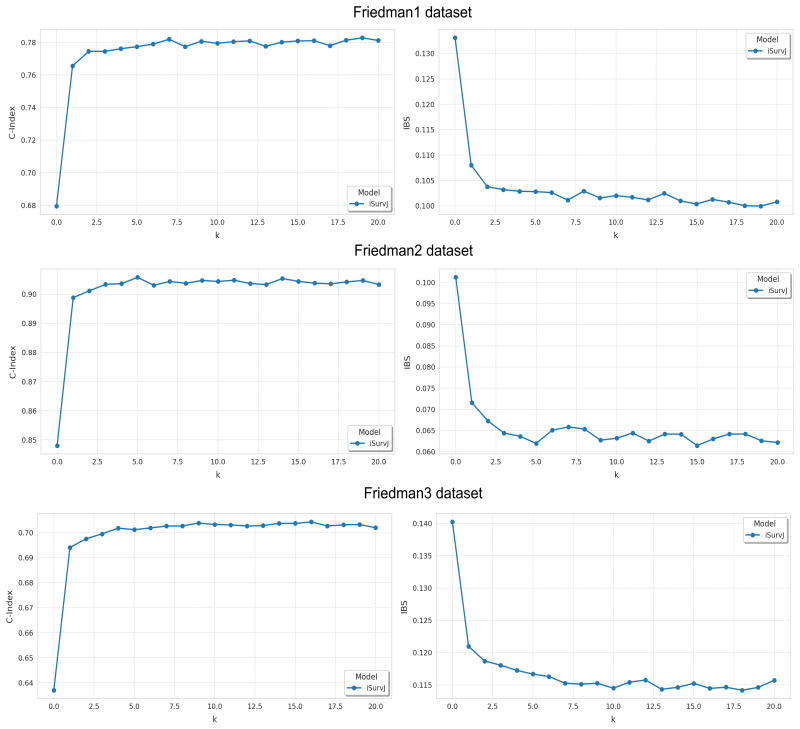
- Among the model's hyperparameters, the window width $k$ for uncensored intervals shows a plateau in accuracy beyond a threshold, so a moderate $k$ avoids unnecessary computation.
Reading between the lines
- A natural extension the authors leave implicit is to use the interval-valued survival bounds as a formal uncertainty region for decision rules, such as delaying an intervention while the upper survival bound stays high.
- The same imprecise-classification encoding could be reused for interval-censored and left-censored events by changing which entries of $\pi^{(i)}$ are free, which the paper mentions only briefly as a motivation for imprecision.
- The $2k+1$ window surrogate can be viewed as label smoothing over neighboring time intervals; if that is the active ingredient, the method's gains might partly come from regularization rather than from the imprecise representation, a hypothesis the paper does not test.
- Extending the models to competing risks or time-varying covariates, which the authors list as future work, would require replacing the scalar interval target with a vector-valued one but would keep the attention machinery unchanged.
Signed reviews
Editorial analysis
A structured set of objections, weighed in public.
Referee Report
Summary. The paper introduces three survival models, iSurvM, iSurvQ, and iSurvJ (plus a Gaussian-kernel variant iSurvJ(G)), built on a discrete-time, imprecise-probability view of censored survival data. Censored observations are represented as interval-valued probability distributions over time intervals, and predictions are obtained through Nadaraya-Watson-style attention weights trained by one of three loss strategies: mean over Monte Carlo-generated distributions, quantile selection of worst-case losses, or joint learning of probabilities and attention. The central claim is that these models, especially iSurvJ and iSurvJ(G), 'consistently outperform' the Beran estimator in both accuracy and computational complexity. The paper reports C-index and Brier-score comparisons on 11 real datasets and several synthetic benchmarks, and includes public code.
Significance. If the claims were established, the paper would contribute a novel synthesis of imprecise probability and attention-based kernel smoothing for survival analysis, with no parametric assumptions and with an explicit interval-valued representation of censoring uncertainty. The availability of public code and the breadth of datasets are positive features. However, the headline empirical claim is not supported by the paper's own tables: iSurvJ loses to Beran on several datasets, iSurvJ(G) loses on a substantial fraction of comparisons, and no uncertainty estimates or significance tests are provided. The computational-complexity claim is asserted rather than measured. Because the central contribution is framed as consistent superiority over Beran, the current evidence is insufficient for the stated conclusions.
major comments (4)
- [Section 6, Tables 1-2] The abstract and Section 6 claim that the proposed models 'consistently outperform' the Beran estimator, but Tables 1 and 2 show multiple losses. For example, in Table 1 iSurvJ has a lower C-index than Beran on AIDS (0.7139 vs. 0.7529) and on Breast Cancer (0.6487 vs. 0.6519), while iSurvJ(G) is worse than Beran on Veterans, AIDS, GBSG2, LND, and GCD. In Table 2, iSurvJ(G) has a worse Brier score than Beran on 6 of 11 datasets, and iSurvJ is worse on AIDS, Breast Cancer, and LND. No standard deviations, confidence intervals, or significance tests are reported, so even the apparent wins cannot be distinguished from noise, particularly on small datasets such as LND (n=87) and GCD (n=90). The accuracy half of the headline claim is therefore not supported by the presented evidence.
- [Section 5.5, Eq. (29)] The replacement of the exact event-interval loss by a sum over 2k+1 neighboring intervals is justified by the argument that, when all event times are unique and uncensored, the self-attention mask removes the only training example that can contribute to p_c(i), making the exact loss zero. That argument does not apply to datasets containing censored observations or tied event intervals, where other training examples contribute mass to the correct-interval probability. The modified loss is nevertheless applied to all models and all datasets, and no analysis of the resulting bias is provided. Since this surrogate loss is used in every accuracy comparison, the experimental results rest on a learning signal whose validity is not established for the data actually used.
- [Section 6, Paragraph on hyperparameter tuning] The comparison between the proposed models and the Beran estimator is asymmetric. The proposed models receive Optuna-based Bayesian hyperparameter optimization over embedding dimensions, learning rates, regularization coefficients, dropout, mask rates, batch sizes, and epoch counts, whereas no comparable tuning procedure for the Beran estimator is described; the only Beran parameter mentioned is a Gaussian kernel temperature in Appendix A.3.1. Observed differences could therefore reflect differences in tuning effort rather than a substantive advantage of the proposed models. The authors should either tune the Beran estimator with the same budget or justify why the chosen baseline configuration is the appropriate reference.
- [Section 6 and Appendix A.3.4] The claim of superiority 'from the computational complexity point of view' is asserted without any runtime measurements or asymptotic analysis; no wall-clock times, flop counts, or scaling experiments are reported. In addition, the interval bounds in Appendix A.3.4 are not strong evidence for the model: because the censored interval probabilities are allowed to range over [0,1] by construction, the resulting survival-function bounds are very wide and any reasonable survival curve will lie inside them. The observation that Beran's curve falls inside the bounds should be presented as an illustration of the imprecise representation, not as an accuracy or validity finding.
minor comments (6)
- [Section 1, Contributions list] In the contributions list, the second model is written as 'iSurvM' twice: the text says 'survival models iSurvM, iSurvM, iSurvM' where the second and third should likely be iSurvQ and iSurvJ.
- [Algorithm 2 caption] The caption of Algorithm 2 says 'An implementation of training the model iSurvM' but the algorithm is for iSurvJ; this should be corrected.
- [Equation (2)] The C-index formula uses predicted expected event times \widehat{T}_i and \widehat{T}_j, but how these expected times are computed from the discrete predicted distribution is not defined anywhere in the paper.
- [Equation (7)] The Gaussian attention weight formula has a notational issue: the parameter vector is denoted w = (w_1, ..., w_n), but the denominator uses the same w_i for every term, which cannot be correct unless all weights are equal; the dependence on the target feature index should be made explicit.
- [Appendix A.3.3] The text says the experiments 'primarily illustrate how the accuracy of the proposed model decreases as the proportion of censored data increases,' yet the abstract and Section 6 claim robustness to heavy censoring; the two statements should be reconciled.
- [Figures 8-9 captions] The captions contain the typo 'censiring rate' instead of 'censoring rate'.
Circularity Check
Central empirical comparison is independent of Beran, but the claim that Beran's SF lies inside the model's interval bounds is true largely by construction.
-
self definitional
[Appendix A.3.4, 'Intervals for Survival Functions'; also referenced in Section 6]
"The bounds for the SF are obtained using (12), where probabilities π(i)_k, k = 1, ..., T, are interval-valued for censored observations. ... It is important to note that the Beran estimator predicts the SF which is totally inside the lower and upper SF bounds. This is a very interesting observation."
By Eq. (11), every censored observation assigns probability [0,1] to each interval after its censoring time. Eq. (12) then forms the predicted interval probabilities as convex combinations of these interval values, so the resulting SF bounds are extremely wide envelopes rather than informative model-specific limits. Any survival curve whose probabilities over the partition are consistent with the censoring pattern — including the Beran estimate — will fall inside such bounds almost automatically. The containment is thus a consequence of the interval construction, not an independent validation that the imprecise model 'encapsulates' the Beran estimator.
full rationale
The paper's main claim is an empirical comparison: iSurvJ and iSurvJ(G) are trained on survival data and evaluated with the C-index and Brier score against the Beran estimator on held-out folds. That comparison is not circular: the model outputs are not constructed from Beran's predictions, and the Beran baseline is an external estimator. No load-bearing self-citation or imported uniqueness theorem appears; the cited kernel/attention results are standard external tools. The only near-circular element is the interval-bounds observation in Appendix A.3.4, where the claim that the Beran SF lies inside the model's lower and upper SF bounds is true largely by construction because each censored interval contributes [0,1] to the interval-valued probabilities, making the envelope very wide. That observation is presented as supporting evidence for the model's uncertainty representation, but it is weak evidence and should not be read as an independent confirmation. Since the central accuracy claim stands or falls on the external experiments rather than on this containment argument, the overall circularity is minor: one structurally trivial containment step, not a derivation that reduces to its own inputs.
Assumptions & free parameters
free parameters (7)
- k, neighborhood window in Eq. 29 =
tuned between 3 and 10
- M, number of Monte Carlo generations =
not stated in the paper
- r, quantile fraction in iSurvQ =
not stated in the paper
- gamma, entropy regularization weight =
0.1 in appendix experiments
- pmask, attention mask threshold =
0.1 to 0.5 in hyperparameter search
- T and interval boundaries =
not specified
- Dirichlet concentration parameters =
not specified
assumptions (6)
- domain assumption The time axis partition into T intervals (Eq. 8) is fixed and each event time is represented by exactly one interval.
- domain assumption For censored observations, the probability of each future interval is in [0,1] (Eq. 11), expressing prior ignorance.
- ad hoc to paper Sampling censored probability distributions via the Dirichlet distribution correctly represents the set R(i).
- domain assumption The attention-weighted average p_k(x0) = sum_i a_{0,i}(w) pi_i(k) (Eq. 12) is a valid estimator of class probabilities for a new instance.
- ad hoc to paper The extended-interval loss (Eq. 29) is a valid surrogate for exact interval prediction for uncensored data.
- ad hoc to paper Attention masking with a random threshold pmask (Eq. 16) does not distort learning.
Cite this review
Pith. "Pith review of Survival Analysis as Imprecise Classification with Trainable Kernels." pith.science (2026). https://pith.science/paper/4FBLQNNX
@misc{pith2026250610140,
  author       = {Pith},
  title        = {Pith review of: Survival Analysis as Imprecise Classification with Trainable Kernels},
  year         = {2026},
  howpublished = {\url{https://pith.science/paper/4FBLQNNX}},
  note         = {Machine review of arXiv:2506.10140}
}
read the original abstract
Survival analysis is a fundamental tool for modeling time-to-event data in healthcare, engineering, and finance, where censored observations pose significant challenges. While traditional methods like the Beran estimator offer nonparametric solutions, they often struggle with the complex data structures and heavy censoring. This paper introduces three novel survival models, iSurvM (the imprecise Survival model based on Mean likelihood functions), iSurvQ (the imprecise Survival model based on the Quantiles of likelihood functions), and iSurvJ (the imprecise Survival model based on the Joint learning), that combine imprecise probability theory with attention mechanisms to handle censored data without parametric assumptions. The first idea behind the models is to represent censored observations by interval-valued probability distributions for each instance over time intervals between events moments. The second idea is to employ the kernel-based Nadaraya-Watson regression with trainable attention weights for computing the imprecise probability distribution over time intervals for the entire dataset. The third idea is to consider three decision strategies for training, which correspond to the proposed three models. Experiments on synthetic and real datasets demonstrate that the proposed models, especially iSurvJ, consistently outperform the Beran estimator from the accuracy and computational complexity points of view. Codes implementing the proposed models are publicly available.
Figures


Figures from the paper (9 more)


Reference graph
Works this paper leans on
- [1]
-
[2]
A deep survival analysis method based on ranking
Bingzhong Jing, Tao Zhang, Zixian Wang, Ying Jin, Kuiyuan Liu, Wenze Qiu, Liangru Ke, Ying Sun, Caisheng He, Dan Hou, et al. A deep survival analysis method based on ranking. Artificial intelligence in medicine , 98:1–9, 2019
work page 2019
-
[3]
Deep learning-based survival analysis for high-dimensional survival data
Lin Hao, Juncheol Kim, Sookhee Kwon, and Il Do Ha. Deep learning-based survival analysis for high-dimensional survival data. Mathematics, 9(11):1244, 2021
work page 2021
-
[4]
E.T. Lee and J.W. Wang. Statistical Methods for Survival Data Analysis . John Wiley & Sons, New Jersey, 2003
work page 2003
-
[5]
T. Hothorn, P. B¨ uhlmann, S. Dudoit, A. Molinaro, and M.J. van der Laan. Survival ensembles. Biostatistics, 7(3):355–373, 2006
work page 2006
- [6]
-
[7]
DNNSurv: Deep Neural Networks for Survival Analysis Using Pseudo Values
L. Zhao and D. Feng. Dnnsurv: Deep neural networks for survival analysis using pseudo values. arXiv:1908.02337v2, March 2020. 14
work page Pith review arXiv 1908
-
[8]
Tutorial on survival modeling with applications to omics data
Zhi Zhao, John Zobolas, Manuela Zucknick, and Tero Aittokallio. Tutorial on survival modeling with applications to omics data. Bioinformatics, 40(3):btae132, 2024
work page 2024
Show all 64 references
-
[9]
Marinos and D
G. Marinos and D. Kyriazis. A survey of survival analysis techniques. In HEALTHINF, pages 716–723, 2021
2021
-
[10]
P. Wang, Y. Li, and C.K. Reddy. Machine learning for survival analysis: A survey.ACM Computing Surveys (CSUR) , 51(6):1–36, 2019
2019
-
[11]
Deep learning for survival analysis: a review
Simon Wiegrebe, Philipp Kopper, Raphael Sonabend, Bernd Bischl, and Andreas Bender. Deep learning for survival analysis: a review. Artificial Intelligence Review , 57(65):1–34, 2024
2024
-
[12]
Ishwaran and U.B
H. Ishwaran and U.B. Kogalur. Random survival forests for r. R News , 7(2):25–31, 2007
2007
-
[13]
Van Belle, K
V. Van Belle, K. Pelckmans, J.A.K. Suykens, and S. Van Huffel. Survival svm: a practical scalable algorithm. In ESANN, pages 89–94, 2008
2008
-
[14]
An introduction to deep survival analysis models for predicting time-to-event outcomes
George H Chen et al. An introduction to deep survival analysis models for predicting time-to-event outcomes. Foundations and Trends® in Machine Learning , 17(6):921–1100, 2024
2024
-
[15]
Arroyo, A
A. Arroyo, A. Cartea, F. Moreno-Pino, and S. Zohren. Deep attentive survival analysis in limit order books: Estimating fill probabilities with convolutional-transformers. Quantitative Finance, 24(1):35–57, 2024
2024
-
[16]
Transformer-based deep survival analysis
Shi Hu, Egill Fridgeirsson, Guido van Wingen, and Max Welling. Transformer-based deep survival analysis. In Survival Prediction-Algorithms, Challenges and Applications , pages 132–148. PMLR, 2021
2021
-
[17]
Hierarchical transformer for sur- vival prediction using multimodality whole slide images and genomics
Chunyuan Li, Xinliang Zhu, Jiawen Yao, and Junzhou Huang. Hierarchical transformer for sur- vival prediction using multimodality whole slide images and genomics. In The 26th International Conference on Pattern Recognition (ICPR) , pages 4256–4262. IEEE Computer Society, 2022
2022
-
[18]
Adaptive transformer modelling of density function for nonparametric survival analysis
Xin Zhang, Deval Mehta, Yanan Hu, Chao Zhu, David Darby, Zhen Yu, Daniel Merlo, Melissa Gresle, Anneke Van Der Walt, Helmut Butzkueven, et al. Adaptive transformer modelling of density function for nonparametric survival analysis. Machine Learning, 114(2):31, 2025
2025
-
[19]
Kaplan and P
E.L. Kaplan and P. Meier. Nonparametric estimation from incomplete observations. Journal of the American Statistical Association , 53(282):457–481, 1958
1958
-
[20]
R. Beran. Nonparametric regression with randomly censored survival data. Technical report, University of California, Berkeley, 1981
1981
-
[21]
Survival kernets: Scalable and interpretable deep kernel survival analysis with an accuracy guarantee
George H Chen. Survival kernets: Scalable and interpretable deep kernel survival analysis with an accuracy guarantee. Journal of Machine Learning Research , 25(40):1–78, 2024
2024
-
[22]
Sparse kernel methods for high-dimensional survival data
Ludger Evers and Claudia-Martina Messow. Sparse kernel methods for high-dimensional survival data. Bioinformatics, 24(14):1632–1638, 2008
2008
-
[23]
A review on smoothing methods for the estimation of the hazard rate based on kernel functions
O Gefeller and P Michels. A review on smoothing methods for the estimation of the hazard rate based on kernel functions. In Computational Statistics: Volume 1: Proceedings of the 10th Symposium on Computational Statistics , pages 459–464. Springer, 1992. 15
1992
-
[24]
Cawley, N.L.C
G.C. Cawley, N.L.C. Talbot, G.J. Janacek, and M.W. Peck. Bayesian kernel learning methods for parametric accelerated life survival analysis. In Proceedings of the First international conference on Deterministic and Statistical Methods in Machine Learning , pages 37–55, 2004
2004
-
[25]
Kernel cox regression models for linking gene expression profiles to censored survival data
Hongzhe Li and Yihui Luan. Kernel cox regression models for linking gene expression profiles to censored survival data. In Biocomputing 2003, pages 65–76. World Scientific, 2002
2003
-
[26]
Kernel cox partially linear regression: Building predictive models for cancer patients’ survival
Yaohua Rong, Sihai Dave Zhao, Xia Zheng, and Yi Li. Kernel cox partially linear regression: Building predictive models for cancer patients’ survival. Statistics in Medicine , 43(1):1–15, 2024
2024
-
[27]
Weighted functional linear cox regression model
Hojin Yang, Hongtu Zhu, Mihye Ahn, and Joseph G Ibrahim. Weighted functional linear cox regression model. Statistical Methods in Medical Research, 30(8):1917–1931, 2021
1917
-
[28]
D.R. Cox. Regression models and life-tables. Journal of the Royal Statistical Society, Series B (Methodological), 34(2):187–220, 1972
1972
-
[29]
Tutz and M
G. Tutz and M. Schmid. Modeling discrete time-to-event data . Springer, 2016
2016
-
[30]
Survival prediction models: an introduc- tion to discrete-time modeling
Krithika Suresh, Cameron Severn, and Debashis Ghosh. Survival prediction models: an introduc- tion to discrete-time modeling. BMC medical research methodology, 22(1):207, 2022
2022
-
[31]
Continuous and discrete-time survival prediction with neural networks
H ˚ avard Kvamme and Ørnulf Borgan. Continuous and discrete-time survival prediction with neural networks. Lifetime data analysis , 27(4):710–736, 2021
2021
-
[32]
Survival analysis as a classification problem
C Zhong and R Tibshirani. Survival analysis as a classification problem. arXiv:1909.11171v2, Sep 2019
1909 arXiv
-
[33]
Nadaraya
E.A. Nadaraya. On estimating regression. Theory of Probability & Its Applications , 9(1):141–142, 1964
1964
-
[34]
G.S. Watson. Smooth regression analysis. Sankhya: The Indian Journal of Statistics, Series A , pages 359–372, 1964
1964
-
[35]
Luong, H
T. Luong, H. Pham, and C.D. Manning. Effective approaches to attention-based neural machine translation. In Proceedings of the 2015 Conference on Empirical Methods in Natural Language Processing, pages 1412–1421. The Association for Computational Linguistics, 2015
2015
-
[36]
Vaswani, N
A. Vaswani, N. Shazeer, N. Parmar, J. Uszkoreit, L. Jones, A.N. Gomez, L. Kaiser, and I. Polo- sukhin. Attention is all you need. In Advances in Neural Information Processing Systems , pages 5998–6008, 2017
2017
-
[37]
Kvamme, O
H. Kvamme, O. Borgan, and I. Scheel. Time-to-event prediction with neural networks and cox regression. Journal of Machine Learning Research , 20:1–30, 2019
2019
-
[38]
F.P.A. Coolen. An imprecise Dirichlet model for Bayesian analysis of failure data including right- censored observations. Reliability Engineering and System Safety , 56:61–68, 1997
1997
-
[39]
Coolen and K.J
F.P.A. Coolen and K.J. Yan. Nonparametric predictive inference withright-censored data. Journal of Statistical Planning andInference , 126:25–54, 2004
2004
-
[40]
Mangili, A
F. Mangili, A. Benavoli, C.P. de Campos, and M. Zaffalon. Reliable survival analysis based on the Dirichlet process. Biometrical Journal, 57(6):1002–1019, 2015. 16
2015
-
[41]
Explainable survival analysis with uncertainty using convolution- involved vision transformer
Zhihao Tang, Li Liu, Zongyi Chen, Guixiang Ma, Jiyan Dong, Xujie Sun, Xi Zhang, Chaozhuo Li, Qingfeng Zheng, Lin Yang, et al. Explainable survival analysis with uncertainty using convolution- involved vision transformer. Computerized Medical Imaging and Graphics , 110:102302, 2023
2023
-
[42]
Resdeepsurv: A survival model for deep neural networks based on residual blocks and self-attention mechanism
Yuchen Wang, Xianchun Kong, Xiao Bi, Lizhen Cui, Hong Yu, and Hao Wu. Resdeepsurv: A survival model for deep neural networks based on residual blocks and self-attention mechanism. Interdisciplinary Sciences: Computational Life Sciences , 16(2):405–417, 2024
2024
-
[43]
High-dimensional survival analysis: Methods and applications
Stephen Salerno and Yi Li. High-dimensional survival analysis: Methods and applications. Annual review of statistics and its application , 10:25–49, 2023
2023
-
[44]
A general machine learning framework for survival analysis
Andreas Bender, David R¨ ugamer, Fabian Scheipl, and Bernd Bischl. A general machine learning framework for survival analysis. In Joint European conference on machine learning and knowledge discovery in databases , pages 158–173. Springer, 2020
2020
-
[45]
Emmert-Streib and M
F. Emmert-Streib and M. Dehmer. Introduction to survival analysis in practice. Machine Learning & Knowledge Extraction , 1:1013–1038, 2019
2019
-
[46]
Deep kernel survival analysis and subject-specific survival time prediction intervals
George H Chen. Deep kernel survival analysis and subject-specific survival time prediction intervals. In Machine learning for healthcare conference, pages 537–565. PMLR, 2020
2020
-
[47]
Deep gated neural network with self-attention mechanism for survival analysis
Xulin Yang and Hang Qiu. Deep gated neural network with self-attention mechanism for survival analysis. IEEE Journal of Biomedical and Health Informatics , 29(4):2945–2956, 2024
2024
-
[48]
Survtrace: Transformers for survival analysis with competing events
Zifeng Wang and Jimeng Sun. Survtrace: Transformers for survival analysis with competing events. In Proceedings of the 13th ACM International Conference on Bioinformatics, Computational Biol- ogy and Health Informatics , pages 1–9, 2022
2022
-
[49]
Mhattnsurv: Multi-head attention for survival prediction using whole-slide pathology images
Shuai Jiang, Arief A Suriawinata, and Saeed Hassanpour. Mhattnsurv: Multi-head attention for survival prediction using whole-slide pathology images. Computers in biology and medicine , 158:106883, 2023
2023
-
[50]
A semi-supervised transformer survival prediction model for lung cancer
Jing Teng, Lan Yang, Shan Wang, and Jing Yu. A semi-supervised transformer survival prediction model for lung cancer. Advanced Functional Materials, page 2419005, 2025
2025
-
[51]
Surformer: An interpretable pattern-perceptive survival transformer for cancer survival prediction from histopathology whole slide images
Zhikang Wang, Qian Gao, Xiaoping Yi, Xinyu Zhang, Yiwen Zhang, Daokun Zhang, Pietro Li` o, Chris Bain, Richard Bassed, Shanshan Li, et al. Surformer: An interpretable pattern-perceptive survival transformer for cancer survival prediction from histopathology whole slide images....
2023
-
[52]
A multi-head attention trans- former framework for oesophageal cancer survival prediction
Zhongyu Yao, Tianhang Chen, Lingkuan Meng, and Ka-Chun Wong. A multi-head attention trans- former framework for oesophageal cancer survival prediction. In 2024 4th International Conference on Artificial Intelligence, Robotics, and Communication (ICAIRC) , pages 309–313. IEEE, 2024
2024
-
[53]
De finetti’s theorem, induction, and a (n) or bayesian nonparametric predictive inference (with discussion)
Bruce M Hill. De finetti’s theorem, induction, and a (n) or bayesian nonparametric predictive inference (with discussion). Bayesian statistics , 3:211–241, 1988
1988
-
[54]
P. Walley. Inferences from multinomial data: Learning about a bag of marbles. Journal of the Royal Statistical Society, Series B , 58:3–57, 1996. with discussion
1996
-
[55]
Harrell, R
F. Harrell, R. Califf, D. Pryor, K. Lee, and R. Rosati. Evaluating the yield of medical tests. Journal of the American Medical Association , 247:2543–2546, 1982. 17
1982
-
[56]
M. May, P. Royston, M. Egger, A.C. Justice, and J.A.C. Sterne. Development and validation of a prognostic model for survival time data: application to prognosis of HIV positive patients treated with antiretroviral therapy. Statistics in Medicine , 23:2375–2398, 2004
2004
-
[57]
Uno, Tianxi Cai, M.J
H. Uno, Tianxi Cai, M.J. Pencina, R.B. D’Agostino, and Lee-Jen Wei. On the c-statistics for evaluating overall adequacy of risk prediction procedures with censored survival data. Statistics in medicine, 30(10):1105–1117, 2011
2011
-
[58]
G.W. Brier. Verification of forecasts expressed in terms of probability. Monthly Weather Review , 78(1):1–3, 1950
1950
-
[59]
E. Graf, C. Schmoor, W. Sauerbrei, and M. Schumacher. Assessment and comparison of prognostic classification schemes for survival data. Statistics in Medicine , 18(17-18):2529–2545, 1999
1999
-
[60]
Bahdanau, K
D. Bahdanau, K. Cho, and Y. Bengio. Neural machine translation by jointly learning to align and translate. arXiv:1409.0473, Sep 2014
2014 arXiv
-
[61]
Rubinstein and D.P
R.Y. Rubinstein and D.P. Kroese. Simulation and the Monte Carlo method, 2nd Edition . Wiley, New Jersey, 2008
2008
-
[62]
Smith and R.W
N.A. Smith and R.W. Tromble. Sampling uniformly from the unit simplex. Technical Report 29, Johns Hopkins University, 2004
2004
-
[63]
Akiba, S
T. Akiba, S. Sano, T. Yanase, T. Ohta, and M. Koyama. Optuna: A next-generation hyperparam- eter optimization framework. In Proceedings of the 25th ACM SIGKDD international conference on knowledge discovery & data mining , pages 2623–2631, 2019
2019
-
[64]
survival
S. Destercke and V. Antoine. Combining imprecise probability masses with maximal coherent subsets: Application to ensemble classification. In Synergies of Soft Computing and Statistics for Intelligent Data Analysis , pages 27–35. Springer, Berlin, Heidelberg, 2013. A Appendix:...
2013
Reviewed August 7, 2026 · model on record in the stance chip above.
Discussion (0). Continue with ORCID to comment.