REVIEW 3 major objections 4 minor 1 cited by
The in-situ exploration of Jupiter's radiation belts (A White Paper submitted in response to ESA's Voyage 2050 Call)
T0 review · 3 major / 4 minor · reviewed 2026-08-14 · deepseek-v4-flash
Pith's one-line read Jupiter's radiation belts have never been surveyed in situ; a dedicated multi-spacecraft mission is the essential next step.
desk verdict A well-referenced white paper making the mission case for Jupiter radiation-belt exploration: no new science, but a solid, honest synthesis; the payload feasibility gap is real but not disqualifying for the genre. read the letter →
The pith
A machine-rendered reading of the paper's core claim, the machinery that carries it, and where it could break.
The reading
What carries the argument
The load-bearing scientific machinery is the separation of competing acceleration and loss processes through energy- and pitch-angle-resolved particle spectra. The technological machinery is a miniaturized magnetic spectrometer—exemplified by the modular MiniPAN concept at less than 10 kg and less than 10 W—that can resolve electron energies to about 100 MeV and ion species, charge states, and energies to several GeV/n, together with radiation-hard electronics and active shielding that let a spacecraft survive repeated crossings of the belt core. The paper's argument depends on combining these two: only with such spectra can adiabatic heating be distinguished from local wave-driven acceleration, and only with such a spacecraft can the belts be sampled in situ at all.
What would settle it
A single concrete observation would settle the 'essential' claim: energy-resolved spectra from Juno's extended mission or JUICE's RADEM showing protons above 100 MeV with a steady CRAND signature inward of Io, or charge-state-resolved heavy ions to about 100 MeV/n, would remove the main scientific gap. Conversely, a detailed design study showing that a <10 kg magnetic spectrometer cannot simultaneously resolve electron energies to 100 MeV, ion charge states, and GeV/n energies in Jupiter's flux environment would falsify the proposed payload.
Extended reading notes
Core claim
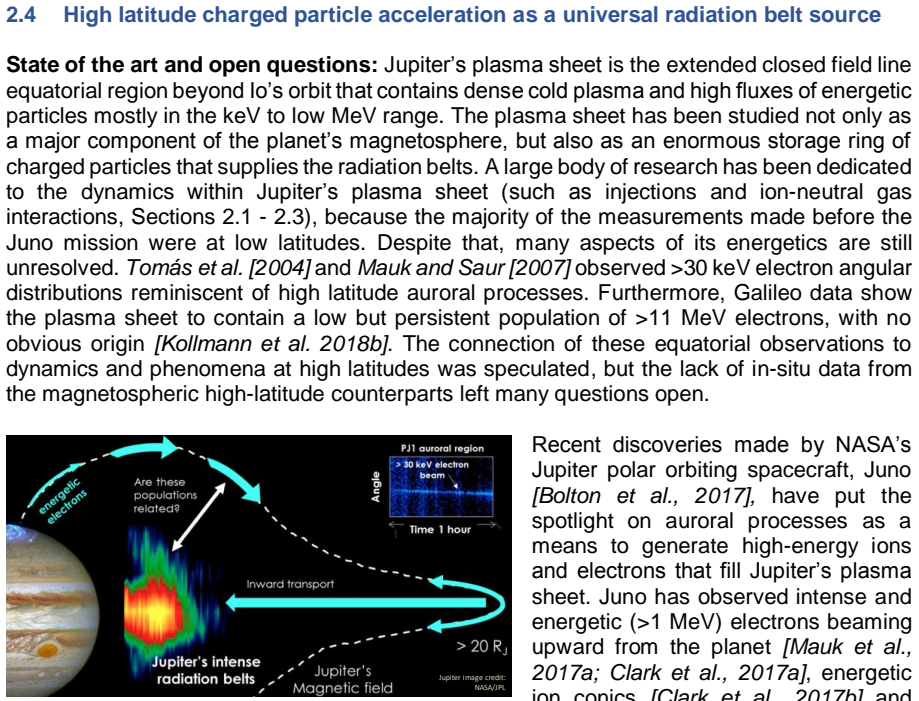
The paper's central claim is that Jupiter's radiation belts are a uniquely accessible physical laboratory for high-energy plasma processes, and that a dedicated multi-spacecraft mission is both essential and technically feasible. The authors argue that no past or approved mission—Pioneer, Voyager, Galileo, Juno, JUICE, or Europa Clipper—was designed to measure energy-resolved distributions of ultrarelativistic electrons (above roughly 50–100 MeV) or heavy ions to about 1 GeV/n with charge-state resolution in the belt core. A two-orbiter configuration, one crossing the belts and one monitoring the solar wind and magnetosphere, would for the first time separate spatial from temporal variations and link high-latitude auroral acceleration to belt populations. The paper treats the mission not as one science instrument among many but as the missing ground-truth measurement needed to test universal radiation-belt mechanisms such as CRAND, adiabatic radial diffusion, and nonlinear wave-particle acceleration.
Load-bearing premise
The recommendation rests on the premise that the science questions listed in Section 2 are genuinely open and that a miniaturized magnetic spectrometer with charge-state resolution can be built, shielded, and flown inside Jupiter's belts within an ESA cost envelope—something the paper points to but does not demonstrate.
Editorial extensions
If this is right
- If the paper's recommendation is followed, the first multi-spacecraft mission to a giant planet's magnetosphere would be flown, with one orbiter crossing the belts and a second monitoring the solar wind and providing two-point measurements.
- Energy-resolved coverage to roughly 100 MeV electrons and 1 GeV/n ions would test whether cosmic-ray albedo neutron decay supplies Jupiter's proton belt, a source that is currently unconfirmed inward of Io.
- Charge-state-resolved heavy ion measurements would decide whether iogenic oxygen and sulphur are accelerated as singly charged or fully stripped populations, settling conflicting evidence from Galileo and Io torus X-rays.
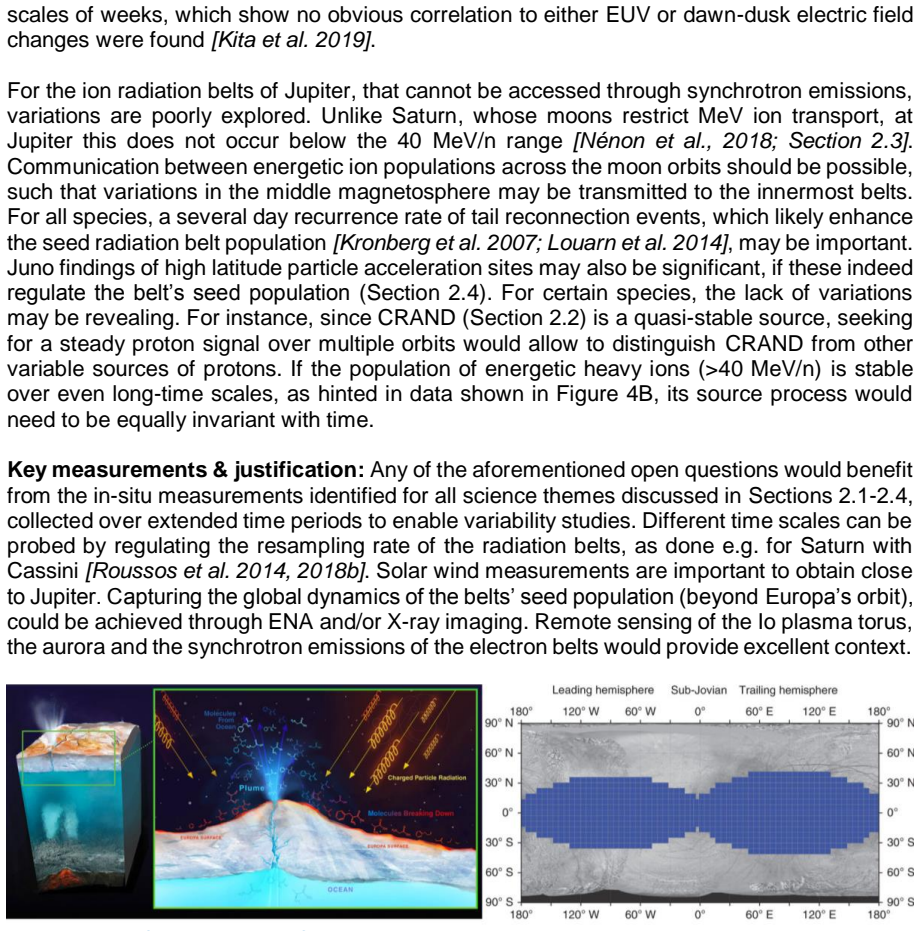
- Long-term, multi-orbit spectra would let modellers replace energy-independent radial diffusion assumptions with measured energy-dependent transport, and would quantify radiation processing of Europa's surface down to the depth where biosignatures could be sought.
- A successful mission would validate miniaturized magnetic spectrometry for other high-radiation targets, including Uranus and Neptune.
Reading between the lines
- The strongest test of the paper's urgency is whether Juno's extended mission or JUICE's radiation monitor can already resolve the highest-energy populations; if they can, the 'essential' case weakens, but the multi-point argument would still stand because a single spacecraft cannot separate spatial from temporal variation.
- The same instrument suite would directly constrain Europa's radiation dose profile, a stated input for choosing sampling depths for a future lander; the paper implies but does not fully develop this landing-site application.
- A proven miniPAN-class spectrometer could also be pointed at Earth's radiation belts, where current spectrometers are too heavy for small missions; that technology transfer is a concrete near-term test of feasibility.
Signed reviews
Editorial analysis
A structured set of objections, weighed in public.
Referee Report
Summary. This white paper, submitted in response to ESA's Voyage 2050 call, argues that Jupiter's radiation belts are a uniquely valuable and underexplored physical system and that a dedicated multi-spacecraft mission to explore them in situ should be a high-priority ESA mission. It reviews six open science questions: adiabatic electron heating versus local wave acceleration; the role of cosmic-ray albedo neutron decay as a proton source; the origin of the heavy ion belts; high-latitude acceleration sources; radiation belt space weather; and radiation processing of moon surfaces. It then discusses scientific and technical design drivers, three mission concepts (L-class two-orbiter, M-class single orbiter, and F/S-class flyby), and enabling technologies, especially miniaturized particle spectrometers and radiation-hard electronics. The paper concludes that a multi-spacecraft Jupiter radiation-belt mission is 'an essential and obvious way forward' and deserves high priority in the Voyage 2050 program.
Significance. The paper's central scientific case is strong: it compiles a large body of observations and models to show that Jupiter's inner belts remain poorly sampled at the energies and charge states that matter most, and it connects the unanswered questions to broad themes in plasma physics, astrobiology, and comparative magnetospherics. The review is well referenced and up to date, and the authors are transparent about the mission concepts being preliminary and about the need for dedicated engineering studies. If the mission were flown, it would deliver the first energy-resolved in-situ measurements of ultrarelativistic electrons and heavy ions in an outer planet's inner radiation belts, with likely transformative impact for radiation belt science. The main weakness is that the policy conclusion is more categorical than the evidence: the payload feasibility and radiation-hardness assumptions are identified but not demonstrated, and no quantitative comparison with other mission priorities is provided.
major comments (3)
- [3.4] The enabling payload for the proposed mission is load-bearing but not demonstrated. Section 3.4 identifies magnetic spectrometry (MiniPAN) and an adapted HEPD as the key instruments, but states that 'a Jupiter-specific design may require further studies' and that 'the energy limit to which magnetic spectrometry can be applied for resolving heavy ion charge states remains to be investigated.' For HEPD, the claim that 'large mass can be greatly reduced' is made without an estimate of the resulting mass, power, or geometry factor. Because the mission recommendation assumes these instruments can be built, shielded, and flown inside Jupiter's belts, the paper should either provide a quantitative feasibility assessment or explicitly limit its conclusion to a call for mission studies rather than asserting that the mission is 'essential and obvious.'
- [3.2] Section 3.2 notes that Galileo accumulated 30-40 krad per belt crossing behind 2.2 g/cm^2 shielding and that JUICE electronics are qualified to ~50 krad, and then states that this tolerance 'should be significantly increased' for a dedicated belt mission. No quantitative path is given for achieving such an increase, and the active shielding discussion in Section 3.4 is similarly programmatic. Since the mission's feasibility depends on surviving repeated crossings of the harshest radiation environment in the solar system, the paper should present at least a first-order dose model for the proposed orbit and shielding concept, or acknowledge this as an open design issue in the conclusion.
- [5 (and Executive Summary)] The concluding claim that a multi-spacecraft radiation-belt mission is 'an essential and obvious way forward' is a value judgment that goes beyond the evidence presented. The paper does not compare cost, risk, or scientific return against other proposed Voyage 2050 mission themes, and it explicitly defers the required mission, instrument, and technology studies to the future. This tension between the categorical conclusion and the acknowledged unknowns should be resolved either by softening the conclusion to 'a compelling candidate for dedicated mission studies' or by adding a comparative prioritization analysis.
minor comments (4)
- [Table 1] In the 'Synchrotron Emissions, X-rays' row, 'GRMT' appears to be a typo for 'GMRT' (Giant Metrewave Radio Telescope), which is used elsewhere in the text.
- [2.4] The citation '[McKibben et al., 1993: Clark et al. 2018]' uses a colon instead of a semicolon between the two references.
- [4.3] The phrase 'open a new are in the exploration' should read 'open a new era in the exploration.'
- [3.2] The sentence comparing the dose accumulated in about nine belt crossings with the Galileo mission total is ambiguous; please clarify the total dose figures and the basis of the comparison.
Circularity Check
No circularity: the white paper presents advocacy and a review of open science questions, with no derivation or fitted parameter equivalent to its conclusion.
full rationale
The paper is a Voyage 2050 white paper, not a quantitative derivation. Its conclusion that a dedicated multi-spacecraft Jupiter radiation-belt mission is an essential way forward follows from assembling open science questions (Section 2), observational gaps (Section 1.3), and mission considerations (Section 3); none of these steps is defined in terms of the conclusion. The abundant self-citations (Roussos, Kollmann, Nénon, Shprits, Woodfield, and others) are used to support statements about the current state of measurements and modeling, not to prove the recommendation, and each cited result is independently grounded in spacecraft data or published modeling. The enabling-technology discussion in Section 3.4 cites MiniPAN as a possible instrument but explicitly states that a Jupiter-specific design 'may require further studies' and that the heavy-ion charge-state energy limit 'remains to be investigated,' so the technology is presented as a feasibility consideration, not as a fitted input or a self-justifying premise. The weak point of the paper is that payload miniaturization, radiation hardness, and shielding are asserted rather than demonstrated, but under-support is a correctness or completeness concern, not circularity. No equation, model output, or fitted parameter is renamed as a prediction, and no uniqueness theorem or prior result is invoked to make the conclusion tautological. The analysis therefore finds no circular step.
Assumptions & free parameters
assumptions (3)
- domain assumption The science questions listed in Section 2 are open and their resolution requires the proposed measurements.
- domain assumption Existing models of Jupiter's radiation belts (e.g., Nénon et al. 2017, 2018a) reliably represent the unmeasured high-energy populations, supporting the predicted need for >100 MeV electron measurements.
- domain assumption Miniaturized magnetic spectrometers and other enabling technologies can reach the required performance and survive the radiation environment.
Cite this review
Pith. "Pith review of The in-situ exploration of Jupiter's radiation belts (A White Paper submitted in response to ESA's Voyage 2050 Call)." pith.science (2026). https://pith.science/paper/NIKU2DMS
@misc{pith2026190802339,
  author       = {Pith},
  title        = {Pith review of: The in-situ exploration of Jupiter's radiation belts (A White Paper submitted in response to ESA's Voyage 2050 Call)},
  year         = {2026},
  howpublished = {\url{https://pith.science/paper/NIKU2DMS}},
  note         = {Machine review of arXiv:1908.02339}
}
read the original abstract
Jupiter has the most energetic and complex radiation belts in our solar system. Their hazardous environment is the reason why so many spacecraft avoid rather than investigate them, and explains how they have kept many of their secrets so well hidden, despite having been studied for decades. In this White Paper we argue why these secrets are worth unveiling. Jupiter's radiation belts and the vast magnetosphere that encloses them constitute an unprecedented physical laboratory, suitable for both interdisciplinary and novel scientific investigations: from studying fundamental high energy plasma physics processes which operate throughout the universe, such as adiabatic charged particle acceleration and nonlinear wave-particle interactions; to exploiting the astrobiological consequences of energetic particle radiation. The in-situ exploration of the uninviting environment of Jupiter's radiation belts present us with many challenges in mission design, science planning, instrumentation and technology development. We address these challenges by reviewing the different options that exist for direct and indirect observation of this unique system. We stress the need for new instruments, the value of synergistic Earth and Jupiter-based remote sensing and in-situ investigations, and the vital importance of multi-spacecraft, in-situ measurements. While simultaneous, multi-point in-situ observations have long become the standard for exploring electromagnetic interactions in the inner solar system, they have never taken place at Jupiter or any strongly magnetized planet besides Earth. We conclude that a dedicated multi-spacecraft mission to Jupiter's radiation belts is an essential and obvious way forward and deserves to be given a high priority in ESA's Voyage 2050 programme.
Figures


Figures from the paper (4 more)


Forward citations
Cited by 1 Pith paper
-
Discovering and Characterising Exoplanets and Ultracool Dwarfs with the Square Kilometre Array
The Square Kilometre Array is projected to enable first radio detections of giant exoplanets, thousands of ultracool dwarfs, and few-Earth-mass planets around nearby UCDs via VLBI astrometry.
Reference graph
Works this paper leans on
-
[1]
Elias Roussos [Max Planck Institute for Solar System Research, Goettingen, Germany]
-
[2]
Oliver Allanson [University of Reading, Reading, Berkshire, UK]
-
[3]
Nicolas André [Research Institute for Astrophysics and Planetology, Toulouse, France]
-
[4]
Bruna Bertucci [University of Perugia, Italy]
-
[5]
Graziella Branduardi-Raymont [UCL Mullard Space Science Laboratory, UK]
-
[6]
George Clark [Johns Hopkins Applied Physics Laboratory, Laurel, Maryland, USA]
-
[7]
Kostantinos Dialynas [Academy of Athens, Athens, Greece]
-
[8]
for Astrophysics and Planetology Toulouse, France]
Iannis Dandouras [Research Inst. for Astrophysics and Planetology Toulouse, France]
Show all 29 references
-
[9]
Ravindra Desai [Imperial College London, London, UK]
-
[10]
Yoshifumi Futaana [Swedish Institute for Space Physics (IRF), Kiruna, Sweden]
-
[11]
Matina Gkioulidou [Johns Hopkins Applied Physics Laboratory, Laurel, Maryland, USA]
-
[12]
Geraint Jones [UCL Mullard Space Science Laboratory, UK]
-
[13]
Peter Kollmann [Johns Hopkins Applied Physics Laboratory, Laurel, Maryland, USA]
-
[14]
Anna Kotova [Research Institute for Astrophysics and Planetology, Toulouse, France]
-
[15]
Elena Kronberg [University of Munich, Germany]
-
[16]
Norbert Krupp [Max Planck Institute for Solar System Research, Goettingen, Germany]
-
[17]
Go Murakami [Institute of Space and Astronautical Science, JAXA, Kanagawa, Japan]
-
[18]
Quentin Nénon [Space Sciences Laboratory, University of California at Berkeley, USA]
-
[19]
Tom Nordheim [Jet Propulsion Laboratory, Pasadena, USA]
-
[20]
Benjamin Palmaerts [University of Liege, Liege, Belgium]
-
[21]
Christina Plainaki [Agenzia Spaziale Italiana (ASI), Rome, Italy]
-
[22]
Jonathan Rae [University College London, London, UK]
-
[23]
Daniel Santos-Costa [Southwest Research Institute, USA]
-
[24]
Theodore Sarris [Democritus University of Thrace, Greece]
-
[25]
Yuri Shprits [Helmholtz-Zentrum, Potsdam, Germany]
-
[26]
Ali Sulaiman [University of Iowa, Iowa, USA]
-
[27]
Emma Woodfield [British Antarctic Survey, Cambridge, UK]
-
[28]
Xin Wu [University of Geneva, Switzerland]
-
[29]
Zhonghua Yao [University of Liege, Liege, Belgium]
Reviewed August 14, 2026 · model on record in the stance chip above.
Discussion (0). Continue with ORCID to comment.