REVIEW 3 major objections 3 minor 76 references
Valence-quark distributions of pions and kaons in a nuclear medium
T0 review · 3 major / 3 minor · reviewed 2026-08-14 · deepseek-v4-flash
Pith's one-line read Combining two effective models, the paper predicts that nuclear matter reshuffles the kaon's valence quarks—u enhanced at small x, anti-strange at large x—while leaving the pion nearly untouched.
desk verdict A serious first calculation of in-medium kaon valence PDFs, but the central K+ flavor-asymmetry claim is not yet clean because the in-medium calculation drops the NJL infrared cutoff that the vacuum baseline keeps, and the abstract contradicts the body's x-dependence. read the letter →
The pith
A machine-rendered reading of the paper's core claim, the machinery that carries it, and where it could break.
The reading
What carries the argument
The load-bearing object is the in-medium light-quark propagator, whose dynamical mass is reduced and whose momentum is shifted by the vector potential, k^μ → k^μ + V^μ, while the strange-quark propagator retains its vacuum form. In the pion, both valence quarks are light and the vector shifts cancel in the bubble diagram, leaving the valence distribution nearly vacuum-like; in the kaon, one light and one strange quark make the vector shift survive, redistributing valence strength between small and large x. The explicit valence-PDF formulas are the NJL expressions of Eqs. (45)–(46) evaluated with density-dependent masses and couplings, together with the Bjorken-x rescaling of Eqs. (47)–(48), and the results are evolved with NLO DGLAP to Q² = 16 GeV².
What would settle it
A kaon-nucleus Drell-Yan measurement at Q² near 16 GeV² that extracts the K+ valence u-quark and anti-strange distributions as a function of nuclear density would settle it: the small-x u enhancement and large-x anti-strange enhancement must grow with density, while the pion distribution stays nearly flat.
Extended reading notes
Core claim
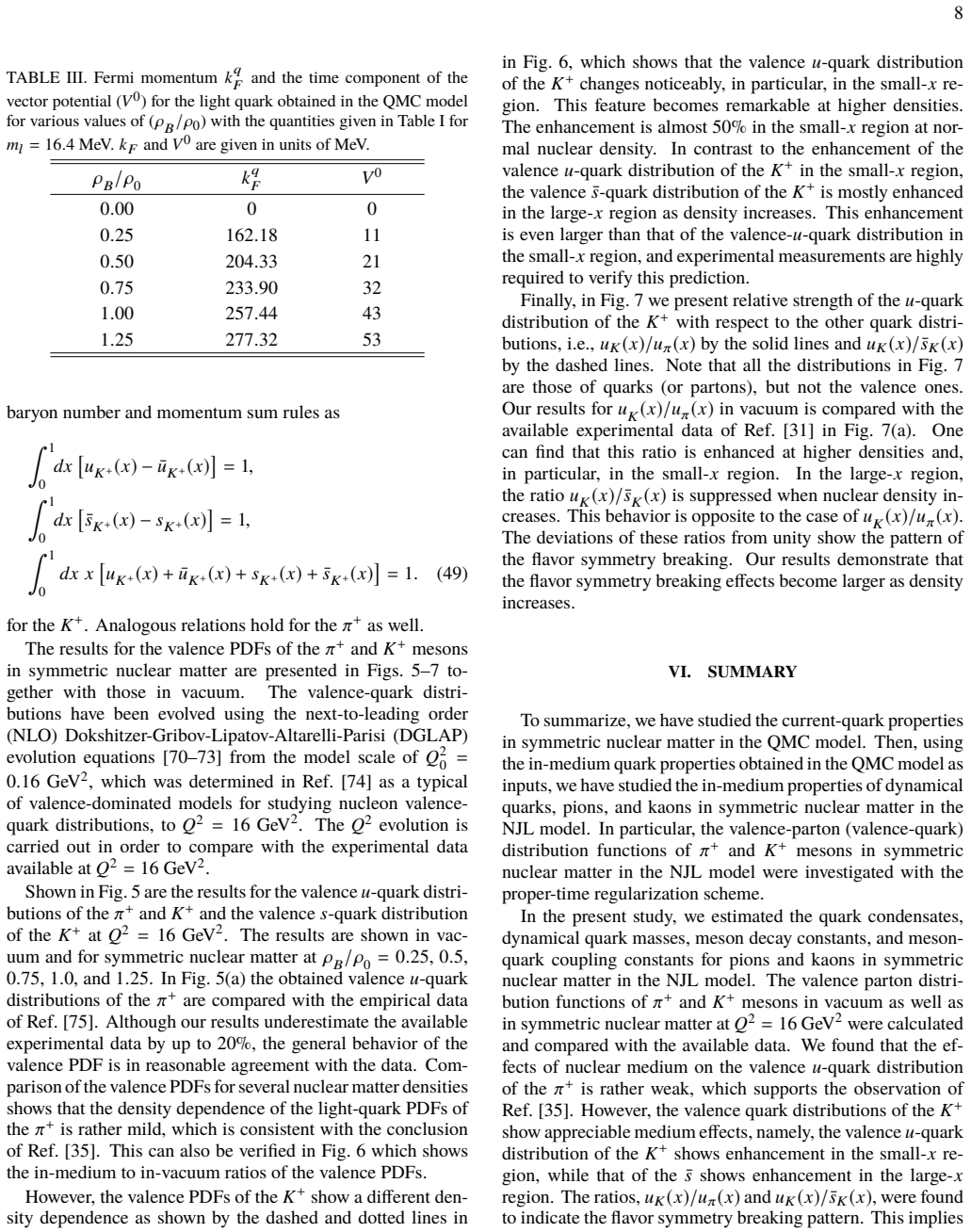
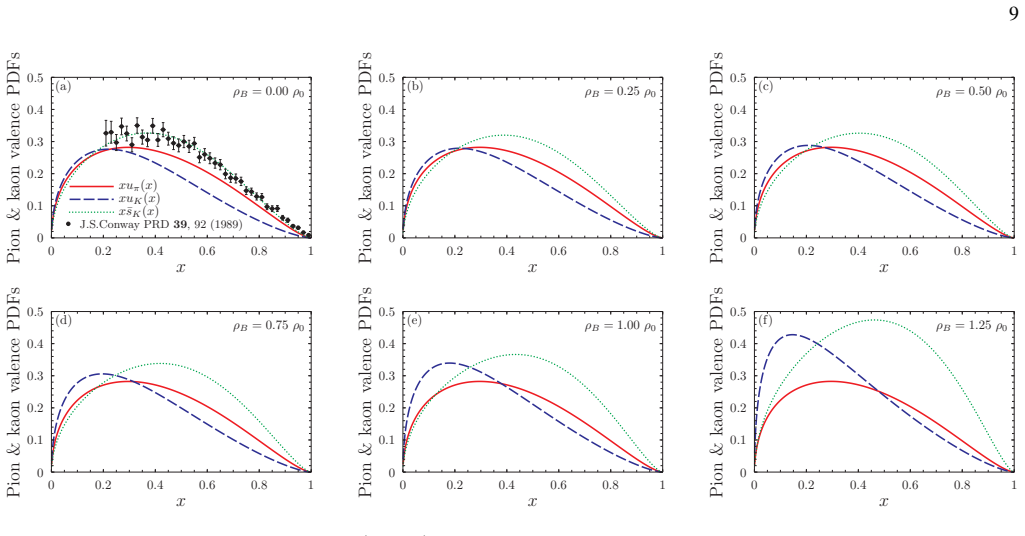
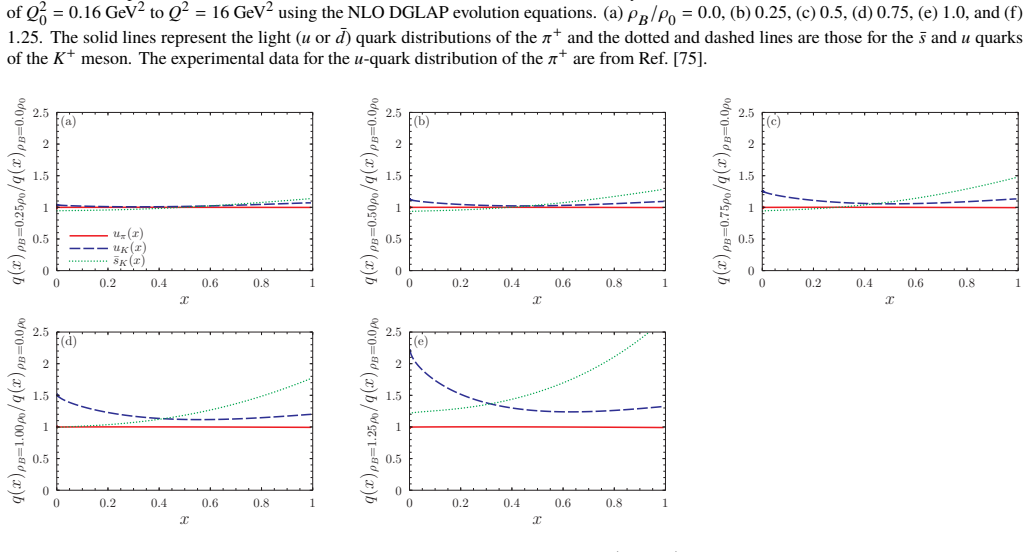
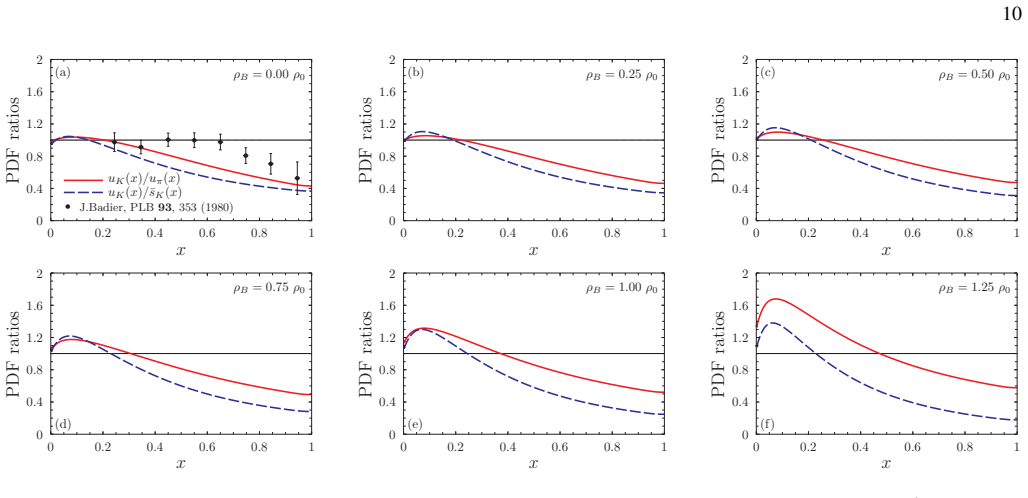
The central claim is that valence-quark distributions of mesons in symmetric nuclear matter are density dependent and flavor dependent. For the K+, the valence u-quark distribution is enhanced in the small-x region and the valence anti-strange distribution is enhanced in the large-x region, with both in-medium-to-vacuum ratios growing as the baryon density rises toward 1.25ρ0. For the π+, the valence u-quark distribution is almost unchanged. This difference arises because the strange quark is treated as decoupled from the nuclear mean fields, so the kaon feels the medium only through its light quark, whereas both quarks in the pion respond to the light-quark mean fields. The authors interpret the density-growing ratios uK/uπ and uK/s̄K as a medium-induced growth of flavor symmetry breaking.
Load-bearing premise
The calculation assumes the strange quark feels none of the nuclear mean field and that the NJL coupling and ultraviolet cutoff stay at their vacuum values; if strange quarks respond to the medium, or if the cutoff choice matters, the kaon predictions change.
Editorial extensions
If this is right
- In-medium pion and kaon valence PDFs at Q² = 16 GeV² are predicted to be density dependent, with the K+ valence u-quark small-x enhancement reaching about 50% at normal nuclear density.
- The kaon's two valence distributions respond oppositely to density: one enhances at small x and the other at large x, so the shape as well as the magnitude of the kaon PDF changes in the medium.
- The ratios uK(x)/uπ(x) and uK(x)/s̄K(x) move away from unity as density increases, indicating that flavor symmetry breaking in meson structure grows in nuclear matter.
- The vacuum calculations describe the available pion and kaon Drell-Yan data reasonably well, giving a baseline on which the in-medium predictions rest.
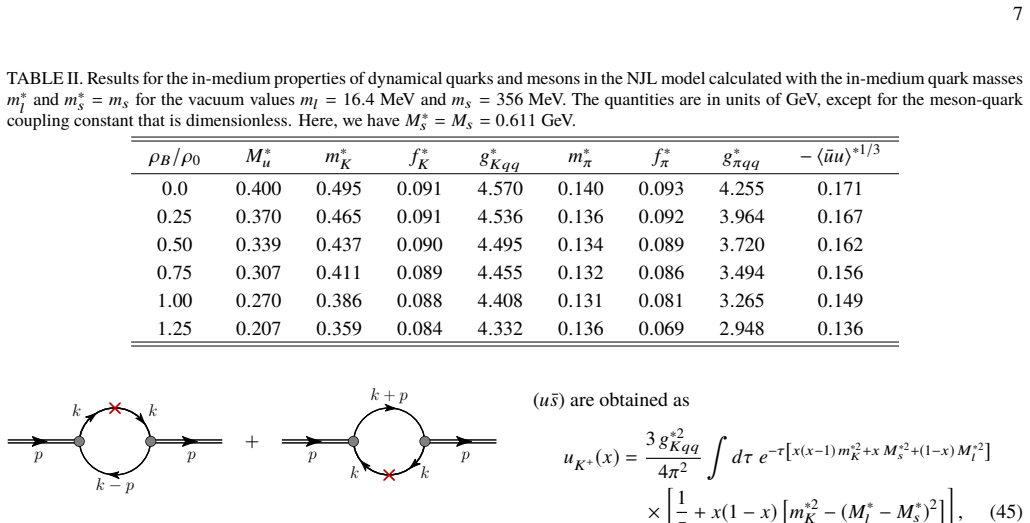
- In-medium kaon and pion masses, decay constants, and meson-quark couplings all decrease with density, but the valence-PDF changes are not simply a mass shift since the x-dependence itself changes.
Reading between the lines
- If strange quarks were coupled to the nuclear scalar and vector mean fields instead of being decoupled, the large-x anti-strange enhancement would likely weaken or change sign; this is a direct test of the paper's central assumption.
- The same machinery could be extended to D and B mesons by replacing the strange quark with a decoupled heavy quark, yielding concrete predictions for heavy-meson valence PDFs inside nuclei.
- The opposite density response of the kaon's u and s̄ distributions suggests the nuclear medium acts as a flavor-dependent filter, which could influence kaon yields and Drell-Yan dilepton spectra in heavy-ion collisions.
Signed reviews
Editorial analysis
A structured set of objections, weighed in public.
Referee Report
Summary. The paper combines the Nambu–Jona-Lasinio (NJL) model with the quark-meson coupling (QMC) model to compute valence-quark distribution functions of the pi+ and K+ mesons in symmetric nuclear matter. The QMC model supplies density-dependent light-quark current masses and vector mean fields, which are used as inputs to the NJL model to obtain in-medium dynamical quark masses, meson masses, decay constants, and meson-quark couplings. The valence PDFs are then evaluated at a low model scale and evolved with NLO DGLAP to Q^2 = 16 GeV^2. The main reported results are that the valence u-quark distribution of the pi+ is nearly unchanged in medium, while the K+ valence u-quark distribution is enhanced at small x and the K+ valence anti-s-quark distribution is enhanced at large x, with the effects growing with density. Vacuum results are compared with pion Drell-Yan data and with the K/pi structure-function ratio data. The manuscript is explicit about the formalism and parameters, but the abstract states the x-dependence of the K+ ratios in the opposite sense to the body, and the in-medium calculation changes the NJL infrared regularization relative to the vacuum baseline.
Significance. If established, the result would provide concrete, falsifiable predictions for flavor- and density-dependent modifications of kaon valence structure, with implications for pion/kaon-induced Drell-Yan processes on nuclei, hadronization in heavy-ion collisions, and the interpretation of nuclear medium effects in meson structure. The paper has genuine strengths: the QMC couplings are fixed by nuclear-matter saturation properties, the NJL parameters are fixed by vacuum meson observables, and the in-medium PDFs are predictions rather than fits to PDF data; the vacuum pion PDF is also compared with experimental Drell-Yan data. The explicit equations and tables make the calculation reproducible in structure. However, the central claim is currently obscured by an internal contradiction between the abstract and the body, and the change of regularization between the vacuum and in-medium calculations means the reported density dependence may not be a pure medium effect. The significance is therefore conditional on resolving these issues.
major comments (3)
- [Abstract and Sec. VI] The abstract states that for the K+ the in-medium/vacuum ratio 'for the valence u-quark distribution increases with x, while that for the valence s quark decreases with x.' This is opposite to the result reported in the body: Sec. V and Sec. VI state that the valence u-quark distribution of the K+ is enhanced in the small-x region and the valence anti-s-quark distribution is enhanced in the large-x region, as shown in Fig. 6. Since both vacuum distributions fall steeply with x, an enhancement at small x corresponds to a ratio that falls with x, not one that increases. The abstract must be corrected to match the body; as written, the paper's headline claim is stated in contradictory ways.
- [Sec. IV, Eq. (28)] The vacuum gap equation, Eq. (4), uses the finite infrared cutoff Lambda_IR = 240 MeV, while the in-medium gap equation, Eq. (28), is solved with Lambda_IR -> 0 (1/Lambda_IR^2 = infinity), with G_pi and Lambda_UV held at their vacuum values. Therefore the rho -> 0 limit of the in-medium calculation is not the same regularized theory as the vacuum calculation that appears in the denominators of the in-medium/vacuum ratios in Fig. 6. The text asserts that the results 'are not affected much' by this change but gives no numerical support; the omitted portion of the proper-time integral grows as M_l^* decreases, which is precisely the density region where the kaon enhancement is claimed. The central ratios should be recomputed with the same finite Lambda_IR for vacuum and medium, or with a documented and justified density dependence of Lambda_IR, so that the reported density dependence is not contaminated by a change of regularization.
- [Sec. V, Eqs. (45)-(48)] The claimed large-x enhancement of the valence anti-s distribution is difficult to assess because the medium rescaling in Eqs. (47)-(48) is stated to be valid only for light (u,d) quarks, while the strange propagator is unmodified in Eq. (30). The density dependence of anti-s_K must then enter only through M_l^*, m_K^*, and g_Kqq^* in Eq. (46), plus the choice of x variable. The manuscript does not specify whether Eq. (47) is applied to the anti-s distribution or how the Bjorken-x variable for anti-s is defined in medium. Without this information, it is unclear whether the reported anti-s large-x enhancement is a genuine strange-quark medium effect or an artifact of the variable rescaling and regularization choices. Please state explicitly the medium relation used for anti-s and show the decomposition.
minor comments (3)
- [Table II] Table II shows that m_pi^* decreases from 0.140 GeV at rho=0 to 0.131 GeV at rho=rho_0 but then increases to 0.136 GeV at rho=1.25 rho_0; the unqualified statement in Sec. IV that the in-medium quantities decrease as density increases should be qualified or explained.
- [Sec. V, Fig. 5(a)] The text says the model underestimates the Conway Drell-Yan data by up to 20%; stating the x range in which the largest discrepancy occurs would help the reader judge the comparison.
- [Eq. (49)] The baryon-number and momentum sum rules are stated without derivation; since the medium relation in Eqs. (47)-(48) is a variable transformation, one sentence confirming that the normalization is preserved for each flavor would be useful.
Circularity Check
No significant circularity: in-medium valence PDFs are genuine model outputs, with parameters fixed by vacuum observables and nuclear-matter saturation.
full rationale
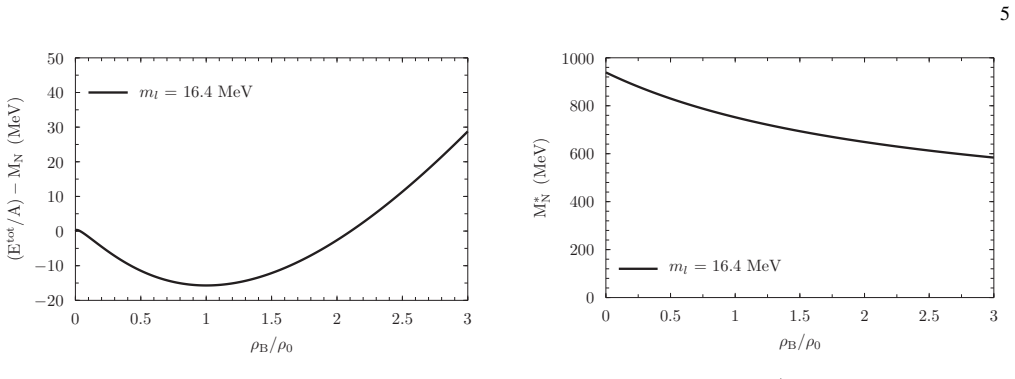
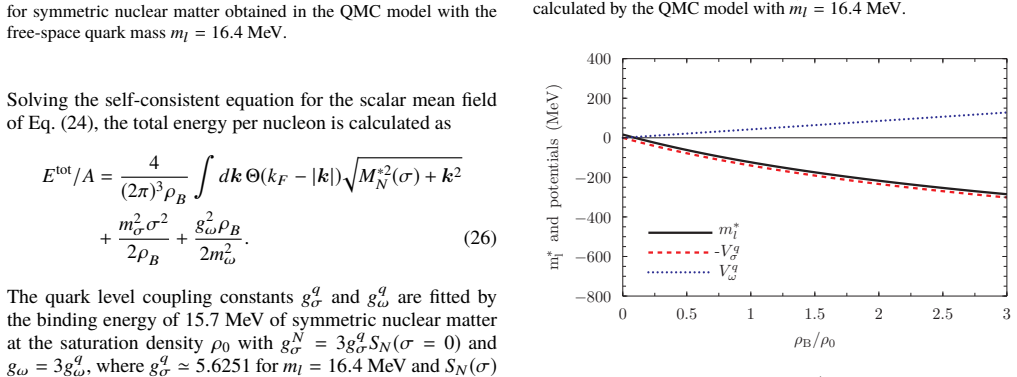
The derivation chain is not circular. Vacuum NJL parameters are fixed to standard vacuum inputs: Lambda_IR = 240 MeV, M_l = 400 MeV, and then Lambda_UV, G_pi, M_s, m_l, m_s are chosen to reproduce m_pi = 140 MeV, m_K = 495 MeV, and f_pi = 93 MeV (Sec. II). The QMC couplings are fitted to the saturation binding energy of symmetric nuclear matter (Sec. III), not to any PDF. The in-medium current-quark mass m*_l and vector potential V_0 come from self-consistent QMC mean-field equations, and the NJL gap and Bethe-Salpeter equations then produce M*_l, m*_K, g*_Kqq, and finally the valence PDFs in Eqs. (45)-(46). These PDFs are compared with experimental data only after the calculation and are not used to adjust parameters, so there is no fitted-input-called-prediction and no self-definitional reduction. The repeated citations of Refs. [5] and [41] are methodological lineage: the NJL formalism is re-derived in the paper, and the cited prior work is not invoked as an unverified uniqueness theorem or as the sole justification of the central claim. The main caveat is the regularization switch in Eq. (28), where Lambda_IR is sent to infinity in the medium while the vacuum denominator retains Lambda_IR = 240 MeV; the paper states this has little effect but gives no numerical support. That is a model-consistency and falsifiability concern, not a circular one, because the density dependence of the ratios is not imposed by construction through that switch.
Assumptions & free parameters
free parameters (7)
- Lambda_UV (NJL ultraviolet cutoff) =
645 MeV
- Gpi (NJL four-fermion coupling) =
19.0 GeV^-2
- ms (current strange quark mass) =
356 MeV
- Lambda_IR (NJL infrared cutoff) =
240 MeV in vacuum; infinity in medium
- g_q_sigma and g_q_omega (QMC quark-meson couplings) =
g_q_sigma about 5.6251 for ml=16.4 MeV; g_omega related through g_omega=3 g_q_omega
- QMC bag constant B and zero-point parameter z_N =
B^1/4=169.2 MeV, z_N=3.334 for ml=16.4 MeV
- Model scale Q0^2 for DGLAP evolution =
0.16 GeV^2
assumptions (5)
- domain assumption The NJL model is a valid effective theory of low-energy QCD with proper-time regularization.
- domain assumption The QMC model describes nuclear matter as nonoverlapping MIT bags with light quarks coupled to sigma and omega mean fields, while strange quarks decouple from the mean fields.
- ad hoc to paper The NJL parameters Gpi and Lambda_UV retain their vacuum values in medium, while Lambda_IR is sent to infinity.
- domain assumption In-medium valence PDFs can be evolved from Q0^2=0.16 GeV^2 to Q^2=16 GeV^2 using free-space NLO DGLAP evolution.
- domain assumption The in-medium to vacuum Bjorken-x mapping of Eqs. (47)-(48), taken from Ref. [69], is valid for light quarks in this framework.
Cite this review
Pith. "Pith review of Valence-quark distributions of pions and kaons in a nuclear medium." pith.science (2026). https://pith.science/paper/H43CAYPQ
@misc{pith2026190802406,
  author       = {Pith},
  title        = {Pith review of: Valence-quark distributions of pions and kaons in a nuclear medium},
  year         = {2026},
  howpublished = {\url{https://pith.science/paper/H43CAYPQ}},
  note         = {Machine review of arXiv:1908.02406}
}
abstract
In-medium valence-quark distributions of $\pi^+$ and $K^+$ mesons in symmetric nuclear matter are studied by combining the Nambu--Jona-Lasinio model and the quark-meson coupling model. The in-medium properties of the current quarks, which are used as inputs for studying the in-medium pion and kaon properties in the Nambu--Jona-Lasinio model, are calculated within the quark-meson coupling model. The light-quark condensates, light-quark dynamical masses, pion and kaon decay constants, and pion- and kaon-quark coupling constants are found to decrease as nuclear density increases. The obtained valence quark distributions in vacuum for both the $\pi^+$ and $K^+$ could reasonably describe the available experimental data over a wide range of Bjorken-$x$. The in-medium valence $u$-quark distribution in the $\pi^+$ at $Q^2=16~\mbox{GeV}^2$ is found to be almost unchanged compared to the in-vacuum case. However, the in-medium to in-vacuum ratios of both the valence $u$-quark and valence $s$-quark distributions of the $K^+$ meson at $Q^2=16~\mbox{GeV}^2$ increase with nuclear matter density, but show different $x$-dependence. Namely, the ratio for the valence $u$-quark distribution increases with $x$, while that for the valence $s$ quark decreases with $x$. These features are enhanced at higher density regions.
Figures
Figures from the paper (4 more)
Reference graph
Works this paper leans on
-
[35]
Suzuki, Pion structure function in a nuclear medium, Phys
K. Suzuki, Pion structure function in a nuclear medium, Phys. Lett. B368, 1 (1996)
work page 1996
-
[5]
P.T.P.Hutauruk,I.C.Cloët,andA.W.Thomas, Flavordepen- dence of the pion and kaon form factors and parton distribution functions, Phys. Rev. C94, 035201 (2016)
work page 2016
-
[41]
P. T. P. Hutauruk, Y. Oh, and K. Tsushima, Electroweak prop- erties of pions in a nuclear medium, Phys. Rev. C99, 015202 (2019)
work page 2019
-
[1]
Y.NambuandG.Jona-Lasinio, Dynamicalmodelofelementary particles based on an analogy with superconductivity. I, Phys. Rev. 122, 345 (1961)
work page 1961
-
[2]
B.L.Ioffe, QCD(QuantumChromodynamics)atlowenergies, Prog. Part. Nucl. Phys.56, 232 (2006)
work page 2006
- [3]
-
[4]
A. V. Belitsky and A. V. Radyushkin, Unraveling hadron struc- ture with generalized parton distributions, Phys. Rep.418, 1 (2005)
work page 2005
-
[6]
P. T. P. Hutauruk, W. Bentz, I. C. Cloët, and A. W. Thomas, Charge symmetry breaking effects in pion and kaon structure, Phys. Rev. C97, 055210 (2018)
work page 2018
Show all 76 references
-
[7]
Raha and A
U. Raha and A. Aste, Electromagnetic pion and kaon form factors in light-cone resummed perturbative QCD, Phys. Rev. D 79, 034015 (2009)
2009
-
[8]
Nam and H.-C
S.-I. Nam and H.-C. Kim, Electromagnetic form factors of the pion and kaon from the instanton vacuum, Phys. Rev. D77, 094014 (2008)
2008
-
[9]
Bijnens and P
J. Bijnens and P. Talavera, Pion and kaon electromagnetic form factors, JHEP03, 046 (2002)
2002
-
[10]
Lett.51B, 54 (1974)
N.Zovko, Pionandkaonformfactorsandheavyvectormesons, Phys. Lett.51B, 54 (1974)
1974
-
[11]
E. O. da Silva, J. P. B. C. de Melo, B. El-Bennich, and V. S. Filho, Pionandkaonelasticformfactorsinarefinedlight-front model, Phys. Rev. C86, 038202 (2012)
2012
-
[12]
Bernard and U.-G
V. Bernard and U.-G. Meissner, Electromagnetic Structure of the Pion and the Kaon, Phys. Rev. Lett.61, 2296 (1988), 61, 2973(E) (1988)
1988
-
[13]
P. T. P. Hutauruk, Kaon structure in the confining Nambu– Jano-Lasinio model, talk at the 45th International Meeting on Fundamental Physics, arXiv:1801.06299
-
[14]
Chang, I
L. Chang, I. C. Cloët, C. D. Roberts, S. M. Schmidt, and P. C. Tandy, Pion Electromagnetic Form Factor at Spacelike Mo- menta, Phys. Rev. Lett.111, 141802 (2013)
2013
-
[15]
G. R. Farrar and D. R. Jackson, Pion Form Factor, Phys. Rev. Lett. 43, 246 (1979)
1979
-
[16]
Koponen, A
J. Koponen, A. C. Zimermmane-Santos, C. T. H. Davies, G. P. Lepage, and A. T. Lytle (HPQCD Collaboration), Pseudoscalar meson electromagnetic form factor at highQ2 from full lattice 11 QCD, Phys. Rev. D96, 054501 (2017)
2017
-
[17]
B. J. Owen, W. Kamleh, D. B. Leinweber, M. Selim Mahbub, and B. J. Menadue, Light meson form factors at near physical masses, Phys. Rev. D91, 074503 (2015)
2015
-
[18]
J. N. Hedditch, W. Kamleh, B. G. Lasscock, D. B. Leinweber, A. G. Williams, and J. M. Zanotti, Pseudoscalar and vector mesonformfactorsfromlatticeQCD, Phys.Rev.D 75,094504 (2007)
2007
-
[19]
Kakazu, K.-I
J. Kakazu, K.-I. Ishikawa, N. Ishizuka, Y. Kuramashi, Y. Naka- mura, Y. Namekawa, Y. Taniguchi, N. Ukita, T. Yamazaki, and T. Yoshie (PACS Collaboration), Electromagnetic pion form factor near physical point inNf = 2 + 1 lattice QCD, PoS LATTICE2016, 160 (2017)
2017
-
[20]
(NA7Collaboration), Ameasurementof the space-like pion electromagnetic form factor, Nucl
S.R.Amendolia etal. (NA7Collaboration), Ameasurementof the space-like pion electromagnetic form factor, Nucl. Phys. B 277, 168 (1986)
1986
-
[21]
S. R. Amendoliaet al., A measurement of the pion charge radius, Phys. Lett.146B, 116 (1984)
1984
-
[22]
G. M. Huberet al.(Jefferson LabFπ Collaboration), Charged pion form factor betweenQ2 = 0.60 and 2.45 GeV2. II. Deter- mination of, and results for, the pion form factor, Phys. Rev. C 78, 045203 (2008)
2008
-
[23]
A. B. Migdal, E. E. Saperstein, M. A. Troitsky, and D. N. Voskresensky, Piondegreesoffreedominnuclearmatter, Phys. Rep. 192, 179 (1990)
1990
-
[24]
J. P. B. C. de Melo, K. Tsushima, B. El-Bennich, E. Rojas, and T. Frederico, Pion structure in the nuclear medium, Phys. Rev. C 90, 035201 (2014)
2014
-
[25]
Blomqvist and J
I. Blomqvist and J. M. Laget, A non-relativistic operator con- venient for analysis of pion photoproduction on nuclei in the ∆(1236)region, Nucl. Phys. A280, 405 (1977)
1977
-
[26]
F. X. Lee, T. Mart, C. Bennhold, and L. E. Wright, Quasifree kaonphotoproductiononnuclei, Nucl.Phys.A 695,237(2001)
2001
-
[27]
J. T. Londergan, G. Q. Liu, and A. W. Thomas, Kaon-nucleus Drell-Yan processes and kaon structure functions, Phys. Lett. B 380, 393 (1996)
1996
-
[28]
J. J. Aubertet al., The ratio of the nucleon structure functions F N 2 for iron and deuterium, Phys. Lett. B123B, 275 (1983)
1983
-
[29]
D.F.Geesaman,K.Saito,andA.W.Thomas, ThenuclearEMC effect, Annu. Rev. Nucl. Part. Sci.45, 337 (1995)
1995
-
[30]
Altet al.(NA49 Collaboration), Pion and kaon production incentral Pb + Pb collisionsat 20Aand 30AGeV:Evidencefor the onset of deconfinement, Phys
C. Altet al.(NA49 Collaboration), Pion and kaon production incentral Pb + Pb collisionsat 20Aand 30AGeV:Evidencefor the onset of deconfinement, Phys. Rev. C77, 024903 (2008)
2008
-
[31]
Badieret al., Measurement of theK−/π− structure function ratio using the Drell-Yan process, Phys
J. Badieret al., Measurement of theK−/π− structure function ratio using the Drell-Yan process, Phys. Lett.93B, 354 (1980)
1980
-
[32]
Adams et al., Letter of intent: A new QCD facility at the M2 beam line of the CERN SPS (COMPASS++/AMBER), arXiv:1808.00848
B. Adams et al., Letter of intent: A new QCD facility at the M2 beam line of the CERN SPS (COMPASS++/AMBER), arXiv:1808.00848
-
[33]
Frederico, In-mediumK+ electromagnetic form factor with a symmetric vertex in a light front approach, Few-Body Syst
G.H.S.Yabusaki,J.P.B.C.deMelo,W.dePaula,K.Tsushima, and T. Frederico, In-mediumK+ electromagnetic form factor with a symmetric vertex in a light front approach, Few-Body Syst. 59, 37 (2018)
2018
-
[34]
Tsushima and J
K. Tsushima and J. P. B. C. de Melo, In-medium pion valence distribution amplitude, Few-Body Syst.58, 85 (2017)
2017
-
[36]
V.Bernard,R.L.Jaffe,andU.-G.Meissner, Strangenessmixing and quenching in the Nambu–Jona-Lasinio model, Nucl. Phys. B 308, 753 (1988)
1988
-
[37]
Bernard and U.-G
V. Bernard and U.-G. Meissner, Properties of vector and axial- vector mesons from a generalized Nambu–Jona-Lasinio model, Nucl. Phys. A489, 647 (1988)
1988
-
[38]
U.VoglandW.Weise, TheNambuandJona-Lasiniomodel: Its applications for hadrons and nuclei, Prog. Part. Nucl. Phys.27, 195 (1991)
1991
-
[39]
S. P. Klevansky, The Nambu–Jona-Lasinio model of Quantum Chromodynamics, Rev. Mod. Phys.64, 649 (1992)
1992
-
[40]
I. C. Cloët, W. Bentz, and A. W. Thomas, Role of diquark correlations and the pion cloud in nucleon elastic form factors, Phys. Rev. C90, 045202 (2014)
2014
-
[42]
P. T. P. Hutauruk,Nonperturbative aspects of kaon structure, PhD thesis, Univ. of Adelaide, 2016
2016
-
[43]
Ninomiya, W
Y. Ninomiya, W. Bentz, and I. C. Cloët, Dressed quark mass dependence of pion and kaon form factors, Phys. Rev. C91, 025202 (2015)
2015
-
[44]
P.A.M.Guichon,Apossiblequarkmechanismforthesaturation of nuclear matter, Phys. Lett. B200, 235 (1988)
1988
-
[45]
P. A. M. Guichon, K. Saito, E. Rodionov, and A. W. Thomas, Theroleofnucleonstructureinfinitenuclei, Nucl.Phys.A 601, 349 (1996)
1996
-
[46]
Saito, K
K. Saito, K. Tsushima, and A. W. Thomas, Self-consistent description of finite nuclei based on a relativistic quark model, Nucl. Phys. A609, 339 (1996)
1996
-
[47]
Saito, K
K. Saito, K. Tsushima, and A. W. Thomas, Variation of hadron masses in finite nuclei, Phys. Rev. C55, 2637 (1997)
1997
-
[48]
J.R.Stone,P.A.M.Guichon,P.G.Reinhard,andA.W.Thomas, Finite Nuclei in the Quark-Meson Coupling Model, Phys. Rev. Lett. 116, 092501 (2016)
2016
-
[49]
P. A. M. Guichon, J. R. Stone, and A. W. Thomas, Quark- meson-coupling (QMC) model for finite nuclei, nuclear matter and beyond, Prog. Part. Nucl. Phys.100, 262 (2018)
2018
-
[50]
K.Tsushima,K.Saito,J.Haidenbauer,andA.W.Thomas, The quark-mesoncouplingmodelfor Λ, Σ and Ξhypernuclei, Nucl. Phys. A630, 691 (1998)
1998
-
[51]
P. A. M. Guichon, A. W. Thomas, and K. Tsushima, Binding of hypernuclei in the latest quark-meson coupling model, Nucl. Phys. A814, 66 (2008)
2008
-
[52]
Stone, P
J. Stone, P. Guichon, and A. Thomas, Superheavy nuclei in the quark-meson-coupling model, EPJ Web Conf.163, 00057 (2017)
2017
-
[53]
D. L. Whittenbury, J. D. Carroll, A. W. Thomas, K. Tsushima, and J. R. Stone, Quark-meson coupling model, nuclear matter constraints,andneutronstarproperties, Phys.Rev.C 89,065801 (2014)
2014
-
[54]
Scholten, S
O. Scholten, S. Tamenaga, and H. Toki, Loop corrections and the K-matrix formalism, Phys. Rev. C75, 055203 (2007)
2007
-
[55]
Krein, A
G. Krein, A. W. Thomas, and K. Tsushima, Nuclear-bound quarkonia and heavy-flavor hadrons, Prog. Part. Nucl. Phys. 100, 161 (2018)
2018
-
[56]
Krein, A
G. Krein, A. W. Thomas, and K. Tsushima, Fock terms in the quark-meson coupling model, Nucl. Phys. A650, 313 (1999)
1999
-
[57]
Chodos, R
A. Chodos, R. L. Jaffe, K. Johnson, C. B. Thorn, and V. F. Weisskopf, New extended model of hadrons, Phys. Rev. D9, 3471 (1974)
1974
-
[58]
B. D. Serot and J. D. Walecka, The relativistic nuclear many body problem, Adv. Nucl. Phys.16, 1 (1986)
1986
-
[59]
B. D. Serot and J. D. Walecka, Recent progress in Quantum Hadrodynamics, Int. J. Mod. Phys. E6, 515 (1997)
1997
-
[60]
Maedan, Influence of current mass on the spatially inhomo- geneouschiralcondensate, Prog.Theor.Phys
S. Maedan, Influence of current mass on the spatially inhomo- geneouschiralcondensate, Prog.Theor.Phys. 123, 285(2010)
2010
-
[61]
D. L. Whittenbury, H. H. Matevosyan, and A. W. Thomas, Hybrid stars using the quark-meson coupling and proper-time Nambu–Jona-Lasinio models, Phys. Rev. C93, 035807 (2016)
2016
-
[62]
F. M. Steffens, K. Tsushima, A. W. Thomas, and K. Saito, Spin dependent parton distributions in a bound nucleon, Phys. Lett. 12 B 447, 233 (1999)
1999
-
[63]
H.Shen,S.Tamenaga,andH.Toki, Variationofhadronmasses innuclearmatterintherelativisticHartreeapproximation, Nucl. Phys. A745, 121 (2004)
2004
-
[64]
I. C. Cloët, G. A. Miller, E. Piasetzky, and G. Ron, Neutron PropertiesintheMedium, Phys.Rev.Lett. 103,082301(2009)
2009
-
[65]
Kienle and T
P. Kienle and T. Yamazaki, Pions in nuclei, a probe of chiral symmetry restoration, Prog. Part. Nucl. Phys.52, 85 (2004)
2004
-
[66]
Kirchbach and H
M. Kirchbach and H. J. Weber, Is theη meson a Goldstone boson?, Comments Part. Nucl. Phys.22, 171 (1998)
1998
-
[67]
Meißner, J
U.-G. Meißner, J. A. Oller, and A. Wirzba, In-medium chiral perturbationtheorybeyondthemean-fieldapproximation, Ann. Phys. (N.Y.)297, 27 (2002)
2002
-
[68]
Thorsson and A
V. Thorsson and A. Wirzba, S-wave meson-nucleon interac- tionsandthemesonmassinnuclearmatterfromchiraleffective Lagrangians, Nucl. Phys. A589, 633 (1995)
1995
-
[69]
Mineo, W
H. Mineo, W. Bentz, N. Ishii, A. W. Thomas, and K. Yazaki, QuarkdistributionsinnuclearmatterandtheEMCeffect, Nucl. Phys. A735, 482 (2004)
2004
-
[70]
M.MiyamaandS.Kumano, Numericalsolutionof Q2evolution equations in a brute-force method, Computer Phys. Commun. 94, 185 (1996)
1996
-
[71]
15,1218 (1972), [Sov
V.N.GribovandL.N.Lipatov, e+e− pairannihilationanddeep inelastic ep scatteringinperturbationtheory, Yad.Fiz. 15,1218 (1972), [Sov. J. Nucl. Phys.15, 675 (1972)]
1972
-
[72]
Altarelli and G
G. Altarelli and G. Parisi, Asymptotic freedom in parton lan- guage, Nucl. Phys. B126, 298 (1977)
1977
-
[73]
Y.L.Dokshitzer, Calculationofthestructurefunctionsfordeep inelasticscatteringand e+e−annihilationbyperturbationtheory in Quantum Chromodynamics, Zh. Eksp. Teor. Fiz.73, 1216 (1977), [Sov. J. Nucl. Phys.46, 641 (1977)]
1977
-
[74]
I. C. Cloët, W. Bentz, and A. W. Thomas, Nucleon quark distributions in a covariant quark-diquark model, Phys. Lett. B 621, 246 (2005)
2005
-
[75]
J.S.Conway etal., Experimentalstudyofmuonpairsproduced by 252-GeV pions on tungsten, Phys. Rev. D39, 92 (1989)
1989
-
[76]
Bentz and A
W. Bentz and A. W. Thomas, The stability of nuclear matter in the Nambu–Jona-Lasinio model, Nucl. Phys. A696, 138 (2001)
2001
Reviewed August 14, 2026 · model on record in the stance chip above.
Discussion (0). Continue with ORCID to comment.