REVIEW 3 major objections 5 minor 82 references
Representations of two-qubit and ququart states via discrete Wigner functions
T0 review · 3 major / 5 minor · reviewed 2026-08-14 · deepseek-v4-flash
Pith's one-line read The paper derives discrete SU(2)⊗SU(2) and SU(4) Wigner representations of two-qubit and ququart states and introduces a difference function that marks quantum correlations in X-states.
desk verdict Useful SU(4) discrete Wigner formulas, but the ΔX entanglement indicator fails a basic separable-state control. read the letter →
The pith
A machine-rendered reading of the paper's core claim, the machinery that carries it, and where it could break.
The reading
What carries the argument
The engine is the mod($N$)-invariant operator basis built from Schwinger unitary operators $\hat{U},\hat{V}$, which maps each generator $\hat{g}_i$ of $\mathrm{SU}(N)$ to a function $(\hat{g}_i)(\mu,\nu)$ on an $N\times N$ discrete phase space. This produces the discrete $\mathrm{SU}(N)$ Wigner function $W(\mu,\nu)=\frac1N+\frac12\sum_i\langle\hat{g}_i\rangle(\hat{g}_i)(\mu,\nu)$. Applied to $N=2\otimes2$ and $N=4$, the same object yields the two-qubit and ququart descriptions; for X-states the new functional $\Delta_X=W_X-Q_XR_X$ is defined as the difference between the full Wigner function and the product of its marginals.
What would settle it
For the Werner state at $F=1/2$, the paper's own formula gives $\Delta_W=-1/4$ or $1/12$, although that state is separable. If $\Delta_X$ is claimed to recognize entanglement, this is already a counterexample; if it is claimed to recognize broader quantum correlations, the decisive test is to compare $\Delta_X$ with quantum discord across the same family of X-states and check whether $\Delta_X$ vanishes exactly when discord vanishes.
Extended reading notes
Core claim
The central discovery is that the same Schwinger-operator framework that yields a discrete SU(N) Wigner function can be specialized to $N=2\otimes2$ and $N=4$, producing two related but distinct representations of two-qubit and ququart density matrices. The $\mathrm{SU}(2)\otimes\mathrm{SU}(2)$ form is written directly in Fano's tensor-product coefficients $a_i,b_j,c_{ij}$; the $\mathrm{SU}(4)$ form is written in the fifteen $\mathrm{SU}(4)$ generators and in density-matrix elements, with explicit linear relations expressing the Fano coefficients in terms of the $\mathrm{SU}(4)$ generators. Through the ququart–two-qubit isomorphism, a two-qubit state acquires a 16-point phase-space plot. For X-states, the paper defines $\Delta_X=W_X-Q_XR_X$ and argues that this function isolates the phase-space contribution of the antidiagonal coherences, making pre-existing quantum correlations visible; it illustrates the behavior on Bell, Werner, Peres–Horodecki, and Gisin states.
Load-bearing premise
The indicator $\Delta_X$ treats the product of the two marginal distributions as the complete correlation-free reference, so any nonzero difference is assigned to quantum correlations; if that reference is not truly the classical part, a separable state could show a nonzero $\Delta_X$ without actually having the quantum correlations claimed.
Editorial extensions
If this is right
- A tomographically reconstructed two-qubit density matrix can be displayed as a discrete $\mathrm{SU}(4)$ Wigner function on a 4×4 grid, so experiments that already perform state tomography can attach phase-space images to their data.
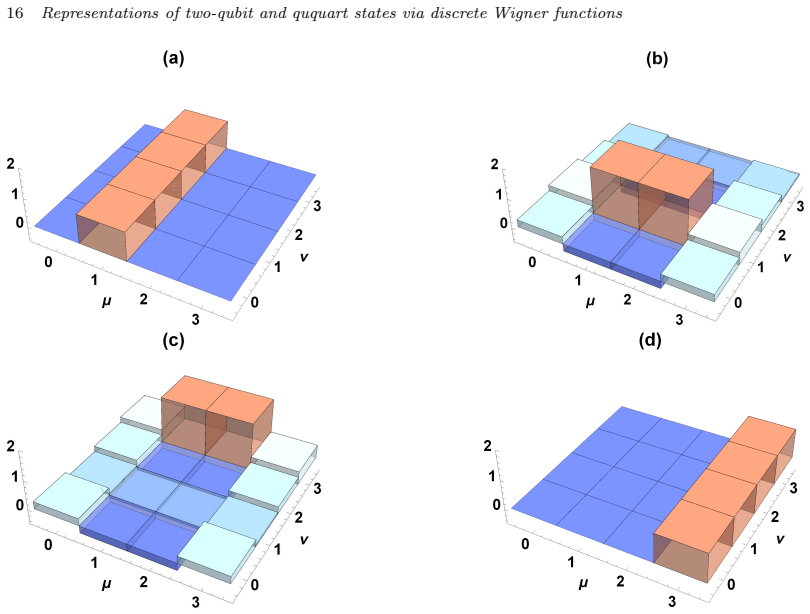
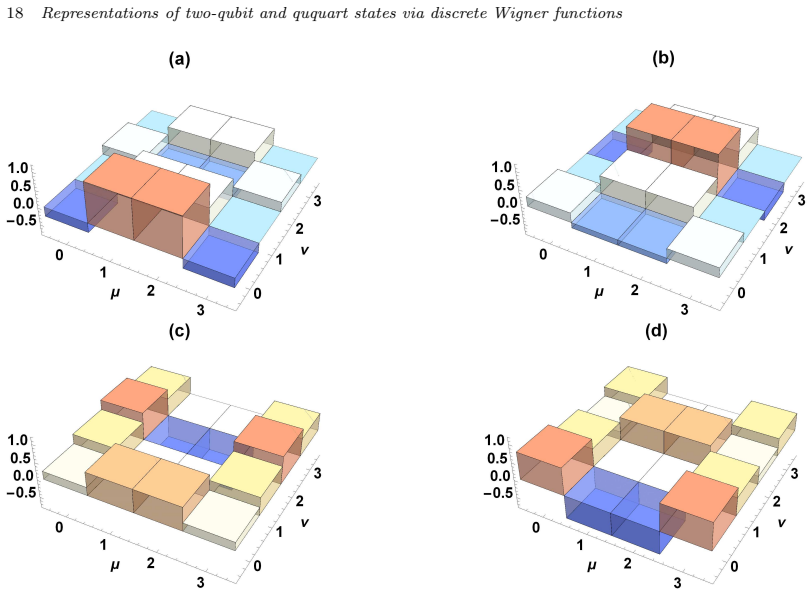
- The Bell and Werner states acquire compact closed-form discrete Wigner functions; for Bell states $\Delta$ takes only two values, $\pm\tfrac34$ or $\pm\tfrac14$, giving a crisp phase-space signature of maximal entanglement.
- Because $Q_X(\mu)$ depends only on diagonal density-matrix entries and $R_X(\nu)$ only on antidiagonal entries, $\Delta_X$ measures the phase-space weight carried by the coherence terms of an X-state.
- The same algebraic construction extends the framework to discrete Husimi and Glauber–Sudarshan functions, and the $\mathrm{SU}(4)$ overlap formula gives a Wigner-function route to the fidelity $\mathrm{Tr}[\hat\rho\hat\sigma]$.
Reading between the lines
- If $\Delta_X$ is read as a quantitative correlation witness, it needs calibration against known separability and discord criteria: the paper itself reports nonzero $\Delta_X$ for separable Werner states at $F=1/2$, so $\Delta_X$ is best read as a marker of general quantum correlations, not of entanglement alone.
- The same marginal-subtraction recipe could be applied to the $\mathrm{SU}(2)\otimes\mathrm{SU}(2)$ Wigner function itself or to higher-dimensional discrete Wigner functions, giving correlation markers for qutrit or ququart–ququart states once tomography data are available.
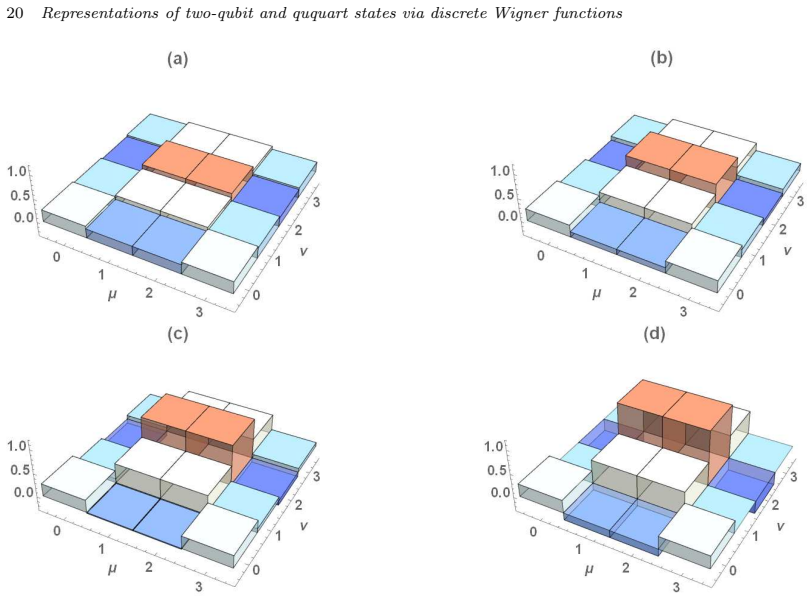
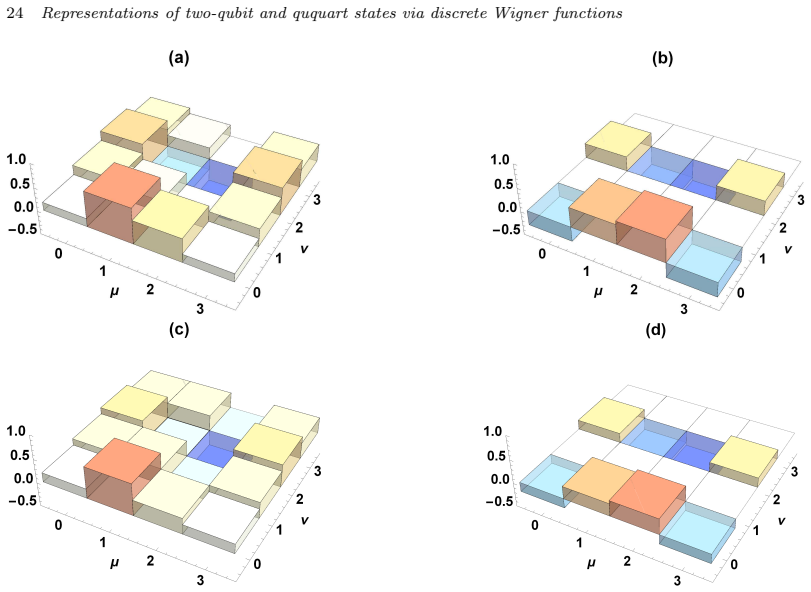
- The ordering of maximal $|\Delta_X|$ across Bell (0.65), Gisin (0.60), and Peres–Horodecki (0.46) states suggests $\Delta_X$ might serve as a qualitative ranking of correlation strength within the X-state family, which the paper does not yet formalize.
Signed reviews
Editorial analysis
A structured set of objections, weighed in public.
Referee Report
Summary. This manuscript constructs discrete Wigner functions for two-qubit and ququart states using a Schwinger-operator mapping to SU(N) generators, following the authors' companion paper [26]. It derives explicit formulas for the SU(2)⊗SU(2) Wigner function (Eq. 13 and 16) and the SU(4) Wigner function (Eq. 25), applies them to Bell and Werner states, and reproduces an NMR ququart experiment [11]. The central new claim, developed in Sections 4–5, is that for two-qubit X-states the quantity ΔX(μ,ν) = WX(μ,ν) − QX(μ)RX(ν), where QX and RX are marginal distributions, recognizes quantum correlations (Section 4, Table 5) and, in the concluding section, entanglement effects.
Significance. If the ΔX claim were correct, the paper would provide a simple, parameter-free phase-space indicator for correlations in X-states, complementing tomographic reconstruction techniques. The algebraic formulas are internally consistent, explicit, and directly usable; the expressions for Bell and Werner states and the ququart experiment are concrete and reproducible. However, the interpretive claim about ΔX is currently unsupported and is contradicted by a separable-state counterexample. The formalism itself is a legitimate contribution to the discrete phase-space literature, mainly because it provides explicit SU(2)⊗SU(2) and SU(4) Wigner functions, which are verified by spot checks and are of practical value for state visualization and fidelity computations (Eq. 42).
major comments (3)
- [Section 4, Table 5, and Section 5] The claim that ΔX recognizes quantum correlations, explicitly attributed to entanglement effects in Section 5, fails a separable-state control. For the X-state ρ = (|Φ+⟩⟨Φ+| + |Ψ+⟩⟨Ψ+|)/2, with ρ11 = ρ22 = ρ33 = ρ44 = 1/4 and ρ14 = ρ23 = 1/4, the partial transpose leaves the density matrix unchanged, so the state is PPT and, for two qubits, separable; the concurrence is 2 max(0, |ρ14| − √(ρ22ρ33), |ρ23| − √(ρ11ρ44)) = 0. Yet Table 5 gives ΔX(0,0) = −[√(2−√2)/2](1 + √2 ρ11) Re(ρ14 + ρ23) ≈ −0.26 ≠ 0. Nonzero ΔX therefore does not imply entanglement. If 'quantum correlations' is meant in a broader sense such as discord, that notion is not defined in the paper and no connection between ΔX and any discord measure is established. The authors should either prove a rigorous statement about what ΔX quantifies, restrict the claim accordingly, or provide control tests on a family of separable X-states.
- [Section 4, definition of ΔX] The product QX(μ)RX(ν) is asserted to represent the uncorrelated classical part of WX without derivation or justification. This assumption is load-bearing for the central claim. It is also false under the entanglement interpretation, as the counterexample above shows. The paper needs a formal definition of 'quantum correlations' in the discrete-phase-space context and a proof (or at least a demonstrated monotonic relation with a known correlation measure such as concurrence or discord) for the X-state family.
- [Section 3.2, Eq. (25)] Equation (25), the general SU(4) Wigner function, is the basis for Table 4 and all subsequent X-state formulas, but its derivation from Eq. (7) and the mapped generator expressions (A.4) is summarized only as 'promptly calculated' in Appendix A. Given that (A.4) contains numerous trigonometric factors, a more explicit derivation for at least the off-diagonal contributions would strengthen the paper and help readers verify the table entries. This is not a fatal flaw, but it is a load-bearing point that would benefit from expansion.
minor comments (5)
- [Throughout] There are several typographical errors: 'computacional basis' should be 'computational basis', 'M orever' should be 'Moreover', 'monitorate' should be 'monitor', 'genuinelly' should be 'genuinely', and 'Ressonance' should be 'Resonance'.
- [Section 2, Eq. (4)] The mod-N Kronecker delta δ[4] is used in Eq. (25) and footnote f of Appendix A but is not defined before its first use; please define δ[4] explicitly in Section 2.
- [Section 4, Table 5] The correspondence between the two-qubit matrix elements ρ and the ququart matrix elements ̺ is mentioned briefly, but readers would benefit from a direct restatement of the mapping for the X-state case (e.g., ̺11 = ρ11, ̺22 = ρ22, ̺33 = ρ33, ̺44 = ρ44, ̺14 = ρ14, ̺23 = ρ23).
- [Section 5, Eq. (39)] The state in Eq. (39) is called the 'Peres-Horodecki (PH)' state, but Peres-Horodecki's work refers to a separability criterion, not a family of states; the terminology is misleading and should be replaced with a reference to the Werner or X-state family.
- [Figures 1–4] The three-dimensional plots lack axis labels and numerical scales, which reduces their usefulness as quantitative illustrations; adding labels or color bars would improve clarity.
Circularity Check
No circularity: all Wigner-function expressions are derived explicitly from the mod(N)-invariant basis, and the ΔX indicator is a defined quantity rather than a fitted or self-referential prediction.
full rationale
The derivation chain is self-contained. The discrete Wigner function W(μ,ν)=Tr[Ĝ†(μ,ν)ρ] is defined in Eq. (6), and the SU(N) expression (7) follows from the mod(N)-invariant operator basis of Ref. [27]; the SU(4) function (25) is obtained by direct substitution of the mean values (A.3) and the mapped generators (A.4). No free parameter is fitted and no external dataset is used, so no fitted input is renamed as a prediction. The paper does lean on the authors' companion paper [26] for the Schwinger-operator mapping and on their earlier X-state universality theorem [24], but both are independent, parameter-free mathematical constructions with stated assumptions that do not include the present target results; citing them is therefore normal scientific support, not load-bearing circularity. The central interpretive step is the identification of ΔX(μ,ν)=WX(μ,ν)−QX(μ)RX(ν) with "quantum correlations" or "entanglement effects" (Sec. 4 and Sec. 5). This is a definitional functional, not a quantity obtained by fitting or by derivation from an entanglement measure. If a separable X-state yields nonzero ΔX, that would refute the interpretive claim as a matter of correctness, but it does not make the claim circular, because the paper never defines "quantum correlations" in terms of ΔX (which would make the statement tautological) nor reduces ΔX to a previously fitted target. Accordingly, no load-bearing step of the derivation is equivalent by construction to its own input.
Assumptions & free parameters
assumptions (4)
- domain assumption The mod(N)-invariant operator basis and the discrete Fourier transform relation to Schwinger unitary operators provide a complete orthonormal operator basis for SU(N) generators.
- domain assumption The computational-basis isomorphism between ququart states and two-qubit states preserves the discrete phase-space representation.
- ad hoc to paper The product of marginal distributions QX(μ)RX(ν) represents the uncorrelated part of the discrete Wigner function, so ΔX quantifies quantum correlations.
- standard math The generators of SU(4) used in Appendix A form a standard Gell-Mann-like basis with Tr[g_i g_j]=2δ_ij.
Cite this review
Pith. "Pith review of Representations of two-qubit and ququart states via discrete Wigner functions." pith.science (2026). https://pith.science/paper/4BIOUT6P
@misc{pith2026190802410,
  author       = {Pith},
  title        = {Pith review of: Representations of two-qubit and ququart states via discrete Wigner functions},
  year         = {2026},
  howpublished = {\url{https://pith.science/paper/4BIOUT6P}},
  note         = {Machine review of arXiv:1908.02410}
}
abstract
By means of a well-grounded mapping scheme linking Schwinger unitary operators and generators of the special unitary group $\mathrm{SU(N)}$, it is possible to establish a self-consistent theoretical framework for finite-dimensional discrete phase spaces which has the discrete $\mathrm{SU(N)}$ Wigner function as a legitimate by-product. In this paper, we apply these results with the aim of putting forth a detailed study on the discrete $\mathrm{SU(2)} \otimes \mathrm{SU(2)}$ and $\mathrm{SU(4)}$ Wigner functions, in straight connection with experiments involving, among other things, the tomographic reconstruction of density matrices related to the two-qubit and ququart states. Next, we establish a formal correspondence between both the descriptions that allows us to visualize the quantum correlation effects of these states in finite-dimensional discrete phase spaces. Moreover, we perform a theoretical investigation on the two-qubit X-states, which combines discrete Wigner functions and their respective marginal distributions in order to obtain a new function responsible for describing qualitatively the quantum correlation effects. To conclude, we also discuss possible extensions to the discrete Husimi and Glauber-Sudarshan distribution functions, as well as future applications on spin chains.
Figures
Figures from the paper (1 more)
Reference graph
Works this paper leans on
-
[26]
M. A. Marchiolli and D. Galetti (2019), On the discrete Wigner function for SU(N) , to appear in J. Phys. A: Math. Theor. https://doi.org/10.1088/1751-8121/ab3bab (arXiv: 1908.01096 [quant-ph])
work page Pith review arXiv 2019
- [11]
-
[1]
Einstein, B
A. Einstein, B. Podolsky, and N. Rosen (1935), Can Quantum-Mechanical Description of Physical Reality Be Considered Complete? , Phys. Rev., 47, pp. 777-780
1935
-
[2]
Schr¨ odinger (1935),Die gegenw¨ artige Situation in der Quantenmechanick, Naturwissenschaften, 23, pp
E. Schr¨ odinger (1935),Die gegenw¨ artige Situation in der Quantenmechanick, Naturwissenschaften, 23, pp. 807-812, 823-828, and also 844-849
1935
-
[3]
R. Horodecki, P. Horodecki, M. Horodecki, and K. Horodecki (2009), Quantum entanglement, Rev. Mod. Phys., 81, pp. 865-942
work page 2009
-
[4]
S. Perseguers, G. J. Lapeyre Jr, D. Cavalcanti, M. Lewenst ein, and A. Ac´ ın (2013),Distribution of entanglement in large-scale networks , Rep. Prog. Phys., 76, pp. 096001
work page 2013
- [5]
-
[6]
G. De Chiara and A. Sanpera (2018), Genuine quantum correlations in quantum many-body sys- tems: a review of recent progress , Rep. Prog. Phys., 81, pp. 074002
work page 2018
Show all 82 references
-
[7]
Li and C-F
J-L. Li and C-F. Qiao (2018), A Necessary and Sufficient Criterion for the Separability of Q uantum State, Sci. Rep., 8, pp. 1442
2018
-
[8]
Witten (2018), APS Medal for Exceptional Achievement in Research: Invited article on entan- glement properties of quantum field theory , Rev
E. Witten (2018), APS Medal for Exceptional Achievement in Research: Invited article on entan- glement properties of quantum field theory , Rev. Mod. Phys., 90, pp. 045003
2018
-
[9]
Nagali, D
E. Nagali, D. Giovannini, L. Marrucci, S. Slussarenko, E. Santamato, and F. Sciarrino (2010), Experimental Optimal Cloning of Four-Dimensional Quantum States of Photons , Phys. Rev. Lett., 105, pp. 073602
2010
-
[10]
Svetitsky, H
E. Svetitsky, H. Suchowski, R. Resh, Y. Shalibo, J. M. Mar tinis, and N. Katz (2014), Hidden two-qubit dynamics of a four-level Josephson circuit , Nat. Comm., 5, pp. 5617
2014
-
[12]
M. Kues, C. Reimer, P. Roztocki, L. R. Cort´ es, S. Sciara,B. Wetzel, Y. Zhang, A. Cino, S. T. Chu, B. E. Little, D. J. Moss, L. Casparini, J. Aza˜ na, and R. Morandotti (2017), On-chip generation of high-dimensional entangled quantum states and their coher ent control, Nature...
2017
-
[13]
X-M. Hu, Y. Guo, B-H. Liu, Y-F. Huang, C-F. Li, and G-C. Guo (2018), Beating the channel capacity limit for superdense coding with entangled ququar ts, Sci. Adv., 4, pp. eaat9304. Marchiolli and Galetti 27
2018
-
[14]
Micadei, J
K. Micadei, J. P. S. Peterson, A. M. Souza, R. S. Sarthour, I. S. Oliveira, G. T. Landi, T. B. Batalh˜ ao, R. M. Serra, and E. Lutz (2019), Reversing the direction of heat flow using quantum correlations, Nat. Comm., 10, pp. 2456
2019
-
[15]
Schneeloch, C
J. Schneeloch, C. C. Tison, M. L. Fanto, P. M. Alsing, and G . A. Howland (2019), Quantifying entanglement in a 68-billion-dimensional quantum state sp ace, Nat. Comm., 10, pp. 2785
2019
-
[16]
M. A. Nielsen and I. L. Chuang (2001), Quantum Computation and Quantum Information , Cam- bridge University Press (Cambridge)
2001
-
[17]
Vedral (2006), Introduction to Quantum Information Science , Oxford University Press (New York)
V. Vedral (2006), Introduction to Quantum Information Science , Oxford University Press (New York)
2006
-
[18]
M. B. Plenio and S. Virmani (2007), An introduction to entanglement measures , Quantum Inf. Comput., 7, pp. 001-051
2007
-
[19]
Bengtsson and K
I. Bengtsson and K. ˙Zyczkowski (2008), Geometry of Quantum States: An Introduction to Quantum Entanglement, Cambridge University Press (New York)
2008
-
[20]
S. M. Barnett (2009), Quantum Information , Oxford University Press (New York)
2009
-
[21]
Desurvire (2009), Classical and Quantum Information Theory: An Introduction for the Telecom Scientist, Cambridge University Press (Cambridge)
E. Desurvire (2009), Classical and Quantum Information Theory: An Introduction for the Telecom Scientist, Cambridge University Press (Cambridge)
2009
-
[22]
D. C. Marinescu and G. M. Marinescu (2012), Classical and Quantum Information , Academic Press (Oxford)
2012
-
[23]
M. M. Wilde (2013), Quantum Information Theory , Cambridge University Press (New York)
2013
-
[24]
P. E. M. F. de Mendon¸ ca, M. A. Marchiolli, and D. Galetti ( 2014), Entanglement universality of two-qubit X-states , Ann. Phys. (NY), 351, pp. 79-103
2014
-
[25]
P. E. M. F. de Mendon¸ ca, M. A. Marchiolli, and S. R. Hedema nn (2017), Maximally entangled mixed states for qubit-qutrit systems , Phys. Rev. A, 95, pp. 022324
2017
-
[27]
Galetti and A
D. Galetti and A. F. R. de Toledo Piza (1992), Discrete quantum phase spaces and the mod N invariance, Physica A, 186, pp. 513-523
1992
-
[28]
Galetti and M
D. Galetti and M. A. Marchiolli (1996), Discrete Coherent States and Probability Distributions in Finite-Dimensional Spaces, Ann. Phys., 249, pp. 454-480
1996
-
[29]
Aldrovandi and D
R. Aldrovandi and D. Galetti (1990), On the structure of quantum phase space , J. Math. Phys., 31, pp. 2987-2995
1990
-
[30]
Fano (1957), Description of States in Quantum Mechanics by Density Matri x and Operator Techniques, Rev
U. Fano (1957), Description of States in Quantum Mechanics by Density Matri x and Operator Techniques, Rev. Mod. Phys., 29, pp. 74-93
1957
-
[31]
Fano (1983), Pairs of two-level systems , Rev
U. Fano (1983), Pairs of two-level systems , Rev. Mod. Phys., 55, pp. 855-874
1983
-
[32]
R. F. Werner (1989), Quantum states with Einstein-Podolski-Rosen correlation s admitting a hidden-variable model, Phys. Rev. A, 40, pp. 4277-4281
1989
-
[33]
E. O. Kiktenko, A. K. Fedorov, O. V. Man’ko, and V. I. Man’ko (2015), Multilevel superconducting circuits as two-qubit systems: Operations, state preparat ion, and entropic inequalities , Phys. Rev. A, 91, pp. 042312
2015
-
[34]
Kimura (2003), The Bloch vector for N -level systems , Phys
G. Kimura (2003), The Bloch vector for N -level systems , Phys. Lett. A, 314, pp. 339-349
2003
-
[35]
M. S. Byrd and N. Khaneja (2003), Characterization of the positivity of the density matrix in terms of the coherence vector representation , Phys. Rev. A, 68, pp. 062322
2003
-
[36]
R. A. Horn and C. R. Johnson (2010), Matrix Analysis, Cambridge University Press (New York)
2010
-
[37]
Kraus (1983), States, Effects, and Operations: Fundamental Notions of Quan tum Theory, Lec- ture Notes in Physics 190, Springer-Verlag (Berlin)
K. Kraus (1983), States, Effects, and Operations: Fundamental Notions of Quan tum Theory, Lec- ture Notes in Physics 190, Springer-Verlag (Berlin)
1983
-
[38]
Peres (1996), Separability Criterion for Density Matrices , Phys
A. Peres (1996), Separability Criterion for Density Matrices , Phys. Rev. Lett., 77, pp. 1413-1415
1996
-
[39]
Horodecki, P
M. Horodecki, P. Horodecki, and R. Horodecki (1996), Separability of mixed states: necessary and sufficient conditions , Phys. Lett. A, 223, pp. 1-8
1996
-
[40]
Horodecki, P
M. Horodecki, P. W. Shor, and M. B. Ruskai (2003), Entanglement Breaking Channels, Rev. Math. Phys., 15, pp. 629-641
2003
-
[41]
M. B. Ruskai (2003), Qubit Entanglement Breaking Channels , Rev. Math. Phys., 15, pp. 643-662. 28 Representations of two-qubit and ququart states via discre te Wigner functions
2003
-
[42]
Jagadish and F
V. Jagadish and F. Petruccione (2018), An Invitation to Quantum Channels , Quanta, 7, pp. 54-67
2018
-
[43]
F. T. Hioe and J. H. Eberly (1981), N -Level Coherence Vector and Higher Conservation Laws in Quantum Optics and Quantum Mechanics , Phys. Rev. Lett., 47, pp. 838-841
1981
-
[44]
Pfeifer (2003), The Lie Algebras su(N): An introduction , Birkh¨ auser (Berlin)
W. Pfeifer (2003), The Lie Algebras su(N): An introduction , Birkh¨ auser (Berlin)
2003
-
[45]
Mahler and V
G. Mahler and V. A. Weberruss (1998), Quantum Networks: Dynamics of Open Nanostructures , Springer (Berlin)
1998
-
[46]
Alicki and K
R. Alicki and K. Lendi (1987), Quantum Dynamical Semigroups and Applications , Springer-Verlag (Berlin)
1987
-
[47]
Kimura and A
G. Kimura and A. Kossakowski (2005), The Bloch-Vector Space for N -Level Systems: the Spherical- Coordinate Point of View , Open Systems & Information Dynamics, 12, pp. 207-229
2005
-
[48]
Schwinger (2001), Quantum Mechanics: Symbolism of Atomic Measurements , Springer (Berlin)
J. Schwinger (2001), Quantum Mechanics: Symbolism of Atomic Measurements , Springer (Berlin)
2001
-
[49]
M. A. Marchiolli and P. E. M. F. Mendon¸ ca (2013), Theoretical formulation of finite-dimensional discrete phase spaces: II. On the uncertainty principle for Schwinger unitary operators, Ann. Phys., 336, pp. 76-97
2013
-
[50]
Tilma and K
T. Tilma and K. Nemoto (2012), SU (N )-symmetric quasi-probability distribution functions , J. Phys. A: Math. Theor., 45, pp. 015302
2012
-
[51]
Tilma, M
T. Tilma, M. J. Everitt, J. H. Samson, W. J. Munro, and K. Ne moto (2016), Wigner Functions for Arbitrary Quantum Systems , Phys. Rev. Lett., 117, pp. 180401
2016
-
[52]
G. Baio, D. Chru´ sci´ nski, P. Horodecki, A. Messina, andG. Sarbicki (2019), Bounds on the entan- glement of two-qutrit systems from fixed marginals , Phys. Rev. A, 99, pp. 062312
2019
-
[53]
E. F. Galv˜ ao (2005),Discrete Wigner functions and quantum computational speed up, Phys. Rev. A, 71, pp. 042302
2005
-
[54]
Ishizaka and T
S. Ishizaka and T. Hiroshima (2000), Local and nonlocal properties of Werner states , Phys. Rev. A, 62, pp. 044302
2000
-
[55]
Horodecki and P
M. Horodecki and P. Horodecki (1999), Reduction criterion of separability and limits for a class of distillation protocols , Phys. Rev. A, 59, pp. 4206-4216
1999
-
[56]
Ishizaka and T
S. Ishizaka and T. Hiroshima (2000), Maximally entangled mixed states under nonlocal unitary operations in two qubits , Phys. Rev. A, 62, pp. 022310
2000
-
[57]
Verstraete, K
F. Verstraete, K. Audenaert, and B. De Moor (2001), Maximally entangled mixed states of two qubits, Phys. Rev. A, 64, pp. 012316
2001
-
[58]
W. J. Munro, D. F. V. James, A. G. White, and P. G. Kwiat (2001), Maximizing the entanglement of two mixed qubtis , Phys. Rev. A, 64, pp. 030302
2001
-
[59]
T-C. Wei, K. Nemoto, P. M. Goldbart, P. G. Kwiat, W. J. Munr o, and F. Verstraete, Maximal entanglement versus entropy for mixed quantum states , Phys. Rev. A, 67, pp. 022110
-
[60]
Ishizaka (2003), Analytical formula connecting entangled states and the clo sest disentangled state, Phys
S. Ishizaka (2003), Analytical formula connecting entangled states and the clo sest disentangled state, Phys. Rev. A, 67, pp. 060301
2003
-
[61]
I. S. Oliveira, T. J. Bonagamba, R. S. Sarthour, J. C. C. Fr eitas, and E. R. de Azevedo (2007), NMR Quantum Information Processing , Elsevier (Amsterdan)
2007
-
[62]
M. A. Yurischev (2015), On the quantum discord of general X states , Quantum Inf. Process., 14, pp. 3399-3421
2015
-
[63]
Bartkiewicz, J
K. Bartkiewicz, J. Beron, K. Lemr, M. Norek, and A. Miranowicz (2015), Quantifying entanglement of a two-qubit system via measurable and invariant moments o f its partially transposed density matrix, Phys. Rev. A, 91, pp. 022323
2015
-
[64]
Nandi, C
S. Nandi, C. Datta, A. Das, and P. Agrawal (2018), Two-qubit mixed states and teleportation fidelity: purity, concurrence, and beyond , Eur. Phys. J. D, 72, pp. 182
2018
-
[65]
S. R. Hedemann (2018), Candidates for universal measures of multipartite entangl ement, Quant. Inf. Comp., 18, pp. 443-471
2018
-
[66]
S. R. Hedemann (2018), X states of same spectrum and entanglement as all two-qubit s tates, Quantum Inf. Process., 17, pp. 293
2018
-
[67]
M. A. Yurischev (2019), Phase diagram for the one-way quantum deficit of two-qubit X s tates, Quantum Inf. Process., 18, pp. 124
2019
-
[68]
Yu and J
T. Yu and J. H. Eberly (2007), Evolution from entanglement to decoherence , Quantum Inf. Com- Marchiolli and Galetti 29 put., 7, pp. 459-468
2007
-
[69]
J. Wang, H. Batelaan, J. Podany, and A. F. Starace (2006),Entanglement evolution in the presence of decoherence, J. Phys. B: At. Mol. Opt. Phys., 39, pp. 4343-4353
2006
-
[70]
M. A. Yurischev (2017), Extremal properties of conditional entropy and quantum dis cord for XXZ, symmetric quantum states , Quantum Inf. Process., 16, pp. 249
2017
-
[71]
Park (2019), Thermal entanglement and thermal discord in two-qubit Heis enberg XYZ chain with Dzyaloshinskii-Moriya interactions , Quantum Inf
D. Park (2019), Thermal entanglement and thermal discord in two-qubit Heis enberg XYZ chain with Dzyaloshinskii-Moriya interactions , Quantum Inf. Process., 18, pp. 172
2019
-
[72]
W. J. Munro, D. F. V. James, A. G. White, and P. G. Kwiat (2001), Maximizing the entanglement of two mixed qubits , Phys. Rev. A, 64, pp. 030302
2001
-
[73]
Gisin (1996), Hidden quantum nonlocality revealed by local filters , Phys
N. Gisin (1996), Hidden quantum nonlocality revealed by local filters , Phys. Lett. A, 210, pp. 151-156
1996
-
[74]
Braga, S
H. Braga, S. Souza, and S. S. Mizrahi (2010), Geometrical meaning of two-qubit entanglement and its symmetries , Phys. Rev. A, 81, pp. 042310
2010
-
[75]
Giscard and C
P-L. Giscard and C. Bonhomme (2019), General solutions for quantum dynamical systems driven by time-varying Hamiltonians: applications to NMR , arXiv: 1905.04024 [quant-ph]
2019 arXiv
-
[76]
Boette and R
A. Boette and R. Rossignoli (2018), History states of systems and operators , Phys. Rev. A, 98, pp. 032108
2018
-
[77]
Liang, Y-H
Y-C. Liang, Y-H. Yeh, P. E. M. F. Mendon¸ ca, R. Y. Teh, M. D. Reid, and P. D. Drummond (2019), Quantum fidelity measures for mixed states , Rep. Prog. Phys., 82, pp. 076001
2019
-
[78]
P. E. M. F. Mendon¸ ca, R. D. J. Napolitano, M. A. Marchiolli, C. J. Foster, and Y-C. Liang (2008), Alternative fidelity measure between quantum states , Phys. Rev. A, 78, pp. 052330
2008
-
[79]
J. A. Miszczak, Z. Pucha/suppress la, P. Horodecki, A. Uhlmann, and K. Zyczkowski (2009), Sub- and super-fidelity as bounds for quantum fidelity , Quantum Inf. Comput., 9, pp. 103-130
2009
-
[80]
Ruzzi, M
M. Ruzzi, M. A. Marchiolli, and D. Galetti (2005), Extended Cahill-Glauber formalism for finite- dimensional spaces: I. Fundamentals , J. Phys. A: Math. Gen., 38, pp. 6239-6251
2005
-
[81]
M. A. Marchiolli, M. Ruzzi, and D. Galetti (2005), Extended Cahill-Glauber formalism for finite- dimensional spaces. II. Applications in quantum tomograph y and quantum teleportation , Phys. Rev. A, 72, pp. 042308
2005
-
[82]
K-C. Ha, K. H. Han, and S-H. Kye (2019), Separability of multi-qubit states in terms of diagonal and anti-diagonal entries , Quantum Inf. Process., 18, pp. 34. Appendix A The mathematical prescription adopted to obtain the generators of SU(4) basically follows that outlined in...
2019
Reviewed August 14, 2026 · model on record in the stance chip above.
Discussion (0). Continue with ORCID to comment.