REVIEW 4 major objections 4 minor 1 cited by
Integrable multi-component difference systems of equations
T0 review · 4 major / 4 minor · reviewed 2026-08-14 · deepseek-v4-flash
Pith's one-line read The paper claims that every member of two new lists of bond-variable difference systems is integrable — multi-dimensionally compatible and equipped with a Lax pair — even without the potentiality constraints that tie them to vertex…
desk verdict A promising construction of integrable bond systems, with one fully worked example, but the general lists rely on unverified assertions and contain typos that currently block the central claim. read the letter →
The pith
A machine-rendered reading of the paper's core claim, the machinery that carries it, and where it could break.
The reading
What carries the argument
The central object is the bond-variable reformulation: each quad-equation is rewritten in the form (7), where the shifted bond variables are obtained from the unshifted ones by a projective (fractional-linear) action, as in (8). This form lets one read off a Lax matrix $L(u,s;p,\lambda)$ whose determinant factors through a gauge function $A$. The load-bearing mechanism is multi-dimensional compatibility: the system is consistent when extended to any finite number of lattice directions, and this consistency is exactly the zero-curvature equation (29), the discrete analogue of a Lax pair. The same compatibility ensures that the companion maps defined by the systems satisfy the Yang-Baxter relation, connecting the bond systems to set-theoretical solutions of the Yang-Baxter equation.
What would settle it
Substitute the Table 1 Lax matrix for mQ1δ into the zero-curvature equation (29), expand the entries in powers of the spectral parameter λ, and require every coefficient to vanish; any nonzero remainder would refute Proposition 5.2. Alternatively, for n=3, compute the two routes to $X^1_{23}$ and $Y^1_{23}$ from generic initial data and test equality, since Proposition 4.1 asserts this compatibility without displaying the calculation.
Extended reading notes
Core claim
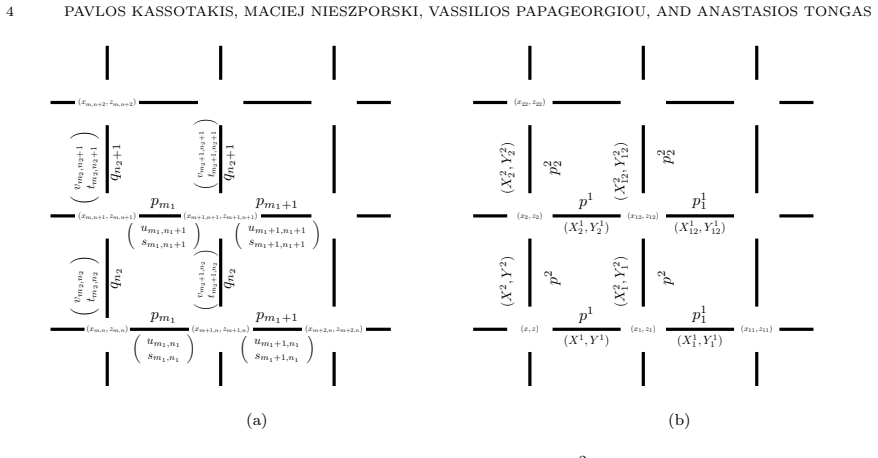
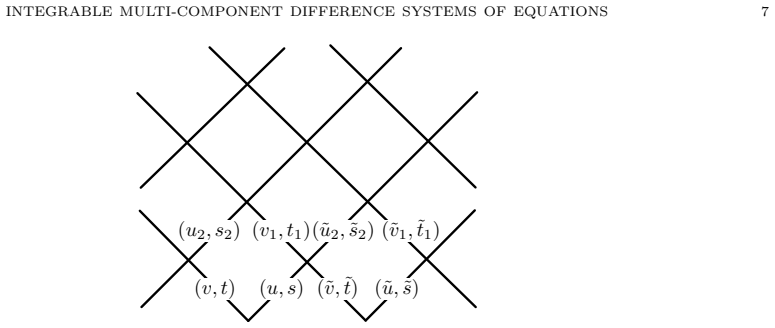
Propositions 4.1 and 4.4 display two lists of difference systems in bond variables, each with seven members (mQ4, mQ3δ, mQ1δ, mA2, mA1δ, mH3δ, mH1 and aQ3δ, aQ2, aQ1δ, aA1δ, aH3δ, aH2, aH1), with the common structure $X^i_j=f_i(\dots)$, $Y^i_j=g_i(\dots)$ for $i\ne j$. For every member, the paper asserts three properties: a pair of alternating invariants listed in Tables 3 and 4; an equivalence between the constraint $X^iY^j-X^jY^i=0$ (or its additive analogue) and the same constraint on shifted variables; and multi-dimensional compatibility, i.e. $X^i_{jk}=X^i_{kj}$ and $Y^i_{jk}=Y^i_{kj}$ for distinct directions $i,j,k$, which is exactly what allows the system to be embedded in $n$ dimensions. The compatibility is equivalent to a discrete zero-curvature equation $L(u_2,s_2;p,\lambda)L(v,t;q,\lambda)=L(v_1,t_1;q,\lambda)L(u,s;p,\lambda)$ for the 4×4 Lax matrices of Tables 1 and 2, and it makes the companion maps of Appendices A and B quadrirational (birational, with birational restrictions to coordinate planes) Yang-Baxter maps. Imposing the constraints, each list reduces to the corresponding member of the standard quad-equation list, including mQ4, which recovers the discrete Krichever-Novikov equation.
Load-bearing premise
The load-bearing premise is that the displayed Lax matrices satisfy the zero-curvature equation and that the asserted multi-dimensional compatibility identities hold for every member of both lists; the paper states these without showing the computations, and one displayed formula (mA2) is visibly corrupted.
Editorial extensions
If this is right
- Every member of the m-list and a-list is an integrable system in its own right, independent of any vertex potential; the standard quad-equations are recovered as special reductions when the consistency constraints are imposed.
- Each system carries a zero-curvature Lax representation, so the usual integrable-system machinery associated with Lax pairs applies at the bond-variable level.
- The companion maps of the bond systems form 14 families of quadrirational, non-involutive Yang-Baxter maps, giving set-theoretical solutions of the Yang-Baxter equation.
- Vertex systems derived from several members are point equivalent to three two-component lattices (double-H1, double-H2, and the double-H3-type lattice), and their non-potential forms include coupled discrete sine-Gordon and coupled Hirota-KdV equations.
- The double-H vertex systems act as auto- or non-auto Bäcklund transformations for new 5-point lattice equations, and under the reduction $h=g$ the non-potential forms reduce to known scalar equations.
Reading between the lines
- Because the compatibility statements in Propositions 4.1 and 4.4 are asserted without displayed calculations, a first testable step is symbolic verification for n=3; if the identities hold, one could probe the two gaps (Q2 and H2 in the m-list; Q4 and A2 in the a-list) with alternative bond-variable pairings or higher-order potentials.
- The Lax matrices in Tables 1 and 2 depend on a single spectral parameter; treating them as Lax operators for lattice hierarchies could connect the bond systems to known continuous integrable equations through continuum limits, a direction the paper does not explore.
- The generation of 5-point stencils from the double-H systems suggests the projective-form recipe is a generative scheme: applying it to other consistent-around-the-cube equations might yield further integrable stencils or higher-component vertex systems.
Signed reviews
Editorial analysis
A structured set of objections, weighed in public.
Referee Report
Summary. The paper introduces a procedure for rewriting ABS quad-equations as four-component systems of difference equations on the edges of a Z^2 lattice, using multiplicative bond variables (the m-list) and additive bond variables (the a-list). For each list, the authors claim that the systems are multi-dimensionally compatible even before imposing the potentiality constraints (16) or (20), that this compatibility yields Lax pairs by the zero-curvature equation (29), and that the associated companion maps are quadrirational Yang-Baxter maps. The motivating example mH1 is worked out in detail with explicit compatibility formulae, invariants, measure preservation, and a vertex-system reduction. For the remaining members of the two lists, the compatibility, Lax matrices, and Yang-Baxter properties are stated in Propositions 4.1, 4.4, 5.2, and 5.3 and the appendices without detailed verification. The paper also derives reductions to known quad-equations, including Q4 and H2, and obtains two-component vertex systems, non-potential forms, and 5-point equations for the H-type members.
Significance. If the central claims are correct, this is a substantial contribution to the theory of integrable difference systems. It gives a uniform bond-variable formulation for the ABS list, shows that the unconstrained systems, not just the constrained reductions, are integrable, and connects each system to an explicit Lax matrix and a Yang-Baxter map. The motivating case mH1 is handled convincingly: Proposition 3.1 provides explicit multi-dimensional compatibility formulae, a Lax matrix, and invariant identities, and Proposition 3.2 gives measure preservation and Poisson structure. The reductions in Section 4.3 are plausible and, for the most part, directly checkable. The paper does not, however, ship machine-checked proofs or a reproducible computation, and the list-wide compatibility and zero-curvature assertions are not demonstrated in the text. Given the algebraic complexity and the typographical corruption in two of the displayed systems, the verification burden is on the authors. The paper is therefore promising but not yet in a checkable state.
major comments (4)
- [Section 4.1, Eq. (18) and Proposition 4.1 (mQ4)] The displayed mQ4 system in Proposition 4.1 does not match the derivation in Section 4.1. Equation (18) gives, in the notation u=X^1, v=X^2, s=Y^1, t=Y^2, the denominator a(1-pqsv)+qs-pt for X^1_2, which reads a(1-p_i p_j Y_i X_j)+p_j Y_i-p_i Y_j in the notation of Proposition 4.1. The printed formula in Proposition 4.1 instead has a(1-p_i p_j X_j Y_j)+p_j Y_i-p_i Y_j. The two denominators differ by swapping the roles of X_j and Y_i and are not identically equal. Since the Lax matrix in Table 1 and the Yang-Baxter map in Appendix A are claimed to satisfy the zero-curvature equation with this system, this discrepancy must be resolved before the mQ4 integrability claim can be checked.
- [Proposition 4.1 (mA2)] The mA2 entry in Proposition 4.1 is not syntactically well-formed. The denominator of X_i^j ends with 'pi(Yj - pi Xj Yi,' containing an unmatched parenthesis and a trailing comma, and the intended expression is not recoverable from the surrounding text. The corresponding numerator or denominator of Y_i^j also appears ambiguous in its placement of X_j. Because mA2 is one of the fourteen systems claimed to be integrable, this is not merely a typographical nuisance: the equation itself, and hence its Lax matrix and Yang-Baxter map, cannot be checked as printed.
- [Propositions 4.1(3) and 4.4(3)] The multi-dimensional compatibility assertions Xi_jk=Xi_kj and Yi_jk=Yi_kj are stated for all members of the m-list and the a-list, but no proof or computation is supplied for any system other than mH1. For mH1, explicit formulae are given in the proof of Proposition 3.1; for the remaining thirteen systems, the reader is asked to accept the equalities without a derivation, a reference, or a reproducible check. Since the unconstrained compatibility is the central integrability claim of the paper, this is a load-bearing gap. The paper needs either compact proofs, a reference to an independent verification, or a symbolic computation that can be checked by the reader.
- [Section 5, Propositions 5.2 and 5.3, Tables 1 and 2] Propositions 5.2 and 5.3 list Lax matrices for all members of both lists but do not verify that any of them satisfies the zero-curvature equation (29) from Definition 5.1. For mH1 the verification is contained in Proposition 3.1(4); for the other systems the identity L(u2,s2;p,lambda)L(v,t;q,lambda)=L(v1,t1;q,lambda)L(u,s;p,lambda) is simply asserted. Given the algebraic complexity of the matrices and the misprints in the defining systems, these checks cannot be taken for granted. The authors should provide either a concise verification or a reproducible computation, especially in view of the mQ4 and mA2 transcription problems.
minor comments (4)
- [Proof of Proposition 4.9] The sentence 'The relations (26) guarantee the existence of a potential function x' in the proof of Proposition 4.9 refers to a non-existent equation number; it should refer to the invariant conditions (24) just established.
- [Section 7, first open question] The first open question mentions 'Liouville integrability as it was indicated in Proposition 4.4, for the motivating example.' The motivating example's Liouville integrability is proved in Proposition 3.2, not Proposition 4.4; the cross-reference should be corrected.
- [Tables 3 and 4] The invariant tables would benefit from a sentence explaining how the quantities A, B, and Pi are defined before they are used; in Table 4, Pi is introduced in the displayed line for aQ3delta after it appears in J, and a reader must work backwards to locate its definition.
- [Proposition 3.1(4)] The proof of Proposition 3.1(4) is only a sketch referencing [36, 9, 41] and the reduction of the system to the projective form (7)-(8). Since this is the Lax proof for the motivating example, a few more details showing that the zero-curvature equation follows from the displayed M and L matrices would make the example self-contained.
Circularity Check
No circularity: the unconstrained bond systems are new explicit objects; the integrability claims rest on unproved compatibility and Lax identities, not on fitting or self-citation.
full rationale
The paper's central construction rewrites ABS quad-equations in bond variables using relations (16)/(20), but the load-bearing claims (multi-dimensional compatibility of the unconstrained systems, and the Lax matrices in Tables 1 and 2) are stated as independent assertions: Xi_jk = Xi_kj is not assumed in the rewriting, and Eq. (29) is an explicit zero-curvature identity that could be checked for each listed matrix. No fitted parameter is renamed as a prediction; the reductions in Propositions 4.9/4.10 are reverse consistency checks, not inputs. Self-citations appear only for terminology and historical context ([19,25,24,28,27], [40]) and are not load-bearing; the cited Lax-matrix mechanism [9,41,36] is external. There are serious verification gaps: Propositions 4.1(3), 4.4(3), 5.2 and 5.3 assert compatibility/Lax identities without computation, and the displayed mQ4 denominator in Proposition 4.1 disagrees with Eq. (18) (p_i p_j X_j Y_j vs p_i p_j Y_i X_j), while mA2 is corrupted with an unmatched parenthesis. These are correctness/checkability problems, not circular reductions.
Assumptions & free parameters
assumptions (3)
- standard math Multi-dimensional consistency (CAC-like property) implies existence of Lax pairs and Yang-Baxter maps, as developed in [3], [9], and [41].
- domain assumption The bond systems and their reductions are considered over C with all denominators assumed non-vanishing on the relevant solution domains.
- domain assumption The point transformations in Remarks 4.2 and 4.5 are invertible on the relevant sets, establishing point equivalence of mQ1δ with mA1δ and of mA2 with mQ3δ.
Cite this review
Pith. "Pith review of Integrable multi-component difference systems of equations." pith.science (2026). https://pith.science/paper/ZEF3DBWG
@misc{pith2026190802413,
  author       = {Pith},
  title        = {Pith review of: Integrable multi-component difference systems of equations},
  year         = {2026},
  howpublished = {\url{https://pith.science/paper/ZEF3DBWG}},
  note         = {Machine review of arXiv:1908.02413}
}
abstract
We present two lists of multi-component systems of integrable difference equations defined on the edges of a $\mathbb{Z}^2$ graph. The integrability of these systems is manifested by their Lax formulation which is a consequence of the multi-dimensional compatibility of these systems. Imposing constraints consistent with the systems of difference equations, we recover known integrable quad-equations including the discrete version of the Krichever-Novikov equation. The systems of difference equations allow us for a straightforward reformulation as Yang-Baxter maps. Certain two-component systems of equation defined on the vertices of a $\mathbb{Z}^2$ lattice, their non-potential form and integrable equations defined on 5-point stencils, are also obtained.
Figures
Forward citations
Cited by 1 Pith paper
-
Tetrahedron maps and symmetries of three dimensional integrable discrete equations
A symmetry-invariant method for 3D lattice equations produces tetrahedron maps, including new vector, non-commutative, and entwining examples.
Reference graph
Works this paper leans on
-
[39]
Yang-Baxter maps associated to elliptic curves
V.G. Papageorgiou and A.G. Tongas. Yang-Baxter maps associated to elliptic curves. arXiv:0906.3258, 2009
work page Pith review arXiv 2009
-
[1]
V.E. Adler. B¨ acklund transformation for the Krichever-Novikov equation.Intern. Math. Research Notices , 1:1–4, 1998
work page 1998
-
[2]
V.E. Adler, A.I. Bobenko, and Yu.B. Suris. Classification of integrable equations on quad-graphs. The consistency ap- proach. Comm. Math. Phys. , 233(3):513–543, 2003
work page 2003
-
[3]
V.E. Adler, A.I. Bobenko, and Yu.B. Suris. Geometry of Yang-Baxter maps: pencils of conics and quadrirational map- pings. Comm. Anal. Geom. , 12(5):967–1007, 2004
work page 2004
-
[4]
Idempotent biquadratics, Yang-Baxter maps and birational representations of Coxeter groups
J. Atkinson. Idempotent biquadratics, Yang-Baxter maps and birational representations of Coxeter groups. arXiv:1301.4613 [nlin.SI] , 2013
work page Pith review arXiv 2013
-
[5]
J. Atkinson and M. Nieszporski. Multi-quadratic quad equations: integrable cases from a factorised-discriminant hypoth- esis. Int. Math. Res. Not. , 2220(15):4215–4240, 2013
work page 2013
-
[6]
Quadrirational Yang-Baxter maps and the elliptic Cremona system
J. Atkinson and Y. Yamada. Quadrirational Yang-Baxter maps and the elliptic Cremona system. arXiv:nlin/1804.01794, 2018. 22 PAVLOS KASSOTAKIS, MACIEJ NIESZPORSKI, VASSILIOS PAPAGEORGIOU, AND ANASTASIOS TONGAS
work page Pith review arXiv 2018
-
[7]
V.V. Bazhanov and S.M. Sergeev. Yang–Baxter maps, discrete integrable equations and quantum groups.Nuclear Physics B, 926:509 – 543, 2018
work page 2018
Show all 42 references
-
[8]
Bobenko, N
A. Bobenko, N. Kutz, and U. Pinkall. The discrete quantum pendulum. Phys. Lett. A , 177(6):399 – 404, 1993
1993
-
[9]
A. I. Bobenko and Yu. B. Suris. Integrable noncommutative equations on quad-graphs. the consistency approach. Lett. Math. Phys. , 61(3):241–254, 2002
2002
-
[10]
Bridgman, W
T. Bridgman, W. Hereman, G. R. W. Quispel, and P. H. van der Kamp. Symbolic computation of Lax pairs of partial difference equations using consistency around the cube.Foundations of Computational Mathematics , 13(4):517–544, 2013
2013
-
[11]
Caudrelier, N
V. Caudrelier, N. Cramp´ e, and Q.C Zhang. Set-theoretical reflection equation: classification of reflection maps. J. Phy. A: Math. Theor. , 46(9):095203, 2013
2013
-
[12]
Dimakis and F
A. Dimakis and F. M¨ uller-Hoissen. Matrix Kadomtsev-Petviashvili equation: Tropical limit, Yang-Baxter and pentagon maps. Theoret. and Math. Phys. , 196(2):1164–1173, 2018
2018
-
[13]
Dimakis and F
A. Dimakis and F. M¨ uller-Hoissen. Matrix KP: tropical limit and Yang-Baxter maps. Lett. Math. Phys. , 2018
2018
-
[14]
P. Etingof. Geometric crystals and set-theoretical solutions to the quantum Yang-Baxter equation. Commun. Algebra , 31(4):1961–1973, 2003
1961
-
[15]
Field, F.W
C.M. Field, F.W. Nijhoff, and H.W. Capel. Exact solutions of quantum mappings from the lattice KdV as multi- dimensional operator difference equations. J. Phys. A: Math. Gen. , 38(43):9503–9527, 2005
2005
-
[16]
Fordy and P.G
A.P. Fordy and P.G. Kassotakis. Integrable maps which preserve functions with symmetries. J. Phys. A: Math. Theor. , 46:205201, 2013
2013
-
[17]
G. G. Grahovski, S. Konstantinou-Rizos, and A. V. Mikhailov. Grassmann extensions of Yang-Baxter maps. J. Phys. A: Math. Theor., 49(14):145202, 2016
2016
-
[18]
Hietarinta
J. Hietarinta. Searching for CAC-maps. J. Nonlinear Math. Phys , 12(sup2):223–230, 2005
2005
-
[19]
Hietarinta and C
J. Hietarinta and C. Viallet. Integrable lattice equations with vertex and bond variables. J. Phys. A: Math. Theor. , 44:13pp, 2011
2011
-
[20]
Joshi and F.W
N Hietarinta, J. Joshi and F.W. Nijhoff. Discrete Systems and Integrablity . Cambridge Texts in Applied Mathematics (No. 54). Cambridge University Press, 2016
2016
-
[21]
R. Hirota. Nonlinear partial difference equation I: A difference analogue of the KdV equation. J. Phys. Soc. Jp. , 43:1429– 1433, 1977
1977
-
[22]
R. Hirota. Nonlinear partial difference equations III: Discrete sine-Gordon equation. J. Phys. Soc. Jpn. , 43:2079–2086, 1977
1977
-
[23]
Invariants in separated variables: Yang-Baxter, entwining and transfer maps
P Kassotakis. Invariants in separated variables: Yang-Baxter, entwining and transfer maps. SIGMA, 15(048):36pp, 2019
2019
-
[24]
Kassotakis and M
P. Kassotakis and M. Nieszporski. Families of integrable equations. SIGMA, 7:100, 2011
2011
-
[25]
Kassotakis and M
P. Kassotakis and M. Nieszporski. On non-multiaffine consistent-around-the-cube lattice equations. Phys. Lett. A , 376(45):3135–3140, 2012. arXiv:1106.0435
2012 arXiv
-
[26]
Kassotakis and M
P. Kassotakis and M. Nieszporski. 2 n−rational maps. J. Phys. A: Math. Theor. , 50(21):21LT01, 2017
2017
-
[27]
Kassotakis and M
P. Kassotakis and M. Nieszporski. Difference systems in bond and face variables and non-potential versions of discrete integrable systems. J. Phys. A: Math. Theor. , 51(38):385203, 2018
2018
-
[28]
Kassotakis and M
P. Kassotakis and M. Nieszporski. Systems of difference equations on a vector valued function that admit 3d vector space of scalar potentials. 2019
2019
-
[29]
Konstantinou-Rizos
S. Konstantinou-Rizos. On the 3D consistency of a Grassmann extended lattice Boussinesq system. arXiv:1908.00565 [nlin.SI], 2019
1908 arXiv
-
[30]
Konstantinou-Rizos and A.V
S. Konstantinou-Rizos and A.V. Mikhailov. Darboux transformations, finite reduction groups and related Yang-Baxter maps. J. Phys. A: Math. Theor. , 46(42):425201, 2013
2013
-
[31]
Konstantinou-Rizos and G
S. Konstantinou-Rizos and G. Papamikos. Entwining Yang-Baxter maps related to NLS type equations.arXiv:1907.00019 [nlin.SI], 2019
1907 arXiv
-
[32]
T. E. Kouloukas. Relativistic collisions as Yang-Baxter maps. Phys. Lett. A , 381(40):3445–3449, 2017
2017
-
[33]
Kouloukas and V.G
T.E. Kouloukas and V.G. Papageorgiou. Entwining Yang-Baxter maps and integrable lattices. Banach Center Publ. , 93:163–175, 2011
2011
-
[34]
Kouloukas and V.G Papageorgiou
T.E. Kouloukas and V.G Papageorgiou. 3d compatible ternary systems and Yang–Baxter maps.J. Phys. A: Math. Theor. , 45(34):345204, 2012
2012
-
[35]
A. V. Mikhailov, G. Papamikos, and J. P. Wang. Darboux transformation for the vector sine-Gordon equation and integrable equations on a sphere. Lett. Math. Phys. , 106(7):973–996, 2016
2016
-
[36]
F.W. Nijhoff. Lax pair for the Adler (lattice Krichever-Novikov)system. Phys. Lett. A , 297:49–58, 2002
2002
-
[37]
Nijhoff and A.J
F.W. Nijhoff and A.J. Walker. The discrete and continuous Painlev´ e VI hierarchy and the Garnier systems. Glasgow Math. J. , 43A:109–123, 2001
2001
-
[38]
Papageorgiou and A.G
V.G. Papageorgiou and A.G. Tongas. Yang–Baxter maps and multi-field integrable lattice equations. J. Phys. A: Math. Theor., 40(42):12677–12690, 2007
2007
-
[40]
Papageorgiou, A.G
V.G. Papageorgiou, A.G. Tongas, and A.P. Veselov. Yang-Baxter maps and symmetries of integrable equations on quad- graphs. J. Math. Phys. , 47:Art. no. 083502, 2006
2006
-
[41]
Yu. B. Suris and A.P. Veselov. Lax matrices for Yang-Baxter maps. J. Nonlin. Math. Phys , 10(2):223–230, 2003
2003
-
[42]
A. Yu. Volkov and L. D. Faddeev. Quantum inverse scattering method on a spacetime lattice. Theor. Math. Phys. , 92(2):837–842, 1992. INTEGRABLE MULTI-COMPONENT DIFFERENCE SYSTEMS OF EQUATIONS 23 Department of Mathematics and Statistics, University of Cyprus, P.O Box: 20537, 16...
1992
Reviewed August 14, 2026 · model on record in the stance chip above.
Discussion (0). Continue with ORCID to comment.