REVIEW 3 major objections 5 minor 39 references
Improved Adversarial Robustness by Reducing Open Space Risk via Tent Activations
T0 review · 3 major / 5 minor · reviewed 2026-08-14 · deepseek-v4-flash
Pith's one-line read Replacing monotonic activations with bounded tent activations makes classifiers robust to six white-box attacks, beating PGD adversarial training on both MNIST and CIFAR-10.
desk verdict The tent activation is a clean idea, but the reported robustness numbers almost certainly owe as much to zero-gradient saturation as to any real boundary robustness. read the letter →
The pith
A machine-rendered reading of the paper's core claim, the machinery that carries it, and where it could break.
The reading
What carries the argument
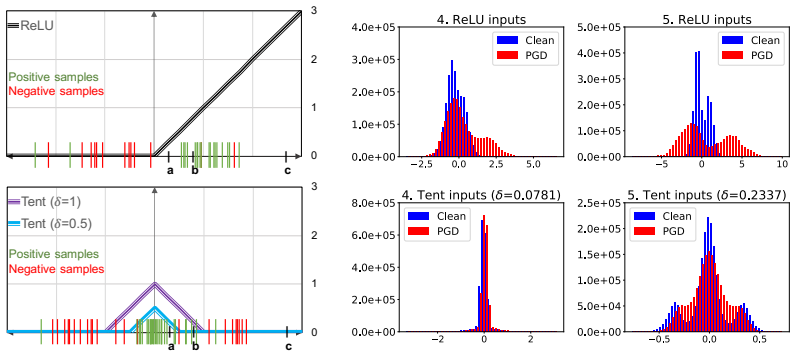
The load-bearing object is the tent activation function $f(x;\delta)=\max(0,\delta-|x|)$, a learnable bump that is zero outside $[-\delta,\delta]$, reaches height $\delta$ at the origin, and has derivative $-\operatorname{sgn}(x)$ inside the interval and zero outside. A normalized tent $\hat{f}(x;\delta)=f(x;\delta)/\delta^2$ acts as a compact probability abating model in the open-set recognition sense, which is what makes its open set risk finite; Theorem 1 of the paper shows no monotonic activation can be bounded this way. In the trained networks, every ReLU is replaced by batch normalization plus a tent, with tents shared across channels, initialized at $\delta=1$, and squeezed by weight decay so that adversarial perturbations pushing activation inputs beyond the tent produce zero output instead of larger responses.
What would settle it
Train the same architecture with a bounded activation that is nonzero across the same interval but has no flat zero-gradient region, such as a smoothed tent, and attack it with the same PGD and Carlini-Wagner budgets; if accuracy collapses relative to the hard tent, the flat tails, not the bounded output, carried the defense.
Extended reading notes
Core claim
The paper's central claim is that replacing monotonic activation functions with tent activations yields significantly improved adversarial robustness compared to the state of the art. It proves that every standard monotonic activation function acts as a weak classifier with unbounded open space risk, then shows that the tent activation $f(x;\delta)=\max(0,\delta-|x|)$ has bounded open space risk. Replacing each ReLU with a tent fed by batch normalization and trained with weight decay on the learnable width $\delta$ produces classifiers whose average accuracy across six white-box attacks reaches 91.8% on MNIST and 73.5% on CIFAR-10, versus 76.8% and 41.8% for PGD adversarial training. The paper presents this as support for its hypothesis that open space risk is a major contributing factor to the success of adversarial attacks.
Load-bearing premise
The explanation assumes that adversarial attacks succeed chiefly because monotonic activations can be pushed to arbitrarily large responses, so capping the response is what makes networks robust; if the accuracy gains actually come from the zero gradients on the tent's flat tails, the explanatory claim would be unsupported even with the accuracy numbers intact.
Editorial extensions
If this is right
- Adversarial robustness can be improved at no extra training cost: tents replace ReLUs without the extra forward and backward passes that PGD adversarial training requires.
- Robustness is more even across attack types: tent classifiers are strong against DeepFool and the Carlini-Wagner attacks, the two families where PGD adversarial training is weakest.
- The trade-off between clean accuracy and adversarial accuracy is gentler on smaller models, as the narrow WRN-28-1 keeps near-82% clean accuracy with tents while adversarial training drops it below 74%.
- The learned tent widths $\delta$ act as a robustness dial: shrinking them with weight decay improves adversarial accuracy until the tents become too small and clean accuracy falls.
Reading between the lines
- The paper does not test combining tents with adversarial training; since tents cap activation output and adversarial training augments the input distribution, the two defenses target different failure modes and may stack, a testable extension.
- Because the same bounded activations that resist attacks also limit the range of internal features, tent networks are a natural candidate for out-of-distribution rejection, an experiment the paper's open-space framing invites but does not run.
- The uniform weight decay applied to all $\delta$ parameters is admittedly crude; per-layer schedules or a learned budget on total open space risk could push the reported accuracies higher.
- The tent's flat zero-gradient tails could in principle be exploited by adaptive attacks; a smoothed bounded activation would separate the effect of bounded range from the effect of zero gradients.
Signed reviews
Editorial analysis
A structured set of objections, weighed in public.
Referee Report
Summary. The paper proposes the tent activation function f(x;δ)=max(0,δ−|x|), argues that monotonic activations such as ReLU have unbounded open space risk while tents have bounded open space risk, and reports that replacing ReLUs with tents yields substantially improved white-box adversarial robustness. On MNIST, the tent network achieves an average accuracy of 91.8% across six white-box attacks versus 76.8% for PGD adversarial training; on CIFAR-10 the corresponding numbers are 73.5% versus 41.8%. The experiments also include black-box transfer results, activation-input distribution analyses, and a formal section connecting the tent to the open-set-risk framework of Scheirer et al.
Significance. If the empirical claim is correct, this is an important result: it suggests that a simple bounded activation function trained at no extra computational cost can match or beat PGD adversarial training on standard benchmarks, and it offers a conceptual link between open space risk and adversarial vulnerability. The paper is also commendable for evaluating six attack types, reporting several weight-decay settings, and including an analysis of activation distributions under attack. However, the central robustness claim is not yet established because the reported white-box accuracies may reflect zero-gradient saturation of the tent activation rather than genuine decision-boundary robustness, and the open-space-risk explanation is not isolated from confounding changes in the training protocol.
major comments (3)
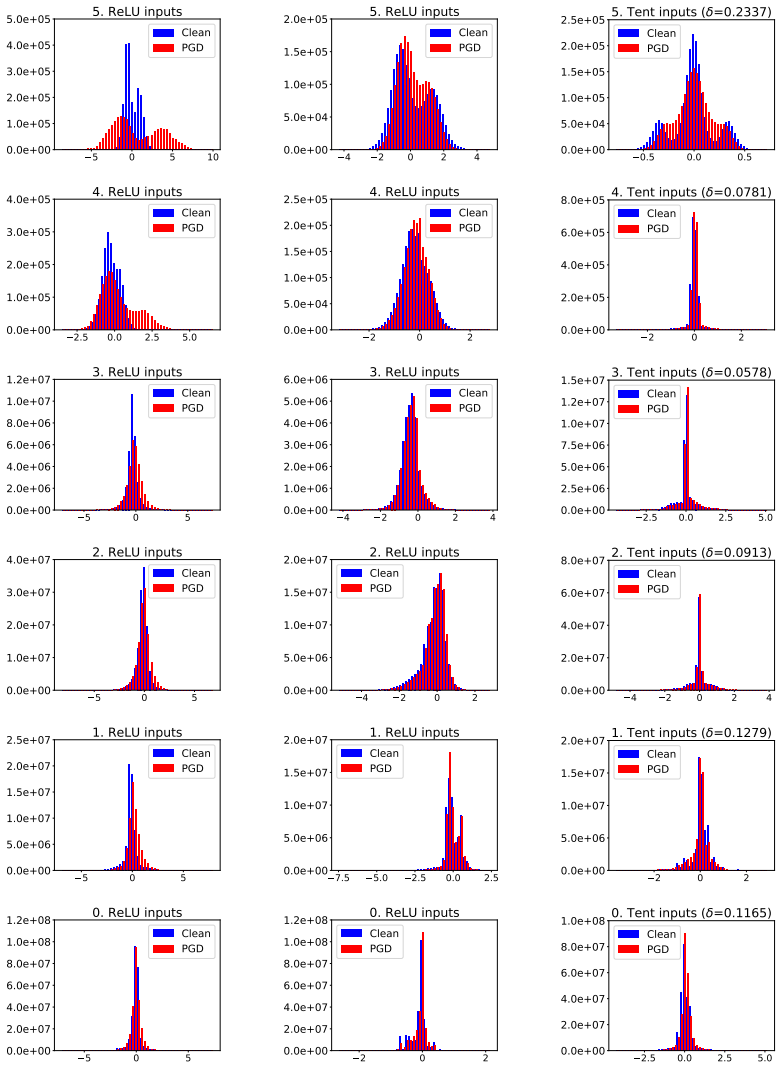
- [§4.2, Tables 1–2; Eq. (2)] The white-box accuracies that support the state-of-the-art claim are not trustworthy without an adaptive attack. The tent activation in Eq. (1) has zero derivative for |x|>δ (Eq. 2), and Appendix B reports learned δ values (e.g., 0.058–0.234 on MNIST) that leave a large fraction of activation inputs in the saturated regime. Under a standard PGD/BIM attack, gradients vanish in those regions, so the attack can terminate at a point of zero local gradient; the reported pattern, with FGSM/BIM/PGD accuracies above 83% but CW-l2 accuracy only 23.65 for WRN-28-10 tent (0.004), is exactly the signature of gradient masking. Please evaluate with an adaptive attack that handles the zero-gradient regions (e.g., BPDA with a straight-through surrogate, or random/ensemble PGD restarts), or provide a certified robustness bound, before the claim of significantly improved adversarial robustness compared to the state of the art can be accepted.
- [§4.1, Tables 1–2; §5] The causal claim that reducing open space risk is the reason for the observed robustness is not identified by the experiments. The tent networks differ from the ReLU baselines in several confounded ways: for MNIST, the primary comparison includes the batch-normalization addition, and for CIFAR-10 the tent models use Adam while the ReLU and adversarial-training models use SGD; in all tent models, weight-decay is applied to the δ parameters rather than to the network weights. Bounding the output range alone, or changing the optimization trajectory, could explain the results without the open-space-risk mechanism. To support the attribution, the authors should compare against other bounded activations (e.g., clipped ReLU, hard tanh, tanh, sigmoid) under a matched training protocol, and ideally vary the bound while holding everything else fixed.
- [§3, Theorems 1–2; §5] The theoretical analysis is at the level of a scalar activation function, but the robustness claim concerns classifiers over input images. Theorem 2 establishes that a tent activation has finite open space risk when viewed as a local recognition function over its own input; it does not establish a relationship between that quantity and the success of adversarial perturbations in image space. The conclusion's assertion that the open space risk model explains many issues for adversarial example generation is therefore stronger than what is proved. Please state the connection as a hypothesis and test it directly, for example by measuring the change in feature-space open space risk under attacks for tent versus ReLU networks.
minor comments (5)
- [Abstract and §5] The state-of-the-art claim is supported only by a comparison to Madry et al. [6]; please either broaden the comparison to other defenses available at the time of submission or temper the wording.
- [§4.1, Tables 1–2] No error bars or multiple-seed results are reported; given that the paper makes a state-of-the-art claim, reporting the mean and variance over at least three runs would strengthen the conclusions.
- [§3, Theorem 1] The proof of Theorem 1 is described as a sketch, although the contributions section says the paper proves the result; please provide a complete proof with explicit assumptions on the activation function and training distribution.
- [Appendix A] The appendix states that quantitative evaluation of adversarial robustness solely based upon accuracies may not be sufficient; this undercuts the accuracy-only evaluation in the main body and should be reconciled in the text.
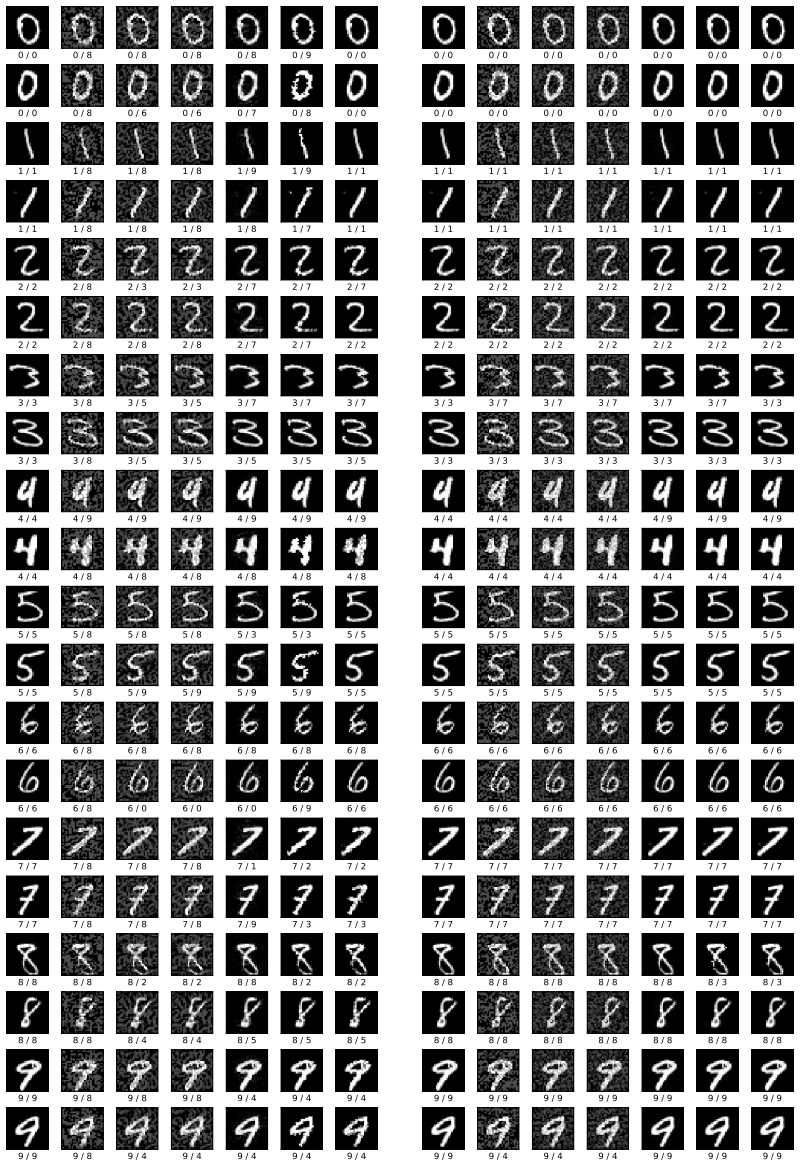
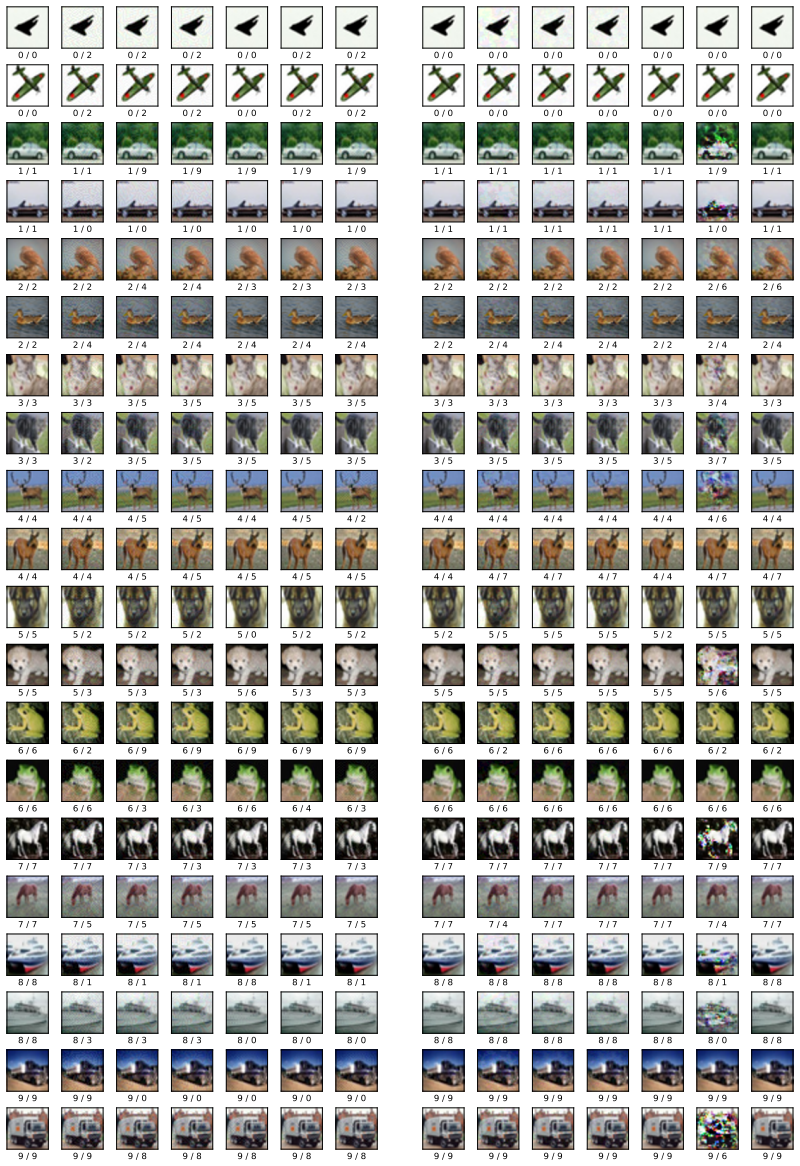
- [Figures 2 and 3 captions] Figure 3's caption has a typo, 'class indeces' should be 'class indices', and both captions could clarify that the displayed images are adversarial examples generated on the source network and then evaluated on the target network.
Circularity Check
No significant circularity: the robustness claims are measured against external white-box attacks, and the open-space-risk analysis is a mathematical property of the tent activation, not an input to the attack numbers.
full rationale
The main robustness claims (91.8% on MNIST and 73.5% on CIFAR-10) are empirical accuracies from Tables 1 and 2 against six external attack implementations (FGSM, BIM, PGD, DeepFool, CW-l2, CW-l∞), compared with a PGD adversarially trained baseline under the same ART settings. These numbers are not derived from the open-space-risk formalism; the weight-decay hyperparameters on δ are varied and reported, and the best models are selected on a validation set rather than fitted to reproduce attack accuracies. The theoretical section shows that monotonic activations have unbounded open-space risk and that the tent f(x;δ)=max(0,δ−|x|) has bounded range and finite integral, which is a direct property of Eq. 1 rather than an imported conclusion. The citation to [8] (Boult is a coauthor) supplies the open-space-risk definitions and the compact-abating-model theorem, but the boundedness of tents is independently evident, and the cited framework is not what produces the reported attack accuracies. The skeptical concern that high white-box accuracies may reflect zero-gradient saturation (gradient masking) is a correctness and adaptive-attack question, not a circularity: it challenges whether the numbers reflect true robustness, not whether the derivation reduces to its inputs. No load-bearing step equates a fitted parameter with a prediction, and no uniqueness result is imported from the authors' prior work to force the conclusion.
Assumptions & free parameters
free parameters (2)
- δ (tent size) =
learned, initialized at 1, bounded [0.05, 1.0]
- weight-decay on δ =
0.12 (MNIST), 0.003 or 0.004 (CIFAR-10 WRN-28-10)
assumptions (3)
- domain assumption Open space risk definitions from Scheirer et al. [8] apply to activation functions as weak classifiers.
- domain assumption Each activation function acts as a weak classifier and the network is a cascade or ensemble of them.
- domain assumption Reducing open space risk at activation level reduces adversarial vulnerability.
Cite this review
Pith. "Pith review of Improved Adversarial Robustness by Reducing Open Space Risk via Tent Activations." pith.science (2026). https://pith.science/paper/GCDLJDP3
@misc{pith2026190802435,
  author       = {Pith},
  title        = {Pith review of: Improved Adversarial Robustness by Reducing Open Space Risk via Tent Activations},
  year         = {2026},
  howpublished = {\url{https://pith.science/paper/GCDLJDP3}},
  note         = {Machine review of arXiv:1908.02435}
}
read the original abstract
Adversarial examples contain small perturbations that can remain imperceptible to human observers but alter the behavior of even the best performing deep learning models and yield incorrect outputs. Since their discovery, adversarial examples have drawn significant attention in machine learning: researchers try to reveal the reasons for their existence and improve the robustness of machine learning models to adversarial perturbations. The state-of-the-art defense is the computationally expensive and very time consuming adversarial training via projected gradient descent (PGD). We hypothesize that adversarial attacks exploit the open space risk of classic monotonic activation functions. This paper introduces the tent activation function with bounded open space risk and shows that tents make deep learning models more robust to adversarial attacks. We demonstrate on the MNIST dataset that a classifier with tents yields an average accuracy of 91.8% against six white-box adversarial attacks, which is more than 15 percentage points above the state of the art. On the CIFAR-10 dataset, our approach improves the average accuracy against the six white-box adversarial attacks to 73.5% from 41.8% achieved by adversarial training via PGD.
Figures
Figures from the paper (1 more)
Reference graph
Works this paper leans on
-
[1]
Szegedy, Wojciech Zaremba, Ilya Sutskever, Joan Bruna, Dumitru Erhan, Ian Goodfellow, and Rob Fergus
Christian J. Szegedy, Wojciech Zaremba, Ilya Sutskever, Joan Bruna, Dumitru Erhan, Ian Goodfellow, and Rob Fergus. Intriguing properties of neural networks. In International Conference on Learning Representation (ICLR), 2014
work page 2014
-
[2]
Goodfellow, Jonathon Shlens, and Christian Szegedy
Ian J. Goodfellow, Jonathon Shlens, and Christian Szegedy. Explaining and harnessing adversarial examples. In International Conference on Learning Representation (ICLR), 2015
work page 2015
-
[3]
Deepfool: a simple and accurate method to fool deep neural networks
Seyed-Mohsen Moosavi-Dezfooli, Alhussein Fawzi, and Pascal Frossard. Deepfool: a simple and accurate method to fool deep neural networks. In Conference on Computer Vision and Pattern Recognition (CVPR). IEEE, 2016
work page 2016
-
[4]
Towards evaluating the robustness of neural networks
Nicholas Carlini and David Wagner. Towards evaluating the robustness of neural networks. In Symposium on Security and Privacy (SP). IEEE, 2017
work page 2017
-
[5]
Alexey Kurakin, Ian J. Goodfellow, and Samy Bengio. Adversarial machine learning at scale. In International Conference on Learning Representation (ICLR), 2017
work page 2017
-
[6]
To- wards deep learning models resistant to adversarial attacks
Aleksander Madry, Aleksandar Makelov, Ludwig Schmidt, Dimitris Tsipras, and Adrian Vladu. To- wards deep learning models resistant to adversarial attacks. In International Conference on Learning Representation (ICLR), 2018
work page 2018
-
[7]
Attacks meet interpretability: Attribute- steered detection of adversarial samples
Guanhong Tao, Shiqing Ma, Yingqi Liu, and Xiangyu Zhang. Attacks meet interpretability: Attribute- steered detection of adversarial samples. In Advances in Neural Information Processing Systems (NIPS), 2018
work page 2018
-
[8]
W.J. Scheirer, L.P. Jain, and T.E. Boult. Probability models for open set recognition. Transactions on Pattern Analysis and Machine Intelligence (TPAMI), 36, 2014
work page 2014
Show all 39 references
-
[9]
Out-of-distribution detection using an ensemble of self supervised leave-out classifiers
Apoorv Vyas, Nataraj Jammalamadaka, Xia Zhu, Dipankar Das, Bharat Kaul, and Theodore L Willke. Out-of-distribution detection using an ensemble of self supervised leave-out classifiers. In Proceedings of the European Conference on Computer Vision (ECCV), 2018
2018
-
[10]
A simple unified framework for detecting out- of-distribution samples and adversarial attacks
Kimin Lee, Kibok Lee, Honglak Lee, and Jinwoo Shin. A simple unified framework for detecting out- of-distribution samples and adversarial attacks. In Advances in Neural Information Processing Systems (NIPS), 2018
2018
-
[11]
Out-of-distribution detection using multiple semantic label representations
Gabi Shalev, Yossi Adi, and Joseph Keshet. Out-of-distribution detection using multiple semantic label representations. In Advances in Neural Information Processing Systems (NIPS), 2018
2018
-
[12]
Extremeweather: A large-scale climate dataset for semi-supervised detection, localization, and understanding of extreme weather events
Evan Racah, Christopher Beckham, Tegan Maharaj, Samira Ebrahimi Kahou, Mr Prabhat, and Chris Pal. Extremeweather: A large-scale climate dataset for semi-supervised detection, localization, and understanding of extreme weather events. In Advances in Neural Information Processin...
2017
-
[13]
A loss framework for calibrated anomaly detection
Aditya Krishna Menon and Robert C Williamson. A loss framework for calibrated anomaly detection. In Proceedings of the 32nd International Conference on Neural Information Processing Systems. Curran Associates Inc., 2018
2018
-
[14]
Generative probabilistic novelty detection with adversarial autoencoders
Stanislav Pidhorskyi, Ranya Almohsen, and Gianfranco Doretto. Generative probabilistic novelty detection with adversarial autoencoders. In Advances in Neural Information Processing Systems (NIPS), 2018
2018
-
[15]
Concrete dropout
Yarin Gal, Jiri Hron, and Alex Kendall. Concrete dropout. In Advances in Neural Information Processing Systems (NIPS), 2017
2017
-
[16]
Simple and scalable predictive uncertainty estimation using deep ensembles
Balaji Lakshminarayanan, Alexander Pritzel, and Charles Blundell. Simple and scalable predictive uncertainty estimation using deep ensembles. In Advances in Neural Information Processing Systems (NIPS), 2017
2017
-
[17]
Evidential deep learning to quantify classification uncertainty
Murat Sensoy, Lance Kaplan, and Melih Kandemir. Evidential deep learning to quantify classification uncertainty. In Advances in Neural Information Processing Systems (NIPS), 2018
2018
-
[18]
Predictive uncertainty estimation via prior networks
Andrey Malinin and Mark Gales. Predictive uncertainty estimation via prior networks. In Advances in Neural Information Processing Systems (NIPS), 2018
2018
-
[19]
Open set fingerprint spoof detection across novel fabrication materials
Ajita Rattani, Walter J Scheirer, and Arun Ross. Open set fingerprint spoof detection across novel fabrication materials. IEEE Transactions on Information Forensics and Security (TIFS), 10(11), 2015. 9
2015
-
[20]
Sparse representation-based open set recognition
He Zhang and Vishal M Patel. Sparse representation-based open set recognition. IEEE Transactions on Pattern Analysis and Machine Intelligence (TPAMI), 39(8):1690–1696, 2016
2016
-
[21]
Open set recognition for automatic target classification with rejection
Matthew D Scherreik and Brian D Rigling. Open set recognition for automatic target classification with rejection. IEEE Transactions on Aerospace and Electronic Systems, 52(2), 2016
2016
-
[22]
Odn: Opening the deep network for open-set action recognition
Yemin Shi, Yaowei Wang, Yixiong Zou, Qingsheng Yuan, Yonghong Tian, and Yu Shu. Odn: Opening the deep network for open-set action recognition. In International Conference on Multimedia and Expo (ICME). IEEE, 2018
2018
-
[23]
Open set incremental learning for automatic target recognition
Sihang Dang, Zongjie Cao, Zongyong Cui, Yiming Pi, and Nengyuan Liu. Open set incremental learning for automatic target recognition. Transactions on Geoscience and Remote Sensing, 2019
2019
-
[24]
Combining clustering and active learning for the detection and learning of new image classes
Luiz FS Coletta, Moacir Ponti, Eduardo R Hruschka, Ayan Acharya, and Joydeep Ghosh. Combining clustering and active learning for the detection and learning of new image classes. Neurocomputing, 2019
2019
-
[25]
Rectified linear units improve restricted Boltzmann machines
Vinod Nair and Geoffrey E Hinton. Rectified linear units improve restricted Boltzmann machines. In International Conference on Machine Learning (ICML), 2010
2010
-
[26]
Batch normalization: Accelerating deep network training by reducing internal covariate shift
Sergey Ioffe and Christian Szegedy. Batch normalization: Accelerating deep network training by reducing internal covariate shift. In International Conference on Machine Learning (ICML), 2015
2015
-
[27]
Noisy activation functions
Caglar Gulcehre, Marcin Moczulski, Misha Denil, and Yoshua Bengio. Noisy activation functions. In International Conference on Machine Learning (ICML), 2016
2016
-
[28]
Rectifier nonlinearities improve neural network acoustic models
Andrew L Maas, Awni Y Hannun, and Andrew Y Ng. Rectifier nonlinearities improve neural network acoustic models. In International Conference on Machine Learning (ICML), 2013
2013
-
[29]
Deep residual learning for image recognition
Kaiming He, Xiangyu Zhang, Shaoqing Ren, and Jian Sun. Deep residual learning for image recognition. In Conference on Computer Vision and Pattern Recognition (CVPR). IEEE, 2016
2016
-
[30]
Self-normalizing neural networks
Günter Klambauer, Thomas Unterthiner, Andreas Mayr, and Sepp Hochreiter. Self-normalizing neural networks. In Advances in Neural Information Processing Systems (NIPS), 2017
2017
-
[31]
Performance analysis of various activation functions in generalized mlp architectures of neural networks
Bekir Karlik and A Vehbi Olgac. Performance analysis of various activation functions in generalized mlp architectures of neural networks. International Journal of Artificial Intelligence and Expert Systems, 1(4), 2011
2011
-
[32]
A comparison of activation functions in artificial neural networks
Cenk Bircano˘glu and Nafiz Arıca. A comparison of activation functions in artificial neural networks. In 26th Signal Processing and Communications Applications Conference (SIU). IEEE, 2018
2018
-
[33]
Efficient formal safety analysis of neural networks
Shiqi Wang, Kexin Pei, Justin Whitehouse, Junfeng Yang, and Suman Jana. Efficient formal safety analysis of neural networks. In Advances in Neural Information Processing Systems (NIPS), 2018
2018
-
[34]
The MNIST database of handwritten digits, 1998
Yann LeCun, Corinna Cortes, and Christopher JC Burges. The MNIST database of handwritten digits, 1998
1998
-
[35]
Learning multiple layers of features from tiny images, 2009
Alex Krizhevsky. Learning multiple layers of features from tiny images, 2009. Technical report. University of Toronto
2009
-
[36]
Adversarial robustness toolbox v0.10.0
Maria-Irina Nicolae, Mathieu Sinn, Minh Ngoc Tran, Beat Buesser, Ambrish Rawat, Martin Wistuba, Valentina Zantedeschi, Nathalie Baracaldo, Bryant Chen, Heiko Ludwig, Ian Molloy, and Ben Edwards. Adversarial robustness toolbox v0.10.0. CoRR, 1807.01069, 2018
-
[37]
Distillation as a defense to adversarial perturbations against deep neural networks
Nicolas Papernot, Patrick McDaniel, Xi Wu, Somesh Jha, and Ananthram Swami. Distillation as a defense to adversarial perturbations against deep neural networks. In Symposium on Security and Privacy (SP). IEEE, 2016
2016
-
[38]
Wide residual networks
Sergey Zagoruyko and Nikos Komodakis. Wide residual networks. In British Machine Vision Conference (BMVC), 2016
2016
-
[39]
Sara Sabour, Yanshuai Cao, Fartash Faghri, and David J. Fleet. Adversarial manipulation of deep representations. In International Conference on Learning Representation (ICLR), 2016. 10 APPENDIX A: Visualization of Adversarial Examples In the paper, similar to Madry et al. [6],...
2016
Reviewed August 14, 2026 · model on record in the stance chip above.
Discussion (0). Continue with ORCID to comment.