REVIEW 4 major objections 4 minor 19 references
Quantum Calculus-based Volterra LMS for Nonlinear Channel Estimation
T0 review · 4 major / 4 minor · reviewed 2026-08-14 · deepseek-v4-flash
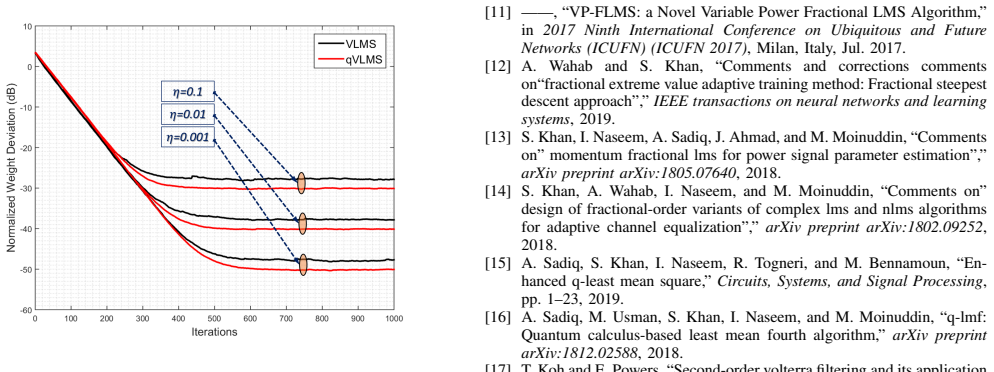
Pith's one-line read q-VLMS, a q-calculus variant of Volterra LMS, converges faster in nonlinear channel estimation, with an average 2.31 dB gain over VLMS.
desk verdict The q-VLMS algorithm is just VLMS with a scaled step size, and the reported 2.31 dB gain is an artifact of that scaling rather than a benefit of q-calculus. read the letter →
The pith
A machine-rendered reading of the paper's core claim, the machinery that carries it, and where it could break.
The reading
What carries the argument
The machinery is the $q$-derivative (Jackson's derivative), $D_q f(x)=(f(qx)-f(x))/((q-1)x)$, used in place of the ordinary gradient of the mean-square error. For a quadratic cost this replaces the VLMS update with $w(r+1)=w(r)+\mu G u(r)e(r)$, where $G=\mathrm{diag}((q_1+1)/2,\ldots,(q_M+1)/2)$ rescales each coordinate's effective step. The paper whitens the quadratic regressor with $S^{-1}$ so that the input correlation is the identity, then derives the mean recursion $E[\Delta w(r+1)]=(I-\mu A)E[\Delta w(r)]$ with $A=GE[S^{-1}uu^{\top}S^{-1}]$, yielding the stability bound $0<\mu<1/\max_i\{(q_i+1)\lambda_i\}$.
What would settle it
Run conventional VLMS on the same second-order Volterra channels with per-tap step sizes $\mu(q_i+1)/2$ (that is, replace $\mu$ by $\mu G$) and compare NWD curves to q-VLMS at step $\mu$; if the curves overlap, the reported 2.31 dB gain is an effective-step-size artifact, not a q-calculus effect.
Extended reading notes
Core claim
The paper's central discovery is the update rule $w(r+1)=w(r)+\mu G u(r)e(r)$, obtained by applying the $q$-derivative to the mean-square error cost of a second-order Volterra filter. The diagonal matrix $G=\mathrm{diag}((q_1+1)/2,\ldots,(q_M+1)/2)$ is the entire mathematical content left by the $q$-gradient; when $q_i=1$ the update reduces to VLMS. The authors show that under a Gaussian i.i.d. input model, the mean weight-error recursion becomes $E[\Delta w(r+1)]=(I-\mu A)E[\Delta w(r)]$ with $A=GE[S^{-1}uu^{\top}S^{-1}]$, giving the stability interval above. They report that the analytical mean absolute error tracks simulation with a correlation coefficient of 0.9995, and that q-VLMS outperforms VLMS by an average 2.31 dB in normalized weight deviation across SNRs of 10, 20, and 30 dB.
Load-bearing premise
The load-bearing premise is that q-VLMS and VLMS are fairly compared at the same nominal step size; since q-VLMS is the VLMS update multiplied by $G=\mathrm{diag}((q_i+1)/2)$, the measured 2.31 dB gain could come from the larger effective step size rather than from any property of the $q$-derivative.
Editorial extensions
If this is right
- Nonlinear channel estimators using q-VLMS can reach a target normalized weight deviation with fewer samples, which matters when the training sequence is short.
- The step-size bound $0<\mu<1/\max_i\{(q_i+1)\lambda_i\}$ gives a formula for setting $\mu$ once the input eigenvalues are known, removing trial-and-error tuning.
- The same convergence analysis used for linear LMS carries over to second-order Volterra filters when the quadratic input is whitened by $S^{-1}$, so the result extends the linear toolkit to nonlinear channels.
- The added cost is only $K$ extra multiplications per update, so the reported gain does not require a heavier filter structure.
Reading between the lines
- Because the update is exactly the VLMS update multiplied by $G$, q-VLMS at step $\mu$ is algebraically VLMS at per-tap steps $\mu(q_i+1)/2$; the paper never compares against VLMS run at those effective steps, so whether the gain is a q-derivative property or a step-size scaling remains open.
- If the gain is step-size scaling, the practical lesson is to choose larger per-tap steps inside the stability bound, with the q-derivative functioning as a derivation device rather than a new mechanism.
- The same diagonal-gain construction could be applied to normalized LMS, affine projection, or kernel adaptive filters, where eigenvalue spread slows convergence; this is an extension the paper does not test.
- A time-varying $q_i$ driven by error-correlation energy, already used in the q-LMS literature the paper cites, would be a natural next test to see whether the gain compounds during adaptation.
Signed reviews
Editorial analysis
A structured set of objections, weighed in public.
Referee Report
Summary. The paper proposes a q-calculus (Jackson derivative) variant of the Volterra least mean square (LMS) algorithm for nonlinear channel estimation. The proposed q-VLMS update is w(r+1)=w(r)+mu G u(r)e(r) with G = diag((q_i+1)/2). The authors derive an optimal solution, analyze mean convergence, compute the step-size bound, and perform simulations at three SNRs. They report that q-VLMS converges faster than conventional VLMS, with an average 2.31 dB NWD improvement.
Significance. If the central claims were established, the paper would offer a simple modification of Volterra LMS with a tunable per-tap gain and would provide a useful convergence analysis. The authors do include an analytical convergence model and a 1000-trial Monte Carlo validation, which are strengths. However, the claimed improvement is not supported: the update reduces to standard VLMS with per-tap step sizes mu(q_i+1)/2, the q-gradient identity in Eq. (6) is not derived and is incorrect under the standard Jackson derivative, and the convergence bound in Eq. (16) is inconsistent with the update. The paper's main conclusion rests on an uncontrolled comparison and an unsupported gradient identity, so the contribution as stated is not established.
major comments (4)
- [Section III, Eqs. (5)-(6)] The q-gradient identity in Eq. (6) is asserted without derivation and is not the standard Jackson derivative defined in Eq. (5). For the instantaneous cost e^2 with e = o - u^T w, the component-wise Jackson derivative with respect to w_i equals -2u_i e + (q_i-1) w_i u_i^2, not -2[(q_i+1)/2]u_i e. The additional (q_i-1)w_i u_i^2 term is dropped without explanation. Because Eq. (7) is derived from Eq. (6), the algorithm is not established as a q-gradient descent method.
- [Section III-B, Eqs. (14)-(16)] The mean weight-error recursion (14) has a sign error: with Delta w = w_opt - w and e = u^T Delta w + eta, the update yields Delta w(r+1) = (I - mu G u u^T)Delta w(r) - mu G u eta (or the analogous expression with the opposite sign convention), not the plus sign shown before the u^T Delta w term. In addition, Eq. (16) is inconsistent with update (7): since G = diag((q_i+1)/2), the stability bound should be mu < 2/(max_i (q_i+1)lambda_i) (or 4/((q+1)lambda_max) under the assumed whitening), not 1/((q+1)lambda_max). The analytical convergence analysis therefore does not match the simulated algorithm.
- [Section IV, Protocol 2] The comparison between q-VLMS and conventional VLMS at the same nominal mu is uncontrolled. Because G is a constant diagonal matrix, update (7) is exactly the standard VLMS update with per-tap step sizes mu_i = mu(q_i+1)/2. For q_i > 1, this is VLMS with a larger effective step size per tap. The reported average 2.31 dB NWD improvement is therefore fully consistent with a step-size scaling artifact and does not demonstrate any benefit of the q-derivative. To support the paper's claim, the authors would need to compare q-VLMS against VLMS with per-tap step sizes mu_i, or otherwise equalize the effective step sizes.
- [Section IV, Protocol 2] The sentence 'we repeat the same simulations with G = SR^-1S' is inconsistent with the definition G = diag((q_i+1)/2) used throughout the algorithm and analysis. If this phrase is intended to define the VLMS comparison, it must be clarified; if not, it introduces a different algorithm whose relationship to the preceding analysis is unclear. More fundamentally, since q enters only through the fixed diagonal gain G, the paper's central claim that q-calculus improves convergence is not supported once the equivalence to per-tap step-size VLMS is recognized.
minor comments (4)
- [Section III, Eq. (5)] The notation in Eq. (5) is ambiguous: 'f(qn)' and '(q-1)i' should be written as f(qx) and (q-1)x, or the component-wise vector generalization should be stated explicitly.
- [Section II, Eq. (8)] The definition of diag(S) uses set braces; please use vector or diagonal-matrix notation for consistency with the rest of the paper.
- [Section IV] Figures 1 and 2 are referenced but not described in the text; please ensure that the plots include axis labels, legends, SNR values, and the q values used in Fig. 2.
- [Title and Abstract] The term 'Quantum Calculus' is used in the title and abstract, but the paper employs Jackson's q-calculus; consider using 'q-calculus' consistently to avoid confusion with quantum computing.
Circularity Check
The q-VLMS gain is built into Eq. (7): G=diag((q_i+1)/2) rescales the step size, and Protocol 2 compares at a common µ; the q-gradient identity in Eq. (6) does not follow from Eq. (5).
-
self definitional
[Section II, Eq. (7); Section IV, Protocol 2; Section III.B, Eq. (16)]
"w(r + 1) = w(r) + µGu(r)e(r). (7) ... diag(G) = [( q1+1 2 ), (q2+1 2 ),..... (qM +1 2 )]⊺. ... Evaluation protocol 2 : Effect of q-parameters amd performance comparison with conventional VLMS on learning rate µ = 1 × 10⁻³"
Since G is a constant diagonal matrix, Eq. (7) is exactly the VLMS recursion with per-tap step sizes µ_i = µ(q_i+1)/2. For q_i>1 the effective step is larger than µ, so comparing q-VLMS and VLMS at the same scalar µ in Protocol 2 builds the reported faster convergence into the choice of G. The convergence bound in Eq. (16) confirms this: q appears only through the product (q_i+1)λ_i, i.e. through the same effective step-size scaling. The average 2.31 dB improvement is therefore a restatement of the larger step size, not a consequence of Jackson's derivative.
-
renaming known result
[Section II, Eqs. (5)-(7)]
"Dq(f (r)) = dq(f (r))/dq(x) = f (qn)−f (r)/(q− 1)i . ... ∇q,wC(w) =−2E[Gu(r)e(r)] (6) where diag(G) = [( q1+1 2 ), ...]⊺. By dropping the expectation in (6) results in ... w(r + 1) = w(r) +µGu(r)e(r). (7)"
Applying the Jackson derivative defined in Eq. (5) to J(w)=e^2(r), with e=d−w^T u, gives D_{q,w_i}J = −2u_i e + (q_i−1)w_i u_i^2, not −2((q_i+1)/2)u_i e. The extra (q_i−1)w_i u_i^2 term is dropped without comment, so Eq. (6) is not the q-gradient of the cost. The G factor is inserted by ansatz; what remains is standard VLMS with scaled step sizes. Calling this q-VLMS renames a step-size-scaled VLMS rather than deriving a q-calculus algorithm.
full rationale
The paper is not an overt circular argument that assumes its conclusion; its MAE validation is internally consistent. However, the load-bearing performance comparison in Fig. 2 reduces to a construction. Eq. (7) defines q-VLMS by inserting a constant diagonal gain G=diag((q_i+1)/2) into the VLMS update. With µ_i=µ(q_i+1)/2 this is exactly VLMS with per-tap step sizes. Protocol 2 compares q-VLMS and VLMS at the same scalar µ, so for q>1 the proposed algorithm is run at a larger effective step. The reported average 2.31 dB NWD improvement is therefore the expected consequence of the larger step size, not an independent prediction of q-calculus. Eq. (16) confirms q enters only through the product (q_i+1)λ_i, i.e., through the effective step size. Additionally, the claimed q-gradient identity Eq. (6) does not follow from the Jackson derivative Eq. (5): differentiating e^2(r) with respect to w_i gives an extra (q_i−1)w_i u_i^2 term that is silently dropped. Thus the q-calculus derivation is not established, and the algorithm is a renamed step-scaled VLMS. The MAE validation validates the same recursion that defines the algorithm, so it does not independently confirm the claimed superiority. No load-bearing self-citation chain was found; the self-citations in the introduction are motivational only.
Assumptions & free parameters
free parameters (2)
- q_i (diagonal of G) =
q=1,5,10 in Protocol 1; unspecified in Protocol 2
- mu (step size) =
0.25*lambda_max^-1 (Protocol 1), 0.001 (Protocol 2)
assumptions (3)
- ad hoc to paper The q-gradient of the cost C(w)=E[e^2] equals -2E[G u e] (Eq. 6)
- domain assumption Input and noise are zero-mean Gaussian with unit variance (Section III-B)
- domain assumption S^{-1} R S^{-1} = I for the scaled Volterra input (Section III-A)
Cite this review
Pith. "Pith review of Quantum Calculus-based Volterra LMS for Nonlinear Channel Estimation." pith.science (2026). https://pith.science/paper/ABQ3W2WP
@misc{pith2026190802510,
  author       = {Pith},
  title        = {Pith review of: Quantum Calculus-based Volterra LMS for Nonlinear Channel Estimation},
  year         = {2026},
  howpublished = {\url{https://pith.science/paper/ABQ3W2WP}},
  note         = {Machine review of arXiv:1908.02510}
}
abstract
A novel adaptive filtering method called $q$-Volterra least mean square ($q$-VLMS) is presented in this paper. The $q$-VLMS is a nonlinear extension of conventional LMS and it is based on Jackson's derivative also known as $q$-calculus. In Volterra LMS, due to large variance of input signal the convergence speed is very low. With proper manipulation we successfully improved the convergence performance of the Volterra LMS. The proposed algorithm is analyzed for the step-size bounds and results of analysis are verified through computer simulations for nonlinear channel estimation problem.
Figures

Reference graph
Works this paper leans on
-
[1]
FLMF: fractional least mean fourth algorithm for channel estimation in non-gaussian environment,
S. Khan, N. Ahmed, M. A. Malik, I. Naseem, R. Togneri, and M. Ben- namoun, “FLMF: fractional least mean fourth algorithm for channel estimation in non-gaussian environment,” inInternational Conference on Information and Communications Technology Convergence 2017 (ICTC 2017), Jeju Island, Korea, Oct. 2017
work page 2017
-
[2]
A novel fractional gradient-based learning algorithm for recurrent neural networks,
S. Khan, J. Ahmad, I. Naseem, and M. Moinuddin, “A novel fractional gradient-based learning algorithm for recurrent neural networks,” Cir- cuits, Systems, and Signal Processing , vol. 37, no. 2, pp. 593–612, Feb 2018
work page 2018
-
[3]
A fractional gradient descent-based rbf neural network,
S. Khan, I. Naseem, M. A. Malik, R. Togneri, and M. Bennamoun, “A fractional gradient descent-based rbf neural network,” Circuits, Systems, and Signal Processing , vol. 37, no. 12, pp. 5311–5332, 2018
work page 2018
-
[4]
Chaotic time series prediction using spatio-temporal rbf neural networks,
A. Sadiq, M. S. Ibrahim, M. Usman, M. Zubair, and S. Khan, “Chaotic time series prediction using spatio-temporal rbf neural networks,” in 2018 3rd International Conference on Emerging Trends in Engineering, Sciences and Technology (ICEEST) . IEEE, 2018, pp. 1–5
work page 2018
-
[5]
Spatio- temporal rbf neural networks,
S. Khan, J. Ahmad, A. Sadiq, I. Naseem, and M. Moinuddin, “Spatio- temporal rbf neural networks,” in 2018 3rd International Conference on Emerging Trends in Engineering, Sciences and Technology (ICEEST) . IEEE, 2018, pp. 1–5
work page 2018
-
[6]
FCLMS: Fractional Complex LMS Algorithm for Complex System Identification,
J. Ahmad, S. Khan, M. Usman, I. Naseem, and M. Moinuddin, “FCLMS: Fractional Complex LMS Algorithm for Complex System Identification,” in 13th IEEE Colloquium on Signal Processing and its Applications (CSPA 2017) . IEEE, 2017
work page 2017
-
[7]
Robust adaptive volterra filter under maximum correntropy criteria in impulsive environments,
W. Wang, H. Zhao, and B. Chen, “Robust adaptive volterra filter under maximum correntropy criteria in impulsive environments,” Circuits, Systems, and Signal Processing , vol. 36, no. 10, pp. 4097–4117, Oct 2017
work page 2017
-
[8]
Efficient computation of bilinear approximations and volterra models of nonlinear systems,
P. M. S. Burt and J. H. de Morais Goulart, “Efficient computation of bilinear approximations and volterra models of nonlinear systems,”IEEE Transactions on Signal Processing , vol. 66, no. 3, pp. 804–816, Feb 2018
work page 2018
Show all 19 references
-
[9]
Rvp- flms: A robust variable power fractional lms algorithm,
J. Ahmad, M. Usman, S. Khan, I. Naseem, and H. J. Syed, “Rvp- flms: A robust variable power fractional lms algorithm,” in 2016 6th IEEE International Conference on Control System, Computing and Engineering (ICCSCE) . IEEE, 2016, pp. 494–497
2016
-
[10]
A robust variable step size fractional least mean square (rvss-flms) algorithm,
S. Khan, M. Usman, I. Naseem, R. Togneri, and M. Bennamoun, “A robust variable step size fractional least mean square (rvss-flms) algorithm,” in 2017 IEEE 13th International Colloquium on Signal Processing & its Applications (CSPA) . IEEE, 2017, pp. 1–6
2017
-
[11]
VP-FLMS: a Novel Variable Power Fractional LMS Algorithm,
——, “VP-FLMS: a Novel Variable Power Fractional LMS Algorithm,” in 2017 Ninth International Conference on Ubiquitous and Future Networks (ICUFN) (ICUFN 2017) , Milan, Italy, Jul. 2017
2017
-
[12]
Comments and corrections comments on“fractional extreme value adaptive training method: Fractional steepest descent approach
A. Wahab and S. Khan, “Comments and corrections comments on“fractional extreme value adaptive training method: Fractional steepest descent approach”,” IEEE transactions on neural networks and learning systems, 2019
2019
-
[13]
Comments on
S. Khan, I. Naseem, A. Sadiq, J. Ahmad, and M. Moinuddin, “Comments on” momentum fractional lms for power signal parameter estimation”,” arXiv preprint arXiv:1805.07640 , 2018
2018 arXiv
-
[14]
Comments on
S. Khan, A. Wahab, I. Naseem, and M. Moinuddin, “Comments on” design of fractional-order variants of complex lms and nlms algorithms for adaptive channel equalization”,” arXiv preprint arXiv:1802.09252 , 2018
2018 arXiv
-
[15]
En- hanced q-least mean square,
A. Sadiq, S. Khan, I. Naseem, R. Togneri, and M. Bennamoun, “En- hanced q-least mean square,” Circuits, Systems, and Signal Processing , pp. 1–23, 2019
2019
-
[16]
q-lmf: Quantum calculus-based least mean fourth algorithm,
A. Sadiq, M. Usman, S. Khan, I. Naseem, and M. Moinuddin, “q-lmf: Quantum calculus-based least mean fourth algorithm,” arXiv preprint arXiv:1812.02588, 2018
2018 arXiv
-
[17]
Second-order volterra filtering and its application to nonlinear system identification,
T. Koh and E. Powers, “Second-order volterra filtering and its application to nonlinear system identification,” IEEE Transactions on Acoustics, Speech, and Signal Processing, vol. 33, no. 6, pp. 1445–1455, Dec 1985
1985
-
[18]
Optimizing the performance of polynomial adaptive filters: making quadratic filters converge like linear filters,
C. W. Therrien, W. K. Jenkins, and X. Li, “Optimizing the performance of polynomial adaptive filters: making quadratic filters converge like linear filters,” IEEE Transactions on Signal Processing , vol. 47, no. 4, pp. 1169–1171, Apr 1999
1999
-
[19]
Performance analysis of nonlinear adaptive filter based on lms algorithm,
S.-L. Chang and T. Ogunfunmi, “Performance analysis of nonlinear adaptive filter based on lms algorithm,” in Conference Record of the Thirty-First Asilomar Conference on Signals, Systems and Computers (Cat. No.97CB36136) , vol. 1, Nov 1997, pp. 107–110 vol.1
1997
Reviewed August 14, 2026 · model on record in the stance chip above.
Discussion (0). Continue with ORCID to comment.