REVIEW 3 major objections 4 minor 47 references
Elastic Properties of Symmetric Liquid-Liquid Interfaces
T0 review · 3 major / 4 minor · reviewed 2026-08-14 · deepseek-v4-flash
Pith's one-line read The paper claims that for symmetric liquid-liquid interfaces the mean bending rigidity is positive everywhere, the Gaussian rigidity turns negative at strong segregation, and these signs control interface fluctuations and droplet formation.
desk verdict A clean SCF calculation that for the first time finds positive mean bending rigidity from a molecular model, but the sign is tied to a specific interface-pinning convention that the authors do not test. read the letter →
The pith
A machine-rendered reading of the paper's core claim, the machinery that carries it, and where it could break.
The reading
What carries the argument
The load-bearing device is the non-local average $\langle \phi_B(r)\rangle = \phi_B(r) + \frac{1}{6}\nabla^2 \phi_B(r)$ appearing in the polymer-solution interaction free energy, together with a Lagrange multiplier that pins the interface at the equimolar surface. The grand potentials of planar, cylindrical, and spherical interfaces are computed at fixed chemical potentials, and the standard curvature expansion of the tension yields $\kappa$ from the cylinder and $2\kappa + \bar{\kappa}$ from the sphere. The non-local term is decisive: when it is replaced by the local approximation $\langle\phi\rangle \to \phi$, the same numerical machinery reproduces earlier self-consistent-field results with negative $\kappa$ and positive $\bar{\kappa}$.
What would settle it
Compute the same grand potentials with a different discretization of the Laplacian, for instance by including next-nearest-neighbor lattice sites in the gradient stencil, and check whether $\kappa$ stays positive and $\bar{\kappa}$ still changes sign. Alternatively, simulate a symmetric polymer blend at fixed chemical potential and extract the capillary-wave spectrum: the predicted positive $\kappa$ and $\lambda$ of order a few segment sizes would be confirmed or refuted by the wavelength dependence of the height fluctuations.
Extended reading notes
Core claim
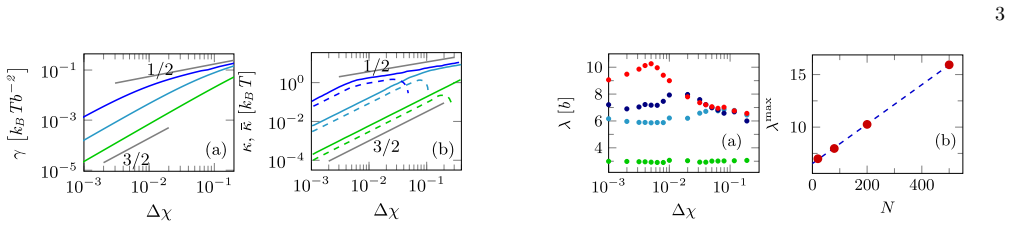
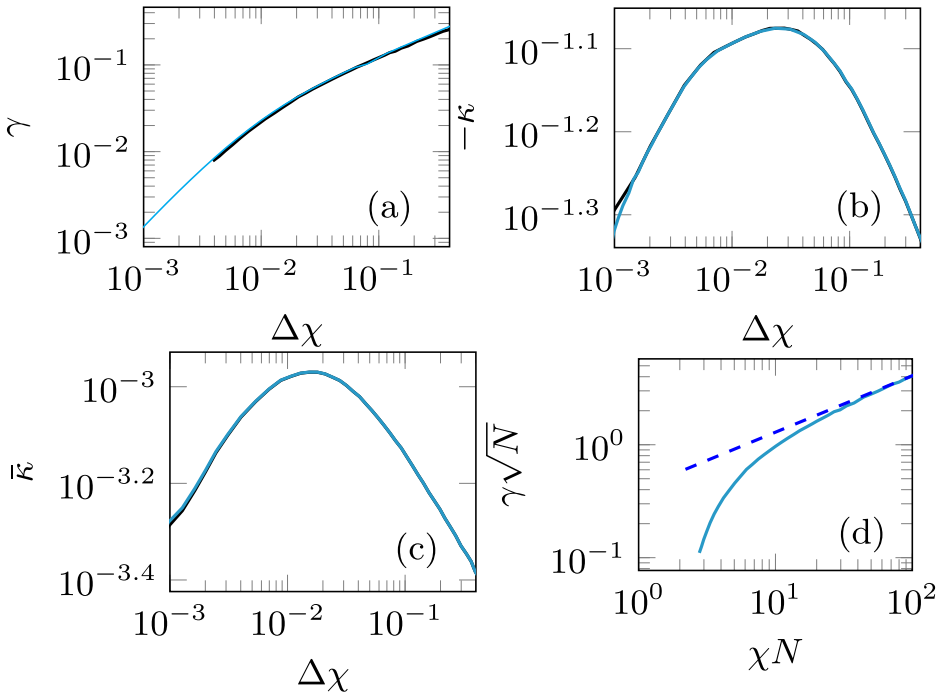
The central discovery is that in a mean-field treatment that keeps non-local corrections to the contact interaction, the elastic moduli of symmetric $A_N$-$B_N$ interfaces have definite signs: $\kappa > 0$ for all $\chi$ above the critical value, while $\bar{\kappa} > 0$ near the critical point and $\bar{\kappa} < 0$ at strong segregation. The ratio $\bar{\kappa}/\kappa$ takes plateau values of $1/2$ in weak segregation and $-3/2$ in strong segregation, and both rigidities scale with $\Delta\chi = \chi - \chi_c$ exactly as the interfacial tension does, as $N(\Delta\chi)^{3/2}$ near criticality and $(\Delta\chi)^{1/2}$ far from it. The sign switch of $\bar{\kappa}$ occurs when the interfacial width shrinks to a few segment lengths, and the paper maps this switch in the $(\sqrt{\Delta\chi}, 1/\sqrt{N})$ plane.
Load-bearing premise
The entire sign result rests on the non-local gradient term $\frac{1}{6}\nabla^2\phi$ in the interaction energy; if the physically correct contact interaction in a density gradient is instead the purely local average, the predicted positive $\kappa$ and the $\bar{\kappa}$ sign switch disappear.
Editorial extensions
If this is right
- Short-wavelength height fluctuations of a symmetric liquid-liquid interface are damped: every deviation from the planar state raises the grand potential, so the interface is an elastic sheet down to the crossover length $\lambda = \sqrt{\kappa/\gamma}$.
- The Gaussian rigidity sign switch means strongly segregated interfaces resist saddle deformations, making pinch-off and droplet formation more difficult, while near-critical interfaces promote such deformations.
- Simulations that extract $\kappa$ from capillary-wave spectra should find their best signal near the maximum of $\lambda$, which grows linearly with chain length as $\lambda_{\max} \simeq 0.02N + 6.54$ in segment units.
- Near the critical point the elastic constants inherit the tension's scaling, so the universal ratios $\bar{\kappa}/\kappa = 1/2$ and $-3/2$ in the weak- and strong-segregation regimes are testable predictions.
Reading between the lines
- A testable extension of the paper's logic: measuring $\lambda$ from the capillary-wave spectrum of a symmetric polymer blend should show a non-monotonic dependence on $\chi$, peaking at the weak-to-strong segregation crossover.
- The identification of interfacial width as the control parameter suggests the sign switch is not unique to symmetric blends; any interface whose width can be tuned through a few segment sizes may show the same $\bar{\kappa}$ sign switch.
- If the non-local gradient term is as decisive as claimed, polymer self-consistent-field codes that drop it may still give accurate interfacial tensions but should not be trusted for elastic coefficients, at least not without including such a term.
Signed reviews
Editorial analysis
A structured set of objections, weighed in public.
Referee Report
Summary. This manuscript presents Scheutjens–Fleer self-consistent field (SF-SCF) calculations of the mean and Gaussian bending rigidities of symmetric AN–BN liquid–liquid interfaces in the grand canonical ensemble. The interface is pinned at the equimolar surface through the Lagrange term Δ_{r;r0} in Eq. (2), and the non-local Cahn–Hilliard contact interaction is retained via Eq. (4). Bending moduli are extracted from the grand-potential differences between cylindrical/spherical and planar interfaces using the Helfrich expansion, Eq. (1). The central claims are: κ>0 for all interactions studied; κ̄>0 near the critical point and negative at strong segregation, with a sign-switch boundary described by (Δχ)^{1/2}=0.2+0.5/√N; the scaling of γ, κ, and κ̄ is ∝N(Δχ)^{3/2} in weak segregation and ∝(Δχ)^{1/2} in strong segregation; and the cross-over length λ=√(κ/γ) is of order the segment size, with a maximum that grows linearly with N. The SI shows that setting ⟨φ_B⟩=φ_B in Eq. (4) reproduces the earlier negative-κ results of Matsen, and hence that the sign difference is caused by the non-local interaction term.
Significance. If the results are robust, they would resolve a long-standing controversy about the sign of κ for symmetric polymer interfaces, provide a quantitative prediction for the sign change of κ̄, and yield falsifiable scaling laws and a sign-switch diagram. The paper has notable strengths: the SCF solutions are internally consistent; the careful benchmark in the SI against Matsen’s classical SCF demonstrates that the numerical machinery is accurate and isolates the physical ingredient (non-local interactions) responsible for the difference; and κ and κ̄ are computed directly from the grand potential rather than fitted to a target. The main caveat is that the central sign result is tied to a specific dividing-surface pinning and to the treatment of non-local interactions; the manuscript does not yet show that the sign is independent of those choices.
major comments (3)
- [Eq. (2) and the interface-pinning procedure] The extraction of κ and κ̄ uses the Helfrich expansion for an interface pinned by the Lagrange term Δ_{r;r0} to the coordinate where φ_A=φ_B. This pinning is a gauge choice: the Helfrich moduli are not invariant under a change of dividing surface. The authors themselves note (paragraph around Refs. [34]–[36]) that Blokhuis found κ to depend on the interface-position convention and to be negative at the surface of tension. The SI benchmark shows that the same pinning without Eq. (4) yields Matsen’s negative κ, but no calculation is provided for another legitimate pinning (surface of tension, Gibbs equimolar surface, or a local external field) within the full SF-SCF model. Unless such a test is supplied, the statement “κ is strictly positive for L/L interfaces” remains contingent on a specific, unvalidated gauge.
- [Eq. (4) and the SI final section] The entire sign of κ and the sign switch of κ̄ rest on the gradient term (1/6)∇²φ_B in Eq. (4). The SI demonstrates that the local approximation ⟨φ_B⟩→φ_B exactly reproduces Matsen’s results, including negative κ and positive κ̄. That is an informative contrast, but it also means the positive-κ conclusion is not robust across two closely related SCF treatments. The manuscript gives no independent check that Eq. (4) is the correct non-local interaction for bending moduli—for example, a comparison with a different lattice discretization, an off-lattice calculation, or a continuum-limit check. Because this term is the load-bearing difference from all previous negative-κ results, this missing validation is a central concern.
- [Figs. 1 and 2 and Fig. 3(b)] The scaling exponents in Figs. 1(a) and 1(b), the sign-switch boundary in Fig. 3(b), and the linear fit λ_max=0.02N+6.54 in Fig. 2(b) are presented without error bars or convergence checks (e.g., with respect to the lattice discretization, the system size, or the radius r0). The paper states that SCF solutions are accurate to nine significant digits, but that does not quantify the error in the fitted slopes or in the location of the sign switch. Since the scaling laws and the sign switch are central quantitative claims, the authors should provide standard errors for the extracted exponents and fit parameters, at least for representative cases.
minor comments (4)
- [SI title] The supplementary information title contains a typo: “Elastic Poperties” should read “Elastic Properties.”
- [SI, section on finite chain length effects] The sentence beginning “small maximum and the height of this maximum is a weakly linear function of the chain length N” appears to be an incomplete fragment; it should be completed or merged with the previous sentence.
- [References] Reference [27] is incompletely specified (“which includes Refs. [4, 13, 20 & 28]”); the full citation information should be provided.
- [Conclusion] The wording “We have proved that the fluctuations from L/L interface away from the planar interface indeed cost free energy” overstates the evidential status of a numerical mean-field calculation; “shown” or “demonstrated” would be more appropriate.
Circularity Check
No circularity: κ and κ̄ are computed outputs of the SF-SCF grand potential, not fitted inputs or consequences of self-citation.
full rationale
The derivation chain starts from the SF-SCF free energy (Eqs. 2–4), solves the SCF equations numerically in planar, cylindrical, and spherical geometries, and obtains κ and κ̄ from the curvature dependence of the computed grand potential via the Helfrich expansion (Eq. 1). No parameter entering the reported sign results is fitted to those results: κ and κ̄ are outputs, and the only linear fits in the paper (Figs. 2b and 3b; SI Figs. 3, 4, 6) are later summaries of already-computed quantities. The self-citation to the authors’ earlier microemulsion work (Ref. [32]) is a motivational comparison, not a load-bearing premise: the liquid/liquid sign switch is established by the SF-SCF calculation presented here. The SI comparison with Matsen’s negative-κ results is a numerical consistency test in the local limit ⟨φ⟩→φ, not an input; it demonstrates that the sign results depend on the non-local Cahn–Hilliard term, which is a model assumption, not a circular reduction. Sensitivity of the sign to the chosen dividing-surface pinning or to Eq. (4) would be a correctness/robustness concern, but no step of the derivation defines its conclusion into its premises.
Assumptions & free parameters
free parameters (2)
- Linear fit coefficients for lambda_max(N) =
a=0.02, b=6.54
- Sign-switch boundary fit coefficients =
0.2 and 0.5 in (Delta chi)^(1/2) = 0.2 + 0.5/N^(1/2)
assumptions (4)
- domain assumption The mean-field free energy functional in Eq. 2, with Flory-Huggins interactions, incompressibility, and freely jointed chains, accurately captures interface thermodynamics.
- domain assumption The non-local interaction is exactly <phi_B(r)> = phi_B(r) + (1/6) nabla^2 phi_B(r) (Eq. 4), with the gradient coefficient fixed by the lattice.
- domain assumption Helfrich's expansion (Eq. 1) to quadratic order in curvature with constant coefficients is valid at molecular length scales and for the curvatures used.
- domain assumption Pinning the interface at the equimolar surface via the Lagrange parameter Delta_{r;r0} (Eq. 2) is a physically legitimate and unique choice for extracting fixed-mu bending rigidities.
Cite this review
Pith. "Pith review of Elastic Properties of Symmetric Liquid-Liquid Interfaces." pith.science (2026). https://pith.science/paper/3KZJ5I2E
@misc{pith2026190802522,
  author       = {Pith},
  title        = {Pith review of: Elastic Properties of Symmetric Liquid-Liquid Interfaces},
  year         = {2026},
  howpublished = {\url{https://pith.science/paper/3KZJ5I2E}},
  note         = {Machine review of arXiv:1908.02522}
}
abstract
The mean ($\kappa$) and Gaussian ($\bar{\kappa}$) bending rigidities of liquid-liquid interfaces, of importance for shape fluctuations and topology of interfaces, respectively, are not yet established: even their signs are debated. Using the Scheutjens Fleer variant of the self-consistent field theory, we implemented a model for a symmetric L/L interface and obtained high precision (mean field) results in the grand canonical $(\mu, V, T)$-ensemble. We report positive values for both moduli when the system is close to critical where the rigidities show the same scaling behavior as the interfacial tension $\gamma$. At strong segregation, when the interfacial width becomes of the order of the segment size, $\bar{\kappa}$ turns negative. The length scale $\lambda \equiv \sqrt{\kappa/\gamma}$ is of order the segment size for all strengths of interaction; yet the $1/\sqrt{N}$ chain length correction reduces $\lambda$ significantly when the chain length $N$ is small.
Figures


Figures from the paper (6 more)

Reference graph
Works this paper leans on
-
[34]
He identified the so-called equi- librium bending mode where µ controls the curvature
must be expected. He identified the so-called equi- librium bending mode where µ controls the curvature. In this case, the bending of the interface is accompa- nied by the development of a Laplace pressure inside the ‘droplet’ phase. γ is then typically computed at the so- called surface of tension (SOT). The position of the inter- face is taken to be at t...
-
[36]
R. Varadharajan and F. A. M. Leermakers, Physical Re- view Letters 120, 028003 (2018)
work page 2018
-
[1]
M. Laradji and O. G. Mouritsen, The Journal of Chemi- cal Physics 112, 8621 (2000)
work page 2000
-
[2]
This proves the importance of the non-local interaction contributions to determine the rigidities
⟨ϕ (r)⟩ → ϕ (r), we do reproduce all results of Matsen to a high accuracy. This proves the importance of the non-local interaction contributions to determine the rigidities. In the absence of these non-local interactions, neither the sign nor the scaling dependen- cies are apparently properly predicted. (ii) A number of years ago Blokhuis has shown that a...
-
[3]
M. W. Matsen, The Journal of Chemical Physics 110, 4658 (1999)
work page 1999
-
[4]
The seg- ment densities are found by the composition law, which for homopolymers read: ϕ i(r) = CiGi(r, s |1)Gi(r, N − s − 1|1)/G i(r). As the position of the interface is already controlled by a Lagrange parameter ∆ r;r0, we no longer need to specify a fixed amount of one of the components (as is needed in a canonical ensemble), but we can nor- malize the...
-
[5]
E. M. Blokhuis and D. Bedeaux, Physica A: Statistical Mechanics and its Applications 184, 42 (1992)
work page 1992
-
[6]
E. M. Blokhuis, J. Groenewold, and D. Bedeaux, Molec- ular Physics 96, 397 (1999)
work page 1999
Show all 47 references
-
[7]
F. A. M. Leermakers, The Journal of Chemical Physics 138, 124103 (2013)
2013
-
[8]
S. M. Oversteegen and E. M. Blokhuis, The Journal of Chemical Physics 112, 2980 (2000)
2000
-
[9]
M¨ uller and F
M. M¨ uller and F. Schmid, in Advanced Computer Simu- lation Approaches for Soft Matter Sciences II (Springer,
-
[10]
A. E. Van Giessen and E. M. Blokhuis, The Journal of chemical physics 116, 302 (2002)
2002
-
[11]
M¨ uller and G
M. M¨ uller and G. Gompper, Physical Review E 66, 041805 (2002)
2002
-
[12]
J. D. Van der Waals, Journal of Statistical Physics 20, 200 (1979)
1979
-
[13]
Laradji and R
M. Laradji and R. C. Desai, The Journal of chemical physics 108, 4662 (1998)
1998
-
[14]
J. D. Van der Waals, Over de continuiteit van den gas- en vloeistof toestand, Ph.D. thesis, Leiden, the Netherlands (1873)
-
[15]
Helfrich, Z
W. Helfrich, Z. Naturforsch. C 28, 693 (1973)
1973
-
[16]
S. A. Safran, Statistical thermodynamics of surfaces, interfaces, and m embranes, Vol. 90 (Perseus Books, New York, 1994)
1994
-
[17]
A. N. Semenov, Macromolecules 26, 6617 (1993)
1993
-
[18]
X. Z. Wu, E. B. Sirota, S. K. Sinha, B. M. Ocko, and M. Deutsch, Physical review letters 70, 958 (1993)
1993
-
[19]
J. S. Rowlinson and B. Widom, Molecular theory of cap- illarity (Courier Corporation, 2013)
2013
-
[20]
D. M. Mitrinovi´ c, A. M. Tikhonov, M. Li, Z. Huang, and M. L. Schlossman, Physical review letters 85, 582 (2000)
2000
-
[21]
J. M. H. M. Scheutjens and G. J. Fleer, J. phys. Chem 83, 1619 (1979)
1979
-
[22]
B. M. Ocko, X. Z. Wu, E. B. Sirota, S. K. Sinha, and M. Deutsch, Physical review letters 72, 242 (1994)
1994
-
[23]
Merkl, T
C. Merkl, T. Pfohl, and H. Riegler, Physical review let- ters 79, 4625 (1997)
1997
-
[24]
R. A. Kik, F. A. M. Leermakers, and J. M. Kleijn, Phys. Rev. E 81, 021915 (2010)
2010
-
[25]
J. M. H. M. Scheutjens and G. J. Fleer, J. Phys. Chem. 84, 178 (1980)
1980
-
[26]
F. A. M. Leermakers, J. Chem. Phys. 138, 04B610 (2013)
2013
-
[27]
[4, 13, 20 & 28]
See Supplemental Material http://link.aps.org/ which in- cludes Refs. [4, 13, 20 & 28]
-
[28]
Fleer, M
G. Fleer, M. A. C. Stuart, J. M. H. M. Scheutjens, T. Cosgrove, and B. Vincent, Polymers at interfaces (Springer Science & Business Media, 1993)
1993
-
[29]
O. A. Evers, J. M. H. M. Scheutjens, and G. J. Fleer, Macromolecules 23, 5221 (1990)
1990
-
[30]
A. N. Semenov, Macromolecules 27, 2732 (1994)
1994
-
[31]
Helfand and Y
E. Helfand and Y. Tagami, Journal of Polymer Science Part B: Polymer Letters 9, 741 (1971)
1971
-
[32]
Helfand, The Journal of Chemical Physics 62, 999 (1975)
E. Helfand, The Journal of Chemical Physics 62, 999 (1975)
1975
-
[33]
Mocan, M
M. Mocan, M. Kamperman, and F. A. M. Leermakers, Polymers 10, 78 (2018)
2018
-
[35]
M¨ uller, K
M. M¨ uller, K. Binder, and W. Oed, Journal of the Chem- ical Society, Faraday Transactions 91, 2369 (1995)
1995
-
[37]
E. M. Blokhuis, The Journal of Chemical Physics 130, 014706 (2009)
2009
-
[38]
F. A. M. Leermakers, A. M. Skvortsov, and L. I. Klushin, Journal of Statistical Mechanics: Theory and Experi- ment 2004, P10001 (2004)
2004
-
[39]
E. M. Blokhuis, J. Kuipers, and R. L. C. Vink, Physical review letters 101, 086101 (2008)
2008
-
[40]
L. Xu, W. W. Zhang, and S. R. Nagel, Physical review letters 94, 184505 (2005)
2005
-
[41]
A. L. Yarin, Annu. Rev. Fluid Mech. 38, 159 (2006)
2006
-
[42]
Tekin, P
E. Tekin, P. J. Smith, and U. S. Schubert, Soft Matter 4, 703 (2008)
2008
-
[43]
C. Duez, C. Ybert, C. Clanet, and L. Bocquet, Nature physics 3, 180 (2007). arXiv:1908.02522v1 [cond-mat.stat-mech] 7 Aug 2019 Supplementary information for Elastic Poperties of Symmet ric Liquid-Liquid Interface Ramanathan Varadharajan ∗ and Frans A. M. Leermakers † Physical ...
2007 arXiv
-
[44]
Matsen, The Journal of chemical physics 110, 4658 (1999)
M. Matsen, The Journal of chemical physics 110, 4658 (1999)
1999
-
[45]
Fleer, M
G. Fleer, M. A. C. Stuart, J. M. H. M. Scheutjens, T. Cosgro ve, and B. Vincent, Polymers at interfaces (Springer Science & Business Media, 1993)
1993
-
[46]
S. A. Safran, Statistical thermodynamics of surfaces, interfaces, and m embranes, Vol. 90 (Perseus Books, 1994)
1994
-
[47]
Mocan, M
M. Mocan, M. Kamperman, and F. A. M. Leermakers, Polymers 10, 78 (2018). 12
2018
Reviewed August 14, 2026 · model on record in the stance chip above.
Discussion (0). Continue with ORCID to comment.