REVIEW 5 minor 71 references
Deriving phase field crystal theory from dynamical density functional theory: consequences of the approximations
T0 review · 0 major / 5 minor · reviewed 2026-08-14 · deepseek-v4-flash
Pith's one-line read Standard phase field crystal theory cannot be derived from density functional dynamics without adding spurious states.
desk verdict This is the first honest derivation audit of PFC from DDFT that follows the approximations through to their phase-diagram consequences, and the two main artifacts it identifies are real. read the letter →
The pith
A machine-rendered reading of the paper's core claim, the machinery that carries it, and where it could break.
The reading
What carries the argument
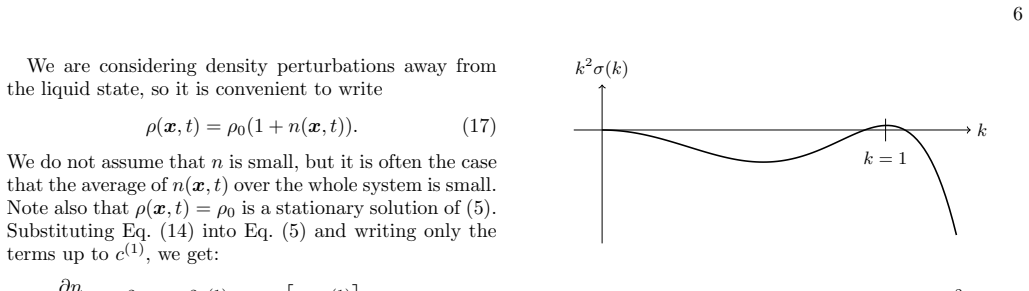
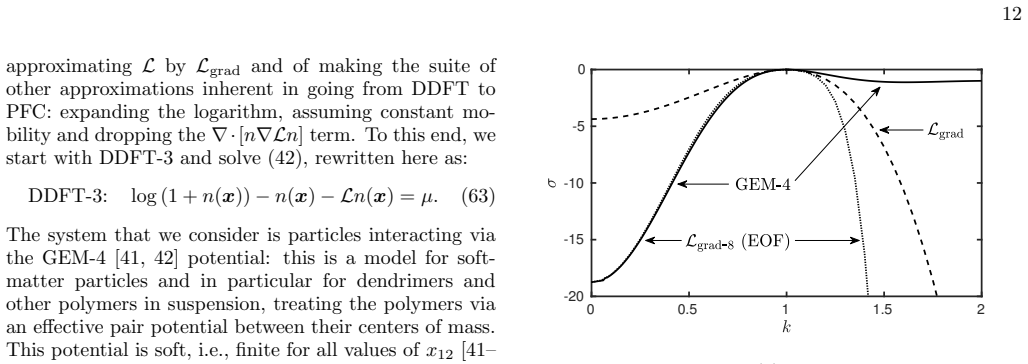
The load-bearing object is the linear operator $L$, defined by $L n(x)=-n(x)+\rho_0\int c^{(2)}(x,x_2)n(x_2)\,dx_2$, whose Fourier eigenvalues $\sigma(k)$ control the linear stability of the liquid; in DDFT it is a nonlocal convolution with the pair direct correlation function. The paper tracks the fate of the term $\nabla\cdot[n\nabla L n]$ in the dynamics, which is linked to the density-dependent mobility and the logarithmic ideal-gas term. The PFC derivation replaces $L$ by the local gradient expansion $L_{\mathrm{grad}}n = r n - \gamma(1+\nabla^2)^2 n$ and replaces $\log(1+n)$ by its truncated Taylor polynomial; the number of real roots of the polynomial versus the one root of the logarithm is the mechanism behind the spurious second spinodal. The paper also constructs a one-mode ansatz for $\varphi=\log(\rho/\rho_0)$, using the decay of the convolution's Fourier coefficients at $|k|\ge 2$ to show why a few modes in $\varphi$ capture sharply peaked density profiles.
What would settle it
Simulate or experimentally measure two-dimensional GEM-4 at temperatures $k_BT/\epsilon > 0.1$ across the density range where PFC predicts stripe, down-hexagon, and second-liquid states; if any of those appear as equilibrium phases, the claim that they are artefacts is wrong.
Extended reading notes
Core claim
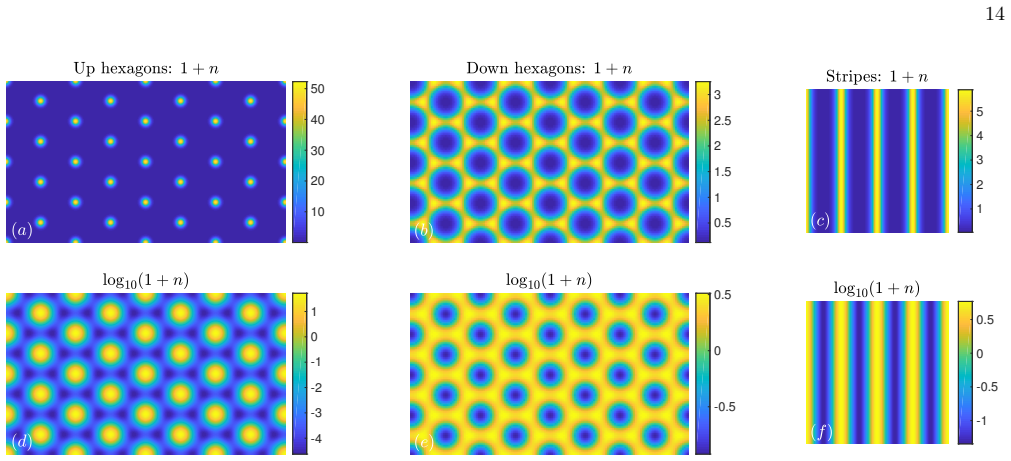
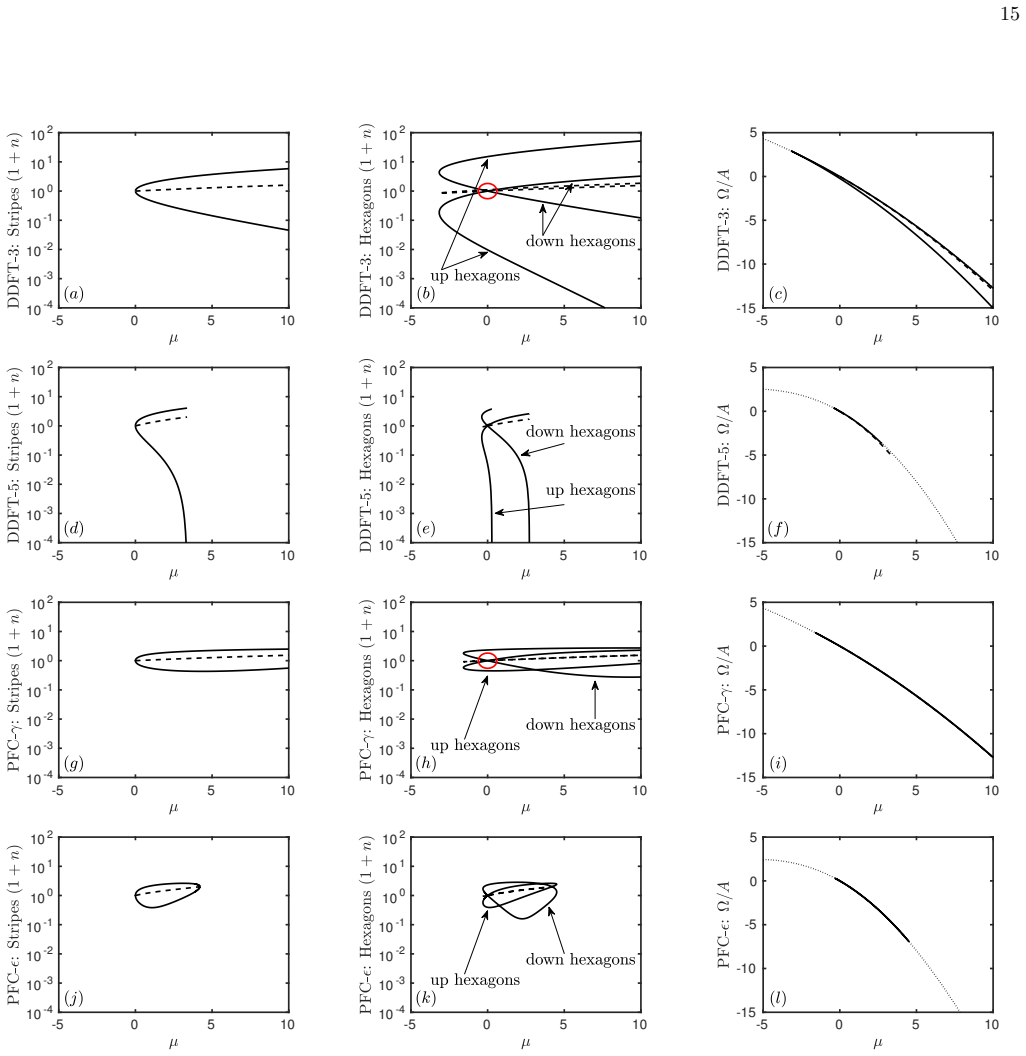
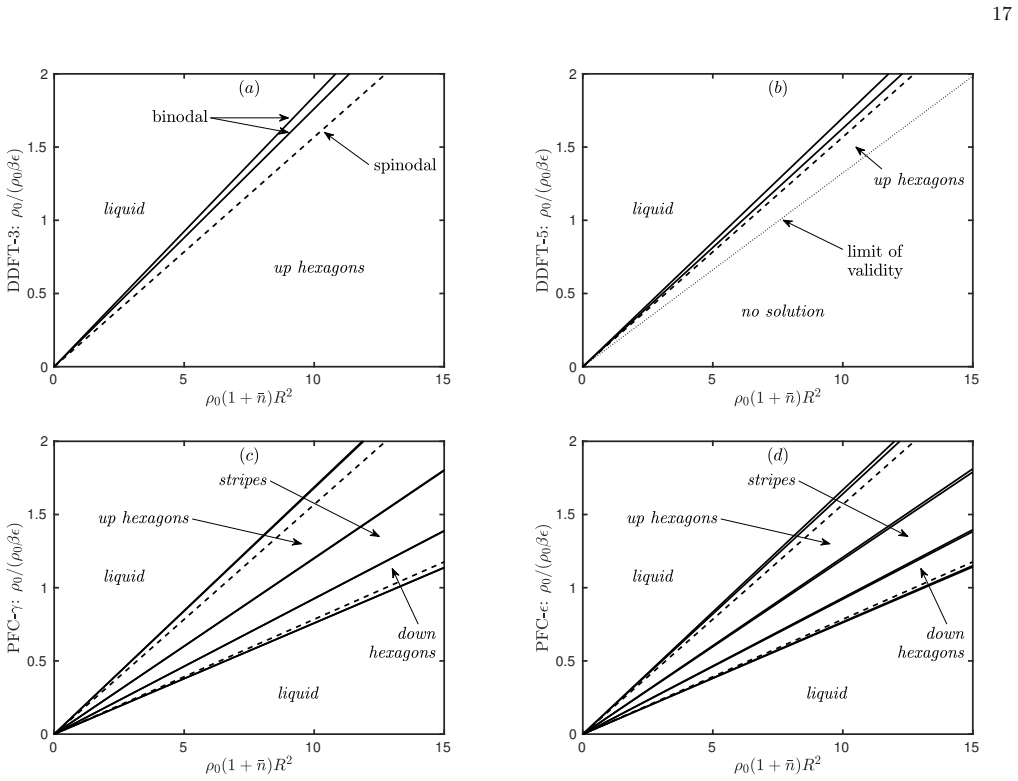
On the paper's own terms, the discovery is that the standard PFC approximations are not harmless when applied to a microscopically accurate DDFT. The term $\nabla\cdot[n\nabla L n]$, usually discarded as higher order, contributes at the same order as retained terms and helps stabilise the crystal relative to stripes. Dropping it forces a constant mobility and a polynomial replacement for $\log(1+n)$; the polynomial has two roots where the logarithm has one, which is exactly the origin of the second spinodal and the erroneous stripe and down-hexagon equilibria. Replacing the convolution $L$ by the gradient operator $L_{\mathrm{grad}}$ makes the density minimum tend to zero at finite chemical potential, with $\log(1+n)\to -\infty$ balanced by $\gamma n_{xxxx}\to +\infty$, so branches of solutions terminate. The paper therefore claims that PFC models are successful as phenomenological models but cannot be derived as accurate microscopic approximations for the density profile.
Load-bearing premise
The random-phase approximation for the free energy is an accurate description of the GEM-4 fluid in the regime studied, so the extra phases predicted by PFC are artefacts rather than states the baseline theory already misses.
Editorial extensions
If this is right
- PFC phase diagrams for crystallising soft matter contain a second liquid spinodal, a stripe phase, and down-hexagons that are not present in the accurate DDFT, so quantitative predictions of crystal thermodynamics away from the coexistence region should not be trusted.
- The gradient-expanded DDFT (DDFT-5) has a finite limit of validity: above a certain average density there is no smooth equilibrium profile, because the density touches zero and no solution exists.
- Agreement between DDFT and PFC is quantitative only for small-amplitude states close to the spinodal; beyond that, agreement is at best qualitative.
- A one-mode approximation for $\log \rho(x)$ reproduces the full DDFT-3 stripe and hexagon branches almost exactly, even when the density varies by orders of magnitude.
- Extending the gradient expansion to higher order (EOF) improves the liquid compressibility but does not remove the no-solution singularity or the second spinodal; it only delays them.
Reading between the lines
- If the one-mode accuracy for $\log\rho$ carries to other potentials, a practical route to faithful PFC-type theories would be to write the free energy in terms of $\varphi=\log(\rho/\rho_0)$ and discard high-wavenumber convolution coefficients, rather than expanding in $n$.
- The same mechanism, a polynomial replacing a logarithm with one root, implies that binary PFC models derived by the same route inherit analogous spurious re-entrant melting and lamellar phases; the paper notes that the $\nabla\cdot[n\nabla L n]$ term is also dropped in binary derivations.
- The second-spinodal artefact should appear generically for any even-order truncation of the logarithm, since the relevant equation keeps $n=0$ and $n=1$ as roots; this could be checked numerically with higher-order truncations of a model free energy.
- For systems where the pair direct correlation function is not well described by the random-phase approximation, the quantitative size of the artefacts may differ, but the structural argument about roots and the gradient expansion should persist.
Signed reviews
Editorial analysis
A structured set of objections, weighed in public.
Referee Report
Summary. The paper systematically derives phase field crystal (PFC) theory from dynamical density functional theory (DDFT), identifying and naming each approximation in the chain: truncation of the functional Taylor expansion of the excess free energy, the Ramakrishnan–Yussouff/RPA treatment, replacement of the nonlocal convolution operator L by a gradient expansion, and finally the suite of changes that converts a DDFT into a PFC model (dropping the ∇·[n∇Ln] term, assuming constant mobility, and replacing the ideal-gas logarithm by a truncated polynomial). The authors construct a hierarchy of models DDFT-0 through DDFT-5 and PFC-β through PFC-ϵ, giving the free energy, chemical potential, and dynamics for each. They illustrate the consequences for the two-dimensional GEM-4 fluid, for which RPA-based DDFT is known to be accurate. Two central artifacts are documented: (i) expanding the logarithm and dropping ∇·[n∇Ln] introduces a second spinodal, producing erroneous stripe and down-hexagon phases and a re-entrant uniform liquid; (ii) making the gradient expansion while retaining the logarithm leads the density to approach zero at isolated points, with the logarithmic singularity balanced by a divergent fourth derivative, after which no real solutions exist.
Significance. This is a significant and carefully executed negative result for the PFC literature. The claim that standard polynomial-in-density PFC models cannot be derived as quantitatively faithful reductions of DDFT is supported by two arguments that are largely independent of the specific pair potential: the second spinodal follows from the algebraic structure of the truncated logarithm (Sec. IV.A), and the no-solution region follows from a local balance between a logarithmic singularity and a fourth derivative (Sec. IV.B and Fig. 8). The numerical work is reproducible: the continuation method is fully described in Appendix B, the singularity is verified at the grid level in Fig. 8(b), and a sample Matlab code is provided as supplementary material. The authors are appropriately careful in scoping their claims to the considered approximation sequence and to the GEM-4 model, and they explicitly flag the reliance on literature support for RPA accuracy in Sec. III. The constructive one-mode log-density result in Sec. V is an important positive step, as it indicates a principled route toward accurate PFC-type descriptions.
minor comments (5)
- [Abstract, Sec. VI] The sentence 'we find it impossible to derive the PFC model as an accurate approximation to DDFT' is stronger than what is demonstrated, since the demonstration concerns the standard polynomial-in-density PFC models and the GEM-4 system; consider adding the qualifier 'for the density field n(x) within the approximation sequence considered here' in the abstract to prevent overgeneralization.
- [Sec. IV.A] The phrase 'which involves the second derivative of Eq. (51) with respect to n' is imprecise: the spinodal condition (75) involves the derivative of the chemical potential, which after cancellation of the quadratic term is the second derivative of the log expansion minus a constant; rephrasing would improve clarity.
- [Eq. (76)] The notation Lgrad-8 in Eq. (76) and in the surrounding text is slightly awkward because of the hyphen and the use of the same subscript 'grad'; consider a cleaner notation such as L_8 or L_grad^(8) for readability.
- [Sec. III, Fig. 5] In the caption of Fig. 5, the circled region of quantitative agreement between DDFT-3 and PFC-γ is mentioned but not visually obvious in the small panels; adding a zoomed inset or a more prominent marker would help the reader locate this claim.
- [Sec. III, Eq. (70)] The observation that equilibria with the same µ do not necessarily have the same mean density ¯n is important for interpreting the phase diagrams in Fig. 7; a brief additional remark on how the phase diagrams are constructed from the grand-potential comparison would be helpful for readers unfamiliar with this convention.
Circularity Check
No significant circularity: the PFC artifact analysis is derived from the stated approximations and checked against an externally supported DDFT baseline.
full rationale
The paper's central claim is negative: the standard PFC approximations to DDFT introduce spurious phases and a no-solution region. This claim is not an input to the derivation. The two headline artifacts are obtained by direct algebra from the model equations: the second PFC spinodal follows because the linearized PFC equation (75) with sigma(k)=0 has roots n_liq=0 and n_liq=1 for any even truncation of log(1+n), independently of the pair potential (Sec. IV.A); the DDFT-5 no-solution region follows from balancing log(1+n) against a fourth-derivative term in Eq. (77), with the balance explicitly verified at grid points in Fig. 8 (Sec. IV.B). The comparison between DDFT-3 and the PFC models involves no parameter fitting to the target phase diagram: the GEM-4 parameters are fixed by the linear dispersion relation sigma(1)=0 and the curvature at k=1 (Appendix A, Table II), and phase stability is computed from the grand potential (70), not imposed. The one-mode log-density approximation in Sec. V is derived by projecting Eq. (79) onto k=0 and k=1 modes and is then tested against the full numerical solution; it is not a fit to that solution. The only soft spot is the accuracy of the RPA/DDFT-3 baseline, which the paper explicitly scopes in Sec. III: 'A full assessment of the validity of the RY/RPA approximation... is beyond the scope of the present study' and 'there are examples in the literature where this approximation is reliable and others where it works badly.' For GEM-4 the RPA accuracy is supported by independent references [42,44]; the presence of a self-citation [45] in this list is not load-bearing because the central artifact arguments (the second spinodal and the singularity) do not depend on RPA accuracy. No equation in the paper reduces by construction to its own input, and no fitted parameter is renamed as a prediction.
Assumptions & free parameters
free parameters (4)
- γ (gradient expansion coefficient) =
4.3692 (2D GEM-4)
- R (GEM-4 range) =
5.0962 (2D)
- ρ0βϵ (GEM-4 coupling) =
0.2455 (2D)
- EB (EOF coefficient) =
14.383 (2D)
assumptions (5)
- domain assumption DDFT-0, Eq. (5), with mobility M(ρ)=Dρ, correctly describes the slow dynamics of the Brownian fluid.
- domain assumption The excess free energy Fex can be represented by a functional Taylor expansion truncated at O(c(4)).
- domain assumption The RPA/RY approximation (c(3)=c(4)=0) is accurate for GEM-4 in the regime studied (kBT/ϵ > 0.1).
- standard math Equilibrium phases are identified by the minimum of the specific grand potential Ω/A at fixed chemical potential.
- domain assumption The periodic solution branches of interest persist under parameter continuation and can be resolved with the stated grid sizes.
Cite this review
Pith. "Pith review of Deriving phase field crystal theory from dynamical density functional theory: consequences of the approximations." pith.science (2026). https://pith.science/paper/T3YLVNBP
@misc{pith2026190802537,
  author       = {Pith},
  title        = {Pith review of: Deriving phase field crystal theory from dynamical density functional theory: consequences of the approximations},
  year         = {2026},
  howpublished = {\url{https://pith.science/paper/T3YLVNBP}},
  note         = {Machine review of arXiv:1908.02537}
}
abstract
Phase field crystal (PFC) theory, extensively used for modelling the structure of solids, can be derived from dynamical density functional theory (DDFT) via a sequence of approximations. Standard derivations neglect a term of form $\nabla\cdot[n\nabla L n]$, where $n$ is the scaled density profile and $L$ is a linear operator. We show that this term makes a significant contribution to the stability of the crystal, and dropping this term from the theory forces another approximation, that of replacing the logarithmic term from the ideal gas contribution to the free energy with its truncated Taylor expansion, to yield a polynomial in $n$. However, the consequences of doing this are the presence of an additional spinodal in the phase diagram, so the liquid is predicted first to freeze and then to melt again as the density is increased; and other periodic structures are erroneously predicted to be thermodynamic equilibria. A second approximation is to replace $L$ by a gradient expansion. This leads to the possibility of solutions failing to exist above a certain value of the average density. We illustrate these conclusions with a simple model two-dimensional fluid. The consequences of the PFC approximations are that the phase diagram is both qualitatively incorrect, in that it has a stripe phase, and quantitatively incorrect (by orders of magnitude) regarding the properties of the crystal. Thus, although PFC models are successful as phenomenological models of crystallisation, we find it impossible to derive the PFC model as an accurate approximation to DDFT, without introducing spurious artefacts. However, making a simple one-mode approximation for the logarithm of the density distribution is surprisingly accurate, which gives a tantalising hint that accurate PFC-type theories may instead be derived for the field $\log(\rho(x))$, rather than for the density profile itself.
Figures

Figures from the paper (6 more)



Reference graph
Works this paper leans on
-
[1]
The branch may have folds (as in Fig
Pseudo-arclength continuation The main idea behind pseudo-arclength continuation is to suppose that we are looking to calculate a branch of solutions n(x) depending on the parameter µ. The branch may have folds (as in Fig. 5), and the method should be able to go around these. The method defines 24 a parameter (the arclength s) that increases or decreases m...
-
[2]
Newton’s method For Newton’s method, we define X = (n,µ ) and solve H(X) = 0. We start with X0 given by the predictor step above in (B4), and follow [68], at each step solving the linear equation ∂H ∂X·δXn =−H(Xn), (B8) where ∂H ∂X is the (N + 1)× (N + 1) matrix of derivatives ofH with respect toX, and then improving our estimate of the root by using δX. T...
-
[3]
For example, for hexagons in DDFT-3, we take n(x) = µ σ(0) ( −1 +eik1·x +eik2·x +eik3·x + c.c
Additional considerations We start the computation of each branch close ton = 0 and µ = 0 using an approximate solution derived from weakly nonlinear theory. For example, for hexagons in DDFT-3, we take n(x) = µ σ(0) ( −1 +eik1·x +eik2·x +eik3·x + c.c. ) , (B14) where the initial value of µ is small, σ(0) comes from Table II, k1 = (1, 0), k2 = (− 1 2, √ 3...
-
[4]
Modeling elasticity in crystal growth,
K. R. Elder, M. Katakowski, M. Haataja, and M. Grant, “Modeling elasticity in crystal growth,” Phys. Rev. Lett. 88, 245701 (2002)
2002
-
[5]
Modeling elastic and plastic deformations in nonequilibrium processing using phase field crystals,
K. R. Elder and M. Grant, “Modeling elastic and plastic deformations in nonequilibrium processing using phase field crystals,” Phys. Rev. E 70, 051605 (2004)
work page 2004
-
[6]
A phase-field-crystal ap- proach to critical nuclei,
R. Backofen and A. Voigt, “A phase-field-crystal ap- proach to critical nuclei,” J. Phys.: Condens. Matter 22, 364104 (2010)
work page 2010
-
[7]
Polymorphism, crystal nu- cleation and growth in the phase-field crystal model in 2D and 3D,
Gyula I. Toth, Gyoergy Tegze, Tamas Pusztai, Gergely Toth, and Laszlo Granasy, “Polymorphism, crystal nu- cleation and growth in the phase-field crystal model in 2D and 3D,” J. Phys.: Condens. Matter 22, 364101 (2010)
work page 2010
-
[8]
Solidification fronts in supercooled liquids: How rapid fronts can lead to disordered glassy solids,
A. J. Archer, M. J. Robbins, U. Thiele, and E. Knobloch, “Solidification fronts in supercooled liquids: How rapid fronts can lead to disordered glassy solids,” Phys. Rev. E 86, 031603 (2012)
work page 2012
Show all 71 references
-
[9]
Simulation of an atomistic dynamic field theory for monatomic liquids: Freezing and glass formation,
J. Berry, K. R. Elder, and M. Grant, “Simulation of an atomistic dynamic field theory for monatomic liquids: Freezing and glass formation,” Phys. Rev. E 77, 061506 (2008)
2008
-
[10]
Phase-field-crystal models for con- densed matter dynamics on atomic length and diffu- sive time scales: an overview,
Heike Emmerich, Hartmut L¨ owen, Raphael Wittkowski, Thomas Gruhn, Gyula I. T´ oth, Gy¨ orgy Tegze, and L´ aszl´ o Gr´ an´ asy, “Phase-field-crystal models for con- densed matter dynamics on atomic length and diffu- sive time scales: an overview,” Adv. Phys. 61, 665–743 (2012)
2012
-
[11]
Phase-field simulation of solidification,
William J. Boettinger, James A. Warren, Christoph Beckermann, and Alain Karma, “Phase-field simulation of solidification,” Annu. Rev. Mater. Res. 32, 163–194 (2002)
2002
-
[12]
Thermodynamics of bcc metals in phase-field- crystal models,
A. Jaatinen, C. V. Achim, K. R. Elder, and T. Ala- Nissila, “Thermodynamics of bcc metals in phase-field- crystal models,” Phys. Rev. E 80, 031602 (2009)
2009
-
[13]
Classical density functional theory and the phase-field crystal method using a rational func- tion to describe the two-body direct correlation func- tion,
N. Pisutha-Arnond, V. W. L. Chan, M. Iyer, V. Gavini, and K. Thornton, “Classical density functional theory and the phase-field crystal method using a rational func- tion to describe the two-body direct correlation func- tion,” Phys. Rev. E 87, 013313 (2013)
2013
-
[14]
Phase- field-crystal model for fcc ordering,
Kuo-An Wu, Ari Adland, and Alain Karma, “Phase- field-crystal model for fcc ordering,” Phys. Rev. E 81, 061601 (2010)
2010
-
[15]
Stabil- ity of quasicrystals composed of soft isotropic particles,
Kobi Barkan, Haim Diamant, and Ron Lifshitz, “Stabil- ity of quasicrystals composed of soft isotropic particles,” Phys. Rev. B 83, 172201 (2011)
2011
-
[16]
Growth modes of quasicrystals,
C. V. Achim, M. Schmiedeberg, and H. L¨ owen, “Growth modes of quasicrystals,” Phys. Rev. Lett. 112, 255501 (2014)
2014
-
[17]
Three-dimensional icosahedral phase field quasicrystal,
P. Subramanian, A. J. Archer, E. Knobloch, and A. M. Rucklidge, “Three-dimensional icosahedral phase field quasicrystal,” Phys. Rev. Lett. 117, 075501 (2016)
2016
-
[18]
Sta- bility of icosahedral quasicrystals in a simple model with two-length scales,
Kai Jiang, Pingwen Zhang, and An-Chang Shi, “Sta- bility of icosahedral quasicrystals in a simple model with two-length scales,” J. Phys.: Condens. Matter29, 124003 (2017)
2017
-
[19]
Multiple-scale structures: from Faraday waves to soft- matter quasicrystals,
Samuel Savitz, Mehrtash Babadi, and Ron Lifshitz, “Multiple-scale structures: from Faraday waves to soft- matter quasicrystals,” IUCrJ 5, 247–268 (2018)
2018
-
[20]
Hydrodynamic fluctu- ations at the convective instability,
J. Swift and P. C. Hohenberg, “Hydrodynamic fluctu- ations at the convective instability,” Phys. Rev. A 15, 319–328 (1977)
1977
-
[21]
Localized states in the conserved Swift– Hohenberg equation with cubic nonlinearity,
U. Thiele, A. J. Archer, M. J. Robbins, H. Gomez, and E. Knobloch, “Localized states in the conserved Swift– Hohenberg equation with cubic nonlinearity,” Phys. Rev. E 87, 042915 (2013)
2013
-
[22]
Kinetics of phase separation in two-dimensional systems with competing interactions,
Celeste Sagui and Rashmi C. Desai, “Kinetics of phase separation in two-dimensional systems with competing interactions,” Phys. Rev. E 49, 2225–2244 (1994)
1994
-
[23]
Spatial localization in dissipative sys- tems,
E. Knobloch, “Spatial localization in dissipative sys- tems,” Annu. Rev. Condens. Matter Phys. 6, 325–359 (2015)
2015
-
[24]
Pattern formation with a conservation law,
P. C. Matthews and S. M. Cox, “Pattern formation with a conservation law,” Nonlinearity 13, 1293–1320 (2000)
2000
-
[25]
Phase-field crystal modeling and classical density functional theory of freezing,
K. R. Elder, N. Provatas, J. Berry, P. Stefanovic, and M. Grant, “Phase-field crystal modeling and classical density functional theory of freezing,” Phys. Rev. B 75, 064107 (2007)
2007
-
[26]
Derivation of the phase-field-crystal model for colloidal solidification,
S. van Teeffelen, R. Backofen, A. Voigt, and H. Lowen, “Derivation of the phase-field-crystal model for colloidal solidification,” Phys. Rev. E 79, 051404 (2009)
2009
-
[27]
Phase-field- crystal dynamics for binary systems: Derivation from dynamical density functional theory, amplitude equation formalism, and applications to alloy heterostructures,
Z. F. Huang, K. R. Elder, and N. Provatas, “Phase-field- crystal dynamics for binary systems: Derivation from dynamical density functional theory, amplitude equation formalism, and applications to alloy heterostructures,” Phys. Rev. E 82, 021605 (2010)
2010
-
[28]
The nature of the liquid-vapour interface and other topics in the statistical mechanics of non-uniform, classical fluids,
R. Evans, “The nature of the liquid-vapour interface and other topics in the statistical mechanics of non-uniform, classical fluids,” Adv. Phys. 28, 143–200 (1979)
1979
-
[29]
Density functionals in the theory of non- uniform fluids,
R. Evans, “Density functionals in the theory of non- uniform fluids,” in Fundamentals of Inhomogeneous Flu- ids, edited by D. Henderson (Marcel Dekker, New York,
-
[30]
Hansen and I
J.-P. Hansen and I. R. McDonald, Theory of Simple Liq- uids with Applications to Soft Matter: Fourth Edition (Elsevier, Oxford, 1992)
1992
-
[31]
Dynamic density functional theory of fluids,
U. Marini Bettolo Marconi and P. Tarazona, “Dynamic density functional theory of fluids,” J. Chem. Phys. 110, 8032 (1999)
1999
-
[32]
Dynamic density functional theory of fluids,
U. Marini Bettolo Marconi and P. Tarazona, “Dynamic density functional theory of fluids,” J. Phys.: Condens. Matter 12, A413 (2000)
2000
-
[33]
Dynamical density functional theory for interacting brownian par- ticles: stochastic or deterministic?
Andrew J. Archer and Markus Rauscher, “Dynamical density functional theory for interacting brownian par- ticles: stochastic or deterministic?” J. Phys. A: Math. Gen. 37, 9325–9333 (2004)
2004
-
[34]
Dynamical density functional theory and its application to spinodal decom- position,
Andrew J. Archer and Robert Evans, “Dynamical density functional theory and its application to spinodal decom- position,” J. Chem. Phys. 121, 4246–4254 (2004)
2004
-
[35]
Dynamical density functional theory for dense atomic liquids,
Andrew J. Archer, “Dynamical density functional theory for dense atomic liquids,” J. Phys.: Condens. Matter 18, 5617 (2006)
2006
-
[36]
Dynamical density functional the- ory for molecular and colloidal fluids: A microscopic ap- proach to fluid mechanics,
Andrew J. Archer, “Dynamical density functional the- ory for molecular and colloidal fluids: A microscopic ap- proach to fluid mechanics,” J. Chem. Phys. 130, 014509 27 (2009)
2009
-
[37]
The overdamped limit of dynamic density functional theory: Rigorous results,
Benjamin D. Goddard, Grigorios A. Pavliotis, and Ser- afim Kalliadasis, “The overdamped limit of dynamic density functional theory: Rigorous results,” Multiscale Modeling & Simulation 10, 633–663 (2012)
2012
-
[38]
Unification of dynamic density functional theory for colloidal fluids to include inertia and hydro- dynamic interactions: derivation and numerical experi- ments,
B. D. Goddard, A. Nold, N. Savva, P. Yatsyshin, and S. Kalliadasis, “Unification of dynamic density functional theory for colloidal fluids to include inertia and hydro- dynamic interactions: derivation and numerical experi- ments,” J. Phys.: Condens. Matter 25, 035101 (2013)
2013
-
[39]
General framework for fluctuating dynamic density functional theory,
Miguel A. Dur´ an-Olivencia, Peter Yatsyshin, Ben- jamin D. Goddard, and Serafim Kalliadasis, “General framework for fluctuating dynamic density functional theory,” New J. Phys. 19, 123022 (2017)
2017
-
[40]
Power functional theory for newto- nian many-body dynamics,
Matthias Schmidt, “Power functional theory for newto- nian many-body dynamics,” J. Chem. Phys. 148, 044502 (2018)
2018
-
[41]
A bidimensional fluid system with competing interactions: spontaneous and induced pattern formation,
A. Imperio and L. Reatto, “A bidimensional fluid system with competing interactions: spontaneous and induced pattern formation,” J. Phys.: Condens. Matter 16, S3769 (2004)
2004
-
[42]
Microphase separation in two-dimensional systems with competing interactions,
A. Imperio and L. Reatto, “Microphase separation in two-dimensional systems with competing interactions,” J. Chem. Phys. 124, 164712 (2006)
2006
-
[43]
Phase behavior of a fluid with competing attractive and repulsive inter- actions,
Andrew J. Archer and Nigel B. Wilding, “Phase behavior of a fluid with competing attractive and repulsive inter- actions,” Phys. Rev. E 76, 031501 (2007)
2007
-
[44]
Formation of poly- morphic cluster phases for a class of models of purely re- pulsive soft spheres,
Bianca M. Mladek, Dieter Gottwald, Gerhard Kahl, Mar- tin Neumann, and Christos N. Likos, “Formation of poly- morphic cluster phases for a class of models of purely re- pulsive soft spheres,” Phys. Rev. Lett.96, 045701 (2006)
2006
-
[45]
Hexatic phase and cluster crystals of two-dimensional GEM4 spheres,
Santi Prestipino and Franz Saija, “Hexatic phase and cluster crystals of two-dimensional GEM4 spheres,” J. Chem. Phys. 141, 184502 (2014)
2014
-
[46]
Effective interactions in soft condensed matter physics,
C. N. Likos, “Effective interactions in soft condensed matter physics,” Phys. Rep. 348, 267–439 (2001)
2001
-
[47]
Clustering in the absence of attractions: Density functional theory and computer simulations,
Bianca M. Mladek, Dieter Gottwald, Gerhard Kahl, Mar- tin Neumann, and Christos N. Likos, “Clustering in the absence of attractions: Density functional theory and computer simulations,” J Phys. Chem. B 111, 12799– 12808 (2007)
2007
-
[48]
Solidification in soft-core fluids: Dis- ordered solids from fast solidification fronts,
Andrew J. Archer, Morgan C. Walters, Uwe Thiele, and Edgar Knobloch, “Solidification in soft-core fluids: Dis- ordered solids from fast solidification fronts,” Phys. Rev. E 90, 042404 (2014)
2014
-
[49]
Elas- tic constants of stressed and unstressed materials in the phase-field crystal model,
Zi-Le Wang, Zhi-Feng Huang, and Zhirong Liu, “Elas- tic constants of stressed and unstressed materials in the phase-field crystal model,” Phys. Rev. B 97, 144112 (2018)
2018
-
[50]
Density functional theory for the crystallization of two- dimensional dipolar colloidal alloys,
W. R. C. Somerville, J. L. Stokes, A. M. Adawi, T. S. Horozov, Andrew J. Archer, and D. M. A. Buzza, “Density functional theory for the crystallization of two- dimensional dipolar colloidal alloys,” J. Phys.: Condens. Matter 30, 405102 (2018)
2018
-
[51]
Freezing of a Lennard–Jones fluid: From nucle- ation to spinodal regime,
Federica Trudu, Davide Donadio, and Michele Par- rinello, “Freezing of a Lennard–Jones fluid: From nucle- ation to spinodal regime,” Phys. Rev. Lett. 97, 105701 (2006)
2006
-
[52]
First-principles order-parameter theory of freezing,
T. V. Ramakrishnan and M. Yussouff, “First-principles order-parameter theory of freezing,” Phys. Rev. B 19, 2775–2794 (1979)
1979
-
[53]
Modeling the structure of liquids and crystals using one- and two-component modified phase-field crystal models,
M. J. Robbins, A. J. Archer, U. Thiele, and E. Knobloch, “Modeling the structure of liquids and crystals using one- and two-component modified phase-field crystal models,” Phys. Rev. E 85, 061408 (2012)
2012
-
[54]
Phase-field-crystal model for ordered crys- tals,
Eli Alster, K. R. Elder, Jeffrey J. Hoyt, and Peter W. Voorhees, “Phase-field-crystal model for ordered crys- tals,” Phys. Rev. E 95, 022105 (2017)
2017
-
[55]
Two-component structural phase-field crystal models for graphene symmetries,
K. L. M. Elder, M. Seymour, M. Lee, M. Hilke, and N. Provatas, “Two-component structural phase-field crystal models for graphene symmetries,” Phil. Trans. Roy. Soc. Lond. A 376 (2018)
2018
-
[56]
Angle- adjustable density field formulation for the modeling of crystalline microstructure,
Zi-Le Wang, Zhirong Liu, and Zhi-Feng Huang, “Angle- adjustable density field formulation for the modeling of crystalline microstructure,” Phys. Rev. B 97, 180102(R) (2018)
2018
-
[57]
Controlling crystal symmetries in phase-field crystal models,
Kuo-An Wu, Mathis Plapp, and Peter W. Voorhees, “Controlling crystal symmetries in phase-field crystal models,” J. Phys.: Condens. Matter 22, 364102 (2010)
2010
-
[58]
Eighth-order phase- field-crystal model for two-dimensional crystallization,
A. Jaatinen and T. Ala-Nissila, “Eighth-order phase- field-crystal model for two-dimensional crystallization,” Phys. Rev. E 82, 061602 (2010)
2010
-
[59]
Density functional theory for inhomogeneous fluids i: Simple fluids in equilibrium,
R. Evans, “Density functional theory for inhomogeneous fluids i: Simple fluids in equilibrium,” in 3rd War- saw School of Statistical Physics , edited by B. Cichocki, M. Napi´ orkowski, and J. Piasechi (Warsaw University Press, Warsaw, 2010) Chap. 2, pp. 43–85
2010
-
[60]
Density functional theory for inhomo- geneous fluids ii: Statics, dynamics and applications,
Hartmut L¨ owen, “Density functional theory for inhomo- geneous fluids ii: Statics, dynamics and applications,” in 3rd Warsaw School of Statistical Physics , edited by B. Cichocki, M. Napi´ orkowski, and J. Piasechi (Warsaw University Press, Warsaw, 2010) Chap. 3, pp. 87–12
2010
-
[61]
Soft matter with soft particles,
C. N. Likos, “Soft matter with soft particles,” Soft Matter 2, 478–498 (2006)
2006
-
[62]
Microscopically resolved simulations prove the existence of soft cluster crystals,
Dominic A. Lenz, Ronald Blaak, Christos N. Likos, and Bianca M. Mladek, “Microscopically resolved simulations prove the existence of soft cluster crystals,” Phys. Rev. Lett. 109, 228301 (2012)
2012
-
[63]
Phase-field crystal mod- eling of equilibrium bcc-liquid interfaces,
Kuo-An Wu and Alain Karma, “Phase-field crystal mod- eling of equilibrium bcc-liquid interfaces,” Phys. Rev. B 76, 184107 (2007)
2007
-
[64]
Recent de- velopments in Rayleigh–B´ enard convection,
E. Bodenschatz, W. Pesch, and G. Ahlers, “Recent de- velopments in Rayleigh–B´ enard convection,” Annu. Rev. Fluid Mech. 32, 709–778 (2000)
2000
-
[65]
Crystal- lization of soft matter under confinement at interfaces and in wedges,
Andrew J. Archer and Alexandr Malijevsk` y, “Crystal- lization of soft matter under confinement at interfaces and in wedges,” J. Phys.: Condens. Matter 28, 244017 (2016)
2016
-
[66]
Bimodal grain-size scal- ing of thermal transport in polycrystalline graphene from large-scale molecular dynamics dimulations,
Zheyong Fan, Petri Hirvonen, Luiz Felipe C. Pereira, Mikko M. Ervasti, Ken R. Elder, Davide Donadio, Ari Harju, and Tapio Ala-Nissila, “Bimodal grain-size scal- ing of thermal transport in polycrystalline graphene from large-scale molecular dynamics dimulations,” Nano Lett. 17...
2017
-
[67]
Long-time behaviour and phase tran- sitions for the McKean–Vlasov equation on the torus,
J. A. Carrillo, R. S. Gvalani, G. A. Pavliotis, and A. Schlichting, “Long-time behaviour and phase tran- sitions for the McKean–Vlasov equation on the torus,” arXiv preprint arXiv:1806.01719 (2018)
2018 arXiv
-
[68]
Dynamics of the Desai– Zwanzig model in multiwell and random energy land- scapes,
Susana N. Gomes, Serafim Kalliadasis, Grigorios A. Pavliotis, and Petr Yatsyshin, “Dynamics of the Desai– Zwanzig model in multiwell and random energy land- scapes,” Phys. Rev. E 99, 032109 (2019)
2019
-
[69]
Source type solutions of a fourth order nonlin- ear degenerate parabolic equation,
Francisco Bernis, Lambertus A. Peletier, and S. M. Williams, “Source type solutions of a fourth order nonlin- ear degenerate parabolic equation,” Nonlinear Analysis 18, 217–234 (1992)
1992
-
[70]
Numerical analysis and control of bifurcation problems (I): Bifur- 28 cation in finite dimensions,
E. Doedel, H. B. Keller, and J. P. Kernevez, “Numerical analysis and control of bifurcation problems (I): Bifur- 28 cation in finite dimensions,” Int. J. Bifurcat. Chaos 1, 493–520 (1991)
1991
-
[71]
C. T. Kelley, Solving Nonlinear Equations with Newton ’s Method (SIAM, Philadelphia, 2003)
2003
Reviewed August 14, 2026 · model on record in the stance chip above.
Discussion (0). Continue with ORCID to comment.