REVIEW 2 major objections 4 minor 90 references
Flat Chern Band From Twisted Bilayer MnBi$_2$Te$_4$
T0 review · 2 major / 4 minor · reviewed 2026-08-14 · deepseek-v4-flash
Pith's one-line read One-degree twist turns MnBi2Te4 into a flat Chern band
desk verdict A solid, timely model-based proposal for flat Chern bands in twisted bilayer MnBi2Te4; the main caveat is that the flatness is a near-cancellation at the truncated interlayer-potential scale, so the quantitative prediction needs validation. read the letter →
The pith
A machine-rendered reading of the paper's core claim, the machinery that carries it, and where it could break.
The reading
What carries the argument
The central object is a continuum moiré model of twisted bilayer MnBi$_2$Te$_4$: each layer is a four-band $\mathbf{k}\cdot\mathbf{p}$ Hamiltonian for the Bi/Te $p_z$ orbitals, rotated by $\pm\theta/2$, and the layers are coupled by an interlayer moiré hopping $T(\mathbf r)$ whose Fourier expansion keeps the constant term plus the six smallest nonzero moiré reciprocal wavevectors. The hopping matrices are fixed by requiring that at the AA and AB stacking points the model reproduces the untwisted bilayer hoppings, with higher harmonics assumed to decay exponentially. The model turns the twist angle $\theta$, a staggered layer potential $U_d$, and the magnetic order strength ($\gamma_f$ or $\gamma_{af}$) into tunable parameters of the band structure. The key mechanism is that $U_d$ flattens the first valence band into an isolated narrow band while the band's Chern number is set by gap-closing transitions at high-symmetry points; the flattening is asymmetric because the monolayer Hamiltonian contains the particle-hole asymmetric term $\epsilon_0(k)=\gamma k^2$.
What would settle it
A decisive check is to measure the first valence band of a twisted bilayer MnBi$_2$Te$_4$ sample near $\theta=1^\circ$ with a staggered layer potential around 40 meV: the claim predicts a bandwidth near 1 meV, a gap near 4 meV, and a nonzero Chern number, so a scanning tunnelling or photoemission measurement showing a much wider band or no isolated gap would refute it. A first-principles calculation of the relaxed twisted interface, including higher harmonic couplings and atomic relaxation, would test whether the six-component continuum hopping is adequate.
Extended reading notes
Core claim
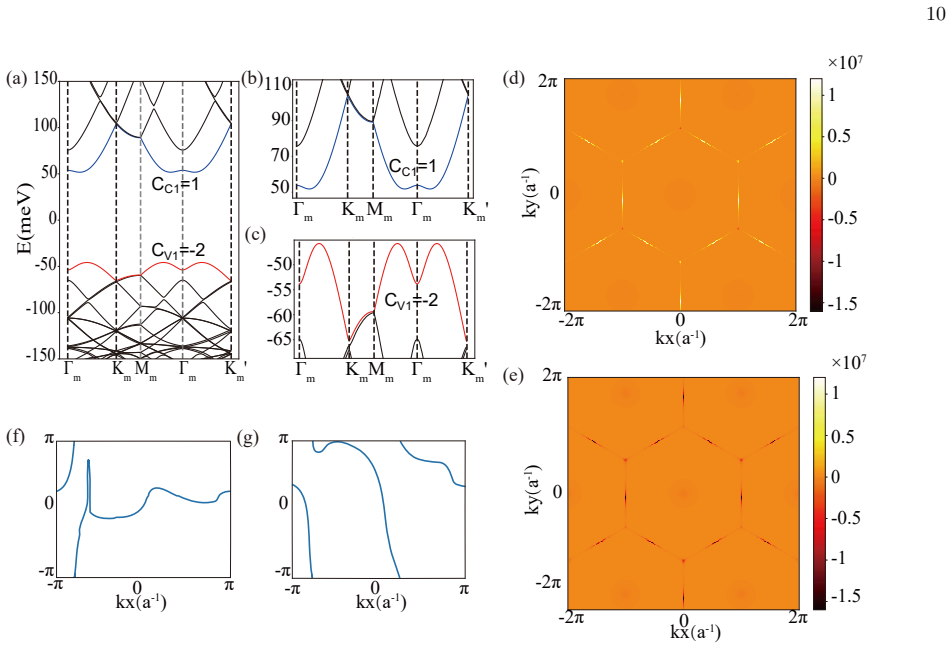
Starting from a four-band $\mathbf{k}\cdot\mathbf{p}$ description of a single MnBi$_2$Te$_4$ septuple layer, the paper builds a continuum moiré model of a twisted bilayer with a spatially periodic interlayer hopping $T(\mathbf r)=T_0+\sum_{j=1}^6 T_j e^{i\mathbf g_j\cdot\mathbf r}$, calibrated to reproduce the untwisted AA and AB stackings. For both ferromagnetic and antiferromagnetic arrangements of the two layers, it finds that at twist angle $\theta\simeq 1^\circ$ and a staggered layer potential $U_d$ of tens of meV, the first valence band narrows to $W\simeq 1$–$3$ meV, opens a gap $\Delta\simeq 4$ meV to neighboring bands, and acquires Chern number $-1$ in the ferromagnetic case or $+1$ in the antiferromagnetic case. The band is nondegenerate and isolated, so partial filling leaves a single Fermi surface; with a dielectric constant $\epsilon_r\simeq 10$, the Coulomb scale $U$ gives $2 \lesssim U/W \lesssim 6$. The paper proposes this isolated flat Chern band as a platform for fractional Chern insulators and $p+ip$ topological superconductivity, and notes that twisting lowers the ferromagnetic strength needed for the quantum anomalous Hall effect.
Load-bearing premise
The load-bearing premise is that the simplified interlayer hopping between the two twisted layers, built from the constant term plus the six smallest moiré wavelike terms and matched to the untwisted AA and AB stackings, accurately represents the real interface, so that atomic relaxation and smaller additional terms do not destroy the predicted flatness, gap, or Chern number.
Editorial extensions
If this is right
- At partial filling, the ratio of Coulomb energy to bandwidth lies between 2 and 6, so electron interactions should produce strongly correlated states such as fractional Chern insulators without an external magnetic field.
- Because the band already breaks time reversal at the single-particle level, the platform avoids the zero-total-Chern-number obstruction of earlier moiré systems.
- Twisting lowers the ferromagnetic exchange field needed for the quantum anomalous Hall effect, so the QAH state may appear where the untwisted bilayer is still trivial.
- Both ferromagnetic and antiferromagnetic layer arrangements give an isolated flat Chern band, so the proposal does not depend on selecting a single magnetic ground state.
- If pairing develops in the nondegenerate flat band, a chiral topological superconductor is a plausible outcome.
Reading between the lines
- If confirmed, the same twisted-stacking recipe could be transferred to other magnetic layered topological insulators, such as Mn2Bi2Te5 and MnBi4Te7, potentially broadening the family of flat-Chern-band platforms.
- The flattening mechanism identified here—a staggered potential acting on one spin-polarized band through particle-hole asymmetry—may serve as a design rule for engineering flat topological bands in other magnetic Dirac-like layered materials.
- The predicted interaction-to-bandwidth ratio sits in a regime where the stability of fractional Chern states is nontrivial, so exact-diagonalization studies of the continuum model bands could map which filling fractions host robust ground states.
- The model assumes rigid layer magnetization; a self-consistent treatment of how the moiré potential modifies the local magnetic order would test whether the flat Chern band survives coupling to magnetic fluctuations.
Signed reviews
Editorial analysis
A structured set of objections, weighed in public.
Referee Report
Summary. The paper constructs a continuum k·p model for twisted bilayer MnBi2Te4 (tBMBT) in both ferromagnetic (FM) and antiferromagnetic (AFM) phases, combining monolayer Hamiltonians with a moiré interlayer hopping potential. The authors compute moiré band structures, Berry curvature, and Wilson-loop Chern numbers, and report that near a twist angle of 1°, with a tunable staggered layer potential, the first valence band becomes an isolated flat Chern band with Chern number ±1, bandwidth W ≈ 1–3 meV, and a gap of about 4 meV. They argue that this gives an interaction-to-bandwidth ratio U/W between 2 and 6, making the system a candidate platform for fractional Chern insulators and p+ip topological superconductors. The paper also presents Chern-number phase diagrams and notes the possibility of Chern numbers up to 3 in higher bands.
Significance. If the model is faithful, this is one of the first proposals for a time-reversal-breaking moiré flat Chern band in a magnetic van der Waals material, with a concrete experimental platform and tunable parameters. The paper is careful in its internal topological characterization: the Chern numbers are computed by two independent methods (Berry curvature integration and Wilson-loop winding), and the full parameter set is listed explicitly in Table I. The main risk is not internal consistency but model fidelity: the central flat-band prediction is comparable in energy to the truncation scale of the interlayer moiré potential, so the result needs robustness checks before the platform claim can be considered established.
major comments (2)
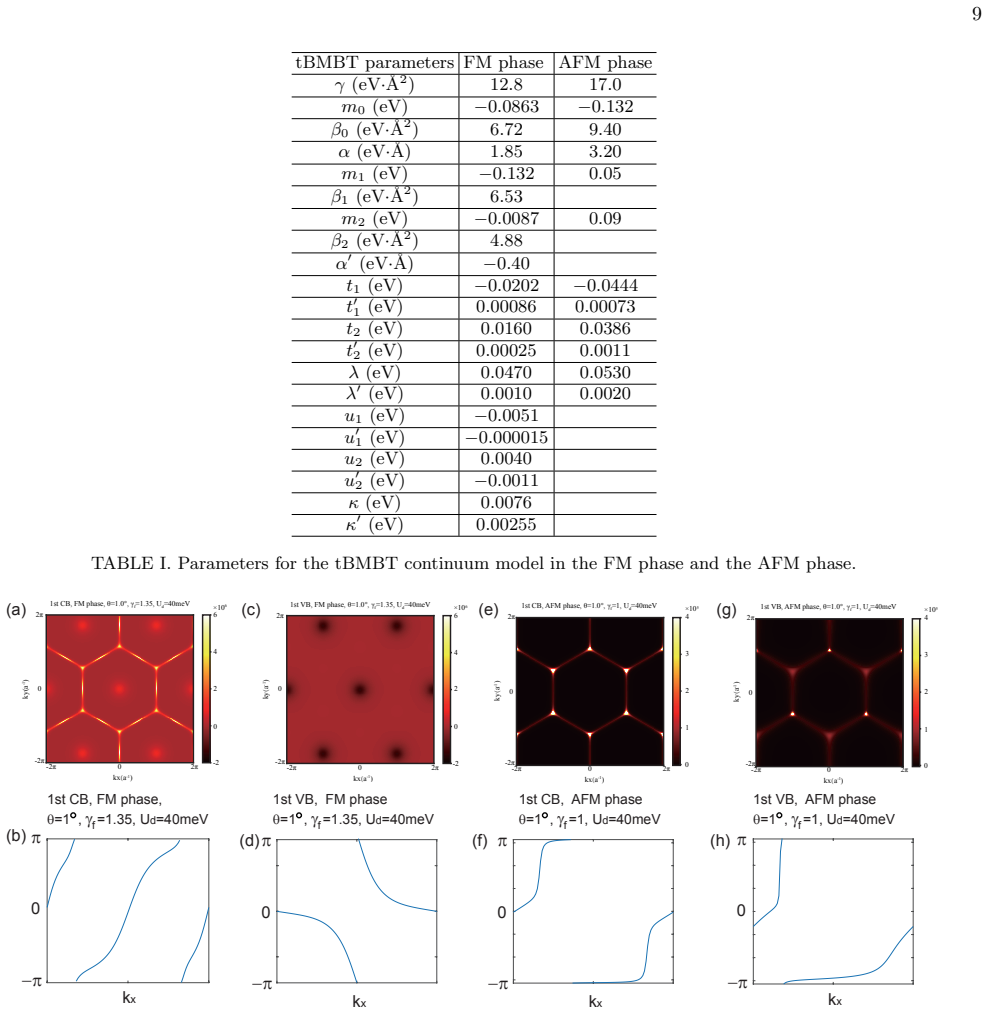
- [§Model, Eq. (5); SM S3, Eqs. (21)–(23); Table I] The interlayer moiré potential T(r) is the load-bearing input for the central claim, and its six-Fourier-component form is calibrated only by matching the untwisted AA and AB stacking configurations. The claimed flat first valence band at θ = 1° has W ≈ 1 meV and Δ ≈ 4 meV (Fig. 2(b)), while the first-harmonic couplings in Table I are t'1 = 0.86 meV and λ' = 1.0 meV in the FM phase and t'1 = 0.73 meV, λ' = 2.0 meV in the AFM phase. The flat-band condition is therefore a near-cancellation at the same energy scale as the truncation of the Fourier expansion. The statement in SM S3 that higher harmonics decay exponentially is not quantified, BA and intermediate stackings are not constrained by the calibration, and lattice relaxation at θ ≈ 1° is not discussed. I request robustness tests: add the next harmonic shell with estimated coefficients, compare the interlayer potential against all high-symmetry stackings (AA, AB, BA) from a microscopic calculation, and estimate or bound relaxation-induced changes to T(r). Without such tests, the predicted W ≈ 1–3 meV flatness and 4 meV isolation could be artifacts of the truncation.
- [SM S1, momentum-space cutoff and large-k regularization] The momentum-space calculation (SM Eq. (12)) requires a cutoff in the reciprocal-lattice vectors Q, and the monolayer k·p Hamiltonian is only valid for small k. The text states that "the low energy physics is not affected by the Q cutoff or large k dispersion corrections," but no convergence test or comparison of different large-k regularizations is shown. Since the target bandwidth is about 1 meV while the monolayer kinetic energy at the first moiré wavevector is about 10 meV, numerical truncation could influence the flatness and the Chern-number phase boundaries. Please provide Q-convergence data for W, Δ, and the relevant Chern numbers for the representative cases in Figs. 2(b) and 3(b).
minor comments (4)
- [Abstract; Figs. 2(f), 2(g), 3(d)] The abstract advertises "Chern bands with Chern number up to 3," but the text states that most bands other than the first conduction and valence bands have no indirect gaps. Chern numbers of bands in a metallic spectrum do not correspond to a quantized transport response, so the high-Chern phase diagrams should be explicitly labeled as band Chern numbers of non-isolated bands, and the physical QAH claim should be restricted to the gapped first-band cases.
- [Fig. 2] The y-axis energy scales and high-symmetry path labels are not consistent across all panels of Fig. 2; for example, panels (a)–(e) would benefit from a single shared axis label and explicit path notation to aid comparison.
- [Discussion, U/W estimate] The estimate U ≈ 6 meV with ϵr ≈ 10 is plausible, but the choice of dielectric constant and the length scale used for the Coulomb energy should be stated explicitly, since the ratio U/W between 2 and 6 is one of the paper's headline figures.
- [SM S3, parameter averaging] The monolayer parameters are said to be obtained by "properly averaging between the AB stacking and AA stacking parameters," but the averaging scheme is not specified. A brief statement of the averaging rule would make the model reproducible.
Circularity Check
No significant circularity: the flat Chern band is a solved output of a continuum model calibrated to external first-principles inputs, not a refit of the target result.
full rationale
The derivation chain is self-contained in the relevant sense. The monolayer k·p Hamiltonians (Eqs. 3, 4, 7, 8) and the interlayer moiré hopping parameters (Table I) are taken from first-principles calculations of bulk and few-layer MnBi2Te4, primarily Ref. [60], which is an independent DFT-based input even though one author overlaps. The interlayer potential T(r) is fixed by Eqs. (5) and (21)-(23), requiring it to reproduce the untwisted AA and AB stacking Hamiltonians; no term in that construction is fitted to a target Chern number, flat bandwidth, or band gap. The claimed flat Chern band with W ≈ 1–3 meV, Δ ≈ 4 meV, and Chern number ±1 is then obtained by diagonalizing the resulting moiré Hamiltonian and computing Berry curvature and Wilson loops (SM Figs. 4-5). The tuning parameters Ud and γf are scanned over phase diagrams, and the flat-band region is an emergent feature of the model rather than an input. The six-harmonic truncation and neglect of lattice relaxation are modeling approximations that could affect quantitative accuracy, but they are not circular: the prediction does not reduce to any fitted quantity by construction, and no self-citation is used to forbid alternatives or to define the target result into existence. Therefore the paper merits a circularity score of 0.
Assumptions & free parameters
free parameters (6)
- Twist angle theta = 1 degree =
1 degree
- Staggered layer potential Ud = 40 meV =
40 meV
- FM exchange strength gamma_f = 1.35 =
1.35
- AFM exchange strength gamma_af = 1 =
1
- Monolayer k.p parameter set (gamma, m0, beta0, alpha, m1, m2, beta1, beta2, alpha') =
Separate FM and AFM columns in Table I of the Supplemental Material
- Interlayer hopping parameter set (t1, t1', t2, t2', lambda, lambda', u1, u1', u2, u2', kappa, kappa') =
Values in Table I of the Supplemental Material
assumptions (6)
- domain assumption The 4x4 k.p Hamiltonian at the Gamma point captures the relevant low-energy orbitals of each MnBi2Te4 septuple layer.
- domain assumption The interlayer moire hopping can be truncated to the six smallest Fourier components.
- domain assumption The interlayer potential is calibrated by matching untwisted AA and AB stacking limits, with monolayer parameters averaged between stackings.
- domain assumption The AFM exchange term is independent of in-plane momentum.
- standard math Bloch bands of the moire Hamiltonian are calculated by Fourier transforming into a reciprocal-lattice hopping model.
- standard math Chern numbers are obtained from Wilson loop winding or Berry curvature integration.
Cite this review
Pith. "Pith review of Flat Chern Band From Twisted Bilayer MnBi$_2$Te$_4$." pith.science (2026). https://pith.science/paper/RYZJZFG7
@misc{pith2026190802581,
  author       = {Pith},
  title        = {Pith review of: Flat Chern Band From Twisted Bilayer MnBi$_2$Te$_4$},
  year         = {2026},
  howpublished = {\url{https://pith.science/paper/RYZJZFG7}},
  note         = {Machine review of arXiv:1908.02581}
}
abstract
We construct a continuum model for the Moir\'e superlattice of twisted bilayer MnBi$_2$Te$_4$, and study the band structure of the bilayer in both ferromagnetic (FM) and antiferromagnetic (AFM) phases. We find the system exhibits highly tunable Chern bands with Chern number up to $3$. We show that a twist angle of $1^\circ$ turns the highest valence band into a flat band with Chern number $\pm1$ that is isolated from all other bands in both FM and AFM phases. This result provides a promising platform for realizing time-reversal breaking correlated topological phases, such as fractional Chern insulator and $p+ip$ topological superconductor. In addition, our calculation indicates that the twisted stacking facilitates the emergence of quantum anomalous Hall effect in MnBi$_2$Te$_4$.
Figures


Figures from the paper (2 more)
Reference graph
Works this paper leans on
-
[1]
Z2 topological order and the quantum spin hall effect,
C. L. Kane and E. J. Mele, “Z2 topological order and the quantum spin hall effect,” Phys. Rev. Lett. 95, 146802 (2005)
2005
-
[2]
Quantum spin hall effect in graphene,
C. L. Kane and E. J. Mele, “Quantum spin hall effect in graphene,” Phys. Rev. Lett. 95, 226801 (2005)
2005
-
[3]
Quan- tum spin hall effect and topological phase transition in hgte quantum wells,
B. A. Bernevig, T. L. Hughes, and S.-C. Zhang, “Quan- tum spin hall effect and topological phase transition in hgte quantum wells,” Science 314, 1757–1761 (2006)
2006
-
[4]
Quantum spin hall insulator state in hgte quantum wells,
M. K¨ onig, S. Wiedmann, C. Br¨ une, A. Roth, H. Buh- mann, L. W. Molenkamp, X.-L. Qi, and S.-C. Zhang, “Quantum spin hall insulator state in hgte quantum wells,” Science 318, 766–770 (2007)
2007
-
[5]
Topological insu- lators in three dimensions,
L. Fu, C. L. Kane, and E. J. Mele, “Topological insu- lators in three dimensions,” Phys. Rev. Lett. 98, 106803 (2007)
2007
-
[6]
Experimental realization of a three-dimensional topo- logical insulator, bi2te3,
Y. L. Chen, J. G. Analytis, J.-H. Chu, Z. K. Liu, S.-K. Mo, X. L. Qi, H. J. Zhang, D. H. Lu, X. Dai, Z. Fang, S. C. Zhang, I. R. Fisher, Z. Hussain, and Z.-X. Shen, “Experimental realization of a three-dimensional topo- logical insulator, bi2te3,” Science 325, 178–181 (2009)
2009
-
[7]
Topological insulators in Bi 2Se3, Bi2Te3 and Sb2Te3 with a single dirac cone on the surface,
H. Zhang, C.-X. Liu, X.-L. Qi, X. Dai, Z. Fang, and S.- C. Zhang, “Topological insulators in Bi 2Se3, Bi2Te3 and Sb2Te3 with a single dirac cone on the surface,” Nature Phys. 5, 438–442 (2009)
2009
-
[8]
Observation of a large-gap topological-insulator class with a single dirac cone on the surface,
Y. Xia, D. Qian, D. Hsieh, L. Wray, A. Pal, H. Lin, A. Bansil, D. Grauer, Y. S. Hor, R. J. Cava, and M. Z. Hasan, “Observation of a large-gap topological-insulator class with a single dirac cone on the surface,” Nature Phys. 5, 398–402 (2009)
2009
Show all 90 references
-
[9]
Colloquium: Topological insulators,
M. Z. Hasan and C. L. Kane, “Colloquium: Topological insulators,” Rev. Mod. Phys. 82, 3045–3067 (2010)
2010
-
[10]
Topological insulators and su- perconductors,
X.-L. Qi and S.-C. Zhang, “Topological insulators and su- perconductors,” Rev. Mod. Phys. 83, 1057–1110 (2011)
2011
-
[11]
Topological states of con- densed matter,
J. Wang and S.-C. Zhang, “Topological states of con- densed matter,” Nature Mat. 16, 1062–1067 (2017)
2017
-
[12]
Model for a quantum hall effect without landau levels: Condensed-matter realization of the
F. D. M. Haldane, “Model for a quantum hall effect without landau levels: Condensed-matter realization of the ”parity anomaly”,” Phys. Rev. Lett. 61, 2015–2018 (1988)
1988
-
[13]
Quantum anomalous hall effect in Hg 1−yMnyTe quan- tum wells,
C.-X. Liu, X.-L. Qi, X. Dai, Z. Fang, and S.-C. Zhang, “Quantum anomalous hall effect in Hg 1−yMnyTe quan- tum wells,” Phys. Rev. Lett. 101, 146802 (2008)
2008
-
[14]
Quantized anomalous hall effect in magnetic topological insulators,
R. Yu, W. Zhang, H.-J. Zhang, S.-C. Zhang, X. Dai, and Z. Fang, “Quantized anomalous hall effect in magnetic topological insulators,” Science 329, 61–64 (2010)
2010
-
[15]
Experimental observation of the quantum anoma- lous hall effect in a magnetic topological insulator,
C.-Z. Chang, J. Zhang, X. Feng, J. Shen, Z. Zhang, M. Guo, K. Li, Y. Ou, P. Wei, L.-L. Wang, Z.-Q. Ji, Y. Feng, S. Ji, X. Chen, J. Jia, X. Dai, Z. Fang, S.-C. Zhang, K. He, Y. Wang, L. Lu, X.-C. Ma, and Q.-K. Xue, “Experimental observation of the quantum anoma- lous hall effect...
2013
-
[16]
Quantum anomalous hall effect with higher plateaus,
J. Wang, B. Lian, H. Zhang, Y. Xu, and S.-C. Zhang, “Quantum anomalous hall effect with higher plateaus,” Phys. Rev. Lett. 111, 136801 (2013)
2013
-
[17]
Quantum anoma- lous hall effect in magnetic topological insulators,
J. Wang, B. Lian, and S.-C. Zhang, “Quantum anoma- lous hall effect in magnetic topological insulators,” Phys. Scr. T164, 014003 (2015)
2015
-
[18]
The quantum anomalous hall effect: Theory and experiment,
C.-X. Liu, S.-C. Zhang, and X.-L. Qi, “The quantum anomalous hall effect: Theory and experiment,” Annu. Rev. Condens. Mat. Phys. 7, 301–321 (2016)
2016
-
[19]
Non-abelian statistics of half-quantum vortices in p-wave superconductors,
D. A. Ivanov, “Non-abelian statistics of half-quantum vortices in p-wave superconductors,” Phys. Rev. Lett.86, 268–271 (2001)
2001
-
[20]
Fault-tolerant quantum computation by anyons,
A.Yu. Kitaev, “Fault-tolerant quantum computation by anyons,” Ann. Phys. 303, 2–30 (2003)
2003
-
[21]
Non-abelian anyons and topological quantum computation,
C. Nayak, S. H. Simon, A. Stern, M. Freedman, and S. Das Sarma, “Non-abelian anyons and topological quantum computation,” Rev. Mod. Phys. 80, 1083–1159 (2008)
2008
-
[22]
Non-abelian statistics and topological quantum information processing in 1d wire networks,
J. Alicea, Y. Oreg, G. Refael, F. von Oppen, and M. P. A. Fisher, “Non-abelian statistics and topological quantum information processing in 1d wire networks,” Nature Phys. 7, 412–417 (2011)
2011
-
[23]
Topological quantum computation based on chiral ma- jorana fermions,
B. Lian, X.-Q. Sun, A. Vaezi, X.-L. Qi, and S.-C. Zhang, “Topological quantum computation based on chiral ma- jorana fermions,” Proc. Natl. Acad. Sci. U.S.A. 115, 10938–10942 (2018)
2018
-
[24]
Fractional topological insula- tors,
M. Levin and A. Stern, “Fractional topological insula- tors,” Phys. Rev. Lett. 103, 196803 (2009)
2009
-
[25]
Frac- tional topological insulators in three dimensions,
J. Maciejko, X.-L. Qi, A. Karch, and S.-C. Zhang, “Frac- tional topological insulators in three dimensions,” Phys. Rev. Lett. 105, 246809 (2010)
2010
-
[26]
Generic wave-function description of fractional quantum anomalous hall states and fractional topological insulators,
X.-L. Qi, “Generic wave-function description of fractional quantum anomalous hall states and fractional topological insulators,” Phys. Rev. Lett. 107, 126803 (2011)
2011
-
[27]
High-temperature fractional quantum hall states,
E. Tang, J.-W. Mei, and X.-G. Wen, “High-temperature fractional quantum hall states,” Phys. Rev. Lett. 106, 236802 (2011)
2011
-
[28]
Nearly flatbands with nontrivial topology,
K. Sun, Z. Gu, H. Katsura, and S. Das Sarma, “Nearly flatbands with nontrivial topology,” Phys. Rev. Lett. 106, 236803 (2011)
2011
-
[29]
Fractional quantum hall states at zero magnetic field,
T. Neupert, L. Santos, C. Chamon, and C. Mudry, “Fractional quantum hall states at zero magnetic field,” Phys. Rev. Lett. 106, 236804 (2011)
2011
-
[30]
Fractional topological insulators: A pedagog- ical review,
A. Stern, “Fractional topological insulators: A pedagog- ical review,” Ann. Rev. Condens. Mat. Phys. 7, 349–368 (2016)
2016
-
[31]
Obser- vation of fractional chern insulators in a van der waals heterostructure,
E. M. Spanton, A. A. Zibrov, H. Zhou, T. Taniguchi, K. Watanabe, M. P. Zaletel, and A. F. Young, “Obser- vation of fractional chern insulators in a van der waals heterostructure,” Science 360, 62–66 (2018)
2018
-
[32]
Moir´ e bands in twisted double-layer graphene,
R. Bistritzer and A. H. MacDonald, “Moir´ e bands in twisted double-layer graphene,” Proc. Natl. Acad. Sci. U.S.A. 108, 12233–12237 (2011). 6
2011
-
[33]
Unconventional su- perconductivity in magic-angle graphene superlattices,
Y. Cao, V. Fatemi, S. Fang, K. Watanabe, T. Taniguchi, E. Kaxiras, and P. Jarillo-Herrero, “Unconventional su- perconductivity in magic-angle graphene superlattices,” Nature 556, 43 (2018)
2018
-
[34]
Tuning superconductivity in twisted bilayer graphene,
M. Yankowitz, S. Chen, H. Polshyn, Y. Zhang, K. Watan- abe, T. Taniguchi, D. Graf, A. F. Young, and C. R. Dean, “Tuning superconductivity in twisted bilayer graphene,” Science 363, 1059–1064 (2019)
2019
-
[35]
Superconductors, Orbital Magnets, and Corre- lated States in Magic Angle Bilayer Graphene,
X. Lu, P. Stepanov, W. Yang, M. Xie, M. A. Aamir, I. Das, C. Urgell, K. Watanabe, T. Taniguchi, G. Zhang, A. Bachtold, A. H. MacDonald, and D. K. Efe- tov, “Superconductors, Orbital Magnets, and Corre- lated States in Magic Angle Bilayer Graphene,” arXiv e-prints , arXiv:1903....
2019 arXiv
-
[36]
All magic angles in twisted bilayer graphene are topological,
Z. Song, Z. Wang, W. Shi, G. Li, C. Fang, and B. A. Bernevig, “All magic angles in twisted bilayer graphene are topological,” Phys. Rev. Lett. 123, 036401 (2019)
2019
-
[37]
Faith- ful tight-binding models and fragile topology of magic- angle bilayer graphene,
H. C. Po, L. Zou, T. Senthil, and A. Vishwanath, “Faith- ful tight-binding models and fragile topology of magic- angle bilayer graphene,” Phys. Rev. B 99, 195455 (2019)
2019
-
[38]
Failure of nielsen-ninomiya theorem and fragile topology in two- dimensional systems with space-time inversion symme- try: Application to twisted bilayer graphene at magic angle,
J. Ahn, S. Park, and B.-J. Yang, “Failure of nielsen-ninomiya theorem and fragile topology in two- dimensional systems with space-time inversion symme- try: Application to twisted bilayer graphene at magic angle,” Phys. Rev. X 9, 021013 (2019)
2019
-
[39]
The Landau Level of Fragile Topology,
B. Lian, F. Xie, and B. A. Bernevig, “The Landau Level of Fragile Topology,” arXiv e-prints , arXiv:1811.11786 (2018), arXiv:1811.11786 [cond-mat.mes-hall]
2018 arXiv
-
[40]
Topology-Bounded Superfluid Weight In Twisted Bi- layer Graphene,
F. Xie, Z. Song, B. Lian, and B. A. Bernevig, “Topology-Bounded Superfluid Weight In Twisted Bi- layer Graphene,” arXiv e-prints , arXiv:1906.02213 (2019), arXiv:1906.02213 [cond-mat.supr-con]
2019 arXiv
-
[41]
Anomalous Hall ferromagnetism in twisted bilayer graphene,
N. Bultinck, S. Chatterjee, and M. P. Zaletel, “Anomalous Hall ferromagnetism in twisted bilayer graphene,” arXiv e-prints , arXiv:1901.08110 (2019), arXiv:1901.08110 [cond-mat.str-el]
2019 arXiv
-
[42]
Emergent ferromagnetism near three-quarters filling in twisted bilayer graphene,
A. L. Sharpe, E. J. Fox, A. W. Barnard, J. Finney, K. Watanabe, T. Taniguchi, M. A. Kastner, and D. Goldhaber-Gordon, “Emergent ferromagnetism near three-quarters filling in twisted bilayer graphene,” Sci- ence (2019), 10.1126/science.aaw3780
2019 doi
-
[43]
Intrinsic quantized anomalous Hall effect in a moir \’e heterostructure,
M. Serlin, C. L. Tschirhart, H. Polshyn, Y. Zhang, J. Zhu, K. Watanabe, T. Taniguchi, L. Balents, and A. F. Young, “Intrinsic quantized anomalous Hall effect in a moir \’e heterostructure,” arXiv e-prints , arXiv:1907.00261 (2019), arXiv:1907.00261 [cond- mat.str-el]
2019 arXiv
-
[44]
Spin-polarized Correlated Insulator and Supercon- ductor in Twisted Double Bilayer Graphene,
X. Liu, Z. Hao, E. Khalaf, J. Y. Lee, K. Watan- abe, T. Taniguchi, A. Vishwanath, and P. Kim, “Spin-polarized Correlated Insulator and Supercon- ductor in Twisted Double Bilayer Graphene,” arXiv e-prints , arXiv:1903.08130 (2019), arXiv:1903.08130 [cond-mat.mes-hall]
2019 arXiv
-
[45]
Electric Field Tunable Correlated States and Magnetic Phase Transitions in Twisted Bilayer-Bilayer Graphene,
Y. Cao, D. Rodan-Legrain, O. Rubies-Bigord` a, J. M. Park, K. Watanabe, T. Taniguchi, and P. Jarillo- Herrero, “Electric Field Tunable Correlated States and Magnetic Phase Transitions in Twisted Bilayer-Bilayer Graphene,” arXiv e-prints , arXiv:1903.08596 (2019), arXiv:1903.08...
2019 arXiv
-
[46]
Observation of superconductivity with Tc onset at 12K in electri- cally tunable twisted double bilayer graphene,
C. Shen, N. Li, S. Wang, Y. Zhao, J. Tang, J. Liu, J. Tian, Y. Chu, K. Watanabe, T. Taniguchi, R. Yang, Z. Y. Meng, D. Shi, and G. Zhang, “Observation of superconductivity with Tc onset at 12K in electri- cally tunable twisted double bilayer graphene,” arXiv e-prints , arXiv:1...
2019 arXiv
-
[47]
Nearly flat chern bands in moir´ e superlat- tices,
Y.-H. Zhang, D. Mao, Y. Cao, P. Jarillo-Herrero, and T. Senthil, “Nearly flat chern bands in moir´ e superlat- tices,” Phys. Rev. B 99, 075127 (2019)
2019
-
[48]
Evidence of a gate-tunable mott insulator in a trilayer graphene moir´ e superlattice,
G. Chen, L. Jiang, S. Wu, B. Lyu, H. Li, B. L. Chittari, K. Watanabe, T. Taniguchi, Z. Shi, J. Jung, Y. Zhang, and F. Wang, “Evidence of a gate-tunable mott insulator in a trilayer graphene moir´ e superlattice,” Nature Phys. 15, 237 (2019)
2019
-
[49]
Signatures of tunable superconductivity in a trilayer graphene moir´ e superlattice,
G. Chen, A. L. Sharpe, P. Gallagher, I. T. Rosen, E. J. Fox, L. Jiang, B. Lyu, H. Li, K. Watanabe, T. Taniguchi, J. Jung, Z. Shi, D. Goldhaber-Gordon, Y. Zhang, and F. Wang, “Signatures of tunable superconductivity in a trilayer graphene moir´ e superlattice,” Nature (2019), 1...
2019 doi
-
[50]
Topological insulators in twisted transition metal dichalcogenide homobilayers,
F. Wu, T. Lovorn, E. Tutuc, I. Martin, and A. H. MacDonald, “Topological insulators in twisted transition metal dichalcogenide homobilayers,” Phys. Rev. Lett. 122, 086402 (2019)
2019
-
[51]
Observation of moir´ e excitons in wse2/ws2 heterostructure superlattices,
C. Jin, E. C. Regan, A. Yan, M. Iqbal Bakti Utama, D. Wang, S. Zhao, Y. Qin, S. Yang, Z. Zheng, S. Shi, K. Watanabe, T. Taniguchi, S. Tongay, A. Zettl, and F. Wang, “Observation of moir´ e excitons in wse2/ws2 heterostructure superlattices,” Nature 567, 76 (2019)
2019
-
[52]
Strong coupling phases of par- tially filled twisted bilayer graphene narrow bands,
J. Kang and O. Vafek, “Strong coupling phases of par- tially filled twisted bilayer graphene narrow bands,” Phys. Rev. Lett. 122, 246401 (2019)
2019
-
[53]
Maximally localized wannier orbitals and the extended hubbard model for twisted bi- layer graphene,
M. Koshino, N. F. Q. Yuan, T. Koretsune, M. Ochi, K. Kuroki, and L. Fu, “Maximally localized wannier orbitals and the extended hubbard model for twisted bi- layer graphene,” Phys. Rev. X 8, 031087 (2018)
2018
-
[54]
Ori- gin of mott insulating behavior and superconductivity in twisted bilayer graphene,
H.C. Po, L. Zou, A. Vishwanath, and T. Senthil, “Ori- gin of mott insulating behavior and superconductivity in twisted bilayer graphene,” Phys. Rev. X 8, 031089 (2018)
2018
-
[55]
Phases of a phenomenological model of twisted bilayer graphene,
J. F. Dodaro, S. A. Kivelson, Y. Schattner, X. Q. Sun, and C. Wang, “Phases of a phenomenological model of twisted bilayer graphene,” Phys. Rev. B 98, 075154 (2018)
2018
-
[56]
Spectroscopic signatures of many-body correlations in magic-angle twisted bilayer graphene,
Y. Xie, B. Lian, B. J¨ ack, X. Liu, C.-L. Chiu, K. Watan- abe, T. Taniguchi, B. A. Bernevig, and A. Yazdani, “Spectroscopic signatures of many-body correlations in magic-angle twisted bilayer graphene,” Nature (2019), 10.1038/s41586-019-1422-x
2019 doi
-
[57]
Max- imized electron interactions at the magic angle in twisted bilayer graphene,
A. Kerelsky, L. J. McGilly, D. M. Kennes, L. Xian, M. Yankowitz, S. Chen, K. Watanabe, T. Taniguchi, J. Hone, C. Dean, A. Rubio, and A. N. Pasupathy, “Max- imized electron interactions at the magic angle in twisted bilayer graphene,” Nature (2019), 10.1038/s41586-019- 1431-9
2019 doi
-
[58]
Imaging Electronic Correlations in Twisted Bilayer Graphene near the Magic Angle,
Y. Choi, J. Kemmer, Y. Peng, A. Thomson, H. Arora, R. Polski, Y. Zhang, H. Ren, J. Alicea, G. Refael, F. von Oppen, K. Watanabe, T. Taniguchi, and S. Nadj-Perge, “Imaging Electronic Correlations in Twisted Bilayer Graphene near the Magic Angle,” arXiv e-prints , arXiv:1901.029...
2019 arXiv
-
[59]
Charge-order and bro- ken rotational symmetry in magic angle twisted bilayer graphene,
Y. Jiang, X. Lai, K. Watanabe, T. Taniguchi, K. Haule, J. Mao, and E.Y. Andrei, “Charge-order and bro- ken rotational symmetry in magic angle twisted bilayer graphene,” Nature (2019), 10.1038/s41586-019-1460-4
2019 doi
-
[60]
Topological axion states in the magnetic in- sulator mnbi2te4 with the quantized magnetoelectric ef- fect,
D. Zhang, M. Shi, T. Zhu, D. Xing, H. Zhang, and 7 J. Wang, “Topological axion states in the magnetic in- sulator mnbi2te4 with the quantized magnetoelectric ef- fect,” Phys. Rev. Lett. 122, 206401 (2019)
2019
-
[61]
Intrinsic magnetic topo- logical insulators in van der waals layered mnbi2te4- family materials,
J. Li, Y. Li, S. Du, Z. Wang, B.-L. Gu, S.-C. Zhang, K. He, W. Duan, and Y. Xu, “Intrinsic magnetic topo- logical insulators in van der waals layered mnbi2te4- family materials,” Sci. Adv. 5, eaaw5685 (2019)
2019
-
[62]
Experimental realization of an intrinsic mag- netic topological insulator,
Y. Gong, J. Guo, J. Li, K. Zhu, M. Liao, X. Liu, Q. Zhang, L. Gu, L. Tang, X. Feng, D. Zhang, W. Li, C. Song, L. Wang, P. Yu, X. Chen, Y. Wang, H. Yao, W. Duan, Y. Xu, S.-C. Zhang, X. Ma, Q.-K. Xue, and K. He, “Experimental realization of an intrinsic mag- netic topological in...
2019
-
[63]
Prediction and observation of the first antiferromagnetic topologi- cal insulator,
M. M. Otrokov, I. I. Klimovskikh, H. Bentmann, A. Zeugner, Z. S. Aliev, S. Gass, Anja U. B. Wolter, A. V. Koroleva, D. Estyunin, A. M. Shikin, M. Blanco- Rey, M. Hoffmann, A. Yu. Vyazovskaya, S. V. Eremeev, Y. M. Koroteev, I. R. Amiraslanov, M. B. Babanly, N. T. Mamedov, N. A. ...
2018 arXiv
-
[64]
Unique thickness-dependent properties of the van der waals inter- layer antiferromagnet mnbi 2te4 films,
M. M. Otrokov, I. P. Rusinov, M. Blanco-Rey, M. Hoff- mann, A. Yu. Vyazovskaya, S. V. Eremeev, A. Ernst, P. M. Echenique, A. Arnau, and E. V. Chulkov, “Unique thickness-dependent properties of the van der waals inter- layer antiferromagnet mnbi 2te4 films,” Phys. Rev. Lett. 122,...
2019
-
[65]
Spin scattering and noncollinear spin structure-induced intrinsic anomalous Hall effect in antiferromagnetic topological insulator MnBi2Te4,
S. Huat Lee, Y. Zhu, Y. Wang, L. Miao, T. Pills- bury, S. Kempinger, D. Graf, N. Alem, C.-Z. Chang, N. Samarth, and Z. Mao, “Spin scattering and noncollinear spin structure-induced intrinsic anomalous Hall effect in antiferromagnetic topological insulator MnBi2Te4,” arXiv e-pri...
2018 arXiv
-
[66]
Crystal growth and magnetic struc- ture of mnbi2te4,
J.-Q. Yan, Q. Zhang, T. Heitmann, Z. Huang, K. Y. Chen, J.-G. Cheng, W. Wu, D. Vaknin, B. C. Sales, and R. J. McQueeney, “Crystal growth and magnetic struc- ture of mnbi2te4,” Phys. Rev. Materials 3, 064202 (2019)
2019
-
[67]
Search- ing the Mn(Sb,Bi) 2Te4 family of materials for the ideal intrinsic magnetic topological insulator,
B. Chen, F. Fei, D. Zhang, B. Zhang, W. Liu, S. Zhang, P. Wang, B. Wei, Y. Zhang, Z. Zuo, J. Guo, Q. Liu, Z. Wang, X. Wu, J. Zong, X. Xie, W. Chen, Z. Sun, D. Shen, S. Wang, Y. Zhang, M. Zhang, X. Wang, F. Song, H. Zhang, and B. Wang, “Search- ing the Mn(Sb,Bi) 2Te4 family of ...
2019 arXiv
-
[68]
Magnetic-field-induced quantized anomalous Hall effect in intrinsic magnetic topological insulator MnBi2Te4,
Y. Deng, Y. Yu, M. Zhu Shi, J. Wang, X. H. Chen, and Y. Zhang, “Magnetic-field-induced quantized anomalous Hall effect in intrinsic magnetic topological insulator MnBi2Te4,” arXiv e-prints , arXiv:1904.11468 (2019), arXiv:1904.11468 [cond-mat.mtrl-sci]
2019 arXiv
-
[69]
Quantum phase transition from axion insulator to Chern insulator in MnBi2Te4,
C. Liu, Y. Wang, H. Li, Y. Wu, Y. Li, J. Li, K. He, Y. Xu, J. Zhang, and Y. Wang, “Quantum phase transition from axion insulator to Chern insulator in MnBi2Te4,” arXiv e-prints , arXiv:1905.00715 (2019), arXiv:1905.00715 [cond-mat.mes-hall]
2019 arXiv
-
[70]
High-Chern-Number and High-Temperature Quantum Hall Effect without Landau Levels,
J. Ge, Y. Liu, J. Li, H. Li, T. Luo, Y. Wu, Y. Xu, and J. Wang, “High-Chern-Number and High-Temperature Quantum Hall Effect without Landau Levels,” arXiv e-prints , arXiv:1907.09947 (2019), arXiv:1907.09947 [cond-mat.mes-hall]
2019 arXiv
-
[71]
Gapless sur- face Dirac cone in antiferromagnetic topological insula- tor MnBi2Te4,
Y.-J. Hao, P. Liu, Y. Feng, X.-M. Ma, E. F. Schwier, M. Arita, S. Kumar, C. Hu, R. Lu, M. Zeng, Y. Wang, Z. Hao, H. Sun, K. Zhang, J. Mei, N. Ni, L. Wu, K. Shi- mada, C. Chen, Q. Liu, and C. Liu, “Gapless sur- face Dirac cone in antiferromagnetic topological insula- tor MnBi2T...
2019 arXiv
-
[72]
Topological Electronic Structure and Its Temper- ature Evolution in Antiferromagnetic Topological Insula- tor MnBi2Te4,
Y. J. Chen, L. X. Xu, J. H. Li, Y. W. Li, C. F. Zhang, H. Li, Y. Wu, A. J. Liang, C. Chen, S. W. Jung, C. Ca- cho, H. Y. Wang, Y. H. Mao, S. Liu, M. X. Wang, Y. F. Guo, Y. Xu, Z. K. Liu, L. X. Yang, and Y. L. Chen, “Topological Electronic Structure and Its Temper- ature Evolut...
2019 arXiv
-
[73]
Dirac surface states in intrinsic magnetic topological insulators EuSn2As2 and MnBi2Te4,
H. Li, S.-Y. Gao, S.-F. Duan, Y.-F. Xu, K.-J. Zhu, S.- J. Tian, W.-H. Fan, Z.-C. Rao, J.-R. Huang, J.-J. Li, Z.-T. Liu, W.-L. Liu, Y.-B. Huang, Y.-L. Li, Y. Liu, G.-B. Zhang, H.-C. Lei, Y.-G. Shi, W.-T. Zhang, H.-M. Weng, T. Qian, and H. Ding, “Dirac surface states in intrinsi...
2019 arXiv
-
[74]
Gapless Dirac surface states in the antiferromagnetic topological insulator MnBi2Te4,
P. Swatek, Y. Wu, L.-L. Wang, K. Lee, B. Schrunk, J. Yan, and A. Kaminski, “Gapless Dirac surface states in the antiferromagnetic topological insulator MnBi2Te4,” arXiv e-prints , arXiv:1907.09596 (2019), arXiv:1907.09596 [cond-mat.mtrl-sci]
2019 arXiv
-
[75]
Dynamical axion field in topological magnetic insulators,
R. Li, J. Wang, X.-L. Qi, and S.-C. Zhang, “Dynamical axion field in topological magnetic insulators,” Nature Phys. 6, 284 (2010)
2010
-
[76]
Topologi- cal magnetic insulators with corundum structure,
J. Wang, R. Li, S.-C. Zhang, and X.-L. Qi, “Topologi- cal magnetic insulators with corundum structure,” Phys. Rev. Lett. 106, 126403 (2011)
2011
-
[77]
Dynamical ax- ion field in a magnetic topological insulator superlattice,
J. Wang, B. Lian, and S.-C. Zhang, “Dynamical ax- ion field in a magnetic topological insulator superlattice,” Phys. Rev. B 93, 045115 (2016)
2016
-
[78]
See Supplemental Material for details
-
[79]
Paired states of fermions in two dimensions with breaking of parity and time-reversal symmetries and the fractional quantum hall effect,
N. Read and D. Green, “Paired states of fermions in two dimensions with breaking of parity and time-reversal symmetries and the fractional quantum hall effect,” Phys. Rev. B 61, 10267–10297 (2000)
2000
-
[80]
Chiral topo- logical superconductor from the quantum hall state,
X.-L. Qi, T. L. Hughes, and S.-C. Zhang, “Chiral topo- logical superconductor from the quantum hall state,” Phys. Rev. B 82, 184516 (2010)
2010
-
[81]
Chiral topological superconductor and half-integer conductance plateau from quantum anomalous hall plateau transi- tion,
J. Wang, Q. Zhou, B. Lian, and S.-C. Zhang, “Chiral topological superconductor and half-integer conductance plateau from quantum anomalous hall plateau transi- tion,” Phys. Rev. B 92, 064520 (2015)
2015
-
[82]
Chiral ma- jorana fermion modes in a quantum anomalous hall in- sulator–superconductor structure,
Q. L. He, L. Pan, A. L. Stern, E. C. Burks, X. Che, G. Yin, J. Wang, B. Lian, Q. Zhou, E. S. Choi, K. Mu- rata, X. Kou, Z. Chen, T. Nie, Q. Shao, Y. Fan, S.-C. Zhang, K. Liu, J. Xia, and K. L. Wang, “Chiral ma- jorana fermion modes in a quantum anomalous hall in- sulator–super...
2017
-
[83]
Graphite, graphene, and the flat band superconductivity,
G. E. Volovik, “Graphite, graphene, and the flat band superconductivity,” JETP Letters 107, 516–517 (2018)
2018
-
[84]
Theory of phonon-mediated superconductivity in twisted bilayer 8 graphene,
F. Wu, A. H. MacDonald, and I. Martin, “Theory of phonon-mediated superconductivity in twisted bilayer 8 graphene,” Phys. Rev. Lett. 121, 257001 (2018)
2018
-
[85]
Twisted bilayer graphene: A phonon-driven superconductor,
B. Lian, Z. Wang, and B. A. Bernevig, “Twisted bilayer graphene: A phonon-driven superconductor,” Phys. Rev. Lett. 122, 257002 (2019)
2019
-
[86]
Strong electron-phonon cou- pling, electron-hole asymmetry, and nonadiabaticity in magic-angle twisted bilayer graphene,
Y. W. Choi and H. J. Choi, “Strong electron-phonon cou- pling, electron-hole asymmetry, and nonadiabaticity in magic-angle twisted bilayer graphene,” Phys. Rev. B 98, 241412 (2018)
2018
-
[87]
Dynamical magnetoelectric effect in an- tiferromagnetic insulator Mn 2Bi2Te5,
J. Zhang, D. Wang, M. Shi, T. Zhu, H. Zhang, and J. Wang, “Dynamical magnetoelectric effect in an- tiferromagnetic insulator Mn 2Bi2Te5,” arXiv e-prints , arXiv:1906.07891 (2019), arXiv:1906.07891 [cond- mat.mes-hall]
2019 arXiv
-
[88]
Natural van der Waals Heterostructures with Tunable Magnetic and Topolog- ical States,
J. Wu, F. Liu, M. Sasase, K. Ienaga, Y. Obata, R. Yukawa, K. Horiba, H. Kumigashira, S. Okuma, T. Inoshita, and H. Hosono, “Natural van der Waals Heterostructures with Tunable Magnetic and Topolog- ical States,” arXiv e-prints , arXiv:1905.02385 (2019), arXiv:1905.02385 [cond-...
2019 arXiv
-
[89]
Wilson-loop characterization of inversion-symmetric topological insulators,
A. Alexandradinata, X. Dai, and B. A. Bernevig, “Wilson-loop characterization of inversion-symmetric topological insulators,” Phys. Rev. B 89, 155114 (2014)
2014
-
[90]
Quantized hall conductance in a two- dimensional periodic potential,
D. J. Thouless, M. Kohmoto, M. P. Nightingale, and M. den Nijs, “Quantized hall conductance in a two- dimensional periodic potential,” Phys. Rev. Lett. 49, 405–408 (1982). SUPPLEMENT AR Y MA TERIAL FOR ”FLA T CHERN BAND FROM TWISTED BILA YER MNBI 2TE4” S1. THE CONTINUUM MODEL ...
1982
Reviewed August 14, 2026 · model on record in the stance chip above.
Discussion (0). Continue with ORCID to comment.