REVIEW 1 major objections 4 minor 30 references
Second law of thermodynamics in nonminimally coupled gravity
T0 review · 1 major / 4 minor · reviewed 2026-08-14 · deepseek-v4-flash
Pith's one-line read Nonminimal matter–gravity coupling makes the comoving entropy of radiation scale with the coupling function $f_2(R)$, allowing it to decrease during cosmic contraction and breaking the second law in its matter-only form.
desk verdict A clean derivation of a conditional result: the entropy decrease in NMC gravity hinges on an unproven choice of the radiation Lagrangian. read the letter →
The pith
A machine-rendered reading of the paper's core claim, the machinery that carries it, and where it could break.
The reading
What carries the argument
The load-bearing object is the coupling function $f_2(R)$ that multiplies the matter Lagrangian, and the carrying identity is $T dS = -3 p a^3 df_2/f_2$, obtained by combining the modified first law with the non-conservation equation. This identity converts a changing coupling into a heat-like exchange between matter and geometry. With radiation kept in equilibrium, it integrates directly to $S\propto f_2^{-3/4}$. The dust component is what makes the Ricci scalar nonzero and time-dependent, so that $f_2(R)$ actually changes; a universe containing only radiation would reduce to general relativity and conserve entropy, and dust alone has zero pressure and therefore no entropy change.
What would settle it
Integrate the full photon Boltzmann equation in the same closed dust-plus-radiation nonminimally coupled cosmology instead of imposing instantaneous equilibrium, and evaluate the comoving entropy of the radiation across a complete expansion-contraction cycle. The paper's claim predicts $T\propto a^{-1}f_2^{-1/4}$ and $S\propto f_2^{-3/4}$ with a decreasing phase; finding that the entropy is nondecreasing at every time once kinetic corrections are included, or that the spectrum departs from the equilibrium form in a way that restores monotonicity, would falsify the generic conclusion.
Extended reading notes
Core claim
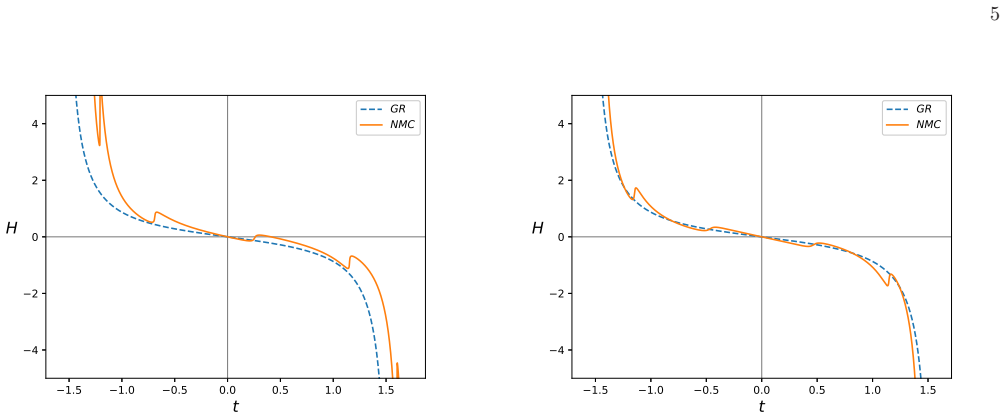
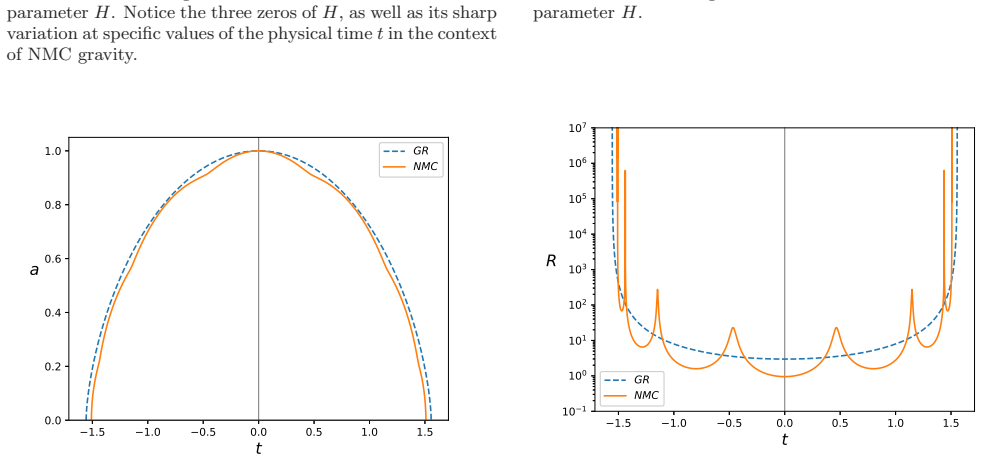
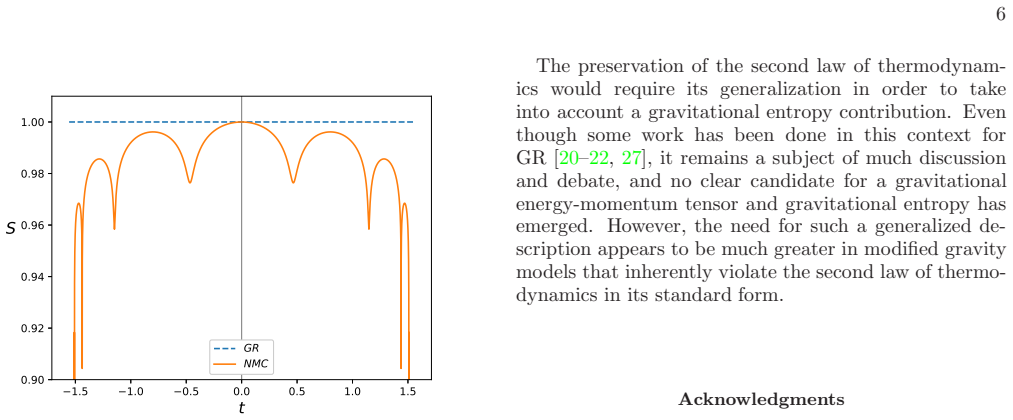
The authors show that in a nonminimally coupled gravity theory with action $S=\int d^4x\sqrt{-g}[f_1(R)+f_2(R)\mathcal{L}_m]$, the on-shell matter Lagrangian $\mathcal{L}_m=T^\mu_\mu=3p-\rho$ turns the non-conservation of the energy-momentum tensor into a modified first law, $T dS = -3 p a^3 df_2/f_2$. For radiation in equilibrium with $\rho_r\propto T^4$, this integrates to $T\propto a^{-1}f_2^{-1/4}$ and therefore $S\propto f_2^{-3/4}$. In a closed universe filled with dust and radiation and with $f_2=\alpha R^\beta$, the numerical solutions show the Ricci scalar falling on average during expansion and rising during contraction, so $f_2$ and the entropy move in opposite directions; the comoving entropy accordingly decreases during contraction, violating the second law. The only function that satisfies $T\dot S\ge 0$ in full generality is a constant $f_2$, which is exactly the general-relativity limit.
Load-bearing premise
The radiation is assumed to stay in perfect thermodynamic equilibrium with zero chemical potential, with scattering timescales much shorter than the timescale on which the coupling function $f_2$ changes; if the nonminimal coupling drives the radiation out of equilibrium, the derivation of $S\propto f_2^{-3/4}$ collapses.
Editorial extensions
If this is right
- In any nonminimally coupled gravity theory with a non-constant $f_2$, the comoving entropy of relativistic matter is not conserved even in an exactly homogeneous and isotropic universe.
- Whenever $f_2$ decreases the quantity $T\dot S$ becomes negative, so the matter sector alone violates the second law; the only coupling that avoids this in every history is $f_2=\mathrm{const}$, the general-relativity limit.
- The effect requires pressure: dust has $p=0$ and conserves entropy, while a radiation-only closed universe reduces to general relativity and also conserves entropy.
- The sign of $\dot S$ is controlled by $\dot R$, tying the thermodynamic arrow of time to whether the universe is expanding or contracting.
- A self-consistent statement of the second law in these theories needs a gravitational entropy contribution that compensates the matter entropy change.
Reading between the lines
- Extension the authors leave implicit: the same $T dS = -3 p a^3 df_2/f_2$ structure should appear in any modified-gravity theory whose matter energy-momentum tensor has a source term of this form, so the conclusion likely extends beyond the specific $f_1(R)+f_2(R)\mathcal{L}_m$ action.
- If a gravitational entropy exists, the relevant quantity is $S_{\rm matter}+S_{\rm gravity}$; constructing it so that the total is nondecreasing would convert the apparent violation into a conservation statement and gives a concrete target for modified-gravity thermodynamics.
- A testable extension: the same $f_2$ evolution that drives the entropy change also produces $n$-type spectral distortions in the cosmic microwave background, so future distortion measurements could constrain how fast $f_2$ changes and hence the size of the entropy variation.
Signed reviews
Editorial analysis
A structured set of objections, weighed in public.
Referee Report
Summary. The paper studies nonminimal coupling (NMC) between gravity and matter through the action S = ∫ d^4x √−g [f1(R) + f2(R)L_m]. Using the on-shell matter Lagrangian L_m = 3p − ρ, which the authors previously derived for a perfect fluid of solitonic particles, they obtain the modified first law of thermodynamics, T dS = −3p a^3 df2/f2 (Eq. 16). For a closed FLRW universe containing dust and radiation, they integrate the non-conservation equation to find T ∝ a^{-1} f2^{-1/4}, ρ_r ∝ a^{-4} f2^{-1}, and hence the comoving radiation entropy S ∝ f2^{-3/4} (Eq. 21). This implies that the comoving entropy can decrease during phases in which f2 decreases, and the paper presents numerical examples with f1 = R, f2 = αR^β to illustrate expanding and contracting phases. The authors conclude that the second law of thermodynamics does not generally hold in NMC gravity and that a generalized gravitational entropy contribution may be needed.
Significance. If the central claim is established, the paper makes a conceptually important point: nonminimal couplings can lead to a violation of the second law for the matter sector, thereby linking the thermodynamic arrow of time to the cosmological dynamics in a new way. The analytic derivation from the action to Eq. (21) is algebraically transparent, and the numerical setup is clearly described, with equations and initial conditions for reproducibility. The paper is also candid about the instability of its illustrative model. However, the broad claim of the title and abstract depends on a specific, non-unique choice of the matter Lagrangian for radiation; the manuscript does not currently address this ambiguity, which is a load-bearing gap.
major comments (1)
- [Sec. IV, illustrative model] The numerical example uses f2 = αR^β with β = 0.01, a model that the authors themselves note is subject to the Dolgov-Kawasaki instability. The instability does not by itself invalidate the analytic entropy result, but the figures showing oscillatory behavior in an unstable background may obscure the physics. I recommend adding a short statement that the background evolution may be unstable and that the entropy result is independent of the stability of the illustrative model, or choosing a stable representative model if possible.
minor comments (4)
- [Sec. II, Eq. (8)] The line element in Eq. (8) is described as the 'flat FLRW metric' although the metric contains the curvature parameter k and the paper later sets k = 1. Please remove 'flat' or write 'FLRW metric with spatial curvature'.
- [Title and running header] The title contains a typographical artifact: 'nonminimally coupled gravi ty' has an extra space. Please correct this in the final version.
- [Eqs. (26)–(29)] The notation '∆ ttF', '∆ iiF', and similar appears in running text; these should be typeset as Δ_{tt}F, Δ_{ii}F, or explicitly explained as the components of the operator Δ_{μν}, to avoid ambiguity.
- [Sec. IV, initial conditions] The values ρ_dust0 = 5.94 and ρ_r0 = 0.06 are used with c = (16πG)^{-1} = 1, but the units of ρ are not explicitly stated. A brief note on the chosen unit conventions would improve readability.
Circularity Check
No significant circularity: the entropy-violation result is derived from the NMC field equations and equilibrium thermodynamics, not assumed as an input.
full rationale
The central chain is explicit: field equation (5) leads to the non-conservation equation (12); with the thermodynamic relation (15) this gives T dS = dQ_NMC = -3p a^3 df2/f2 (Eq. 16). For radiation, using pr = rhor/3 and rhor ∝ T^4, Eq. (18) integrates to T ∝ a^{-1} f2^{-1/4} (Eq. 19), and then Eq. (16) integrates to S ∝ f2^{-3/4} (Eq. 21). Each step is a stated equation in the paper; Eq. (21) is the integral of Eq. (16), not a separate assumption. The input Lm = 3p - ρ is taken from the authors' prior work [5,14], but that prior work is stated to derive it for solitonic perfect fluids with fixed mass and structure, assumptions that do not include the target second-law conclusion; the paper also gives a consistency argument from Eqs. (10)-(11). The sign change of dS in the contracting phase is a computed consequence of the numerical evolution of R through the modified Friedmann and Raychaudhuri equations (33)-(35), not a pre-imposed condition. There are no fitted parameters renamed as predictions and no uniqueness theorem invoked to forbid alternatives. The skeptical concerns about whether the solitonic matter Lagrangian applies to a thermal photon gas, and the equilibrium assumption stated in Sec. III, are physical-robustness issues, not circularity. The manuscript's own caveat that the results are generic only 'in the absence of significant perturbations of the matter fields' is an applicability limitation, not a circular reduction. Therefore the derivation is self-contained relative to its stated assumptions, and no circular step is present.
Assumptions & free parameters
free parameters (6)
- alpha =
0.95
- beta =
0.01
- rho_dust0 =
5.94
- rho_r0 =
0.06
- H0 =
0
- ddot_H0 =
0.5 or 0
assumptions (4)
- domain assumption The on-shell Lagrangian of a perfect fluid of non-interacting solitonic particles is L_m = T^μ_μ = 3p - ρ (Eq. 6).
- domain assumption The fundamental thermodynamic relation T dS = d(ρa^3) + p d(a^3) (Eq. 15) is applied to the matter fields in NMC gravity despite the non-conservation of T^{μν}.
- domain assumption Radiation remains in thermal equilibrium with zero chemical potential, with scattering timescale much shorter than the NMC variation timescale (Sec. III, before Eq. 17).
- standard math The gravitational field equations are derived from the action with Levi-Civita connection; the FLRW metric is assumed (Eqs. 1-8).
Cite this review
Pith. "Pith review of Second law of thermodynamics in nonminimally coupled gravity." pith.science (2026). https://pith.science/paper/KGLUYCUA
@misc{pith2026190802629,
  author       = {Pith},
  title        = {Pith review of: Second law of thermodynamics in nonminimally coupled gravity},
  year         = {2026},
  howpublished = {\url{https://pith.science/paper/KGLUYCUA}},
  note         = {Machine review of arXiv:1908.02629}
}
read the original abstract
In the present work we show that the second law of thermodynamics does not generally hold if the matter and gravitational fields are nonminimally coupled. We demonstrate this result by explicitly computing the evolution of the entropy of the matter fields in the case of a closed homogeneous and isotropic universe filled with dust and radiation, showing that, in this case, the sign of the entropy variation is determined by the evolution of the universe. The preservation of the second law of thermodynamics in these modified theories would require its generalization to account for a gravitational entropy contribution.
Figures

Figures from the paper (1 more)
Reference graph
Works this paper leans on
-
[1]
S. Nojiri and S. D. Odintsov, Phys. Lett. B 599, 137 (2004), ISSN 03702693, 0403622, URL http://linkingh ub.elsevier.com/retrieve/pii/S0370269304012201
work page 2004
-
[3]
O. Bertolami, C. G. B¨ ohmer, T. Harko, and F. S. N. Lobo, Phys. Rev. D 75, 104016 (2007), ISSN 1550-7998, 0704.1733, URL https://link.aps.org/doi/10.1103/P hysRevD.75.104016
arXiv 2007
-
[4]
T. P. Sotiriou and V. Faraoni, Class. Quantum Gravity 25, 205002 (2008), ISSN 0264-9381, arXiv:0805.1249v2, URL http://stacks.iop.org/0264-9381/25/i=20/a=2 05002?key=crossref.1418b59d85760534de845481e6f1f d48
arXiv 2008
-
[5]
is given by ˙ρ + 3H(ρ + p) = −(Lm + ρ) ˙f2 f2 . (11) For eqs. ( 10) and ( 11) to be consistent with the depen- dence of the proper pressure p on the proper density ρ and on the root mean square velocity of the particles ⟨v2⟩ (p = ρ⟨v2⟩/ 3), one can easily verify that the matter La- grangian must indeed given by Eq. ( 6) (see [ 5, 14] for alternative deriv...
-
[6]
acts as an additional constraint, and with a0 = 1 and H0 = 0 becomes ρr0 + α [ Rβ 0 + β (6 − R0)Rβ −1 0 ] ρdust0 = 6 , (36) and therefore sets ˙H0 at the initial time, leaving only one additional initial condition, ¨H0 . Fig. 1 displays the evolution of the scale factor a as a function of the physical time t in the context of two dis- tinct cosmological m...
work page 2017
-
[7]
R. P. L. Azevedo and P. P. Avelino, Phys. Rev. D 99, 064027 (2019), ISSN 2470-0010, URL https://link.ap s.org/doi/10.1103/PhysRevD.99.064027
- [8]
-
[9]
S. D. Odintsov and D. S´ aez-G´ omez, Phys. Lett. B 725, 437 (2013), ISSN 03702693, arXiv:1304.5411, URL http://linkinghub.elsevier.com/retrieve/pii /S0370269313005881
arXiv 2013
Show all 30 references
-
[11]
may also be written as ˙ρ + 3H(ρ + p) = −3p ˙f2 f2 . (12) Equation (11) is akin to the first law of thermodynam- ics, d(ρa3) + pd(a3) = dQNMC , (13) with the right-hand side acting as a “heat” transfer rate per comoving volume, and so we can rewrite it as [ 7] ˙ρ + 3H(ρ + p) = ...
-
[12]
P. P. Avelino and R. P. L. Azevedo, Phys. Rev. D 97, 64018 (2018), ISSN 2470-0010, URL https://link.aps .org/doi/10.1103/PhysRevD.97.064018
2018 doi
-
[13]
R. P. L. Azevedo and P. P. Avelino, Phys. Rev. D 98, 064045 (2018), ISSN 2470-0010, URL https://link.ap s.org/doi/10.1103/PhysRevD.98.064045
2018 doi
-
[14]
P. P. Avelino and L. Sousa, Phys. Rev. D 97, 64019 (2018), ISSN 2470-0010, 1802.03961, URL https://li nk.aps.org/doi/10.1103/PhysRevD.97.064019
2018 arXiv
-
[15]
Uzan, Living Rev
J.-P. Uzan, Living Rev. Relativ. 14, 2 (2011), ISSN 2367- 3613, 1009.5514, URL http://link.springer.com/10.1 2942/lrr-2011-2
2011 arXiv
-
[16]
E. J. Copeland, A. Rajantie, C. Contaldi, P. Dauncey, and H. Stoica, in AIP Conf. Proc. (AIP, 2007), vol. 957, pp. 21–29, ISBN 9780735404717, ISSN 0094243X, 0603057, URL http://aip.scitation.org/doi/abs/10 .1063/1.2823765
2007
-
[17]
Bertolami and M
O. Bertolami and M. C. Sequeira, Phys. Rev. D 79, 104010 (2009), ISSN 1550-7998, 0903.4540, URL http s://link.aps.org/doi/10.1103/PhysRevD.79.104010
2009 arXiv
-
[19]
Bertolami, F
O. Bertolami, F. S. N. Lobo, and J. P´ aramos, Phys. Rev. D 78, 064036 (2008), ISSN 1550-7998, 0806.4434, URL https://link.aps.org/doi/10.1103/PhysRevD.7 8.064036
2008 arXiv
-
[20]
M. ´A. G. Bonilla and J. M. M. Senovilla, Gen. Relativ. Gravit. 29, 91 (1997), ISSN 0001-7701, URL http://li nk.springer.com/10.1023/A:1010256231517
1997 doi
-
[21]
Clifton, G
T. Clifton, G. F. R. Ellis, and R. Tavakol, Class. Quantum Gravity 30, 125009 (2013), ISSN 0264-9381, URL http://stacks.iop.org/0264-9381/30/i=12/a=1 25009?key=crossref.6a5451930f226fae7034e7d503b56 efd
2013
-
[22]
with all generality would be f2 = const., which corresponds to the GR limit. IV. NUMERICAL RESULTS AND DISCUSSION Here, we shall consider a homogeneous and isotropic universe with positive curvature filled with dust and ra- diation. This provides a fair representation of the en...
-
[23]
Sousa and P
L. Sousa and P. P. Avelino, Phys. Rev. D 83, 103507 (2011), ISSN 1550-7998, arXiv:1103.1381v1, URL https ://link.aps.org/doi/10.1103/PhysRevD.83.103507
2011 arXiv
-
[24]
Sousa and P
L. Sousa and P. P. Avelino, Phys. Rev. D 84, 063502 (2011), ISSN 1550-7998, arXiv:1107.4582v1, URL https ://link.aps.org/doi/10.1103/PhysRevD.84.063502
2011 arXiv
-
[25]
P. P. Avelino and L. Sousa, Phys. Rev. D 93, 023519 (2016), ISSN 2470-0010, 1511.05897, URL https://lin k.aps.org/doi/10.1103/PhysRevD.93.023519
2016 arXiv
-
[26]
Motohashi, A
H. Motohashi, A. A. Starobinsky, and J. Yokoyama, J. Cosmol. Astropart. Phys. 2011, 006 (2011), ISSN 1475-7516, URL http://stacks.iop.org/1475-7516/2 011/i=06/a=006?key=crossref.8e3ec3a865ed72385b73 c496caff9055
2011
-
[27]
Acquaviva, D
G. Acquaviva, D. Kofroˇ n, and M. Scholtz, Class. Quan- tum Gravity 35, 095001 (2018), ISSN 0264-9381, URL h ttp://stacks.iop.org/0264-9381/35/i=9/a=095001?k ey=crossref.2890b1ab7e702d63693fac660210d9aa
2018
-
[28]
R. A. Sussman and J. Larena, Class. Quantum Gravity 31, 075021 (2014), ISSN 0264-9381, URL http://stack s.iop.org/0264-9381/31/i=7/a=075021?key=crossref .54b06cb39360335b92ba919adb244c35
2014
-
[29]
Faraoni, Phys
V. Faraoni, Phys. Rev. D 76, 127501 (2007), ISSN 1550- 7998, URL https://link.aps.org/doi/10.1103/PhysR evD.76.127501
2007 doi
-
[30]
Bertolami and M
O. Bertolami and M. C. Sequeira, Phys. Rev. D 79, 104010 (2009), ISSN 1550-7998, URL https://link.a ps.org/doi/10.1103/PhysRevD.79.104010
2009 doi
-
[31]
S. A. Appleby, R. A. Battye, and A. A. Starobinsky, J. Cosmol. Astropart. Phys. 2010, 005 (2010), ISSN 1475-7516, URL http://stacks.iop.org/1475-7516/2 010/i=06/a=005?key=crossref.c9666ff75242b59a26a8 953fc3796990
2010
-
[33]
(35) Starting from an arbitrary initial time ( t = 0), we in- tegrate Eq
becomes ( H 2 + a−2) F = 1 6 ρr0a−4 + α 6 Rβ ( 1 − β − 18H 2 R ) ρdust0a−3 + 6αβ (β − 1)Rβ −2ρdust0a−3H 2 ( ¨H H + 4 ˙H − 2a−2 ) . (35) Starting from an arbitrary initial time ( t = 0), we in- tegrate Eq. ( 34) using a 5th-order backwards differenti- ation formula, first backwar...
-
[35]
Hence, the Ricci scalar R would vanish and, Eq
would reduce to the standard Friedmann equation found in GR. Hence, the Ricci scalar R would vanish and, Eq. ( 16) would again imply the conservation of the comoving entropy. In the remainder of this paper we shall consider cos- mologies with ρdust0 = 5 . 94, ρr0 = 0 . 06 and ...
Reviewed August 14, 2026 · model on record in the stance chip above.
Discussion (0). Continue with ORCID to comment.