REVIEW 2 major objections 5 minor 53 references
Spin-polarized neutron matter, the maximum mass of neutron stars, and GW170817
T0 review · 2 major / 5 minor · reviewed 2026-08-14 · deepseek-v4-flash
Pith's one-line read A phase transition to spin-polarized neutron matter would cap neutron-star masses below 2.6-2.9 solar masses.
desk verdict A physically motivated cap on the neutron-star maximum mass from spin-polarized matter, with new AFDMC results, though the bound is only as strong as the extrapolated polarized EOS. read the letter →
The pith
A machine-rendered reading of the paper's core claim, the machinery that carries it, and where it could break.
The reading
What carries the argument
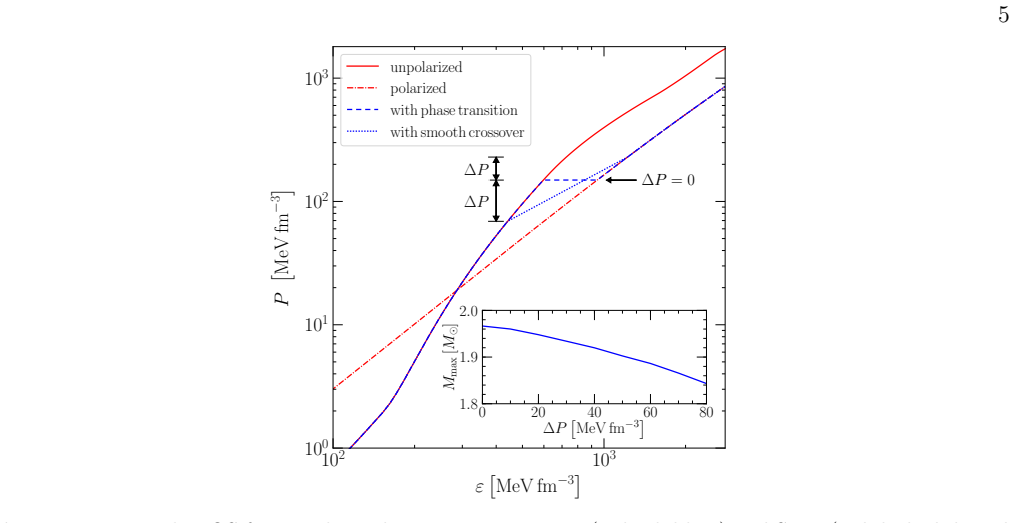
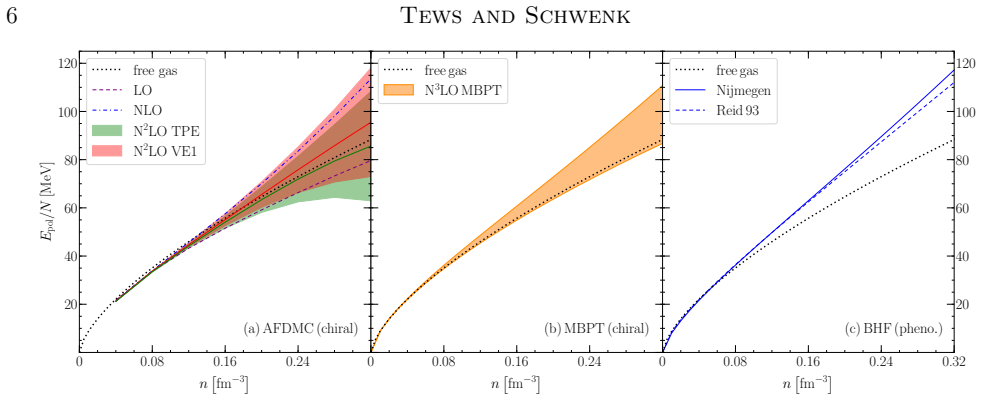
The load-bearing object is the equation of state of spin-polarized neutron matter (SPM), neutron matter in which all spins are aligned so that a single spin state is occupied and Pauli blocking makes interactions weak. The paper computes SPM with three independent methods: auxiliary-field diffusion Monte Carlo with local chiral forces, many-body perturbation theory with chiral $N^3$LO interactions, and Brueckner-Hartree-Fock with phenomenological potentials. Each result is extended to higher density with the functional form $E_{\rm pol}/N = a(n/n_{\rm sat})^\alpha + b(n/n_{\rm sat})^\beta$, and for every allowed unpolarized neutron-star equation of state from a causal speed-of-sound extension, a Maxwell construction transitions to SPM at the crossing pressure. The crossing of the two equations of state is what sets the end of the stable branch and therefore the maximum mass.
What would settle it
A clean falsification would be a neutron star with a precisely measured mass above about 2.9 solar masses, or a measurement showing that the fully polarized phase is stiffer at high density than the near-free-Fermi-gas behavior assumed here.
Extended reading notes
Core claim
The central claim is that a phase transition from unpolarized neutron-star matter to fully spin-polarized neutron matter in the core limits the maximum mass of neutron stars to $M_{\rm max}\lesssim 2.6$-$2.9\,M_\odot$, depending on which microscopic nuclear force is used in the spin-polarized calculation. Without the transition, the same general speed-of-sound extension of the equation of state allows $M_{\rm max}$ up to about $3$-$4\,M_\odot$. The mechanism is that interactions in spin-polarized neutron matter are weak, close to a free Fermi gas, so the pressure rises only slowly once that phase is thermodynamically preferred, and the stable branch of the mass-radius relation ends near the crossing point. The paper further finds that the masses thus obtained agree with the upper limits inferred from the kilonova and gravitational-wave signal of GW170817, and that neutron stars containing a large spin-polarized core are ruled out by the radius constraint from the same event.
Load-bearing premise
The bound depends on the spin-polarized neutron-matter equation of state being reliable at the density where the phase transition happens, and for stiff unpolarized equations of state that density lies beyond the range of the microscopic calculations and is reached by a simple two-term power-law extrapolation.
Editorial extensions
If this is right
- If the transition exists, no isolated neutron star can exceed about $2.9\,M_\odot$; the heaviest measured neutron stars must sit near or below that ceiling.
- General equation-of-state extension schemes that allow arbitrarily stiff pressure at high density overestimate the maximum mass unless the spin-polarized phase is absent or much stiffer than current calculations indicate.
- Neutron stars with a substantial spin-polarized core are effectively excluded: the mass in the polarized phase is at most about $0.02\,M_\odot$ once GW170817 radius constraints are applied.
- The theoretical upper bound and the independent upper limits from GW170817 reinforce each other, because the theoretical bound is derived without using any merger information.
Reading between the lines
- A testable extension: a precise measurement of a neutron star above roughly $2.9\,M_\odot$ would contradict the predicted ceiling, while a star near $2.5\,M_\odot$ with a small radius would sharpen the crossing density.
- The same Maxwell-construction machinery could be applied to other candidate high-density phases; the paper notes quark matter cannot yet give a firm bound, but a future first-principles quark-matter equation of state would provide a natural point of comparison.
- If the spin-polarized phase is realized, radius measurements near the maximum mass should show a kink or flattening as mass approaches the ceiling, distinguishing this transition from smoother equations of state.
Signed reviews
Editorial analysis
A structured set of objections, weighed in public.
Referee Report
Summary. This manuscript argues that a first-order phase transition from unpolarized neutron-star matter to fully spin-polarized neutron matter (SPM) generically cuts off the high-pressure branch of the neutron-star equation of state, limiting the maximum mass Mmax to approximately 2.6-2.9 Msun. The authors combine a general ensemble of low-density EOSs from chiral EFT/Quantum Monte Carlo with three microscopic calculations of the SPM energy (AFDMC with local chiral N2LO interactions, MBPT with chiral N3LO interactions, and BHF with phenomenological potentials), fit the SPM energies with the two-power-law form of Eq. (1), and construct hybrid EOSs via a Maxwell construction. They then solve the Tolman-Oppenheimer-Volkoff equations and compare the resulting mass-radius relations and Mmax values with constraints inferred from GW170817. The central, observation-independent conclusion is that an EOS that would otherwise support Mmax above about 2.6-2.9 Msun is viable only if the SPM transition is absent; once the transition is included, the stable branch ends earlier and the maximum mass is lowered.
Significance. If the calculation is correct, this is an important observation-independent theoretical bound: it is more restrictive than generic speed-of-sound extensions of the EOS and complementary to the empirical GW170817 limits. The paper's strengths are that the SPM EOS is computed from several independent many-body methods with explicit uncertainty bands; the Maxwell construction is varied, and smearing the transition only lowers Mmax, so the bound is conservative with respect to the transition width; and the GW170817 comparison is used after the fact rather than as input. The data in Table 1 and the enumeration of EOS variants make the calculation transparent. The main weakness is the reliance on Eq. (1) outside the density range where the microscopic SPM calculations are actually constrained.
major comments (2)
- [Section 3, Eq. (1)] The headline upper bound (Mmax about 2.9 Msun) is set by the extrapolated SPM energy above 2 nsat. For the stiff unpolarized EOSs that would otherwise give the largest masses, the crossing between the unpolarized and SPM branches can occur above 2 nsat, i.e., beyond the density range of the AFDMC and MBPT calculations. The fit-quality check described in Section 3 (fit to n <= nsat and compare with data up to 2 nsat) validates the functional form only inside the fitted density range; it does not certify the two-power-law behavior beyond 2 nsat. If the true SPM energy rises slightly more steeply than the extrapolated upper band, the transition density moves upward and Mmax can exceed the quoted limit. Please either restrict the claim to a value robust against this extrapolation (about 2.6 Msun from the MBPT/BHF results) or provide a quantitative estimate of the extrapolation error above 2 nsat.
- [Section 3, AFDMC upper bound] The upper end of the reported range comes from the AFDMC upper uncertainty band, which the authors themselves describe as 'most likely overestimated' by local regulator artifacts. Quoting 2.6-2.9 Msun as the limit therefore mixes a robust result with a source explicitly identified as unreliable. The authors should either quantify the regulator contribution to that band or report the 2.9 Msun value only as an unvalidated extreme, with the firm theoretical bound given by the MBPT/BHF results (around 2.6 Msun).
minor comments (5)
- [Abstract] The rendering '2.6$-$$2.9' should be corrected to a proper en-dash range.
- [Section 1] The text contains 'many many follow-up observations'; this should be edited to a single 'many'.
- [Section 3] The statement that the mass of the SPM domain is '<= 0.005 Msun, largely a result of numerical discretization artifacts' is confusing; please clarify whether these are stars with essentially no physical SPM core and explain how the discretization affects the quoted bound.
- [Section 3, Eq. (1)] For reproducibility, please provide the fitted parameter values (a, alpha, b, beta) for each SPM EOS variant, or at least specify the fit ranges and weighting used for the upper/lower bounds.
- [Figure 1 caption] The caption should state explicitly that the gray areas are the baseline EOS band without the SPM transition, while the hatched areas are the SPM-inclusive bands; the meaning of the solid red line in panel (a) (the centroid) is clear but should be stated for all panels.
Circularity Check
No circularity: the Mmax bound is an output of the TOV calculation from microscopic SPM EOSs, not an input; GW170817 is compared only after the fact.
full rationale
The paper's derivation chain is: (1) build an unpolarized EOS band from chiral-EFT nuclear-matter calculations plus a speed-of-sound extension; (2) compute the spin-polarized neutron matter (SPM) EOS from AFDMC, MBPT, and BHF calculations; (3) fit the two-term power law of Eq. (1) to the SPM energies; (4) construct phase-transition EOSs by a Maxwell construction; (5) solve the Tolman-Oppenheimer-Volkoff equations to obtain Mmax; and (6) only afterwards compare with GW170817-based constraints. The maximum-mass limits 2.6-2.9 Msun are outputs of this calculation, not inputs. The parameters a, alpha, b, beta in Eq. (1) are fitted to microscopic SPM results, not to Mmax or to GW170817; therefore the central claim is not a fitted quantity renamed as a prediction. The paper does rely on the authors' earlier EOS extension scheme (Tews et al. 2018a,b), but that scheme is a general sampling method for causal, stable EOSs and does not itself assume the SPM transition or the Mmax bound; it is not a uniqueness theorem invoked to forbid alternatives. The in-paper check of the Eq. (1) extrapolation against AFDMC data between nsat and 2nsat is an internal validation, and the concern that the extrapolation may be unreliable beyond 2nsat is a robustness limitation, explicitly acknowledged by the authors, not a circularity. Likewise, the statements that chiral interactions become less reliable at high density and that the stiffest AFDMC case is likely overestimated are uncertainty caveats, not evidence that the derivation assumes its conclusion. No specific equation or fitted parameter reduces to the claimed result by construction, so there is no circular step to report.
Assumptions & free parameters
free parameters (1)
- a, alpha, b, beta (Eq. 1)
assumptions (5)
- domain assumption The EOS extension scheme of Tews et al. 2018a,b, combining chiral EFT at nuclear densities with a speed-of-sound extension, spans all possible EOSs consistent with nuclear-physics constraints.
- domain assumption The microscopic calculations of spin-polarized neutron matter (AFDMC, MBPT, BHF) correctly describe the fully polarized phase in the density range where the phase transition is evaluated.
- domain assumption The Maxwell construction (or smeared Gibbs variant) appropriately connects the unpolarized and polarized phases.
- domain assumption Neglecting proton corrections, magnetic fields, and gradual polarization does not invalidate the upper bound on Mmax.
- domain assumption The extrapolation form Eq. (1) is valid beyond the fitted range.
Cite this review
Pith. "Pith review of Spin-polarized neutron matter, the maximum mass of neutron stars, and GW170817." pith.science (2026). https://pith.science/paper/GGVGW4AJ
@misc{pith2026190802638,
  author       = {Pith},
  title        = {Pith review of: Spin-polarized neutron matter, the maximum mass of neutron stars, and GW170817},
  year         = {2026},
  howpublished = {\url{https://pith.science/paper/GGVGW4AJ}},
  note         = {Machine review of arXiv:1908.02638}
}
abstract
We investigate how a phase transition from neutron-star matter to spin-polarized neutron matter affects the equation of state and mass-radius relation of neutron stars. While general extension schemes for the equation of state allow for high pressures inside neutron stars, we find that a phase transition to spin-polarized neutron matter excludes extreme regimes. Hence, such a transition limits the maximum mass of neutron stars to lie below 2.6$-$$2.9 \, M_{\odot}$, depending on the microscopic nuclear forces used, while significantly larger masses could be reached without these constraints. These limits are in good agreement with recent constraints extracted from the neutron-star merger GW170817 and its electromagnetic counterpart. Assuming the description in terms of spin-polarized neutron matter to be valid in the center of neutron stars, we find that stars with a large spin-polarized domain in their core are ruled out by GW170817.
Figures

Reference graph
Works this paper leans on
-
[1]
Abbott, B. P., et al. 2017a, Phys. Rev. Lett., 119, 161101, doi: 10.1103/PhysRevLett.119.161101 —. 2017b, Astrophys. J., 848, L12, doi: 10.3847/2041-8213/aa91c9 —. 2017c, Astrophys. J., 848, L13, doi: 10.3847/2041-8213/aa920c —. 2019, Phys. Rev., X9, 011001, doi: 10.1103/PhysRevX.9.011001
-
[2]
Alford, M. G., Han, S., & Prakash, M. 2013, Phys. Rev. D, 88, 083013, doi: 10.1103/PhysRevD.88.083013
-
[3]
Annala, E., Gorda, T., Kurkela, A., & Vuorinen, A. 2018, Phys. Rev. Lett., 120, 172703, doi: 10.1103/PhysRevLett.120.172703
-
[4]
2013, Science, 340, 6131, doi: 10.1126/science.1233232
Antoniadis, J., et al. 2013, Science, 340, 6131, doi: 10.1126/science.1233232
-
[5]
Bhattacharyya, A., Mishustin, I. N., & Greiner, W. 2010, J. Phys. G, 37, 025201, doi: 10.1088/0954-3899/37/2/025201
-
[6]
Carlson, J., Gandolfi, S., Pederiva, F., et al. 2015, Rev. Mod. Phys., 87, 1067, doi: 10.1103/RevModPhys.87.1067
-
[7]
Cromartie, H. T., Fonseca, E., Ransom, S. M., et al. 2020, Nature Astronomy, 4, 72, doi: 10.1038/s41550-019-0880-2
-
[8]
Danielewicz, P., Lacey, R., & Lynch, W. G. 2002, Science, 298, 1592, doi: 10.1126/science.1078070
Show all 53 references
-
[9]
2010, Nature, 467, 1081, doi: 10.1038/nature09466
Demorest, P., Pennucci, T., Ransom, S., Roberts, M., & Hessels, J. 2010, Nature, 467, 1081, doi: 10.1038/nature09466
2010 doi
- [10]
-
[11]
2009, Reviews of Modern Physics, 81, 1773, doi: 10.1103/RevModPhys.81.1773
Epelbaum, E., Hammer, H.-W., & Meißner, U.-G. 2009, Reviews of Modern Physics, 81, 1773, doi: 10.1103/RevModPhys.81.1773
2009 doi
-
[12]
Epelbaum, E., Krebs, H., & Meißner, U. G. 2015, Eur. Phys. J. A, 51, 53, doi: 10.1140/epja/i2015-15053-8
2015 doi
-
[13]
2016, Astrophys
Fonseca, E., et al. 2016, Astrophys. J., 832, 167, doi: 10.3847/0004-637X/832/2/167 Gandolfi, S., Illarionov, A. Yu., Schmidt, K. E.,
2016 doi
-
[14]
2009, Phys
Pederiva, F., & Fantoni, S. 2009, Phys. Rev. C, 79, 054005, doi: 10.1103/PhysRevC.79.054005 Gandolfi, S., Lippuner, J., Steiner, A. W., et al. 2019, J. Phys., G46, 103001, doi: 10.1088/1361-6471/ab29b3
2009 doi
-
[15]
2012, Proc
Gendreau, K., Arzoumanian, Z., & Okaajima, T. 2012, Proc. SPIE, 8443, 844313, doi: 10.1117/12.926396
2012 doi
-
[16]
2014, Phys
Gezerlis, A., Tews, I., Epelbaum, E., et al. 2014, Phys. Rev. C, 90, 054323, doi: 10.1103/PhysRevC.90.054323 —. 2013, Phys. Rev. Lett., 111, 032501, doi: 10.1103/PhysRevLett.111.032501
2014 doi
-
[17]
Glendenning, N. K. 1992, Phys. Rev. D, 46, 1274, doi: 10.1103/PhysRevD.46.1274
1992 doi
-
[18]
Schwenk, A., & Watts, A. L. 2019, Mon. Not. Roy. Astron. Soc., 485, 5363, doi: 10.1093/mnras/stz654
2019 doi
-
[19]
2013, Rev
Hammer, H.-W., Nogga, A., & Schwenk, A. 2013, Rev. Mod. Phys., 85, 197, doi: 10.1103/RevModPhys.85.197
2013 doi
-
[20]
D., Men´ endez, J., & Schwenk, A
Hebeler, K., Holt, J. D., Men´ endez, J., & Schwenk, A. 2015, Annu. Rev. Nucl. Part. Sci., 65, 457, doi: 10.1146/annurev-nucl-102313-025446 10 Tews and Schwenk
2015 doi
- [21]
-
[22]
J., & Staubo, E
Heiselberg, H., Pethick, C. J., & Staubo, E. F. 1993, Phys. Rev. Lett., 70, 1355, doi: 10.1103/PhysRevLett.70.1355
1993 doi
-
[23]
E., & Schwenk, A
Huth, L., Tews, I., Lynn, J. E., & Schwenk, A. 2017, Phys. Rev. C, 96, 054003, doi: 10.1103/PhysRevC.96.054003
2017 doi
-
[24]
1996, Astrophys
Kalogera, V., & Baym, G. 1996, Astrophys. J., 470, L61, doi: 10.1086/310296 Kr¨ uger, T., Hebeler, K., & Schwenk, A. 2015, Phys. Lett. B, 744, 18, doi: 10.1016/j.physletb.2015.03.027 Kr¨ uger, T., Tews, I., Hebeler, K., & Schwenk, A. 2013, Phys. Rev. C, 88, 025802, doi: 10.110...
1996 doi
-
[25]
Lattimer, J. M. 2012, Ann. Rev. Nucl. Part. Sci., 62, 485, doi: 10.1146/annurev-nucl-102711-095018
2012 doi
-
[26]
M., & Prakash, M
Lattimer, J. M., & Prakash, M. 2016, Phys. Rept., 621, 127, doi: 10.1016/j.physrep.2015.12.005
2016 doi
-
[27]
E., Tews, I., Carlson, J., et al
Lynn, J. E., Tews, I., Carlson, J., et al. 2016, Phys. Rev. Lett., 116, 062501, doi: 10.1103/PhysRevLett.116.062501
2016 doi
-
[28]
E., Tews, I., Gandolfi, S., & Lovato, A
Lynn, J. E., Tews, I., Gandolfi, S., & Lovato, A. 2019, Ann. Rev. Nucl. Part. Sci., 69, 279, doi: 10.1146/annurev-nucl-101918-023600
2019 doi
-
[29]
Machleidt, R., & Entem, D. R. 2011, Phys. Rept., 503, 1, doi: 10.1016/j.physrep.2011.02.001
2011 doi
-
[30]
Margalit, B., & Metzger, B. D. 2017, Astrophys. J., 850, L19, doi: 10.3847/2041-8213/aa991c
2017 doi
-
[31]
C., et al
Miller, M. C., et al. 2019, Astrophys. J. Lett., 887, L24. https://arxiv.org/abs/1912.05705
2019 arXiv
-
[32]
R., Weih, L
Most, E. R., Weih, L. R., Rezzolla, L., & Schaffner-Bielich, J. 2018, Phys. Rev. Lett., 120, 261103, doi: 10.1103/PhysRevLett.120.261103
2018 doi
-
[33]
1973, Astrophys
Nauenberg, M., & Chapline, Jr., G. 1973, Astrophys. J., 179, 277, doi: 10.1086/151868
1973 doi
-
[34]
R., & Volkoff, G
Oppenheimer, J. R., & Volkoff, G. M. 1939, Phys. Rev., 55, 374, doi: 10.1103/PhysRev.55.374 ¨Ozel, F., & Freire, P. 2016, Annu. Rev. Astron. Astrophys., 54, 401, doi: 10.1146/annurev-astro-081915-023322
1939 doi
-
[35]
2019a, Astrophys
Raaijmakers, G., et al. 2019a, Astrophys. J. Lett., 887, L22, doi: 10.3847/2041-8213/ab451a —. 2019b. https://arxiv.org/abs/1912.11031
1912 arXiv
-
[36]
R., & Weih, L
Rezzolla, L., Most, E. R., & Weih, L. R. 2018, Astrophys. J., 852, L25, doi: 10.3847/2041-8213/aaa401
2018 doi
-
[37]
E., & Ruffini, R
Rhoades, Jr., C. E., & Ruffini, R. 1974, Phys. Rev. Lett., 32, 324, doi: 10.1103/PhysRevLett.32.324
1974 doi
-
[38]
E., et al
Riley, T. E., et al. 2019, Astrophys. J. Lett., 887, L21, doi: 10.3847/2041-8213/ab481c
2019 doi
-
[39]
Riz, L., Pederiva, F., & Gandolfi, S. 2020, J. Phys., G47, 045106, doi: 10.1088/1361-6471/ab6520
2020 doi
-
[40]
L., & Tsokaros, A
Ruiz, M., Shapiro, S. L., & Tsokaros, A. 2018, Phys. Rev. D, 97, 021501, doi: 10.1103/PhysRevD.97.021501
2018 doi
-
[41]
E., & Fantoni, S
Schmidt, K. E., & Fantoni, S. 1999, Phys. Lett. B, 446, 99, doi: 10.1016/S0370-2693(98)01522-6
1999 doi
-
[42]
2017, Phys
Shibata, M., Fujibayashi, S., Hotokezaka, K., et al. 2017, Phys. Rev. D, 96, 123012, doi: 10.1103/PhysRevD.96.123012
2017 doi
-
[43]
2019, Phys
Shibata, M., Zhou, E., Kiuchi, K., & Fujibayashi, S. 2019, Phys. Rev., D100, 023015, doi: 10.1103/PhysRevD.100.023015
2019 doi
-
[44]
W., Lattimer, J
Steiner, A. W., Lattimer, J. M., & Brown, E. F. 2010, Astrophys. J., 722, 33, doi: 10.1088/0004-637X/722/1/33
2010 doi
-
[45]
Stoks, V. G. J., Klomp, R. A. M., Terheggen, C. P. F., & de Swart, J. J. 1994, Phys. Rev. C, 49, 2950, doi: 10.1103/PhysRevC.49.2950
1994 doi
-
[46]
2018a, Astrophys
Tews, I., Carlson, J., Gandolfi, S., & Reddy, S. 2018a, Astrophys. J., 860, 149, doi: 10.3847/1538-4357/aac267
-
[47]
2016, Phys
Tews, I., Gandolfi, S., Gezerlis, A., & Schwenk, A. 2016, Phys. Rev. C, 93, 024305, doi: 10.1103/PhysRevC.93.024305
2016 doi
-
[48]
2013, Phys
Tews, I., Kr¨ uger, T., Hebeler, K., & Schwenk, A. 2013, Phys. Rev. Lett., 110, 032504, doi: 10.1103/PhysRevLett.110.032504
2013 doi
-
[49]
2018b, Phys
Tews, I., Margueron, J., & Reddy, S. 2018b, Phys. Rev. C, 98, 045804, doi: 10.1103/PhysRevC.98.045804
-
[50]
Tolman, R. C. 1939, Phys. Rev., 55, 364, doi: 10.1103/PhysRev.55.364
1939 doi
-
[51]
2002, Phys
Vidana, I., Polls, A., & Ramos, A. 2002, Phys. Rev. C, 65, 035804, doi: 10.1103/PhysRevC.65.035804
2002 doi
-
[52]
L., et al
Watts, A. L., et al. 2016, Rev. Mod. Phys., 88, 021001, doi: 10.1103/RevModPhys.88.021001 —. 2019, Sci. China Phys. Mech. Astron., 62, 29503, doi: 10.1007/s11433-017-9188-4
2016 doi
-
[53]
H., & Shen, H
Wu, X. H., & Shen, H. 2019, Phys. Rev. C, 99, 065802, doi: 10.1103/PhysRevC.99.065802
2019 doi
Reviewed August 14, 2026 · model on record in the stance chip above.
Discussion (0). Continue with ORCID to comment.