REVIEW 4 major objections 5 minor 35 references
Topological and Finite Size Effects in a Kitaev Chain Heat Engine
T0 review · 4 major / 5 minor · reviewed 2026-08-14 · deepseek-v4-flash
Pith's one-line read A finite Kitaev chain run as an Otto engine reaches its maximum work output and efficiency exactly at the topological phase transition, with the boundary contributing a refrigerator-like negative work.
desk verdict Plausible but under-supported: the Kitaev-chain engine peak at the topological transition needs parameter sweeps and a validated linear-fit decomposition before it can be trusted. read the letter →
The pith
A machine-rendered reading of the paper's core claim, the machinery that carries it, and where it could break.
The reading
What carries the argument
The load-bearing machinery is the bulk-boundary decomposition of the grand potential, written as $\Phi(\mu,T,L)=\Phi_c(\mu,T)L+\Phi_0(\mu,T)$, where $\Phi_c L$ is the extensive bulk term and $\Phi_0$ is the subdivision potential, the non-extensive cost of adding one more replica of the finite system. The associated entropy split $S=S_cL+S_0$ is obtained by a linear fit of the total entropy against chain length in the interval $200<n<225$, and the resulting $S_c(T)$ and $S_0(T)$ curves define separate Otto cycles for bulk and boundary. The second mechanism is the temperature-dependent energy levels (TDEL) correction, $\delta Q_{\rm eff}=\delta Q-\langle \partial H/\partial T\rangle\,dT$, which treats the subdivision potential as energy dissipated at the system-bath interface and gives reduced effective heat and work. Work and efficiency are then read off from the entropy-temperature curves at two hopping values, with the constant-entropy intersections fixing the intermediate temperatures of the cycle.
What would settle it
Compute the entropy $S(\mu,T,n)$ for the same parameters at many lengths (for example every integer from $n=50$ to $n=500$) and test whether $S=S_c n+S_0$ holds with length-independent $S_c$ and $S_0$: if the residuals of the fit are curved or the extracted $S_0$ changes with the fitting window, the bulk-boundary engine and refrigerator cycles are fitting artifacts. A second check is to evaluate the exact $S$–$T$ curve for a single $n=225$ chain and compare it with the total curve reconstructed from the fitted bulk and boundary entropies at that length.
Extended reading notes
Core claim
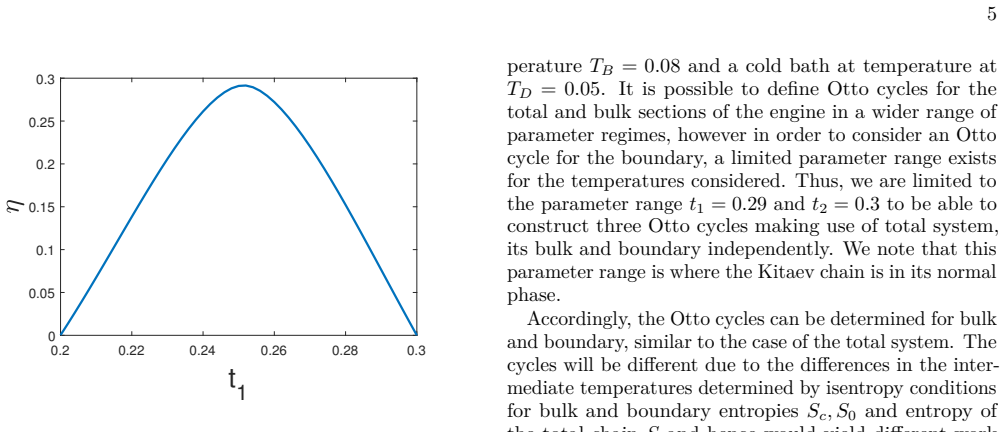
The paper's central claim is that the topological phase transition of a finite Kitaev chain is thermodynamically marked: for an Otto cycle operating between a hot bath at $T_B=0.08$ and a cold bath at $T_D=0.05$, with the hopping parameter $t$ of the cold isochore varied between $0.2$ and $0.3$ and the hot isochore fixed at $t_2=0.3$, the injected heat, the net work output, and the efficiency of the total chain all peak at $t=0.25=\mu/2$, the critical point. Under the bulk-boundary split $\Phi=\Phi_c L+\Phi_0$, the same peak appears in the bulk contribution to work and efficiency, while the boundary contribution to the net work is negative across the studied range and about an order of magnitude smaller, so it cannot change the qualitative behavior. In a narrow parameter window in the trivial phase, the authors construct three separate Otto cycles—total, bulk, and boundary—and find that the bulk and total cycles run as engines while the boundary runs as a refrigerator, with the bulk engine more efficient than the total. Including the temperature-dependent energy level correction reduces both absorbed and ejected heat and makes the effective work negative outside a window around the transition, but the maximum at the critical point remains.
Load-bearing premise
The load-bearing premise is that, for chain lengths between 200 and 225 sites, the total entropy of the finite Kitaev chain is exactly linear in length, so a slope and an intercept cleanly separate a bulk and a boundary contribution; if finite-size corrections are nonlinear in that window, the separate bulk engine and boundary refrigerator cycles are artifacts of the fitting procedure rather than physical components.
Editorial extensions
If this is right
- The topological transition is visible in the engine's bulk performance: total and bulk work output and efficiency peak at $t=\mu/2$, so no edge-state measurement is needed to locate the transition.
- The boundary contributes negative work in the studied range, so on its own it behaves as a refrigerator even though the total system is an engine.
- In the trivial-phase window a single chain can run three independent Otto cycles between the same baths, with the bulk more efficient than the total.
- Interface dissipation modeled by TDELs lowers both heat exchanged and effective work, but preserves the maximum at the transition, so finite-size corrections change magnitudes rather than the qualitative signature.
- Because the maximum coincides with the critical point, operating a topological Kitaev chain as a heat engine is most productive exactly at the phase boundary.
Reading between the lines
- If the peak at $t=\mu/2$ survives changes in pairing strength $\Delta$, chain length, and bath temperatures, then a purely thermodynamic sweep—recording work or efficiency as a function of $t$—could map the phase boundary of a Kitaev wire; the paper demonstrates this only for the single parameter set it studies, so the generality is an extrapolation.
- The boundary refrigerator appears in a window $0.29\le t_1 \le 0.3$ in the trivial phase; testing whether the refrigerator role persists or reverses when the cycle straddles the topological phase would clarify whether it is tied to Majorana edge modes or to generic finite-size boundary terms.
- The bulk-boundary split treats $S_0$ as a fitted intercept; because the same approach can yield negative boundary entropies, independent estimates of boundary entropy (for example from chains with modified boundary couplings) would show whether the 'boundary refrigerator' is a real subsystem or a bookkeeping artifact.
Signed reviews
Editorial analysis
A structured set of objections, weighed in public.
Referee Report
Summary. The manuscript studies a finite-length Kitaev chain used as the working substance of an Otto cycle, with the hopping parameter t as the control parameter. Using Hill's nanothermodynamics the authors decompose the grand potential and the entropy into bulk and boundary parts via the ansatz Φ = Φ_c L + Φ_0 and a linear fit of the total entropy in the chain length over 200 < n < 225. They compute heat, work, and efficiency for the total system, the bulk, and the boundary over a temperature interval (T_D = 0.05, T_B = 0.08) and report that the work output and efficiency of the total and bulk engine have a maximum at the topological phase transition t_1 = μ/2 = 0.25. They also identify independent Otto cycles for the total system, bulk, and boundary in a narrow trivial-phase window, with the boundary operating as a refrigerator, and they compare the Hill results with an effective-heat calculation based on temperature-dependent energy levels that reduces both heat exchanges and work.
Significance. If the central claim holds, the paper offers a thermodynamic signature of a topological transition in a finite system and an interesting decomposition of a quantum Otto engine into bulk engine and boundary refrigerator components. The work is clearly framed, the connection between Hill's subdivision potential and the temperature-dependent-level formalism is a useful synthesis, and the critical point t = μ/2 is set by the Hamiltonian rather than fitted to the data, so the observed extremum is not a circular artifact of parameter fitting. The main limitations are numerical: the key results rest on a single parameter path and on a linear-fit decomposition whose validity is not demonstrated. With additional sensitivity and convergence analyses the paper could be a solid contribution to the quantum thermodynamics of topological systems.
major comments (4)
- [Sec. IV.A, Figs. 2 and 3] The central claim that the work output and efficiency of the total engine peak exactly at the topological phase transition is supported only by a single parameter path (t2 = 0.3, Δ = 0.25, μ = 0.5, n = 225, TB = 0.08, TD = 0.05), with t1 varied from 0.2 to 0.3. Since a finite chain has no exact gap closing at t1 = μ/2, the extremum is not protected by a nonanalyticity, and the paper gives no analytic argument or scaling law that would explain why the maximum should remain pinned to t1 = μ/2 under changes of t2, Δ, bath temperatures, or chain length. I ask the authors to provide a sensitivity analysis over at least these parameters and, if possible, a finite-size scaling argument; without that, the headline coincidence is underdetermined.
- [Sec. III, Eq. (14)] The bulk and boundary entropies S_c and S_0 are obtained by a linear fit to the total entropy S(n) over 200 < n < 225, but the paper reports no residuals, no alternative fit windows, and no test of whether 1/n or exponential finite-size corrections contaminate the linear ansatz. Because every bulk/boundary result in Secs. IV.B and IV.C, including the boundary refrigerator, is built on this decomposition, a biased fit would make those cycles artifacts. I request a validation of the linear fit (residual plots, fit-window dependence, and comparison with exact asymptotic forms) before the bulk/boundary engine and refrigerator conclusions can be accepted.
- [Sec. IV.C, Figs. 5 and 6] The separate boundary Otto refrigerator is demonstrated only in the narrow interval t1 = 0.29...0.30, i.e., deep in the trivial phase, as the authors themselves state. The abstract and conclusions, however, present the independent Otto refrigerator as a general finding without this restriction. The text should either extend the analysis to a wider parameter regime or explicitly qualify the claim to the demonstrated window.
- [Sec. III and Figs. 1-8] The computation of the entropy S(T; t, n, μ, Δ), which underlies every heat, work, and efficiency result, is described only by the sentence 'We first find the eigenvalues of the Hamiltonian in Eq. (12) then evaluate the total entropy S of the chain.' No explicit diagonalization formula, no expression for S in terms of the single-particle spectrum, and no numerical convergence test are given. Since the central extremum is a numerical observation, the absence of this detail prevents the reader from reproducing or checking the results. I request that the entropy formula, the diagonalization procedure, and a convergence check in n be added.
minor comments (5)
- [Sec. II.A and Sec. III] There are several typographical errors: 'identical' appears as 'idential', 'phenomenological' as 'phemonoelogical', and 'length' as 'lenght'; these should be corrected.
- [Eq. (15) and Fig. 2] The sign convention for Q_out is not stated explicitly: the integral in Eq. (15) runs from T_D to T_A and yields a negative value in Fig. 2, while the text refers to 'ejected heat' without clarifying that the plotted quantity is the heat leaving the system and hence negative.
- [References] References [12] and [35] are the same Kitaev paper ('Unpaired Majorana fermions in quantum wires') and should be consolidated to avoid duplication.
- [Sec. III and Conclusions] The manuscript uses both 'isentropic' and 'isoentropic' for the adiabatic stages of the Otto cycle; one spelling should be chosen and used consistently.
- [Fig. 1 caption] The caption refers to 'S−T curves' while the axes plot entropy on the vertical axis and temperature on the horizontal axis; 'T−S curves' would be more accurate.
Circularity Check
No significant circularity: the central TPT-extremum result is computed from exact spectra, not forced by a fitted parameter.
full rationale
The central claim is that work and efficiency of the finite Kitaev-chain Otto engine are extremized at the topological phase transition. That transition point is fixed independently by the Hamiltonian condition |mu| = 2t, here t = 0.25 for mu = 0.5, and the extremum in Figs. 2 and 3 is obtained by direct diagonalization of the finite chain and integration of the resulting entropy-temperature curves; no parameter is adjusted to make the extremum occur at t = 0.25. The bulk/boundary split is an explicit Hill-nanothermodynamics ansatz, Eq. (13), with S_c and S_0 determined by a stated linear fit over 200 < n < 225; this is a transparent modeling assumption rather than a hidden identity, and the paper itself acknowledges the narrow parameter window in which a separate boundary Otto refrigerator can be defined (Sec. IV.C). The self-citation [11] is motivational and not load-bearing: the present calculation independently produces the reported signature. No equation is equivalent to its input by construction, and no fitted quantity is renamed as a prediction. Hence the derivation is self-contained for the paper's headline result.
Assumptions & free parameters
free parameters (7)
- Chain length n =
225
- Chemical potential mu =
0.5
- Pairing parameter Delta =
0.25
- Hot isochore hopping t2 =
0.3
- Hot bath temperature T_B =
0.08
- Cold bath temperature T_D =
0.05
- Bulk and boundary entropies S_c(T), S_0(T)
assumptions (6)
- standard math Entropy of the Kitaev chain is computed from the grand canonical ensemble of the exact spectrum.
- domain assumption Hill's nanothermodynamics relations, including the subdivision potential, apply to an ensemble of noninteracting replicas of the finite chain.
- domain assumption The grand potential splits as Phi = Phi_c(mu,T)L + Phi_0(mu,T) with a linear bulk term and a length-independent boundary term.
- domain assumption The subdivision potential equals the temperature-dependent energy level correction, X = Phi_0, connecting Hill's and TDEL heat formulas.
- domain assumption Otto cycle isentropic strokes keep the relevant entropy constant for the total, bulk, and boundary separately.
- standard math Kitaev chain topological phase boundary is at |mu| = 2t.
Cite this review
Pith. "Pith review of Topological and Finite Size Effects in a Kitaev Chain Heat Engine." pith.science (2026). https://pith.science/paper/5C534KGY
@misc{pith2026190802643,
  author       = {Pith},
  title        = {Pith review of: Topological and Finite Size Effects in a Kitaev Chain Heat Engine},
  year         = {2026},
  howpublished = {\url{https://pith.science/paper/5C534KGY}},
  note         = {Machine review of arXiv:1908.02643}
}
read the original abstract
We investigate a heat engine with a finite length Kitaev chain in an Otto cycle. Finite size effects are taken into account using method of Hill's nano-thermodynamics as well as using the method of temperature dependent energy levels. We distinguish the bulk and boundary contributions to the efficiency and the work output of Kitaev chain engine and identify them as non-Otto heat engine and refrigerator cycles, respectively. Possibility of separately running Otto engine cycles associated with the bulk and the whole system, and an Otto refrigerator at the boundary is pointed out. It is found that the critical point of the topological phase coincides with the extremum of the efficiency and the work output of the bulk and the total Otto engine.
Figures


Figures from the paper (4 more)


Reference graph
Works this paper leans on
-
[1]
Hill, Thermodynamics of Small Systems (Courier Corporation, 1964)
Terrell L. Hill, Thermodynamics of Small Systems (Courier Corporation, 1964)
work page 1964
-
[2]
Thermodynamics of small systems, part i,
Terrell L. Hill, “Thermodynamics of small systems, part i,” Isr. J. Chem.3, 39–39 (1965)
work page 1965
-
[3]
The big world of nanothermodynam- ics,
R. V. Chamberlin, “The big world of nanothermodynam- ics,” Entropy17, 52–73 (2015)
work page 2015
-
[4]
Perspective : Nanothermodynamics,
Terrell L. Hill, “Perspective : Nanothermodynamics,” Nano Lett.1, 111–112 (2001)
work page 2001
-
[5]
A different approach to nanothermody- namics,
Terrell L. Hill, “A different approach to nanothermody- namics,” Nano Lett.1, 273–275 (2001)
work page 2001
-
[6]
Thermo- dynamic signatures of edge states in topological insula- tors,
A. Quelle, E. Cobanera, and C. Morais Smith, “Thermo- dynamic signatures of edge states in topological insula- tors,” Phys. Rev. B94, 075133 (2016)
work page 2016
-
[7]
Uni- versalities of thermodynamic signatures in topological phases,
S. N. Kempkes, A. Quelle, and C. Morais Smith, “Uni- versalities of thermodynamic signatures in topological phases,” Sci. Rep.6, 38530 (2016)
work page 2016
-
[8]
Two- dimensional density-matrix topological fermionic phases: Topological uhlmann numbers,
O. Viyuela, A. Rivas, and M. A. Martin-Delgado, “Two- dimensional density-matrix topological fermionic phases: Topological uhlmann numbers,” Phys. Rev. Lett.113, 076408 (2014). 9
work page 2014
Show all 35 references
-
[9]
Uhlmann phase as a topological measure for one- dimensional fermion systems,
O. Viyuela, A. Rivas, and M. A. Martin-Delgado, “Uhlmann phase as a topological measure for one- dimensional fermion systems,” Phys. Rev. Lett.112, 130401 (2014)
2014
-
[10]
Thermodynamic study of topological Kondo insulators,
J. J. van den Broeke, S. N. Kempkes, A. Quelle, X. F. Wang, J. Paglione, and C. Morais Smith, “Thermodynamic study of topological Kondo insulators,” arXiv:1803.03553 (2018)
2018 arXiv
-
[11]
Topo- logical phase transition in quantum-heat-engine cycles,
M. Fadaie, E. Yunt, and Ö. E. Müstecaplıoğlu, “Topo- logical phase transition in quantum-heat-engine cycles,” Phys. Rev. E98, 052124 (2018)
2018
-
[12]
Unpaired majorana fermions in quantum wires,
A .Y. Kitaev, “Unpaired majorana fermions in quantum wires,” Physics-Uspekhi44, 131–136 (2001)
2001
-
[13]
Fault-tolerant quantum computation by anyons,
A. Y. Kitaev, “Fault-tolerant quantum computation by anyons,” Ann. Phys.303, 2 – 30 (2003)
2003
-
[14]
New directions in the pursuit of majorana fermions in solid state systems,
J. Alicea, “New directions in the pursuit of majorana fermions in solid state systems,” Rep. Prog. Phys75, 076501 (2012)
2012
-
[15]
Sens- ing floquet-majorana fermions via heat transfer,
P. Molignini, E. van Nieuwenburg, and R. Chitra, “Sens- ing floquet-majorana fermions via heat transfer,” Phys. Rev. B96, 125144 (2017)
2017
-
[16]
Temperature depen- dent energy levels in statistical mechanics,
E .W. Elcock and P. T. Landsberg, “Temperature depen- dent energy levels in statistical mechanics,” Proc. Phys. Soc., B70, 161–168 (1957)
1957
-
[17]
On the statistical mechanics of as- semblies whose energy-levels depend on the temperature,
G. S. Rushbrooke, “On the statistical mechanics of as- semblies whose energy-levels depend on the temperature,” Trans. Faraday Soc.36, 1055–1062 (1940)
1940
-
[18]
Finite systems in a heat bath: Spectrum perturbations and thermodynamics,
R. de Miguel and J. M. Rubi, “Finite systems in a heat bath: Spectrum perturbations and thermodynamics,” J. Phys. Chem. B120, 9180–9186 (2016)
2016
-
[19]
Thermodynamics far from the thermodynamic limit,
R. de Miguel and J. M. Rubí, “Thermodynamics far from the thermodynamic limit,” J. Phys. Chem. B121, 10429– 10434 (2017)
2017
-
[20]
Temperature-dependent energy levels and size-independent thermodynamics,
R. de Miguel, “Temperature-dependent energy levels and size-independent thermodynamics,” Phys. Chem. Chem. Phys. 17, 15691–15693 (2015)
2015
-
[21]
Efficiencies of thermodynamics when temperature-dependent energy levels exist,
T. Yamano, “Efficiencies of thermodynamics when temperature-dependent energy levels exist,” Phys. Chem. Chem. Phys.18, 7011–7014 (2016)
2016
-
[22]
Effect of temperature-dependent energy levels on exergy,
T. Yamano, “Effect of temperature-dependent energy levels on exergy,” J. Phys. Commun.1, 055007 (2017)
2017
-
[23]
Shannon meets carnot: Gen- eralized second thermodynamic law,
O. Shental and I. Kanter, “Shannon meets carnot: Gen- eralized second thermodynamic law,” EPL (Europhysics Letters) 85, 10006 (2009)
2009
-
[24]
Thermodynamic Proper- ties of Small Systems,
J. L. Lebowitz and J. K. Percus, “Thermodynamic Proper- ties of Small Systems,” Phys. Rev.124, 1673–1681 (1961)
1961
-
[25]
Quantum shape effects and novel thermodynamic behaviors at nanoscale,
A. Aydin and A. Sisman, “Quantum shape effects and novel thermodynamic behaviors at nanoscale,” Phys. Lett. A 383, 655 – 665 (2019)
2019
-
[26]
Hill’s nano- thermodynamics is equivalent with Gibbs’ thermo- dynamics for surfaces of constant curvatures,
D. Bedeaux and S. Kjelstrup, “Hill’s nano- thermodynamics is equivalent with Gibbs’ thermo- dynamics for surfaces of constant curvatures,” Chem. Phys. Lett.707, 40–43 (2018)
2018
-
[27]
Temperature dependence of the energy gap in semiconductors,
Y.P. Varshni, “Temperature dependence of the energy gap in semiconductors,” Physica34, 149 – 154 (1967)
1967
-
[28]
Effect of temperature-dependent energy-level shifts on a semiconductor’s peltier heat,
D. Emin, “Effect of temperature-dependent energy-level shifts on a semiconductor’s peltier heat,” Phys. Rev. B 30, 5766–5770 (1984)
1984
-
[29]
Theory of the temperature dependence of electronic band structures,
P. B. Allen and V. Heine, “Theory of the temperature dependence of electronic band structures,” J. Phys. C: Solid State Phys.9, 2305–2312 (1976)
1976
-
[30]
Unified theory of elec- tron–phonon renormalization and phonon-assisted opti- cal absorption,
C. E. Patrick and F. Giustino, “Unified theory of elec- tron–phonon renormalization and phonon-assisted opti- cal absorption,” J. Phys.: Condens. Matter26, 365503 (2014)
2014
-
[31]
Ripplonic lamb shift for electrons on liquid helium,
M. I. Dykman, K. Kono, D. Konstantinov, and M. J. Lea, “Ripplonic lamb shift for electrons on liquid helium,” Phys. Rev. Lett.119, 256802 (2017)
2017
-
[32]
Optomechanical oscillator controlled by variation in its heat bath temper- ature,
M. Kolář, A. Ryabov, and R. Filip, “Optomechanical oscillator controlled by variation in its heat bath temper- ature,” Phys. Rev. A95, 042105 (2017)
2017
-
[33]
First and Second Law of Thermodynamics at Strong Coupling,
U. Seifert, “First and Second Law of Thermodynamics at Strong Coupling,” Phys. Rev. Lett.116, 020601 (2016)
2016
-
[34]
Open system trajectories specify fluctuating work but not heat,
P. Talkner and P. Hänggi, “Open system trajectories specify fluctuating work but not heat,” Phys. Rev. E94, 022143 (2016)
2016
-
[35]
Unpaired Majorana fermions in quantum wires,
A. Y. Kitaev, “Unpaired Majorana fermions in quantum wires,” Physics-Uspekhi44, 131–136 (2001)
2001
Reviewed August 14, 2026 · model on record in the stance chip above.
Discussion (0). Continue with ORCID to comment.