REVIEW 4 major objections 4 minor 54 references
Interpretable and Fine-Grained Visual Explanations for Convolutional Neural Networks
T0 review · 4 major / 4 minor · reviewed 2026-08-14 · deepseek-v4-flash
Pith's one-line read FGVis produces fine-grained, class-discriminative explanations directly in image space by clipping gradients that would let the explanation activate neurons beyond the range seen in the original image.
desk verdict FGVis delivers a genuinely new gradient-clipping defense and fine-grained image-space masks, but the defense's guarantee is overstated — Eq. 4 permits deletion-based adversarial evidence that Table 1 never tests. read the letter →
The pith
A machine-rendered reading of the paper's core claim, the machinery that carries it, and where it could break.
The reading
What carries the argument
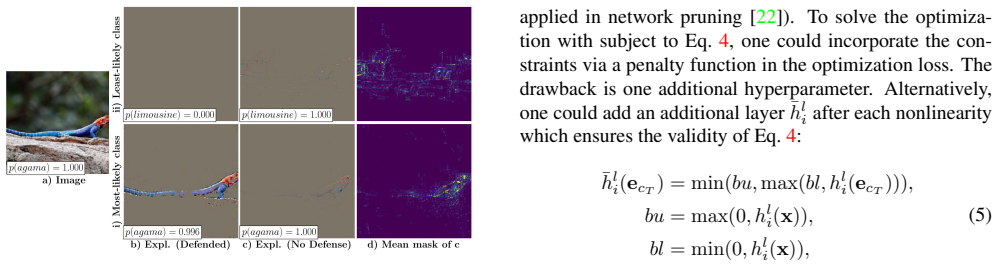
The central object is the backward-pass gradient-clipping rule of Eq. 6, which is equivalent to inserting a clipping layer after each nonlinearity whose forward pass is the identity. For every neuron $i$ in layer $l$, the layer stores bounds $b_u = \max(0, h_i^l(x))$ and $b_l = \min(0, h_i^l(x))$ computed on the original image $x$, and in the backward pass the incoming gradient is multiplied by the indicator that the explanation's activation $h_i^l(e_{c_T})$ lies inside $[b_l, b_u]$. This enforces the constraint of Eq. 4 -- the explanation may activate a neuron no more strongly than the original image did -- while leaving the forward model untouched, adding no hyperparameters, and imposing no smoothness or resolution limit on the mask. The mask optimization of Eq. 2 and Eq. 3 with a zero reference image then yields sparse, pixel-level explanations that are valid model inputs.
What would settle it
Run the defended optimization (generation game with $\lambda=0$) on a large held-out set of images, targeting a class that is visually absent, and count how often the resulting explanation is classified as that class with softmax score above a fixed threshold such as 10%; the paper reports near-zero success on 1000 ImageNet images, so any material fraction of successes would refute the claim that the defense blocks adversarial evidence. A second test would construct an input and target class where legitimate evidence requires a neuron to fire more strongly than it does in the original image, and check whether the per-location clipping suppresses that evidence; if it does, the constraint is too strong for fine-grained explanations.
Extended reading notes
Core claim
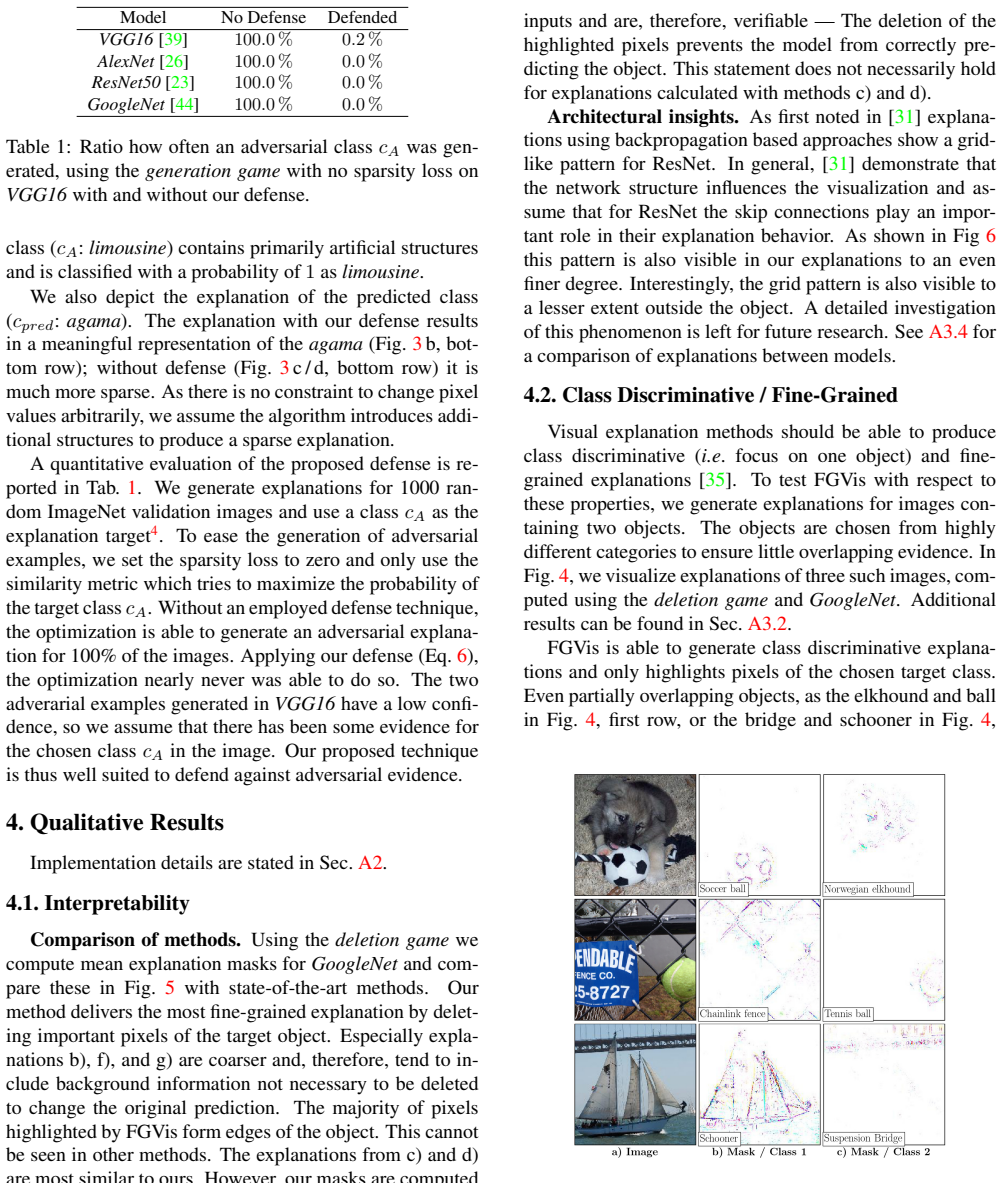
The paper's central claim is that optimization-based visual explanations can be made both fine-grained and free of adversarial evidence without any human-tuned defense parameters. The mechanism is a backward-pass gradient clip: after every nonlinear layer, the explanation's activation for each neuron is silently constrained to the range that the same neuron attains on the original input, which the paper justifies by the pruning convention that zero activations carry the least information. In effect the feature set the explanation may use is a subset of the features already present in the image, so the optimizer cannot sculpt brand-new evidence. The paper validates the defense by trying to generate explanations for the least-likely ImageNet class: without the defense an adversarial explanation is produced for 100% of images, and with the defense for roughly 0% across VGG16, AlexNet, ResNet50, and GoogleNet. Built on this defense, FGVis computes deletion and preservation explanations directly in image space and, to the authors' knowledge, is the first method able to produce fine-grained explanations directly in the image space.
Load-bearing premise
The defense assumes that a neuron whose activation is zero carries the least information, so that preventing any neuron from firing more strongly in the explanation than it does in the original image is enough to stop the optimizer from inventing new evidence; if that premise fails, the clipping would either admit some adversarial artifacts or filter out legitimate fine-grained evidence that needs a neuron to exceed its original activation.
Editorial extensions
If this is right
- Explanations from FGVis are valid model inputs, so faithfulness metrics such as deletion curves can be computed directly on the model without proxy measures or preprocessing that could distort the result.
- The parameter-free defense removes the need to tune smoothness or resolution regularizers per model, making fine-grained explanations practical across different CNN architectures.
- In medical imaging, weakly supervised localization of small lesions -- such as red small dots in diabetic retinopathy -- reaches sensitivities comparable to supervised detectors designed for a single lesion type.
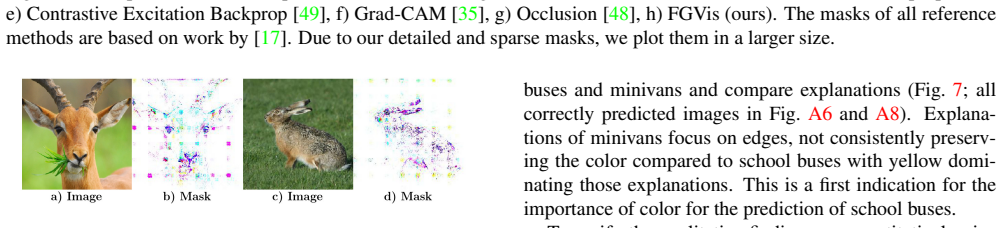
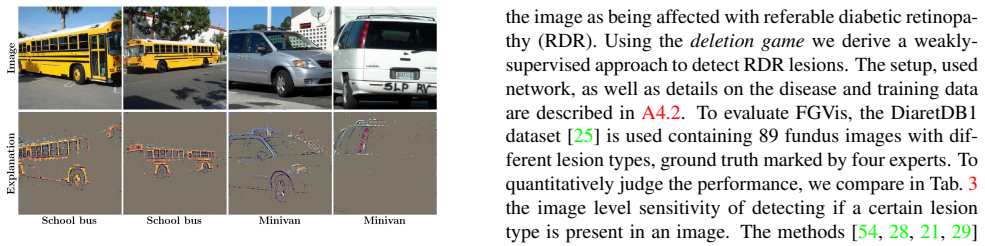
- The method can expose training-data biases: preservation explanations of school buses consistently feature yellow, and swapping color channels collapses the model's accuracy for color-dependent classes.
- The defense gives a simple verification check: if the model is confident for a class that is visually absent, the explanation should be nearly empty, so users can test an explanation's credibility directly.
Reading between the lines
- Because the constraint is applied per neuron at a fixed spatial location, FGVis implicitly treats features as location-bound; a testable extension would allow location-shifted evidence using the network's own translational invariances and check whether that can be added without reintroducing adversarial artifacts.
- The zero-activation premise is the most promising attack surface: an adversary could try to encode a class through a combination of already-active neurons, none of which individually exceeds its original bound, which would bypass the defense without violating Eq. 4.
- The color-bias analysis suggests a systematic audit recipe: compute preservation explanations for a class, swap color channels, then measure both the accuracy drop and the shift in explanation color; applied broadly, that recipe could reveal dataset biases that accuracy alone hides.
- On DiaretDB1 the paper compares FGVis at a 25% overlap threshold against a published CAM baseline reported at 50% overlap; a head-to-head with identical thresholds would separate a genuine fine-grained-localization advantage from a metric artifact.
Signed reviews
Editorial analysis
A structured set of objections, weighed in public.
Referee Report
Summary. The paper proposes FGVis, a post-hoc optimization-based visual explanation method that produces fine-grained, image-space explanations by optimizing a mask-based perturbation of the input. Its main technical contribution is an adversarial-defense technique that clips gradients during backpropagation whenever a hidden activation would exceed the range of activations produced by the original image (Eqs. 4–6). The defense is designed to prevent the optimization from hallucinating adversarial evidence while avoiding human-tuned hyperparameters. The authors evaluate the defense on an adversarial-generation task (Table 1), compare faithfulness against Grad-CAM, LIME, RISE, and sliding-window occlusion using the deletion metric (Table 2), and apply FGVis to weakly supervised lesion detection in diabetic retinopathy fundus images (Table 3). The paper also presents qualitative results on class discriminability, fine-grained detail, and training-data color bias.
Significance. If the central claims held as stated, the work would be valuable: it offers a parameter-free mechanism for constraining explanation optimization to use only evidence present in the original image, which would be a practically useful alternative to low-resolution masking or stochastic defenses. The derivation of the backward-pass clipping rule (Eq. 6) is clean and readily implementable, and the adversarial-generation experiment in Table 1 is a useful stress test showing that the defense blocks additive hallucination. The medical localization study goes beyond toy benchmarks. However, the paper's core guarantee that the defense prevents adversarial evidence is stronger than what Eq. 4 actually enforces, and several quantitative comparisons are not evaluated on equal terms. These issues bear directly on the paper's main contribution, so the manuscript needs substantive revision and additional experiments rather than cosmetic changes.
major comments (4)
- [§3.2, Eqs. (4)–(6)] The claim that the activation-bounding constraint prevents adversarial evidence is too strong. For a ReLU network, Eq. 4 allows any activation h_i^l(e) to decrease to zero even when h_i^l(x) > 0. Because the logit for a target class c_A is linear in the top-layer activations, logit_{c_A}(e) = Σ_i W_{c_A,i} h_i^L(e) + b_{c_A}, deleting a feature that is active in x and has a negative weight for c_A increases logit_{c_A}(e). The feasible set of Eq. 4 therefore contains explanations for a visually absent class c_A that are obtained by deleting existing evidence, not by generating new evidence. Table 1 and Table A1 validate the defense only with the generation game starting from a zero image, so the defense's guarantee against deletion-based adversarial evidence is not established by the reported experiments. Please either extend the validation to the deletion/repression games or explicitly restrict the claim to additive hallucination.
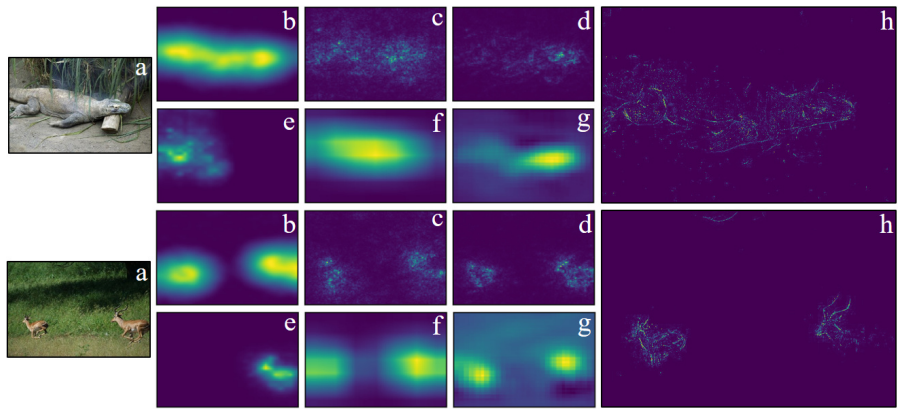
- [§5.1, Table 2] The faithfulness evaluation is partly circular. The deletion metric measures how quickly the target-class probability drops when pixels are removed in order of an importance map, and that importance map is exactly the mask produced by the deletion game (Eq. 3), which optimizes a sparsity-weighted objective to drop the target-class probability. A method that directly optimizes this objective is expected to score well on the deletion metric relative to methods that are not trained against it. The paper should report an independent faithfulness measure (e.g., an insertion metric or a human-grounded evaluation) or at least discuss this optimization-to-metric alignment as a limitation before claiming that FGVis 'outperforms' the reference methods by a large margin.
- [§5.2, Table 3] The comparison with Gondal et al. is not threshold-matched: FGVis is evaluated with a 25% overlap criterion, whereas the reference weakly supervised method uses a 50% overlap criterion. At the 50% overlap that is also reported in Table 3, FGVis is below Gondal et al. for H and HE and comparable for SE, so the statement that FGVis 'performs comparable or outperforms fully supervised approaches' at image-level lesion detection is not supported when the same evaluation criterion is used. The headline comparison should be made at the same threshold, or the claim should be qualified accordingly.
- [§3.2, Eq. (6)] The forward pass is not clamped, so Eq. 4 is not actually enforced at any iteration or at the final explanation. Equation 6 only zeros gradients whose update would violate the bounds; an SGD step can still move an activation beyond a bound, after which the indicator in Eq. 6 is zero for that neuron and the violation can persist. The paper states that the technique is equivalent to adding a clipping layer that 'acts as the identity in the forward pass', which means the constraint is never imposed on forward evaluations. The authors should either apply a forward clamp at inference time or empirically verify that final explanations satisfy Eq. 4, and they should soften the wording that claims the constraint 'ensures' the allowed activation range.
minor comments (4)
- [§5.1, Table 2] Table 2 reports no error bars, confidence intervals, or numbers of runs; the claim that FGVis outperforms the baselines by a large margin should be accompanied by variance estimates over image subsets or model seeds.
- [§5.1, Table 2] The reference-method results in Table 2 are taken from Petsiuk et al. [32] rather than rerun in the authors' pipeline. Please confirm that the experimental settings such as image preprocessing, deletion protocol, and model checkpoints are identical, or note any differences.
- [§4.3] The color-bias experiment uses small sample sizes (21 minivan and 42 school bus images); the 8.3% versus 83.3% comparison would benefit from a confidence interval or a statistical significance test.
- [A4.2] The supplementary material states that FGVis highlights mutations in the optic disk and blood vessels that are not covered by the ground-truth markings, producing visual false positives; this limitation should also be acknowledged in the main text's medical application section.
Circularity Check
Deletion-metric advantage largely restates the method's own loss; core defense is not circular.
-
self definitional
[Sec. 3.1 (Eq. 3); Sec. A2; Sec. 5.1 / A4.1]
"Alternatively, we can compute a deleting explanation using: e*_cT = m*_cT * x, m*_cT = arg max_{m_cT} {phi(y^{cT}_x, y^{cT}_e) + lambda * ||m_cT||_1}. (3) ... For the similarity metric phi(.,.) we use the cross-entropy for the generation and preservation game and the negative probability for the deletion and repression game. ... The deletion metric is computed by measuring the area under the curve AUC of the deletion curve ... using the trapezoidal rule."
The deletion game (Eq. 3) optimizes the mask to maximize the negative target-class softmax (plus sparsity), i.e. it searches for pixels whose removal lowers the target probability. The deletion metric (Sec. 5.1 / A4.1) removes exactly those pixels and scores the resulting drop. Thus the low AUC in Table 2 is the method's own objective, not an independent faithfulness test. Grad-CAM, LIME, RISE, and sliding-window occlusion do not optimize this objective, so the reported margin is structurally favored. Additionally, A4.1 uses a line-search for lambda that stops when y^{cT}_e < 0.02 * y^{cT}_x, placing the explanation at the bottom of the deletion curve before the metric is computed. The headline deletion-metric result is therefore substantially by construction.
full rationale
The central contribution, the gradient-clipping defense of Sec. 3.2, depends on an explicitly stated assumption (zero activations have the lowest information) and is not circular: the adversarial validations in Table 1 and Table A1 run an optimization game from zero/black images and empirically measure whether it can synthesize evidence; these checks do not reduce to the method's equations by construction. The clearest circularity is the faithfulness evaluation: Eq. 3's deletion game maximizes the negative target softmax, and the deletion metric removes the resulting mask and measures the target softmax drop. Since competing methods are not trained to minimize this same metric, the large deletion-metric advantage in Table 2 is partly guaranteed by construction. Moreover, A4.1's lambda line-search stops precisely when the explanation already satisfies a softmax below 2% of the original, so the explanation is already at the bottom of the deletion curve before the metric is evaluated. The medical lesion detection on DiaretDB1 uses expert-marked ground truth and is not circular. The citation to Gondal et al. [18] for the medical training setup is not load-bearing for the central claims. Concerns that the clip range of Eq. 4 permits deletion-based adversarial evidence are correctness risks, not circularity, and do not raise the score further.
Assumptions & free parameters
free parameters (3)
- sparsity weight λ =
line-search over 13 values between 1e-4 and 1e-10; fixed 1e-10 for medical
- SGD learning rate =
0.1 default, 0.25 medical, 0.3 deletion metric
- mask binarization threshold for medical evaluation =
4% of maximum mask value
assumptions (3)
- domain assumption Zero activations carry the lowest information content.
- standard math The CNN is differentiable with respect to the input and SGD can optimize the mask.
- domain assumption A zero image is an information-free reference that leads to high-entropy model output.
Cite this review
Pith. "Pith review of Interpretable and Fine-Grained Visual Explanations for Convolutional Neural Networks." pith.science (2026). https://pith.science/paper/GAZU2ZSP
@misc{pith2026190802686,
  author       = {Pith},
  title        = {Pith review of: Interpretable and Fine-Grained Visual Explanations for Convolutional Neural Networks},
  year         = {2026},
  howpublished = {\url{https://pith.science/paper/GAZU2ZSP}},
  note         = {Machine review of arXiv:1908.02686}
}
read the original abstract
To verify and validate networks, it is essential to gain insight into their decisions, limitations as well as possible shortcomings of training data. In this work, we propose a post-hoc, optimization based visual explanation method, which highlights the evidence in the input image for a specific prediction. Our approach is based on a novel technique to defend against adversarial evidence (i.e. faulty evidence due to artefacts) by filtering gradients during optimization. The defense does not depend on human-tuned parameters. It enables explanations which are both fine-grained and preserve the characteristics of images, such as edges and colors. The explanations are interpretable, suited for visualizing detailed evidence and can be tested as they are valid model inputs. We qualitatively and quantitatively evaluate our approach on a multitude of models and datasets.
Figures


Figures from the paper (4 more)
Reference graph
Works this paper leans on
-
[1]
Local explanation methods for deep neural networks lack sensitivity to parameter values
Julius Adebayo, Justin Gilmer, Ian Goodfellow, and Been Kim. Local explanation methods for deep neural networks lack sensitivity to parameter values. In Workshop at the In- ternational Conference on Learning Representations (ICLR),
-
[2]
A survey on automated microaneurysm detection in dia- betic retinopathy retinal images
Ankita Agrawal, Charul Bhatnagar, and Anand Singh Jalal. A survey on automated microaneurysm detection in dia- betic retinopathy retinal images. InInternational Conference on Information Systems and Computer Networks (ISCON) , pages 24–29. IEEE, 2013. 10
work page 2013
-
[3]
R. Arunkumar and P. Karthigaikumar. Multi-retinal dis- ease classification by reduced deep learning features. Neural Computing and Applications, 28(2):329–334, 2017. 10
work page 2017
-
[4]
Sebastian Bach, Alexander Binder, Gr ´egoire Montavon, Frederick Klauschen, Klaus-Robert M ¨uller, and Wojciech Samek. On pixel-wise explanations for non-linear classi- fier decisions by layer-wise relevance propagation.PloS one, 10(7):e0130140, 2015. 2
work page 2015
-
[5]
How to explain individual classification decisions
David Baehrens, Timon Schroeter, Stefan Harmeling, Mo- toaki Kawanabe, Katja Hansen, and Klaus-Robert M ¨uller. How to explain individual classification decisions. Journal of Machine Learning Research, 11(Jun):1803–1831, 2010. 2
work page 2010
-
[6]
Explaining image classifiers by counter- factual generation
Chun-Hao Chang, Elliot Creager, Anna Goldenberg, and David Duvenaud. Explaining image classifiers by counter- factual generation. arXiv e-prints, page arXiv:1807.08024, Jul 2018. 2, 3, 4, 5
arXiv 2018
-
[7]
Aditya Chattopadhay, Anirban Sarkar, Prantik Howlader, and Vineeth N. Balasubramanian. Grad-cam++: General- ized gradient-based visual explanations for deep convolu- tional networks. In Winter Conference on Applications of Computer Vision (WACV), pages 839–847, 2018. 2
work page 2018
- [8]
Show all 54 references
-
[9]
The cityscapes dataset for semantic urban scene understanding
Marius Cordts, Mohamed Omran, Sebastian Ramos, Timo Rehfeld, Markus Enzweiler, Rodrigo Benenson, Uwe Franke, Stefan Roth, and Bernt Schiele. The cityscapes dataset for semantic urban scene understanding. In Proceed- ings of the IEEE Conference on Computer Vision and Pattern Re...
2016
-
[10]
EyePACS: an adapt- able telemedicine system for diabetic retinopathy screening
Jorge Cuadros and George Bresnick. EyePACS: an adapt- able telemedicine system for diabetic retinopathy screening. Journal of Diabetes Science and Technology, 3(3):509–516,
-
[11]
Real time image saliency for black box classifiers
Piotr Dabkowski and Yarin Gal. Real time image saliency for black box classifiers. In Advances in Neural Information Processing Systems (NIPS), pages 6967–6976, 2017. 1, 2, 3, 4, 5
2017
-
[12]
Doll ´ar, C
P. Doll ´ar, C. Wojek, B. Schiele, and P. Perona. Pedestrian de- tection: A benchmark. In Proceedings of the IEEE Confer- ence on Computer Vision and Pattern Recognition (CVPR) ,
-
[13]
Techniques for interpretable machine learning
Mengnan Du, Ninghao Liu, and Xia Hu. Techniques for interpretable machine learning. arXiv e-prints , page arXiv:1808.00033, Jul 2018. 2
2018 arXiv
-
[14]
To- wards explanation of dnn-based prediction with guided fea- ture inversion
Mengnan Du, Ninghao Liu, Qingquan Song, and Xia Hu. To- wards explanation of dnn-based prediction with guided fea- ture inversion. In Proceedings of the 24th ACM SIGKDD International Conference on Knowledge Discovery & Data Mining, pages 1358–1367, 2018. 2, 3, 4
2018
-
[15]
https://www.kaggle.com/c/diabetic-retinopathy- detection
EyePACS. https://www.kaggle.com/c/diabetic-retinopathy- detection. assessed on 2018-09-23, 2015. 10
2018
-
[16]
https://www.kaggle.com/c/diabetic-retinopathy- detection/discussion/15617
EyePACS. https://www.kaggle.com/c/diabetic-retinopathy- detection/discussion/15617. assessed on 2018-09-23. 10
2018
-
[17]
Fong and Andrea Vedaldi
Ruth C. Fong and Andrea Vedaldi. Interpretable explanations of black boxes by meaningful perturbation. In Proceedings of the IEEE International Conference on Computer Vision (ICCV), pages 3429–3437, 2017. 1, 2, 3, 4, 5, 7
2017
-
[18]
Gondal, Jan M
Waleed M. Gondal, Jan M. K ¨ohler, Ren ´e Grzeszick, Ger- not A. Fink, and Michael Hirsch. Weakly-supervised local- ization of diabetic retinopathy lesions in retinal fundus im- ages. In IEEE International Conference on Image Process- ing (ICIP), pages 2069–2073, 2017. 1, 8, 10
2017
-
[19]
Explaining and harnessing adversarial examples
Ian Goodfellow, Jonathon Shlens, and Christian Szegedy. Explaining and harnessing adversarial examples. In Inter- national Conference on Learning Representations (ICLR) ,
-
[20]
Development and validation of a deep learning algo- rithm for detection of diabetic retinopathy in retinal fundus photographs
Varun Gulshan, Lily Peng, Marc Coram, Martin C Stumpe, Derek Wu, Arunachalam Narayanaswamy, Subhashini Venu- gopalan, Kasumi Widner, Tom Madams, Jorge Cuadros, et al. Development and validation of a deep learning algo- rithm for detection of diabetic retinopathy in retinal fun...
2016
-
[21]
A gaussian scale space approach for exudates detection, clas- sification and severity prediction
Mrinal Haloi, Samarendra Dandapat, and Rohit Sinha. A gaussian scale space approach for exudates detection, clas- sification and severity prediction. arXiv e-prints , page arXiv:1505.00737, May 2015. 8
2015 arXiv
-
[22]
Learning both weights and connections for efficient neural network
Song Han, Jeff Pool, John Tran, and William Dally. Learning both weights and connections for efficient neural network. In Advances in Neural Information Processing Systems (NIPS), pages 1135–1143, 2015. 5
2015
-
[23]
Deep residual learning for image recognition
Kaiming He, Xiangyu Zhang, Shaoqing Ren, and Jian Sun. Deep residual learning for image recognition. In Proceed- ings of the IEEE Conference on Computer Vision and Pattern Recognition (CVPR), pages 770–778, 2016. 6
2016
-
[24]
Distilling the knowledge in a neural network
Geoffrey Hinton, Oriol Vinyals, and Jeff Dean. Distilling the knowledge in a neural network. arXiv e-prints , page arXiv:1503.02531, Mar 2015. 3
2015 arXiv
-
[25]
The DIARETDB1 diabetic retinopathy database and evaluation protocol
Tomi Kauppi, Valentina Kalesnykiene, Joni-Kristian Ka- marainen, Lasse Lensu, Iiris Sorri, Asta Raninen, Raija V outilainen, Hannu Uusitalo, Heikki K¨alvi¨ainen, and Juhani Pietil¨a. The DIARETDB1 diabetic retinopathy database and evaluation protocol. In British Machine Vision...
2007
-
[26]
ImageNet classification with deep convolutional neural net- works
Alex Krizhevsky, Ilya Sutskever, and Geoffrey E Hinton. ImageNet classification with deep convolutional neural net- works. In Advances in Neural Information Processing Sys- tems (NIPS), pages 1097–1105, 2012. 6, 1
2012
-
[27]
Adver- sarial examples in the physical world
Alexey Kurakin, Ian Goodfellow, and Samy Bengio. Adver- sarial examples in the physical world. arXiv e-prints, page arXiv:1607.02533, Jul 2016. 4, 5
2016 arXiv
-
[28]
A location-to-segmentation strategy for automatic exudate segmentation in colour retinal fundus images
Qing Liu, Beiji Zou, Jie Chen, Wei Ke, Kejuan Yue, Zail- iang Chen, and Guoying Zhao. A location-to-segmentation strategy for automatic exudate segmentation in colour retinal fundus images. Computerized Medical Imaging and Graph- ics, 55:78–86, 2017. 8
2017
-
[29]
De- tection of red lesions in diabetic retinopathy affected fundus images
Vijay M Mane, Ramish B Kawadiwale, and DV Jadhav. De- tection of red lesions in diabetic retinopathy affected fundus images. In IEEE International Advance Computing Confer- ence (IACC), pages 56–60, 2015. 8
2015
-
[30]
Concrete problems for autonomous vehicle safety: Advantages of Bayesian deep learning
Rowan McAllister, Yarin Gal, Alex Kendall, Mark Van Der Wilk, Amar Shah, Roberto Cipolla, and Adrian Vivian Weller. Concrete problems for autonomous vehicle safety: Advantages of Bayesian deep learning. InInternational Joint Conferences on Artificial Intelligence (IJCAI), 2017. 1
2017
-
[31]
A theoretical ex- planation for perplexing behaviors of backpropagation-based visualizations
Weili Nie, Yang Zhang, and Ankit Patel. A theoretical ex- planation for perplexing behaviors of backpropagation-based visualizations. arXiv e-prints, page arXiv:1805.07039, May
-
[32]
Rise: Random- ized input sampling for explanation of black-box models
Vitali Petsiuk, Abir Das, and Kate Saenko. Rise: Random- ized input sampling for explanation of black-box models. In British Machine Vision Conference (BMVC), 2018. 1, 2, 7, 8, 10
2018
-
[33]
Why should I trust you?: Explaining the predictions of any classifier
Marco Tulio Ribeiro, Sameer Singh, and Carlos Guestrin. Why should I trust you?: Explaining the predictions of any classifier. In Proceedings of the 22nd ACM SIGKDD In- ternational Conference on Knowledge Discovery and Data Mining, pages 1135–1144, 2016. 2, 8
2016
-
[34]
Berg, and Li Fei-Fei
Olga Russakovsky, Jia Deng, Hao Su, Jonathan Krause, San- jeev Satheesh, Sean Ma, Zhiheng Huang, Andrej Karpathy, Aditya Khosla, Michael Bernstein, Alexander C. Berg, and Li Fei-Fei. ImageNet large scale visual recognition chal- lenge. International Journal of Computer Vision ...
2015
-
[35]
Selvaraju, Michael Cogswell, Abhishek Das, Ramakrishna Vedantam, Devi Parikh, and Dhruv Ba- tra
Ramprasaath R. Selvaraju, Michael Cogswell, Abhishek Das, Ramakrishna Vedantam, Devi Parikh, and Dhruv Ba- tra. Grad-CAM: Visual explanations from deep networks via gradient-based localization. In Proceedings of the IEEE In- ternational Conference on Computer Vision (ICCV) , p...
2017
-
[36]
Regional multi- scale approach for visually pleasing explanations of deep neural networks
Dasom Seo, Kanghan Oh, and Il-Seok Oh. Regional multi- scale approach for visually pleasing explanations of deep neural networks. arXiv e-prints, page arXiv:1807.11720, Jul
-
[37]
Learning important features through propagating activation differences
Avanti Shrikumar, Peyton Greenside, and Anshul Kundaje. Learning important features through propagating activation differences. In Proceedings of the 34th International Confer- ence on Machine Learning (ICML), pages 3145–3153, 2017. 2
2017
-
[38]
Deep inside convolutional networks: Visualising image clas- sification models and saliency maps
Karen Simonyan, Andrea Vedaldi, and Andrew Zisserman. Deep inside convolutional networks: Visualising image clas- sification models and saliency maps. International Confer- ence on Learning Representations (ICLR), 2014. 2, 7
2014
-
[39]
Very deep convo- lutional networks for large-scale image recognition
Karen Simonyan and Andrew Zisserman. Very deep convo- lutional networks for large-scale image recognition. arXiv e-prints, page arXiv:1409.1556, Sep 2014. 6
2014 arXiv
-
[40]
Smoothgrad: removing noise by adding noise
Daniel Smilkov, Nikhil Thorat, Been Kim, Fernanda Vi ´egas, and Martin Wattenberg. Smoothgrad: removing noise by adding noise. arXiv e-prints, page arXiv:1706.03825, Jun
-
[41]
Solomon, Emily Chew, Elia J
Sharon D. Solomon, Emily Chew, Elia J. Duh, Lucia Sobrin, Jennifer K. Sun, Brian L. VanderBeek, Charles C. Wykoff, and Thomas W. Gardner. Diabetic retinopathy: a position statement by the American diabetes association. Diabetes care, 40(3):412–418, 2017. 10, 16
2017
-
[42]
Striving for simplicity: The all convolutional net
Jost Tobias Springenberg, Alexey Dosovitskiy, Thomas Brox, and Martin Riedmiller. Striving for simplicity: The all convolutional net. In International Conference on Learn- ing Representations (ICLR), 2015. 1, 2, 7
2015
-
[43]
Axiomatic attribution for deep networks
Mukund Sundararajan, Ankur Taly, and Qiqi Yan. Axiomatic attribution for deep networks. In Proceedings of the 34th In- ternational Conference on Machine Learning (ICML), pages 3319–3328, 2017. 2
2017
-
[44]
Going deeper with convolutions
Christian Szegedy, Wei Liu, Yangqing Jia, Pierre Sermanet, Scott Reed, Dragomir Anguelov, Dumitru Erhan, Vincent Vanhoucke, and Andrew Rabinovich. Going deeper with convolutions. In Proceedings of the IEEE Conference on Computer Vision and Pattern Recognition (CVPR), 2015. 6
2015
-
[45]
In- triguing properties of neural networks
Christian Szegedy, Wojciech Zaremba, Ilya Sutskever, Joan Bruna, Dumitru Erhan, Ian Goodfellow, and Rob Fergus. In- triguing properties of neural networks. In International Con- ference on Learning Representations (ICLR), 2014. 4
2014
-
[46]
Development and validation of a deep learn- ing system for diabetic retinopathy and related eye diseases using retinal images from multiethnic populations with dia- betes
Daniel Shu Wei Ting, Carol Yim-Lui Cheung, Gilbert Lim, Gavin Siew Wei Tan, Nguyen D Quang, Alfred Gan, Haslina Hamzah, Renata Garcia-Franco, Ian Yew San Yeo, Shu Yen Lee, et al. Development and validation of a deep learn- ing system for diabetic retinopathy and related eye di...
2017
-
[47]
Rogers, Ryo Kawasaki, Ecosse L
Joanne WY Yau, Sophie L. Rogers, Ryo Kawasaki, Ecosse L. Lamoureux, Jonathan W. Kowalski, Toke Bek, Shih-Jen Chen, Jacqueline M. Dekker, Astrid Fletcher, Jakob Grauslund, et al. Global prevalence and major risk factors of diabetic retinopathy. Diabetes care, 35(3):556–564, 2012. 10
2012
-
[48]
Zeiler and Rob Fergus
Matthew D. Zeiler and Rob Fergus. Visualizing and under- standing convolutional networks. In Proceedings of the Eu- ropean Conference on Computer Vision (ECCV), pages 818– 833, 2014. 2, 7, 8
2014
-
[49]
Top-down neural attention by excitation backprop
Jianming Zhang, Zhe Lin, Jonathan Brandt, Xiaohui Shen, and Stan Sclaroff. Top-down neural attention by excitation backprop. In Proceedings of the European Conference on Computer Vision (ECCV), pages 543–559, 2016. 1, 2, 7
2016
-
[50]
Visual interpretability for deep learning: A survey
Quan-shi Zhang and Song-Chun Zhu. Visual interpretability for deep learning: A survey. Frontiers of Information Tech- nology & Electronic Engineering, 19(1):27–39, 2018. 2
2018
-
[51]
Uniqueness-driven saliency analysis for automated lesion detection with applications to retinal diseases
Yitian Zhao, Yalin Zheng, Yifan Zhao, Yonghuai Liu, Zhili Chen, Peng Liu, and Jiang Liu. Uniqueness-driven saliency analysis for automated lesion detection with applications to retinal diseases. In International Conference on Medical Im- age Computing and Computer-Assisted Int...
2018
-
[52]
Object Detectors Emerge in Deep Scene CNNs
Bolei Zhou, Aditya Khosla, Agata Lapedriza, Aude Oliva, and Antonio Torralba. Object Detectors Emerge in Deep Scene CNNs. arXiv e-prints , page arXiv:1412.6856, Dec
-
[53]
Learning deep features for discrimi- native localization
Bolei Zhou, Aditya Khosla, Agata Lapedriza, Aude Oliva, and Antonio Torralba. Learning deep features for discrimi- native localization. In Proceedings of the IEEE Conference on Computer Vision and Pattern Recognition (CVPR), pages 2921–2929, 2016. 1, 2, 8
2016
-
[54]
Au- tomatic hemorrhage detection in color fundus images based on gradual removal of vascular branches
Lei Zhou, Penglin Li, Qi Yu, Yu Qiao, and Jie Yang. Au- tomatic hemorrhage detection in color fundus images based on gradual removal of vascular branches. In IEEE Interna- tional Conference on Image Processing (ICIP) , pages 399– 403, 2016. 8 Interpretable and Fine-Grained Vis...
2016
Reviewed August 14, 2026 · model on record in the stance chip above.
Discussion (0). Continue with ORCID to comment.