REVIEW 4 major objections 5 minor 73 references
Learning Conditional Deformable Templates with Convolutional Networks
T0 review · 4 major / 5 minor · reviewed 2026-08-14 · deepseek-v4-flash
Pith's one-line read This paper claims that a single convolutional network can jointly estimate a deformable template for a whole population—or one conditioned on attributes such as age and sex—and provide fast diffeomorphic alignment to any new image.
desk verdict A clean, novel method for learning conditional templates jointly with a registration network; the MNIST evidence is solid, but the neuroimaging evaluation does not yet show that conditioning helps. read the letter →
The pith
A machine-rendered reading of the paper's core claim, the machinery that carries it, and where it could break.
The reading
What carries the argument
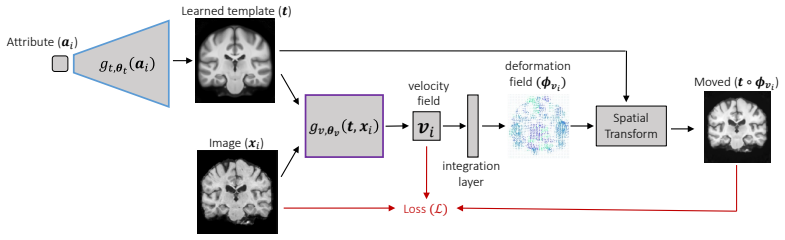
The central objects are a conditional template network $g_{t,\theta_t}(a_i) = t$, implemented as a decoder, and a registration network $g_{v,\theta_v}(t, x_i) = v$, implemented as a U-Net, joined by the stationary-velocity-field parametrization of diffeomorphisms: integrating $v$ via scaling and squaring gives the deformation $\phi_v$, and warping the template by $\phi_v$ reconstructs the image. The generative model ties these together through the likelihood $p(x_i \mid v_i; a_i) = \mathcal{N}(x_i;\, f_{\theta_t}(a_i) \circ \phi_{v_i},\, \sigma^2 I)$ and the velocity prior $p(V) \propto \exp(-\gamma\|\bar{u}\|^2)\prod_i \mathcal{N}(u_i;\, 0,\, \Sigma_u)$, where the mean-displacement term enforces an unbiased central template and the Laplacian-based covariance encourages smooth deformations. Minimizing the negative log likelihood with stochastic gradients updates template and registration networks jointly, sidestepping expensive iterative pairwise registration.
What would settle it
Train the same model on a cohort that includes focal lesions or large scanner contrast differences and compare per-subject alignment quality, for example Dice overlap or reconstruction error, against a model trained only on homogeneous controls. If the conditional template cannot be deformed to match the atypical images with topology-preserving smooth fields, and those subjects' metrics fall well below the control average, the central modeling assumption is violated.
Extended reading notes
Core claim
The central claim is that template estimation and image alignment can be cast as a single maximum-likelihood learning problem. For each image $x_i$, the model posits that $x_i$ is generated by warping a conditional template $t = f_{\theta_t}(a_i)$ through a diffeomorphism $\phi_{v_i}$ parameterized by a stationary velocity field $v_i$, with an additive Gaussian or normalized-cross-correlation likelihood and a deformation prior that penalizes the mean displacement and encourages smoothness. A network $g_\theta(x_i, a_i) = (v_i, t)$ is trained end-to-end by minimizing the negative log likelihood, learning at once a template function and a fast registration network; at test time, both the template and the deformation are obtained in a forward pass, and inverse deformations come from integrating the negative velocity field. The experiments claim that this produces central templates requiring smaller deformations than instance-based or decoder-only baselines, and conditional brain templates consistent with known age-related anatomical changes.
Load-bearing premise
The load-bearing assumption is that every image in the dataset can be represented as a single smoothly deformed version of a shared conditional template; images that cannot be diffeomorphically matched to one central shape, such as brains with tumors, lesions, or strong scanner-related contrast differences, would force the template into a compromise and bias the deformation estimates.
Editorial extensions
If this is right
- A single trained model provides both a template and a deformation field for any new image in one forward pass, making on-demand atlas construction practical in clinical settings where no pre-existing template is available.
- Conditional templates let the same data support many subpopulation atlases, such as an age- and sex-specific brain template, without subdividing the dataset or arbitrarily thresholding continuous attributes.
- Because the template is a learned function of attributes, the model can synthesize templates for attribute values that were sparsely observed or held out during training, interpolating age-related anatomy across the whole range.
- Learning to represent images up to a deformation means the method captures geometric variability aligned with the conditioning attributes, and can reduce confounding effects when those attributes are supplied.
Reading between the lines
- Beyond the paper, the learned template function could be inverted to estimate attributes such as age from a scan, by finding the attribute value whose template best aligns with the input; the paper mentions this only as future work.
- The latent-attribute experiment suggests a fully unsupervised version of this framework could build class- or mode-conditional templates without observed labels, effectively discovering geometric factors of variation in a dataset.
- A testable extension would apply the model to multi-site clinical data with strong scanner or contrast differences; under the current likelihood, such appearance variation might be absorbed into the template and deformations rather than being modeled as noise.
- If conditional template functions are smooth in the attributes, the framework implicitly yields a generative model of anatomy along those axes, so one could synthesize new population samples by deforming a conditional template with sampled velocity fields.
Signed reviews
Editorial analysis
A structured set of objections, weighed in public.
Referee Report
Summary. The paper proposes a probabilistic framework for learning deformable templates from image collections, in which each image is modeled as a diffeomorphic deformation of a template that may itself be a function of observed attributes. The authors derive a maximum-likelihood objective (Eq. 6) combining an image likelihood, a deformation-magnitude prior, and a smoothness prior, and optimize it end-to-end with a template-generation network and a registration network. They present experiments on MNIST and QuickDraw with controlled scaling/rotation attributes, and on a large multi-site brain MRI dataset, where they build unconditional and age/sex-conditioned templates. The paper claims that the learned templates are comparable in quality to a widely used atlas and that conditional templates capture age-related anatomical changes such as ventricle growth and hippocampal shrinkage.
Significance. The maximum-likelihood derivation is clear, the method is general, and the implementation (as part of VoxelMorph) with code and atlases released is a strength. The conditional-template formulation is a useful contribution: it provides a single network that can generate on-demand templates for arbitrary observed attributes without subdividing the population, and the MNIST experiments demonstrate that the model can learn attribute-driven geometric variability and generalize to sparse or held-out attribute values. The neuroimaging results, however, do not yet substantiate the claim that conditional templates improve or match existing atlases in a quantitatively meaningful way, because the only quantitative comparison is explicitly not apples-to-apples and shows no gain over the unconditional template. The value of the contribution therefore rests mainly on the toy experiments and visual/descriptive neuroimaging evidence.
major comments (4)
- [Section 4.2, Dice evaluation] The Dice comparison cannot support the abstract-level claim that the learned atlases are 'similar in quality and utility to a widely used atlas.' The authors state that 'these numbers may not be directly compared' because the baseline atlas and segmentations were produced with an external dataset and a different labeling pipeline, while their template labels come from FreeSurfer on their own training images. Moreover, the conditional template achieves Dice 0.795 ± 0.116, numerically below the unconditional template's 0.800 ± 0.110, with no significance test. A matched comparison on the same test subjects, using the same segmentation protocol for all templates, and a conditional-versus-unconditional comparison, is required to support the utility claim.
- [Section 4.2, Fig. 13] The age-related volume trends in Figure 13 are computed by warping training segmentations into the model's own conditional templates and measuring volumes of those templates. Because the template network and the deformation network are optimized jointly and the loss in Eq. (6) contains no term that explicitly forces attribute-related geometry into the template, these trends are a description of the learned model's outputs rather than an independent validation that conditional templates capture true anatomical variability. A non-circular test could compare registration accuracy or segmentation accuracy on held-out images when using matched versus mismatched conditional templates (e.g., age-appropriate versus age-inappropriate templates).
- [Section 4.1.1, centrality metrics] The centrality metric (mean displacement norm) is directly penalized in the training objective through the term -γ‖ū‖² in Eq. (6), so reporting lower centrality for the proposed method as a success criterion is partly circular. The comparison with the decoder baseline is informative about the objective being optimized, but it does not establish that the templates are better in an independent sense. The more decisive quantitative evidence in this section is the MSE and Jacobian behavior, which should be emphasized, and centrality should be presented as an objective-matching check rather than an external quality measure.
- [Section 3.1, generative assumption] The generative model assumes that each image is a spatially deformed version of a single conditional template under a diffeomorphic stationary-velocity-field deformation. In heterogeneous clinical cohorts containing lesions, tumors, or large contrast differences, this assumption is violated and the learned template will be a compromise that cannot be registered accurately to all images. Since the paper motivates clinical applications, the authors should either add a stress test with such images (e.g., synthetic lesions or outlier scans) or explicitly scope the claims to populations that satisfy the mutual-diffeomorphism assumption.
minor comments (5)
- [Section 3.2, Eq. (6)] The running-average approximation of ū is introduced only in the text; the notation in Eq. (6) treats ū as if it were the full dataset mean. The approximation should be made explicit in the equation or immediately after it.
- [Section 4.2] The text says the conditional model was trained 'using only the ADNI and ABIDE datasets' but the overall dataset includes many sources; clarify which splits were used for the unconditional and conditional models and how the 250 test subjects were selected.
- [Section 4.2, Figure 13] No error bars or confidence intervals are given for the volume-age trends, and the y-axis units ('x1000 voxels') are potentially confusing; specify whether these are raw voxel counts and report variability across subjects or templates.
- [Sections 2.2 and 3.1] The term 'unbiased population templates' is used for a template whose mean deformation is small; this is not the same as statistical unbiasedness of an estimator. Consider rewording to 'central' templates.
- [Throughout] There are several typos and notation issues: 'levarges' should be 'leverages' in Section 2.2, and in Section 4.1.1 the expression '|Jφ(p)|≤0' should be clarified to mean Jacobian determinants at or below zero, with the intended interpretation of non-topology-preserving pixels.
Circularity Check
Centrality metrics duplicate the training-loss regularizers, but the core conditional-template learning chain is self-contained.
-
self definitional
[Section 4.1.1, 'Evaluation criteria' (and Fig. 6), vs. Eq. (6) in Section 3.2 and Section 1's template definition.]
"Our first two quantitative evaluation criteria relate to centrality, for which we computed the norm of the mean displacement field ‖¯u‖2 and the average displacement size 1 n ∑ i‖ui‖2."
Section 1 defines template quality as minimizing geometric distance: 'A good template therefore minimizes the geometric distance to all images in a dataset.' Equation (6) instantiates this with the loss L = −(1/2σ²)‖x_i − g_t(a_i)∘φ_v_i‖² − γ‖u_bar‖² − (λ_d d/2)Σ_i‖u_i‖² + (λ_a/2)Σ_i‖∇u_i‖² + const. The two 'centrality' evaluation metrics in Section 4.1.1, ‖u_bar‖² and (1/n)Σ_i‖u_i‖², are exactly the second and third terms being minimized. Reporting them as evidence that the method yields 'more central templates requiring smaller deformations' therefore evaluates the training objective itself. This is a partial self-evaluation; the comparison against differently trained baselines remains informative, but the metric is definitionally aligned with the method's objective.
full rationale
The main derivation is self-contained: Eq. (1) poses a maximum-likelihood problem, the network in Section 3.2 minimizes the resulting negative log-likelihood in Eq. (6), and the MNIST/QuickDraw experiments evaluate on held-out images against instance and decoder baselines, so the core claim of jointly learning conditional templates and fast diffeomorphic alignment is not circular. The only concrete circular step I found is the centrality evaluation in Section 4.1.1, which uses the same displacement norms the loss is built to minimize. This is a minor, evaluation-level circularity and does not force the central result. The age-conditioned brain templates are not hard-coded by the loss; conditioning enters only through the input attribute vector and the observed age trends emerge from the joint optimization, so Figure 13 is descriptive output rather than a definitional tautology. Section 4.2 explicitly disclaims the Dice comparison: 'We emphasize that these numbers may not be directly compared, since the baseline atlas (and segmentations) were obtained using a different process involving an external dataset and manual labeling, while our template was built with our training images (and their FreeSurfer segmentations to obtain template labels).' That is a support limitation for the atlas-quality claim, not a circularity. No load-bearing self-citation chain or imported uniqueness theorem appears; prior VoxelMorph work is cited for architectures and integration layers, which are technical building blocks rather than the paper's central claim.
Assumptions & free parameters
free parameters (5)
- gamma (mean-deformation prior weight) =
0.01 (initial, tuned on validation)
- lambda_d (deformation-size prior weight) =
0.001 (initial, tuned)
- lambda_a (deformation-smoothness prior weight) =
0.01 (initial, tuned)
- sigma (image noise standard deviation) =
1
- c (running-average window) =
100
assumptions (5)
- domain assumption Each image is a diffeomorphic deformation of a conditional template plus noise.
- domain assumption Deformation prior enforces smoothness and unbiasedness.
- domain assumption Likelihood models (Gaussian for 2D images, normalized cross-correlation for MRI) are appropriate.
- ad hoc to paper The running average over the last c displacements approximates the true mean deformation.
- ad hoc to paper The registration network has sufficient capacity to predict the optimal velocity field for every image-template pair.
Cite this review
Pith. "Pith review of Learning Conditional Deformable Templates with Convolutional Networks." pith.science (2026). https://pith.science/paper/AKIAJJUB
@misc{pith2026190802738,
  author       = {Pith},
  title        = {Pith review of: Learning Conditional Deformable Templates with Convolutional Networks},
  year         = {2026},
  howpublished = {\url{https://pith.science/paper/AKIAJJUB}},
  note         = {Machine review of arXiv:1908.02738}
}
read the original abstract
We develop a learning framework for building deformable templates, which play a fundamental role in many image analysis and computational anatomy tasks. Conventional methods for template creation and image alignment to the template have undergone decades of rich technical development. In these frameworks, templates are constructed using an iterative process of template estimation and alignment, which is often computationally very expensive. Due in part to this shortcoming, most methods compute a single template for the entire population of images, or a few templates for specific sub-groups of the data. In this work, we present a probabilistic model and efficient learning strategy that yields either universal or conditional templates, jointly with a neural network that provides efficient alignment of the images to these templates. We demonstrate the usefulness of this method on a variety of domains, with a special focus on neuroimaging. This is particularly useful for clinical applications where a pre-existing template does not exist, or creating a new one with traditional methods can be prohibitively expensive. Our code and atlases are available online as part of the VoxelMorph library at http://voxelmorph.csail.mit.edu.
Figures


Figures from the paper (10 more)




Reference graph
Works this paper leans on
-
[1]
Cross-words reference template for dtw-based speech recognition systems
Waleed H Abdulla, David Chow, and Gary Sin. Cross-words reference template for dtw-based speech recognition systems. In TENCON 2003. Conference on convergent technologies for Asia-Pacific region, volume 4, pages 1576–1579. IEEE, 2003
work page 2003
-
[2]
Unsupervised convolutional neural networks for motion estimation
Aria Ahmadi and Ioannis Patras. Unsupervised convolutional neural networks for motion estimation. In Image Processing (ICIP), 2016 IEEE International Conference on, pages 1629–
work page 2016
-
[3]
Towards a coherent statistical framework for dense deformable template estimation
Stéphanie Allassonnière, Yali Amit, and Alain Trouvé. Towards a coherent statistical framework for dense deformable template estimation. Journal of the Royal Statistical Society: Series B (Statistical Methodology), 69(1):3–29, 2007
work page 2007
-
[4]
Martin Arjovsky, Soumith Chintala, and Léon Bottou. Wasserstein gan. arXiv preprint arXiv:1701.07875, 2017
arXiv 2017
- [5]
-
[6]
Symmetric diffeo- morphic image registration with cross-correlation: evaluating automated labeling of elderly and neurodegenerative brain
Brian B Avants, Charles L Epstein, Murray Grossman, and James C Gee. Symmetric diffeo- morphic image registration with cross-correlation: evaluating automated labeling of elderly and neurodegenerative brain. Medical image analysis, 12(1):26–41, 2008
2008
-
[7]
R. Bajcsy and S. Kovacic. Multiresolution elastic matching. Computer Vision, Graphics, and Image Processing, 46:1–21, 1989
work page 1989
-
[8]
G. Balakrishnan, A. Zhao, M.R. Sabuncu, J. Guttag, and A.V . Dalca. An unsupervised learning model for deformable medical image registration. In Proceedings of the IEEE Conference on Computer Vision and Pattern Recognition, pages 9252–9260, 2018
work page 2018
Show all 73 references
-
[9]
Balakrishnan, A
G. Balakrishnan, A. Zhao, M.R. Sabuncu, J. Guttag, and A.V . Dalca. V oxelmorph: A learning framework for deformable medical image registration. IEEE Transactions on Medical Imaging, 2018
2018
-
[10]
Beg et al
M.F. Beg et al. Computing large deformation metric mappings via geodesic flows of diffeomor- phisms. Int. J. Comput. Vision, 61:139–157, 2005
2005
-
[11]
High accuracy optical flow estimation based on a theory for warping
Thomas Brox et al. High accuracy optical flow estimation based on a theory for warping. European Conference on Computer Vision (ECCV), pages 25–36, 2004
2004
-
[12]
Deformable image registration based on similarity-steered cnn regression
Xiaohuan Cao, Jianhua Yang, Jun Zhang, Dong Nie, Minjeong Kim, Qian Wang, and Dinggang Shen. Deformable image registration based on similarity-steered cnn regression. InInternational 12 Conference on Medical Image Computing and Computer-Assisted Intervention, pages 300–308. Sp...
2017
-
[13]
Large deformation diffeo- morphic metric mapping of vector fields
Yan Cao, Michael I Miller, Raimond L Winslow, and Laurent Younes. Large deformation diffeo- morphic metric mapping of vector fields. IEEE transactions on medical imaging, 24(9):1216– 1230, 2005
2005
-
[14]
Multi-contrast large deformation diffeomorphic metric mapping for diffusion tensor imaging
Can Ceritoglu, Kenichi Oishi, Xin Li, Ming-Chung Chou, Laurent Younes, Marilyn Albert, Constantine Lyketsos, Peter CM van Zijl, Michael I Miller, and Susumu Mori. Multi-contrast large deformation diffeomorphic metric mapping for diffusion tensor imaging. Neuroimage, 47(2):618–...
2009
-
[15]
Infogan: Interpretable representation learning by information maximizing generative adversarial nets
Xi Chen, Yan Duan, Rein Houthooft, John Schulman, Ilya Sutskever, and Pieter Abbeel. Infogan: Interpretable representation learning by information maximizing generative adversarial nets. In Advances in neural information processing systems, pages 2172–2180, 2016
2016
-
[16]
Dagley et al
A. Dagley et al. Harvard aging brain study: dataset and accessibility. NeuroImage, 2015
2015
-
[17]
Dalca, G
A.V . Dalca, G. Balakrishnan, J. Guttag, and M.R Sabuncu. Unsupervised learning for fast prob- abilistic diffeomorphic registration. In International Conference on Medical Image Computing and Computer-Assisted Intervention, pages 729–738. Springer, 2018
2018
-
[18]
Dalca, G
A.V . Dalca, G. Balakrishnan, J. Guttag, and M.R. Sabuncu. Unsupervised learning of probabilis- tic diffeomorphic registration for images and surfaces. Medical Image Analysis, 57:226–236, 2019
2019
-
[19]
Dalca et al
A.V . Dalca et al. Patch-based discrete registration of clinical brain images. In International Workshop on Patch-based Techniques in Medical Imaging, pages 60–67. Springer, 2016
2016
-
[20]
Dalca, J
A.V . Dalca, J. Guttag, and M.R Sabuncu. Anatomical priors in convolutional networks for unsupervised biomedical segmentation. In Proceedings of the IEEE Conference on Computer Vision and Pattern Recognition, pages 9290–9299, 2018
2018
-
[21]
Large deformation minimum mean squared error template estimation for computational anatomy
Brad Davis, Peter Lorenzen, and Sarang C Joshi. Large deformation minimum mean squared error template estimation for computational anatomy. In ISBI, volume 4, pages 173–176, 2004
2004
-
[22]
Population shape regression from random design data
Brad C Davis, P Thomas Fletcher, Elizabeth Bullitt, and Sarang Joshi. Population shape regression from random design data. International journal of computer vision, 90(2):255–266, 2010
2010
-
[23]
de V os et al
B.D. de V os et al. End-to-end unsupervised deformable image registration with a convolutional neural network. In DLMIA, pages 204–212. 2017
2017
-
[24]
Di Martino et al
A. Di Martino et al. The autism brain imaging data exchange: towards a large-scale evaluation of the intrinsic brain architecture in autism. Molecular psychiatry, 19(6):659–667, 2014
2014
-
[25]
Dosovitskiy et al
A. Dosovitskiy et al. Flownet: Learning optical flow with convolutional networks. 2015
2015
-
[26]
Hierarchical matching of deformable shapes
Pedro F Felzenszwalb and Joshua D Schwartz. Hierarchical matching of deformable shapes. In 2007 IEEE Conference on Computer Vision and Pattern Recognition, pages 1–8. IEEE, 2007
2007
-
[27]
B. Fischl. Freesurfer. Neuroimage, 62(2):774–781, 2012
2012
-
[28]
Dense image registration through mrfs and efficient linear programming
Ben Glocker et al. Dense image registration through mrfs and efficient linear programming. Medical image analysis, 12(6):731–741, 2008
2008
-
[29]
Gollub et al
R.L. Gollub et al. The mcic collection: a shared repository of multi-modal, multi-site brain image data from a clinical investigation of schizophrenia. Neuroinformatics, 11(3):367–388, 2013
2013
-
[30]
Deep learning
Ian Goodfellow, Yoshua Bengio, and Aaron Courville. Deep learning. MIT Press, 2016
2016
-
[31]
A spatio-temporal atlas of the human fetal brain with application to tissue seg- mentation
Piotr A Habas, Kio Kim, Francois Rousseau, Orit A Glenn, A James Barkovich, and Colin Studholme. A spatio-temporal atlas of the human fetal brain with application to tissue seg- mentation. In International Conference on Medical Image Computing and Computer-Assisted Interventio...
2009
-
[32]
Registration of anatomical images using paths of diffeomorphisms parameterized with stationary vector field flows
Monica Hernandez, Matias N Bossa, and Salvador Olmos. Registration of anatomical images using paths of diffeomorphisms parameterized with stationary vector field flows. International Journal of Computer Vision, 85(3):291–306, 2009. 13
2009
-
[33]
beta-vae: Learning basic visual concepts with a constrained variational framework
Irina Higgins, Loic Matthey, Arka Pal, Christopher Burgess, Xavier Glorot, Matthew Botvinick, Shakir Mohamed, and Alexander Lerchner. beta-vae: Learning basic visual concepts with a constrained variational framework. ICLR, 2(5):6, 2017
2017
-
[34]
J Holmes et al
A. J Holmes et al. Brain genomics superstruct project initial data release with structural, functional, and behavioral measures. Scientific data, 2, 2015
2015
-
[35]
Horn and Brian G
Berthold K.P. Horn and Brian G. Schunck. Determining optical flow. 1980
1980
-
[36]
Flownet 2.0: Evolution of optical flow estimation with deep networks
Eddy Ilg, Nikolaus Mayer, Tonmoy Saikia, Margret Keuper, Alexey Dosovitskiy, and Thomas Brox. Flownet 2.0: Evolution of optical flow estimation with deep networks. InIEEE conference on computer vision and pattern recognition (CVPR), volume 2, page 6, 2017
2017
-
[37]
Jain, Yu Zhong, and Sridhar Lakshmanan
Anil K. Jain, Yu Zhong, and Sridhar Lakshmanan. Object matching using deformable templates. IEEE Transactions on pattern analysis and machine intelligence, 18(3):267–278, 1996
1996
-
[38]
Back to basics: Unsupervised learn- ing of optical flow via brightness constancy and motion smoothness
J Yu Jason, Adam W Harley, and Konstantinos G Derpanis. Back to basics: Unsupervised learn- ing of optical flow via brightness constancy and motion smoothness. In European Conference on Computer Vision, pages 3–10. Springer, 2016
-
[39]
The quick, draw!-ai experiment
Jonas Jongejan, Henry Rowley, Takashi Kawashima, Jongmin Kim, and Nick Fox-Gieg. The quick, draw!-ai experiment. Mount View, CA, accessed Feb, 17:2018, 2016
2018
-
[40]
Unbiased diffeomorphic atlas construction for computational anatomy
Sarang Joshi, Brad Davis, Matthieu Jomier, and Guido Gerig. Unbiased diffeomorphic atlas construction for computational anatomy. NeuroImage, 23:S151–S160, 2004
2004
-
[41]
Landmark matching via large deformation diffeomor- phisms
Sarang C Joshi and Michael I Miller. Landmark matching via large deformation diffeomor- phisms. IEEE transactions on image processing, 9(8):1357–1370, 2000
2000
-
[42]
Deformable spatial pyramid matching for fast dense correspondences
Jaechul Kim, Ce Liu, Fei Sha, and Kristen Grauman. Deformable spatial pyramid matching for fast dense correspondences. In Proceedings of the IEEE Conference on Computer Vision and Pattern Recognition, pages 2307–2314, 2013
2013
-
[43]
Kingma and M
D.P. Kingma and M. Welling. Auto-encoding variational bayes. ICLR, 2014
2014
-
[44]
Intrinsic shape context descriptors for deformable shapes
Iasonas Kokkinos, Michael M Bronstein, Roee Litman, and Alex M Bronstein. Intrinsic shape context descriptors for deformable shapes. In 2012 IEEE Conference on Computer Vision and Pattern Recognition, pages 159–166. IEEE, 2012
2012
-
[45]
Krebs, T
J. Krebs, T. Mansi, B. Mailhé, N. Ayache, and H. Delingette. Unsupervised probabilistic deformation modeling for robust diffeomorphic registration. Deep Learning in Medical Image Analysis, 2018
2018
-
[46]
Learn- ing a probabilistic model for diffeomorphic registration
Julian Krebs, Hervé e Delingette, Boris Mailhé, Nicholas Ayache, and Tommaso Mansi. Learn- ing a probabilistic model for diffeomorphic registration. IEEE transactions on medical imaging, 2019
2019
-
[47]
Robust non-rigid registration through agent-based action learning
Julian Krebs et al. Robust non-rigid registration through agent-based action learning. InMedical Image Computing and Computer-Assisted Intervention (MICCAI), pages 344–352, Cham, 2017. Springer International Publishing
2017
-
[48]
A dynamic 4d probabilistic atlas of the developing brain
Maria Kuklisova-Murgasova, Paul Aljabar, Latha Srinivasan, Serena J Counsell, Valentina Doria, Ahmed Serag, Ioannis S Gousias, James P Boardman, Mary A Rutherford, A David Edwards, et al. A dynamic 4d probabilistic atlas of the developing brain. NeuroImage, 54(4):2750–2763, 2011
2011
-
[49]
The mnist database of handwritten digits
Yann LeCun. The mnist database of handwritten digits. http://yann. lecun. com/exdb/mnist/, 1998
1998
-
[50]
Bayesian template estimation in computational anatomy
Jun Ma, Michael I Miller, Alain Trouvé, and Laurent Younes. Bayesian template estimation in computational anatomy. NeuroImage, 42(1):252–261, 2008
2008
-
[51]
Adver- sarial autoencoders
Alireza Makhzani, Jonathon Shlens, Navdeep Jaitly, Ian Goodfellow, and Brendan Frey. Adver- sarial autoencoders. arXiv preprint arXiv:1511.05644, 2015
2015 arXiv
-
[52]
Marcus et al
D.S. Marcus et al. Open access series of imaging studies (oasis): cross-sectional mri data in young, middle aged, nondemented, and demented older adults. Journal of cognitive neuro- science, 19(9):1498–1507, 2007
2007
-
[53]
Marek et al
K. Marek et al. The parkinson progression marker initiative (ppmi). Progress in neurobiology, 95(4):629–635, 2011. 14
2011
-
[54]
Milham et al
M.P. Milham et al. The adhd-200 consortium: a model to advance the translational potential of neuroimaging in clinical neuroscience. Front. Sys. Neurosci, 6:62, 2012
2012
-
[55]
Increasing the power of functional maps of the medial temporal lobe by using large deformation diffeomorphic metric mapping
Michael I Miller, M Faisal Beg, Can Ceritoglu, and Craig Stark. Increasing the power of functional maps of the medial temporal lobe by using large deformation diffeomorphic metric mapping. Proceedings of the National Academy of Sciences, 102(27):9685–9690, 2005
2005
-
[56]
Modat, I.J.A
M. Modat, I.J.A. Simpson, M.J. Cardoso, D.M. Cash, N. Toussaint, N.C. Fox, and S. Ourselin. Simulating neurodegeneration through longitudinal population analysis of structural and diffu- sion weighted mri data. Medical Image Computing and Computer-Assisted Intervention, LNCS 8...
2014
-
[57]
Parametric non-rigid registration using a stationary velocity field
Marc Modat, Pankaj Daga, M Jorge Cardoso, Sebastien Ourselin, Gerard R Ridgway, and John Ashburner. Parametric non-rigid registration using a stationary velocity field. In 2012 IEEE Workshop on Mathematical Methods in Biomedical Image Analysis , pages 145–150. IEEE, 2012
2012
-
[58]
Mueller et al
S.G. Mueller et al. Ways toward an early diagnosis in Alzheimer’s disease: the Alzheimer’s Disease Neuroimaging Initiative (ADNI). Alzheimer’s & Dementia, 1(1):55–66, 2005
2005
-
[59]
Atlas-based whole brain white matter analysis using large deformation diffeomorphic metric mapping: application to normal elderly and alzheimer’s disease participants
Kenichi Oishi, Andreia Faria, Hangyi Jiang, Xin Li, Kazi Akhter, Jiangyang Zhang, John T Hsu, Michael I Miller, Peter CM van Zijl, Marilyn Albert, et al. Atlas-based whole brain white matter analysis using large deformation diffeomorphic metric mapping: application to normal e...
2009
-
[60]
Optical flow estimation using a spatial pyramid network
Anurag Ranjan and Michael J Black. Optical flow estimation using a spatial pyramid network. In IEEE Conference on Computer Vision and Pattern Recognition (CVPR), volume 2, page 2. IEEE, 2017
2017
-
[61]
Rohé et al
M.M. Rohé et al. SVF-Net: Learning deformable image registration using shape matching. In MICCAI, pages 266–274. Springer, 2017
2017
-
[62]
Ronneberger et al
O. Ronneberger et al. U-net: Convolutional networks for biomedical image segmentation. In MICCAI, pages 234–241. Springer, 2015
2015
-
[63]
Image-driven popula- tion analysis through mixture modeling
Mert R Sabuncu, Serdar K Balci, Martha E Shenton, and Polina Golland. Image-driven popula- tion analysis through mixture modeling. IEEE transactions on medical imaging, 28(9):1473– 1487, 2009
2009
-
[64]
Sokooti et al
H. Sokooti et al. Nonrigid image registration using multi-scale 3d convolutional neural networks. In MICCAI, pages 232–239, Cham, 2017. Springer
2017
-
[65]
Template deformation for point cloud fitting
Carsten Stoll, Zachi Karni, Christian Rössl, Hitoshi Yamauchi, and Hans-Peter Seidel. Template deformation for point cloud fitting. In SPBG, pages 27–35, 2006
2006
-
[66]
Sun et al
D. Sun et al. Secrets of optical flow estimation and their principles. IEEE Conf. on Computer Vision and Pattern Recognition (CVPR), pages 2432–2439, 2010
2010
-
[67]
J.P. Thirion. Image matching as a diffusion process: an analogy with maxwell’s demons. Medical Image Analysis, 2(3):243–260, 1998
1998
-
[68]
Deep end2end voxel2voxel prediction
Du Tran, Lubomir Bourdev, Rob Fergus, Lorenzo Torresani, and Manohar Paluri. Deep end2end voxel2voxel prediction. In Proceedings of the IEEE Conference on Computer Vision and Pattern Recognition Workshops, pages 17–24, 2016
2016
-
[69]
Diffeomorphic demons: Efficient non-parametric image registration
Tom Vercauteren et al. Diffeomorphic demons: Efficient non-parametric image registration. NeuroImage, 45(1):S61–S72, 2009
2009
-
[70]
Yang et al
X. Yang et al. Quicksilver: Fast predictive image registration–a deep learning approach. NeuroImage, 158:378–396, 2017
2017
-
[71]
Learning task-optimal registration cost functions for localizing cytoarchitecture and function in the cerebral cortex
BT Thomas Yeo, Mert R Sabuncu, Tom Vercauteren, Daphne J Holt, Katrin Amunts, Karl Zilles, Polina Golland, and Bruce Fischl. Learning task-optimal registration cost functions for localizing cytoarchitecture and function in the cerebral cortex. IEEE transactions on medical imag...
2010
-
[72]
Automated evaluation of physical therapy exercises using multi-template dynamic time warping on wearable sensor signals
Aras Yurtman and Billur Barshan. Automated evaluation of physical therapy exercises using multi-template dynamic time warping on wearable sensor signals. Computer methods and programs in biomedicine, 117(2):189–207, 2014
2014
-
[73]
Zhang et al
M. Zhang et al. Frequency diffeomorphisms for efficient image registration. In IPMI, pages 559–570. Springer, 2017. 15 1 Architectures. We model the conditional template network architecture as a decoder with a dense layer followed by several upsampling and convolutional levels...
2017
Reviewed August 14, 2026 · model on record in the stance chip above.
Discussion (0). Continue with ORCID to comment.