REVIEW 2 major objections 3 minor 2 cited by
DoFun 3.0: Functional equations in Mathematica
T0 review · 2 major / 3 minor · reviewed 2026-08-14 · deepseek-v4-flash
Pith's one-line read DoFun 3.0 now derives composite-operator correlation equations in Mathematica.
desk verdict A solid, honest software update whose composite-operator feature is demonstrated within its documented limits; the main weakness is the lack of independent verification of the worked example. read the letter →
The pith
A machine-rendered reading of the paper's core claim, the machinery that carries it, and where it could break.
The reading
What carries the argument
The central mechanism is the replacement identity $\langle F(\varphi)\rangle = F(\Phi_i + D_{ij}^J \, \delta/\delta\Phi_j)$, which turns a full correlation function of any operator into a sequence of functional derivatives acting on dressed propagators and vertices. The package represents a composite operator as an auxiliary contracted object $C$ that behaves like a vertex, so the same differentiation and diagram-generation code used for DSEs and flow equations handles operator correlation functions. Three derivative rules, including $\delta/\delta\Phi_i\, D_{jk}^J = -\epsilon^i_{jm}\, D_{jm}^J\, \Gamma_{imn}^J\, D_{nk}^J$, carry all propagator and vertex derivatives, with the sign function $\epsilon$ encoding Grassmann field anticommutation.
What would settle it
Take a two-loop DSE or composite-operator equation in a theory with mixed boson-fermion propagators, derive it by hand, and run DoFun's identifyGraphs: if a mixed-propagator diagram is not recognized as identical to its hand-derived counterpart or is dropped after 1PI extraction, the stated limitation is confirmed.
Extended reading notes
Core claim
DoFun 3.0 claims to automate the derivation of DSEs, functional RGEs, and composite-operator correlation functions from a symbolic action, producing output that can be plotted as Feynman diagrams and translated into algebraic expressions. The composite-operator derivation writes the operator as a contracted vertex-like object and then applies the replacement identity of Eq. (21), with the number of loops in the final correlation function ranging up to $n-2$ for an $n$-field operator. In the energy-momentum-tensor example, the package generates 72 diagrams, reduces them by symmetry, keeps connected diagrams, and extracts 1PI diagrams, yielding a compact two-loop expression. The authors state that the symbolic and algebraic results are correct, while the automated identification of identical diagrams is known to work reliably only up to two loops and can fail for mixed propagators.
Load-bearing premise
The automated recognition and classification of Feynman diagrams must correctly identify all generated diagrams, but the paper itself states that this identification only works reliably up to two loops and can fail when mixed propagators appear.
Editorial extensions
If this is right
- Users can derive DSEs and flow equations from a symbolic action without enumerating Feynman diagrams by hand.
- Composite-operator correlation functions, such as those of the energy-momentum tensor, become accessible through the same automated pipeline.
- The symbolic output can be converted to algebraic expressions suitable for trace evaluation or numerical computation.
- Explicit field typing removes ambiguity for complex scalar fields and improves sign handling with left-derivatives.
- New diagram-classification tools let users select by loop number, connectedness, 1PI property, or named diagram type.
Reading between the lines
- The same auxiliary-vertex trick likely extends to composite operators with more than two fields, but the two-loop limit on graph identification is the practical bottleneck for higher-loop operator equations.
- Applying the method to fermionic bound-state operators would require carefully rechecking the Grassmann sign conventions, a task the paper's left-derivative setup makes tractable.
- If the graph-isomorphism step were made more robust, the package could handle three-loop operator equations and theories with mixed propagators without manual diagram identification.
Editorial analysis
A structured set of objections, weighed in public.
Referee Report
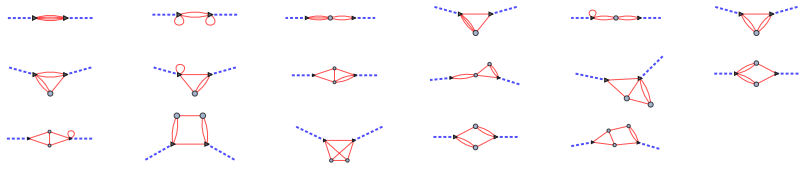
Summary. This paper presents version 3.0 of DoFun, a Mathematica package for deriving Dyson-Schwinger equations, functional renormalization group equations, and—new in this version—correlation functions of composite operators. The authors describe installation and basic workflow, the explicit field-type handling introduced in this version, the derivation algorithms based on the standard master equations (the DSE master equation, the Wetterich equation, and the replacement identity Eq. (21)), and a set of new tools such as diagram identification, connected/1PI extraction, and canonical ordering. The main new-feature demonstration is the two-loop correlation function of the spatial, traceless energy-momentum tensor in Yang-Mills theory, Eq. (26), obtained through doCO, getConnected, identifyGraphs, get1PI, and getAE, with diagrammatic results in Figs. 1–2. Appendices list changes from DoFun 2 and document known limitations of diagram identification and plotting.
Significance. If the implementation is correct, the new composite-operator functionality extends a widely used, publicly available tool (GPLv3, with a public git repository) and provides a nontrivial worked example relevant to transport calculations. The algorithms are parameter-free implementations of established functional identities, so there is no circularity or fitting. However, the paper does not provide an independent check of the new feature's output: no algebraic result is displayed, no test suite or verification notebook is referenced, and Appendix C concedes that diagram identification is reliable only up to two loops and can fail for mixed propagators. This makes the unverified two-loop example the main risk to the paper's central claim.
major comments (2)
- [§3.4, Figs. 1–2 and Appendix C] The two-loop composite-operator result, which is the advertised new feature of DoFun 3.0, is presented only as a symbolic diagrammatic expression, with the algebraic translation described only schematically around In[19]–In[20]. Appendix C states that identifyGraphs works only up to two loops and can fail for mixed propagators, yet the paper asserts without further evidence that “the symbolic and algebraic results, though, are correct.” This assertion is load-bearing: if identifyGraphs merges distinct diagrams or misassigns symmetry factors, or if get1PI drops a nonvanishing diagram, then Eq. (26) and Figs. 1–2 are wrong. Please add a reproducibility artifact—for example, a notebook that runs the full pipeline of Sec. 3.4 and checks the number of diagrams, their symmetry factors, and the 1PI truncation—or provide a low-order algebraic expression verified against an independent manual derivation. Please also state explicitly that the two-loop example lies within the reliability regime of identifyGraphs and clarify whether get1PI has any analogous limitation.
- [§3.4, In[8] and Eq. (29)] The example uses the Yang-Mills action without ghost fields, stating that ghosts “do not contribute in this case.” This is not obvious: even though the composite operator πij depends only on the gluon field, ghost loops can enter connected multi-loop diagrams through ghost-gluon vertices, and no color or BRST argument is given for their vanishing at this order. If ghost diagrams were nonvanishing, the displayed result would be incomplete. Please provide the missing justification or repeat the example with ghosts included to demonstrate that doCO treats them correctly.
minor comments (3)
- [§2, In[3]–In[4]] The typeset code samples for setFields and the action contain brace structures that are easy to misread and may have unbalanced delimiters when copied verbatim; please check that the displayed input matches the code in the repository.
- [§3.4, In[14]] The sentence “Of the originally 72 diagrams, many of which are identical, though, now 63 remain” is grammatically confusing; clarify whether the 63 are before or after summing identical diagrams.
- [Appendix C] The limitation section would be more useful if it stated explicitly which functions are affected by the two-loop and mixed-propagator restrictions, and whether getConnected and get1PI are free of the same restrictions.
Circularity Check
No circularity: the paper is a software implementation of externally established master equations, and its self-citations are not load-bearing.
full rationale
The derivation chain in DoFun 3.0 starts from externally established master equations: the DSE master equation from a total derivative (Eq. (15)), the Wetterich equation (Eq. (18)) attributed to Wetterich [72], and the composite-operator identity (Eq. (21)) taken from Pawlowski's review [8]. The composite-operator result, the paper's new feature, is obtained by substituting the operator into Eq. (21) and representing the operator as an auxiliary vertex C contracted with ordinary fields (Eqs. (23)-(24)); no fitted parameter, no output-dependent normalization, and no target equation is inserted as an input. Self-citations to DoFun 2 [20] and DoDSE [71] are used for implementation details and background, not to justify the central result, and the new functionality is presented with its own derivation and explicit Mathematica steps. Appendix C's admission that diagram identification only works up to two loops and can fail for mixed propagators is a correctness and robustness caveat about the example's reliability, not a circularity: it concerns whether the automated code misclassifies diagrams, not whether the input already contains the output. The symbolic and algebraic results are claimed correct but this is an unverified software-verification issue, which is outside the circularity categories. No step in the paper is equivalent to its input by construction, no prediction is a renamed fit, and no load-bearing claim rests solely on a self-citation.
Assumptions & free parameters
assumptions (4)
- domain assumption Legendre transform defines the effective action and correlation functions (Eq. 1).
- domain assumption Wetterich equation for the effective average action (Eq. 18).
- domain assumption Master identity for composite operator correlation functions (Eq. 21).
- standard math Functional derivative rules (Eq. 10).
Cite this review
Pith. "Pith review of DoFun 3.0: Functional equations in Mathematica." pith.science (2026). https://pith.science/paper/B2RIL62O
@misc{pith2026190802760,
  author       = {Pith},
  title        = {Pith review of: DoFun 3.0: Functional equations in Mathematica},
  year         = {2026},
  howpublished = {\url{https://pith.science/paper/B2RIL62O}},
  note         = {Machine review of arXiv:1908.02760}
}
read the original abstract
We present version 3.0 of the Mathematica package DoFun for the derivation of functional equations. In this version, the derivation of equations for correlation functions of composite operators was added. In the update, the general workflow was slightly modified taking into account experience with the previous version. In addition, various tools were included to improve the usage experience and the code was partially restructured for easier maintenance.
Figures


Forward citations
Cited by 2 Pith papers
-
Functional renormalization of QCD in $1 + 1$ dimensions: four-fermion interactions from quark-gluon dynamics
First functional renormalization group study of two-dimensional QCD with a mass-like regulator, producing flow equations for the gauge coupling, quark mass, and a Fierz-complete set of four-fermion interactions.
-
A beginner's guide to functional methods in particle physics
A pedagogical review showing how Dyson-Schwinger, 3PI, and Bethe-Salpeter equations can be chained together to compute glueball masses in pure Yang-Mills theory, matching lattice QCD.
Reference graph
Works this paper leans on
-
[8]
J. M. Pawlowski, Annals Phys. 322 (2007) 2831–2915. doi: 10.1016/j.aop.2007.01.007. arXiv:hep-th/0512261
arXiv 2007
-
[19]
D. Benedetti, K. Groh, P. F. Machado, F. Saueressig, JHEP 06 (2011) 079. doi: 10.1007/ JHEP06(2011)079. arXiv:1012.3081
arXiv 2011
-
[20]
M. Q. Huber, J. Braun, Comput.Phys.Commun. 183 (2012) 1290–1320. doi: 10.1016/j.cpc. 2012.01.014. arXiv:1102.5307
arXiv 2012
-
[1]
Wolfram, The Mathematica Book, Wolfram Media and Cambridge University Press, 2004
S. Wolfram, The Mathematica Book, Wolfram Media and Cambridge University Press, 2004
work page 2004
-
[2]
R. Harlander, M. Steinhauser, Prog. Part. Nucl. Phys. 43 (1999) 167–228. doi: 10.1016/ S0146-6410(99)00095-2. arXiv:hep-ph/9812357
arXiv 1999
-
[3]
Precision Calculations for Future Colliders
U. Baur, Int. J. Mod. Phys. E17 (2008) 826–844. doi: 10.1142/S0218301308010192. arXiv:hep-ph/0701164
work page Pith review arXiv 2008
-
[4]
Track 3: Computations in theoretical physics -- techniques and methods
G. Luisoni, S. Poslavsky, Y. Schroder, J. Phys. Conf. Ser. 762 (2016) 012077. doi: 10.1088/ 1742-6596/762/1/012077. arXiv:1604.03370. 12
work page Pith review arXiv 2016
- [5]
Show all 74 references
-
[6]
C. D. Roberts, S. M. Schmidt, Prog. Part. Nucl. Phys. 45 (2000) S1–S103. doi: 10.1016/ S0146-6410(00)90011-5. arXiv:nucl-th/0005064
2000 arXiv
-
[7]
Alkofer, L
R. Alkofer, L. von Smekal, Phys. Rept. 353 (2001) 281. doi: 10.1016/S0370-1573(01) 00010-2. arXiv:hep-ph/0007355
2001 arXiv
-
[9]
C. S. Fischer, J. Phys. G32 (2006) R253–R291. doi: 10.1088/0954-3899/32/8/R02. arXiv:hep-ph/0605173
2006 arXiv
-
[10]
Gies, Lect.Notes Phys
H. Gies, Lect.Notes Phys. 852 (2012) 287–348. doi: 10.1007/978-3-642-27320-9_6 . arXiv:hep-ph/0611146
2012 arXiv
-
[11]
Schaefer, J
B.-J. Schaefer, J. Wambach, Phys. Part. Nucl. 39 (2008) 1025–1032. doi: 10.1134/ S1063779608070083. arXiv:hep-ph/0611191
2008 arXiv
-
[12]
Binosi, J
D. Binosi, J. Papavassiliou, Phys. Rept. 479 (2009) 1–152. doi: 10.1016/j.physrep.2009.05
2009 doi
-
[13]
Braun, J
J. Braun, J. Phys. G39 (2012) 033001. doi: 10.1088/0954-3899/39/3/033001. arXiv:1108.4449
2012 arXiv
-
[14]
Maas, Phys.Rept
A. Maas, Phys.Rept. 524 (2013) 203–300. doi: 10.1016/j.physrep.2012.11.002. arXiv:1106.3942
2013 arXiv
-
[15]
Eichmann, H
G. Eichmann, H. Sanchis-Alepuz, R. Williams, R. Alkofer, C. S. Fischer, Prog. Part. Nucl. Phys. 91 (2016) 1–100. doi: 10.1016/j.ppnp.2016.07.001. arXiv:1606.09602
2016 arXiv
-
[16]
Sanchis-Alepuz, R
H. Sanchis-Alepuz, R. Williams, Comput. Phys. Commun. 232 (2018) 1–21. doi: 10.1016/j. cpc.2018.05.020. arXiv:1710.04903
2018 arXiv
-
[17]
M. Q. Huber (2018). arXiv:1808.05227
2018 arXiv
-
[18]
Alkofer, M
R. Alkofer, M. Q. Huber, K. Schwenzer, Phys. Rev. D81 (2010) 105010. doi: http://link. aps.org/doi/10.1103/PhysRevD.81.105010. arXiv:0801.2762
2010 arXiv
-
[21]
Fischbacher, F
T. Fischbacher, F. Synatschke-Czerwonka, Comput. Phys. Commun. 184 (2013) 1931–1945. doi:10.1016/j.cpc.2013.03.002. arXiv:1202.5984
2013 arXiv
-
[22]
M. Q. Huber, M. Mitter, Comput.Phys.Commun. 183 (2012) 2441–2457. doi: 10.1016/j.cpc. 2012.05.019. arXiv:1112.5622
2012 arXiv
-
[23]
A. K. Cyrol, M. Mitter, N. Strodthoff, Comput. Phys. Commun. 219 (2017) 346–352. doi: 10. 1016/j.cpc.2017.05.024. arXiv:1610.09331
2017 arXiv
-
[24]
van Ritbergen, A
T. van Ritbergen, A. N. Schellekens, J. A. M. Vermaseren, Int. J. Mod. Phys. A14 (1999) 41–96. doi:10.1142/S0217751X99000038. arXiv:hep-ph/9802376
1999 arXiv
-
[25]
J. A. M. Vermaseren (2000). arXiv:math-ph/0010025
2000 arXiv
-
[26]
Kuipers, T
J. Kuipers, T. Ueda, J. A. M. Vermaseren, J. Vollinga, Comput. Phys. Commun. 184 (2013) 1453–1467. doi:10.1016/j.cpc.2012.12.028. arXiv:1203.6543
2013 arXiv
-
[27]
Kuipers, T
J. Kuipers, T. Ueda, J. A. M. Vermaseren, Comput. Phys. Commun. 189 (2015) 1–19. doi: 10. 1016/j.cpc.2014.08.008. arXiv:1310.7007. 13
2015 arXiv
- [28]
-
[29]
Wiebusch, Comput
M. Wiebusch, Comput. Phys. Commun. 195 (2015) 172–190. doi: 10.1016/j.cpc.2015.04
2015 doi
-
[30]
Mertig, M
R. Mertig, M. Bohm, A. Denner, Comput. Phys. Commun. 64 (1991) 345–359. doi: 10.1016/ 0010-4655(91)90130-D
1991
-
[31]
Shtabovenko, R
V. Shtabovenko, R. Mertig, F. Orellana, Comput. Phys. Commun. 207 (2016) 432–444. doi:10. 1016/j.cpc.2016.06.008. arXiv:1601.01167
2016 arXiv
-
[32]
Shtabovenko, Comput
V. Shtabovenko, Comput. Phys. Commun. 218 (2017) 48–65. doi: 10.1016/j.cpc.2017.04
2017 doi
-
[33]
Alkofer, M
R. Alkofer, M. Q. Huber, K. Schwenzer, Eur. Phys. J. C62 (2009) 761–781. doi: 10.1140/ epjc/s10052-009-1066-3 . arXiv:0812.4045
2009 arXiv
-
[34]
M. Q. Huber, K. Schwenzer, R. Alkofer, Eur. Phys. J. C68 (2010) 581–600. doi: 10.1140/ epjc/s10052-010-1371-x . arXiv:0904.1873
2010 arXiv
-
[35]
M. Q. Huber, R. Alkofer, S. P. Sorella, Phys. Rev. D81 (2010) 065003. doi:10.1103/PhysRevD. 81.065003. arXiv:0910.5604
2010 arXiv
-
[36]
Fister, R
L. Fister, R. Alkofer, K. Schwenzer, Phys. Lett. B688 (2010) 237–243. doi: 10.1016/j. physletb.2010.04.001. arXiv:1003.1668
2010 arXiv
-
[37]
Macher, A
V. Macher, A. Maas, R. Alkofer, Int. J. Mod. Phys. A27 (2012) 1250098. doi: 10.1142/ S0217751X12500984. arXiv:1106.5381
2012 arXiv
-
[38]
Alkofer, R
N. Alkofer, R. Alkofer, Phys. Lett. B702 (2011) 158–163. doi: 10.1016/j.physletb.2011.06
2011 doi
-
[39]
M. Q. Huber, A. Maas, L. von Smekal, JHEP 1211 (2012) 035. doi:10.1007/JHEP11(2012)035. arXiv:1207.0222
2012 arXiv
-
[40]
M. Q. Huber, L. von Smekal, JHEP 1304 (2013) 149. doi: 10.1007/JHEP04(2013)149. arXiv:1211.6092
2013 arXiv
-
[41]
A. Blum, M. Q. Huber, M. Mitter, L. von Smekal, Phys. Rev. D 89 (2014) 061703(R). doi: 10. 1103/PhysRevD.89.061703. arXiv:1401.0713
2014 arXiv
-
[42]
Braun, L
J. Braun, L. Fister, J. M. Pawlowski, F. Rennecke, Phys. Rev. D94 (2016) 034016. doi: 10. 1103/PhysRevD.94.034016. arXiv:1412.1045
2016 arXiv
-
[43]
Mitter, J
M. Mitter, J. M. Pawlowski, N. Strodthoff, Phys. Rev. D91 (2015) 054035. doi: 10.1103/ PhysRevD.91.054035. arXiv:1411.7978
2015 arXiv
-
[44]
M. Q. Huber, D. R. Campagnari, H. Reinhardt, Phys.Rev. D91 (2015) 025014. doi: 10.1103/ PhysRevD.91.025014. arXiv:1410.4766
2015 arXiv
-
[45]
A. K. Cyrol, M. Q. Huber, L. von Smekal, Eur. Phys. J. C75 (2015) 102. doi: 10.1140/epjc/ s10052-015-3312-1 . arXiv:1408.5409
2015 arXiv
-
[46]
M. Q. Huber, L. von Smekal, JHEP 1406 (2014) 015. doi: 10.1007/JHEP06(2014)015. arXiv:1404.3642
2014 arXiv
-
[47]
Rennecke, Phys
F. Rennecke, Phys. Rev. D92 (2015) 076012. doi: 10.1103/PhysRevD.92.076012. arXiv:1504.03585
2015 arXiv
-
[48]
M. Q. Huber, Phys. Rev. D91 (2015) 085018. doi: 10.1103/PhysRevD.91.085018. arXiv:1502.04057
2015 arXiv
-
[49]
M. Q. Huber, Phys. Rev. D93 (2016) 085033. doi: 10.1103/PhysRevD.93.085033. arXiv:1602.02038. 14
2016 arXiv
-
[50]
A. K. Cyrol, L. Fister, M. Mitter, J. M. Pawlowski, N. Strodthoff, Phys. Rev. D94 (2016) 054005. doi:10.1103/PhysRevD.94.054005. arXiv:1605.01856
2016 arXiv
-
[51]
M. Q. Huber, Eur. Phys. J. C77 (2017) 733. doi: 10.1140/epjc/s10052-017-5310-y . arXiv:1709.05848
2017 arXiv
-
[52]
A. K. Cyrol, M. Mitter, J. M. Pawlowski, N. Strodthoff, Phys. Rev. D97 (2018) 054006. doi:10.1103/PhysRevD.97.054006. arXiv:1706.06326
2018 arXiv
-
[53]
Corell, A
L. Corell, A. K. Cyrol, M. Mitter, J. M. Pawlowski, N. Strodthoff, SciPost Phys. 5 (2018) 066. doi:10.21468/SciPostPhys.5.6.066. arXiv:1803.10092
2018 arXiv
-
[54]
M. Q. Huber, EPJ Web Conf. 137 (2017) 07009. doi: 10.1051/epjconf/201713707009. arXiv:1611.06136
2017
-
[55]
A. K. Cyrol, M. Mitter, J. M. Pawlowski, N. Strodthoff, Phys. Rev. D97 (2018) 054015. doi:10.1103/PhysRevD.97.054015. arXiv:1708.03482
2018 arXiv
-
[56]
Contant, M
R. Contant, M. Q. Huber, Phys. Rev. D96 (2017) 074002. doi: 10.1103/PhysRevD.96.074002. arXiv:1706.00943
2017 arXiv
-
[57]
Leonhardt, M
M. Leonhardt, M. Pospiech, B. Schallmo, J. Braun, C. Drischler, K. Hebeler, A. Schwenk (2019). arXiv:1907.05814
2019 arXiv
- [58]
-
[59]
Hajizadeh, M
O. Hajizadeh, M. Q. Huber, A. Maas, J. M. Pawlowski (2019). arXiv:1909.12727
2019 arXiv
- [60]
-
[61]
Strodthoff, Phys
N. Strodthoff, Phys. Rev. D95 (2017) 076002. doi: 10.1103/PhysRevD.95.076002. arXiv:1611.05036
2017 arXiv
-
[62]
J. M. Pawlowski, N. Strodthoff, N. Wink, Phys. Rev. D98 (2018) 074008. doi: 10.1103/ PhysRevD.98.074008. arXiv:1711.07444
2018 arXiv
-
[63]
Braun, M
J. Braun, M. Leonhardt, M. Pospiech, Phys. Rev. D96 (2017) 076003. doi:10.1103/PhysRevD. 96.076003. arXiv:1705.00074
2017 arXiv
-
[64]
Braun, M
J. Braun, M. Leonhardt, M. Pospiech, Phys. Rev. D97 (2018) 076010. doi:10.1103/PhysRevD. 97.076010. arXiv:1801.08338
2018 arXiv
-
[65]
J. Eser, F. Divotgey, M. Mitter, D. H. Rischke, Phys. Rev. D98 (2018) 014024. doi: 10.1103/ PhysRevD.98.014024. arXiv:1804.01787
2018 arXiv
-
[66]
Alkofer, A
R. Alkofer, A. Maas, W. A. Mian, M. Mitter, J. Par´ ıs-L´ opez, J. M. Pawlowski, N. Wink, Phys. Rev. D99 (2019) 054029. doi: 10.1103/PhysRevD.99.054029. arXiv:1810.07955
2019 arXiv
-
[67]
Divotgey, J
F. Divotgey, J. Eser, M. Mitter, Phys. Rev. D99 (2019) 054023. doi: 10.1103/PhysRevD.99. 054023. arXiv:1901.02472
2019 arXiv
-
[68]
T. Denz, J. M. Pawlowski, M. Reichert, Eur. Phys. J. C78 (2018) 336. doi: 10.1140/epjc/ s10052-018-5806-0 . arXiv:1612.07315
2018 arXiv
-
[69]
Janssen, H
L. Janssen, H. Gies, Phys. Rev. D86 (2012) 105007. doi: 10.1103/PhysRevD.86.105007. arXiv:1208.3327
2012 arXiv
-
[70]
Brizuela, J
D. Brizuela, J. M. Martin-Garcia, G. A. Mena Marugan, Gen. Rel. Grav. 41 (2009) 2415–2431. doi:10.1007/s10714-009-0773-2 . arXiv:0807.0824
2009 arXiv
-
[71]
Alkofer, M
R. Alkofer, M. Q. Huber, K. Schwenzer, Comput. Phys. Commun. 180 (2009) 965–976. doi:10. 1016/j.cpc.2008.12.009. arXiv:0808.2939
2009 arXiv
-
[72]
Wetterich, Phys
C. Wetterich, Phys. Lett. B301 (1993) 90–94. doi: 10.1016/0370-2693(93)90726-X
1993 doi
-
[73]
R. Kubo, J. Phys. Soc. Jap. 12 (1957) 570–586. doi: 10.1143/JPSJ.12.570
1957 doi
-
[74]
Haas, Spectral functions in finite temperature SU(3) gauge theory and appli- cations to transport phenomena, 2014
M. Haas, Spectral functions in finite temperature SU(3) gauge theory and appli- cations to transport phenomena, 2014. URL: http://archiv.ub.uni-heidelberg.de/ volltextserver/17875/, Ph.D. Thesis, University of Heidelberg. 15
2014
Reviewed August 14, 2026 · model on record in the stance chip above.
Discussion (0). Continue with ORCID to comment.