REVIEW 5 major objections 4 minor 1 cited by
Scale Invariant Entanglement Negativity at the Many-Body Localization Transition
T0 review · 5 major / 4 minor · reviewed 2026-08-14 · deepseek-v4-flash
Pith's one-line read At the many-body localization transition, the logarithmic negativity between two blocks decays exponentially with the ratio of separation to block size, while mutual information decays as a power law, showing that critical eigenstates are…
desk verdict A clever two-length-scale probe of the MBL transition, but the scale-invariance claim rests on a self-selected critical point at a single system size. read the letter →
The pith
A machine-rendered reading of the paper's core claim, the machinery that carries it, and where it could break.
The reading
What carries the argument
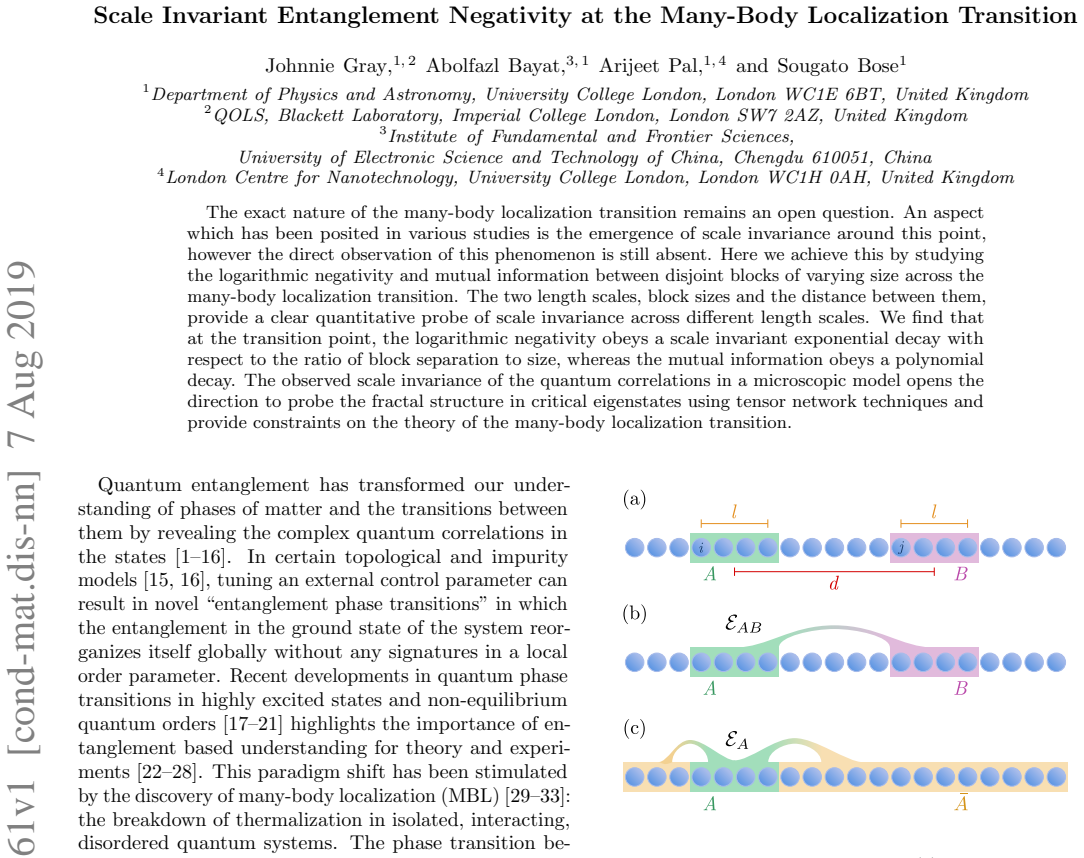
The central object is the pair of length scales, block size $l$ and separation $d$, combined into the normalized separation $\tilde{d}=d/l$. By averaging the normalized logarithmic negativity $\tilde{E}=E/l$ and mutual information $\tilde{I}=I/l$ over pairs of blocks with the same $\tilde{d}$, the authors test whether all dependence on $l$ disappears at the transition. The mechanism is the data collapse: at $h=3.25$ the curves for different $l$ converge onto a universal exponential for logarithmic negativity and a power law for mutual information, which is the signature of scale invariance.
What would settle it
Compute the same quantities for a larger chain, say $L=24$ or $L=28$, at several disorder strengths around $h=3.25$, and check whether the data collapse persists at a disorder strength that is independently identified as critical (for example, from level statistics or other standard probes); if no choice of $h$ yields collapse for all block sizes at larger $L$, the scale-invariant exponential and power-law ansatzes are falsified.
Extended reading notes
Core claim
The central discovery is that the bond logarithmic negativity and the mutual information between disjoint blocks of equal size $l$, expressed as functions of the normalized separation $\tilde{d}=d/l$, become independent of $l$ at the MBL transition point. Specifically, the logarithmic negativity decays exponentially as $\tilde{E}_{\tilde{d}}(l) = C_E e^{-\tilde{d}/\lambda_E}$ with fitted $C_E\approx 2$ and $\lambda_E\approx 0.45$, while the mutual information decays as $\tilde{I}_{\tilde{d}}(l) = C_I \tilde{d}^{-1/\alpha_I}$ with fitted $C_I\approx 0.3$ and $\alpha_I\approx 0.5$. This scale invariance is accompanied by a logarithmic growth of the average self-entanglement with block size at the transition, in contrast to linear growth in the ergodic phase and area-law (constant) behavior deep in the localized phase. The authors interpret this as evidence for a scale-invariant, multipartite entanglement structure in critical eigenstates.
Load-bearing premise
The transition point for $L=20$ is identified as $h=3.25$ from the same nearest-neighbor data collapse (Fig. 3) that is then used to demonstrate scale invariance in Fig. 4, so if the true critical point for that system size were different or shifts significantly with system size, the collapse could be coincidental.
Editorial extensions
If this is right
- If correct, critical eigenstates near the MBL transition have a scale-invariant entanglement structure, meaning any theory of the transition must reproduce the exponential decay of negativity and the polynomial decay of mutual information with normalized separation.
- The observed collapse provides a parameter-free way to identify the transition point in finite systems, independent of the usual finite-size scaling with total system size.
- The logarithmic growth of self-entanglement at the transition suggests a connection to conformal field theory or infinite-randomness fixed points, and may support a multiscale entanglement renormalization ansatz (MERA) description of critical eigenstates, enabling tensor-network simulations beyond exact diagonalization.
- The distinction between the decay of quantum correlations (exponential) and total correlations (power law) at the same point implies that the critical state is not captured by simple quantum-classical equivalences, constraining strong-disorder renormalization group approaches.
Reading between the lines
- A natural next step would be to check whether the scale-invariant collapse persists for larger system sizes than $L=20$; if it moves with $L$, the observed $h=3.25$ collapse might be a finite-size artifact rather than a true critical point.
- The power-law decay of mutual information with exponent near $1/2$ could be related to a logarithmic growth of entanglement entropy when integrated over separations; testing the probability distribution of negativity instead of just the mean would further probe the multipartite structure.
- The exponential decay length $\lambda_E\approx 0.45$ in units of $d/l$ might be interpretable as a critical correlation length in the ratio variable, which real-space renormalization group schemes should predict if they respect scale invariance.
Signed reviews
Editorial analysis
A structured set of objections, weighed in public.
Referee Report
Summary. The paper studies the scale-invariance of entanglement and correlation measures at the many-body localization (MBL) transition in a disordered Heisenberg chain. For L=20, exact diagonalization is used to compute the logarithmic negativity and mutual information between two disjoint blocks of equal size l separated by distance d. The authors report that at disorder strength h≈3.25, the normalized block measures collapse onto a single curve as a function of d/l, with logarithmic negativity decaying exponentially and mutual information decaying as a power law. They also report a logarithmic scaling of the self-entanglement near the transition and argue that these findings reveal a scale-invariant, multipartite entanglement structure in critical eigenstates, with implications for tensor-network descriptions of the MBL transition.
Significance. If correct, the result provides a concrete and falsifiable signature of scale invariance at the MBL transition and a clear distinction between the decay of logarithmic negativity and mutual information, which would constrain renormalization-group and tensor-network theories of the transition. The use of two controllable length scales (block size and separation) is a natural and powerful probe, and the visual collapse in Fig. 4 is striking. The paper also releases code (quimb) that enables independent verification of the numerics. However, the central claim rests on a single disorder strength at a single system size, with the critical field selected from the same data that is later used to claim collapse, and no quantitative collapse metrics or error estimates are provided. These issues temper the significance of the result as it stands.
major comments (5)
- [Results, Fig. 3 and text after Eq. (4)] The identification of h=3.25 as the transition point for L=20 is made by the observed collapse of the nearest-neighbor normalized quantities in Fig. 3, and the same value is then used in Fig. 4(b,e) to demonstrate the scale-invariant decay. This is a circular selection: the collapse in Fig. 4 is not an independent test but a consequence of choosing h to make the nearest-neighbor data collapse. The text states 'We infer that h∼3.25 corresponds to the transition point for this total system size of L=20, which matches previous studies [73],' but reference [73] is a software paper and does not provide an independent estimate of h_c. Since the Model section itself quotes the suspected transition range h~3.5-5, the manuscript needs an independent determination of h_c(L=20)—for example from level statistics or entanglement entropy scaling—before the collapse can be attributed to criticality. As written, the scale invariance claim is not tested but imposed.
- [Results, Fig. 4 and Eqs. (5)-(6)] The exponential and power-law fits to the collapsed data in Fig. 4 are reported without any uncertainties, goodness-of-fit measures, or comparison to alternative forms. The statement in the Fig. 4 caption that a stretched exponential 'was not found to be as natural as a power law' is not supported by any quantitative criterion. Furthermore, no error bars or collapse-quality metric (e.g., variance of the curves, a Q-test, or bootstrap analysis) are provided, so the reader cannot judge whether the residual l-dependence in Fig. 4(b,e) is statistically significant. A quantitative collapse measure is essential for the central claim of scale invariance.
- [Results, Fig. 4] The scale-invariance claim is demonstrated only at L=20. Although Fig. 5 examines the self entanglement for L=14,16,18,20 and shows a peak in the log-law coefficient, the bond quantities E~d(l) and I~d(l) are never analyzed as functions of L. Consequently, it is unknown whether the data collapse improves with system size or whether the fitted parameters (λE≈0.45, αI≈0.5) drift. Without a finite-size scaling analysis, the observed bundle of curves at one disorder strength and one system size cannot be distinguished from a finite-size crossing.
- [Results, Fig. 4] The accessible range of d/l depends strongly on the block size l because two disjoint blocks of size l in an open chain of length L satisfy d ≤ L-l. For L=20, l=10 admits only d/l=1, while l=1 admits d/l up to 19. Thus the large-d/l tail of the collapse in Fig. 4 is supported almost entirely by the smallest block sizes, and the exponential (Eq. 5) and power-law (Eq. 6) forms are not tested uniformly across all block sizes. The authors should either restrict the quoted functional forms to the common range of d/l for all l, or present the data separated by l to show the collapse holds in overlapping ranges.
- [Eqs. (5)-(6) and the paragraph after them] The text says that the coefficients CE, CI, λE, and αI 'might all be functions of L, l and h,' but then quotes single values (CE~2, λE~0.45, CI~0.3, αI~0.5). If these coefficients carry any l-dependence, the apparent collapse in Fig. 4 after normalizing by l would be a trivial scaling property rather than a universal signature. The authors must state explicitly that the fits in Eqs. (5)-(6) assume l-independent constants, and should report the fitting residuals as a function of l to demonstrate that the collapse is not an artifact of the normalization.
minor comments (4)
- [Eq. (3)] The partial transpose in the definition of logarithmic negativity is written as ρ_AB^{T_X} with 'subsystem X' undefined; it should specify TX = TA or TB.
- [Fig. 3 caption] The word 'Blocked' in the caption 'Average Nearest Neighbour Blocked Logarithmic Negativity' appears to be a typo; likely 'block' or 'block-entanglement' was intended.
- [Fig. 5 caption] The caption reports mean fitting uncertainties for the three coefficients but the main text does not refer to them; providing analogous uncertainties for the fits in Eqs. (5)-(6) would improve the manuscript.
- [Model section, paragraph 2] The sentence 'The transition point, h_c, between these two phases is suspected to lie between h∼3.5−5 [42,69]' is in tension with the later use of h=3.25; the discrepancy should be acknowledged and discussed in the text.
Circularity Check
No significant circularity; scale-invariance claim is an empirical collapse observation with h_c fixed by the same data family but not by construction.
full rationale
This paper is a numerical-observation study, not a derivation, and I find no step in which a claimed prediction reduces by construction to an input. The critical field h≈3.25 for L=20 is identified empirically from the nearest-neighbour collapse in Fig. 3 and then used in Fig. 4; although this is a self-referential way to locate the transition, it is not a circular reduction: the full d/l collapse in Fig. 4(b,e) is a much larger set of data than the d~=1 curves used to fix h_c, and the collapse is not guaranteed by the normalization. The exponential and power-law forms in Eqs. (5)-(6) are explicitly presented as ansatzes fitted to the data ('we suggest the following ansatzes', 'we perform least squares fitting'), not as predictions derived from the model. The self-citations [42] and [73] are used only to note consistency with previous estimates and numerical methods; the load-bearing evidence is the authors' own exact-diagonalization data. There is no imported uniqueness theorem, no ansatz smuggled in via citation, and no renaming of a known result. The main caveat—that h_c is not independently located by finite-size scaling—is a correctness/robustness concern, not a circularity.
Assumptions & free parameters
free parameters (8)
- h_c (critical disorder strength for L=20) =
3.25
- lambda_E (decay length in Eq. 5) =
~0.45
- C_E (prefactor in Eq. 5) =
~2
- alpha_I (power-law exponent in Eq. 6) =
~0.5
- C_I (prefactor in Eq. 6) =
~0.3
- a_vol (volume-law coefficient, Eq. 7) =
varies with h; approaches 1 in ergodic regime
- a_crit (log-law coefficient, Eq. 7) =
peaks near hc
- a_area (area-law coefficient, Eq. 7) =
dominates in MBL regime
assumptions (5)
- domain assumption The random-field Heisenberg chain (Eq. 1) hosts the MBL transition for uniform disorder h around 3.5-5, with the L=20 critical point near 3.25.
- domain assumption A single eigenvector at the middle of the spectrum of each disorder instance represents infinite-temperature behavior.
- domain assumption The TNSLQ method from Refs. [72,73] computes logarithmic negativity accurately for blocks with 2l>12.
- ad hoc to paper Scale invariance at a critical point implies data collapse of normalized quantities versus d/l.
- domain assumption Disorder averaging over at least 100 noise realizations is sufficient for convergence of the averaged quantities.
Cite this review
Pith. "Pith review of Scale Invariant Entanglement Negativity at the Many-Body Localization Transition." pith.science (2026). https://pith.science/paper/S3I7IPE3
@misc{pith2026190802761,
  author       = {Pith},
  title        = {Pith review of: Scale Invariant Entanglement Negativity at the Many-Body Localization Transition},
  year         = {2026},
  howpublished = {\url{https://pith.science/paper/S3I7IPE3}},
  note         = {Machine review of arXiv:1908.02761}
}
read the original abstract
The exact nature of the many-body localization transition remains an open question. An aspect which has been posited in various studies is the emergence of scale invariance around this point, however the direct observation of this phenomenon is still absent. Here we achieve this by studying the logarithmic negativity and mutual information between disjoint blocks of varying size across the many-body localization transition. The two length scales, block sizes and the distance between them, provide a clear quantitative probe of scale invariance across different length scales. We find that at the transition point, the logarithmic negativity obeys a scale invariant exponential decay with respect to the ratio of block separation to size, whereas the mutual information obeys a polynomial decay. The observed scale invariance of the quantum correlations in a microscopic model opens the direction to probe the fractal structure in critical eigenstates using tensor network techniques and provide constraints on the theory of the many-body localization transition.
Figures


Figures from the paper (2 more)


Forward citations
Cited by 1 Pith paper
-
Genuine multipartite entanglement as a probe of many-body localization in disordered spin chains with Dzyaloshinskii-Moriya interactions
Quenched genuine multipartite entanglement (GGM) tracks the ergodic-MBL transition in disordered Heisenberg chains, with three-body DM interactions delaying localization to higher disorder strengths.
Reference graph
Works this paper leans on
-
[73]
Fast Computation of Many-Body Entanglement
J. Gray, “Fast computation of many-body entanglement,” arXiv preprint arXiv:1809.01685 , 2018
work page Pith review arXiv 2018
-
[1]
Sachdev, Quantum phase transitions
S. Sachdev, Quantum phase transitions . Cambridge Uni- versity Press, 2011
2011
-
[2]
Manipulat- ing quantum entanglement with atoms and photons in a cavity,
J.-M. Raimond, M. Brune, and S. Haroche, “Manipulat- ing quantum entanglement with atoms and photons in a cavity,” Rev. Mod. Phys. , vol. 73, no. 3, p. 565, 2001
2001
-
[3]
Scaling of entanglement close to a quantum phase transition,
A. Osterloh, L. Amico, G. Falci, and R. Fazio, “Scaling of entanglement close to a quantum phase transition,” Nature, vol. 416, no. 6881, p. 608, 2002
2002
-
[4]
Entanglement in a simple quantum phase transition,
T. J. Osborne and M. A. Nielsen, “Entanglement in a simple quantum phase transition,” Phys. Rev. A , vol. 66, no. 3, p. 032110, 2002
2002
-
[5]
Entanglement spectrum, critical exponents, and order parameters in quantum spin chains,
G. De Chiara, L. Lepori, M. Lewenstein, and A. Sanpera, “Entanglement spectrum, critical exponents, and order parameters in quantum spin chains,” Phys. Rev. Lett. , vol. 109, no. 23, p. 237208, 2012
work page 2012
-
[6]
En- tanglement probe of two-impurity kondo physics in a spin chain,
A. Bayat, S. Bose, P. Sodano, and H. Johannesson, “En- tanglement probe of two-impurity kondo physics in a spin chain,” Phys. Rev. Lett. , vol. 109, no. 6, p. 066403, 2012
work page 2012
-
[7]
Entan- glement structure of the two-channel kondo model,
B. Alkurtass, A. Bayat, I. Affleck, S. Bose, H. Johannes- son, P. Sodano, E. S. Sørensen, and K. Le Hur, “Entan- glement structure of the two-channel kondo model,” Phys. Rev. B, vol. 93, no. 8, p. 081106, 2016
work page 2016
Show all 84 references
-
[8]
Scaling of entanglement between separated blocks in spin chains at criticality,
H. Wichterich, J. Molina-Vilaplana, and S. Bose, “Scaling of entanglement between separated blocks in spin chains at criticality,” Phys. Rev. A , vol. 80, no. 1, p. 010304, 2009
2009
-
[9]
Critical and noncritical long-range entanglement in klein- gordon fields,
S. Marcovitch, A. Retzker, M. Plenio, and B. Reznik, “Critical and noncritical long-range entanglement in klein- gordon fields,” Phys. Rev. A , vol. 80, no. 1, p. 012325, 2009
2009
-
[10]
Entangle- ment in quantum critical phenomena,
G. Vidal, J. I. Latorre, E. Rico, and A. Kitaev, “Entangle- ment in quantum critical phenomena,” Phys. Rev. Lett. , vol. 90, no. 22, p. 227902, 2003
2003
-
[11]
Entanglement in the xy spin chain,
A. R. Its, B.-Q. Jin, and V. E. Korepin, “Entanglement in the xy spin chain,” Journal of Physics A: Mathematical and General, vol. 38, no. 13, p. 2975, 2005
2005
-
[12]
Entanglement entropy and quantum field theory,
P. Calabrese and J. Cardy, “Entanglement entropy and quantum field theory,” Journal of Statistical Mechanics: Theory and Experiment, vol. 2004, no. 06, p. P06002, 2004
2004
-
[13]
Entanglement neg- ativity in extended systems: a field theoretical approach,
P. Calabrese, J. Cardy, and E. Tonni, “Entanglement neg- ativity in extended systems: a field theoretical approach,” Journal of Statistical Mechanics: Theory and Experiment , vol. 2013, no. 02, p. P02008, 2013
2013
-
[14]
Negativity spectrum in 1d gapped phases of matter,
G. B. Mbeng, V. Alba, and P. Calabrese, “Negativity spectrum in 1d gapped phases of matter,” Journal of Physics A: Mathematical and Theoretical , vol. 50, no. 19, p. 194001, 2017
2017
-
[15]
Topological entanglement entropy,
A. Kitaev and J. Preskill, “Topological entanglement entropy,” Phys. Rev. Lett. , vol. 96, no. 11, p. 110404, 2006
2006
-
[16]
An order parameter for impurity systems at quantum criti- cality,
A. Bayat, H. Johannesson, S. Bose, and P. Sodano, “An order parameter for impurity systems at quantum criti- cality,” Nat. Commun. , vol. 5, p. 3784, 2014
2014
-
[17]
Localization-protected quantum order,
D. A. Huse, R. Nandkishore, V. Oganesyan, A. Pal, and S. L. Sondhi, “Localization-protected quantum order,” Phys. Rev. B , vol. 88, p. 014206, Jul 2013
2013
-
[18]
Hilbert-Glass Transition: New Universal- ity of Temperature-Tuned Many-Body Dynamical Quan- tum Criticality,
D. Pekker, G. Refael, E. Altman, E. Demler, and V. Oganesyan, “Hilbert-Glass Transition: New Universal- ity of Temperature-Tuned Many-Body Dynamical Quan- tum Criticality,” Phys. Rev. X , vol. 4, p. 011052, Mar 2014
2014
-
[19]
Lo- calization and topology protected quantum coherence at the edge of hot matter,
Y. Bahri, R. Vosk, E. Altman, and A. Vishwanath, “Lo- calization and topology protected quantum coherence at the edge of hot matter,” Nature communications, vol. 6, p. 7341, 2015
2015
-
[20]
Many-body localization and symmetry-protected topological order,
A. Chandran, V. Khemani, C. R. Laumann, and S. L. Sondhi, “Many-body localization and symmetry-protected topological order,” Phys. Rev. B , vol. 89, p. 144201, Apr 2014
2014
-
[21]
Many- body localization in a disordered quantum Ising chain,
J. A. Kj¨ all, J. H. Bardarson, and F. Pollmann, “Many- body localization in a disordered quantum Ising chain,” Phys. Rev. Lett. , vol. 113, no. 10, p. 107204, 2014
2014
-
[22]
Observation of many-body localization of inter- acting fermions in a quasirandom optical lattice,
M. Schreiber, S. S. Hodgman, P. Bordia, H. P. L¨ uschen, M. H. Fischer, R. Vosk, E. Altman, U. Schneider, and I. Bloch, “Observation of many-body localization of inter- acting fermions in a quasirandom optical lattice,” Science, vol. 349, no. 6250, pp. 842–845, 2015
2015
-
[23]
Exploring the many-body localization transition in two dimensions,
J.-y. Choi, S. Hild, J. Zeiher, P. Schauß, A. Rubio-Abadal, T. Yefsah, V. Khemani, D. A. Huse, I. Bloch, and C. Gross, “Exploring the many-body localization transition in two dimensions,” Science, vol. 352, no. 6293, pp. 1547–1552, 2016
2016
-
[24]
Signatures of many-body localization in a controlled open quantum system,
H. P. L¨ uschen, P. Bordia, S. S. Hodgman, M. Schreiber, S. Sarkar, A. J. Daley, M. H. Fischer, E. Altman, I. Bloch, and U. Schneider, “Signatures of many-body localization in a controlled open quantum system,” Phys. Rev. X , vol. 7, no. 1, p. 011034, 2017
2017
-
[25]
Observation of many- body localization in a one-dimensional system with a single-particle mobility edge,
T. Kohlert, S. Scherg, X. Li, H. P. L¨ uschen, S. D. Sarma, I. Bloch, and M. Aidelsburger, “Observation of many- body localization in a one-dimensional system with a single-particle mobility edge,” Phys. Rev. Lett. , vol. 122, no. 17, p. 170403, 2019
2019
-
[26]
Many-body localization in a quantum simulator with pro- grammable random disorder,
J. Smith, A. Lee, P. Richerme, B. Neyenhuis, P. W. Hess, P. Hauke, M. Heyl, D. A. Huse, and C. Monroe, “Many-body localization in a quantum simulator with pro- grammable random disorder,” Nat. Phys. , vol. 12, no. 10, p. 907, 2016
2016
-
[27]
Emulating many-body localization with a superconducting quantum processor,
K. Xu, J.-J. Chen, Y. Zeng, Y.-R. Zhang, C. Song, W. Liu, Q. Guo, P. Zhang, D. Xu, H. Deng, et al. , “Emulating many-body localization with a superconducting quantum processor,” Phys. Rev. Lett. , vol. 120, no. 5, p. 050507, 2018
2018
-
[28]
Propagation and localization of collective excitations on a 24-qubit superconducting processor,
Y. Ye, Z.-Y. Ge, Y. Wu, S. Wang, M. Gong, Y.-R. Zhang, Q. Zhu, R. Yang, S. Li, F. Liang, et al. , “Propagation and localization of collective excitations on a 24-qubit superconducting processor,” Phys. Rev. Lett. , vol. 123, no. 5, p. 050502, 2019
2019
-
[29]
Metal–insulator transition in a weakly interacting many- electron system with localized single-particle states,
D. M. Basko, I. L. Aleiner, and B. L. Altshuler, “Metal–insulator transition in a weakly interacting many- electron system with localized single-particle states,” Ann. Phys., vol. 321, pp. 1126–1205, May 2006. 7
2006
-
[30]
Localization of interacting fermions at high temperature,
V. Oganesyan and D. A. Huse, “Localization of interacting fermions at high temperature,” Phys. Rev. B , vol. 75, no. 15, p. 155111, 2007
2007
-
[31]
Many-body localization phase transition,
A. Pal and D. A. Huse, “Many-body localization phase transition,” Phys. Rev. B , vol. 82, no. 17, p. 174411, 2010
2010
-
[32]
Many-Body Localiza- tion and Thermalization in Quantum Statistical Mechan- ics,
R. Nandkishore and D. A. Huse, “Many-Body Localiza- tion and Thermalization in Quantum Statistical Mechan- ics,” Annual Review of Condensed Matter Physics , vol. 6, pp. 15–38, 2015
2015
-
[33]
Col- loquium: Many-body localization, thermalization, and entanglement,
D. A. Abanin, E. Altman, I. Bloch, and M. Serbyn, “Col- loquium: Many-body localization, thermalization, and entanglement,” Rev. Mod. Phys. , vol. 91, p. 021001, May 2019
2019
-
[34]
Many-body localization,
A. Pal, “Many-body localization,” 2012
2012
-
[35]
Area laws in a many-body localized state and its implications for topological order,
B. Bauer and C. Nayak, “Area laws in a many-body localized state and its implications for topological order,” Journal Of Statistical Mechanics-Theory And Experiment , vol. 2013, p. P09005, sep 2013
2013
-
[36]
Un- bounded Growth of Entanglement in Models of Many- Body Localization,
J. H. Bardarson, F. Pollmann, and J. E. Moore, “Un- bounded Growth of Entanglement in Models of Many- Body Localization,” Phys. Rev. Lett. , vol. 109, p. 017202, July 2012
2012
-
[37]
Universal slow growth of entanglement in interacting strongly disordered systems,
M. Serbyn, Z. Papi´ c, and D. A. Abanin, “Universal slow growth of entanglement in interacting strongly disordered systems,” Phys. Rev. Lett. , vol. 110, no. 26, p. 260601, 2013
2013
-
[38]
Phe- nomenology of fully many-body-localized systems,
D. A. Huse, R. Nandkishore, and V. Oganesyan, “Phe- nomenology of fully many-body-localized systems,” Phys. Rev. B, vol. 90, p. 174202, Nov. 2014
2014
-
[39]
Local conserva- tion laws and the structure of the many-body localized states,
M. Serbyn, Z. Papi´ c, and D. A. Abanin, “Local conserva- tion laws and the structure of the many-body localized states,” Phys.l Rev. Lett. , vol. 111, no. 12, p. 127201, 2013
2013
-
[40]
Entanglement spreading in a many-body localized system,
A. Nanduri, H. Kim, and D. A. Huse, “Entanglement spreading in a many-body localized system,” Phys. Rev. B, vol. 90, no. 6, p. 064201, 2014
2014
-
[41]
Many-body localization edge in the random-field heisenberg chain,
D. J. Luitz, N. Laflorencie, and F. Alet, “Many-body localization edge in the random-field heisenberg chain,” Phys. Rev. B , vol. 91, no. 8, p. 081103, 2015
2015
-
[42]
Many-body localiza- tion transition: Schmidt gap, entanglement length, and scaling,
J. Gray, S. Bose, and A. Bayat, “Many-body localiza- tion transition: Schmidt gap, entanglement length, and scaling,” Phys. Rev. B , vol. 97, no. 20, p. 201105, 2018
2018
-
[43]
Bimodal entangle- ment entropy distribution in the many-body localization transition,
X. Yu, D. J. Luitz, and B. K. Clark, “Bimodal entangle- ment entropy distribution in the many-body localization transition,” Phys. Rev. B , vol. 94, p. 184202, Nov 2016
2016
-
[44]
Power-law entanglement spectrum in many-body localized phases,
M. Serbyn, A. A. Michailidis, D. A. Abanin, and Z. Papi´ c, “Power-law entanglement spectrum in many-body localized phases,” Phys. Rev. Lett., vol. 117, no. 16, p. 160601, 2016
2016
-
[45]
Quantum mutual information as a probe for many-body localization,
G. De Tomasi, S. Bera, J. H. Bardarson, and F. Pollmann, “Quantum mutual information as a probe for many-body localization,” Phys. Rev. Lett. , vol. 118, p. 016804, Jan 2017
2017
-
[46]
Crit- ical properties of the many-body localization transition,
V. Khemani, S.-P. Lim, D. Sheng, and D. A. Huse, “Crit- ical properties of the many-body localization transition,” Phys. Rev. X , vol. 7, no. 2, p. 021013, 2017
2017
-
[48]
Critical Properties of the Many-Body Localization Tran- sition,
V. Khemani, S. P. Lim, D. N. Sheng, and D. A. Huse, “Critical Properties of the Many-Body Localization Tran- sition,” arXiv:1607.05756, July 2016
2016 arXiv
-
[49]
Analytically solvable renormalization group for the many-body local- ization transition,
A. Goremykina, R. Vasseur, and M. Serbyn, “Analytically solvable renormalization group for the many-body local- ization transition,” Phys. Rev. Lett. , vol. 122, p. 040601, Jan 2019
2019
-
[50]
Kosterlitz-thouless scaling at many-body localization phase transitions,
P. T. Dumitrescu, A. Goremykina, S. A. Parameswaran, M. Serbyn, and R. Vasseur, “Kosterlitz-thouless scaling at many-body localization phase transitions,” Phys. Rev. B, vol. 99, p. 094205, Mar 2019
2019
-
[51]
Behavior of l-bits near the many-body localization transition,
A. K. Kulshreshtha, A. Pal, T. B. Wahl, and S. H. Si- mon, “Behavior of l-bits near the many-body localization transition,” Phys. Rev. B , vol. 98, p. 184201, Nov 2018
2018
-
[52]
Multiscale entanglement clusters at the many-body localization phase transition,
L. Herviou, S. Bera, and J. H. Bardarson, “Multiscale entanglement clusters at the many-body localization phase transition,” Phys. Rev. B , vol. 99, p. 134205, Apr 2019
2019
-
[53]
Volume of the set of separable states,
K. ˙Zyczkowski, P. Horodecki, A. Sanpera, and M. Lewen- stein, “Volume of the set of separable states,” Phys. Rev. A, vol. 58, no. 2, p. 883, 1998
1998
-
[54]
Partial teleportation of entanglement in a noisy environment,
J. Lee, M. Kim, Y. Park, and S. Lee, “Partial teleportation of entanglement in a noisy environment,” J. Mod. Opt. , vol. 47, pp. 2151–2164, Oct. 2000
2000
-
[55]
Computable measure of entanglement,
G. Vidal and R. F. Werner, “Computable measure of entanglement,” Phys. Rev. A , vol. 65, p. 032314, Feb. 2002
2002
-
[56]
Logarithmic negativity: a full entangle- ment monotone that is not convex,
M. B. Plenio, “Logarithmic negativity: a full entangle- ment monotone that is not convex,” Phys. Rev. Lett. , vol. 95, no. 9, p. 090503, 2005
2005
-
[57]
Negativity as the entanglement measure to probe the kondo regime in the spin-chain kondo model,
A. Bayat, P. Sodano, and S. Bose, “Negativity as the entanglement measure to probe the kondo regime in the spin-chain kondo model,” Physical Review B, vol. 81, no. 6, p. 064429, 2010
2010
-
[58]
Entanglement negativity after a global quantum quench,
A. Coser, E. Tonni, and P. Calabrese, “Entanglement negativity after a global quantum quench,” Journal of Statistical Mechanics: Theory and Experiment , vol. 2014, no. 12, p. P12017, 2014
2014
-
[59]
Towards the en- tanglement negativity of two disjoint intervals for a one dimensional free fermion,
A. Coser, E. Tonni, and P. Calabrese, “Towards the en- tanglement negativity of two disjoint intervals for a one dimensional free fermion,” Journal of Statistical Mechan- ics: Theory and Experiment , vol. 2016, no. 3, p. 033116, 2016
2016
-
[60]
Negativity for two blocks in the one-dimensional spin-1 affleck-kennedy- lieb-tasaki model,
R. A. Santos, V. Korepin, and S. Bose, “Negativity for two blocks in the one-dimensional spin-1 affleck-kennedy- lieb-tasaki model,” Phys. Rev. A , vol. 84, no. 6, p. 062307, 2011
2011
-
[61]
Universality of the negativity in the lipkin-meshkov-glick model,
H. Wichterich, J. Vidal, and S. Bose, “Universality of the negativity in the lipkin-meshkov-glick model,” Phys. Rev. A, vol. 81, p. 032311, Mar 2010
2010
-
[62]
Scaling of tripartite entanglement at impurity quantum phase transitions,
A. Bayat, “Scaling of tripartite entanglement at impurity quantum phase transitions,” Phys. Rev. Lett. , vol. 118, no. 3, p. 036102, 2017
2017
-
[63]
Uni- versal Properties of Many-Body Delocalization Transi- tions,
A. C. Potter, R. Vasseur, and A. Parameswaran, S., “Uni- versal Properties of Many-Body Delocalization Transi- tions,” Phys. Rev. X , vol. 5, p. 031033, Sept. 2015
2015
-
[64]
Theory of the Many-Body Localization Transition in One-Dimensional Systems,
R. Vosk, D. A. Huse, and E. Altman, “Theory of the Many-Body Localization Transition in One-Dimensional Systems,” Phys. Rev. X , vol. 5, p. 31032, sep 2015
2015
-
[65]
Many- body localization phase transition: A simplified strong- randomness approximate renormalization group,
L. Zhang, B. Zhao, T. Devakul, and D. A. Huse, “Many- body localization phase transition: A simplified strong- randomness approximate renormalization group,” Phys. Rev. B, vol. 93, p. 224201, Jun 2016
2016
-
[66]
Scaling theory of entanglement at the many-body localization transition,
P. T. Dumitrescu, R. Vasseur, and A. C. Potter, “Scaling theory of entanglement at the many-body localization transition,” Phys. Rev. Lett. , vol. 119, p. 110604, Sep 2017
2017
-
[67]
Renormalization-group study of the many-body localization transition in one dimension,
A. Morningstar and D. A. Huse, “Renormalization-group study of the many-body localization transition in one dimension,” Phys. Rev. B , vol. 99, p. 224205, Jun 2019. 8
2019
-
[68]
Entanglement negativity in random spin chains,
P. Ruggiero, V. Alba, and P. Calabrese, “Entanglement negativity in random spin chains,” Phys. Rev. B , vol. 94, p. 035152, Jul 2016
2016
-
[69]
Many-body localization edge in the random-field Heisenberg chain,
D. J. Luitz, N. Laflorencie, and F. Alet, “Many-body localization edge in the random-field Heisenberg chain,” Phys. Rev. B , vol. 91, p. 081103, Feb. 2015
2015
-
[70]
Parallel distributed computing using Python,
L. D. Dalcin, R. R. Paz, P. A. Kler, and A. Cosimo, “Parallel distributed computing using Python,”Adv. Water Resour., vol. 34, pp. 1124–1139, Sept. 2011
2011
-
[71]
SLEPc: A Scalable and Flexible Toolkit for the Solution of Eigen- value Problems,
V. Hernandez, J. E. Roman, and V. Vidal, “SLEPc: A Scalable and Flexible Toolkit for the Solution of Eigen- value Problems,” ACM Trans. Math. Softw. , vol. 31, pp. 351–362, Sept. 2005
2005
-
[72]
quimb: a python library for quantum infor- mation and many-body calculations,
J. Gray, “ quimb: a python library for quantum infor- mation and many-body calculations,” Journal of Open Source Software, vol. 3, no. 29, p. 819, 2018
2018
-
[74]
Dis- tributed entanglement,
V. Coffman, J. Kundu, and W. K. Wootters, “Dis- tributed entanglement,” Physical Review A , vol. 61, no. 5, p. 052306, 2000
2000
-
[75]
Strong monogamy of bipar- tite and genuine multipartite entanglement: the gaussian case,
G. Adesso and F. Illuminati, “Strong monogamy of bipar- tite and genuine multipartite entanglement: the gaussian case,” Phys. Rev. Lett. , vol. 99, no. 15, p. 150501, 2007
2007
-
[76]
Entanglement between two subsystems, the wigner semi- circle and extreme-value statistics,
U. T. Bhosale, S. Tomsovic, and A. Lakshminarayan, “Entanglement between two subsystems, the wigner semi- circle and extreme-value statistics,” Phys. Rev. A , vol. 85, no. 6, p. 062331, 2012
2012
-
[77]
Class of quantum many-body states that can be efficiently simulated,
G. Vidal, “Class of quantum many-body states that can be efficiently simulated,” Phys. Rev. Lett., vol. 101, p. 110501, Sep 2008
2008
-
[78]
Algorithms for entanglement renormalization,
G. Evenbly and G. Vidal, “Algorithms for entanglement renormalization,” Phys. Rev. B , vol. 79, p. 144108, Apr 2009
2009
-
[79]
Finding Matrix Prod- uct State Representations of Highly Excited Eigenstates of Many-Body Localized Hamiltonians,
X. Yu, D. Pekker, and B. K. Clark, “Finding Matrix Prod- uct State Representations of Highly Excited Eigenstates of Many-Body Localized Hamiltonians,” Phys. Rev. Lett. , vol. 118, p. 017201, Jan 2017
2017
-
[80]
Obtain- ing Highly Excited Eigenstates of Many-Body Localized Hamiltonians by the Density Matrix Renormalization Group Approach,
V. Khemani, F. Pollmann, and S. L. Sondhi, “Obtain- ing Highly Excited Eigenstates of Many-Body Localized Hamiltonians by the Density Matrix Renormalization Group Approach,” Phys. Rev. Lett. , vol. 116, p. 247204, Jun 2016
2016
-
[81]
Spectral tensor networks for many-body localization,
A. Chandran, J. Carrasquilla, I. H. Kim, D. A. Abanin, and G. Vidal, “Spectral tensor networks for many-body localization,” Phys. Rev. B , vol. 92, p. 024201, Jul 2015
2015
-
[82]
Efficient variational diagonalization of fully many-body localized Hamiltonians,
F. Pollmann, V. Khemani, J. I. Cirac, and S. L. Sondhi, “Efficient variational diagonalization of fully many-body localized Hamiltonians,” Phys. Rev. B , vol. 94, p. 041116, Jul 2016
2016
-
[83]
Encoding the structure of many-body localization with matrix product operators,
D. Pekker and B. K. Clark, “Encoding the structure of many-body localization with matrix product operators,” Phys. Rev. B , vol. 95, p. 035116, Jan 2017
2017
-
[84]
Efficient represen- tation of fully many-body localized systems using tensor networks,
T. B. Wahl, A. Pal, and S. H. Simon, “Efficient represen- tation of fully many-body localized systems using tensor networks,” Phys. Rev. X , vol. 7, p. 021018, May 2017
2017
-
[85]
Signatures of the many-body localized regime in two dimensions,
T. B. Wahl, A. Pal, and S. H. Simon, “Signatures of the many-body localized regime in two dimensions,” Nature Physics, vol. 15, no. 2, p. 164, 2019
2019
Reviewed August 14, 2026 · model on record in the stance chip above.
Discussion (0). Continue with ORCID to comment.