REVIEW 2 major objections 5 minor 14 references
Debiasing Embeddings for Reduced Gender Bias in Text Classification
T0 review · 2 major / 5 minor · reviewed 2026-08-14 · deepseek-v4-flash
Pith's one-line read Standard word-embedding debiasing can worsen a text classifier's gender bias; removing the gender direction from every word instead improves fairness while keeping accuracy.
desk verdict Shows that standard embedding debiasing can backfire downstream while a simple all-word variant helps; the directional finding holds up, but the magnitudes and the 'remove the entire signal' claim need a closer look. read the letter →
The pith
A machine-rendered reading of the paper's core claim, the machinery that carries it, and where it could break.
The reading
What carries the argument
The load-bearing object is a one-dimensional gender subspace $B$, estimated by SVD from a set of gender word pairs; the gender information in an embedding is its projection onto $B$. The original debiasing recipe projects all neutral words orthogonally to $B$ and equalizes gender pairs, while the paper's variant sets the neutral set to the whole vocabulary before equalizing. The mechanism is signal denoising: neutral words carry a noisy gender component that hides the clear signal from gender-specific words. Projecting only neutral words leaves the clean signal in gender-specific words, making gender easy for the classifier to read; projecting all words removes that signal. The equalization step, which maps each gender pair to the same vector, does most of the bias-reduction work, while projection alone is ineffective (TPR gap 0.103 versus 0.069 for the full method).
What would settle it
Train the strongly debiased model and then train a nonlinear (for example, multilayer perceptron) probe on its frozen sentence representations to predict the biography's gender. If that probe exceeds the linear probe's accuracy of 0.66 and approaches the GloVe model's 0.86, gender information survives outside the one-dimensional linear subspace, and the claim that strong debiasing removes the exploitable signal is false.
Extended reading notes
Core claim
The central claim is that the canonical debiasing algorithm of Bolukbasi et al. (2016), which projects only "neutral" words orthogonally to the gender subspace, is counterproductive for downstream classification. Because about 95% of the words in each biography are neutral, their noisy gender components actually mask the sharper gender signal carried by gender-specific words; debiasing the neutral words removes the mask and gives the classifier a cleaner channel for inferring the subject's gender, raising the TPR gap from 0.091 to 0.119. Setting the neutral set $N$ to the entire vocabulary, which the paper calls strong debiasing, removes the gender component from all words so the denoised channel disappears. This yields the best fairness (TPR gap 0.069) with accuracy 0.817, compared with 0.818 for untouched GloVe embeddings and 0.804 for token scrubbing, and it drops the accuracy of a gender probe on the sentence representation from 0.86 to 0.66.
Load-bearing premise
The argument rests on the assumption that the single gender direction learned from a fixed list of word pairs captures essentially all the gender information a downstream classifier can exploit, so projecting every word along that direction removes the usable signal.
Editorial extensions
If this is right
- Standard embedding debiasing should be validated by downstream fairness metrics, not by analogy or embedding-probe scores; on occupation classification it moves the TPR gap in the wrong direction.
- Strongly debiased embeddings can replace scrubbing: they reduce bias about as much (TPR gap 0.069 versus 0.070) while costing far less accuracy (0.1% versus 1.4%).
- The equalization step of the debiasing algorithm is the main driver of fairness gains; projection alone cuts little bias when applied only to neutral words.
- Because the embeddings are fixed and precomputed, strong debiasing is a drop-in input-layer change for existing text classifiers.
- A gender probe on the model's sentence representation drops from 0.86 to 0.66 accuracy, confirming that less gender information reaches the classifier.
Reading between the lines
- The denoising mechanism likely generalizes: any intervention that clears away noisy correlates of a protected attribute while keeping a clean signal can increase measured disparity, so fairness interventions are best evaluated on the end task.
- Strong debiasing removes only the linear projection onto one estimated direction; gender information expressed in other directions, or through nonlinear combinations, would survive and could still be exploited by a powerful classifier.
- A testable extension is to apply the same all-word projection to race- or age-related subspaces; the accuracy/fairness trade-off may differ when the protected attribute has no compact set of explicit indicator words.
- The equalized gender pairs collapse to identical vectors, so strong debiasing trades away the ability to distinguish, say, 'he' from 'she'; this is acceptable for occupation classification but may be costly for tasks that need grammatical gender.
Editorial analysis
A structured set of objections, weighed in public.
Referee Report
Summary. The paper studies how the Bolukbasi et al. (2016) word-embedding debiasing procedure affects a downstream occupation classifier on the BiosBias benchmark. It compares four conditions—unmodified GloVe embeddings, scrubbing of explicit gender indicators, standard debiasing (projecting only neutral words off a one-dimensional gender subspace plus equalization of gendered pairs), and a proposed 'strong debiasing' variant in which all vocabulary words are projected off the subspace before equalization. The reported results (Table 2) are that standard debiasing raises the TPR gap from 0.091 to 0.119, while strong debiasing lowers it to 0.069 at essentially unchanged accuracy (0.817 vs 0.818). A logistic probe on the frozen sentence representation (Table 3) and an ablation study (Table 4) are offered as supporting analysis, and the paper argues that the mechanism is that standard debiasing denoises the gender channel for the classifier.
Significance. If the empirical claims hold, the paper makes a useful and somewhat counterintuitive contribution: a drop-in, fixed-embedding intervention can improve equality-of-opportunity metrics at negligible accuracy cost, and it cautions against standard neutral-only debiasing in downstream use. The design has real strengths: embeddings are fixed rather than fine-tuned, the evaluation uses an externally labeled benchmark, scrubbing is included as a baseline, and the ablation separates projection from equalization. The caveats are that the headline differences are small, no uncertainty quantification is reported, and the analysis that strong debiasing removes all usable gender signal relies on a linear probe. The paper would be strengthened by a residual/nonlinear probe analysis and multiple-seed confidence intervals.
major comments (2)
- [Section 6.1, 6.2, Table 3; Section 6.3, Table 4] The central claim that strong debiasing 'remove[s] the entire signal' is supported only by a logistic classifier applied to the frozen sentence representation. A logistic probe is linear in that representation and cannot detect gender cues encoded in nonlinear interactions among token embeddings or in dimensions orthogonal to the single estimated gender direction B. Table 4 compounds the concern: projection alone leaves the TPR gap at 0.103, no better than GloVe's 0.091, so the component tied to B is not sufficient by itself. Since Section 1 cites Gonen and Goldberg (2019) as showing that debiasing can merely hide bias, the paper needs a nonlinear probe or a residual-bias analysis (e.g., training a nonlinear gender classifier on the strongly debiased representation, or probing subspaces beyond the top-1 direction) before the mechanism claim can be accepted.
- [Table 2 and Section 5.1] The central quantitative claims rest on very small differences reported without uncertainty. Accuracy is 0.818 for GloVe and 0.817 for strong debiasing, and the TPR-gap reduction from 0.091 to 0.069 is computed from a single model run with no confidence interval, random seeds, or significance test. Section 5.1 further states that all hyperparameters were tuned for the GloVe model and fixed for the other conditions, so it is unknown whether the comparison is robust to architecture or hyperparameter choices. Please report multiple random seeds or bootstrap intervals, and ideally a small hyperparameter sensitivity analysis for the debiased conditions, so that the central 'simultaneously reduce bias and maintain high accuracy' claim is not resting on noise-level differences.
minor comments (5)
- [Section 4] The definition of TPR gap is written for a binary outcome, but the task is multi-class occupation classification; please state explicitly how the per-occupation binary TPR gaps are averaged and how the demographic variable A is coded in each binary comparison.
- [Section 3.1] The notation wB is used ambiguously: it appears to denote the component of w orthogonal to the gender subspace, whereas standard notation would suggest the projection onto B. Please define the notation consistently.
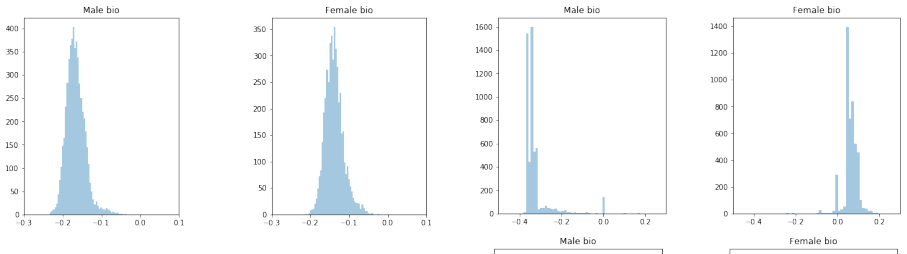
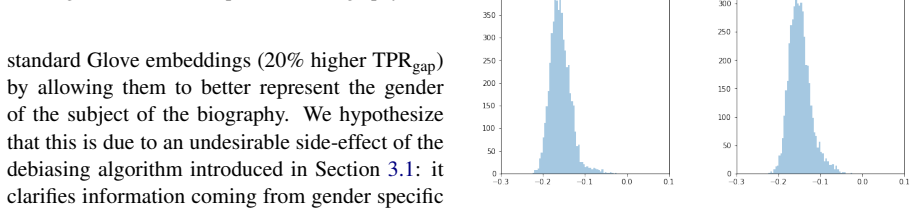
- [Section 6.2, Figure 1] Footnote 2 says the all-negative gender component is an idiosyncrasy of BiosBias established by comparing to other large datasets, but no details are given; please either substantiate this claim or remove it.
- [Section 1] There is a typo in the first sentence of the introduction: 'This paper investigate' should be 'This paper investigates'.
- [Section 5.1 / 6.1] The manuscript does not report the training details (optimizer, epochs, batch size, random seed, and whether the gender probe in Table 3 is evaluated on the test split) needed for exact reproduction; adding these details would improve reproducibility.
Circularity Check
No significant circularity: the paper's claims are empirical comparisons against external labels, not derivations from fitted inputs.
full rationale
The paper's central claims are measured outcomes, not derived predictions. Table 2 reports accuracy and TPR gap for five embedding conditions; TPR gap is computed from the external BiosBias labels using the Equality of Opportunity definition, and the embeddings are fixed inputs obtained from a cited prior algorithm (Bolukbasi et al., 2016). No parameter is fitted to the fairness metric: the paper states 'All hyper parameters were tuned for the standard GloVe model and the optimal values were used for the subsequent runs,' so the debiasing comparison is not a fitted prediction. The gender subspace B is computed from a fixed word-pair list taken from Bolukbasi et al.; although a co-author of the present paper is an author of that prior work, the cited method is code-reproduced, parameter-free with respect to the target outcome, and is the intervention under study rather than a conclusion derived from it. The Section 6.2 statement that strongly debiased embeddings 'remove the entire signal' is an explanatory description of the projection operation (removing the B component from all words), and the paper provides an independent empirical check in Section 6.1 with a separately trained logistic gender classifier on frozen sentence representations. The improvement in TPR gap from 0.091 to 0.069 is observed, not implied by the construction of B. Any concern that the 1D linear subspace B may not capture all nonlinear gender information is a correctness/robustness limitation, not circularity. The paper is therefore self-contained against external benchmarks and contains no step where an output is equivalent to an input by definition.
Assumptions & free parameters
free parameters (3)
- Gender subspace dimension k =
1
- DNN hyperparameters
- Gender word-pair sets for subspace and equalization
assumptions (4)
- domain assumption The gender information in word embeddings lies in a low-dimensional subspace that can be identified from a small set of defining word pairs.
- domain assumption Equality of Opportunity, measured by TPR gap, is the appropriate fairness criterion for occupation classification.
- ad hoc to paper The average of word-level gender components is a meaningful measure of the gender signal of a whole biography.
- ad hoc to paper A logistic classifier trained on frozen sentence representations reveals the amount of gender information the model could use.
Cite this review
Pith. "Pith review of Debiasing Embeddings for Reduced Gender Bias in Text Classification." pith.science (2026). https://pith.science/paper/6JKJ3F24
@misc{pith2026190802810,
  author       = {Pith},
  title        = {Pith review of: Debiasing Embeddings for Reduced Gender Bias in Text Classification},
  year         = {2026},
  howpublished = {\url{https://pith.science/paper/6JKJ3F24}},
  note         = {Machine review of arXiv:1908.02810}
}
read the original abstract
(Bolukbasi et al., 2016) demonstrated that pretrained word embeddings can inherit gender bias from the data they were trained on. We investigate how this bias affects downstream classification tasks, using the case study of occupation classification (De-Arteaga et al.,2019). We show that traditional techniques for debiasing embeddings can actually worsen the bias of the downstream classifier by providing a less noisy channel for communicating gender information. With a relatively minor adjustment, however, we show how these same techniques can be used to simultaneously reduce bias and maintain high classification accuracy.
Figures
Reference graph
Works this paper leans on
-
[1]
URL: " 'urlintro :=
ENTRY address author booktitle chapter edition editor howpublished institution journal key month note number organization pages publisher school series title type volume year eprint doi pubmed url lastchecked label extra.label sort.label short.list INTEGERS output.state before.all mid.sentence after.sentence after.block STRINGS urlintro eprinturl eprintpr...
-
[2]
write newline
" write newline "" before.all 'output.state := FUNCTION n.dashify 't := "" t empty not t #1 #1 substring "-" = t #1 #2 substring "--" = not "--" * t #2 global.max substring 't := t #1 #1 substring "-" = "-" * t #2 global.max substring 't := while if t #1 #1 substring * t #2 global.max substring 't := if while FUNCTION word.in bbl.in capitalize " " * FUNCT...
-
[3]
Alex Beutel, Jilin Chen, Tulsee Doshi, Hai Qian, Allison Woodruff, Christine Luu, Pierre Kreitmann, Jonathan Bischof, and Ed H Chi. 2019. Putting fairness principles into practice: Challenges, metrics, and improvements. arXiv preprint arXiv:1901.04562
work page Pith review arXiv 2019
-
[4]
Piotr Bojanowski, Edouard Grave, Armand Joulin, and Tomas Mikolov. 2017. Enriching word vectors with subword information. Transactions of the Association for Computational Linguistics, 5:135--146
2017
-
[5]
Tolga Bolukbasi, Kai-Wei Chang, James Y Zou, Venkatesh Saligrama, and Adam T Kalai. 2016. Man is to computer programmer as woman is to homemaker? debiasing word embeddings. In Advances in neural information processing systems, pages 4349--4357
2016
-
[6]
Maria De-Arteaga, Alexey Romanov, Hanna Wallach, Jennifer Chayes, Christian Borgs, Alexandra Chouldechova, Sahin Geyik, Krishnaram Kenthapadi, and Adam Tauman Kalai. 2019. Bias in bios: A case study of semantic representation bias in a high-stakes setting. In Proceedings of the Conference on Fairness, Accountability, and Transparency, pages 120--128. ACM
work page 2019
-
[7]
Lucas Dixon, John Li, Jeffrey Sorensen, Nithum Thain, and Lucy Vasserman. 2018. Measuring and mitigating unintended bias in text classification. In Proceedings of the 2018 AAAI/ACM Conference on AI, Ethics, and Society, pages 67--73. ACM
work page 2018
-
[8]
Sorelle A Friedler, Carlos Scheidegger, Suresh Venkatasubramanian, Sonam Choudhary, Evan P Hamilton, and Derek Roth. 2019. A comparative study of fairness-enhancing interventions in machine learning. In Proceedings of the Conference on Fairness, Accountability, and Transparency, pages 329--338. ACM
work page 2019
Show all 14 references
-
[9]
Sahaj Garg, Vincent Perot, Nicole Limtiaco, Ankur Taly, H Chi, and Alex Beutel. 2019. Counterfactual fairness in text classification through robustness. In Proceedings of the 2019 AAAI/ACM Conference on AI, Ethics, and Society. ACM
2019
-
[10]
Hila Gonen and Yoav Goldberg. 2019. Lipstick on a pig: Debiasing methods cover up systematic gender biases in word embeddings but do not remove them. arXiv preprint arXiv:1903.03862
2019 arXiv
-
[11]
Moritz Hardt, Eric Price, Nati Srebro, et al. 2016. Equality of opportunity in supervised learning. In Advances in neural information processing systems, pages 3315--3323
2016
-
[12]
Tomas Mikolov, Kai Chen, Greg Corrado, and Jeffrey Dean. 2013. Efficient estimation of word representations in vector space. arXiv preprint arXiv:1301.3781
2013 arXiv
-
[13]
Arvind Narayanan. 2018. Translation tutorial: 21 fairness definitions and their politics. In Proc. Conf. Fairness Accountability Transp., New York, USA
2018
-
[14]
Jeffrey Pennington, Richard Socher, and Christopher Manning. 2014. Glove: Global vectors for word representation. In Proceedings of the 2014 conference on empirical methods in natural language processing (EMNLP), pages 1532--1543
2014
Reviewed August 14, 2026 · model on record in the stance chip above.
Discussion (0). Continue with ORCID to comment.