REVIEW 1 major objections 5 minor 118 references
Spatiotemporal dynamics of frictional systems: The interplay of interfacial friction and bulk elasticity
T0 review · 1 major / 5 minor · reviewed 2026-08-14 · deepseek-v4-flash
Pith's one-line read This paper argues that spatially extended friction cannot be understood from interfacial contact laws alone: bulk elasticity and the interfacial constitutive relation are inseparable, and together they set stability, nucleation, and…
desk verdict A credible feature-paper synthesis of this group's rate-and-state-plus-bulk-elasticity program; the new FEM results are solid, but the propagating-mode taxonomy leans on an N-shaped friction curve that is a constitutive assumption, not a generic consequence of interface-bulk coupling. read the letter →
The pith
A machine-rendered reading of the paper's core claim, the machinery that carries it, and where it could break.
The reading
What carries the argument
The central object is the coupled interface–bulk problem in Eq. (3), with the interfacial law on one side and the bulk elastic functionals $\mathcal{F}_\tau$ and $\mathcal{F}_\sigma$ on the other. The load-bearing interfacial ingredient is the extended friction law: a total stress $\tau=\tau^{el}+\tau^{vis}$, an elastic stress that grows as the interface is sheared and relaxes with slip, $\dot{\tau}^{el}=(\mu_0/h)Av-\tau^{el}|v|g(\tau,v)/D$, and a short-time cutoff in the contact area that saturates logarithmic aging and creates the N-shaped steady-state curve. The load-bearing bulk ingredient is the elastodynamic functional $\mathcal{F}_\tau$: in the thin-system limit it reduces to a local scalar wave operator $\mathcal{F}_\tau\simeq\rho H\,\partial_{tt}\delta-\bar\mu H\,\partial_{xx}\delta$, making the analysis tractable, while in infinite systems it is the long-ranged radiation-damping plus singular-integral kernel. Linear stability analysis around homogeneous sliding produces $L_c$, and co-moving-frame analysis of steady fronts ($\xi=x-ct$) produces the width and speed scalings.
What would settle it
Measure a steady-state friction curve $f_{ss}(v)$ on a well-characterized multi-contact interface over slip velocities from well below $D/\varphi_*$ to well above it. If the curve is monotonic (no low-velocity maximum and no high-velocity minimum), then for any load $\tau_0$ there are not three fixed points, and the predicted rupture and healing speed spectra, creep-patch nucleation at $L_c$, and slip-pulse critical nuclei should be absent. Alternatively, in an edge-loaded slab, directly test the nucleation claim by measuring the creep-patch size at runaway as a function of $H$ and checking whether $L_c(H)$ grows like $\sqrt{H}$ for small $H$ and saturates for large $H$.
Extended reading notes
Core claim
On the paper's own terms, the discovery is that Eq. (3)—the equality between the bulk-mediated interfacial shear and normal stresses and the interfacial constitutive relation—is the organizing equation of frictional dynamics. With an extended rate-and-state law that adds a linear elastic interfacial stress and a short-time cutoff, the steady-state friction curve $f_{ss}(v)$ acquires a generic N-shape: strengthening at very low velocities, weakening in the middle, and strengthening again above a minimum at $v_{\min}\simeq D/\varphi_*$. For loading stresses $\tau_0>\tau_{\min}$ the curve has three homogeneous fixed points, and the unstable middle fixed point, once coupled to bulk elasticity, organizes the dynamics. Homogeneous sliding on the weakening branch is unstable only for wavelengths longer than $L_c\sim\sqrt{\bar\mu H D/[-\sigma_0\,df_{ss}/d\log v]}$, and the same length controls when a growing creep patch loses stability. Steady rupture fronts in thin systems have width $\ell\sim\sqrt{\bar\mu H D/\Delta\tau_{p-r}}$ and speed $c\sim v_p\sqrt{\bar\mu H/(\Delta\tau_{p-r}D)}$; healing fronts have the opposite load dependence of speed, and their crossing with the rupture spectrum at a load $\tau_*$ produces slip pulses that act as critical nuclei for rupture.
Load-bearing premise
The predictions rest on the assumption that a real interface's steady-state friction curve is N-shaped—weakly strengthening at the lowest slip velocities, weakening in between, and strengthening again above a minimum—so that for $\tau_0>\tau_{\min}$ there are exactly three fixed points; if an interface lacks the low-velocity strengthening branch, or if thermal weakening at high speeds removes the high-velocity minimum, the three-fixed-point structure and the predicted creep-patch, front, and pulse behavior would change.
Editorial extensions
If this is right
- A velocity-weakening interface is not unstable at arbitrarily long wavelengths: perturbations shorter than $L_c$ decay, so increasing body stiffness or height stabilizes sliding, and the marginal mode sets the nucleation length for runaway slip.
- Under edge loading, the onset of sliding is a spatially extended creep-patch process: the patch length grows like $\sqrt{H}$ in thin systems and linearly in time in tall systems, and a runaway begins only when the patch reaches $L_c(H)$, which can be computed from homogeneous stability.
- Rupture-front profiles from thin systems collapse when coordinates are rescaled by $\sqrt{H}$, with width $\ell\sim\sqrt{\bar\mu H D/\Delta\tau_{p-r}}$ and speed $c\sim v_p\sqrt{\bar\mu H/(\Delta\tau_{p-r}D)}$, giving a direct experimental signature.
- Rupture speed grows from a finite minimum near $\tau_{\min}$ and saturates at the wave speed, while healing speed decreases with load; the two spectra cross at $\tau_*$, where slip pulses appear, and these pulses behave like critical nuclei in a first-order-like transition.
- Residual stress behind a rupture is not intrinsic to the friction law: steady finite-height fronts leave $\tau_r=\tau_0$, but transient infinite-height ruptures leave a finite stress drop, so interpreting stress drops requires the bulk dynamics.
Reading between the lines
- Because the quantitative predictions hang on the N-shape of $f_{ss}(v)$ rather than on its microscopic origin, the same $L_c$, $\ell$, and $c$ scalings should transfer to any interface with that shape—including lubricated contacts, whose Stribeck curve the paper notes is similar; this transfer is an extrapolation the paper suggests but does not demonstrate.
- The slip-pulse critical-nucleus picture implies a stochastic nucleation problem not treated here: for a locked interface held above $\tau_*$, the waiting time for a rupture should be controlled by how often local fluctuations exceed the pulse width $L(\tau_0)$, which is testable in controlled loading protocols.
- The model deliberately excludes high-velocity thermal weakening; at seismic slip rates that weakening would remove the high-velocity strengthening branch, turning the N-shape into a different shape and altering the predicted speed saturation and stress drops.
Signed reviews
Editorial analysis
A structured set of objections, weighed in public.
Referee Report
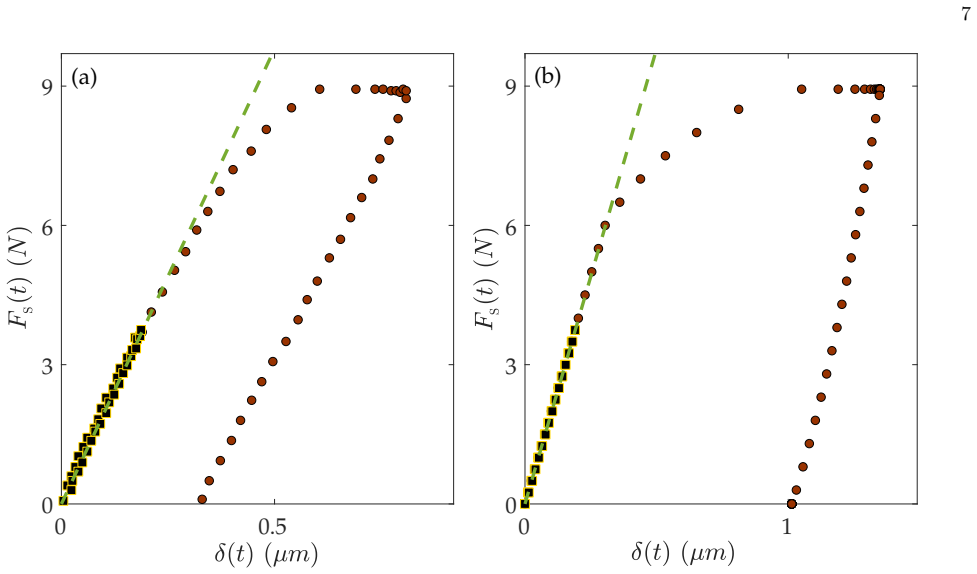
Summary. This feature paper argues that the dynamics of spatially-extended frictional systems are governed by an inseparable coupling between the interfacial constitutive law and bulk elasticity, encapsulated in Eq. (3). The authors first review conventional rate-and-state friction, identify two limitations (absence of a linear reversible interfacial response and divergence at short contact times), and propose an extended rate-and-state model with an interfacial elastic stress (Eqs. (9)-(10)) and a short-time cutoff (Eq. (12)). They then derive an N-shaped steady-state friction curve (Fig. 3) and analyze how this interfacial law, combined with bulk elasticity, controls the linear stability of homogeneous sliding (Eq. (17) for the critical length Lc), the nucleation and propagation of creep patches (Sec. IV B), and steady-state propagating rupture fronts, healing fronts, and slip pulses (Sec. IV C, Eqs. (18)-(20)). The paper supports its analytical scaling predictions with quasi-1D and 2D treadmill FEM calculations, and it demonstrates the extended friction model on load-hold-unload experiments (Fig. 2).
Significance. If the results hold, this paper provides a useful synthesis of a substantial body of work on the interface-bulk coupling in frictional systems. Its strengths include clean analytical scaling derivations for Lc, the transition length l, and the propagation speed c; direct comparison of these scalings against FEM calculations over a 16-fold range of H (Fig. 6-7); and several falsifiable predictions, such as the c(τ0) spectrum with a finite minimal speed near τmin and the H-dependent collapse of rupture-front profiles. The paper is also transparent about its constitutive assumptions and about the regimes it does not cover, which is commendable. The central caveat is that the propagating-mode taxonomy in Sec. IV C depends on the N-shaped steady-state friction curve, a constitutive assumption that is not itself a consequence of the interface-bulk coupling in Eq. (3).
major comments (1)
- [Sec. IV C and Sec. II B 2] The propagating-mode analysis in Sec. IV C (the three-fixed-point structure, the rupture/healing/slip-pulse classification, the speed spectra in Fig. 7, and the slip-pulse nucleation scenario in Fig. 8) presupposes the N-shaped steady-state friction curve of Fig. 3, with a low-velocity strengthening branch, an intermediate velocity-weakening branch, and a high-velocity strengthening branch below the onset of thermal weakening. This shape is not implied by the interface-bulk coupling in Eq. (3); it follows from the specific constitutive choices in Eqs. (A1)-(A3), and the paper itself notes in Sec. II B 2 that for α>β the curve is purely velocity-strengthening and that thermal softening at very high slip rates is excluded. For a real interface that lacks the low-velocity strengthening branch, or for which flash heating or thermal weakening sets in before the minimum at vmin, the three-fixed-point structure disappears, and the predicted rupture and healing speed spectra and the slip-pulse nucleation scenario would change qualitatively. Because the abstract and conclusions present these propagating modes as generic outcomes of the interface-bulk interplay, this constitutive assumption is load-bearing for the paper's central claim and should be explicitly flagged as a condition on those claims, not merely noted as a caveat deep in Sec. II B 2; I recommend adding a qualifier to the abstract and conclusions.
minor comments (5)
- [Sec. II B 1 and Appendix B] The demonstration in Fig. 2b, presented as a semi-quantitative reproduction of the load-hold-unload experiments, is partly constructed: the interfacial elastic stiffness ratio µ0/h is extracted from the initial linear slope of the very same experimental data, so the agreement is a fit rather than an independent prediction. The authors disclose this in Appendix B, but the main text should make clearer that Fig. 2b is a consistency check, not a parameter-free validation.
- [Figure 2] In the reproduction of Fig. 2a, neither the shear force axis nor the slip displacement axis is explicitly labeled with units in the figure or its caption; since the figure is compared with experimental data from [50], the axes should be identified (e.g., FS in N and δ in µm) to allow the reader to assess the claimed semi-quantitative agreement.
- [Throughout] There are several typographical errors that should be corrected in a revision: 'viscoealstic' (Sec. II B 1), 'Bolzmann' (Sec. II A), 'lenthscale' (Sec. IV C), 'here with' instead of 'here' (Sec. IV C), and 'Sciense & Buisness' in reference [2].
- [Sec. IV C, Eq. (18)] The scaling relation c/l ∼ vp/D is introduced with a brief heuristic argument about accumulated slip; the sentence that this relation 'can be somewhat more formally rationalized using Eq. (8)' would benefit from a short derivation or a specific reference, since Eq. (18) is used as the basis for the subsequent scaling predictions in Eqs. (19)-(20).
- [Sec. III, Eq. (14)] The transition from Eq. (13) to Eq. (14) states that in the quasi-static limit the radiation-damping term is negligible, but the text does not explain why the time-integral structure in s(x,t) also drops out; a sentence clarifying that Eq. (14) corresponds to a quasi-static, non-inertial limit would prevent confusion.
Circularity Check
The Fig. 2b 'reproduction' of the PMMA experiments fits mu0/h and tau_c to the same FS(delta) data it reproduces; the central stability and rupture-front scalings are otherwise self-contained.
-
fitted input called prediction
[Sec. II B 1 and Appendix B (Eq. (11), Fig. 2b; determination of mu0/h and tau_c).]
""The only missing parameter is the interfacial elasticity ratio mu0/h, which is directly extracted from the initial linear slope in the FS(delta) experimental data (dashed line in Fig. 2a) according to dFS/ddelta= mu0 FN / (h sigma_H) [1 + b log(1 + phi(t=0)/phi*)], resulting in f~0 = D mu0/(h sigma_H) = 0.209" ... "we set tau_c = 70 MPa" ... "The solutions of these equations for the two experimental protocols ... are presented in Fig. 2b, reproducing all of the experimental observations semi-quantitatively.""
The extended model is said to reproduce the experimental FS(delta) response of Fig. 2a, but the elastic stiffness ratio mu0/h is extracted from the initial linear slope of that same dataset, and the yield stress tau_c is chosen so that irreversible response begins near 7 N in that same dataset. The linear branch of the model therefore matches the experiment by construction, and the agreement in Fig. 2b is a consistency check of the fitted parameters rather than an independent prediction of the constitutive extension. This fit is localized to the small-stress illustration and does not feed the Lc, l, or c scalings of Secs. IV A-C, whose parameters are fixed in Table I rather than fitted to rupture properties.
full rationale
The central derivations of the paper are not circular. Eq. (17) and Eqs. (19)-(20) follow from linearization of Eq. (3) plus the stated constitutive equations and are compared with FEM calculations and quasi-1D calculations whose material parameters are listed in Table I; neither the critical nucleation length nor the rupture-front width and speed are used to fit those parameters, so the reported agreement is a nontrivial check of the analytical scalings. The N-shaped steady-state curve of Fig. 3 is an explicit constitutive assumption built from the cutoff in Eq. (12), the aging law, and g(v), with the paper itself noting that for alpha > beta the curve is purely velocity-strengthening and that high-velocity thermal softening is excluded; this is a model limitation rather than a circular derivation, since the shape is not claimed to be a consequence of the interface-bulk coupling. The heavy self-citation (e.g., refs. 43, 60, 61, 87, 102) is visible, but the load-bearing formulas are restated and derived in the present text, and no self-citation is invoked as a uniqueness theorem to forbid alternatives. The one genuine circular element is the small-stress example: Appendix B fits mu0/h to the initial slope of the same FS(delta) data shown in Fig. 2a and chooses tau_c to match the onset of nonlinearity in that data, then presents the resulting curves as reproducing the observations. Because this fitted demonstration is secondary, and the paper explicitly disclaims quantitative fitting ('no attempt has been made to quantitatively reproduce the experimental data'), the appropriate score is low rather than a finding of pervasive circularity.
Assumptions & free parameters
free parameters (4)
- Interfacial yield stress tau_c =
70 MPa for Fig. 2b
- Interfacial elastic stiffness ratio mu0/h (through f~0) =
f~0 = D mu0/(h sigma_H) = 0.209 for Fig. 2b
- Velocity cutoff v* in g(v) =
10^-7 m/s
- Mass density rho in treadmill FEM =
60 kg/m^3
assumptions (5)
- domain assumption Linear elastodynamics describes the bulk (Hooke's law with momentum balance rho u_ddot = div sigma).
- domain assumption The interfacial constitutive relation is local, depending on delta, v, phi, tau_el but not on spatial derivatives.
- domain assumption The quasi-static approximation holds for creep patches and for small-H rupture fronts (neglect of radiation damping and inertial terms).
- domain assumption For creep patches, the average slip velocity scales with the driving velocity vd, so homogeneous linear stability applies locally.
- domain assumption The steady-state friction curve fss(v) is N-shaped with three fixed points for tau0 > tau_min.
Cite this review
Pith. "Pith review of Spatiotemporal dynamics of frictional systems: The interplay of interfacial friction and bulk elasticity." pith.science (2026). https://pith.science/paper/VJXHYDXO
@misc{pith2026190802820,
  author       = {Pith},
  title        = {Pith review of: Spatiotemporal dynamics of frictional systems: The interplay of interfacial friction and bulk elasticity},
  year         = {2026},
  howpublished = {\url{https://pith.science/paper/VJXHYDXO}},
  note         = {Machine review of arXiv:1908.02820}
}
read the original abstract
Frictional interfaces are abundant in natural and engineering systems, and predicting their behavior still poses challenges of prime scientific and technological importance. At the heart of these challenges lies the inherent coupling between the interfacial constitutive relation -- the macroscopic friction law -- and the bulk elasticity of the bodies that form the frictional interface. In this feature paper, we discuss the generic properties of the macroscopic friction law and the many ways in which its coupling to bulk elasticity gives rise to rich spatiotemporal frictional dynamics. We first present the widely used rate-and-state friction constitutive framework, discuss its power and limitations, and propose extensions that are supported by experimental data. We then discuss how bulk elasticity couples different parts of the interface, and how the range and nature of this interaction are affected by the system's geometry. Finally, in light of the coupling between interfacial and bulk physics, we discuss basic phenomena in spatially-extended frictional systems, including the stability of homogeneous sliding, the onset of sliding motion and a wide variety of propagating frictional modes (e.g. rupture fronts, healing fronts and slip pulses). Overall, the results presented and discussed in this feature paper highlight the inseparable roles played by interfacial and bulk physics in spatially-extended frictional systems.
Figures


Figures from the paper (5 more)


Reference graph
Works this paper leans on
-
[1]
The Friction and Lubrication of Solids ; Clarendon Press, 1950
Bowden, F.P.; Tabor, D. The Friction and Lubrication of Solids ; Clarendon Press, 1950
1950
-
[2]
Sliding friction: physical principles and applications ; Springer Sciense & Buisness Media, 1998
Persson, B.N.J. Sliding friction: physical principles and applications ; Springer Sciense & Buisness Media, 1998
1998
-
[3]
Brittle Fracture Theory Describes the Onset of Frictional Motion
Svetlizky, I.; Bayart, E.; Fineberg, J. Brittle Fracture Theory Describes the Onset of Frictional Motion. Annu. Rev. Condens. Matter Phys. 2019, 10, 031218–013327. doi:10.1146/annurev-conmatphys-031218-013327. 21
-
[4]
Simulations of atomic-scale sliding friction
Sørensen, M.; Jacobsen, K.; Stoltze, P. Simulations of atomic-scale sliding friction. Phys. Rev. B 1996, 53, 2101–2113. doi:10.1103/PhysRevB.53.2101
-
[5]
Frictional ageing from interfacial bonding and the origins of rate and state friction
Li, Q.; Tullis, T.E.; Goldsby, D.L.; Carpick, R.W. Frictional ageing from interfacial bonding and the origins of rate and state friction. Nature 2011, 480, 233–236. doi:10.1038/nature10589
-
[6]
Colloquium: Modeling friction: From nanoscale to mesoscale
Vanossi, A.; Manini, N.; Urbakh, M.; Zapperi, S.; Tosatti, E. Colloquium: Modeling friction: From nanoscale to mesoscale. Rev. Mod. Phys. 2013, 85, 529–552. doi:10.1103/RevModPhys.85.529
-
[7]
Armstrong-H´ elouvry, B.; Dupont, P.; Canudas de Wit, C. A Survey of Models, Analysis Tools and Compensations Methods for the Control of Machines with Friction.Automatica 1994, 30, 1083–1138. doi:http://dx.doi.org/10.1016/0005- 1098(94)90209-7
doi:10.1016/0005- 1994
-
[8]
Hysteretic effects of dry friction: modelling and experi- mental studies
Wojewoda, J.; Stefa´ nski, A.; Wiercigroch, M.; Kapitaniak, T. Hysteretic effects of dry friction: modelling and experi- mental studies. Philos. Trans. A. Math. Phys. Eng. Sci. 2008, 366, 747–765. doi:10.1098/rsta.2007.2125
arXiv 2008
Show all 118 references
-
[9]
Laboratoty-derived friction laws and their application to seismic faulting
Marone, C. Laboratoty-derived friction laws and their application to seismic faulting. Annu. Rev. Earth Planet. Sci. 1998, 26, 643–696. doi:10.1146/annurev.earth.26.1.643
1998 doi
-
[10]
Dynamic ruptures in recent models of earthquake faults
Ben-Zion, Y. Dynamic ruptures in recent models of earthquake faults. J. Mech. Phys. Solids 2001, 49, 2209–2244. doi:10.1016/S0022-5096(01)00036-9
2001 doi
-
[11]
The mechanics of earthquakes and faulting ; Cambridge university press, 2002
Scholz, C.H. The mechanics of earthquakes and faulting ; Cambridge university press, 2002
2002
-
[12]
The physics of rock failure and earthquakes ; Cambridge University Press, 2013
Ohnaka, M. The physics of rock failure and earthquakes ; Cambridge University Press, 2013
2013
-
[13]
Friction experiments on the nanometre scale
Gnecco, E.; Bennewitz, R.; Gyalog, T.; Meyer, E. Friction experiments on the nanometre scale. J. Phys. Condens. Matter 2001, 13, 202. doi:10.1088/0953-8984/13/31/202
2001 doi
-
[14]
Solid friction from stickslip down to pinning and aging
Baumberger, T.; Caroli, C. Solid friction from stickslip down to pinning and aging. Adv. Phys. 2006, 55, 279–348. doi:10.1080/00018730600732186
2006 doi
-
[15]
Collective behavior of earthquakes and faults: Continuum-discrete transitions, progressive evolutionary changes, and different dynamic regimes
Ben-Zion, Y. Collective behavior of earthquakes and faults: Continuum-discrete transitions, progressive evolutionary changes, and different dynamic regimes. Rev. Geophys. 2008, 46, RG4006. doi:10.1029/2008RG000260
2008 doi
-
[16]
Modeling and simulation in tribology across scales: An overview
Vakis, A.; Yastrebov, V.; Scheibert, J.; Nicola, L.; Dini, D.; Minfray, C.; Almqvist, A.; Paggi, M.; Lee, S.; Limbert, G.; Molinari, J.; Anciaux, G.; Aghababaei, R.; Echeverri Restrepo, S.; Papangelo, A.; Cammarata, A.; Nicolini, P.; Putignano, C.; Carbone, G.; Stupkiewicz, S....
2018 doi
-
[17]
Time-dependent friction and the mechanics of stick-slip
Dieterich, J.H. Time-dependent friction and the mechanics of stick-slip. Pure Appl. Geophys. 1978, 116, 790–806. doi:10.1007/BF00876539
1978 doi
-
[18]
Modeling of rock friction: 1
Dieterich, J.H. Modeling of rock friction: 1. Experimental results and constitutive equations. J. Geophys. Res. Solid Earth 1979, 84, 2161. doi:10.1029/JB084iB05p02161
1979 doi
-
[19]
Stability of Steady Frictional Slipping
Rice, J.R.; Ruina, A.L. Stability of Steady Frictional Slipping. J. Appl. Mech. 1983, 50, 343–349. doi:10.1115/1.3167042
1983 doi
-
[20]
Slip instability and state variable friction laws
Ruina, A.L. Slip instability and state variable friction laws. J. Geophys. Res. 1983, 88, 10359–10370. doi:10.1029/JB088iB12p10359
1983 doi
-
[21]
Creep, stick-slip, and dry-friction dynamics: Experiments and a heuristic model
Heslot, F.; Baumberger, T.; Perrin, B.; Caroli, B.; Caroli, C. Creep, stick-slip, and dry-friction dynamics: Experiments and a heuristic model. Phys. Rev. E 1994, 49, 4973–4988. doi:10.1103/PhysRevE.49.4973
1994 doi
-
[22]
Accelerated creep as a precursor of friction instability and earthquake prediction
Popov, V.L.; Grzemba, B.; Starcevic, J.; Fabry, C. Accelerated creep as a precursor of friction instability and earthquake prediction. Phys. Mesomech. 2010, 13, 283–291. doi:10.1016/j.physme.2010.11.009
2010 doi
-
[23]
A model for the nucleation of earthquake slip
Dieterich, J.H. A model for the nucleation of earthquake slip. In Earthq. source Mech.; Wiley Online Library, 1986; pp. 37–47. doi:10.1029/GM037p0037
1986 doi
-
[24]
The mechanics of earthquake rupture
Rice, J.R. The mechanics of earthquake rupture. In Phys. Earth’s Inter. ; 1980; pp. 555–649. doi:10.1.1.161.3251
1980
-
[25]
The Nature of the Static and Kinetic Coefficients of Friction
Rabinowicz, E. The Nature of the Static and Kinetic Coefficients of Friction. J. Appl. Phys. 1951, 22, 1373–1379. doi:10.1063/1.1699869
1951 doi
-
[26]
Direct observation of frictional contacts: New insights for state-dependent properties
Dieterich, J.H.; Kilgore, B.D. Direct observation of frictional contacts: New insights for state-dependent properties. Pure Appl. Geophys. 1994, 143, 283–302. doi:10.1007/BF00874332
1994 doi
-
[27]
Detachment fronts and the onset of dynamic friction
Rubinstein, S.M.; Cohen, G.; Fineberg, J. Detachment fronts and the onset of dynamic friction. Nature 2004, 430, 1005–
2004
-
[28]
Dynamics of Precursors to Frictional Sliding
Rubinstein, S.M.; Cohen, G.; Fineberg, J. Dynamics of Precursors to Frictional Sliding. Phys. Rev. Lett. 2007, 98, 226103. doi:10.1103/PhysRevLett.98.226103
2007 doi
-
[29]
Monitoring frictional strength with acoustic wave transmission
Nagata, K.; Nakatani, M.; Yoshida, S. Monitoring frictional strength with acoustic wave transmission. Geophys. Res. Lett. 2008, 35, L06310. doi:10.1029/2007GL033146
2008 doi
-
[30]
On a model of frictional sliding.Pure Appl
Estrin, Y.; Br´ echet, Y. On a model of frictional sliding.Pure Appl. Geophys.1996, 147, 745–762. doi:10.1007/BF01089700
1996 doi
-
[31]
Time-dependent friction in rocks
Dieterich, J.H. Time-dependent friction in rocks. J. Geophys. Res. 1972, 77, 3690–3697. doi:10.1029/JB077i020p03690
1972 doi
-
[32]
The roles of time and displacement in the evolution effect in rock friction, 1994
Beeler, N.M.; Tullis, T.E.; Weeks, J.D. The roles of time and displacement in the evolution effect in rock friction, 1994. doi:10.1029/94GL01599
1994 doi
-
[33]
Physical analysis of the state- and rate-dependent friction law: Static friction, 1999
Berthoud, P.; Baumberger, T.; G’Sell, C.; Hiver, J.M. Physical analysis of the state- and rate-dependent friction law: Static friction, 1999. doi:10.1103/PhysRevB.59.14313
1999 doi
-
[34]
Low-velocity friction between macroscopic solids
Bureau, L.; Baumberger, T.; Caroli, C.; Ronsin, O. Low-velocity friction between macroscopic solids. Comptes Rendus l’Acad´ emie des Sci. - Ser. IV - Phys. 2001, 2, 699–707. doi:10.1016/S1296-2147(01)01212-4
2001 doi
-
[35]
Slip-stick and the evolution of frictional strength
Ben-David, O.; Rubinstein, S.M.; Fineberg, J. Slip-stick and the evolution of frictional strength. Nature 2010, 463, 76–9. doi:10.1038/nature08676
2010 doi
-
[36]
Constitutive behavior and stability of frictional sliding of granite
Tullis, T.E.; Weeks, J.D. Constitutive behavior and stability of frictional sliding of granite. Pure Appl. Geophys. 1986, 124, 383–414. doi:10.1007/BF00877209. 22
1986 doi
-
[37]
Velocity dependent friction of granite over a wide range of conditions
Kilgore, B.D.; Blanpied, M.L.; Dieterich, J.H. Velocity dependent friction of granite over a wide range of conditions. Geophys. Res. Lett. 1993, 20, 903–906. doi:10.1029/93GL00368
1993 doi
-
[38]
Physical analysis of the state- and rate-dependent friction law
Baumberger, T.; Berthoud, P. Physical analysis of the state- and rate-dependent friction law. II. Dynamic friction. Phys. Rev. B 1999, 60, 3928–3939. doi:10.1103/PhysRevB.60.3928
1999 doi
-
[39]
Fault weakening and earthquake instability by powder lubrication
Reches, Z.; Lockner, D.A. Fault weakening and earthquake instability by powder lubrication. Nature 2010, 467, 452–455. doi:10.1038/nature09348
2010 doi
-
[40]
Rate and state dependent friction and the stability of sliding between elastically deformable solids
Rice, J.R.; Lapusta, N.; Ranjith, K. Rate and state dependent friction and the stability of sliding between elastically deformable solids. J. Mech. Phys. Solids 2001, 49, 1865–1898. doi:10.1016/S0022-5096(01)00042-4
2001 doi
-
[41]
Conceptual and physical clarification of rate and state friction: Frictional sliding as a thermally activated rheology
Nakatani, M. Conceptual and physical clarification of rate and state friction: Frictional sliding as a thermally activated rheology. J. Geophys. Res. Solid Earth 2001, 106, 13347–13380. doi:10.1029/2000JB900453
2001 doi
-
[42]
The instantaneous rate dependence in low temperature labo- ratory rock friction and rock deformation experiments
Beeler, N.M.; Tullis, T.E.; Kronenberg, A.K.; Reinen, L.A. The instantaneous rate dependence in low temperature labo- ratory rock friction and rock deformation experiments. J. Geophys. Res. 2007, 112, B07310. doi:10.1029/2005JB003772
2007 doi
-
[43]
On the velocity-strengthening behavior of dry friction
Bar-Sinai, Y.; Spatschek, R.; Brener, E.A.; Bouchbinder, E. On the velocity-strengthening behavior of dry friction. J. Geophys. Res. Solid Earth 2014, 119, 1738–1748. doi:10.1002/2013JB010586
2014 doi
-
[44]
Multimechanism friction constitutive model for ultrafine quartz gouge at hypocentral condi- tions
Chester, F.M.; Higgs, N.G. Multimechanism friction constitutive model for ultrafine quartz gouge at hypocentral condi- tions. J. Geophys. Res. 1992, 97, 1859–1870. doi:10.1029/91JB02349
1992 doi
-
[45]
Self-healing slip pulse on a frictional surface
Perrin, G.; Rice, J.R.; Zheng, G. Self-healing slip pulse on a frictional surface. J. Mech. Phys. Solids 1995, 43, 1461–1495. doi:10.1016/0022-5096(95)00036-I
1995 doi
-
[46]
Steady and transient sliding under rate-and-state friction
Putelat, T.; Dawes, J.H. Steady and transient sliding under rate-and-state friction. J. Mech. Phys. Solids 2015, 78, 70–93. doi:10.1016/j.jmps.2015.01.016
2015 doi
-
[47]
Conditions under which velocity-weakening friction allows a self-healing versus a cracklike mode of rupture
Zheng, G.; Rice, J.R. Conditions under which velocity-weakening friction allows a self-healing versus a cracklike mode of rupture. Bull. Seismol. Soc. Am. 1998, 88, 1466–1483
1998
-
[48]
The effect of a tangential force on the contact of metallic bodies
Courtney-Pratt, J.S.; Eisner, E. The effect of a tangential force on the contact of metallic bodies. Proc. R. Soc. Lond. A. 1957, 238, 529–550. doi:10.1098/rspa.1957.0016
1957
-
[49]
Elastic Deformation and the Laws of Friction
Archard, J.F. Elastic Deformation and the Laws of Friction. Proc. R. Soc. A Math. Phys. Eng. Sci. 1957, 243, 190–205. doi:10.1098/rspa.1957.0214
1957
-
[50]
Shear stiffness of a solid-solid multicontact interface
Berthoud, P.; Baumberger, T. Shear stiffness of a solid-solid multicontact interface. Proc. R. Soc. A Math. Phys. Eng. Sci. 1998, 454, 1615–1634. doi:10.1098/rspa.1998.0223
1998
-
[51]
Shear response of a frictional interface to a normal load modulation
Bureau, L.; Baumberger, T.; Caroli, C. Shear response of a frictional interface to a normal load modulation. Phys. Rev. E 2000, 62, 6810–6820. doi:10.1103/PhysRevE.62.6810
-
[52]
Transverse and normal interfacial stiffness of solids with randomly rough surfaces
Campa˜ n´ a, C.; Persson, B.N.J.; M¨ user, M.H. Transverse and normal interfacial stiffness of solids with randomly rough surfaces. J. Phys. Condens. Matter 2011, 23, 085001. doi:10.1088/0953-8984/23/8/085001
2011 doi
-
[53]
Finite Element Simulations of Fiber Pull-Out
Povirk, G.L.; Needleman, A. Finite Element Simulations of Fiber Pull-Out. J. Eng. Mater. Technol. 1993, 115, 286. doi:10.1115/1.2904220
1993 doi
-
[54]
Frictional sliding modes along an interface between identical elastic plates subject to shear impact loading
Coker, D.; Lykotrafitis, G.; Needleman, A.; Rosakis, A.J. Frictional sliding modes along an interface between identical elastic plates subject to shear impact loading. J. Mech. Phys. Solids 2005, 53, 884–922. doi:10.1016/j.jmps.2004.11.003
2005 doi
-
[55]
Properties of dynamic rupture and energy partition in a solid with a frictional interface
Shi, Z.; Ben-Zion, Y.; Needleman, A. Properties of dynamic rupture and energy partition in a solid with a frictional interface. J. Mech. Phys. Solids 2008, 56, 5–24. doi:10.1016/j.jmps.2007.04.006
2008 doi
-
[56]
Dynamics of Transition from Static to Kinetic Friction
Braun, O.M.; Barel, I.; Urbakh, M. Dynamics of Transition from Static to Kinetic Friction. Phys. Rev. Lett. 2009, 103, 194301. doi:10.1103/PhysRevLett.103.194301
2009 doi
-
[57]
Slip modes and partitioning of energy during dynamic frictional sliding between identical elasticviscoplastic solids
Shi, Z.; Needleman, A.; Ben-Zion, Y. Slip modes and partitioning of energy during dynamic frictional sliding between identical elasticviscoplastic solids. Int. J. Fract. 2010, 162, 51–67. doi:10.1007/s10704-009-9388-6
2010 doi
-
[58]
Slow Cracklike Dynamics at the Onset of Frictional Sliding
Bouchbinder, E.; Brener, E.A.; Barel, I.; Urbakh, M. Slow Cracklike Dynamics at the Onset of Frictional Sliding. Phys. Rev. Lett. 2011, 107, 235501. doi:10.1103/PhysRevLett.107.235501
2011 doi
-
[59]
Slip Sequences in Laboratory Experiments Resulting from Inhomogeneous Shear as Analogs of Earthquakes Associated with a Fault Edge.Pure Appl
Rubinstein, S.M.; Barel, I.; Reches, Z.; Braun, O.M.; Urbakh, M.; Fineberg, J. Slip Sequences in Laboratory Experiments Resulting from Inhomogeneous Shear as Analogs of Earthquakes Associated with a Fault Edge.Pure Appl. Geophys. 2011, 168, 2151–2166. doi:10.1007/s00024-010-0239-1
2011 doi
-
[60]
Slow rupture of frictional interfaces
Bar Sinai, Y.; Brener, E.A.; Bouchbinder, E. Slow rupture of frictional interfaces. Geophys. Res. Lett. 2012, 39, L03308. doi:10.1029/2011GL050554
2012 doi
-
[61]
Instabilities at frictional interfaces: Creep patches, nucleation, and rupture fronts
Bar-Sinai, Y.; Spatschek, R.; Brener, E.A.; Bouchbinder, E. Instabilities at frictional interfaces: Creep patches, nucleation, and rupture fronts. Phys. Rev. E 2013, 88, 060403. doi:10.1103/PhysRevE.88.060403
2013 doi
-
[62]
Viscoelastic Properties of Polymers, 3rd Edition ; Wiley, 1980
Ferry, J. Viscoelastic Properties of Polymers, 3rd Edition ; Wiley, 1980
1980
-
[63]
On the Elasticity and Viscosity of Metals
Thomson, W. On the Elasticity and Viscosity of Metals. Proc. R. Soc. London 1865, 14, 289–297. doi:10.1098/rspl.1865.0052
-
[64]
Elasticity and onset of frictional dissipation at a non-sliding multi-contact interface
Bureau, L.; Caroli, C.; Baumberger, T. Elasticity and onset of frictional dissipation at a non-sliding multi-contact interface. Proc. R. Soc. A Math. Phys. Eng. Sci. 2003, 459, 2787–2805. doi:10.1098/rspa.2003.1146
2003
-
[65]
Intrinsic and apparent short-time limits for fault healing: Theory, observations, and implica- tions for velocity-dependent friction
Nakatani, M.; Scholz, C.H. Intrinsic and apparent short-time limits for fault healing: Theory, observations, and implica- tions for velocity-dependent friction. J. Geophys. Res. Solid Earth 2006, 111, 1–19. doi:10.1029/2005JB004096
2006 doi
-
[66]
A revised rate- and state-dependent friction law obtained by constraining constitutive and evolution laws separately with laboratory data
Nagata, K.; Nakatani, M.; Yoshida, S. A revised rate- and state-dependent friction law obtained by constraining constitutive and evolution laws separately with laboratory data. J. Geophys. Res. Solid Earth 2012, 117, B02314. doi:10.1029/2011JB008818
2012 doi
-
[67]
The effect of loading rate on static friction and the rate of fault healing during the earthquake cycle
Marone, C. The effect of loading rate on static friction and the rate of fault healing during the earthquake cycle. Nature 1998, 391, 69–72. doi:10.1038/34157
1998 doi
-
[68]
Transition Between Frictional Slip and Ductile Flow for Halite Shear Zones at Room Temperature.Science 23 1986, 231, 711–714
Shimamoto, T. Transition Between Frictional Slip and Ductile Flow for Halite Shear Zones at Room Temperature.Science 23 1986, 231, 711–714. doi:10.1126/science.231.4739.711
1986 doi
-
[69]
Velocity-strengthening friction significantly affects interfacial dynamics, strength and dissipation
Bar-Sinai, Y.; Spatschek, R.; Brener, E.A.; Bouchbinder, E. Velocity-strengthening friction significantly affects interfacial dynamics, strength and dissipation. Sci. Rep. 2015, 5, 7841. doi:10.1038/srep07841
2015 doi
-
[70]
Friction falls towards zero in quartz rock as slip velocity approaches seismic rates
Di Toro, G.; Goldsby, D.L.; Tullis, T.E. Friction falls towards zero in quartz rock as slip velocity approaches seismic rates. Nature 2004, 427, 436–439. doi:10.1038/nature02249
2004 doi
-
[71]
Flash Heating Leads to Low Frictional Strength of Crustal Rocks at Earthquake Slip Rates
Goldsby, D.L.; Tullis, T.E. Flash Heating Leads to Low Frictional Strength of Crustal Rocks at Earthquake Slip Rates. Science 2011, 334, 216–218. doi:10.1126/science.1207902
2011 doi
-
[72]
Unstable slippage across a fault that separates elastic media of different elastic constants
Weertman, J. Unstable slippage across a fault that separates elastic media of different elastic constants. J. Geophys. Res. Solid Earth 1980, 85, 1455–1461. doi:10.1029/JB085iB03p01455
1980 doi
-
[73]
Frictional Sliding without Geometrical Reflection Symmetry
Aldam, M.; Bar-Sinai, Y.; Svetlizky, I.; Brener, E.A.; Fineberg, J.; Bouchbinder, E. Frictional Sliding without Geometrical Reflection Symmetry. Phys. Rev. X 2016, 6, 041023. doi:10.1103/PhysRevX.6.041023
2016 doi
-
[74]
Poroelastic effects destabilize mildly rate-strengthening friction to generate stable slow slip pulses
Heimisson, E.R.; Dunham, E.M.; Almquist, M. Poroelastic effects destabilize mildly rate-strengthening friction to generate stable slow slip pulses. J. Mech. Phys. Solids 2019, 130, 262–279. doi:10.1016/j.jmps.2019.06.007
2019 doi
-
[75]
A spectral method for three-dimensional elastodynamic fracture problems
Geubelle, P.; Rice, J.R. A spectral method for three-dimensional elastodynamic fracture problems. J. Mech. Phys. Solids 1995, 43, 1791–1824. doi:10.1016/0022-5096(95)00043-I
1995 doi
-
[76]
A numerical scheme for mode III dynamic fracture problems
Morrissey, J.W.; Geubelle, P.H. A numerical scheme for mode III dynamic fracture problems. Int. J. Numer. Methods Eng. 1997, 40, 1181–1196. doi:10.1002/(SICI)1097-0207(19970415)40:7¡1181::AID-NME108¿3.0.CO;2-X
1997 doi
-
[77]
Numerical analysis of dynamic debonding under 2D in-plane and 3D loading
Breitenfeld, M.S.; Geubelle, P.H. Numerical analysis of dynamic debonding under 2D in-plane and 3D loading. Int. J. Fract. 1998, 93, 13–38. doi:10.1023/A:1007535703095
1998 doi
-
[78]
Slip patterns and earthquake populations along different classes of faults in elastic solids
Ben-Zion, Y.; Rice, J.R. Slip patterns and earthquake populations along different classes of faults in elastic solids. J. Geophys. Res. Solid Earth 1995, 100, 12959–12983. doi:10.1029/94JB03037
1995 doi
-
[79]
The role of radiation damping in the modeling of repeated earthquake events
Crupi, P.; Bizzarri, A. The role of radiation damping in the modeling of repeated earthquake events. Ann. Geophys. 2013, 56, R0111. doi:10.4401/ag-6200
2013 doi
-
[80]
Relationship between displacements on a free surface and the stress on a fault
Weertman, J. Relationship between displacements on a free surface and the stress on a fault. Bulletin of the Seismological Society of America 1965, 55, 945–953
1965
-
[81]
Elementary fluid dynamics ; Oxford University Press, 1990
Acheson, D.J. Elementary fluid dynamics ; Oxford University Press, 1990
1990
-
[82]
Self-similar slip instability on interfaces with rate- and state-dependent friction
Viesca, R.C. Self-similar slip instability on interfaces with rate- and state-dependent friction. Proc. R. Soc. A Math. Phys. Eng. Sci. 2016, 472, 20160254. doi:10.1098/rspa.2016.0254
2016
-
[83]
Using fast vibrations to quench friction-induced oscillations
Thomsen, J. Using fast vibrations to quench friction-induced oscillations. J. Sound Vib. 1999, 228, 1079–1102. doi:10.1006/jsvi.1999.2460
1999
-
[84]
The role of friction film in friction, wear and noise of automotive brakes
Rhee, S.; Jacko, M.; Tsang, P. The role of friction film in friction, wear and noise of automotive brakes. Wear 1991, 146, 89–97. doi:10.1016/0043-1648(91)90226-K
1991 doi
-
[85]
Stick-Slip as a Mechanism for Earthquakes
Brace, W.F.; Byerlee, J.D. Stick-Slip as a Mechanism for Earthquakes. Science 1966, 153, 990–992. doi:10.1126/science.153.3739.990
1966 doi
-
[86]
Model for earthquake precursers based on premonitory fault slip
Dieterich, J.H. Model for earthquake precursers based on premonitory fault slip. Trans. Geophys. Union 1975, 56, 1059– 1060
1975
-
[87]
Critical Nucleation Length for Accelerating Frictional Slip
Aldam, M.; Weikamp, M.; Spatschek, R.; Brener, E.A.; Bouchbinder, E. Critical Nucleation Length for Accelerating Frictional Slip. Geophys. Res. Lett. 2017, 44, 11,390–11,398. doi:10.1002/2017GL074939
2017 doi
-
[88]
Earthquake nucleation on faults with rate-and state-dependent strength
Dieterich, J.H. Earthquake nucleation on faults with rate-and state-dependent strength. Tectonophysics 1992, 211, 115–
1992
-
[89]
Dynamic instabilities of frictional sliding at a bimaterial interface
Brener, E.A.; Weikamp, M.; Spatschek, R.; Bar-Sinai, Y.; Bouchbinder, E. Dynamic instabilities of frictional sliding at a bimaterial interface. J. Mech. Phys. Solids 2016, 89, 149–173. doi:10.1016/j.jmps.2016.01.009
2016 doi
-
[90]
Nucleation and early seismic propagation of small and large events in a crustal earthquake model
Lapusta, N.; Rice, J.R. Nucleation and early seismic propagation of small and large events in a crustal earthquake model. J. Geophys. Res. Solid Earth 2003, 108, 2205. doi:10.1029/2001JB000793
2003 doi
-
[91]
Earthquake nucleation on (aging) rate and state faults
Rubin, A.M.; Ampuero, J.P. Earthquake nucleation on (aging) rate and state faults. J. Geophys. Res. Solid Earth 2005, 110, B11312. doi:10.1029/2005JB003686
2005 doi
-
[92]
Earthquake nucleation on rate and state faults Aging and slip laws
Ampuero, J.P.; Rubin, A.M. Earthquake nucleation on rate and state faults Aging and slip laws. J. Geophys. Res. Solid Earth 2008, 113, B01302. doi:10.1029/2007JB005082
2008 doi
-
[93]
On the Propagation of Slip Fronts at Frictional Interfaces
Kammer, D.S.; Yastrebov, V.A.; Spijker, P.; Molinari, J.F. On the Propagation of Slip Fronts at Frictional Interfaces. Tribol. Lett. 2012, 48, 27–32. doi:10.1007/s11249-012-9920-0
2012 doi
-
[94]
Classical shear cracks drive the onset of dry frictional motion
Svetlizky, I.; Fineberg, J. Classical shear cracks drive the onset of dry frictional motion. Nature 2014, 509, 205–208. doi:10.1038/nature13202
2014 doi
-
[95]
Fracture and friction: Stick-slip motion
Brener, E.A.; Malinin, S.V.; Marchenko, V.I. Fracture and friction: Stick-slip motion. Eur. Phys. J. E 2005, 17, 101–113. doi:10.1140/epje/i2004-10112-3
2005 doi
-
[96]
On the slip-weakening behavior of rate- and state dependent constitutive laws
Cocco, M.; Bizzarri, A. On the slip-weakening behavior of rate- and state dependent constitutive laws. Geophys. Res. Lett. 2002, 29, 1516. doi:10.1029/2001GL013999
2002 doi
-
[97]
Dynamic Fracture Mechanics; Cambridge university press: Cambridge, 1998
Freund, L.B. Dynamic Fracture Mechanics; Cambridge university press: Cambridge, 1998
1998
-
[98]
The Dynamics of the Onset of Frictional Slip
Ben-David, O.; Cohen, G.; Fineberg, J. The Dynamics of the Onset of Frictional Slip. Science 2010, 330, 211–214. doi:10.1126/science.1194777
2010 doi
-
[99]
Slow Earthquakes, Preseismic Velocity Changes, and the Origin of Slow Frictional Stick-Slip
Kaproth, B.M.; Marone, C. Slow Earthquakes, Preseismic Velocity Changes, and the Origin of Slow Frictional Stick-Slip. Science 2013, 341, 1229–1232. doi:10.1126/science.1239577
2013 doi
-
[100]
The geophysics, geology and mechanics of slow fault slip
B¨ urgmann, R. The geophysics, geology and mechanics of slow fault slip. Earth Planet. Sci. Lett. 2018, 495, 112–134. doi:10.1016/j.epsl.2018.04.062
2018 doi
-
[101]
A phase-plane analysis of localized frictional waves
Putelat, T.; Dawes, J.H.; Champneys, A.R. A phase-plane analysis of localized frictional waves. Proc. R. Soc. A Math. 24 Phys. Eng. Sci. 2017, 473, 20160606. doi:10.1098/rspa.2016.0606
2017
-
[102]
Unstable Slip Pulses and Earthquake Nucleation as a Nonequilibrium First-Order Phase Transition
Brener, E.A.; Aldam, M.; Barras, F.; Molinari, J.F.; Bouchbinder, E. Unstable Slip Pulses and Earthquake Nucleation as a Nonequilibrium First-Order Phase Transition. Phys. Rev. Lett. 2018, 121, 234302. doi:10.1103/PhysRevLett.121.234302
2018 doi
-
[103]
Evidence for and implications of self-healing pulses of slip in earthquake rupture
Heaton, T.H. Evidence for and implications of self-healing pulses of slip in earthquake rupture. Phys. Earth Planet. Inter. 1990, 64, 1–20. doi:10.1016/0031-9201(90)90002-F
1990 doi
-
[104]
Earthquake ruptures with thermal weakening and the operation of major faults at low overall stress levels
Noda, H.; Dunham, E.M.; Rice, J.R. Earthquake ruptures with thermal weakening and the operation of major faults at low overall stress levels. J. Geophys. Res. Solid Earth 2009, 114, B07302. doi:10.1029/2008JB006143
2009 doi
-
[105]
Universal nucleation length for slip-weakening rupture instability under nonuniform fault loading
Uenishi, K.; Rice, J.R. Universal nucleation length for slip-weakening rupture instability under nonuniform fault loading. J. Geophys. Res. Solid Earth 2003, 108, 2042. doi:10.1029/2001JB001681
2003 doi
-
[106]
The emergence of crack-like behavior of frictional rupture: The origin of stress drops
Barras, F.; Aldam, M.; Roch, T.; Brener, E.A.; Bouchbinder, E.; Molinari, J.F. The emergence of crack-like behavior of frictional rupture: The origin of stress drops. arXiv 2019, arXiv:1906.11533. [1906.11533]
2019 arXiv
-
[107]
The emergence of crack-like behavior of frictional rupture: Edge singularity and energy balance
Barras, F.; Aldam, M.; Roch, T.; Brener, E.A.; Bouchbinder, E.; Molinari, J.F. The emergence of crack-like behavior of frictional rupture: Edge singularity and energy balance. arXiv 2019, arXiv:1907.04376. [1907.04376]
2019 arXiv
-
[108]
Rupture modes in laboratory earthquakes: Effect of fault prestress and nucleation conditions
Lu, X.; Rosakis, A.J.; Lapusta, N. Rupture modes in laboratory earthquakes: Effect of fault prestress and nucleation conditions. J. Geophys. Res. Solid Earth 2010, 115, 1–25. doi:10.1029/2009JB006833
2010 doi
-
[109]
Cohesive force across the tip of a longitudinal-shear crack and Griffith’s specific surface energy
Ida, Y. Cohesive force across the tip of a longitudinal-shear crack and Griffith’s specific surface energy. J. Geophys. Res. 1972, 77, 3796–3805. doi:10.1029/JB077i020p03796
1972 doi
-
[110]
The growth of slip surfaces in the progressive failure of over-consolidated clay
Palmer, A.C.; Rice, J.R. The growth of slip surfaces in the progressive failure of over-consolidated clay. Proc. R. Soc. A Math. Phys. Eng. Sci. 1973, 332, 527–548. doi:10.1098/rspa.1973.0040
1973
-
[111]
Are there reliable constitutive laws for dynamic friction? Philos
Woodhouse, J.; Putelat, T.; McKay, A. Are there reliable constitutive laws for dynamic friction? Philos. Trans. R. Soc. A Math. Phys. Eng. Sci. 2015, 373, 20140401. doi:10.1098/rsta.2014.0401
2015
-
[112]
Survival of Heterogeneous Stress Distributions Created by Precursory Slip at Frictional Interfaces
Radiguet, M.; Kammer, D.S.; Gillet, P.; Molinari, J.F. Survival of Heterogeneous Stress Distributions Created by Precursory Slip at Frictional Interfaces. Phys. Rev. Lett. 2013, 111, 164302. doi:10.1103/PhysRevLett.111.164302
2013 doi
-
[113]
The role of viscoelasticity on heterogeneous stress fields at frictional interfaces
Radiguet, M.; Kammer, D.S.; Molinari, J.F. The role of viscoelasticity on heterogeneous stress fields at frictional interfaces. Mech. Mater. 2015, 80, 276–287. doi:10.1016/j.mechmat.2014.03.009
2015 doi
-
[114]
Earthquake cycle simulations with rate-and-state friction and power-law viscoelasticity
Allison, K.L.; Dunham, E.M. Earthquake cycle simulations with rate-and-state friction and power-law viscoelasticity. Tectonophysics 2017. doi:10.1016/j.tecto.2017.10.021
2017 doi
-
[115]
Earthquake slip between dissimilar poroelastic materials
Dunham, E.M.; Rice, J.R. Earthquake slip between dissimilar poroelastic materials. J. Geophys. Res. Solid Earth 2008, 113, B09304. doi:10.1029/2007JB005405
2008 doi
-
[116]
New development in freefem++
Hecht, F. New development in freefem++. J. Numer. Math. 2012, 20. doi:10.1515/jnum-2012-0013
2012 doi
-
[134]
doi:10.1016/0040-1951(92)90055-B
1951 doi
-
[1009]
doi:10.1038/nature02830
Reviewed August 14, 2026 · model on record in the stance chip above.
Discussion (0). Continue with ORCID to comment.