REVIEW 3 major objections 5 minor 15 references
Unsupervised Feature Learning in Remote Sensing
T0 review · 3 major / 5 minor · reviewed 2026-08-14 · deepseek-v4-flash
Pith's one-line read An unsupervised feature extractor trained on xView satellite imagery transfers to classification, retrieval, outlier detection, and hierarchy learning, and beats a fully supervised random-start model in top-5 accuracy.
desk verdict Useful applied study of UFL on xView, but the star claim is an apples-to-oranges comparison against a randomly initialized supervised baseline. read the letter →
The pith
A machine-rendered reading of the paper's core claim, the machinery that carries it, and where it could break.
The reading
What carries the argument
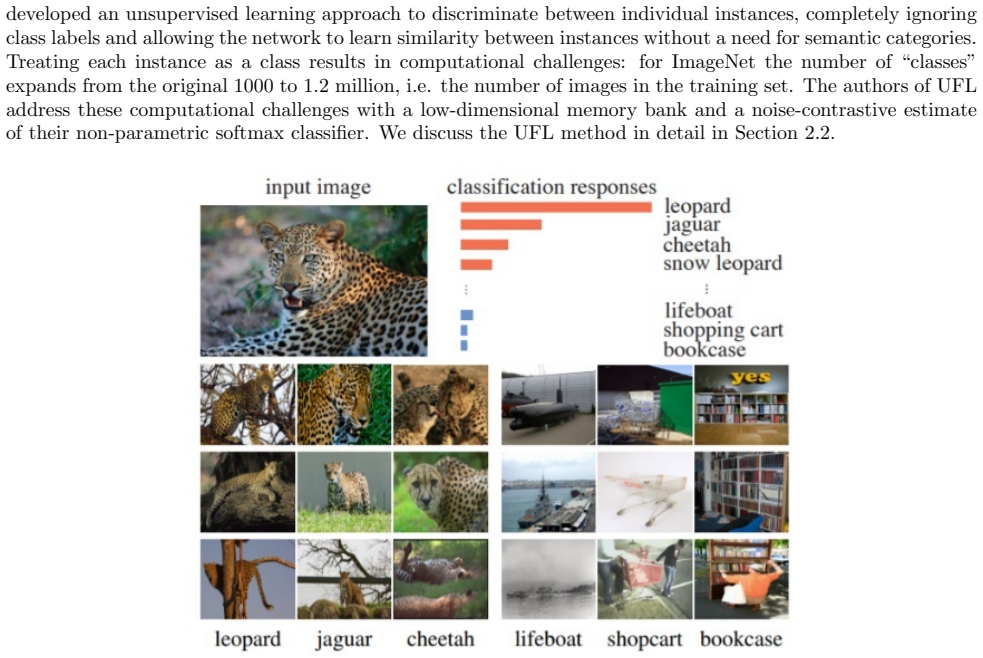
The central mechanism is non-parametric instance discrimination: each training image is treated as its own class, and the network is trained with a softmax over cosine similarities to all stored feature vectors on a 128-dimensional unit hypersphere. A memory bank stores previous feature vectors, and noise-contrastive estimation approximates the expensive softmax denominator, with temperature $\tau=0.07$ controlling concentration. This objective pushes visually similar instances together while spreading the embedding evenly over the sphere, which is what lets the same features serve classification, retrieval, outlier, and hierarchy tasks.
What would settle it
Compute human-judged retrieval precision@5 for all rare classes with fewer than 100 training chips; if mean precision over those classes is no better than a random baseline, the paper's claim that UFL generalizes to rare classes fails.
Extended reading notes
Core claim
The central claim is that Unsupervised Feature Learning via Non-Parametric Instance-level Discrimination, applied to xView imagery with all labels withheld, produces an embedding that adapts to four tasks: classification, visual similarity search, outlier detection, and automatic hierarchy learning. The strongest quantitative result is that after fine-tuning on xView, the unsupervised UFL classifier reaches 54.5% mean top-5 accuracy across all 60 classes, beating the fully supervised randomly initialized model's 50.5% despite using no labels during feature-extractor training. On low-shot classes such as Aircraft, UFL retrieval returns visually relevant neighbors, while a reconstruction autoencoder returns only background-color matches. The paper also shows the same model flags likely label errors and unusual instances, and that agglomerative clustering over its confusion matrix recovers a visual hierarchy where building types and maritime vessel types group together.
Load-bearing premise
The load-bearing premise is that after fine-tuning, the learned feature space places visually similar objects close together for every one of the 60 classes, including classes with only dozens of noisy examples.
Editorial extensions
If this is right
- Fine-tuned UFL reaches 54.5% mean top-5 accuracy across the 60 xView classes, about 8% relative above a fully supervised random-start model, so unsupervised representation learning can substitute for some supervised training in overhead imagery.
- On low-shot classes like Aircraft, which has only 73 training chips, nearest-neighbor retrieval returns visually relevant matches, whereas a reconstruction autoencoder returns only background-color matches.
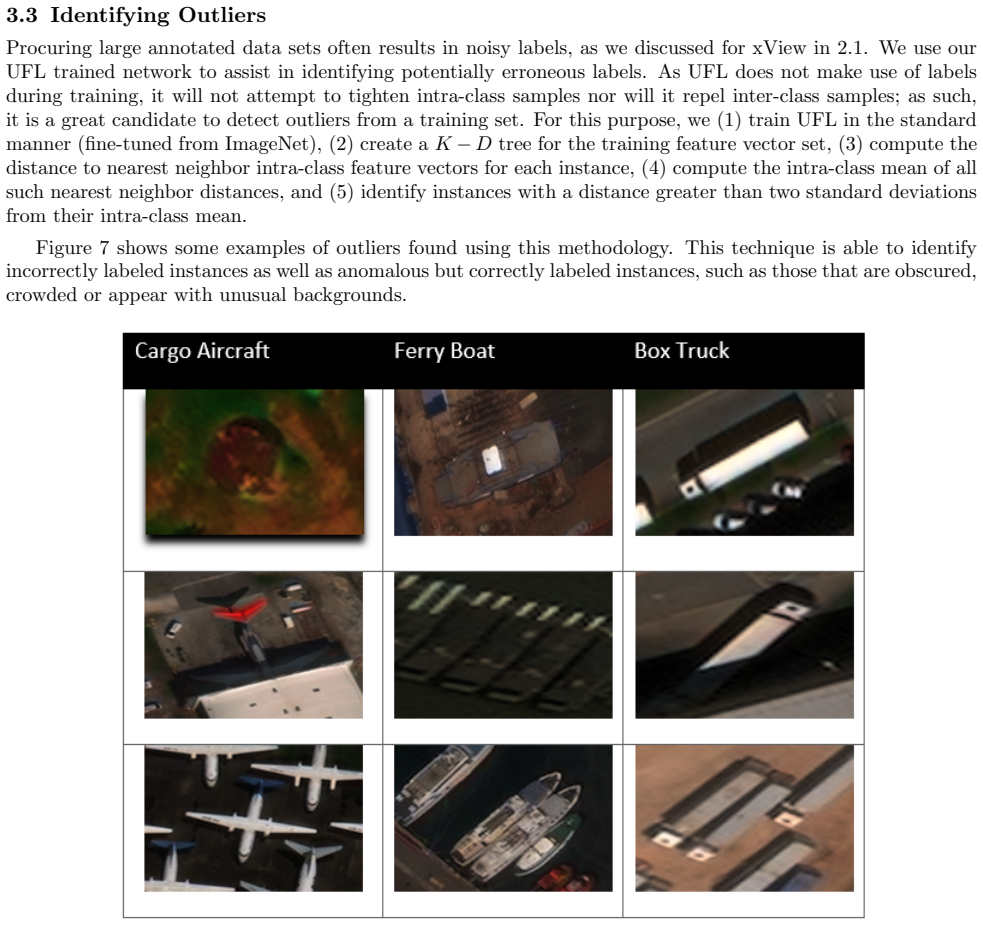
- Outlier scores computed inside the UFL embedding flag both mislabeled instances and unusual-but-correct examples, including obscured or crowded objects.
- Agglomerative clustering over UFL top-1 and top-5 confusion matrices produces a visual hierarchy that groups building types and maritime vessel types together.
- A ResNet50 backbone improves UFL top-5 accuracy to 55.2%, suggesting deeper backbones continue to help under the same architecture-agnostic recipe.
Reading between the lines
- If this transfer holds beyond xView, the same label-free pretraining recipe is a candidate for other overhead or oblique imagery domains with scarce labels; a direct test would be training UFL on a second satellite dataset and measuring retrieval precision.
- The outlier method implies a label-cleaning workflow: train once on noisy labels, prune flagged chips, and retrain on cleaned labels, but the paper does not test whether such cleaning actually improves downstream accuracy.
- Because similarity search, outlier detection, and hierarchy results are qualitative, a precision@k, outlier precision/recall, or dendrogram agreement metric would be needed to verify that the embedding's similarity is semantic for every class, especially Helicopter, where the single retrieval shown is incorrect.
Editorial analysis
A structured set of objections, weighed in public.
Referee Report
Summary. The paper applies the Unsupervised Feature Learning via Non-Parametric Instance-level Discrimination (UFL) method of Wu et al. to the xView remote sensing dataset, training a ResNet feature extractor without using xView labels and then evaluating it on classification, similarity search, outlier detection, and class hierarchy learning. Classification experiments use a weighted KNN classifier on a 128-dimensional embedding, report class-averaged top-1/top-5 accuracy, and compare against an autoencoder and a fully supervised model with random and ImageNet-pretrained initializations. The paper claims that fine-tuned UFL beats a randomly initialized fully supervised model by 8% top-5, despite having no labeled data during training, and provides qualitative demonstrations of the other three tasks.
Significance. If the claims were fully supported, the paper would demonstrate that an instance-discrimination objective applied to noisy, extremely imbalanced remote sensing data can yield embeddings useful for multiple tasks, including rare classes and label-noise detection. The paper has several strengths: class-averaged metrics are used to avoid dominance by the two largest classes; multiple baselines (autoencoder, supervised) and both random and ImageNet initializations are reported; the full class-by-class result table is provided in the appendix; and the UFL hyperparameters (tau, k) are taken directly from prior work rather than tuned on the paper's results. However, the central quantitative comparison is confounded by ImageNet supervision, and the non-classification tasks are supported only by qualitative examples. With the current evidence, the paper's significance is substantially weaker than its abstract and Section 3.1 claim.
major comments (3)
- The headline claim that fine-tuned UFL beats a fully supervised model by 8% top-5 'despite having no labeled data during training' is misleading because the UFL model is initialized from ImageNet weights trained with labels, while the 'Supervised Random Init' baseline is randomly initialized. The paper's own Table 2 shows that UFL Pre-trained, not Fine-tuned achieves 47.6 top-5, which is already close to the 54.5 of UFL Fine-tuned and above the 50.5 of Supervised Random Init; UFL from random initialization achieves only 28.9 top-5, far below the supervised random-init baseline. Thus most of the reported unsupervised advantage is inherited from supervised ImageNet pretraining, and the unsupervised fine-tuning on xView contributes only a modest increment. The appropriate matched comparison, UFL Fine-tuned vs. Supervised Fine-tuned with both ImageNet-pretrained, shows UFL at 54.5 vs. 65.6, a substantial deficit. The central claim that UFL provides a label-free feature extractor for remote sensing is therefore overstated and needs to be reframed with a matched baseline and a clear statement that the model uses ImageNet labels during its initialization phase.
- The claims that the UFL feature extractor adapts to similarity search, outlier detection, and hierarchy learning are supported only by qualitative examples and figures, with no quantitative evaluation. For similarity search (Section 3.2), only five example queries for four classes are shown, with no retrieval precision/recall, no comparison to a random or feature-baseline retriever, and no evaluation over the full test set. For outlier detection (Section 3.3), the method is described and a few example outliers are shown, but there is no ground truth of label errors or anomalous instances, no precision/recall, and no comparison against the supervised model or random features. For hierarchy learning (Section 3.4), the learned dendrograms are presented without any quantitative agreement with a reference hierarchy (e.g., the xView class taxonomy or WordNet) and may simply reflect the confusion structure of the classifier rather than a natural semantic hierarchy. These tasks are central to the paper's claim of generalization, and without metrics, the claim that the feature extractor 'adapts to several tasks' is not established.
- The abstract and introduction describe the method as 'unsupervised feature learning' and emphasize that no labeled data are needed, but the experiments actually use a model pre-trained on ImageNet with supervised labels. While Section 3.1 openly discloses that 'pre-training on ImageNet results in dramatic improvements,' the framing throughout the paper obscures that the resulting feature extractor is not trained without any labeled data. This is a load-bearing presentation issue because the paper's contribution is positioned as demonstrating the value of unsupervised learning, whereas the results mostly demonstrate the value of ImageNet transfer. The authors should either retrain UFL from random initialization with a clearly stated comparison, or explicitly reposition the contribution as studying whether unsupervised fine-tuning on a domain dataset improves a supervised pretrained representation, and adjust the title, abstract, and claims accordingly.
minor comments (5)
- Typographical errors: 'autencoder' should be 'autoencoder', 'affects' should be 'effects', and 'generelizability' in the discussion of ResNet50 should be 'generalizability'.
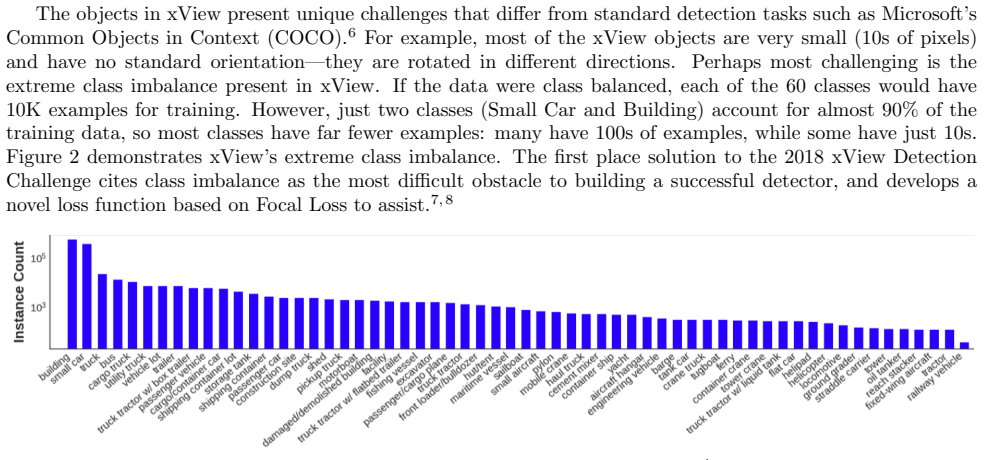
- The phrase 'almost 90% of the training data' for the combined Small Car and Building populations is consistent with Section 3.1's 88% figure, but the two statements should be harmonized for precision.
- Figures 1 and 3 are reproduced from Wu et al.; the paper should confirm that reproduction permission is obtained and that all reused figures are clearly credited in the captions.
- The reference to 'Universitat Polit` encia de Val` encia' contains a typo; it should be 'Universitat Politècnica de València'.
- The choice of k=50 for the weighted KNN classifier is stated but not justified or analyzed; a brief sensitivity check (e.g., varying k) would strengthen the robustness of the classification results.
Circularity Check
No significant circularity: the paper is a straightforward application of an externally developed unsupervised method; the main comparisons are potentially confounded by pretraining choices but are not self-referential.
full rationale
This paper does not exhibit circular reasoning. It applies an externally developed method, UFL from Wu et al. (Ref. 3), with hyperparameters (tau = 0.07, k = 50, memory-bank dimension 128, and the noise-contrastive approximations) taken unchanged from that prior work rather than fitted to this paper's own results. The classification protocol in Eqs. 2-4 trains on instance identity only and uses class labels solely for weighted voting over nearest neighbors at evaluation time, so the reported top-1/top-5 accuracies are genuine test-set measurements, not quantities defined in terms of fitted parameters. The similarity-search, outlier-detection, and hierarchy sections are post-hoc analyses of the trained embedding. In particular, the hierarchy in Section 3.4 is explicitly constructed by clustering the UFL classifier's confusion matrix; this makes it a model-dependent visualization rather than an independent validation, but the paper does not present it as an independent validation, so no prediction is reduced to its input by construction. The admitted limitations, such as the incorrectly labeled Railway Vehicle test set (Section 2.1), the decision not to use class-balanced sampling even though it improves UFL results (Section 3.1), and the purely qualitative evaluation of retrieval, outliers, and hierarchy, are evidence-quality or correctness concerns. Likewise, the prominent comparison between fine-tuned UFL and a randomly initialized supervised model is a baseline-fairness issue, not a circularity issue: the comparison may overstate the contribution of unsupervised learning on xView, but the measured score is not derived from the model's own assumptions. No load-bearing self-citation chain appears, and no equation in the paper reduces to another equation by construction. The finding is therefore no significant circularity, score 0.
Assumptions & free parameters
free parameters (4)
- temperature tau =
0.07
- number of neighbors k =
50
- feature dimension =
128
- learning rates =
0.03 (random init), 0.001 (fine-tune), decay 0.5 every two epochs
assumptions (4)
- domain assumption UFL objective and noise-contrastive estimation, as described in Wu et al. 2018, produce useful instance-level features.
- domain assumption Square image chips centered on xView bounding boxes are a sufficient training distribution.
- domain assumption Cosine similarity between L2-normalized feature vectors is an appropriate measure of visual similarity.
- domain assumption The xView bounding-box labels, despite acknowledged errors, are adequate for training the memory bank and evaluating the KNN classifier.
Cite this review
Pith. "Pith review of Unsupervised Feature Learning in Remote Sensing." pith.science (2026). https://pith.science/paper/QKRVJPCA
@misc{pith2026190802877,
  author       = {Pith},
  title        = {Pith review of: Unsupervised Feature Learning in Remote Sensing},
  year         = {2026},
  howpublished = {\url{https://pith.science/paper/QKRVJPCA}},
  note         = {Machine review of arXiv:1908.02877}
}
read the original abstract
The need for labeled data is among the most common and well-known practical obstacles to deploying deep learning algorithms to solve real-world problems. The current generation of learning algorithms requires a large volume of data labeled according to a static and pre-defined schema. Conversely, humans can quickly learn generalizations based on large quantities of unlabeled data, and turn these generalizations into classifications using spontaneous labels, often including labels not seen before. We apply a state-of-the-art unsupervised learning algorithm to the noisy and extremely imbalanced xView data set to train a feature extractor that adapts to several tasks: visual similarity search that performs well on both common and rare classes; identifying outliers within a labeled data set; and learning a natural class hierarchy automatically.
Figures

Figures from the paper (6 more)




Reference graph
Works this paper leans on
-
[1]
Imagenet classification with deep convolutional neural networks,
A. Krizhevsky, I. Sutskever, and G. E. Hinton, “Imagenet classification with deep convolutional neural networks,” in Proceedings of the 25th International Conference on Neural Information Processing Systems - Volume 1, NIPS’12, pp. 1097–1105, Curran Associates Inc., (USA), 2012
work page 2012
-
[2]
ImageNet: A large-scale hierarchical image database,
J. Deng, W. Dong, R. Socher, L.-J. Li, K. Li, and L. Fei-Fei, “ImageNet: A large-scale hierarchical image database,” in Proceedings of the IEEE Conference on Computer Vision and Pattern Recognition (CVPR) , 2009
work page 2009
-
[3]
Unsupervised feature learning via non-parametric instance dis- crimination,
Z. Wu, Y. Xiong, X. Y. Stella, and D. Lin, “Unsupervised feature learning via non-parametric instance dis- crimination,” in Proceedings of the IEEE Conference on Computer Vision and Pattern Recognition (CVPR), 2018
work page 2018
-
[4]
xView: Objects in context in overhead imagery,
D. Lam, R. Kuzma, K. McGee, S. Dooley, M. Laielli, M. Klaric, Y. Bulatov, and B. McCord, “xView: Objects in context in overhead imagery,” arXiv:1802.07856 , 2018
arXiv 2018
-
[5]
DIUx xView 2018 detection challenge
“DIUx xView 2018 detection challenge.” http://xviewdataset.org. Accessed: 2019-05-20
work page 2018
-
[6]
Microsoft COCO: Common objects in context,
T.-Y. Lin, M. Maire, S. Belongie, L. Bourdev, R. Girshick, J. Hays, P. Perona, D. Ramanan, C. L. Zitnick, and P. Dollr, “Microsoft COCO: Common objects in context,” in The European Conference on Computer Vision (ECCV), 2014
work page 2014
-
[7]
Reduced focal loss: 1st place solution to xview object detection in satellite imagery,
N. Sergievskiy and A. Ponamarev, “Reduced focal loss: 1st place solution to xview object detection in satellite imagery,” arXiv:1903.01347 , 2019
arXiv 1903
-
[8]
Focal loss for dense object detection,
T. Lin, P. Goyal, R. B. Girshick, K. He, and P. Doll´ ar, “Focal loss for dense object detection,” inThe IEEE International Conference on Computer Vision (ICCV) , October 2017
work page 2017
Show all 15 references
-
[9]
Non-contrastive estimation: A new estimation principle for unnormalized statistical models,
M. Gutman and A. Hyvarinen, “Non-contrastive estimation: A new estimation principle for unnormalized statistical models,” in International Conference on Artificial Intelligence , 2010
2010
-
[10]
Recent advance in content-based image retrieval: A literature survey,
W. Zhou, H. Li, and Q. Tian, “Recent advance in content-based image retrieval: A literature survey,” arXiv:1706.06064 , 2017
2017 arXiv
-
[11]
Bag-of-visual-words and spatial extensions for land-use classification,
Y. Yang and S. Newsam, “Bag-of-visual-words and spatial extensions for land-use classification,” in ACM SIGSPATIAL International Conference on Advances in Geographic Information Systems (ACM GIS), 2010
2010
-
[12]
UC Merced land use dataset
“UC Merced land use dataset.” http://weegee.vision.ucmerced.edu/datasets/landuse.html. Accessed: 2019- 05-20
2019
-
[13]
Visualizing data using t-SNE,
L. van der Maaten and G. Hinton, “Visualizing data using t-SNE,” Journal of Machine Learning Research9, pp. 2579–2605, 11 2008
2008
-
[14]
Fellbaum, WordNet: An Electronic Lexical Database , Bradford Books, 1998
C. Fellbaum, WordNet: An Electronic Lexical Database , Bradford Books, 1998
1998
-
[15]
Improving performance of multiclass classification by inducing class hierarchies,
D. Silva-Palacios, C. Ferri, and M. J. Ram´ ırez-Quintana, “Improving performance of multiclass classification by inducing class hierarchies,” Procedia Computer Science 108, pp. 1692–1701, 06 2017. APPENDIX A. UNSUPERVISED CLASSIFICATION RESULTS Table 3. Detailed results for Re...
2017
Reviewed August 14, 2026 · model on record in the stance chip above.
Discussion (0). Continue with ORCID to comment.