REVIEW 2 major objections 4 minor 60 references
Stochastic model of randomly end-linked polymer network micro-regions
T0 review · 2 major / 4 minor · reviewed 2026-08-14 · deepseek-v4-flash
Pith's one-line read This paper derives exact probability distributions for the numbers of free, dangling, and intact strands in a polymer network micro-region during end-linking gelation.
desk verdict A paper with a genuinely useful exact-distribution result whose central equation, as printed, fails normalization for α≠1 — likely a typo, but a load-bearing one. read the letter →
The pith
A machine-rendered reading of the paper's core claim, the machinery that carries it, and where it could break.
The reading
What carries the argument
The central object is the master equation for the probability that a micro-region contains $n_1$ dangling and $n_2$ intact strands. The quenched version is a one-way chain $s_0\to s_1\to s_2$ with rates $2(N_s-n_1-n_2)$ and $\alpha n_1$; it is solved by the generating function $G(z_0,z_1,t)$, whose first-order PDE is integrated by the method of characteristics to yield the multinomial solution above. The annealed version is a rearrangement chain $2s_1\rightleftharpoons s_0+s_2$ at fixed $m$; detailed balance on the rearrangement master equation gives the ratio between neighboring $n_2$ states and the closed-form equilibrium distribution. The combined equation is the superposition of the two chains and is solved numerically. Together these equations turn the question 'how many intact strands does this micro-region have?' from an average into a probability.
What would settle it
Run a kinetic Monte Carlo simulation in which each binding event requires a randomly chosen free end to meet a complementary free end at a rate proportional to the number of available partners, and compare the resulting configuration distribution with the paper's multinomial solution; a systematic deviation, such as a variance that peaks below $N_s/4$, would falsify the constant-rate assumption.
Extended reading notes
Core claim
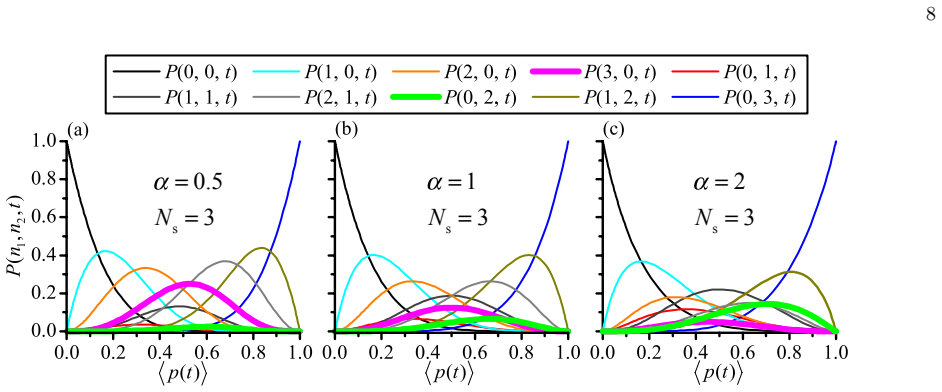
At the center of the paper is the claim that the full configuration distribution $P(n_1,n_2,t)$ for a micro-region of $N_s$ bifunctional strands can be derived exactly. For irreversible (quenched) binding, where each free end-group binds at a constant rate and a parameter $\alpha$ weights the second binding of an already dangling strand, the solution is the multinomial $$P(n_1,n_2,t)=\binom{N_s}{n_1,n_2} $e^{{-2t(N_s-n_1-n_2)}}$\left(\frac{2($e^{{-\alpha t}}$-$e^{{-2t}}$)}{2-\$\alpha$}\right)^{n_1}\left(\frac{1+\$\alpha$ $e^{{-2t}}$-$2e^{{-\alpha t}}$}{2-\$\alpha$}\right)^{n_2},$$ so the probability of every micro-region configuration is known at every time. For reversible (annealed) binding with a fixed number of bound end-groups, the steady state reduces to the combinatorial form $P^*(n_2)\propto (2/\alpha)^{m-2n_2}N_s!/[(m-2n_2)!\,n_2!(N_s-m+n_2)!]$, identical to the equilibrium counting formula. The paper further combines binding and rearrangement into one master equation whose fast-annealing limit reproduces the equilibrium distribution and whose quenched limit reproduces the multinomial.
Load-bearing premise
The load-bearing premise is that every free end-group binds at the same constant rate no matter how many other free end-groups are nearby, so binding events are effectively independent; if end-linking instead requires two free ends to collide, the exact distributions derived here would not describe the process.
Editorial extensions
If this is right
- Mean-field strand fractions are recovered exactly from the quenched solution with $\alpha=1$ at the time $t^*$ satisfying $\langle p(t^*)\rangle=1-e^{-t^*}$; outside that special case, average-only descriptions miss the spread.
- The variance of the number of intact strands reaches the universal maximum $N_s/4$, attained at a time independent of $\alpha$, so heterogeneity is largest at intermediate extents of reaction and shrinks as micro-regions grow.
- Quenched and annealed networks differ qualitatively: under fast annealing $\langle n_1\rangle$ is symmetric about $p=1/2$, while under quenched binding it is skewed, so a network formed by irreversible end-linking should not be modeled with equilibrium combinatorial formulas.
- From the full distribution one can compute the probability that a micro-region has at least $n_2^*$ intact strands, which the paper interprets as the probability that a network bond spans the micro-region, feeding percolation estimates of stiffening.
- The same state framework maps photodegradation onto reverse gelation: intact strands become free strands as ends cleave, so the distributions also describe network degradation and rigidity collapse.
Reading between the lines
- An extension the paper leaves implicit: because the quenched solution is a product of independent per-end-group survival factors, the same generating-function method should give exact joint distributions for strands with more than two reactive ends, though the state space grows combinatorially.
- A testable prediction outside the paper's simulations: if real end-linking requires two free ends to encounter each other, the observed configuration variance should fall below the $N_s/4$ peak (or shift in time) predicted here; single-molecule counting or super-resolution imaging could look for this.
- The reactivity parameter $\alpha$ acts like a chemical potential in the annealed distribution $\propto(2/\alpha)^{m-2n_2}\cdots$, so the model connects to exponential random graph and statistical-mechanics pictures of crosslinked networks; fitting $\alpha$ to measured configuration frequencies would extract cooperative binding strength.
- The paper applies the micro-region independence assumption only to percolation, but the same distributions could predict cell-to-cell variability in mechanical-sensing experiments, since cells respond to local modulus and mesh size.
Signed reviews
Editorial analysis
A structured set of objections, weighed in public.
Referee Report
Summary. The paper develops a stochastic master-equation model for the composition of micro-regions in randomly end-linked polymer networks built from Ns bifunctional strands. For irreversible (quenched) binding it derives a generating-function solution for the joint probability P(n0,n1,n2,t) of free, dangling, and intact strands, and for reversible (annealed) binding it constructs a rearrangement master equation whose steady state matches a combinatorial equilibrium distribution with a cooperativity parameter alpha. The authors also couple binding with rearrangement and provide explicit formulas for means, variances, and correlations. The central claim is that these exact finite-Ns distributions resolve micro-region heterogeneity beyond mean-field averages such as Eq. (1), with particular emphasis on intermediate extents of reaction and on the difference between quenched and annealed network formation.
Significance. If the printed errors in the exact solution are corrected, the paper provides a useful and nontrivial contribution: a closed-form time-dependent distribution for the quenched process, a detailed-balance steady state that coincides with the combinatorial weight Eq. (8), and explicit variance formulas including the parameter-independent maximum Var(n2)=Ns/4. The analytic derivations are largely transparent, and the consistency of the Appendix A moment formulas with the corrected generating-function coefficient is a real strength. The model also makes falsifiable predictions about how configuration fluctuations depend on Ns, alpha, and p, and the explicit contrast between quenched and annealed kinetics is practically relevant for hydrogel formation and degradation.
major comments (2)
- [§II.B.1, Eqs. (23)–(25)] The constant term in the generating function is incorrect as printed. The term (1+alpha e^{-2t}-2e^{-alpha t})/(2-alpha) does not vanish at t=0, so G(z0,z1,0)=[z0+(alpha-1)/(2-alpha)]^{Ns} rather than the required z0^{Ns}; consequently the total probability in Eq. (25) sums to (2-alpha)^{-Ns} for alpha≠1. For example, with alpha=0.5 and t=1 the printed coefficient is negative, so Eq. (25) assigns negative probabilities to configurations with odd n2. The correct coefficient is (2-alpha+alpha e^{-2t}-2e^{-alpha t})/(2-alpha) = 1 - e^{-2t} - 2(e^{-alpha t}-e^{-2t})/(2-alpha), which restores normalization and the initial condition. Because Eqs. (24) and (25) inherit this error, the exact quenched distribution and all quantities evaluated from it, including Figures 5 and 6, must be recomputed with the corrected coefficient; the Appendix A moment formulas are consistent with the corrected expression, indicating the error is local but load-bearing.
- [§II.B.1, Eqs. (16), (23)–(25)] The case alpha=2 is not handled. All of these formulas contain (2-alpha) in the denominator, and at alpha=2 the apparent 0/0 limits are not supplied even though alpha=2 is shown as an allowed parameter value in Figures 5(a–c) and 9(c). The authors should either state that alpha=2 is understood only as a limit and provide the limiting forms (for instance B=2te^{-2t} and C=1-(1+2t)e^{-2t} in the generating function), or explicitly exclude alpha=2 from the parameter range and adjust the discussion and figures accordingly.
minor comments (4)
- [§II.B.1, Eq. (30)] The displayed expansion of (Ns-n1-n2)^2 has incorrect signs: the terms should be -2Ns⟨n1⟩, -2Ns⟨n2⟩, and +2⟨n1 n2⟩. The printed expression is inconsistent with the correct result in Eq. (A11), even though the final variance in Eq. (A12) is correct.
- [§II.B.1, Eq. (11)] The assumption that each free end-group binds at a constant rate lambda regardless of the availability of complementary partners is stated, but its important consequence—that strands evolve independently and the solution is the trinomial distribution in Eq. (25)—is not discussed. A sentence clarifying the intended regime and noting that pairwise-encounter kinetics would require nonlinear rates would help readers assess the model's scope.
- [§II.B.3, Eq. (36)] The numerical solution used to produce Figure 8 is not described. The authors should state the integration scheme, time-step size or error tolerance, and the initial conditions used for the plotted curves so that the results can be reproduced.
- [General] Throughout the text, equations involving (2-alpha) denominators are written without noting the removable singularity at alpha=2; a short remark near Eq. (16) would prevent readers from applying these formulas at that parameter value.
Circularity Check
No significant circularity: the master equations are solved directly from stated rates and initial conditions; alpha is a free parameter, and the equilibrium match to the combinatoric distribution is a consistency check, not a fitted prediction.
full rationale
The derivation chain is self-contained. The quenched-binding model is defined by the master equation Eq 11 (equivalently Eq 13), with alpha and the binding rate as free model parameters. The generating-function PDE Eq 22 is solved under the stated initial condition G(z0,z1,0)=z0^Ns, producing the multinomial solution Eq 25, from which averages and variances (Eqs 16, 26-30, and Appendix A) are then computed; these are consequences of the stated dynamics, not fitted inputs. The rearrangement model Eq 31 is an independently specified rate model, and its detailed-balance steady state Eq 34 is explicitly noted to coincide with the earlier combinatoric distribution Eq 8; this is a consistency check between two formulations, not a reduction of the result to its own input. The combined model Eq 36 is treated numerically, as the paper explicitly notes that no full analytical time-dependent solution can be found; this is a stated limitation, not a circular step. No parameter is fitted to any target result, no uniqueness theorem is imported, and the self-citations [36-40] are methodological background rather than load-bearing evidence. The paper's main claimed advance is the exact time-dependent distribution for quenched binding, which does not depend on any prior result of the same authors.
Assumptions & free parameters
free parameters (2)
- alpha (reactivity/cooperative binding parameter) =
Not fitted; plotted for 0.5, 1, 2, etc.
- kappa (rearrangement rate ratio) =
0, 1, 1000 in figures
assumptions (5)
- domain assumption Micro-regions are statistically identical, independent, composed of a fixed number Ns of strands, with negligible boundary effects.
- domain assumption Each free end-group binds at constant rate lambda independent of the presence of other free end-groups (reservoir assumption).
- domain assumption Strands are homobifunctional with N equal to 2 end-groups; branchpoint functionality and network topology are not modeled.
- ad hoc to paper Rearrangement rates in Eq 31 are constructed to satisfy detailed balance with the combinatorial weights (2 divided by alpha) to the n1 power.
- domain assumption Extent of reaction p equal to m divided by 2Ns can be treated as a mean-field binding probability for any end-group.
Cite this review
Pith. "Pith review of Stochastic model of randomly end-linked polymer network micro-regions." pith.science (2026). https://pith.science/paper/AUT4IBWA
@misc{pith2026190802957,
  author       = {Pith},
  title        = {Pith review of: Stochastic model of randomly end-linked polymer network micro-regions},
  year         = {2026},
  howpublished = {\url{https://pith.science/paper/AUT4IBWA}},
  note         = {Machine review of arXiv:1908.02957}
}
read the original abstract
Polymerization and formation of crosslinked polymer networks are important processes in manufacturing, materials fabrication, and in the case of hydrated polymer networks, synthesis of biomedical materials, drug delivery, and tissue engineering. While considerable research has been devoted to the modeling of polymer networks to determine averaged, mean-field, global properties, there are fewer studies that specifically examine the variance of the composition across "micro-regions" (composed of a large, but finite, number of polymer network strands) within the larger polymer network.Here, we mathematically model the stochastic formation of polymer networks comprised of linear homobifunctional network strands that undergo an end-linking gelation process. We introduce a master equation that describes the evolution of the probabilities of possible network micro-region configurations as a function of time and extent of reaction. We specifically focus on the dynamics of network formation and the statistical variability of the gel micro-regions, particularly at intermediate extents of reaction. We also consider possible annealing effects and study how cooperative binding between the two end-groups on a single network-strand affects network formation. Our results allow for a more detailed and thorough understanding of polymer network dynamics and variability of network properties.
Figures


Figures from the paper (6 more)



Reference graph
Works this paper leans on
-
[1]
We also assume the binding rate λ of an end-group is constant
Quenched end-group binding The first case we consider is that of irreversible (or quenched) end-group binding, whereby once an end- group has bound, it will not detach. We also assume the binding rate λ of an end-group is constant. Under these conditions, the master equation for the probability distribution P (n1,n 2,t ) evolves according to dP (n1,n 2,t )...
-
[2]
Dynamic end-group rearrangement/redistribution We now consider an equilibration process that allows the bound end-groups in a micro-region to dynamically rearrange, attaching and detaching until thermodynamic equilibrium is reached[45] while maintaining a fixed to- tal number of m bound end-groups. We assume that m < 2Ns, (p < 1) so that the reaction is no...
-
[3]
End-group rearrangement/redistribution and bond formation We now consider the two processes of bond formation and redistribution occurring simultaneously and combine P(5,0,t) P(1,2,t) P(3,1,t) κ = 0κ >> 1(a) = 2 Ns = 5 m = 5 = 0.5 Ns = 5 m = 5 (b) FIG. 8. Configuration probabilities P (n1,n 2,t ) calculated from Equation 36 and plotted parametrically again...
-
[4]
This quantity can then be interpreted as the probability for a “bond” to stretch across a micro- region. One can then calculate the likelihood that a given number of contiguous micro-regions with n2≥ n∗ 2 span the sample through percolation, leading to a dramatic stiffening of the network. Finally, our work can also be applied to the study of 13 network de...
-
[5]
De Gennes, Scaling concepts in polymer physics (Cornell University Press, 1979)
P.-G. De Gennes, Scaling concepts in polymer physics (Cornell University Press, 1979)
work page 1979
-
[6]
P. J. Flory, Principles of polymer chemistry (Cornell Uni- versity Press, 1953)
1953
-
[7]
M. Rubinstein and R. H. Colby, Polymer Physics , June (Oxford University Press, New York, 2003)
work page 2003
-
[8]
N. A. Peppas, J. Z. Hilt, A. Khademhosseini, and R. Langer, Hydrogels in Biology and Medicine: From Molecular Principles to Bionanotechnology, Advanced Materials 18, 1345 (2006)
2006
Show all 60 references
-
[9]
Stauffer, A
D. Stauffer, A. Coniglio, and M. Adam, Gelation and critical phenomena, in Polymer Networks , edited by K. Duˇ sek (Springer Berlin Heidelberg, Berlin, Heidel- berg, 1982) pp. 103–158
1982
-
[10]
N. M. Sangeetha and U. Maitra, Supramolecular gels: Functions and uses, Chemical Society Reviews 34, 821 (2005)
2005
-
[11]
W. A. Laftah, S. Hashim, and A. N. Ibrahim, Polymer Hydrogels: A Review, Polymer-Plastics Technology and Engineering 50, 1475 (2011)
2011
-
[12]
P. C. Nicolson and J. Vogt, Soft contact lens polymers: an evolution, Biomaterials 22, 3273 (2001)
2001
-
[13]
Hild, Model networks based on ‘endlinking’ processes: synthesis, structure and properties, Progress in Polymer 15 Science 23, 1019 (1998)
G. Hild, Model networks based on ‘endlinking’ processes: synthesis, structure and properties, Progress in Polymer 15 Science 23, 1019 (1998)
1998
-
[14]
J. E. Mark and J. L. Sullivan, Model networks of endlinked polydimethylsiloxane chains. I. Comparisons between experimental and theoretical values of the elas- tic modulus and the equilibrium degree of swelling, The Journal of Chemical Physics 66, 1006 (1977)
1977
-
[15]
Lin and K
C.-C. Lin and K. S. Anseth, PEG Hydrogels for the Con- trolled Release of Biomolecules in Regenerative Medicine, Pharmaceutical Research 26, 631 (2009)
2009
-
[16]
J. L. STANFORD, R. F. T. STEPTO, and R. H. STILL, Formation and Properties of Polymer Networks, in Chemical & Engineering News , ACS Symposium Se- ries, Vol. 243, edited by S. S. Labana and R. A. Dickie (American Chemical Society, Washington, D.C., 1984) pp. 1–20
1984
-
[17]
Mespouille, J
L. Mespouille, J. L. Hedrick, and P. Dubois, Expanding the role of chemistry to produce new amphiphilic polymer (co)networks, Soft Matter 5, 4878 (2009)
2009
-
[18]
S. J. Buwalda, K. W. Boere, P. J. Dijkstra, J. Feijen, T. Vermonden, and W. E. Hennink, Hydrogels in a his- torical perspective: From simple networks to smart ma- terials, Journal of Controlled Release 190, 254 (2014)
2014
-
[19]
A. T. Metters, C. N. Bowman, and K. S. Anseth, A Statistical Kinetic Model for the Bulk Degradation of PLA- b -PEG- b -PLA Hydrogel Networks, The Journal of Physical Chemistry B 104, 7043 (2000)
2000
-
[20]
A. E. Tonelli and E. Helfand, Elastically Ineffective Cross-Links in Rubbers, Macromolecules 7, 59 (1974)
1974
-
[21]
Y. Gu, J. Zhao, and J. A. Johnson, A (Macro)Molecular- Level Understanding of Polymer Network Topology, Trends in Chemistry 1, 318 (2019)
2019
-
[22]
Seiffert, Origin of nanostructural inhomogeneity in polymer-network gels, Polymer Chemistry 8, 4472 (2017)
S. Seiffert, Origin of nanostructural inhomogeneity in polymer-network gels, Polymer Chemistry 8, 4472 (2017)
2017
-
[23]
Bastide and L
J. Bastide and L. Leibler, Large-scale heterogeneities in randomly cross-linked networks, Macromolecules 21, 2647 (1988)
1988
-
[24]
Ikkai and M
F. Ikkai and M. Shibayama, Inhomogeneity control in polymer gels, Journal of Polymer Science Part B: Poly- mer Physics 43, 617 (2005)
2005
-
[25]
M. A. Bibbo and E. M. Valles, Calculation of average properties of the pendant chains in a network, Macro- molecules 15, 1293 (1982)
1982
-
[26]
Duˇ sek, M
K. Duˇ sek, M. Duˇ skov´ a-Smrˇ ckov´ a, J. J. Fedderly, G. F. Lee, J. D. Lee, and B. Hartmann, Polyurethane networks with controlled architecture of dangling chains, Macro- molecular Chemistry and Physics 203, 1936 (2002)
2002
-
[27]
J. L. Stanford and R. F. T. Stepto, Rate theory of irre- versible linear random polymrisation. Part 1.Basic the- ory, Journal of the Chemical Society, Faraday Transac- tions 1: Physical Chemistry in Condensed Phases 71, 1292 (1975)
1975
-
[28]
J. L. Stanford, R. F. T. Stepto, and D. R. Waywell, Rate theory of irreversible linear random polymerisation. Part 2.Application to intramolecular reaction in AA + BB type polymerisations, Journal of the Chemical Soci- ety, Faraday Transactions 1: Physical Chemistry in Con- de...
1975
-
[29]
Ahmad and R
Z. Ahmad and R. F. T. Stepto, Approximate theories of gelation, Colloid and Polymer Science 258, 663 (1980)
1980
-
[30]
Schamboeck, P
V. Schamboeck, P. D. Iedema, and I. Kryven, Dynamic Networks that Drive the Process of Irreversible Step- Growth Polymerization, Scientific Reports 9, 1 (2019)
2019
-
[31]
R. Wang, A. Alexander-Katz, J. A. Johnson, and B. D. Olsen, Universal Cyclic Topology in Polymer Networks, Physical Review Letters 116, 188302 (2016)
2016
-
[32]
T.-S. Lin, R. Wang, J. A. Johnson, and B. D. Olsen, Topological Structure of Networks Formed from Sym- metric Four-Arm Precursors, Macromolecules 51, 1224 (2018)
2018
-
[33]
Kroll and S
D. Kroll and S. Croll, Heterogeneity in polymer net- works formed by a single copolymerization reaction: II. Post-gelation structure and pendants, Polymer 116, 113 (2017)
2017
-
[34]
Kroll and S
D. Kroll and S. Croll, Influence of crosslinking function- ality, temperature and conversion on heterogeneities in polymer networks, Polymer 79, 82 (2015)
2015
-
[35]
Balabanyan, E
A. Balabanyan, E. Kramarenko, I. Ronova, and A. Khokhlov, Monte Carlo study of structure and kinet- ics of formation of end-linked polymer networks, Polymer 46, 4248 (2005)
2005
-
[36]
Gilra, C
N. Gilra, C. Cohen, and A. Z. Panagiotopoulos, A Monte Carlo study of the structural properties of end-linked polymer networks, The Journal of Chemical Physics112, 6910 (2000)
2000
-
[37]
Leung and B
Y. Leung and B. E. Eichinger, Computer simulation of endlinked elastomers. II. Bulk cured tetrafunctional net- works, The Journal of Chemical Physics 80, 3885 (1984)
1984
-
[38]
Leung and B
Y. Leung and B. E. Eichinger, Computer simulation of endlinked elastomers. I. Trifunctional networks cured in the bulk, The Journal of Chemical Physics 80, 3877 (1984)
1984
-
[39]
Hosono, Y
N. Hosono, Y. Masubuchi, H. Furukawa, and T. Watan- abe, A molecular dynamics simulation study on polymer networks of end-linked flexible or rigid chains, The Jour- nal of Chemical Physics 127, 164905 (2007)
2007
-
[40]
Chou and M
T. Chou and M. R. D’Orsogna, Coarsening and acceler- ated equilibration in mass-conserving heterogeneous nu- cleation, Physical Review E 84, 011608 (2011)
2011
-
[41]
M. R. D’Orsogna, G. Lakatos, and T. Chou, Stochastic self-assembly of incommensurate clusters, The Journal of Chemical Physics 136, 084110 (2012)
2012
-
[42]
Yvinec, M
R. Yvinec, M. R. D’Orsogna, and T. Chou, First pas- sage times in homogeneous nucleation and self-assembly, The Journal of Chemical Physics 137, 244107 (2012), arXiv:1211.1093
2012 arXiv
-
[43]
M. R. D’Orsogna, B. Zhao, B. Berenji, and T. Chou, Combinatoric analysis of heterogeneous stochastic self- assembly, The Journal of Chemical Physics 139, 121918 (2013)
2013
-
[44]
J. K. Davis and S. S. Sindi, A mathematical model of the dynamics of prion aggregates with chaperone-mediated fragmentation, Journal of Mathematical Biology72, 1555 (2016)
2016
-
[45]
D. R. Miller and C. W. Macosko, A New Derivation of Post Gel Properties of Network Polymers, Macro- molecules 9, 206 (1976)
1976
-
[46]
C. W. Macosko and D. R. Miller, A New Derivation of Average Molecular Weights of Nonlinear Polymers, Macromolecules 9, 199 (1976)
1976
-
[47]
M. W. Tibbitt, A. M. Kloxin, and K. S. Anseth, Modeling controlled photodegradation in optically thick hydrogels, Journal of Polymer Science Part A: Polymer Chemistry 51, 1899 (2013)
2013
-
[48]
S. C. P. Norris, T. Chou, and A. M. Kasko, Diffu- sion of Photoabsorbing Degradation Byproducts in Pho- todegradable Polymer Networks, Macromolecular The- 16 ory and Simulations 26, 1700007 (2017)
2017
-
[49]
C. N. Bowman and C. J. Kloxin, Covalent Adaptable Networks: Reversible Bond Structures Incorporated in Polymer Networks, Angewandte Chemie International Edition 51, 4272 (2012)
2012
-
[50]
M. C. Roberts, M. C. Hanson, A. P. Massey, E. A. Karren, and P. F. Kiser, Dynamically Restructuring Hydrogel Networks Formed with Reversible Covalent Crosslinks, Advanced Materials 19, 2503 (2007)
2007
-
[51]
B. Yang, Y. Zhang, X. Zhang, L. Tao, S. Li, and Y. Wei, Facilely prepared inexpensive and biocompatible self- healing hydrogel: a new injectable cell therapy carrier, Polymer Chemistry 3, 3235 (2012)
2012
-
[52]
C. B. Rodell, R. J. Wade, B. P. Purcell, N. N. Dusaj, and J. a. Burdick, Selective Proteolytic Degradation of GuestHost Assembled, Injectable Hyaluronic Acid Hy- drogels, ACS Biomaterials Science & Engineering 1, 277 (2015)
2015
-
[53]
C. Yang, F. W. DelRio, H. Ma, A. R. Killaars, L. P. Basta, K. A. Kyburz, and K. S. Anseth, Spatially pat- terned matrix elasticity directs stem cell fate, Proceed- ings of the National Academy of Sciences 113, E4439 (2016)
2016
-
[54]
Li and A
C. Li and A. Strachan, Free volume evolution in the pro- cess of epoxy curing and its effect on mechanical proper- ties, Polymer 97, 456 (2016)
2016
-
[55]
D. R. Griffin and A. M. Kasko, Photodegradable Macromers and Hydrogels for Live Cell Encapsulation and Release, Journal of the American Chemical Society 134, 13103 (2012)
2012
-
[56]
C. Xue, D. Y. Wong, and A. M. Kasko, Complex Dy- namic Substrate Control: Dual-Tone Hydrogel Photore- sists Allow Double-Dissociation of Topography and Mod- ulus, Advanced Materials 26, 1577 (2014)
2014
-
[57]
K¨ apyl¨ a, S
E. K¨ apyl¨ a, S. M. Delgado, and A. M. Kasko, Shape- Changing Photodegradable Hydrogels for Dynamic 3D Cell Culture, ACS Applied Materials & Interfaces 8, 17885 (2016)
2016
-
[58]
S. C. P. Norris, S. M. Delgado, and A. M. Kasko, Me- chanically robust photodegradable gelatin hydrogels for 3D cell culture and in situ mechanical modification, Poly- mer Chemistry 10, 3180 (2019)
2019
-
[59]
D. Y. Wong, D. R. Griffin, J. Reed, and A. M. Kasko, Photodegradable Hydrogels to Generate Positive and Negative Features over Multiple Length Scales, Macro- molecules 43, 2824 (2010)
2010
-
[60]
S. C. P. Norris, P. Tseng, and A. M. Kasko, Direct Gradi- ent Photolithography of Photodegradable Hydrogels with Patterned Stiffness Control with Submicrometer Resolu- tion, ACS Biomaterials Science & Engineering 2, 1309 (2016)
2016
Reviewed August 14, 2026 · model on record in the stance chip above.
Discussion (0). Continue with ORCID to comment.