REVIEW 3 major objections 6 minor 75 references
Manifold Modeling in Embedded Space: A Perspective for Interpreting Deep Image Prior
T0 review · 3 major / 6 minor · reviewed 2026-08-14 · deepseek-v4-flash
Pith's one-line read Splitting convolution into embedding plus transformation yields a simple network that matches deep image prior, supporting the view that DIP works by enforcing a low-dimensional patch-manifold prior.
desk verdict A simple Hankelization-plus-autoencoder model matches DIP on four restoration tasks, and the claim that DIP is a low-dimensional patch-manifold prior is plausible but not proven—the authors mostly say so themselves. read the letter →
The pith
A machine-rendered reading of the paper's core claim, the machinery that carries it, and where it could break.
The reading
What carries the argument
The load-bearing mechanism is the multiway delay-embedding transform (Hankelization) sandwiched around a denoising auto-encoder. The transform $\mathcal{H}$ slides a window of size $\tau$ over the tensor, arranging all overlapping patches as columns of a matrix; the auto-encoder, with encoder $\phi_r: \mathbb{R}^D \to \mathbb{R}^r$ and decoder $\psi_r$, maps those columns into an $r$-dimensional patch manifold; the pseudo-inverse $\mathcal{H}^\dagger$ folds the auto-encoded columns back into an image. The objective combines a reconstruction loss $\|Y - F(\mathcal{H}^\dagger A_r \mathcal{H}(Z))\|_F^2$ with an auto-encoding loss $\|\mathcal{H}(Z) - A_r \mathcal{H}(Z)\|_F^2$, trained with additive noise. This structure is what enforces the low-dimensional patch-manifold prior and produces the impedance-like behavior.
What would settle it
Take a natural image and a version with identical patch statistics but randomly reordered patch positions, then optimize both DIP and MMES while recording mean squared error over time. The paper's account predicts both methods will show the same ordering of convergence rates because both are governed by the patch manifold, whereas a spatial-locality account predicts DIP resists the shuffled image much more than MMES; that divergence would falsify the interpretation.
Extended reading notes
Core claim
On the paper's own terms, the discovery is that the successful behavior of DIP does not depend on deep convolutional filters: replacing every convolution by the combination of a Hankelization (delay-embedding) step, an auto-encoder that compresses each patch to r dimensions, and the pseudo-inverse embedding yields comparable or better restorations on color-image completion up to 99% missing pixels, 3D MRI completion, ×4 and ×8 super-resolution, deconvolution, and denoising. The same noise impedance phenomenon—natural images optimize fastest, noisy images slower, shuffled and uniform patterns slowest—appears in MMES. The proposed interpretation is that DIP is a low-dimensional patch-manifold prior: convolutional layers constrain every local patch to lie near a low-dimensional manifold, and the kernel size and filter count correspond to the window size τ and latent dimension r in MMES.
Load-bearing premise
The interpretation stands on the assumption that the low-dimensional patch structure learned by the auto-encoder from the corrupted image is the same prior that makes DIP's convolutional network effective; if the resemblance comes instead from a shared tendency to fit smooth or repetitive content first, the paper's explanation of DIP does not follow.
Editorial extensions
If this is right
- MMES reaches DIP-level quality on completion, super-resolution, deconvolution, and denoising, so the convolutional structure of DIP is not the sole source of its image prior.
- Because MMES also exhibits noise impedance, the paper's explanation of impedance transfers: a denoising auto-encoder maps noisy patches toward higher-density regions on the patch manifold, pulling reconstructions away from noise.
- DIP's architecture can be described in plain terms: local patch statistics are confined to a low-dimensional manifold, with kernel size and filter count playing the roles of window size τ and latent dimension r.
- MMES is computationally lighter than DIP on 3D data in the reported experiments, making it a practical surrogate for unsupervised restoration when GPU memory or time is limited.
- Patch size becomes a central hyperparameter: too large a window creates too many patch variations, while too small a window loses the self-similarity information needed for heavily corrupted inputs.
Reading between the lines
- If the paper is right, the large literature on denoising auto-encoders—training noise as Tikhonov regularization, entropy reduction, and mapping toward high-density regions—becomes a quantitative toolkit for predicting when DIP will succeed or fail.
- If the paper is right, behaviors that DIP and MMES share cannot be attributed to spatially extended convolutional kernels, since MMES uses only pointwise transforms after embedding; remaining differences would isolate what genuine convolution adds.
- If the paper is right, a natural extension is to swap the denoising auto-encoder for PCA, a variational auto-encoder, or an adversarial auto-encoder; if DIP-like behavior persists only with denoising training, that would pin the prior on the noise-reconstruction objective rather than on manifold dimensionality alone.
Signed reviews
Editorial analysis
A structured set of objections, weighed in public.
Referee Report
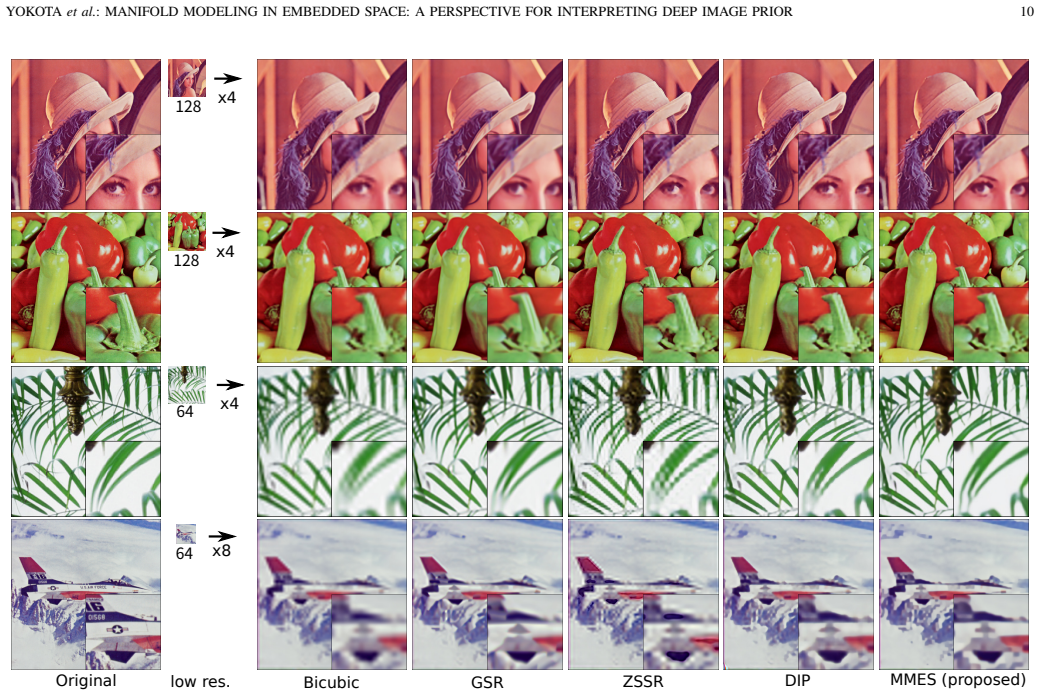
Summary. The paper proposes Manifold Modeling in Embedded Space (MMES), an unsupervised image/tensor restoration model that replaces convolution with a multiway delay-embedding (Hankelization) step, a nonlinear encoder-decoder autoencoder, and the pseudo-inverse embedding (Eqs. (5)-(8)). The authors frame this as a minimal translation of the convolutional generator used in Deep Image Prior (DIP), with patch size tau and latent dimension r playing the roles of kernel size and filter size. They report experiments across tensor completion, super-resolution, deconvolution, and denoising, showing that MMES produces results 'quite similar even competitive to DIP', and they interpret the similarity as evidence that DIP's implicit prior is a low-dimensional patch-manifold prior. The paper also reproduces DIP's 'noise impedance' phenomenon with MMES in a toy experiment.
Significance. If the central claim were established, this would be a valuable conceptual contribution: it would translate the opaque CNN prior of DIP into a checkable classical image-modeling vocabulary, namely low-dimensional patch manifolds, and it would connect DIP to dynamical-systems delay embedding and self-similarity. The paper's empirical body is a genuine strength: MMES is simple and precisely described, and the four-task comparison with numerous baselines is unusually broad for an interpretability paper. The toy manifold visualization and the noise-impedance comparison are nice illustrations. However, the evidence supports only a sufficiency statement, not the necessity/causal claim made in the title and abstract, and the comparison protocol is not fully symmetric. With the causal gap addressed or the claim appropriately weakened, the paper would be a solid empirical contribution.
major comments (3)
- [Abstract; Section V.B] The central interpretive claim that DIP's success is explained by an implicit low-dimensional patch-manifold prior is not secured by the evidence. What the experiments show is a sufficiency result: MMES, which explicitly imposes this prior through Eq. (5) and Eq. (8), produces restoration results and noise-impedance curves similar to DIP. This does not establish that the manifold constraint is the operative mechanism in DIP, because other priors favoring smooth or low-frequency content could produce the same behavioral signature. The manuscript never varies the manifold constraint independently (for example by changing r or tau while holding the rest of the model fixed and measuring whether DIP's behavior tracks the change), nor does it test whether DIP's internal patch representations lie near the learned manifold. The authors' own language in Section V.B, using 'prospect', 'rough explanation', and 'we believe', is more cautious than the title and abstract, and the claim should either be supported by such a causal or diagnostic experiment or explicitly downgraded to a conjecture.
- [Section IV.D.1 and Table I] The empirical claim that MMES is 'quite similar even competitive to DIP' is weakened by an asymmetric comparison protocol. MMES hyperparameters (tau, r) are tuned per image and per missing rate for best PSNR/SSIM (Table I), while DIP is run only with the default architecture and no search over kernel sizes, filter sizes, or depth. Conversely, DIP is given oracle early stopping, with the best iteration chosen by PSNR, while MMES is stopped at a fixed 20,000 iterations in the completion task. These asymmetries cut in different directions and make the aggregate curves in Fig. 16 difficult to interpret as a head-to-head test. Please either standardize the protocols, by giving both methods comparable per-image tuning or fixed hyperparameters, or present the comparison as illustrative rather than as evidence of competitiveness.
- [Section IV.D.2] The 3D MRI comparison is also affected by a capacity mismatch: the authors state that DIP's 3D filter counts were 'slightly reduced' because of GPU memory, and they attribute part of DIP's degradation to this. Since this experiment is used to claim that MMES outperforms DIP at low missing rates, the result should either be repeated with matched capacity and comparable computational cost or explicitly labeled as preliminary. As written, the sentence 'the proposed MMES outperformed DIP in low-rate missing cases' overstates what the experiment can support.
minor comments (6)
- [Table I] The entry 'saiboat' appears to be a typo and should read 'sailboat'.
- [Fig. 12] The hyperparameter sensitivity discussion refers only to visual quality; reporting PSNR/SSIM for each (r, sigma) and (tau, r) cell would make the claims about appropriate parameter ranges quantitatively checkable.
- [Algorithm 1] The stopping criterion 'until converge' is not defined; please specify a concrete termination condition, such as a maximum iteration count or a tolerance on the loss change.
- [Section II] There is a typo: 'point could' should be 'point cloud'; in addition, the sentence 'the MMES is originally/essentially has only decoder' is grammatically awkward and should be rewritten.
- [Section IV.D.4] The deconvolution comparison is reported only as per-image PSNR/SSIM values in Fig. 20; please include average values over the nine cases to support the statement that the methods are similar 'qualitatively and quantitatively'.
- [Footnotes] Several footnotes contain hard line breaks inside URLs (e.g., footnotes 7 and 8); please repair the line breaks so the links are readable.
Circularity Check
No significant circularity: MMES is independently constructed, and the paper explicitly frames the DIP interpretation as a prospective explanation rather than a derivation.
full rationale
The derivation chain is self-contained. Equations (1)-(8) construct MMES from an explicit low-dimensional patch-manifold assumption: multi-way delay embedding H, a denoising auto-encoder A_r defining the manifold, and reconstruction through H† A_r H(Z). This is a genuine model, not a restatement of DIP. The paper's central claim is an empirical-interpretive one: MMES, which explicitly imposes the patch-manifold prior, produces restoration quality and noise-impedance behavior similar to DIP, and this similarity 'would help us for reinterpreting/characterizing the DIP' (abstract). The paper itself marks the explanation as tentative: Section V.B calls it 'a prospect' and 'our rough explanation,' and Section VI says 'we believe' it gives insight. No equation in the paper reduces DIP's output or optimization behavior to MMES by construction; DIP is an external baseline (Ulyanov et al.) that is simulated but not derived from the MMES equations. The only self-citation used structurally, Yokota et al. [66] for the multiway-delay embedding transform, is not load-bearing because the transform is fully defined in Eqs. (2)-(4) of this paper and can be checked independently. The skeptical concern that the low-dimensional patch-manifold constraint is never isolated as the causal mechanism inside DIP is a limitation of evidence for an interpretive hypothesis, not a circular reduction. Accordingly, no fitted parameter is relabeled as a prediction and no claimed result is equivalent to its inputs by definition.
Assumptions & free parameters
free parameters (5)
- tau (patch size) =
varies per task and image, e.g., (6,6) to (16,16) for completion (Table I), (4,4,4) for MRI, 6 for super-resolution…
- r (latent dimension of autoencoder) =
varies per task and image, e.g., 1, 4, 8, 16, 32, 48, 64 in Table I and Fig.
- sigma (noise std for denoising autoencoder) =
0.05 in completion, MRI, and denoising; 0.1 in super-resolution; 0.01 in deconvolution
- lambda (trade-off parameter) =
initialized to 5.0, then adapted multiplicatively (1.1 or 0.99) based on Lrec < LAE
- AE architecture (hidden layer sizes) =
[8*tau^2, r, 8*tau^2] for super-resolution and denoising; [32*tau^2, r, 32*tau^2] for deconvolution; Fig.
assumptions (4)
- standard math The pseudo-inverse H-dagger satisfies H-dagger(H) is the identity on the image space (Eq. 4).
- domain assumption Natural image patches lie on a low-dimensional manifold in patch space.
- domain assumption A denoising autoencoder trained on corrupted patches maps inputs toward higher-density regions of the data distribution.
- ad hoc to paper The low-dimensional patch-manifold constraint is equivalent, in essence, to the implicit prior of DIP's convolutional architecture.
Cite this review
Pith. "Pith review of Manifold Modeling in Embedded Space: A Perspective for Interpreting Deep Image Prior." pith.science (2026). https://pith.science/paper/LKPCGUAZ
@misc{pith2026190802995,
  author       = {Pith},
  title        = {Pith review of: Manifold Modeling in Embedded Space: A Perspective for Interpreting Deep Image Prior},
  year         = {2026},
  howpublished = {\url{https://pith.science/paper/LKPCGUAZ}},
  note         = {Machine review of arXiv:1908.02995}
}
read the original abstract
Deep image prior (DIP), which utilizes a deep convolutional network (ConvNet) structure itself as an image prior, has attracted attentions in computer vision and machine learning communities. It empirically shows the effectiveness of ConvNet structure for various image restoration applications. However, why the DIP works so well is still unknown, and why convolution operation is useful for image reconstruction or enhancement is not very clear. In this study, we tackle these questions. The proposed approach is dividing the convolution into ``delay-embedding'' and ``transformation (\ie encoder-decoder)'', and proposing a simple, but essential, image/tensor modeling method which is closely related to dynamical systems and self-similarity. The proposed method named as manifold modeling in embedded space (MMES) is implemented by using a novel denoising-auto-encoder in combination with multi-way delay-embedding transform. In spite of its simplicity, the image/tensor completion, super-resolution, deconvolution, and denoising results of MMES are quite similar even competitive to DIP in our extensive experiments, and these results would help us for reinterpreting/characterizing the DIP from a perspective of ``low-dimensional patch-manifold prior''.
Figures


Figures from the paper (15 more)




Reference graph
Works this paper leans on
-
[1]
G. Alain and Y . Bengio. What regularized auto-encoders learn from the data-generating distribution. The Journal of Machine Learning Research, 15(1):3563–3593, 2014. 12
work page 2014
-
[2]
J. Batson and L. Royer. Noise2self: Blind denoising by self-supervision. In Proceedings of ICML , pages 524–533, 2019. 3
work page 2019
-
[3]
C. M. Bishop. Training with noise is equivalent to Tikhonov regular- ization. Neural Computation, 7(1):108–116, 1995. 5
work page 1995
- [4]
-
[5]
S. Cha, T. Park, and T. Moon. Gan2gan: Generative noise learning for blind image denoising with single noisy images. arXiv preprint arXiv:1905.10488, 2019. 3
arXiv 1905
-
[6]
A. Cichocki, R. Zdunek, A. H. Phan, and S.-i. Amari. Nonnegative Matrix and Tensor Factorizations: Applications to Exploratory Multi- way Data Analysis and Blind Source Separation . John Wiley & Sons,
-
[7]
A. Creswell and A. A. Bharath. Denoising adversarial autoen- coders. IEEE Transactions on Neural Networks and Learning Systems , 30(4):968–984, 2018. 5
work page 2018
- [8]
Show all 75 references
-
[9]
Dabov, A
K. Dabov, A. Foi, V . Katkovnik, and K. Egiazarian. Image denoising by sparse 3-d transform-domain collaborative filtering. IEEE Transactions on Image Processing , 16(8), 2007. 1, 6, 7
2007
-
[10]
M. W. Diederik P Kingma. Auto-encoding variational bayes. In Proceedings of ICLR , 2014. 5
2014
-
[11]
T. Ding, M. Sznaier, and O. I. Camps. A rank minimization approach to video inpainting. In Proceedings of ICCV , pages 1–8. IEEE, 2007. 12
2007
-
[12]
Elad and M
M. Elad and M. Aharon. Image denoising via learned dictionaries and sparse representation. In Proceedings of CVPR , volume 1, pages 895–
-
[13]
Elad and M
M. Elad and M. Aharon. Image denoising via sparse and redundant representations over learned dictionaries. IEEE Transactions on Image processing, 15(12):3736–3745, 2006. 11
2006
-
[14]
Gal and Z
Y . Gal and Z. Ghahramani. Dropout as a bayesian approximation: Representing model uncertainty in deep learning. In Proceedings of ICML, pages 1050–1059, 2016. 5
2016
-
[15]
Gandelsman, A
Y . Gandelsman, A. Shocher, and M. Irani. ”double-dip”: Unsupervised image decomposition via coupled deep-image-priors. In Proceedings of CVPR, June 2019. 12
2019
-
[16]
K. Gong, C. Catana, J. Qi, and Q. Li. PET image reconstruction using deep image prior. IEEE Transactions on Medical Imaging , 2018. 12
2018
-
[17]
Goodfellow, Y
I. Goodfellow, Y . Bengio, and A. Courville. Deep Learning. MIT press,
-
[18]
W. E. L. Grimson. From Images to Surfaces: A Computational Study of the Human Early Visual System . MIT Press, 1981. 1
1981
-
[19]
S. Gu, L. Zhang, W. Zuo, and X. Feng. Weighted nuclear norm minimization with application to image denoising. In Proceedings of CVPR, pages 2862–2869, 2014. 6, 7
2014
-
[20]
Guichard and F
F. Guichard and F. Malgouyres. Total variation based interpolation. In Proceedings of EUSIPCO , pages 1–4. IEEE, 1998. 1
1998
-
[21]
Heckel and P
R. Heckel and P. Hand. Deep decoder: Concise image represen- tations from untrained non-convolutional networks. arXiv preprint arXiv:1810.03982, 2018. 3
2018 arXiv
-
[22]
G. E. Hinton and R. R. Salakhutdinov. Reducing the dimensionality of data with neural networks. Science, 313(5786):504–507, 2006. 4
2006
-
[23]
F. L. Hitchcock. The expression of a tensor or a polyadic as a sum of products. Journal of Mathematics and Physics , 6(1):164–189, 1927. 1
1927
-
[24]
Hotelling
H. Hotelling. Analysis of a complex of statistical variables into principal components. Journal of Educational Psychology , 24(6):417, 1933. 1
1933
-
[25]
W. Hu, D. Tao, W. Zhang, Y . Xie, and Y . Yang. The twist tensor nuclear norm for video completion. IEEE Transactions on Neural Networks and Learning Systems, 28(12):2961–2973, 2016. 1
2016
-
[26]
Hyvarinen, J
A. Hyvarinen, J. Karhunen, and E. Oja. Independent Component Analysis, volume 46. John Wiley & Sons, 2004. 1
2004
-
[27]
H. Ji, C. Liu, Z. Shen, and Y . Xu. Robust video denoising using low rank matrix completion. In Proceedings of CVPR , pages 1791–1798. IEEE, 2010. 1
2010
-
[28]
D. P. Kingma and J. Ba. Adam: A method for stochastic optimization. arXiv preprint arXiv:1412.6980 , 2014. 5
2014 arXiv
-
[29]
Krull, T.-O
A. Krull, T.-O. Buchholz, and F. Jug. Noise2void-learning denoising from single noisy images. In Proceedings of CVPR , pages 2129–2137,
-
[30]
Laine, J
S. Laine, J. Lehtinen, and T. Aila. Self-supervised deep image denoising. arXiv preprint arXiv:1901.10277 , 2019. 3
1901 arXiv
-
[31]
D. D. Lee and H. S. Seung. Learning the parts of objects by non-negative matrix factorization. Nature, 401(6755):788, 1999. 1
1999
-
[32]
Lehtinen, J
J. Lehtinen, J. Munkberg, J. Hasselgren, S. Laine, T. Karras, M. Aittala, and T. Aila. Noise2noise: Learning image restoration without clean data. In Proceedings of ICML , pages 2971–2980, 2018. 3
2018
-
[33]
S. Z. Li. Markov random field models in computer vision. In Proceedings of ECCV , pages 361–370. Springer, 1994. 1
1994
-
[34]
Y . Li, K. R. Liu, and J. Razavilar. A parameter estimation scheme for damped sinusoidal signals based on low-rank Hankel approximation. IEEE Transactions on Signal Processing , 45(2):481–486, 1997. 12
1997
-
[35]
J. Liu, P. Musialski, P. Wonka, and J. Ye. Tensor completion for estimating missing values in visual data. IEEE Transactions on Pattern Analysis and Machine Intelligence , 35(1):208–220, 2013. 1, 7, 9
2013
-
[36]
Majumdar
A. Majumdar. Blind denoising autoencoder. IEEE Transactions on Neural Networks and Learning Systems , 30(1):312–317, 2018. 5
2018
-
[37]
Makhzani, J
A. Makhzani, J. Shlens, N. Jaitly, I. Goodfellow, and B. Frey. Adversarial autoencoders. arXiv preprint arXiv:1511.05644 , 2015. 5
2015 arXiv
-
[38]
Markovsky
I. Markovsky. Structured low-rank approximation and its applications. Automatica, 44(4):891–909, 2008. 12
2008
-
[39]
Osher, Z
S. Osher, Z. Shi, and W. Zhu. Low dimensional manifold model for image processing. SIAM Journal on Imaging Sciences , 10(4):1669– 1690, 2017. 2
2017
-
[40]
N. H. Packard, J. P. Crutchfield, J. D. Farmer, and R. S. Shaw. Geometry from a time series. Physical Review Letters , 45(9):712, 1980. 12
1980
-
[41]
K. Pearson. LIII. On lines and planes of closest fit to systems of points in space. The London, Edinburgh, and Dublin Philosophical Magazine and Journal of Science , 2(11):559–572, 1901. 1
1901
-
[42]
G. Peyre. Manifold models for signals and images. Computer Vision and Image Understanding , 113(2):249–260, 2009. 2
2009
-
[43]
Poggio, V
T. Poggio, V . Torre, and C. Koch. Computational vision and regulariza- tion theory. Nature, 317:26, 1985. 1
1985
-
[44]
Rosca, B
M. Rosca, B. Lakshminarayanan, D. Warde-Farley, and S. Mohamed. Variational approaches for auto-encoding generative adversarial net- works. arXiv preprint arXiv:1706.04987 , 2017. 5
2017 arXiv
-
[45]
T. R. Shaham, T. Dekel, and T. Michaeli. Singan: Learning a generative model from a single natural image. In Proceedings of ICCV , pages 4570–4580, 2019. 3
2019
-
[46]
Shi, Y .-M
Q. Shi, Y .-M. Cheung, Q. Zhao, and H. Lu. Feature extraction for incomplete data via low-rank tensor decomposition with feature regularization. IEEE Transactions on Neural Networks and Learning Systems, 30(6):1803–1817, 2018. 1
2018
-
[47]
Shocher, S
A. Shocher, S. Bagon, P. Isola, and M. Irani. Ingan: Capturing and retargeting the DNA of a natural image. In Proceedings of ICCV, pages 4492–4501, 2019. 3
2019
-
[48]
Shocher, N
A. Shocher, N. Cohen, and M. Irani. Zero-shot super-resolution using deep internal learning. In Proceedings of CVPR, pages 3118–3126, 2018. 3
2018
-
[49]
Sonoda and N
S. Sonoda and N. Murata. Transportation analysis of denoising au- toencoders: A novel method for analyzing deep neural networks. arXiv preprint arXiv:1712.04145, 2017. 5
2017 arXiv
-
[50]
Szummer and R
M. Szummer and R. W. Picard. Temporal texture modeling. In Proceedings of ICIP , volume 3, pages 823–826. IEEE, 1996. 12
1996
-
[51]
Tibshirani
R. Tibshirani. Regression shrinkage and selection via the lasso. Journal of the Royal Statistical Society: Series B (Methodological) , 58(1):267– 288, 1996. 1
1996
-
[52]
L. R. Tucker. Some mathematical notes on three-mode factor analysis. Psychometrika, 31(3):279–311, 1966. 1
1966
-
[53]
Ulyanov, A
D. Ulyanov, A. Vedaldi, and V . Lempitsky. Deep image prior. In Proceedings of CVPR , pages 9446–9454, 2018. 1, 7, 8, 9, 10, 11
2018
-
[54]
Van Overschee and B
P. Van Overschee and B. De Moor. Subspace algorithms for the stochastic identification problem. In Proceedings of IEEE Conference on Decision and Control , pages 1321–1326. IEEE, 1991. 12
1991
-
[55]
Van Veen, A
D. Van Veen, A. Jalal, M. Soltanolkotabi, E. Price, S. Vishwanath, and A. G. Dimakis. Compressed sensing with deep image prior and learned regularization. arXiv preprint arXiv:1806.06438 , 2018. 12
2018 arXiv
-
[56]
Vincent, H
P. Vincent, H. Larochelle, Y . Bengio, and P.-A. Manzagol. Extracting and composing robust features with denoising autoencoders. In Proceedings of ICML, pages 1096–1103, 2008. 5
2008
-
[57]
C. R. V ogel and M. E. Oman. Fast, robust total variation-based reconstruction of noisy, blurred images. IEEE Transactions on Image YOKOTA et al.: MANIFOLD MODELING IN EMBEDDED SPACE: A PERSPECTIVE FOR INTERPRETING DEEP IMAGE PRIOR 14 Processing, 7(6):813–824, 1998. 1
1998
-
[58]
W. Wang, V . Aggarwal, and S. Aeron. Efficient low rank tensor ring completion. In Proceedings of ICCV , pages 5697–5705, 2017. 1
2017
-
[59]
Williams, T
F. Williams, T. Schneider, C. Silva, D. Zorin, J. Bruna, and D. Panozzo. Deep geometric prior for surface reconstruction. In Proceedings of CVPR, pages 10130–10139, 2019. 3
2019
-
[60]
Y . Wu, H. Tan, Y . Li, J. Zhang, and X. Chen. A fused cp factorization method for incomplete tensors. IEEE Transactions on Neural Networks and Learning Systems , 30(3):751–764, 2018. 1
2018
-
[61]
J. Xu, Y . Huang, L. Liu, F. Zhu, X. Hou, and L. Shao. Noisy-as- clean: Learning unsupervised denoising from the corrupted image. arXiv preprint arXiv:1906.06878, 2019. 3
1906 arXiv
-
[62]
J. Xu, L. Zhang, D. Zhang, and X. Feng. Multi-channel weighted nuclear norm minimization for real color image denoising. In Proceedings of ICCV, pages 1096–1104, 2017. 10
2017
-
[63]
Y . Xu, R. Hao, W. Yin, and Z. Su. Parallel matrix factorization for low-rank tensor completion. Inverse Problems & Imaging , 9(2), 2015. 7, 9
2015
-
[64]
J. Xue, Y . Zhao, W. Liao, J. C.-W. Chan, and S. G. Kong. Enhanced sparsity prior model for low-rank tensor completion. IEEE Transactions on Neural Networks and Learning Systems , 2019. 1
2019
-
[65]
Yair and T
N. Yair and T. Michaeli. Multi-scale weighted nuclear norm image restoration. In Proceedings of CVPR , pages 3165–3174, 2018. 7
2018
-
[66]
Yokota, B
T. Yokota, B. Erem, S. Guler, S. K. Warfield, and H. Hontani. Missing slice recovery for tensors using a low-rank model in embedded space. In Proceedings of CVPR , pages 8251–8259, 2018. 2, 3, 6, 7, 9
2018
-
[67]
Yokota and H
T. Yokota and H. Hontani. Simultaneous visual data completion and denoising based on tensor rank and total variation minimization and its primal-dual splitting algorithm. In Proceedings of CVPR , pages 3732– 3740, 2017. 7, 9
2017
-
[68]
Yokota and H
T. Yokota and H. Hontani. Simultaneous tensor completion and denoising by noise inequality constrained convex optimization. IEEE Access, 2019. 7
2019
-
[69]
Yokota, K
T. Yokota, K. Kawai, M. Sakata, Y . Kimura, and H. Hontani. Dy- namic PET image reconstruction using nonnegative matrix factorization incorporated with deep image prior. In Proceedings of ICCV , pages 3126–3135, 2019. 12
2019
-
[70]
Yokota, Q
T. Yokota, Q. Zhao, and A. Cichocki. Smooth PARAFAC decomposi- tion for tensor completion. IEEE Transactions on Signal Processing , 64(20):5423–5436, 2016. 7, 9
2016
-
[71]
Zhang, D
J. Zhang, D. Zhao, and W. Gao. Group-based sparse representation for image restoration. IEEE Transactions on Image Processing, 23(8):3336– 3351, 2014. 2, 6, 7, 9
2014
-
[72]
Zhang, W
L. Zhang, W. Wei, Q. Shi, C. Shen, A. van den Hengel, and Y . Zhang. Accurate tensor completion via adaptive low-rank representation. IEEE Transactions on Neural Networks and Learning Systems , 2019. 1
2019
-
[73]
X. Zhang. A nonconvex relaxation approach to low-rank tensor com- pletion. IEEE Transactions on Neural Networks and Learning Systems , 30(6):1659–1671, 2018. 1
2018
-
[74]
Zhang, G
Z. Zhang, G. Ely, S. Aeron, N. Hao, and M. Kilmer. Novel methods for multilinear data completion and de-noising based on tensor-SVD. In Proceedings of CVPR , pages 3842–3849, 2014. 7, 9
2014
-
[75]
Q. Zhao, L. Zhang, and A. Cichocki. Bayesian CP factorization of in- complete tensors with automatic rank determination. IEEE Transactions on Pattern Analysis and Machine Intelligence , 37(9):1751–1763, 2015. 1
2015
Reviewed August 14, 2026 · model on record in the stance chip above.
Discussion (0). Continue with ORCID to comment.