REVIEW 1 major objections 4 minor 61 references
Symmetry Analysis of Magnetoelectric Effects in Honeycomb Antiferromagnet Co4Nb2O9
T0 review · 1 major / 4 minor · reviewed 2026-08-14 · deepseek-v4-flash
Pith's one-line read This paper derives the measured counter-rotating, twice-as-fast electric polarization of Co4Nb2O9 from C3 site symmetry and quadrupole operators.
desk verdict Clean symmetry analysis of Co4Nb2O9 explains the 2θ rotation; the pure-2θ claim depends on the assumed collinear ab-plane structure. read the letter →
The pith
A machine-rendered reading of the paper's core claim, the machinery that carries it, and where it could break.
The reading
What carries the argument
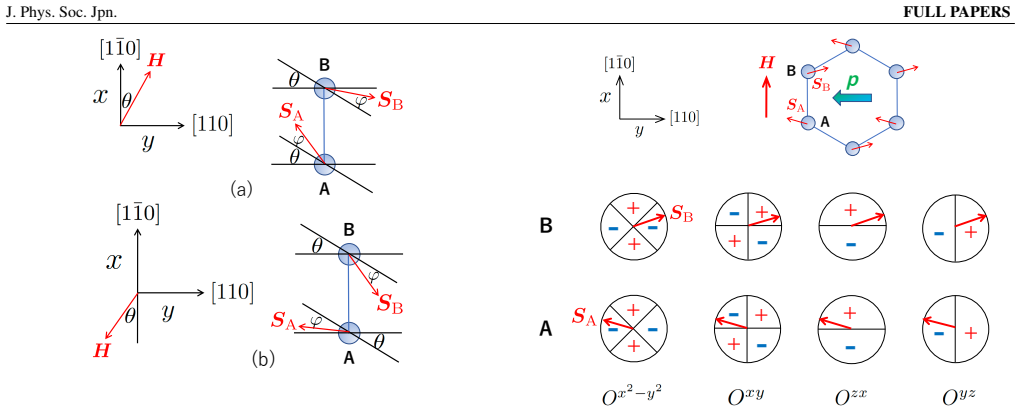
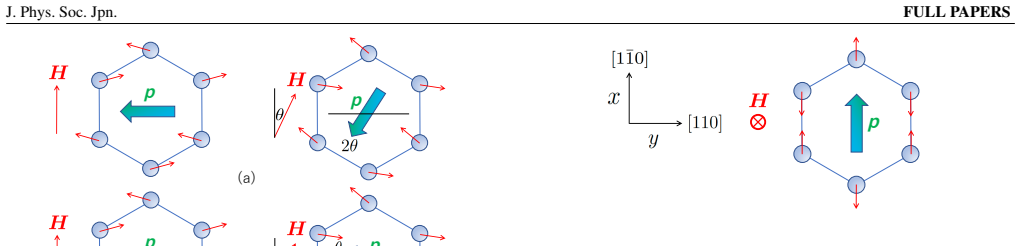
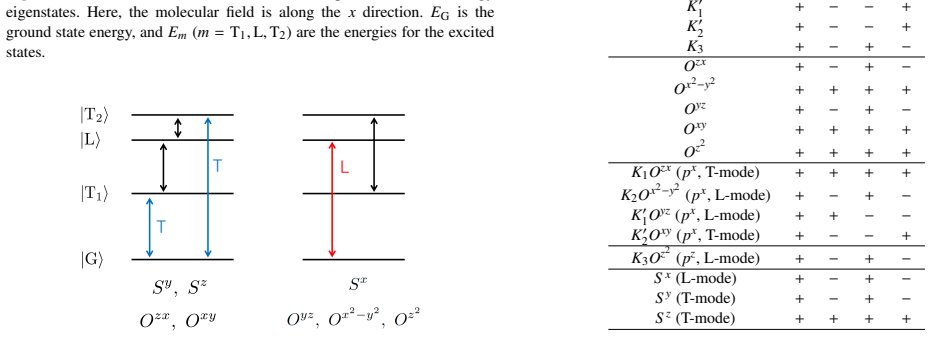
The load-bearing object is the spin-dependent electric dipole operator $p_\alpha = K^\alpha_{\beta\gamma} S_\beta S_\gamma$, classified by the C3 point group at each Co site and written in terms of the quadrupole operators $O_{zx}$, $O_{yz}$, $O_{xy}$, $O_{x^2-y^2}$, and $O_{z^2}$. For each of the eight Co ions, the inversion center and the twofold axis of the $P\bar3c1$ unit cell generate the dipole operator at all equivalent sites with the same coupling constants; summing over the four sites cancels the $K'_1$, $K'_2$, and $K_3$ terms. What remains is Eq. (2.13): a $\theta$-rotation part built from $O_{zx}$ and $O_{yz}$, and a $2\theta$-rotation part built from $O_{x^2-y^2}$ and $O_{xy}$, with the threefold axis forcing the $2\theta$ part to rotate opposite to the spin.
What would settle it
Measure the electric polarization while rotating a precisely in-plane magnetic field and resolve both the $\theta$ and $2\theta$ Fourier components; the theory predicts only the $(\sin 2\theta,\cos 2\theta)$ component, while any finite $(\sin\theta,-\cos\theta)$ component or any $\langle P_z\rangle \neq 0$ would falsify the idealized collinear assumption. The same measurement repeated with the field tilted out of plane should turn on the $\theta$ component linearly in $H_z$.
Extended reading notes
Core claim
On the paper's own terms, the central result is Eq. (2.13): for a magnetic field rotated by angle $\theta$ in the $ab$-plane, the electric polarization per unit cell is $$(\langle P_x\rangle,\langle P_y\rangle) = 4\tilde K_1 O_1\cos\varphi\,(\sin\$\theta$,-\cos\$\theta$) + 4\tilde K_2 O_2\sin 2\varphi\,(\sin 2\$\theta$,\cos 2\$\theta$), \qquad \langle P_z\rangle = 0.$$ The first term rotates with the field; the second rotates at twice the angle in the opposite direction. Because the field lies in the $ab$-plane, the out-of-plane spin component vanishes, so $O_1 = 0$ and only the $2\theta$ component survives. The inversion centers and twofold axes of the $P\bar3c1$ space group cancel the $K'_1$, $K'_2$, and $K_3$ contributions, leaving this clean form. The field-reversal sign change follows from $\varphi \to -\varphi$, which makes $\sin 2\varphi$ change sign, and for weak fields $\sin 2\varphi \propto H$ gives the observed linear-field dependence.
Load-bearing premise
The argument assumes the ordered moments stay exactly in the $ab$-plane and cant uniformly by the small angle $\varphi$ under an in-plane field, with no out-of-plane moment, so the clean $O_1 = 0$ cancellation that leaves only the $2\theta$ component holds.
Editorial extensions
If this is right
- For a magnetic field in the $ab$-plane, the electric polarization is locked to the $2\theta$ component, so rotating the field once sweeps the polarization through two full turns in the opposite sense; reversing the field reverses the polarization linearly in $H$.
- If the field tilts toward the $c$-axis, a $\theta$-rotation component proportional to $H_z$ should appear, which no in-plane-field measurement could detect.
- At zero field the combined inversion-times-time-reversal symmetry forces $\langle P\rangle = 0$, so no electric polarization is expected in the collinear antiferromagnetic state.
- In the ordered phase, light propagating along the $y$ direction should show directional dichroism, natural circular dichroism, and magnetic circular dichroism, while circular dichroism appears for propagation along $x$ or $z$ under a magnetic field along $z$.
- A quadrupolar excitation at $\omega = 2D + 2g\mu_B H_z$ should be electrically active, with the resonance frequency changing twice as fast with field as the ordinary magnetic transition.
Reading between the lines
- Because the argument uses only site symmetry (C3, $S\ge 1$, no inversion at the magnetic site), the same two-component polarization rule should appear in any magnet with such sites and collinear easy-plane order, including other A4B2O9-type honeycomb compounds.
- A direct quantitative test would be to measure the ratio of the $K_1$ and $K_2$ couplings from tilted-field data; symmetry fixes the functional forms but not these magnitudes, so the ratio carries microscopic information.
- If the reported slight $c$-axis canting of the antiferromagnetic moment is real, the ideal $O_1 = 0$ cancellation is only approximate, and a weak $\theta$-rotation component should be visible even for nominally in-plane fields; its size would directly measure the canting.
- Because the electric dipole is built from on-site quadrupoles, the same symmetry classification should also constrain a strain-induced magnetoelectric response, which could be tested by uniaxial stress measurements.
Signed reviews
Editorial analysis
A structured set of objections, weighed in public.
Referee Report
Summary. The paper presents a symmetry analysis of the magnetoelectric response of the honeycomb antiferromagnet Co4Nb2O9. The authors use the C3 point-group classification of the spin-dependent electric dipole at each Co site and combine the inversion and twofold symmetries of the P-3c1 space group to construct the unit-cell electric polarization. Their central result, Eq. (2.13), contains a θ-rotating component proportional to K1 and a 2θ counter-rotating component proportional to K2; for an in-plane magnetic field, under the assumption that the ordered moments lie purely in the ab-plane, only the 2θ component survives, reproducing the polarization rotation observed by Khanh et al. The paper also analyzes optical properties, predicting quadrupolar excitations and a classification of directional, natural, and magnetic circular dichroism in the ordered phases.
Significance. If the result holds, the paper provides a compact and falsifiable symmetry explanation of the main observed magnetoelectric effect, with concrete predictions for optical dichroism and quadrupolar excitations. The derivation is internally consistent and unusually self-contained: the matrix elements are given in Appendices E and F, the symmetry operations are specified, and the final polarization formula is algebraic and directly testable. The use of an independently published classification (Ref. 25) avoids circularity, and the sign of K2 is fixed by experiment, which strengthens the comparison. The main limitation is that the central cancellation O1=0 depends on an idealized collinear ab-plane magnetic structure, which the cited structural data do not fully guarantee.
major comments (1)
- [Sec. 2.4.1 (Eq. 2.13) and Sec. 2.1] The statement that only the 2θ-rotation component remains for an in-plane field rests on setting O1=0 in Eq. (2.13), which requires the ordered moments to have zero c-axis component. The paper's Sec. 2.1 cites single-crystal neutron data reporting a slight c-axis canting, and Sec. 2.4 defines O1 via Eq. (2.12) but does not justify O1=0 for the actual structure. If the c-axis canting is staggered between A and B sites, with S‖_A = +s and S‖_B = −s, substitution into Eq. (2.10) gives a contribution 4K̃1O1 sinφ (cosθ, sinθ) in addition to the 2θ term; this component is first order in the in-plane field and rotates with θ, not 2θ. A uniform S‖ would instead break the IΘ symmetry invoked in Eq. (2.14) and would allow a zero-field polarization. The authors should either quantify the size and staggered/uniform character of the c-axis component from the cited neutron data and show that O1 is negligible, or revise the claim that only the 2θ component is present for in-plane fields.
minor comments (4)
- [Sec. 2.4.1] The proportionality sin2φ ∝ H is asserted rather than derived; a short mean-field argument or an explicit reference would make the explanation of the linear field dependence of the polarization more complete.
- [Sec. 2.4] The sentence "We assume that the external magnetic field has a z component" is confusingly placed immediately before the in-plane-field case is discussed; the general expression in Eq. (2.12) should be derived for arbitrary field direction and then specialized to Hz = 0.
- [Appendix C.1] The displayed transformation of the site-indexed dipoles contains a misplaced factor: it should read I(pβ_a, pβ_b, pβ_a′, pβ_b′)I^{-1} = (−pβ_b, −pβ_a, −pβ_b′, −pβ_a′), without the trailing I^{-1}.
- [Table I and Sec. 3.2.1] The notation "(x,z)" in the DD column is explained only in the table caption; repeating this explanation in the main text near the table would help readers, as would a clearer visual indication of the four special linear polarizations for which DD is unobservable.
Circularity Check
No significant circularity: Eq. (2.13) is a derived consequence of an independent C3 symmetry classification and an explicitly stated spin ansatz; no fitted parameter is renamed as a prediction.
full rationale
The derivation chain is self-contained from Eq. (2.2) onward. Eq. (2.2) is quoted from the authors' Ref. 25, but that is a general, parameter-free point-group classification of spin-dependent dipoles under C3, whose assumptions do not include the Co4Nb2O9 target result; it is therefore independent support rather than a circular premise. The lattice summation through Eqs. (2.6)-(2.10) uses only the inversion and twofold operations of P-3c1, and the field dependence in Eq. (2.13) follows by substituting the stated spin expectation values in Eqs. (2.11)-(2.12). No parameter is fitted to the polarization data and then called a prediction; the undetermined coefficients K1, K2, K3, O1, O2 are not adjusted to reproduce the 2θ effect, and the 2θ-opposite rotation property is independent of the sign choice for K̃2. The paper explicitly flags its main idealization in Sec. 2.1, stating 'Since the main common result is that the AF moment aligns in the basal ab-plane, we assume this structure to capture the essence of the magnetoelectric effects,' and again in Sec. 2.4.1, 'no magnetic moment is induced in the z direction ... O1 = 0.' That assumption may be questioned in view of the cited small c-axis canting, but it is an input assumption, not a circular reduction: the claim that only the 2θ component remains is conditional on O1 = 0, not forced by the definition of the theory. The optical and dichroism predictions similarly follow from the same symmetry input and a model Hamiltonian, with no reduction to a fitted quantity. Overall circularity score is therefore 0.
Assumptions & free parameters
free parameters (3)
- K1, K2, K3 (and K̃1, K̃2)
- O1, O2, Oz
- Sign of K̃2 =
negative
assumptions (4)
- domain assumption The local point group at each Co site is C3 with no inversion symmetry at the Co site (space group P-3c1).
- domain assumption The AF ordered moments lie in the ab-plane with a small canting angle φ relative to the perpendicular-to-field direction, as described by Eq. (2.11).
- standard math The spin-dependent electric dipole operator is expressed as a symmetric third-rank polar tensor coupling to quadrupole operators, Eq. (2.1), following the standard type-II symmetry classification of Ref. 25.
- domain assumption The electric polarization is obtained by summing single-site electric dipole expectation values; intersite (type-I) contributions are neglected.
Cite this review
Pith. "Pith review of Symmetry Analysis of Magnetoelectric Effects in Honeycomb Antiferromagnet Co4Nb2O9." pith.science (2026). https://pith.science/paper/GZ3AZ3JH
@misc{pith2026190803004,
  author       = {Pith},
  title        = {Pith review of: Symmetry Analysis of Magnetoelectric Effects in Honeycomb Antiferromagnet Co4Nb2O9},
  year         = {2026},
  howpublished = {\url{https://pith.science/paper/GZ3AZ3JH}},
  note         = {Machine review of arXiv:1908.03004}
}
read the original abstract
Magnetoelectric effects in honeycomb antiferromagnet Co4Nb2O9 are investigated on the basis of symmetry analyses of Co ions in trigonal P-3c1 space group. For each Co ion, the possible spin dependence is classified by C3 point-group symmetry. This accounts for the observed main effect that an electric polarization rotates in the opposite direction at the twice speed relative to the rotation of the external magnetic field applied in the ab-plane. Inversion centers and twofold axes in the unit cell restrict the active spin-dependence of the electric polarization, which well explains the observed experimental results. Expected optical properties of quadrupolar excitation and various types of dichroism are also discussed.
Figures


Figures from the paper (5 more)


Reference graph
Works this paper leans on
-
[1]
Symmetry Analysis of Magnetoelectric Effects in Honeycomb Antiferromagnet Co4Nb2O9
Introduction We propose that the honeycomb antiferromagnet Co4Nb2O91) is a typical example for the investigation of the magnetoelectric e ffects from a picture of quantum spin systems. The magnetoelectric e ffects in A 4B2O9 (A: Co or Mn, B: Nb or Ta) system were found by Fischer and coworkers a long time ago. 2) Since the reports on a spin-flop driven magne...
work page Pith review arXiv 1908
-
[2]
and (a2, b2, a′ 2, b′
-
[3]
Here, a and b cor- respond to the A(up) and B(down) sites in the AF phase, respectively
sites for the Co(1) and Co(2), respectively. Here, a and b cor- respond to the A(up) and B(down) sites in the AF phase, respectively. The Co2+ ions connected by solid lines form honeycomb lattices at various posi- tions of z. The honeycomb lattices are not flat but are buckled in the z direc- tion. We have four honeycomb lattices in the unit cell along the...
-
[4]
Spin-Dependent Electric Dipole 2.1 Crystal structure and AF order A schematic of crystal structure of Co 4Nb2O9 is shown in Fig. 1. 1, 10, 31) Co2+ ions form a honeycomb lattice struc- ture along the ab-plane through O2− ions. The space group is P¯3c1 and the local symmetry at the Co site is represented by the C3 point group with no inversion symmetry at ...
-
[5]
indicate that the elec- tric dipole rotates byφs with the spin rotation in the xy-plane, while the last two components (K2 and K′
-
[6]
indicate that it ro- tates by−2φs, which is twice of the spin rotation in the oppo- ) ( ) )( ( ) )( ) ( ) )( ( ) )( Fig. 3. (Color online) Schematic of rotation of electric dipole moment in the xy-plane. Circles represent Co 2+ ions in C3 point-group symmetry. p1 and p2 represent electric dipole moments for the φs and−2φs rotation com- ponents, respective...
-
[7]
component in p1 (p2), as shown in Eq. (2.5). (a) For p1. After the spin rotation of φs, p1 rotates by φs in the same direction. (b) For p2. After the spin rotation of φs, p2 rotates by 2φs in the opposite direction. Forφs = 120◦, p2 rotates by−240◦ = 120◦. Thus, the both p1 and p2 are rotated by 120◦ when the spin rotates by 120◦, indicating that the C3 s...
-
[8]
Y . P. Lu, C. X. Ji, Y . L. Sun, Y . Fang, L. Zhang, Z. D. Han, B. Qian, X. F. Jiang, and W. P. Zhou, J. Alloys Compd.679, 213 (2016)
work page 2016
Show all 61 references
-
[9]
As in Eq
for simplicity. As in Eq. (2.2), the spin-dependent electric dipole operator on the a site is given by (px a py a ) = Ozx a Ox2−y2 a Oyz a Oxy a Oyz a −Oxy a −Ozx a Ox2−y2 a K1 K2 K′ 1 K′ 2 , pz a = Oz2 a K3. (2.6) Here, (px a, py ...
-
[10]
Optical Properties Optical properties are also unique in the presence of mag- netoelectric effects. In this section, we theoretically study pos- sible optical absorption in Co4Nb2O9, where the electric field component of light can participate in the excitation process as well as...
-
[11]
◦”, and the dichroism does not appear. This is represented by the symbol “ −
It is pure electric and the resonance frequency is given by ω = 2D+2gµBHz. The slope of Hz inω is twice as that of the 1 2→ − 1 2 case, i.e. quadrupolar excitation. 30) This is owing to the fact that the Ox2−y2 and Oxy quadrupole operators have a finite matrix element when the ...
-
[12]
cite in the unit cell (see Fig. 1). The important point is that both the matrix element⟨L|S x iµ|G⟩ and the coupling constant eω µ3 = Kµ3Eω are staggered on the A (µ = a1, a′ 1, a2, a′
-
[13]
and B (µ = b1, b′ 1, b2, b′
-
[14]
There are eight longitudinal spin-wave excitation modes in the first Bril- louin zone, reflecting the eight Co sites in the unit cell
sites. There are eight longitudinal spin-wave excitation modes in the first Bril- louin zone, reflecting the eight Co sites in the unit cell. Each L-mode has a finite excitation gap. The perturbation Hamil- tonian in Eq. (3.15) connects the ground sate to a L-mode at the Γ point ...
-
[15]
(i) Each Co2+ ion carries spin-dependent elec- tric dipole operator
Summary and Discussions We investigated the spin-dependent electric polarization appearing in Co 4Nb2O9 on the basis of the symmetry anal- yses of the Co2+ ions in the P¯3c1 space group by the follow- ing procedures. (i) Each Co2+ ion carries spin-dependent elec- tric dipole o...
-
[16]
We take the ˜z-axis along the [111] direction
and its equivalent directions. We take the ˜z-axis along the [111] direction. The ˜x- and ˜y-axes are taken perpendicular to the ˜z-axis, as shown in Fig. B·1 We introduce the following unitary transformation U whose matrix elements are given by Ui j = ˜ei· e j: U = ...
-
[17]
E. F. Bertaut, L. Corliss, F. Forrat, R. Aleonard, and R. Pauthenet, J. Phys. Chem. Solids 21, 234 (1961)
1961
-
[18]
Fischer, G
E. Fischer, G. Gorodetsky, and R. M. Hornreich, Solid State Commun. 10, 1127 (1972)
1972
-
[19]
Kolodiazhnyi, H
T. Kolodiazhnyi, H. Sakurai, and N. Vittayakorn, Appl. Phys. Lett. 99, 132906 (2011)
2011
-
[20]
Y . Fang, Y . Q. Song, W. P. Zhou, R. Zhao, R. J. Tang, H. Yang, L. Y . Lv, S. G. Yang, D. H. Wangand, and Y . W. Du, Sci. Rep.4, 3860 (2014)
2014
-
[21]
Y . Cao, Y . Yang, M. Xiang, Z. Feng, B. Kang, J. Zhang,W. Ren, and S. Cao, J. Cryst. Growth 420, 90 (2015)
2015
-
[22]
N. D. Khanh, N. Abe, H. Sagayama, A. Nakao, T. Hanashima, R. Kiyanagi, Y . Tokunaga, and T. Arima, Phys. Rev. B93, 075117 (2016)
2016
-
[23]
I. V . Solovyev and T. V . Kolodiazhnyi, Phys. Rev. B94, 094427 (2016)
2016
-
[24]
T. A. Kaplan and S. D. Mahanti, Phys. Rev. B 83, 174432 (2011)
2011
-
[25]
N. D. Khanh, N. Abe, S. Kimura, Y . Tokunaga, and T. Arima, Phys. Rev. B 96, 094434 (2017)
2017
-
[26]
G. Deng, Y . Cao, W. Ren, S. Cao, A. J. Studer, N. Gauthier, M. Kenzel- mann, G. Davidson, K. C. Rule, J. S. Gardner, P. Imperia, C. Ulrich, and G. J. McIntyre, Phys. Rev. B 97, 085154 (2018)
2018
-
[27]
Yanagi, S
Y . Yanagi, S. Hayami, and H. Kusunose, Physica B 536, 107 (2018)
2018
-
[28]
Yanagi, S
Y . Yanagi, S. Hayami, and H. Kusunose, Phys. Rev. B 97, 020404(R) (2018)
2018
-
[29]
Y . M. Xie, H. Zang, W. D. Ceng, H. Y . Wu, and C. C. Wang, Appl. Phys. Lett. 113, 082906 (2018)
2018
-
[30]
Kimura, T
T. Kimura, T. Goto, H. Shintani, K. Ishizaka, T. Arima, and Y . Tokura, Nature 426, 55 (2003)
2003
-
[31]
Katsura, N
H. Katsura, N. Nagaosa, and A. V . Balatsky, Phys. Rev. Lett.95, 057205 (2005)
2005
-
[32]
I. A. Sergienko and E. Dagotto, Phys. Rev. B 73, 094434 (2006)
2006
-
[33]
Arima, J
T. Arima, J. Phys. Soc. Jpn. 76, 073702 (2007)
2007
-
[34]
Murakawa, Y
H. Murakawa, Y . Onose, S. Miyahara, N. Furukawa, and Y . Tokura, Phys. Rev. Lett. 105, 137202 (2010)
2010
-
[35]
Murakawa, Y
H. Murakawa, Y . Onose, S. Miyahara, N. Furukawa, and Y . Tokura, Phys. Rev. B 85, 174106 (2012)
2012
-
[36]
K. Penc, J. Romh ´anyi, T. R ˜o˜om, U. Nagel, ´A. Antal, T. Feh ´er, A. J´anossy, H. Engelkamp, H. Murakawa, Y . Tokura, D. Szaller, S. Bord´acs, and I. K´ezsm´arki, Phys. Rev. Lett. 108, 257203 (2012)
2012
-
[37]
K ´ezsm´arki, N
I. K ´ezsm´arki, N. Kida, H. Murakawa, S. Bord ´acs, Y . Onose, and Y . Tokura, Phys. Rev. Lett.106, 057403 (2011)
2011
-
[38]
Miyahara and N
S. Miyahara and N. Furukawa, J. Phys. Soc. Jpn. 80, 073708 (2011)
2011
-
[39]
K ´ezsm´arki, D
I. K ´ezsm´arki, D. Szaller, S. Bord´acs, V . Kocsis, Y . Tokunaga, Y . Taguchi, H. Murakawa, Y . Tokura, H. Engelkamp, T. R˜o˜om, and U. Nagel, Nat. Commun. 5, 3203 (2014)
2014
-
[40]
This can be checked in parallel with the discussion in Ap- pendix C.1. With respect to the mirror operation perpendicular to the y direction (σy), the quadrupole operators are transformed as σy(Oyz, Ozx, Oxy, Ox2−y2 , Oz2 )σ−1 y = (−Oyz, Ozx,−Oxy, Ox2−y2 , Oz2 ). The subsequen...
-
[41]
Matsumoto, K
M. Matsumoto, K. Chimata, and M. Koga, J. Phys. Soc. Jpn.86, 034704 (2017)
2017
-
[42]
W. B. Mims, The Linear Electric Field E ffect in Paramagnetic Reso- nance (Oxford University Press, U.K., 1976)
1976
-
[43]
Kimura, K
S. Kimura, K. Kakihata, Y . Sawada, K. Watanabe, M. Matsumoto, M. Hagiwara, and H. Tanaka, Nat. Commun. 7, 12822 (2016)
2016
-
[44]
Kimura, K
S. Kimura, K. Kakihata, Y . Sawada, K. Watanabe, M. Matsumoto, M. Hagiwara, and H. Tanaka, Phys. Rev. B95, 184420 (2017)
2017
-
[45]
Kimura, M
S. Kimura, M. Matsumoto, M. Akaki, M. Hagiwara, K. Kindo, and H. Tanaka, Phys. Rev. B97, 140406(R) (2018)
2018
-
[46]
Akaki, D
M. Akaki, D. Yoshizawa, A. Okutani, T. Kida, J. Romh ´anyi, K. Penc, and M. Hagiwara, Phys. Rev. B 96, 214406 (2017)
2017
-
[47]
M. A. R. Castellanos, S. Bern `es, and M. Vega-Gonz´alez, Acta Crystal- logr. Sect. E 62, i117 (2006)
2006
-
[48]
See, for instance, M. I. Aroyo, International Tables for Crystallography Volume A: Space-group symmetry(Wiley; 6th Edition, 2017)
2017
-
[49]
See, for instance, J. F. Nye, Physical Properties of Crystals: Their Rep- resentation by Tensors and Matrices(Oxford University Press, Oxford, U.K., 1985)
1985
-
[50]
The c-glide symmetry can be checked by subsequent operations of the inversion and twofold transformations shown in Fig. 1. Let us begin with a position at (x, y, z)1. After the inversion operation at (0, 0, 0), we obtain ( x, y, z)1 → (−x,−y,−z)2. With respect to the twofold o...
-
[51]
(2.14), (3.8), (A ·3), and (C·5), see, for instance, Eqs
For the first equalities in Eqs. (2.14), (3.8), (A ·3), and (C·5), see, for instance, Eqs. (4.4.39) and (4.4.40) in J. J. Sakurai and J. Napolitano, Modern Quantum Mechanics (Cambridge University Press; 2nd Edi- 14 J. Phys. Soc. Jpn. FULL PAPERS tion, 2017)
2017
-
[52]
J. J. Hopfield and D. G. Thomas, Phys. Rev. Lett. 4, 357 (1960)
1960
-
[53]
W. F. Brown Jr., S. Shtrikman, and D. Treves, J. Appl. Phys. 34, 1233 (1963)
1963
-
[54]
Szaller, S
D. Szaller, S. Bord ´acs, and I. K ´ezsm´arki, Phys. Rev. B 87, 014421 (2013)
2013
-
[55]
This can be checked in parallel with the discussion in Ap- pendix C.1. With respect to the C2y operation, the quadrupole operators are transformed as C2y(Oyz, Ozx, Oxy, Ox2−y2 , Oz2 )C−1 2y = (−Oyz, Ozx,−Oxy, Ox2−y2 , Oz2 ), whereas the site indexes for the quadrupole operator...
-
[57]
Romh ´anyi and K
J. Romh ´anyi and K. Penc, Phys. Rev. B 86, 174428 (2012)
2012
-
[58]
M. Soda, M. Matsumoto, M. Månsson, O. Ohira-Kawamura, K. Naka- jima, R. Shiina, and T. Masuda, Phys. Rev. Lett.112, 127205 (2014)
2014
-
[59]
Soda, L.-J
M. Soda, L.-J. Chang, M. Matsumoto, V . O. Garlea, B. Roessli, J. S. White, H. Kwano-Furukawa, and T. Masuda, Phys. Rev. B 97, 214437 (2018)
2018
-
[60]
|α⟩ and|β⟩ are eigenstates of C2x as C2x|α⟩ = λα|α⟩ and C2x|β⟩ = λβ|β⟩
Let us assume that operators A± satisfy C2xA±C−1 2x =±A±, respectively. |α⟩ and|β⟩ are eigenstates of C2x as C2x|α⟩ = λα|α⟩ and C2x|β⟩ = λβ|β⟩. The following matrix element is calculated as ⟨β|A±|α⟩ = ⟨C2xβ|C2xA±C−1 2x|C2xα⟩ =±λ∗ βλα⟨β|A±|α⟩. When⟨β|A+|α⟩ , 0,λ∗ βλα = 1 and th...
-
[61]
Here, hFM and hz represent the molecular and external magnetic fields, respectively
Let us begin with the following eigenstate defined by H0(hMF)|m⟩ = Em|m⟩ withH0(hMF) = D(S z)2−hMFS x−hzS z as the local Hamiltonian. Here, hFM and hz represent the molecular and external magnetic fields, respectively. The molecular field hMF inH0(hMF) can be reversed by the foll...
-
[111]
In this case, we can ex- pect the same electromagnetic properties under the broken inversion symmetry
and its equivalent directions. In this case, we can ex- pect the same electromagnetic properties under the broken inversion symmetry. T and Td are the point group symme- tries that match the conditions. The possible spin-dependent electric dipole operators for T and Td are lis...
Reviewed August 14, 2026 · model on record in the stance chip above.
Discussion (0). Continue with ORCID to comment.