REVIEW 3 major objections 7 minor 32 references
A Theoretical Paradigm for Thermal Rectification via Phonon Filtering and Energy Carrier Confinement
T0 review · 3 major / 7 minor · reviewed 2026-08-14 · deepseek-v4-flash
Pith's one-line read A graded diamond film stack could act as a solid-state thermal rectifier by confining phonon wavelengths, with theoretical rectification ratios between 0.75 and 6.
desk verdict A transparent upper-bound model for phonon-confinement thermal rectification; the large TR is built into the integration bounds rather than derived, so treat as an idealized estimate, not a diamond prediction. read the letter →
The pith
A machine-rendered reading of the paper's core claim, the machinery that carries it, and where it could break.
The reading
What carries the argument
The central object is the modified Callaway phonon gas model for spectral thermal conductivity, $\kappa(k)=\int_{k_{\min}}^{k_{\max}} \hbar\omega(k)\,\mathrm{DOS}(k)\,(\partial f_{\mathrm{BE}}/\partial T)\,\nu(k)\,[l_{\mathrm{in}}(k)^{-1}+l_{\mathrm{bound}}^{-1}]^{-1}\,dk$. The novelty is the lower bound: instead of $k_{\min}\to 0$, the paper sets $k_{\min}=\pi/t$, treating the film thickness as a confinement length that removes long-wavelength phonons from the population. This cutoff, applied once in the thin filter layer and then kept through the stack, is what produces direction-dependent conductivity.
What would settle it
Measure thermal conductivity in both directions on an epitaxial, coherent diamond bilayer with a ~1 nm filter layer and a ~1 $\mu$m base at room temperature: if the thin-to-thick conductivity is not substantially lower than thick-to-thin, so the rectification ratio falls far below 0.75, the central claim is wrong.
Extended reading notes
Core claim
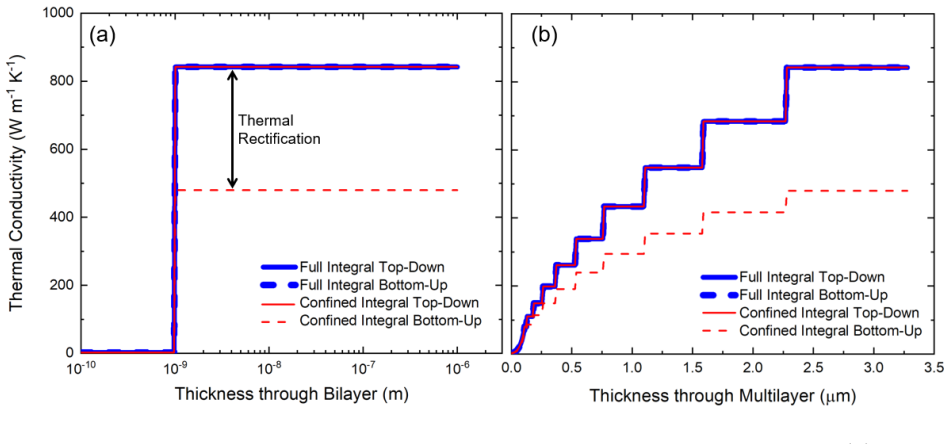
On its own terms, the paper claims that directional dependence of thermal conductivity arises from directional dependence of the available phonon population. In a coherent, lattice-matched bilayer, a thin phonon-filter layer admits only short-wavelength phonons into the thick layer; because the lower integration limit $k_{\min}=\pi/t$ is set by the thinnest layer, the thick layer conducts less when heat enters from the thin side than when heat enters directly from the thick side. The authors compute this for diamond using a real acoustic dispersion, intrinsic and boundary mean free paths, and a spherical density of states, and obtain thermal rectification ratios between 75% and 600% depending on the thickness mismatch. They also show that a 20-layer logarithmically graded stack from 1 nm to 1 $\mu$m gives a slightly reduced ratio of 63%, and that filters thicker than about 10 nm produce negligible rectification.
Load-bearing premise
The load-bearing assumption is that phonons crossing from the thin filter layer into the thick layer keep their truncated spectrum—they do not anharmonically scatter into the long wavelengths the thick layer would otherwise support—so the conductivity deficit persists across the stack.
Editorial extensions
If this is right
- A coherent diamond bilayer with a 1 nm filter layer and a 1 $\mu$m base should act as a passive thermal diode at room temperature, with a rectification ratio above 75%.
- The rectification grows with the thickness mismatch between filter and base, reaching several hundred percent in the full-confinement limit.
- Filter thickness matters: once the thin layer exceeds roughly 10 nm, its cutoff removes too few heat-carrying phonons and rectification becomes negligible.
- Multilayer graded stacks show the same physics but dilute it; a 20-layer stack from 1 nm to 1 $\mu$m yields about 63% instead of 75% for the same extremes in a bilayer.
- Because the mechanism is spectral rather than driven by mass or temperature gradients, it is additive with existing rectification strategies such as geometric asymmetry or applied thermal bias.
Reading between the lines
- The model's upper-bound character suggests a clear degradation test: any real device should show rectification that shrinks as temperature rises, since anharmonic scattering becomes stronger and repopulates the truncated spectrum; the paper does not make this temperature-dependence explicit.
- The same spectral-filtering argument should transfer to any material with weak anharmonicity and a coherent interface, so the framework gives a criterion for screening candidate rectifier materials: low three-phonon scattering, long intrinsic mean free path, and lattice-matched deposition.
- If realized, such a passive heat diode could be arranged into networks without moving parts or external fields, pointing toward phononic logic elements, though the paper only gestures at this.
- One could test the mechanism's origin by varying the thick-layer thickness at a fixed 1 nm filter: the model predicts a monotonic increase in rectification with thick-layer thickness, which would distinguish confinement from ordinary interface-resistance effects.
Signed reviews
Editorial analysis
A structured set of objections, weighed in public.
Referee Report
Summary. The manuscript proposes a theoretical mechanism for solid-state thermal rectification based on "phonon filtering and energy carrier confinement." The authors modify the Callaway phonon-gas thermal-conductivity expression by truncating the lower wave-vector integration limit at kmin = π/t, where t is the film thickness, thereby discarding phonons with wavelengths longer than the confinement dimension. For a bilayer of diamond films (a 1 nm filter layer on a 1 µm thick layer), the model computes the thick-layer thermal conductivity with kmin = π/t_thin when heat flows from the thin side and with kmin = π/t_thick when heat flows from the thick side, producing a direction-dependent conductivity and thermal rectification ratios TR = (κTD − κBU)/κBU between 0.75 and 6. The key assumption, stated explicitly, is that phonons injected from the filter layer do not scatter anharmonically into other wavelengths within the thick layer; the authors frame the multilayer results as an upper limit. Results are given for bilayer and graded 20-layer diamond stacks.
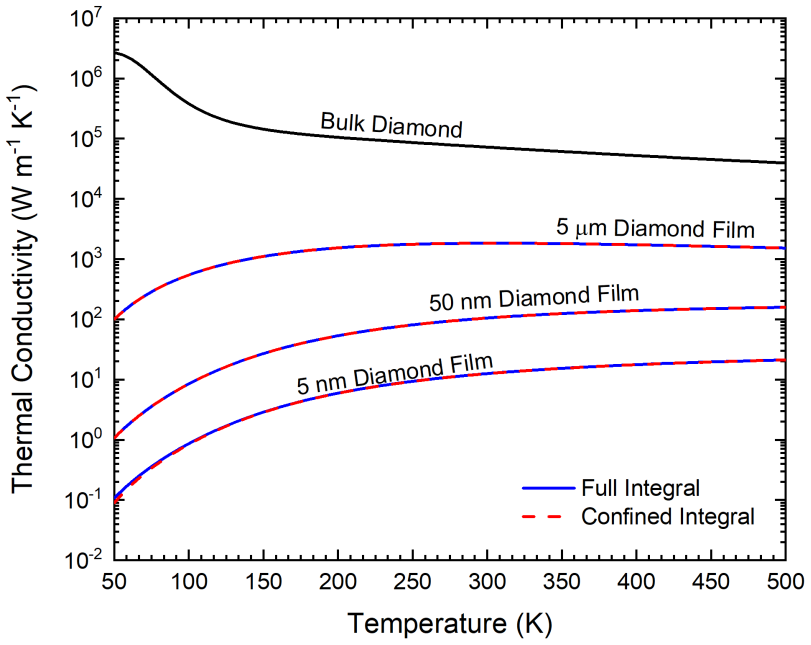
Significance. Were the mechanism to operate as described, the predicted rectification ratios (75–600%) would substantially exceed previously reported values at modest temperature bias, and the layered geometry is compatible with standard thin-film processing; the potential payoff is therefore considerable. The manuscript has genuine strengths: the central assumption is stated transparently; the single-layer confined-population model is checked against the full-integral Callaway model (Fig. 2); Fig. 4 provides a specific, in-principle falsifiable prediction of TR versus filter-layer thickness; and the required material conditions (specular, lattice-matched interfaces; weak anharmonicity) are identified. The decisive difficulty is that the directional asymmetry is written into the model through the choice of integration limits rather than derived from phonon-transport physics, so the predicted rectification is an upper bound attained essentially by construction. The contribution is therefore conditional on a regime — coherent transmission of a truncated phonon population over micrometer distances — that the paper neither derives nor supports with independent evidence.
major comments (3)
- [Thermal rectification in nanostructured film stack (paragraph following Eq. 4)] The direction-dependent thermal conductivity is imposed by the choice of integration limits rather than derived from transport physics. In the bottom-up direction the thick-layer conductivity is evaluated with kmin = π/t_thin = π nm⁻¹ even after lbound relaxes to 1 µm, while in the top-down direction it is evaluated with kmin = π/t_thick; the text states this directly: "Even though the mean free path is relaxed as the heat moves into the thick layer (lbound = 1 µm), kmin does not change and so the confinement results in diminished thermal transport." Because every directional difference enters through this manually selected lower bound, the rectification ratio in Eq. 5 is a restatement of the model's assumption, not a consequence of the scattering physics. To establish the mechanism, the manuscript needs a transport-level argument (for example, a mode-resolved Boltzmann-transport or molecular-dynamics calculation) showing that the truncated injected population persists across a micrometer-scale layer.
- [Thermal rectification in nanostructured film stack (assumption paragraph); Discussion] The no-anharmonic-redistribution postulate is load-bearing and is acknowledged in the manuscript: "we assume that the phonons injected into the thick film from the filter layer do not scatter anharmonically into other wavelengths that may not have been available to begin with," and, for the multilayer case, "traversing this many interfaces in a real material system would inevitably lead to some redistribution of phonon populations." The model itself fits a finite phonon-phonon mean free path for diamond (Fig. 2), so diamond is not anharmonicity-free on the paper's own inputs; the Discussion's statement that diamond demonstrates "negligible anharmonic scattering" does not remove this tension. If three-phonon scattering re-thermalizes the injected population within the 1 µm thick layer, κBU rises toward κTD and the predicted TR collapses. The manuscript provides no estimate of the mode-conversion length scale in diamond, so the values in Fig. 4 are not secured as an upper bound for any physically realizable diamond stack.
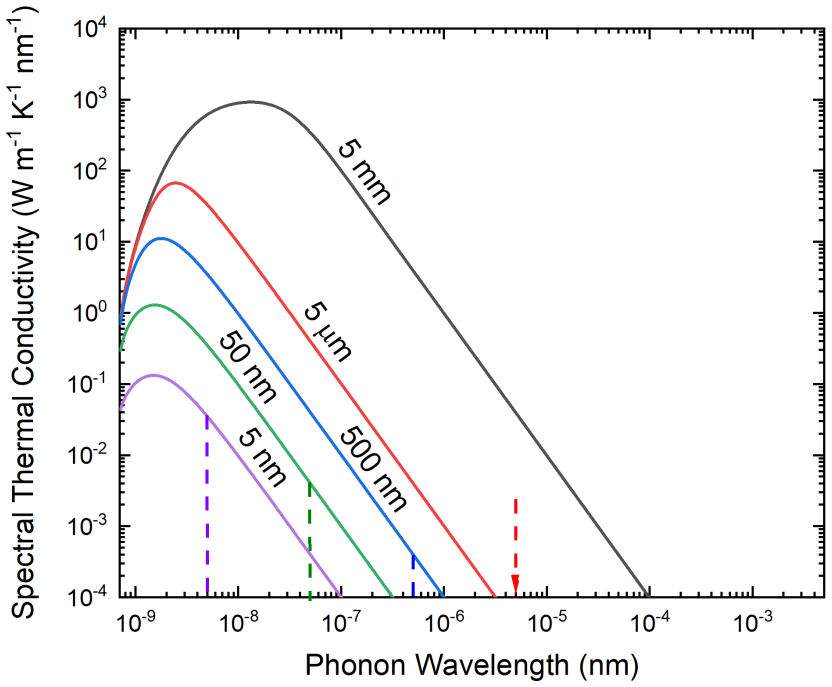
- [Modeling thermal rectification via phonon confinement (Figs. 1-2); Fig. 4] The single-layer validation does not test the regime in which the rectification is claimed. The near-agreement between the confined-population and full-integral models in Fig. 2 demonstrates that truncating at kmin = π/t is harmless when boundary scattering (lbound = t) already suppresses the long-wavelength modes. In the bilayer bottom-up case, by contrast, the thick layer has lbound = 1 µm, and the excluded modes (λ > 2 nm) are the low-frequency modes whose intrinsic mean free paths in diamond are long; these are precisely the carriers that contribute strongly to the unfiltered thick-layer conductivity. Fig. 4 shows that TR grows as the thick-layer boundary scattering weakens, which is exactly the regime where the Fig. 2 consistency check provides no support. The validation therefore confirms the truncation only where it changes nothing.
minor comments (7)
- [Modeling thermal rectification via phonon confinement (text near Fig. 2)] The unresolved cross-reference "In Fig. ??" should read "In Fig. 2."
- [Eq. 4] The symbol κ(k) is used for the spectral integrand while κ denotes the total thermal conductivity elsewhere; a distinct symbol such as s(k, T) for the spectral contribution would avoid confusion.
- [Modeling thermal rectification via phonon confinement (bulk fit discussion)] The fitted phonon-phonon and phonon-impurity scattering parameters for diamond are not reported, so the bulk validation in Fig. 2 and the predictions in Fig. 4 cannot be reproduced; the parameter values should be given in a table or appendix.
- [Abstract and Fig. 4 discussion] The rectification values are given as "between 0.75 and 6" in the abstract and as "> 75%" and "> 600%" in the text; the paper should state consistently whether TR in Eq. 5 is a dimensionless ratio or a percentage.
- [Introduction (Ref. [15])] Reference [15] (Wang et al., Nano Letters 14, 592 (2014)) already proposes thermal rectification via phonon lateral confinement in asymmetric single-material nanostructures, which is the closest prior mechanism to the one proposed here; the manuscript cites it but does not explain how the present mechanism differs or what new physics it adds.
- [Modeling thermal rectification via phonon confinement (Eq. 4)] The truncation kmin = π/t is applied to the scalar wavevector magnitude while the 3D diamond dispersion and a spherical density of states are used; a sentence clarifying how the stated one-dimensional cross-plane transport assumption relates to the 3D spectral integration would improve the physical transparency of Eq. 4.
- [Fig. 3] In Fig. 3, the two blue curves representing the direction-independent scattering-limited model will be difficult to distinguish in print; consider using distinct markers or line styles.
Circularity Check
Thermal rectification ratio is imposed by the directional choice of integration limits (kmin=π/t), so the predicted TR is the model's input assumption re-expressed as an output.
-
self definitional
[Section 'Thermal rectification in nanostructured film stack', Eqs. 4-5 and Fig. 4]
"Mathematically, the resulting thermal rectification originates from modifications to the limits of integration in Eq. 4. Considering the case when heat emanates from the thick-film side, kmin = π µm−1 (as well as lbound = 1 µm), which then become limited in the thin film portion of the stack. In the opposing direction, however, kmin = π nm−1 (and lbound = 1 nm). Even though the mean free path is relaxed as the heat moves into the thick layer (lbound = 1 µm), kmin does not change and so the confinement results in diminished thermal transport."
The central rectification ratio (Eq. 5, Fig. 4) is generated by integrating Eq. 4 with direction-dependent lower limits: top-down flow uses kmin≈π/µm in the thick layer, while bottom-up flow keeps kmin=π/nm even though lbound is relaxed to 1 µm. That directional kmin asymmetry is asserted, not derived; it rests entirely on the paper's stated assumption that 'the phonons injected into the thick film from the filter layer do not scatter anharmonically into other wavelengths that may not have been available to begin with.' Consequently κ_BU < κ_TD and TR>0 are guaranteed by construction, and the numerical TR values simply output the imposed population truncation as a 'prediction.'
full rationale
The single-layer validation is not circular: the confined-integral model is compared with a full Callaway integral and fitted to external bulk-diamond literature data, so those checks have independent content. However, the paper's load-bearing claim—thermal rectification in a bilayer/graded stack—reduces to the directional integration limits it chooses. The text states explicitly that 'the resulting thermal rectification originates from modifications to the limits of integration in Eq. 4,' and the only physical justification for keeping kmin fixed at the thin-film value inside the thick layer is the no-anharmonic-repopulation assumption. That assumption is not an output of the model; it is an input. Therefore Fig. 4's large TR values are the assumed population confinement expressed as a calculated ratio, not a first-principles prediction. No significant self-citation chain is involved; the few self-citations (e.g., Ref. 18) are peripheral background. Score 8 reflects that the central result is forced by definition rather than by a fit to data or by an external self-citation chain.
Assumptions & free parameters
free parameters (2)
- Intrinsic phonon mean free path fitting parameters (phonon-phonon and phonon-impurity scattering strengths) =
Not stated in the manuscript
- Minimum wavevector truncation kmin = pi/t =
kmin = pi/t, where t is the first layer thickness
assumptions (4)
- domain assumption Callaway phonon gas model with Matthiessen's rule (Eqs. 1-3)
- ad hoc to paper Phonons with wavelengths longer than the film thickness contribute negligibly to thermal conductivity and can be discarded
- ad hoc to paper No anharmonic phonon-phonon scattering redistributes the injected phonon population in the thick layer
- domain assumption Interfaces are coherent and lattice matched so that no diffuse scattering re-thermalizes the phonon population
Cite this review
Pith. "Pith review of A Theoretical Paradigm for Thermal Rectification via Phonon Filtering and Energy Carrier Confinement." pith.science (2026). https://pith.science/paper/OW7D2Z7E
@misc{pith2026190803048,
  author       = {Pith},
  title        = {Pith review of: A Theoretical Paradigm for Thermal Rectification via Phonon Filtering and Energy Carrier Confinement},
  year         = {2026},
  howpublished = {\url{https://pith.science/paper/OW7D2Z7E}},
  note         = {Machine review of arXiv:1908.03048}
}
read the original abstract
We provide a theoretical framework for the development of a solid-state thermal rectifier through a confinement in the available population of phonons on one side of an asymmetrically graded film stack. Using a modification of the phonon gas model to account for phonon filtering and population confinement, we demonstrate that for an ideal material, with low phonon anharmonicity, significant thermal rectification can be achieved even in the absence of ballistic phonon transport. This formalism is used to illustrate thermal rectification in a thin-film of diamond (1-5 nm) graded to dimensions > 1 {\mu}m exhibiting theoretical values of thermal rectification ratios between 0.75 and 6. Our theoretical formulation for thermal rectification is therefore expected to produce opportunities to design advanced solid-state devices that enable a variety of critical technologies.
Figures
Figures from the paper (1 more)

Reference graph
Works this paper leans on
-
[1]
L. Wang and B. Li, Thermal logic gates: computation with phonons, Physical Review Letters 99, 177208 (2007)
work page 2007
-
[2]
C. Dames, Solid-state thermal rectification with existing bulk materials, Journal of Heat Trans- fer 131, 061301 (2009)
work page 2009
-
[3]
Y. Li, X. Shen, Z. Wu, J. Huang, Y. Chen, Y. Ni, and J. Huang, Temperature-dependent transformation thermotics: From switchable thermal cloaks to macroscopic thermal diodes, Physical Review Letters 115, 195503 (2015)
work page 2015
-
[4]
M. Hu, P. Keblinski, and B. Li, Thermal rectification at silicon-amorphous polyethylene in- terface, Applied Physics Letters 92, 211908 (2008)
work page 2008
-
[5]
N. A. Roberts and D. Walker, Phonon transport in asymmetric sawtooth nanowires, in ASME/JSME 2011 8th Thermal Engineering Joint Conference (American Society of Me- chanical Engineers, 2011) pp. T30053–T30053
work page 2011
-
[6]
J. Zhu, K. Hippalgaonkar, S. Shen, K. Wang, Y. Abate, S. Lee, J. Wu, X. Yin, A. Majumdar, and X. Zhang, Temperature-gated thermal rectifier for active heat flow control, Nano Letters 14, 4867 (2014)
work page 2014
- [7]
-
[8]
N. A. Roberts and D. Walker, A review of thermal rectification observations and models in solid materials, International Journal of Thermal Sciences 50, 648 (2011)
work page 2011
Show all 32 references
-
[9]
C. W. Chang, D. Okawa, A. Majumdar, and A. Zettl, Solid-state thermal rectifier, Science 314, 1121 (2006)
2006
-
[10]
N. Yang, G. Zhang, and B. Li, Thermal rectification in asymmetric graphene ribbons, Applied Physics Letters 95, 033107 (2009). 13
2009
-
[11]
Pereira, Sufficient conditions for thermal rectification in general graded materials, Physical Review E 83, 031106 (2011)
E. Pereira, Sufficient conditions for thermal rectification in general graded materials, Physical Review E 83, 031106 (2011)
2011
-
[12]
Z. Yu, L. Ferrer-Argemi, and J. Lee, Investigation of thermal conduction in symmetric and asymmetric nanoporous structures, Journal of Applied Physics 122, 244305 (2017)
2017
-
[13]
Zhong, W.-H
W.-R. Zhong, W.-H. Huang, X.-R. Deng, and B.-Q. Ai, Thermal rectification in thickness- asymmetric graphene nanoribbons, Applied Physics Letters 99, 193104 (2011)
2011
-
[14]
N. Yang, N. Li, L. Wang, and B. Li, Thermal rectification and negative differential thermal resistance in lattices with mass gradient, Physical Review B 76, 020301 (2007)
2007
-
[15]
Y. Wang, A. Vallabhaneni, J. Hu, B. Qiu, Y. P. Chen, and X. Ruan, Phonon lateral confine- ment enables thermal rectification in asymmetric single-material nanostructures, Nano letters 14, 592 (2014)
2014
-
[16]
M. J. Mart´ ınez-P´ erez, A. Fornieri, and F. Giazotto, Rectification of electronic heat current by a hybrid thermal diode, Nature Nanotechnology 10, 303 (2015)
2015
-
[17]
Callaway, Model for lattice thermal conductivity at low temperatures, Physical Review113, 1046 (1959)
J. Callaway, Model for lattice thermal conductivity at low temperatures, Physical Review113, 1046 (1959)
1959
-
[18]
B. F. Donovan, B. M. Foley, J. F. Ihlefeld, J.-P. Maria, and P. E. Hopkins, Spectral phonon scattering effects on the thermal conductivity of nano-grained barium titanate, Applied Physics Letters 105, 082907 (2014)
2014
-
[19]
K. T. Regner, J. P. Freedman, and J. A. Malen, Advances in studying phonon mean free path dependent contributions to thermal conductivity, Nanoscale and Microscale Thermophysical Engineering 19, 183 (2015)
2015
-
[20]
J. Cuffe, J. K. Eliason, A. A. Maznev, K. C. Collins, J. A. Johnson, A. Shchepetov, M. Prun- nila, J. Ahopelto, C. M. S. Torres, G. Chen, et al. , Reconstructing phonon mean-free-path contributions to thermal conductivity using nanoscale membranes, Physical Review B 91, 245423 (2015)
2015
-
[21]
Jiang, L
P. Jiang, L. Lindsay, and Y. K. Koh, Role of low-energy phonons with mean-free-paths¿ 0.8 µ m in heat conduction in silicon, Journal of Applied Physics 119, 245705 (2016)
2016
-
[22]
A. J. Minnich, Determining phonon mean free paths from observations of quasiballistic thermal transport, Physical review letters 109, 205901 (2012)
2012
-
[23]
Jain, Y.-J
A. Jain, Y.-J. Yu, and A. J. McGaughey, Phonon transport in periodic silicon nanoporous films with feature sizes greater than 100 nm, Physical Review B 87, 195301 (2013). 14
2013
-
[24]
Ghosh, W
S. Ghosh, W. Bao, D. L. Nika, S. Subrina, E. P. Pokatilov, C. N. Lau, and A. A. Balandin, Dimensional crossover of thermal transport in few-layer graphene, Nature Materials 9, 555 (2010)
2010
-
[25]
Lindsay, D
L. Lindsay, D. Broido, and N. Mingo, Flexural phonons and thermal transport in graphene, Physical Review B 82, 115427 (2010)
2010
-
[26]
Warren, J
J. Warren, J. Yarnell, G. Dolling, and R. Cowley, Lattice dynamics of diamond, Physical Review 158, 805 (1967)
1967
-
[27]
G. A. Slack, Thermal conductivity of pure and impure silicon, silicon carbide, and diamond, Journal of Applied Physics 35, 3460 (1964)
1964
-
[28]
J. Ma, W. Li, and X. Luo, Examining the callaway model for lattice thermal conductivity, Physical Review B 90, 035203 (2014)
2014
-
[29]
Cheng, B
Z. Cheng, B. M. Foley, T. Bougher, L. Yates, B. A. Cola, and S. Graham, Thermal rectification in thin films driven by gradient grain microstructure, Journal of Applied Physics 123, 095114 (2018)
2018
-
[30]
Cheng, T
Z. Cheng, T. Bougher, T. Bai, S. Y. Wang, C. Li, L. Yates, B. M. Foley, M. Goorsky, B. A. Cola, F. Faili, et al., Probing growth-induced anisotropic thermal transport in high-quality cvd diamond membranes by multifrequency and multiple-spot-size time-domain thermoreflectance, A...
2018
-
[31]
A. Sood, J. Cho, K. D. Hobart, T. I. Feygelson, B. B. Pate, M. Asheghi, D. G. Cahill, and K. E. Goodson, Anisotropic and inhomogeneous thermal conduction in suspended thin-film polycrystalline diamond, Journal of Applied Physics 119, 175103 (2016)
2016
-
[32]
X. Fan, G. Zeng, C. LaBounty, J. E. Bowers, E. Croke, C. C. Ahn, S. Huxtable, A. Majumdar, and A. Shakouri, Sigec/si superlattice microcoolers, Applied Physics Letters 78, 1580 (2001). 15
2001
Reviewed August 14, 2026 · model on record in the stance chip above.
Discussion (0). Continue with ORCID to comment.