REVIEW 4 major objections 6 minor 50 references
A Privacy-preserving Method to Optimize Distributed Resource Allocation
T0 review · 4 major / 6 minor · reviewed 2026-08-14 · deepseek-v4-flash
Pith's one-line read A privacy-preserving algorithm computes optimal aggregate allocations without any agent revealing her constraints or profile.
desk verdict A solid, useful algorithm with a genuine gap in the finite-time termination guarantee; worth refereeing but needs a fix. read the letter →
The pith
A machine-rendered reading of the paper's core claim, the machinery that carries it, and where it could break.
The reading
What carries the argument
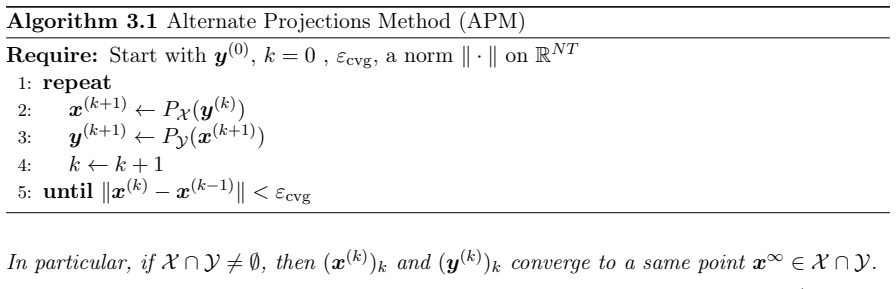
The load-bearing machinery is alternating projections (APM) applied to the private product polyhedron $X$ and the aggregate affine subspace $Y_p$. Its convergence to a pair of points, one in each set, converts the feasibility question into an optimization problem whose stationary conditions yield exact multipliers; those multipliers identify the subset of resources that is oversupplied, and the corresponding flow-feasibility inequality becomes a violated cut on the aggregate allocation $p$. A second piece is secure multiparty summation, which computes sums of agent profiles and cut constants while each agent sends only random shares, so the operator sees only aggregates. The third piece is a spectral-graph bound on the APM contraction rate in the transportation case, giving the explicit geometric rate $\left(1-\frac{4}{N(T+1)^2(T-1)}\right)^k$; this makes the finite-time tolerance argument quantitative.
What would settle it
Take a small transportation instance with rational bounds, set the APM tolerance $\varepsilon_{\mathrm{cvg}}$ above $\nu/(2B)$ while keeping $B>1/(1-\rho)$, and run Algorithm 3.3 to see whether it returns a genuinely violated cut or, on the tolerance-halving path, ever stops with a nonviolated cut. A single such instance with a wrong cut would refute the practical claim that exact cut recovery follows from the finite-time condition.
Extended reading notes
Core claim
At the core is a disaggregation oracle that learns nothing but aggregate information. Given a candidate allocation $p$, the disaggregation problem asks whether private profiles $x_n\in X_n$ sum to $p$; the paper represents this as the intersection of $X=\prod_n X_n$ with the affine subspace $Y_p$ of profiles aggregating to $p$. The discovery is that when $X\cap Y_p$ is empty, the limit of alternating projections between $X$ and $Y_p$ is not wasted information: the two limit points $x^\infty$ and $y^\infty$ encode, through which coordinates exceed their bounds, an exact feasibility inequality that $p$ violates. The paper proves this, shows that finite-time iterates can recover the exact cut constants provided tolerances are small relative to the smallest nonzero dual gap, and wraps the procedure in a secure multiparty summation so that only aggregate sums and cut data reach the operator. In the transportation case the scheme terminates after at most $2^T-2$ master iterations, and the alternating-projection subproblem has an explicit geometric rate with a $1/N$ dependence, both confirmed in numerical experiments.
Load-bearing premise
For the algorithm's guarantee to hold, the operator must know, or guess safely, two numbers that depend on the agents' private data: how fast the projection iterates contract and the size of the smallest nonzero gap between the two limit points.
Editorial extensions
If this is right
- An energy operator can optimize flexible consumption against a nonconvex generation cost while households reveal neither their appliance constraints nor their consumption profiles.
- The number of master iterations is at most $2^T-2$ in the transportation case, independent of the number of agents $N$, so large populations do not inflate the outer loop.
- Each alternating-projection step decomposes into independent local projections, so the per-iteration work parallelizes across agents, and the proved rate degrades only linearly with $N$.
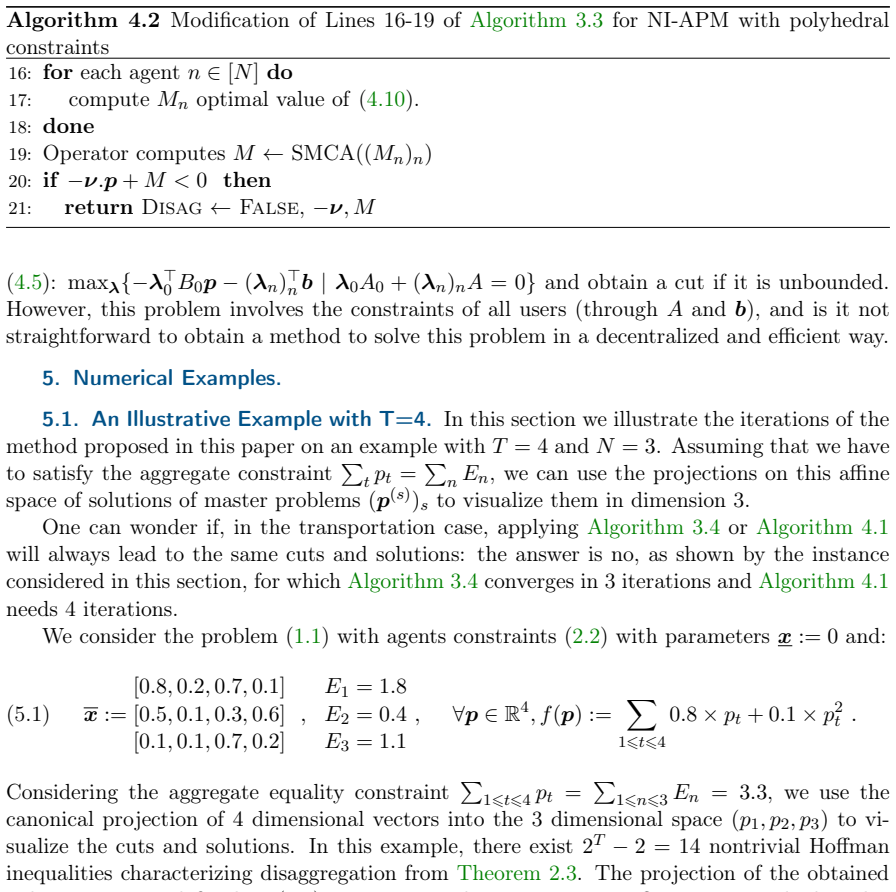
- When agent constraints are arbitrary polyhedra, the same projection limit yields decomposition-style cuts, though termination is proved only in the transportation case.
- Privacy holds against a malicious operator and against collusion of fewer than $N-1$ agents, at the level of permutation symmetry of the aggregate information.
Reading between the lines
- Editorial inference: the finite-time recovery guarantee depends on two constants, the APM contraction rate $\rho$ and the smallest nonzero dual gap $\nu$, that the operator cannot know without the private data; the paper's tolerance-halving fallback is plausible but unproven, so a stress test on adversarially scaled data would be valuable.
- Editorial inference: the privacy guarantee is permutation-level symmetry, not differential privacy; profile-level information can still leak through the sequence of cuts, so a differential-privacy version would need calibrated noise or secure aggregation with formal leakage bounds.
- Editorial inference: the per-iteration communication cost of the secure summation is $O(N)$ messages per agent; a natural extension, noted in the paper via $k$-splitting, is to trade privacy against collusion for communication cost in very large populations.
- Editorial inference: the same 'read the violated inequality from the projection limit' mechanism should transfer to other feasibility problems with a finite description of aggregate feasibility, such as polymatroid or network-flow constraints, where an analogue of the flow-feasibility inequalities exists.
Signed reviews
Editorial analysis
A structured set of objections, weighed in public.
Referee Report
Summary. The paper proposes a privacy-preserving cutting-plane method for a resource allocation problem in which a central operator minimizes a possibly nonconvex cost over an aggregate allocation p while each agent n must realize an individual profile x_n in a private feasible set X_n, and the profiles must sum to p. The authors assume first that each X_n is a transportation polytope (a demand constraint plus componentwise bounds) and later discuss a general polyhedral extension. The central idea is to solve a sequence of master problems with increasingly constrained feasible sets P^(s), and to use the Alternate Projections Method (APM) to test whether the current aggregate allocation is disaggregable. If the disaggregation is infeasible, the limit cycle of APM is used to construct a violated Hoffman inequality, which is added as a cut; secure multiparty computation (SMC) is used to compute the needed aggregates without revealing individual profiles. The paper states a finite-time version of the cut-generation procedure (Propositions 3.8 and 3.9), termination after at most 2^T - 2 cuts (Proposition 3.12), a correctness statement (Proposition 3.13), an explicit APM convergence-rate bound in the transportation case (Theorem 3.20), and numerical experiments on a nonconvex microgrid problem.
Significance. If the advertised guarantees held, this would be a valuable contribution to distributed, privacy-aware optimization: it applies to nonconvex master problems, it has a finite cut bound that is independent of the number of agents in the transportation case, and its use of SMC to protect individual constraints and iterates is a useful design. The core cut-validity argument (Theorem 3.3 and the supporting Proposition 3.4) is a self-contained and interesting piece of polyhedral analysis, and the explicit APM rate is a worthwhile attempt to quantify the linear dependence on N. However, the finite-time exactness claims depend on unverifiable data-dependent constants, the practical halving heuristic is not proven sound, and the stopping criteria of the non-intrusive algorithm are not fully specified in a privacy-preserving way. These issues are load-bearing for the central correctness theorem, so the paper needs substantial revision before the main claims can be accepted.
major comments (4)
- [§3.2, Algorithm 3.3, lines 16–22; Props. 3.8 and 3.9] The acceptance test on line 18 of Algorithm 3.3 only checks whether the candidate cut is violated by the current p. It does not verify that the set T computed on line 16 coincides with T∞. If APM has stopped with a coarse ε_cvg, the hypotheses of Proposition 3.8 may not hold, so T can differ from T∞; then Proposition 3.9 does not apply, and the returned value AT may not equal AT(x∞). The inequality sum_{t∈T} p_t ≤ AT added in Algorithm 3.4 may therefore be invalid for some feasible disaggregations, and adding it can remove true optimal allocations. The halving loop proves only that if no earlier cut is accepted, a sufficiently small ε_cvg is eventually reached; it does not exclude a false positive at an earlier, coarser precision. Proposition 3.13 is therefore not established for the algorithm as stated. The authors should either prove that passing the line-18 test implies T = T∞, or modify the algorithm so that a cut is added only after its validity is certified, for example by computing the true Hoffman right-hand side for the candidate T via SMC and adding the cut only when that valid inequality is violated.
- [§3.2, paragraph after Algorithm 3.3; Prop. 3.13] Proposition 3.13 is conditional on constants B and ε_cvg satisfying B > 1/(1−ρ) and 2B ε_cvg < ν, where ρ is the APM contraction rate and ν := min{|ν∞_t| > 0} is the smallest nonzero component of the limit multiplier. Neither ρ nor ν is known a priori, and ν depends on the private data of all agents. The paper explicitly notes that a conservative lower bound on ν could be obtained by Diophantine arguments in a rational-input model, but no such bound is stated. The suggested practical procedure—halve ε_cvg until a violated cut is found—is the same heuristic whose soundness is questioned above. The sentence 'Proposition 3.8 ensures that this loop terminates in finite time' only guarantees that the loop would eventually find the correct set if it did not return an invalid cut earlier. The constructive claim that Algorithm 3.4 computes the optimal allocation therefore needs either a certified parameter-selection procedure or a more modest statement of what is guaranteed when ν is unknown.
- [§3.2, Algorithm 3.3, lines 11–12; §3.3] The stopping conditions in Algorithm 3.3 require the values ||x^(k) − x^(k−1)|| and ||x^(k) − y^(k)||. The operator only receives the aggregate profiles S^(k) from the SMC summation protocol and cannot compute these norms from S^(k) alone, because the individual iterates x^(k)_n are private. The pseudocode does not specify a privacy-preserving procedure for evaluating these norms, and the information set I_op defined in §3.3 omits them. As written, either the algorithm is not implementable without revealing profile-level information to the operator, or the privacy analysis is incomplete. This can be repaired by having each agent send shares of its local squared norm through the same SMC mechanism, but that step must be written explicitly and its effect on the privacy guarantees must be analyzed.
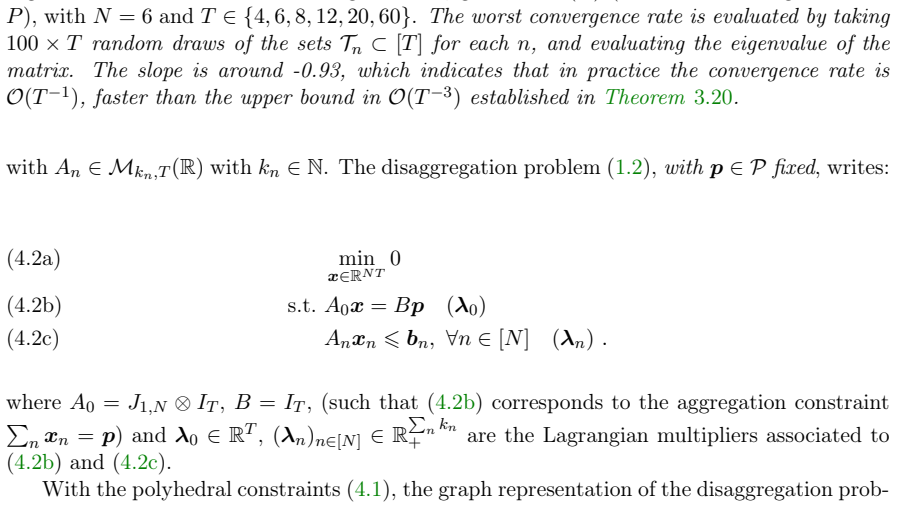
- [§3.4, Lemma 3.21 and Theorem 3.20] The proof of Theorem 3.20 relies on Lemma 3.21 to pass from the known subspace APM rate to the polyhedral sets X and Y. The lemma is quoted from [33] as an 'intuitive generalization', but no proof is given here and no precise theorem number in [33] is cited. Since the explicit convergence rate is one of the paper's main results, the authors should either prove Lemma 3.21 or provide an exact reference that establishes it. Without one, Theorem 3.20 is not fully established. This issue does not affect the cut-validity result of Theorem 3.3, but it undercuts the claimed convergence-rate contribution and, through ρ, the practical interpretability of Proposition 3.8.
minor comments (6)
- [Abstract and throughout] There are numerous typos and minor grammatical issues, e.g. 'adress' in the abstract and the '⊿' symbols in Algorithm 3.3 that appear to be intended as comments or bullets. A careful proofreading pass is needed.
- [Proposition 3.13] The statement contains a double comma in 'p(s)∈P , , ∀n∈[N]'. Additionally, the notation ‖∑_n x*_n − p(s)‖ is used without specifying which norm is meant; the algorithm uses a norm chosen by the operator, so the correctness statement should make the norm dependency explicit.
- [Proof of Proposition 3.9] The displayed chain in the proof ends with an inequality '≤' followed by 'which equals AT(x∞)'. The intended relation is an equality: by Lemma 3.10 the two expressions are identical. The inequality should be replaced by an equality to avoid confusion.
- [§4, Algorithm 4.1 and Conclusion] The paper acknowledges in the conclusion that termination of Algorithm 4.1 is not proved in the general polyhedral case. This limitation should be stated in Section 4 itself, directly after Algorithm 4.1, rather than only in the conclusion, and the algorithm should be labeled as heuristic when the polyhedral structure is arbitrary.
- [§5.2, Table 5.1] The numerical table reports only means over 100 instances. Reporting standard deviations or quartiles would strengthen the claim that the number of master iterations remains 'almost constant' and that the projection count grows sublinearly, given that the displayed means are not monotone in N.
- [§3.3, Corollary 3.17] The phrase 'cannot infer ... with probability 1' is informal. The proof only establishes permutation-invariance of the operator's information. This is a meaningful structural property, but the privacy claim should be stated more carefully, e.g. as indistinguishability of the operator's transcript under agent permutations, and the residual information leaks illustrated in Remark 3.18 should be acknowledged in the abstract or introduction if the term 'privacy-preserving' is used prominently.
Circularity Check
No circularity: the derivation is self-contained, with external Hoffman cuts and in-paper APM proofs; the ε_cvg halving heuristic is a correctness caveat, not a circular step.
full rationale
The derivation chain is self-contained. Theorem 3.3 obtains the cut from APM limit points via stationarity conditions, and the cut's validity rests on Hoffman's external feasibility theorem (Theorem 2.3, [22]); the cuts are valid inequalities, not parameters fitted to a target answer. Propositions 3.8 and 3.9 prove exact finite-time recovery of the cut under explicit hypotheses (B > 1/(1−ρ) and 2B ε_cvg < ν), and Theorem 3.20 supplies an explicit upper bound on ρ. The paper does flag that ν is unknown a priori and proposes, in Algorithm 3.3 (lines 16–22) and Remark 4.4, to halve ε_cvg until a violated cut appears; Proposition 3.8 is invoked to justify termination of that loop. This is a genuine correctness/complexity caveat—a false positive cut may be accepted before the hypotheses hold—but it is not a reduction of a claimed result to its own inputs. The only self-citation, [24], is an announcement of some results, while the present paper contains the full proofs, so that citation is not load-bearing. No fitted input is renamed as a prediction, and no uniqueness or ansatz is imported from the authors' prior work. Accordingly, there is no significant circularity.
Assumptions & free parameters
free parameters (5)
- B (cut identification threshold) =
hand-chosen; needs B > 1/(1-rho)
- epsilon_cvg (APM stopping tolerance) =
started at 0.1 in experiments, halved adaptively
- epsilon_dis (disaggregation tolerance) =
0.01 in experiments
- nu (minimal positive dual gap) =
unknown
- rho (APM contraction rate) =
upper-bounded by 1 - 4/(N(T+1)^2(T-1)) in Theorem 3.20, exact value unknown
assumptions (5)
- standard math Hoffman's circulation theorem (Theorem 2.3)
- standard math Alternating projections convergence theorem for closed convex sets (Theorem 3.2, [20])
- ad hoc to paper Face-wise Friedrichs angle bound for APM on polyhedra (Lemma 3.21, from [33])
- domain assumption Assumptions 1 and 2 (transportation-polytope constraints and aggregate constraints holding for all p in P)
- domain assumption Privacy model: honest, semi-honest, and malicious operator or agents, plus the SMC protocol security properties
Cite this review
Pith. "Pith review of A Privacy-preserving Method to Optimize Distributed Resource Allocation." pith.science (2026). https://pith.science/paper/CHZITGV2
@misc{pith2026190803080,
  author       = {Pith},
  title        = {Pith review of: A Privacy-preserving Method to Optimize Distributed Resource Allocation},
  year         = {2026},
  howpublished = {\url{https://pith.science/paper/CHZITGV2}},
  note         = {Machine review of arXiv:1908.03080}
}
read the original abstract
We consider a resource allocation problem involving a large number of agents with individual constraints subject to privacy, and a central operator whose objective is to optimize a global, possibly nonconvex, cost while satisfying the agents' constraints, for instance an energy operator in charge of the management of energy consumption flexibilities of many individual consumers. We provide a privacy-preserving algorithm that does compute the optimal allocation of resources, avoiding each agent to reveal her private information (constraints and individual solution profile) neither to the central operator nor to a third party. Our method relies on an aggregation procedure: we compute iteratively a global allocation of resources, and gradually ensure existence of a disaggregation, that is individual profiles satisfying agents' private constraints, by a protocol involving the generation of polyhedral cuts and secure multiparty computations (SMC). To obtain these cuts, we use an alternate projection method, which is implemented locally by each agent, preserving her privacy needs. We adress especially the case in which the local and global constraints define a transportation polytope. Then, we provide theoretical convergence estimates together with numerical results, showing that the algorithm can be effectively used to solve the allocation problem in high dimension, while addressing privacy issues.
Figures


Figures from the paper (5 more)


Reference graph
Works this paper leans on
-
[33]
K. K. Lai, K. Lam, and W. K. Chan , Shipping container logistics and allocation, J. Oper. Res. Soc., 46 (1995), pp. 687–697
work page 1995
-
[1]
E. A. Abbe, A. E. Khandani, and A. W. Lo , Privacy-preserving methods for sharing financial risk exposures, American Economic Review, 102 (2012), pp. 65–70
work page 2012
-
[2]
Resource Allocation and Transportation Structure. 2.1. A Decomposition Method Based on Disaggregation.As stated in the introduction, we consider a centralized entity (e.g. an energy operator) interested in minimizing a possibly nonconvex cost functionp↦→f(p), wherep∈ RT is theaggregate allocationofT dimensional resources (for example power production over...
work page 1957
-
[3]
Disaggregation Based on APM. 3.1. Generation of Hoffman’s Cuts by APM.In this section, we propose an algorithm that solves (1.1) while preserving the privacy of the agent’s constraintsXn and individual profilexn∈ RT. To do this, the proposed algorithm is implemented in a decentralized manner and relies on the method ofalternate projections(APM) to solve the...
-
[4]
Generalization to Polyhedral Agents Constraints. In this section, we extend our results to a more general framework where for eachn∈ [N],Xn is an arbitrary polyhedron, instead of having the particular structure given in (2.2). Let us now consider that(Xn)n are polyhedra with, for eachn: (4.1) Xn ={xn∈ RT|Anxn ⩽bn} , 22 Figure 3.2: Evolution of the converg...
-
[5]
Numerical Examples. 5.1. An Illustrative Example with T=4.In this section we illustrate the iterations of the method proposed in this paper on an example withT = 4 andN = 3. Assuming that we have to satisfy the aggregate constraint∑ tpt =∑ nEn, we can use the projections on this affine space of solutions of master problems(p(s))s to visualize them in dimens...
-
[6]
Conclusion. Weprovidedanon-intrusivealgorithmthatenablestocomputeanoptimal resource allocation, solution of a–possibly nonconvex–optimization problem, and affect to each agent an individual profile satisfying a global demand and lower and upper bounds constraints. Our method uses local projections and works in a distributed fashion. Hence, the resolution of...
-
[7]
Y. P. Aneja and K. P. Nair , Bicriteria transportation problem, Management Science, 25 (1979), pp. 73–78
work page 1979
Show all 50 references
-
[8]
M. F. Anjos, A. Lodi, and M. Tanneau , A decentralized framework for the optimal coordina- tion of distributed energy resources, IEEE Trans. Pow. Sys., 34 (2018), pp. 349–359
2018
-
[9]
Atallah, M
M. Atallah, M. Bykov a, J. Li, K. Frikken, and M. Topkara , Private collaborative fore- casting and benchmarking, in Proceedings of the 2004 ACM workshop on Privacy in the electronic society, 2004, pp. 103–114
2004
-
[10]
H. H. Bauschke and J. M. Bor wein , On the convergence of Von Neumann’s alternating projection algorithm for two sets, Set-Valued Analysis, 1 (1993), pp. 185–212
1993
-
[11]
, Dykstra’s alternating projection algorithm for two sets, Journal of Approximation Theory, 79 (1994), pp. 418–443
1994
-
[12]
H. H. Bauschke, J. Chen, and X. W ang , A Bregman projection method for approximating fixed points of quasi-Bregman nonexpansive mappings, Applicable Analysis, 94 (2015), pp. 75–84
2015
-
[13]
J. F. Benders , Partitioning procedures for solving mixed variables programming problems, Nu- merische mathematik, 4 (1962), pp. 238–252
1962
-
[14]
D. P. Bertsekas , Nonlinear programming, Athena Scientific, 1999
1999
-
[15]
D. P. Bertsekas and J. N. Tsitsiklis , Parallel and distributed computation: numerical meth- ods, vol. 23, Prentice hall Englewood Cliffs, NJ, 1989
1989
-
[16]
E. D. Bolker , Transportation polytopes, Journal of Combinatorial Theory, Series B, 13 (1972), pp. 251–262
1972
-
[17]
J. M. Bor wein, G. Li, and L. Yao , Analysis of the convergence rate for the cyclic projection algorithm applied to basic semialgebraic convex sets, SIAM J. Optim., 24 (2014), pp. 498–527
2014
-
[18]
Clifton, M
C. Clifton, M. Kantarcioglu, J. V aidya, X. Lin, and M. Y. Zhu , Tools for privacy preserving distributed data mining, ACM Sigkdd Explorations Newsletter, 4 (2002), pp. 28–34
2002
-
[19]
Cohen and D
G. Cohen and D. L. Zhu , Decomposition and coordination methods in large scale optimization problems: The nondifferentiable case and the use of augmented lagrangians, Adv. in Large Scale Systems 1, (1984), pp. 203–266
1984
-
[20]
W. J. Cook, W. Cunningham, W. Pulleyblank, and A. Schrijver , Combinatorial opti- mization, Springer, 2009
2009
-
[21]
Deng, M.-J
W. Deng, M.-J. Lai, Z. Peng, and W. Yin , Parallel multi-block admm with o (1/k) conver- gence, Journal of Scientific Computing, 71 (2017), pp. 712–736
2017
-
[22]
R. L. Dykstra , An algorithm for restricted least squares regression, Journal of the American Statistical Association, 78 (1983), pp. 837–842
1983
-
[23]
Glowinski and A
R. Glowinski and A. Marroco , Sur l’approximation, par éléments finis d’ordre un, et la résolution, par pénalisation-dualité d’une classe de problèmes de dirichlet non linéaires, ESAIM, 9 (1975), pp. 41–76
1975
-
[24]
Goldreich, S
O. Goldreich, S. Micali, and A. Wigderson , How to play any mental game, in Proceedings of the Nineteenth Annual ACM Symposium on Theory of Computing, STOC ’87, New York, NY, USA, 1987, Association for Computing Machinery, p. 218–229. 33
1987
-
[25]
Gubin, B
L. Gubin, B. T. Polyak, and E. Raik , The method of projections for finding the common point of convex sets, USSR Comput. Math. & Math. Phys., 7 (1967), pp. 1 – 24
1967
-
[26]
J. He, L. Cai, P. Cheng, J. Pan, and L. Shi , Consensus-based data-privacy preserving data aggregation, IEEE Trans. Autom. Control, (2019), pp. 1–1
2019
-
[27]
A. J. Hoffman , Some recent applications of the theory of linear inequalities to extremal combi- natorial analysis, in Proc. of Symposia on Applied Mathematics, 1960, pp. 113–127
1960
-
[28]
B. A. Huberman, E. Adar, and L. R. Fine , Valuating privacy, IEEE security & privacy, 3 (2005), pp. 22–25
2005
-
[29]
Jacquot, O
P. Jacquot, O. Beaude, P. Benchimol, S. Gaubert, and N. Oudjane , A privacy- preserving disaggregation algorithm for non-intrusive management of flexible energy, in IEEE 58th Conference on Decision and Control (CDC), IEEE, 2019
2019
-
[30]
Jacquot, O
P. Jacquot, O. Beaude, S. Gaubert, and N. Oudjane , Analysis and implementation of an hourly billing mechanism for demand response management, IEEE Trans. Smart Grid, 10 (2019), pp. 4265–4278
2019
-
[31]
Jagannathan, K
G. Jagannathan, K. Pillaipakkamnatt, and R. N. Wright , A new privacy-preserving distributed k-clustering algorithm, in Proc. of the 2006 SIAM Int. Conf. on Data Mining, SIAM, 2006, pp. 494–498
2006
-
[32]
Katiraei, R
F. Katiraei, R. Ira v ani, N. Hatziargyriou, and A. Dimeas, Microgrids management, IEEE power and energy magazine, 6 (2008)
2008
-
[34]
Lemaréchal, A
C. Lemaréchal, A. Nemirovskii, and Y. Nesterov , New variants of bundle methods, Math. Program., 69 (1995), pp. 111–147
1995
-
[35]
P.-Y. R. Ma et al. , A task allocation model for distributed computing systems, IEEE Trans. Computers, 100 (1982), pp. 41–47
1982
-
[36]
F. L. Müller, J. Szabó, O. Sundström, and J. Lygeros , Aggregation and disaggregation of energetic flexibility from distributed energy resources, IEEE Trans. Smart Grid, (2017)
2017
-
[37]
Munkres, Algorithms for the assignment and transportation problems, SIAM J
J. Munkres, Algorithms for the assignment and transportation problems, SIAM J. App. Math., 5 (1957), pp. 32–38
1957
-
[38]
Nishihara, S
R. Nishihara, S. Jegelka, and M. I. Jordan , On the convergence rate of decomposable submodular function minimization, in NIPS, 2014, pp. 640–648
2014
-
[39]
D. P. Palomar and M. Chiang , A tutorial on decomposition methods for network utility maximization, IEEE J. Sel. Areas Commun., 24 (2006), pp. 1439–1451
2006
-
[40]
Rais and A
A. Rais and A. Viana , Operations research in healthcare: a survey, Int. Trans. Oper. Res., 18 (2011), pp. 1–31
2011
-
[41]
M. Ruan, H. Gao, and Y. W ang , Secure and privacy-preserving consensus, IEEE Transactions on Automatic Control, 64 (2019), pp. 4035–4049
2019
-
[42]
Seong, M
K. Seong, M. Mohseni, and J. M. Cioffi , Optimal resource allocation for ofdma downlink systems, in Information Theory, 2006 IEEE Int. Sym., IEEE, 2006, pp. 1394–1398
2006
-
[43]
R.-h. Shi, Y. Mu, H. Zhong, J. Cui, and S. Zhang , Secure multiparty quantum computation for summation and multiplication, Scientific reports, 6 (2016), pp. 1–9
2016
-
[44]
Von Neumann , Functional operators: Measures and integrals, vol
J. Von Neumann , Functional operators: Measures and integrals, vol. 1, Princeton University Press, 1950
1950
-
[45]
Xiao and S
L. Xiao and S. Boyd , Optimal scaling of a gradient method for distributed resource allocation, J. Optim. Theory. Appl., 129 (2006), pp. 469–488
2006
-
[46]
L. Xiao, M. Johansson, and S. P. Boyd , Simultaneous routing and resource allocation via dual decomposition, IEEE Trans. Comm., 52 (2004), pp. 1136–1144
2004
-
[47]
A. C. Yao , How to generate and exchange secrets, in 27th Annual Symp. Found. of Comp. Sci. (SFCS), 1986, pp. 162–167
1986
-
[48]
Yu and M
H. Yu and M. J. Neely , A simple parallel algorithm with an o(1/t) convergence rate for general convex programs, SIAM J. Optim., 27 (2017), pp. 759–783
2017
-
[49]
A. Zoha, A. Gluhak, M. A. Imran, and S. Rajasegarar , Non-intrusive load monitoring 34 approaches for disaggregated energy sensing: A survey, Sensors, 12 (2012), pp. 16838–16866
2012
-
[50]
Zulhasnine, C
M. Zulhasnine, C. Huang, and A. Sriniv asan , Efficient resource allocation for device-to- device communication underlaying lte network, in WiMob, 2010 IEEE 6th Int. Conference, IEEE, 2010, pp. 368–375. 35
2010
Reviewed August 14, 2026 · model on record in the stance chip above.
Discussion (0). Continue with ORCID to comment.