REVIEW 3 major objections 5 minor 20 references
Nondiffusive Fluxes in Brownian System with Lorentz Force
T0 review · 3 major / 5 minor · reviewed 2026-08-14 · deepseek-v4-flash
Pith's one-line read For a charged Brownian particle in an inhomogeneous magnetic field, the Lorentz force creates nondiffusive fluxes that alter density evolution, except when the field is uniform or the initial density shares the field's symmetry.
desk verdict A real and useful observation about nondiffusive fluxes in inhomogeneous magnetic fields, but the 'special cases' claim in the abstract ignores the reflecting boundary condition and is too strong. read the letter →
The pith
A machine-rendered reading of the paper's core claim, the machinery that carries it, and where it could break.
The reading
What carries the argument
The central object is the position-dependent Fokker-Planck tensor $\mathbf D(\mathbf r)=\mathbf D_s(\mathbf r)+\mathbf D_a(\mathbf r)$, where $\mathbf D_s$ is the symmetric diffusion tensor and $\mathbf D_a$ is the antisymmetric part encoding how the Lorentz force curves particle trajectories. The argument turns on the divergence of the associated nondiffusive flux $\mathbf J_a=-\mathbf D_a\nabla P$. For constant $\mathbf D_a$, antisymmetry forces $\nabla\cdot\mathbf J_a=0$, but once the magnetic field varies, the term involving gradients of $\mathbf D_a$ contracted with gradients of $P$ survives and couples the flux to density evolution; only when $P$ and the field share a symmetry does this term vanish. The paper also uses this decomposition to split the total flux into diffusive and nondiffusive parts in its numerical solutions.
What would settle it
Simulate the underdamped Langevin equation with a small but finite mass for the sinusoidally varying field $\kappa(y)=-10\sin(\pi y/4)$ and rectangular initial condition, and compare the density at $t=1.0$ to the two versions of the Fokker-Planck equation (full tensor vs. symmetric part only); if the underdamped density matches the symmetric-only result instead of the full Fokker-Planck result, the premise that the overdamped equation is the correct limit fails.
Extended reading notes
Core claim
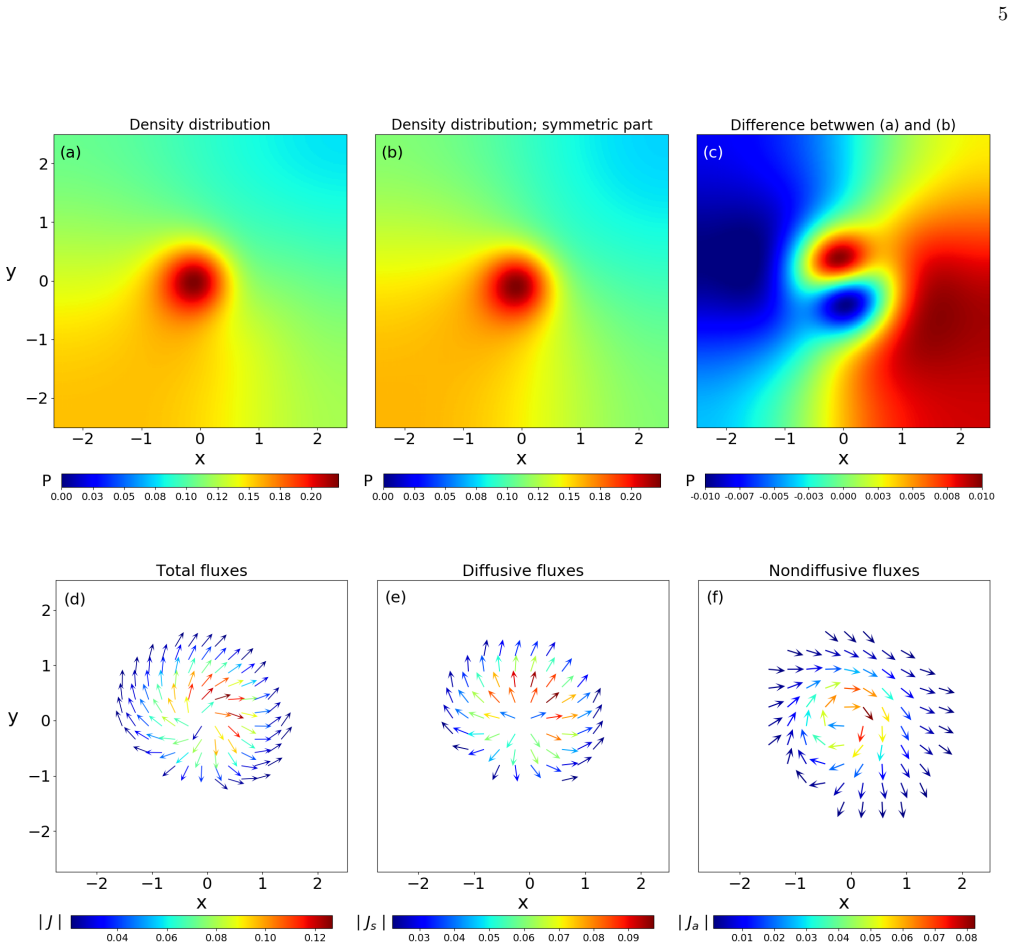
On the paper's own terms, the discovery is that the nondiffusive fluxes generated by the Lorentz force are not always bystanders in the density evolution. Writing the Fokker-Planck coefficient as $\mathbf D(\mathbf r)=\mathbf D_s+\mathbf D_a$ and the flux as $\mathbf J=-\mathbf D\nabla P$, the antisymmetric part gives a contribution $\mathbf J_a=-\mathbf D_a\nabla P$ that is perpendicular to $\nabla P$. In a constant field $\mathbf D_a$ is constant and antisymmetric, so $\nabla\cdot\mathbf J_a=0$; in an inhomogeneous field the divergence has an extra term involving gradients of $\mathbf D_a$ contracted with gradients of $P$, which is generically nonzero. The paper therefore claims that, unless the density distribution has the same symmetry as the field, or the field is uniform, $\mathbf J_a$ contributes directly to $\partial_t P$. Numerical solutions for a Gaussian-shaped field centred at the origin, with the initial cloud displaced by $(-0.3,-0.3)$, and for a sinusoidally varying field $\kappa(y)=-10\sin(\pi y/4)$ with a rectangular initial cloud, show that the density differs from the dynamics that keeps only $\mathbf D_s$.
Load-bearing premise
The central result relies on the overdamped Fokker-Planck equation with the position-dependent magnetic tensor being exactly the small-mass limit of the underlying Langevin equation; the paper takes this limit from earlier work rather than deriving it freshly.
Editorial extensions
If this is right
- For any spatially varying magnetic field, the density evolution must include the antisymmetric part of the tensor; omitting it changes the predicted density whenever the initial state breaks the field symmetry.
- In a uniform magnetic field, density evolution is the same with or without the antisymmetric part, even though the actual particle flux has a rotational component; flux measurements, not just density measurements, are then needed to see the Lorentz force.
- When the initial density shares the symmetry of the magnetic field, the antisymmetric part can be dropped for density evolution, but only for that special initial condition; a small displacement restores its influence.
- The equilibrium density remains uniform and independent of the magnetic field, so the nondiffusive fluxes are a transient, nonequilibrium effect that disappears at long times.
- The nondiffusive fluxes can distort an initially rectangular cloud into a non-rectangular shape, whereas the symmetric-only dynamics would keep it rectangular.
Reading between the lines
- Inference: The nondiffusive contribution can be rewritten as an effective advection velocity $\mathbf v_{\rm eff} = -(\mathbf D_a\nabla P)/P$; measuring this velocity in particle-tracking experiments would isolate the Lorentz-force contribution from ordinary diffusion.
- Inference: The symmetry condition suggests a bifurcation in which the density difference between full and symmetric-only dynamics grows monotonically as the initial cloud is displaced from the field centre; this is a directly testable prediction the paper's examples illustrate but do not scan.
- Inference: For interacting or active particles, the same finite-divergence mechanism would inject a nonlocal current into the coarse-grained density evolution, plausibly shifting phase-separation thresholds or steady-state fluxes in spatially varying fields.
Signed reviews
Editorial analysis
A structured set of objections, weighed in public.
Referee Report
Summary. The manuscript studies the Fokker-Planck equation (3) for an overdamped Brownian particle in an inhomogeneous magnetic field, where the diffusion tensor contains an antisymmetric part Da giving nondiffusive fluxes Ja = -Da ∇P. The authors argue that for inhomogeneous fields, ∇·Ja is generally nonzero and therefore Ja contributes to the density evolution; exceptions are a uniform field and initial conditions sharing the symmetry of the field. They support this with finite-difference solutions for constant, radially symmetric, and y-dependent magnetic fields, comparing full dynamics with dynamics retaining only the symmetric part Ds.
Significance. The paper gives a useful and essentially parameter-free criterion for when the antisymmetric part of the diffusion tensor can be omitted from the continuity equation, which matters for coarse-grained modeling of charged Brownian particles in magnetic fields. The core antisymmetry argument is standard and correctly applied to the bulk divergence, and the numerical examples illustrate the claimed effect. However, the paper overstates the special cases by neglecting the reflecting boundary condition and by claiming exhaustiveness of the symmetry-based classification.
major comments (3)
- [§II.A and Abstract] The conclusion that a divergence-free Ja implies that the nondiffusive flux does not affect the density evolution is not valid for the reflecting bounded domain defined in Section II. With the boundary condition n·(Js+Ja)=0, the weak form of the Fokker-Planck equation contains a boundary integral involving n·Ja; even when ∇·Ja=0, this boundary term is generally nonzero, so the solution of the full problem differs from the solution obtained by dropping Ja and imposing n·Js=0. The numerical snapshots in Figs. 1 and 2 are at times and box sizes for which the density has not yet reached the boundary, so they do not test this. The abstract's 'only in the special cases...' is therefore too strong as stated.
- [§II.B] The radially symmetric example uses a square computational domain, which does not share the rotational symmetry of the magnetic field. The assertion that P(r,t) remains a function of r only is exact only on a rotationally symmetric domain; on a square with reflecting boundaries, the solution is not exactly radial for any positive time, and the deviation becomes significant once the density reaches the boundary. The statement that the initial condition has 'the same symmetry as the magnetic field' is insufficient in a square box. The authors should either restrict the claim to times before boundary contact or use a domain that respects the symmetry, such as a circle.
- [Abstract, §II.B, and §III] The 'only' classification is not exhaustive. For a two-dimensional field with α(r)=κ/(1+κ^2), one obtains ∇·Ja = α_y P_x - α_x P_y, which vanishes whenever ∇P is parallel to ∇α, not only for radial symmetry. For example, a field depending only on x with an initial condition depending only on x gives zero divergence of Ja, assuming boundary conditions are compatible. The paper should either prove exhaustiveness or phrase the conclusion as 'the divergence is generally nonzero rather than zero only in these cases.'
minor comments (5)
- [Eq. (4)] The typeset expression for D(r) is garbled and difficult to read; please rewrite it with explicit brackets and define M^2 and the action of M on vectors.
- [Fig. 4 caption] The caption appears to swap 'perpendicular' and 'parallel' for the diffusive and nondiffusive fluxes: the main text correctly states that in Fig. 4(e) the diffusive fluxes are parallel to the density gradient, whereas the caption says they are perpendicular.
- [§II.A and §II.C] There are several typos, including 'centred at , respectively origin' and 'Figs. (d-e)' which should be 'Figs. 3(d)-(f)'.
- [§II numerical method] The discretization of the reflecting boundary condition n·J=0 is not described; since the boundary condition is central to the issues raised above, please specify how it is implemented for both the full dynamics and the symmetric-only dynamics.
- [Abstract] The phrase 'finite divergence' is ambiguous; the intended meaning appears to be 'generally nonzero divergence', which should be stated explicitly.
Circularity Check
No significant circularity; the inhomogeneous-field result is a direct consequence of the cited Fokker–Planck tensor, with independent support from Ref [5].
full rationale
The paper's central assertion follows by direct differentiation of the position-dependent tensor D(r)=D_s(r)+D_a(r) given in Eq. (4), which is presented as a known result with citations to Refs [2,5]. Ref [5] (Hottovy, McDaniel, Volpe, Wehr) is an independent mathematical derivation of the Smoluchowski–Kramers limit with state-dependent friction, so the starting Fokker–Planck equation is not imported solely from the authors' own prior work. No parameter is fitted to the target observation: the numerical experiments compare the full evolution (3) with the evolution retaining only D_s, and the difference is a consequence of the model, not a fitted outcome. The special cases in which the nondiffusive fluxes are said to be ignorable are algebraic identities: ∇·J_a=0 follows from the antisymmetry of D_a contracted with the symmetric Hessian (constant field) or from the orthogonality of ∇D_a and ∇P under radial symmetry. These are exact consequences of the stated definitions rather than assumed conclusions. The only caveats raised by a critical reader—boundary contributions in the weak form and the square domain breaking radial symmetry—are correctness issues for the statements as applied to bounded domains, not circularity in the derivation chain. Accordingly, no circular step is present.
Assumptions & free parameters
assumptions (4)
- domain assumption The overdamped Fokker-Planck equation ∂P/∂t = ∇·[D(r)∇P] with D(r) from Eq. (4) is the correct small-mass limit of Eq. (1) for position statistics and fluxes.
- standard math The probability density and field profiles are smooth enough for the antisymmetric part D_a to contract with the symmetric Hessian to zero.
- domain assumption Reflecting boundaries with nb·J=0 model the confinement.
- domain assumption The explicit finite-difference scheme with ∆t=5e-5 and ∆x=∆y=0.01 converges to the solution of Eq. (3).
Cite this review
Pith. "Pith review of Nondiffusive Fluxes in Brownian System with Lorentz Force." pith.science (2026). https://pith.science/paper/GVJ4EGK3
@misc{pith2026190803101,
  author       = {Pith},
  title        = {Pith review of: Nondiffusive Fluxes in Brownian System with Lorentz Force},
  year         = {2026},
  howpublished = {\url{https://pith.science/paper/GVJ4EGK3}},
  note         = {Machine review of arXiv:1908.03101}
}
read the original abstract
The Fokker-Planck equation provides complete statistical description of a particle undergoing random motion in a solvent. In the presence of Lorentz force due to an external magnetic field, the Fokker-Planck equation picks up a tensorial coefficient, which reflects the anisotropy of the particle's motion. This tensor, however, can not be interpreted as a diffusion tensor; there are antisymmetric terms which give rise to fluxes perpendicular to the density gradients. Here, we show that for an inhomogeneous magnetic field these nondiffusive fluxes have finite divergence and therefore affect the density evolution of the system. Only in the special cases of a uniform magnetic field or carefully chosen initial condition with the same symmetry as the magnetic field can these fluxes be ignored in the density evolution.
Figures


Figures from the paper (1 more)

Reference graph
Works this paper leans on
-
[1]
H.-M. Chun, X. Durang, and J. D. Noh, Emergence of nonwhite noise in langevin dynamics with magnetic lorentz force, Physical Review E 97, 032117 (2018)
work page 2018
-
[2]
H. D. Vuijk, J. M. Brader, and A. Sharma, Anomalous fluxes in overdamped brownian dynamics with lorentz force, Journal of Statistical Mechanics: Theory and Ex- periment 2019, 063203 (2019)
work page 2019
-
[3]
Langevin, Sur la th´ eorie du mouvement Brownien, C
P. Langevin, Sur la th´ eorie du mouvement Brownien, C. R. Acad. Sci. 146, 530 (1908)
work page 1908
-
[4]
Gardiner, Stochastic Methods (Springer Berlin, 2009)
C. Gardiner, Stochastic Methods (Springer Berlin, 2009)
2009
-
[5]
S. Hottovy, A. McDaniel, G. Volpe, and J. Wehr, The smoluchowski-kramers limit of stochastic differential equations with arbitrary state-dependent friction, Com- munications in Mathematical Physics 336, 1259 (2015)
work page 2015
-
[6]
G. Volpe and J. Wehr, Effective drifts in dynamical systems with multiplicative noise: a review of recent progress, Reports on Progress in Physics 79, 053901 (2016)
work page 2016
-
[7]
H. D. Vuijk, A. Sharma, D. Mondal, J.-U. Sommer, and H. Merlitz, Pseudochemotaxis in inhomogeneous active brownian systems, Physical Review E 97, 042612 (2018)
work page 2018
-
[8]
M. E. Cates and J. Tailleur, When are active brown- ian particles and run-and-tumble particles equivalent? consequences for motility-induced phase separation, EPL (Europhysics Letters) 101, 20010 (2013)
work page 2013
Show all 20 references
-
[9]
T. F. Farage, P. Krinninger, and J. M. Brader, Effective interactions in active brownian suspensions, Physical Re- view E 91, 042310 (2015)
2015
-
[10]
Sharma and J
A. Sharma and J. M. Brader, Communication: Green- kubo approach to the average swim speed in active brow- nian systems (2016)
2016
-
[11]
Stenhammar, R
J. Stenhammar, R. Wittkowski, D. Marenduzzo, and M. E. Cates, Light-induced self-assembly of active rec- tification devices, Science advances 2, e1501850 (2016)
2016
-
[12]
Sharma, R
A. Sharma, R. Wittmann, and J. M. Brader, Escape rate of active particles in the effective equilibrium approach, Physical Review E 95, 012115 (2017)
2017
-
[13]
Sharma and J
A. Sharma and J. M. Brader, Brownian systems with spatially inhomogeneous activity, Physical review E 96, 032604 (2017)
2017
-
[14]
H. D. Vuijk, J. U. Sommer, H. Merlitz, J. M. Brader, and A. Sharma, Lorentz forces induce inhomogeneity and fluxes in active systems, arXiv 1908.02577 (2019)
2019 arXiv
-
[15]
Balakrishnan, Elements of Nonequilibrium Statistical Mechanics (Ane Books, 2008)
V. Balakrishnan, Elements of Nonequilibrium Statistical Mechanics (Ane Books, 2008)
2008
-
[16]
Cerrai and M
S. Cerrai and M. Freidlin, Small mass asymptotics for a charged particle in a magnetic field and long-time influ- ence of small perturbations, Journal of Statistical Physics 144, 101 (2011)
2011
-
[17]
Freidlin and M
M. Freidlin and M. Weber, Perturbations of the motion of a charged particle in a noisy magnetic field, Journal of Statistical Physics 147, 565 (2012)
2012
-
[18]
Adams, The hall and corbino effects, in Proc
E. Adams, The hall and corbino effects, in Proc. Am. Phil. Soc, Vol. 54 (1915) pp. 47–51
1915
-
[19]
A. J. Archer and R. Evans, Dynamical density functional theory and its application to spinodal decomposition, The Journal of chemical physics 121, 4246 (2004)
2004
-
[20]
H. D. Vuijk, J. M. Brader, and A. Sharma, Effect of anisotropic diffusion on spinodal decomposition, Soft matter 15, 1319 (2019)
2019
Reviewed August 14, 2026 · model on record in the stance chip above.
Discussion (0). Continue with ORCID to comment.