REVIEW 3 major objections 3 minor 7 references
Entanglement distance for an arbitrary state of M qubits
T0 review · 3 major / 3 minor · reviewed 2026-08-14 · deepseek-v4-flash
Pith's one-line read A single distance formula gives an entanglement measure for any pure M-qubit state.
desk verdict The scalar measure is Meyer-Wallach in disguise, and the advertised distance interpretation uses the wrong line element; the metric construction is nice but the paper overclaims. read the letter →
The pith
A machine-rendered reading of the paper's core claim, the machinery that carries it, and where it could break.
The reading
What carries the argument
The central object is the entanglement metric $\tilde{g}=g(\tilde{v}_\nu)$, defined as the Fubini-Study metric---the natural infinitesimal distance on the space of pure quantum states---restricted to infinitesimal rotations of each qubit and evaluated at the orientation $\{\tilde{v}_\nu\}$ that minimizes $\operatorname{tr}(g)$. The measure is the minimized trace itself. This object carries the argument because it turns entanglement, a property that must be unchanged under local operations, into a geometric distance along the directions swept out by local rotations; the infimum removes the dependence on the particular local unitaries, and the eigenvalues of $\tilde{g}$ encode how the distance grows in different directions.
What would settle it
Minimize $\operatorname{tr}(g)$ numerically over the $3M$ angles defining the orientations $v_\nu$ for a state such as $|r,\pi/2\rangle_7$ from Eq. (13): if any orientation yields a trace below the paper's closed-form value (22), or if the search approaches an infimum that is never attained, then Eq. (7) does not define a well-defined entanglement measure on all pure states.
Extended reading notes
Core claim
The paper's central claim is that $E(|s\rangle)=\inf_{\{v_\nu\}}\operatorname{tr}(g)$, the Fubini-Study metric pulled back to infinitesimal local $SU(2)$ rotations and minimized over all local orientations, is an entanglement measure valid for every pure state of $M$ qubits. It has the three properties demanded of such a measure here: invariance under local unitary transformations, value zero on fully separable states, and maximum value $M/4$ on maximally entangled states. On the one-parameter families and the two-parameter three-qubit family studied, the formula gives zero at separable parameter values, $1/4$ per qubit at maximally entangled values, and intermediate values elsewhere; it also reproduces the known fact that the maximally entangled states of the two one-parameter families are equivalent for $M\le 3$ but inequivalent for $M\ge 4$.
Load-bearing premise
The definition of $E$ requires the infimum over local orientations to be attained for every pure state, and the paper excludes pathological cases only 'in measure' without giving a topology or regularity condition that guarantees the minimum exists; if some state lacks a minimizing orientation, $E(|s\rangle)$ is undefined and the example calculations do not apply to that state.
Editorial extensions
If this is right
- For any pure $M$-qubit state, the formula gives a numerical entanglement value that cannot depend on which local unitaries were used to prepare it, because the infimum removes exactly that freedom.
- Fully separable states get $E=0$ and maximally entangled states get $E=M/4$, so the measure produces the expected endpoints for the classes on which it is tested.
- The inequality $ds^2 \ge E(|s\rangle)\,dr^2$ gives the measure a direct geometric reading: entanglement is the minimum density of distance between a state and its infinitesimally locally rotated neighbours.
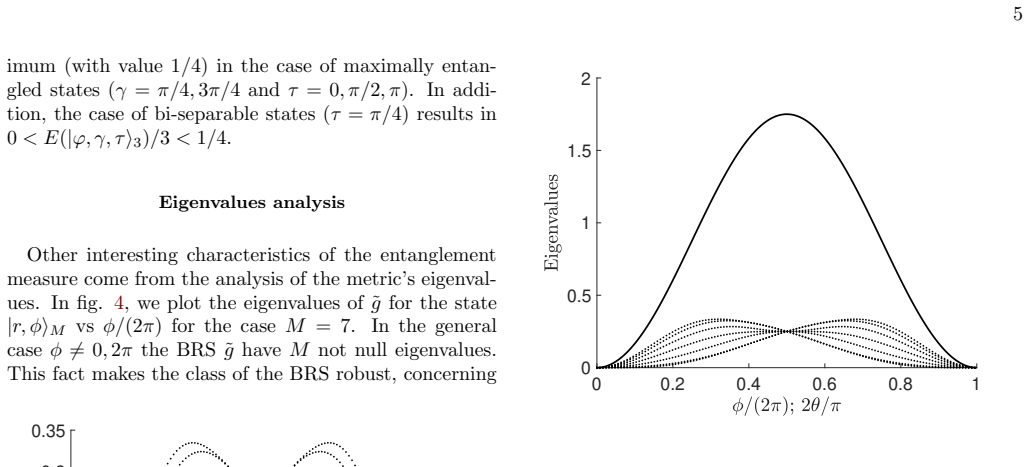
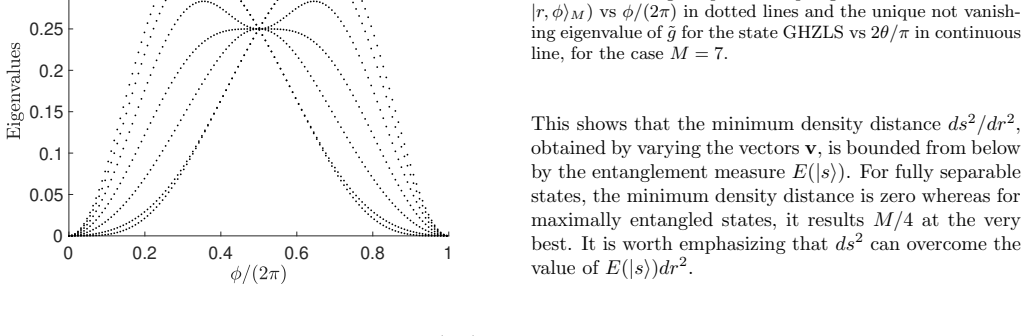
- The eigenvalue spectrum of $\tilde{g}$ distinguishes robust from fragile entanglement: the GHZ-like family has one nonzero eigenvalue and $M-1$ zero directions, while the first family has $M$ nonzero eigenvalues, and the paper suggests this kind of analysis can flag states with super-Heisenberg metrological sensitivity.
Reading between the lines
- Not explored in the paper: $E$ could be computed for arbitrary random $M$-qubit states by numerical minimization over the $3M$ local angles, providing values for states outside the special families and stress-testing the closed-form minimizers.
- Because the Fubini-Study trace corresponds to the quantum Fisher information, one reading of the construction is that $E$ is the worst-case quantum Fisher information over local orientations; that link would make $E$ a potential metrological quantifier, though the paper does not develop this.
- A natural extension would be to define entanglement of mixed states by minimizing $E$ over pure-state decompositions, but nothing in the paper addresses mixed states.
- The eigenvalue count could be turned into a scalar robustness index that orders states by how many local directions preserve a large distance, extending the paper's one-versus-$M$ eigenvalue comparison.
Signed reviews
Editorial analysis
A structured set of objections, weighed in public.
Referee Report
Summary. The paper proposes a pure-state entanglement quantifier for M qubits. For a state |s>, the authors consider the Fubini-Study metric g pulled back to the manifold of local unitary rotations of |s>, and define E(|s>) = inf_{v_ν} tr(g) in Eq. (7), where the infimum is over orientations of local rotation axes. They call E an entanglement distance, claim it is invariant under local unitary transformations, vanishes on fully separable states, and reaches M/4 on maximally entangled states. Explicit formulas are derived for the Briegel-Raussendorf states, the GHZ-like states, and a two-parameter three-qubit family, and the eigenvalues of the minimizing metric g̃ are used to discuss robustness and super-Heisenberg sensitivity.
Significance. If the central distance interpretation were correct, the paper would supply a computable and intuitive entanglement measure for arbitrary pure states. The explicit formulas in Eqs. (14)-(30) appear internally consistent and correctly reproduce the expected zero values for separable states and the maximal value for the GHZ-like states. However, the claimed Fubini-Study distance interpretation is contradicted by the paper's own GHZ-like example, and the quantity E is not a new entanglement measure but an affine function of the Meyer-Wallach measure. The main conceptual contribution therefore does not survive; what remains is a set of correct but elementary calculations concerning single-qubit reduced density matrices.
major comments (3)
- [Results, Eq. (31)] Eq. (31) identifies the distance to an infinitesimally close state with ds^2 = tr(g(v)) dr^2, but this is not the Fubini-Study line element defined by Eq. (5). The line element is the quadratic form dξ^T g(v) dξ. For the GHZ-like states at the minimizing orientations, Eq. (25) gives g̃ = (sin^2 2θ/4) J_M. For the tangent vector dξ = (1,-1,0,...,0), one has dξ^T g̃ dξ = 0, so the actual Fubini-Study distance vanishes, while Eq. (26) gives E = M/4 sin^2 2θ > 0 for θ not equal to 0 or π/2. Thus the inequality in Eq. (31) is a trivial consequence of E = inf tr(g) and does not bound the true minimum distance; property ii in the Introduction is false as stated.
- [Eq. (7)] The paper does not prove that E is an entanglement monotone; local-unitary invariance and the worked examples are insufficient for the claim that Eq. (7) is an entanglement measure. Moreover, because the trace in Eq. (7) involves only the diagonal of g, the minimization factorizes and E(|s>) = (1/4) Σ_j (1 - |r_j|^2) = Σ_j det ρ_j, where ρ_j is the single-qubit reduced density matrix. Up to a factor M/4 this is the Meyer-Wallach measure Q_MW, so the proposal carries no information beyond single-qubit purities and is not a distance-based measure of multipartite correlations. In particular, the four-qubit cluster state and the four-qubit GHZ state both have E = 1 even though they are not locally equivalent.
- [Eigenvalues analysis] The robustness and super-Heisenberg sensitivity statements in the Eigenvalues analysis are not supported by the definition of E. The eigenvalues of g̃ describe the quadratic form dξ^T g̃ dξ if g̃ is treated as a metric, but the entanglement measure E is the trace, not the minimum eigenvalue or a directional distance. Therefore the observation that the GHZLS have M-1 zero eigenvalues in Fig. 5 indicates that the actual Fubini-Study metric has null directions, which contradicts the advertised interpretation of E as an obstacle to infinitesimal distances; the eigenvalue discussion does not repair the central flaw.
minor comments (3)
- [Eq. (7)] The phrase "in measure" after Eq. (7) is undefined: for a fixed state |s>, tr(g) is a continuous function on a compact product of unit spheres, so the infimum is attained and no exclusion of pathological cases is needed.
- [Eq. (5)] The notation in Eq. (5) uses the index ν both as a free index and as a label in v_ν, which is confusing; please distinguish the metric components g_{μν} from the unit vectors v_ν.
- [Eigenvalues analysis] The term "super-Heisenberg sensitivity" is used without a definition, and the precise connection between the eigenvalues of g̃ and metrological sensitivity is not stated.
Circularity Check
One minor self-definitional step: Eq. (31) restates the definition of E as an infimum; the numerical measure is not circular.
-
self definitional
[Results, Eq. (31), relying on Eq. (7)]
"by defining the distance between a given state represented by the vector |U,s> and an infinitesimally close state associated with the vector |dU,s> as ds2 = tr(g(v))dr2 where sum(dξµ)^2 = dr2, it results ds2≥E(|s>)dr2. (31)"
E(|s>) is defined in Eq. (7) as inf_v tr(g), and ds^2 is defined as tr(g(v)) dr^2. Therefore ds^2 ≥ E(|s>) dr^2 is not a derived bound but the definition of an infimum: it holds for every v by construction. The advertised interpretation of entanglement as an 'obstacle to the minimum distance between infinitesimally close states' is thus a restatement of the measure's definition, not an independent result. The circularity is local and interpretive; the example calculations of E are direct evaluations and do not inherit this tautology.
full rationale
The construction of E in Eq. (7) is self-contained: no parameter is fitted to data, no external entanglement formula is used as input, and the invariance under local unitaries is built into the infimum over all local orientations. The results for BRS, GHZLS, and the two-parameter three-qubit family are direct computations from the definition, and the agreement with known maximally-entangled cases is a check, not a fit. No load-bearing self-citation or imported uniqueness theorem appears; reference [5] supplies independent facts about state equivalence. The only circular feature is the interpretive inequality Eq. (31), which restates the defining infimum; it does not affect the numerical content of the proposed measure.
Assumptions & free parameters
assumptions (4)
- standard math The Fubini-Study metric (1) is the correct metric on the projective Hilbert space.
- standard math For a pure state, the local operators v_μ·σ_μ for different qubits commute and (v_μ·σ_μ)^2 = I, so the trace of g depends only on diagonal elements.
- ad hoc to paper The infimum over unit vectors v_ν is well-defined and attained for every pure state; pathological cases are excluded by fiat ('in measure').
- ad hoc to paper The eigenvalues of ~g determine the robustness of entanglement and can indicate super-Heisenberg sensitivity.
Cite this review
Pith. "Pith review of Entanglement distance for an arbitrary state of M qubits." pith.science (2026). https://pith.science/paper/JRHHAE6Y
@misc{pith2026190803117,
  author       = {Pith},
  title        = {Pith review of: Entanglement distance for an arbitrary state of M qubits},
  year         = {2026},
  howpublished = {\url{https://pith.science/paper/JRHHAE6Y}},
  note         = {Machine review of arXiv:1908.03117}
}
abstract
We propose a measure of entanglement that can be computed for any pure state of an $M$-qubit system. The entanglement measure has the form of a distance that we derive from an adapted application of the Fubini-Study metric. This measure is invariant under local unitary transformations and defined as trace of a suitable metric that we derive, the entanglement metric $\tilde{g}$. Furthermore, the analysis of the eigenvalues of $\tilde{g}$ gives information about the robustness of entanglement.
Figures


Figures from the paper (1 more)
Reference graph
Works this paper leans on
-
[1]
+s(v2 2−v0 2) )2] /4, (17) is minimised with the choices ˜v0 = ( c,−s, 0), ˜v1 = (1, 0, 0) and ˜v2 = (c,s, 0). The EM and the entangle- ment measure in this case results to be ˜g = s2 4 1 c −2s2c2 c 1 +c2 c −2s2c2 c 1 (18) and E(|r,φ⟩3) = s2 4 ( 3 +c2) , (19) respectively. By direct calculation, one can verify that in the case of the maximally ent...
- [2]
- [3]
-
[4]
V. Giovannetti, S. Mancini, D. Vitali, and P. Tombesi, Phys. Rev. A 67, 022320 (2003)
work page 2003
-
[5]
Gibbons, Journal of Geometry and Physics 8, 147 (1992)
G. Gibbons, Journal of Geometry and Physics 8, 147 (1992)
work page 1992
-
[6]
H. J. Briegel and R. Raussendorf, Phys. Rev. Lett. 86, 910 (2001)
work page 2001
-
[7]
D. M. Greenberger, M. Horne, and A. Zeilinger, edited by M. Kafatos, Dordrecht, p. 69 (1989)
work page 1989
Reviewed August 14, 2026 · model on record in the stance chip above.
Discussion (0). Continue with ORCID to comment.