REVIEW 3 major objections 4 minor 44 references
Dynamic Scale Inference by Entropy Minimization
T0 review · 3 major / 4 minor · reviewed 2026-08-14 · deepseek-v4-flash
Pith's one-line read This paper claims that minimizing prediction entropy during inference—by iteratively updating classifier and scale parameters—improves semantic segmentation accuracy and generalizes beyond feedforward dynamic scale prediction under large…
desk verdict Entropy-minimizing test-time adaptation for dynamic scale inference is a simple, sensible idea with modest but consistent gains on PASCAL VOC; the main risks are unreleased code, single-run numbers, and an unvalidated entropy-as-accuracy proxy. read the letter →
The pith
A machine-rendered reading of the paper's core claim, the machinery that carries it, and where it could break.
The reading
What carries the argument
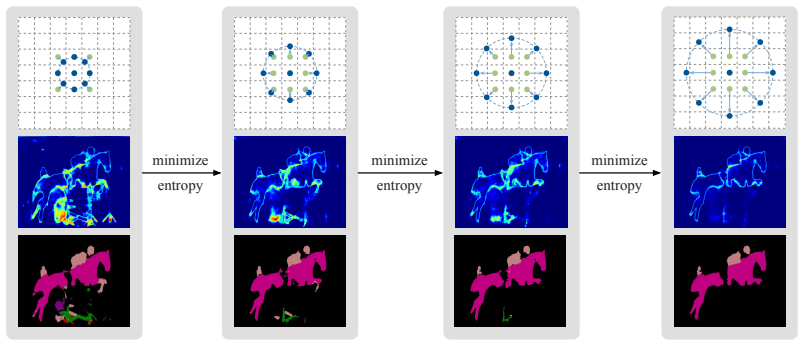
The objective is the sum of per-pixel Shannon entropies, restricted to pixels whose entropy is above the current mean: $\mathcal{L}(\hat{Y}) = \sum_{(i,j)\in S} H_{i,j}(\hat{Y})$ with $S = \{(i,j): H_{i,j} > H_\mu\}$. The variables are the task parameters $\theta_{\text{score}}$ of the final classification filter and the structure parameters $\theta_{\text{scale}}$ of the scale regressor; both are updated by gradient descent (Adam) at test time. Updating these shared parameters indirectly updates the local predictions $\hat{Y}$ and local receptive-field scales $\hat{\Sigma}$, which avoids degenerate input-independent solutions and keeps the optimized set small. A partial forward pass then re-infers predictions and scales for the next iteration.
What would settle it
Measure, on a held-out scale-shifted set, the per-pixel accuracy and expected calibration error before and after 32 optimization steps, restricted to pixels whose entropy decreases; if mean IoU on those pixels falls or calibration worsens while entropy falls, the entropy-to-accuracy proxy is disproven for that setting.
Extended reading notes
Core claim
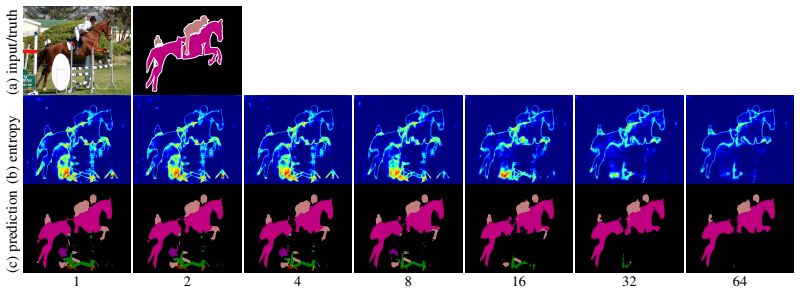
The central discovery is that inference-time optimization over a small, constrained set of parameters—the output classification filter and the scale regression filter of a dynamic Gaussian receptive field network—can outperform one-step feedforward scale prediction. Optimizing the sum of thresholded per-pixel entropies of the segmentation output for about 32 gradient steps raises accuracy on shifted test scales and also gives a small refinement at the training scale. The scale parameters matter most: adversarially maximizing entropy through them destroys accuracy, and the oracle (minimizing true cross-entropy to ground truth) still improves beyond entropy minimization, showing the method helps while leaving headroom.
Load-bearing premise
The load-bearing premise is that lowering the Shannon entropy of the per-pixel class predictions moves the model toward correct, confident labels rather than toward confidently wrong ones, even when the input is outside the training scale distribution.
Editorial extensions
If this is right
- Adaptation during inference can be added to an already trained dynamic model without retraining or changing its architecture; the improvement is obtained purely at test time.
- The gain over feedforward scale regression grows as the scale shift grows, so test-time optimization is most useful exactly where predictors are weakest.
- The number of optimization steps controls computation, so the degree of adaptation can be traded against inference cost; 32 steps suffice in the experiments.
- Because entropy minimization also improves accuracy at the training scale, the objective behaves as a general test-time refinement, not only a correction for large shifts.
- Adversarial entropy maximization lowers accuracy substantially, confirming that the structure parameters for scale carry much of the adaptation.
Reading between the lines
- The entropy objective could be viewed as a form of test-time self-training: it sharpens already confident predictions while ignoring the most uncertain pixels through the mean threshold; combining it with consistency regularization across scales might be even stronger.
- The gap between entropy minimization and the oracle implies the chosen objective is only a partial proxy for accuracy; an objective based on calibrated confidence or local scale consistency might capture more of the oracle's gains.
- The same mechanism may transfer to other dynamic parameters beyond scale—orientation, location, or feature transformation—because the optimization only requires an unsupervised output statistic and a small set of structure parameters.
- One testable extension is to run the optimization with a convergence rule such as relative tolerance instead of fixed steps; the paper notes this possibility, and it could adapt computation per image.
Signed reviews
Editorial analysis
A structured set of objections, weighed in public.
Referee Report
Summary. This paper proposes a test-time optimization procedure for dynamic scale inference in semantic segmentation. It extends a feedforward dynamic Gaussian receptive-field model [35] by iteratively updating the classification (score) and scale-regression (scale) parameters to minimize an unsupervised Shannon-entropy objective over above-average-entropy pixels (Eq. 2). Experiments on PASCAL VOC under scale shifts from 1.5x to 4x report consistent mIoU improvements over the feedforward baseline, with ablations comparing optimization variables, iteration counts, oracle optimization, and adversarial optimization.
Significance. If the empirical claims hold, the paper demonstrates a simple, label-free mechanism for adapting a trained segmentation model to out-of-distribution scale shifts, and the conceptual move from one-step dynamic prediction to iterative test-time optimization is interesting. The strengths are the clean objective formulation, the oracle/adversary controls in Table 3, and the consistent direction of the reported improvements. However, the significance is currently bounded by the absence of comparisons to independently implemented dynamic-scale or multi-scale baselines, by the lack of error bars or significance tests, and by the fact that the baseline is the authors' own prior model. Reproducibility is also weakened because code and models are promised but not actually released in the manuscript.
major comments (3)
- [Section 2.1 / Table 2] Table 2 shows that at 3.5x and 4x scale shifts in the without-augmentation condition, increasing the number of optimization steps from 32 to 128 lowers mIoU (35.8 to 35.2 and 29.2 to 28.5, respectively), even though both runs minimize the same entropy objective. This decoupling between entropy minimization and accuracy indicates that the reported gains at 32 steps are contingent on a stopping rule selected from a validation sweep, and it directly weakens the abstract's claim that the method generalizes better to extreme scale variations. Please report per-iteration curves of the objective value and mIoU, and directly test whether a decrease in entropy predicts an increase in IoU at the per-image level for each scale shift.
- [Section 3.1 / Tables 1 and 2] The central empirical claim rests on improvements of roughly 0.8 to 2.0 mIoU from a single validation run, with no error bars, bootstrap intervals, or significance tests. Without this information it is difficult to assess whether the consistent-looking improvements are meaningful, especially for the small gains at 1.5x and 2.0x with data augmentation. Please report variance over multiple training runs or bootstrap confidence intervals over the validation set.
- [Section 3.1] The only dynamic-scale baseline is the authors' own prior model [35], which also serves as the initialization for the proposed method. To substantiate the claim of generalization beyond feedforward dynamic inference, the paper should compare with at least one independently implemented or well-established alternative, such as test-time multi-scale pyramid evaluation or a deformable-convolution-based scale-adaptive model, under matched inference compute.
minor comments (4)
- [Section 2.2] The word 'alterantive' should be corrected to 'alternative'.
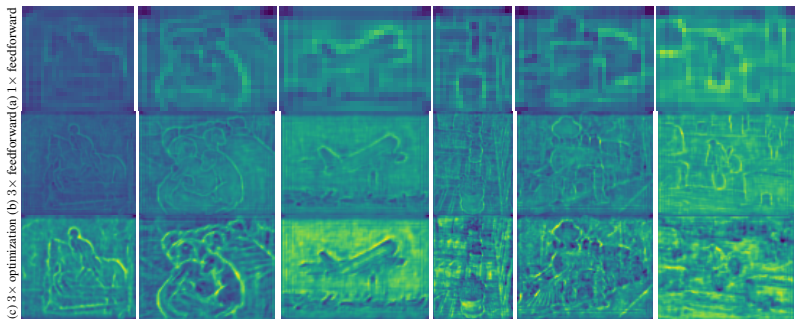
- [Figure 4 caption] The phrase 'consistently brigther' contains a typo and should read 'consistently brighter'; the surrounding sentence could also be rephrased for clarity.
- [Section 2.1] The claim that thresholding the objective by average entropy 'mildly improves accuracy' is not supported by any table or figure; please include this ablation quantitatively.
- [Section 3 / Reproducibility] The statement 'We will release code and the reference models' is a promise rather than an availability statement; please indicate a repository URL or a clear timeline for release.
Circularity Check
No significant circularity: the entropy objective is unsupervised, accuracy is measured against ground-truth labels, and the self-cited baseline is a comparator rather than a premise.
full rationale
The paper's derivation chain is empirical and self-contained. Equation (2) defines an unsupervised Shannon-entropy objective, Section 2.3 optimizes the classifier and scale-regression parameters by gradient descent without access to labels, and Section 3.1 evaluates the result by mean IoU against PASCAL VOC ground truth. There is no equation that identifies entropy with accuracy, and no fitted parameter is relabeled as a prediction: the entropy minimization is not defined in terms of the mIoU metric. The dynamic Gaussian receptive-field model and the feedforward baseline come from the authors' prior work [35], but this is a comparison base and initialization, not a theorem whose unverified content forces the result; the oracle and adversary ablations in Table 3 independently bound the behavior of the objective. The step-ablation in Table 2, where 128 steps give lower mIoU than 32 steps at 3.5x/4x scales, is a robustness concern about the entropy proxy and the chosen stopping rule, not a circularity. The central claim therefore has independent empirical content.
Assumptions & free parameters
free parameters (3)
- Inference optimization learning rate =
0.001
- Number of optimization steps =
32
- Entropy threshold selection rule =
pixels with entropy above the mean
assumptions (5)
- standard math Shannon entropy is a valid measure of output uncertainty for pixel-wise class predictions.
- domain assumption Reducing prediction entropy at test time drives predictions toward correct labels rather than toward confidently wrong labels.
- domain assumption The dynamic Gaussian receptive field model from Shelhamer et al. 2019 (reference [35]) provides a valid way for scale parameters to change receptive field sizes.
- domain assumption Optimizing only the score and scale parameters is sufficient, while optimizing all parameters end-to-end fails.
- ad hoc to paper The above-average-entropy pixel selection rule improves optimization.
Cite this review
Pith. "Pith review of Dynamic Scale Inference by Entropy Minimization." pith.science (2026). https://pith.science/paper/TGGIUQQW
@misc{pith2026190803182,
  author       = {Pith},
  title        = {Pith review of: Dynamic Scale Inference by Entropy Minimization},
  year         = {2026},
  howpublished = {\url{https://pith.science/paper/TGGIUQQW}},
  note         = {Machine review of arXiv:1908.03182}
}
read the original abstract
Given the variety of the visual world there is not one true scale for recognition: objects may appear at drastically different sizes across the visual field. Rather than enumerate variations across filter channels or pyramid levels, dynamic models locally predict scale and adapt receptive fields accordingly. The degree of variation and diversity of inputs makes this a difficult task. Existing methods either learn a feedforward predictor, which is not itself totally immune to the scale variation it is meant to counter, or select scales by a fixed algorithm, which cannot learn from the given task and data. We extend dynamic scale inference from feedforward prediction to iterative optimization for further adaptivity. We propose a novel entropy minimization objective for inference and optimize over task and structure parameters to tune the model to each input. Optimization during inference improves semantic segmentation accuracy and generalizes better to extreme scale variations that cause feedforward dynamic inference to falter.
Figures

Figures from the paper (2 more)

Reference graph
Works this paper leans on
-
[35]
Blurring the Line Between Structure and Learning to Optimize and Adapt Receptive Fields
Shelhamer, E., Wang, D., and Darrell, T. Blurring the line between structure and learning to optimize and adapt receptive fields. arXiv preprint arXiv:1904.11487, 2019
work page Pith review arXiv 1904
-
[1]
Understanding the impact of entropy on policy optimization
Ahmed, Z., Le Roux, N., Norouzi, M., and Schuurmans, D. Understanding the impact of entropy on policy optimization. In ICML, pp. 151–160, 2019
work page 2019
-
[2]
End-to-end learning for structured prediction energy networks
Belanger, D., Yang, B., and McCallum, A. End-to-end learning for structured prediction energy networks. In ICML, 2017
work page 2017
-
[3]
Burt, P. and Adelson, E. The laplacian pyramid as a compact image code. Communications, IEEE Transactions on, 31(4):532–540, 1983
work page 1983
-
[4]
Human pose estimation with iterative error feedback
Carreira, J., Agrawal, P., Fragkiadaki, K., and Malik, J. Human pose estimation with iterative error feedback. In CVPR, June 2016
work page 2016
-
[5]
Chen, L.-C., Papandreou, G., Kokkinos, I., Murphy, K., and Yuille, A. L. Deeplab: Semantic image segmentation with deep convolutional nets, atrous convolution, and fully connected crfs. TPAMI, 2018
work page 2018
-
[6]
Cohen, T. S. and Welling, M. Steerable cnns. In ICLR, 2017
work page 2017
-
[7]
Deformable convolutional networks
Dai, J., Qi, H., Xiong, Y ., Li, Y ., Zhang, G., Hu, H., and Wei, Y . Deformable convolutional networks. In ICCV, 2017
work page 2017
Show all 44 references
-
[8]
Dynamic filter networks
De Brabandere, B., Jia, X., Tuytelaars, T., and Van Gool, L. Dynamic filter networks. In NIPS, 2016
2016
-
[9]
K., Winn, J., and Zisserman, A
Everingham, M., Van Gool, L., Williams, C. K., Winn, J., and Zisserman, A. The pascal visual object classes (voc) challenge. International journal of computer vision , 88(2):303–338, 2010
2010
-
[10]
Model-agnostic meta-learning for fast adaptation of deep networks
Finn, C., Abbeel, P., and Levine, S. Model-agnostic meta-learning for fast adaptation of deep networks. arXiv preprint arXiv:1703.03400, 2017
2017 arXiv
-
[11]
and Bengio, Y
Grandvalet, Y . and Bengio, Y . Semi-supervised learning by entropy minimization. InNIPS, 2005
2005
-
[12]
Guo, C., Pleiss, G., Sun, Y ., and Weinberger, K. Q. On calibration of modern neural networks. arXiv preprint arXiv:1706.04599, 2017
2017 arXiv
-
[13]
Deep value networks learn to evaluate and iteratively refine structured outputs
Gygli, M., Norouzi, M., and Angelova, A. Deep value networks learn to evaluate and iteratively refine structured outputs. In ICML, pp. 1341–1351, 2017
2017
-
[14]
Semantic contours from inverse detectors
Hariharan, B., Arbeláez, P., Bourdev, L., Maji, S., and Malik, J. Semantic contours from inverse detectors. In ICCV, 2011
2011
-
[15]
Howard, A. G. Some improvements on deep convolutional neural network based image classification. arXiv preprint arXiv:1312.5402, 2013
2013 arXiv
-
[16]
Spatial transformer networks
Jaderberg, M., Simonyan, K., Zisserman, A., and Kavukcuoglu, K. Spatial transformer networks. In NIPS, 2015
2015
-
[17]
Transductive inference for text classification using support vector machines
Joachims, T. Transductive inference for text classification using support vector machines. In ICML, volume 99, pp. 200–209, 1999
1999
-
[18]
Locally scale-invariant convolutional neural networks
Kanazawa, A., Sharma, A., and Jacobs, D. Locally scale-invariant convolutional neural networks. arXiv preprint arXiv:1412.5104, 2014
2014 arXiv
-
[19]
Kingma, D. P. and Ba, J. Adam: A method for stochastic optimization. In ICLR, 2015
2015
-
[20]
and Friedman, N
Koller, D. and Friedman, N. Probabilistic graphical models: principles and techniques . MIT press, 2009
2009
-
[21]
Imagenet classification with deep convolutional neural networks
Krizhevsky, A., Sutskever, I., and Hinton, G. Imagenet classification with deep convolutional neural networks. Advances in Neural Information Processing Systems , 25, 2012
2012
-
[22]
Gradient-based learning applied to document recognition
LeCun, Y ., Bottou, L., Bengio, Y ., and Haffner, P. Gradient-based learning applied to document recognition. Proceedings of the IEEE, 86(11):2278–2324, 1998. 9
1998
-
[23]
A tutorial on energy-based learning
LeCun, Y ., Chopra, S., Hadsell, R., Ranzato, M., and Huang, F. A tutorial on energy-based learning. Predicting structured data, 2006
2006
-
[24]
Feature pyramid networks for object detection
Lin, T.-Y ., Dollár, P., Girshick, R., He, K., Hariharan, B., and Belongie, S. Feature pyramid networks for object detection. In CVPR, 2017
2017
-
[25]
Scale-space theory in computer vision , volume 256
Lindeberg, T. Scale-space theory in computer vision , volume 256. Springer Science & Business Media, 1994
1994
-
[26]
Long, M., Zhu, H., Wang, J., and Jordan, M. I. Unsupervised domain adaptation with residual transfer networks. In NIPS, 2016
2016
-
[27]
Distinctive image features from scale-invariant keypoints
Lowe, D. Distinctive image features from scale-invariant keypoints. IJCV, 2004
2004
-
[28]
A., Anderson, C
Olshausen, B. A., Anderson, C. H., and Van Essen, D. C. A neurobiological model of visual attention and invariant pattern recognition based on dynamic routing of information. Journal of Neuroscience, 13(11):4700–4719, 1993
1993
-
[29]
Automatic differentiation in pytorch
Paszke, A., Gross, S., Chintala, S., Chanan, G., Yang, E., DeVito, Z., Lin, Z., Desmaison, A., Antiga, L., and Lerer, A. Automatic differentiation in pytorch. In NIPSW, 2017
2017
-
[30]
Film: Visual reasoning with a general conditioning layer
Perez, E., Strub, F., De Vries, H., Dumoulin, V ., and Courville, A. Film: Visual reasoning with a general conditioning layer. arXiv preprint arXiv:1709.07871, 2017
2017 arXiv
-
[31]
Pinheiro, P. H. and Collobert, R. Recurrent convolutional neural networks for scene labeling. In ICML, 2014
2014
-
[32]
Semi-supervised domain adaptation via minimax entropy
Saito, K., Kim, D., Sclaroff, S., Darrell, T., and Saenko, K. Semi-supervised domain adaptation via minimax entropy. arXiv preprint arXiv:1904.06487, 2019
1904 arXiv
-
[33]
Shannon, C. E. A mathematical theory of communication. Bell system technical journal , 1948
1948
-
[34]
Fully convolutional networks for semantic segmentation
Shelhamer, E., Long, J., and Darrell, T. Fully convolutional networks for semantic segmentation. PAMI, 2017
2017
-
[36]
Springenberg, J. T. Unsupervised and semi-supervised learning with categorical generative adversarial networks. In ICLR, 2016
2016
-
[37]
Simultaneous deep transfer across domains and tasks
Tzeng, E., Hoffman, J., Darrell, T., and Saenko, K. Simultaneous deep transfer across domains and tasks. In ICCV, December 2015
2015
-
[38]
Statistical Learning Theory
Vapnik, V . Statistical Learning Theory. Wiley, 1998
1998
-
[39]
Advent: Adversarial entropy mini- mization for domain adaptation in semantic segmentation
Vu, T.-H., Jain, H., Bucher, M., Cord, M., and Pérez, P. Advent: Adversarial entropy mini- mization for domain adaptation in semantic segmentation. arXiv preprint arXiv:1811.12833, 2018
2018 arXiv
-
[40]
and Jordan, M
Wainwright, M. and Jordan, M. Graphical models, exponential families, and variational inference. F oundations and TrendsR© in Machine Learning, 1(1-2):1–305, 2008
2008
-
[41]
Williams, R. J. and Peng, J. Function optimization using connectionist reinforcement learning algorithms. Connection Science, 3(3):241–268, 1991
1991
-
[42]
Deep layer aggregation
Yu, F., Wang, D., Shelhamer, E., and Darrell, T. Deep layer aggregation. In CVPR, 2018
2018
-
[43]
and Fergus, R
Zeiler, M. and Fergus, R. Visualizing and understanding convolutional networks. In ECCV, 2014
2014
-
[44]
Scale-adaptive convolutions for scene parsing
Zhang, R., Tang, S., Zhang, Y ., Li, J., and Yan, S. Scale-adaptive convolutions for scene parsing. In ICCV, 2017. 10
2017
Reviewed August 14, 2026 · model on record in the stance chip above.
Discussion (0). Continue with ORCID to comment.