REVIEW 3 major objections 4 minor 73 references
Annihilation of topological solitons in magnetism with spin wave burst finale: The role of nonequilibrium electrons causing nonlocal damping and spin pumping over ultrabroadband frequency range
T0 review · 3 major / 4 minor · reviewed 2026-08-14 · deepseek-v4-flash
Pith's one-line read Magnetic domain-wall annihilation pumps spin currents with a 27 THz spectrum.
desk verdict A self-consistent TDNEGF+LLG simulation predicts ultrabroadband spin pumping and nonlocal damping during domain-wall annihilation, but the headline 1 T THz bandwidth rests on a single 100 T run with no field-convergence check. read the letter →
The pith
A machine-rendered reading of the paper's core claim, the machinery that carries it, and where it could break.
The reading
What carries the argument
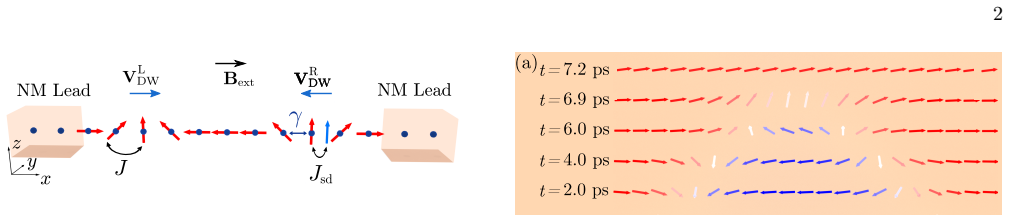
The calculation couples two levels of description self-consistently: classical Landau-Lifshitz-Gilbert equations for the localized magnetic moments, and time-dependent nonequilibrium Green functions for the conduction electrons in a tight-binding chain attached to normal-metal leads. The backaction is captured by the spin-transfer torque $\mathbf{T}_i[\mathbf{M}_i(t)] = J_{sd}(\langle \hat{\mathbf{s}}_i\rangle^{\rm neq}(t) - \langle \hat{\mathbf{s}}_i\rangle^{\rm eq}_t)\times \mathbf{M}_i(t)$, whose damping-like component is compared with the local Gilbert damping $\lambda \mathbf{M}_i\times\partial_t\mathbf{M}_i$. The model reproduces the experimentally observed spin-wave burst at annihilation, and the FFT of the pumped spin current gives the ultrabroadband spectrum.
What would settle it
A time-resolved measurement of the THz emission from field-driven domain-wall annihilation in a metallic nanowire: an ultrabroadband burst up to ~27 THz (for ~1 T, extending from ~0.03 THz) would confirm; a single narrow emission line near the precession frequency would falsify the central prediction.
Extended reading notes
Core claim
The central claim is that annihilation of a domain-wall pair—two topological solitons with opposite winding numbers—is not a purely classical magnetic event. The collapsing texture sources time-dependent fields in the quantum Hamiltonian of conduction electrons, and the self-consistent electron dynamics produces spin currents with a power spectrum that is essentially white up to ~27 THz before annihilation completes. This is qualitatively different from ordinary spin pumping from a precessing magnetization, which produces a single spectral line. The same nonequilibrium electrons exert a damping-like spin-transfer torque on the local moments that is spatially and temporally nonuniform and about 2.4 times larger than the local Gilbert damping used in the model, signaling that micromagnetic simulations without conduction electrons omit an important channel.
Load-bearing premise
The entire prediction rests on assuming that the collision dynamics computed at an artificial 100 T field on a 45-atom chain represent what happens at the experimental ~1 T field, with only the lowest frequency scale changed.
Editorial extensions
If this is right
- A field-driven DW-collision device could act as a source of THz radiation with bandwidth set by electronic energy scales, and a tunable low-frequency cutoff set by the applied magnetic field.
- Micromagnetic simulations that omit conduction electrons understate damping during annihilation; adding the nonlocal damping term changes the predicted spin-wave spectrum.
- Phenomenological spin-motive-force formulas miss the ultrabroadband pumping and underestimate the nonlocal damping, so quantitative predictions for DW dynamics need the microscopic treatment.
- The same mechanism could operate in other topological soliton collisions, generating spin currents even without bias voltage.
Reading between the lines
- If the 100 T simulated dynamics carries over to the 1 T regime, the predicted THz bandwidth suggests DW annihilation is a compact on-chip THz source; experimentally, the emitted spectrum should be measured to test the extrapolation.
- The paper's ratio of nonlocal to local damping (~2.4) matches a measured value in permalloy (~2.3), hinting that this backaction may explain the enhanced damping seen in field-driven DW experiments.
- A direct experimental test could time-resolve the spin current or THz emission during annihilation; observing a broadband burst rather than a narrow line would confirm the mechanism.
- The adiabatic approximation fails for the parameters used, implying that theories relying on it should be reexamined for narrow DWs and fast dynamics.
Signed reviews
Editorial analysis
A structured set of objections, weighed in public.
Referee Report
Summary. The manuscript presents a fully microscopic, self-consistent TDNEGF+LLG simulation of magnetic-field-driven annihilation of two domain walls in a 1D ferromagnetic nanowire attached to normal-metal leads. It reports (i) reproduction of the spin-wave burst observed experimentally by Woo et al.; (ii) a prediction that the annihilation pumps electronic spin currents with an ultrabroadband power spectrum before the annihilation instant, convertible via the inverse spin Hall effect into THz radiation with bandwidth ~27 THz; and (iii) a backaction of nonequilibrium electrons on the magnetic texture that acts as nonlocal damping roughly 2.4 times larger than the local Gilbert damping. The paper also contrasts these results with spin-motive-force phenomenological formulas, which it argues miss the ultrabroadband pumping and underestimate the nonlocal damping.
Significance. If the central claims hold, the paper would establish a new mechanism for ultrabroadband THz emission from soliton annihilation and demonstrate that conduction-electron backaction can materially modify domain-wall collision dynamics, beyond what classical micromagnetics captures. Its strengths are explicit: the framework is fully microscopic and self-consistent, the method is published in prior work by the same group, the comparison to SMF theory is concrete, and the predicted ~27 THz bandwidth is a falsifiable quantitative statement. The main weakness is that the quantitative predictions currently rest on a single simulation at B_ext = 100 T on a 45-site chain with λ = 0.01, and the extrapolation to the experimental field regime (~1 T) is not demonstrated by any convergence check or scaling argument.
major comments (3)
- [Models and methods; Conclusions and outlook] The headline prediction of 0.03–27 THz radiation for |B_ext| ~ 1 T is an extrapolation from the FFT power spectrum in Fig. 3(d), which is computed at |B_ext| = 100 T because the simulation is said to be too costly at lower fields. The manuscript provides no intermediate-field run (e.g., 10–50 T) and no analytical scaling argument showing that the high-frequency edge (~27 THz) and the spectral weight are independent of the applied field. At 100 T the Zeeman energy is comparable to the exchange and anisotropy energies, while at 1 T it is two orders of magnitude smaller, so the violence of the annihilation and the resulting spectral content may change substantially. This is a load-bearing issue for the central claim, and I ask the authors to either supply field-convergence data or restrict the claim to the simulated field regime.
- [Results, Fig. 2(f) and Eq. (2)] The statement that nonlocal damping is ~2.4 times larger than conventional local Gilbert damping is computed for a single value of λ = 0.01 and at B_ext = 100 T. Because λ appears in the denominator of the ratio plotted in Fig. 2(f), the reported factor is sensitive to the assumed λ, and because the nonlocal torque may scale differently with field, the ratio is not established as a robust quantitative result. A short sensitivity scan over λ (e.g., 0.005–0.02) and a check of the ratio at a lower field would be needed to support the general claim.
- [Models and methods, Eq. (4)] The numerical results are obtained for a 45-site chain with open leads, and the paper does not report finite-size convergence tests or sensitivity to model parameters such as J_sd and γ. Since the spin-pump spectrum and the damping ratio are central outputs, the absence of any system-size or parameter robustness check makes it difficult to assess whether the predicted ultrabroadband spectrum is generic or an artifact of the particular short chain. I request at least one finite-size comparison (e.g., 60 or 90 sites) and a statement on parameter sensitivity.
minor comments (4)
- [Abstract] The abstract contains a stray closing brace in 'highly unusual}' that should be removed.
- [Eq. (2)] The symbol T_i[I_Sα_ext] is used before it is defined; while the text later states that the external current is absent, the notation should be introduced or removed for clarity.
- [Results, Fig. 3] The vertical axis labels and units of the FFT power spectra in Fig. 3(d) and (h) are not specified; stating the normalization and units (e.g., arbitrary units or physical current spectral density) would aid quantitative interpretation.
- [Discussion] The comparison to SMF theory would benefit from a brief statement of the conductivity parameter G0 used in Fig. 4(a) and (b), since the magnitude of the SMF result depends on this input.
Circularity Check
No circularity: forward simulation from a fixed Hamiltonian; the pumped-current spectrum and nonlocal damping ratio are computed outputs, not fitted inputs.
full rationale
The paper's derivation chain is a forward many-body simulation. The classical LMM Hamiltonian, Eq. (1), and the electronic tight-binding Hamiltonian, Eq. (4), are specified with fixed microscopic parameters (J = 0.1 eV, K = 0.05 eV, D = 0.007 eV, J_sd = 0.1 eV, lambda = 0.01, gamma = 1 eV, E_F = 0 eV). The LLG equation, Eq. (2), with the electronic backaction torque, Eq. (3), is then integrated self-consistently with the TDNEGF computation of the nonequilibrium spin density. The pumped spin current in Figs. 3(a)-(c) is a transport output of this Hamiltonian, and its FFT in Fig. 3(d) is a numerical transform of that output; nothing in the paper defines the ultrabroadband spectrum as an input or fits a parameter to produce the 27 THz bandwidth. Likewise, the nonlocal damping ratio in Fig. 2(f) is the ratio of the computed DL torque T_i[M_i(t)] to the conventional lambda M_i x dM_i/dt term in the same simulation; neither quantity is tuned to make the ratio 2.4. The comparison of TDNEGF+LLG results to SMF theory (Fig. 4) is against an external phenomenological benchmark, and the reproduction of the annihilation-induced SW burst is a qualitative comparison to the Woo et al. experiment, not an inversion of experimental data into model parameters. The authors do cite their own method papers (Refs. 27, 46-48, 55) for the TDNEGF+LLG machinery, but the machinery is independently published, peer reviewed, and its essential equations are restated in this paper, so this is ordinary method self-citation rather than load-bearing circularity. The explicit sentence 'Due to the computational complexity of TDNEGF calculations, we use magnetic field |B_ext| = 100 T to complete DW annihilation on ~ ps time scale' flags an extrapolation to |B_ext| ~ 1 T in the Conclusions; that is an untested scaling assumption and a correctness/robustness risk, but it is not circular because the 27 THz bandwidth and the 2.4x damping ratio are outputs of a fixed-parameter simulation, not assumptions feeding the calculation. Overall, the central claims are self-contained numerical predictions from stated Hamiltonians and do not reduce by construction to their inputs.
Assumptions & free parameters
free parameters (3)
- lambda (local Gilbert damping) =
0.01
- B_ext (applied field) =
100 T
- System size (nanowire length) =
45 sites
assumptions (4)
- domain assumption Classical fixed length localized magnetic moments described by LLG equations
- domain assumption Electrons described by a single particle tight binding s-d exchange Hamiltonian without electron electron interactions, spin orbit coupling, or disorder
- domain assumption The self consistent TDNEGF plus LLG algorithm with time step 0.1 fs is numerically exact
- ad hoc to paper Dynamics at B_ext = 100 T is representative of dynamics at about 1 T for the purpose of the frequency range claim
Cite this review
Pith. "Pith review of Annihilation of topological solitons in magnetism with spin wave burst finale: The role of nonequilibrium electrons causing nonlocal damping and spin pumping over ultrabroadband frequency range." pith.science (2026). https://pith.science/paper/OZGSZQKN
@misc{pith2026190803194,
  author       = {Pith},
  title        = {Pith review of: Annihilation of topological solitons in magnetism with spin wave burst finale: The role of nonequilibrium electrons causing nonlocal damping and spin pumping over ultrabroadband frequency range},
  year         = {2026},
  howpublished = {\url{https://pith.science/paper/OZGSZQKN}},
  note         = {Machine review of arXiv:1908.03194}
}
abstract
We not only reproduce burst of short-wavelength spin waves (SWs) observed in recent experiment [S. Woo et al., Nat. Phys. 13, 448 (2017)] on magnetic-field-driven annihilation of two magnetic domain walls (DWs) but, furthermore, we predict that this setup additionally generates highly unusual} pumping of electronic spin currents in the absence of any bias voltage. Prior to the instant of annihilation, their power spectrum is ultrabroadband, so they can be converted into rapidly changing in time charge currents, via the inverse spin Hall effect, as a source of THz radiation of bandwidth $\simeq 27$ THz where the lowest frequency is controlled by the applied magnetic field. The spin pumping stems from time-dependent fields introduced into the quantum Hamiltonian of electrons by the classical dynamics of localized magnetic moments (LMMs) comprising the domains. The pumped currents carry spin-polarized electrons which, in turn, exert backaction on LMMs in the form of nonlocal damping which is more than twice as large as conventional local Gilbert damping. The nonlocal damping can substantially modify the spectrum of emitted SWs when compared to widely-used micromagnetic simulations where conduction electrons are completely absent. Since we use fully microscopic (i.e., Hamiltonian-based) framework, self-consistently combining time-dependent electronic nonequilibrium Green functions with the Landau-Lifshitz-Gilbert equation, we also demonstrate that previously derived phenomenological formulas miss ultrabroadband spin pumping while underestimating the magnitude of nonlocal damping due to nonequilibrium electrons.
Figures


Figures from the paper (1 more)

Reference graph
Works this paper leans on
- [1]
-
[2]
Tatara, Effective gauge field theory of spintronics, Physica E 106 , 208 (2019)
G. Tatara, Effective gauge field theory of spintronics, Physica E 106 , 208 (2019)
work page 2019
-
[3]
K.-J. Kim, Y. Yoshimura, and T. Ono, Current-driven magnetic domain wall motion and its real-time detection, Jap. J. Appl. Phys., 56 0802A4 (2017)
work page 2017
-
[4]
S. Parkin and S.-H. Yang, Memory on the racetrack, Nat. Nanotech. 10 195 (2015)
work page 2015
-
[5]
D. A. Allwood, G. Xiong, M. D. Cooke, C. C. Faulkner, D. Atkinson, N. Vernier, and R. P. Cowburn, Submicrometer ferromagnetic not gate and shift register, Science 296 , 2003 (2002)
work page 2002
-
[6]
J. Grollier, D. Querlioz, and M. D. Stiles, Spintronic nanodevices for bioinspired computing, Proc. IEEE 104 , 2024 (2016)
work page 2016
- [7]
-
[8]
Braun, Topological effects in nanomagnetism: From superparamagnetism to chiral quantum solitons, Adv
H.-B. Braun, Topological effects in nanomagnetism: From superparamagnetism to chiral quantum solitons, Adv. Phys. 61 , 1 (2012)
work page 2012
Show all 73 references
-
[9]
Kunz, Field induced domain wall collisions in thin magnetic nanowires, Appl
A. Kunz, Field induced domain wall collisions in thin magnetic nanowires, Appl. Phys. Lett. 94 , 132502 (2009)
2009
-
[10]
Kunz and E
A. Kunz and E. W. Rentsch, Simulations of field driven domain wall interactions in ferromagnetic nanowires, IEEE Trans. Magn. 46 , 1556 (2010)
2010
-
[11]
Ghosh, K
A. Ghosh, K. S. Huang, and O. Tchernyshyov, Annihilation of domain walls in a ferromagnetic wire, Phys. Rev. B 95 , 180408 (2017)
2017
-
[12]
S. K. Kim, S. Takei, and Y. Tserkovnyak, Topological spin transport by Brownian diffusion of domain walls, Phys. Rev. B 92 , 220409 (2015)
2015
-
[13]
Manton and P
N. Manton and P. Sutcliffe, Topological solitons (Cambridge University Press, Cambridge, 2004)
2004
-
[14]
D. I. Bradley, S. N. Fisher, A. M. Guénault, R. P. Haley, J. Kopu, H. Martin, G. R. Pickett, J. E. Roberts, and V. Tsepelin, Relic topological defects from brane annihilation simulated in superfluid ^3 He, Nat. Phys. 4 , 46 (2008)
2008
-
[15]
Nakayama, F
K. Nakayama, F. Takahashi, and N. Yokozaki, Gravitational waves from domain walls and their implications, Phys. Lett. B 770 , 500 (2017)
2017
-
[16]
Dvali and A
G. Dvali and A. Vilenkin, Solitonic D-branes and brane annihilation, Phys. Rev. D 67 , 046002 (2003)
2003
-
[17]
Shen and I
Y. Shen and I. Dierking, Annihilation dynamics of topological defects induced by microparticles in nematic liquid crystals, Soft Matter 10.1039/C9SM01710K (2019)
2019 doi
-
[18]
Takeuchi, K
H. Takeuchi, K. Kasamatsu, M. Tsubota, and M. Nitta, Tachyon condensation due to domain-wall annihilation in Bose-Einstein condensates, Phys. Rev. Lett. 109 , 245301 (2012)
2012
-
[19]
Nitta, K
M. Nitta, K. Kasamatsu, M. Tsubota, and H. Takeuchi, Creating vortons and three-dimensional skyrmions from domain-wall annihilation with stretched vortices in Bose-Einstein condensates, Phys. Rev. A 85 , 053639 (2012)
2012
-
[20]
S. Woo, T. Delaney, and G. S. D. Beach, Magnetic domain wall depinning assisted by spin wave bursts, Nat. Phys. 13 , 448 (2017)
2017
-
[21]
A. V. Chumak, V. I. Vasyuchka, A. A. Serga, and B. Hillebrands, Magnon spintronics, Nat. Phys. 11 , 453 (2015)
2015
-
[22]
Kim, Micromagnetic computer simulations of spin waves in nanometre-scale patterned magnetic elements, J
S.-K. Kim, Micromagnetic computer simulations of spin waves in nanometre-scale patterned magnetic elements, J. Phys. D: Appl. Phys 43 , 264004 (2010)
2010
-
[23]
Navabi et al
A. Navabi et al. , Efficient excitation of high-frequency exchange-dominated spin waves in periodic ferromagnetic structures, Phys. Rev. Applied 7 , 034027 (2017)
2017
-
[24]
Liu et al
C. Liu et al. , Long-distance propagation of short-wavelength spin waves, Nat. Commun. 9 , 738 (2018)
2018
-
[25]
R. F. L. Evans, W. J. Fan, P. Chureemart, T. A. Ostler, M. O. A. Ellis, and R. W. Chantrell, Atomistic spin model simulations of magnetic nanomaterials, J. Phys.: Condens. Matter 26 , 103202 (2014)
2014
-
[26]
Tserkovnyak, A
Y. Tserkovnyak, A. Brataas, G. E. W. Bauer, and B. I. Halperin, Nonlocal magnetization dynamics in ferromagnetic heterostructures, Rev. Mod. Phys. 77 , 1375 (2005)
2005
-
[27]
M. D. Petrovi\' c , B. S. Popescu, U. Bajpai, P. Plech\' a c , and B. K. Nikoli\' c , Spin and charge pumping by a steady or pulse-current-driven magnetic domain wall: A self-consistent multiscale time-dependent quantum-classical hybrid approach, Phys. Rev. Applied 10 , 054038 (2018)
2018
-
[28]
Chen, C.-R
S.-H. Chen, C.-R. Chang, J. Q. Xiao, and B. K. Nikoli\' c , Spin and charge pumping in magnetic tunnel junctions with precessing magnetization: A nonequilibrium Green function approach, Phys. Rev. B 79 , 054424 (2009)
2009
-
[29]
Bajpai, B
U. Bajpai, B. S. Popescu, P. Plech\' a c , B. K. Nikoli\' c , L. E. F. Foa Torres, H. Ishizuka, and N. Nagaosa, Spatio-temporal dynamics of shift current quantum pumping by femtosecond light pulse, J. Phys.: Mater. 2 , 025004 (2019)
2019
-
[30]
Ralph and M
D. Ralph and M. Stiles, Spin transfer torques, J. Magn. Mater. 320 , 1190 (2008)
2008
-
[31]
Sayad and M
M. Sayad and M. Potthoff, Spin dynamics and relaxation in the classical-spin Kondo-impurity model beyond the Landau-Lifschitz-Gilbert equation, New J. Phys. 17 , 113058 (2015)
2015
-
[32]
Zhang and S
S. Zhang and S. S.-L. Zhang, Generalization of the Landau-Lifshitz-Gilbert equation for conducting ferromagnets, Phys. Rev. Lett. 102 , 086601 (2009)
2009
-
[33]
Kim, J.-H
K.-W. Kim, J.-H. Moon, K.-J. Lee, and H.-W. Lee, Prediction of giant spin motive force due to Rashba spin-orbit coupling, Phys. Rev. Lett. 108 , 217202 (2012)
2012
-
[34]
Foros, A
J. Foros, A. Brataas, Y. Tserkovnyak, and G. E. W. Bauer, Current-induced noise and damping in nonuniform ferromagnets, Phys. Rev. B 78 , 140402(R) (2008)
2008
-
[35]
Tserkovnyak, E
Y. Tserkovnyak, E. M. Hankiewicz, and G. Vignale, Transverse spin diffusion in ferromagnets, Phys. Rev. B 79 , 094415 (2009)
2009
-
[36]
E. M. Hankiewicz, G. Vignale, and Y. Tserkovnyak, Inhomogeneous Gilbert damping from impurities and electron-electron interactions, Phys. Rev. B 78 , 020404(R) (2008)
2008
-
[37]
Z. Yuan, K. M. D. Hals, Y. Liu, A. A. Starikov, A. Brataas, and P. J. Kelly, Gilbert damping in noncollinear ferromagnets, Phys. Rev. Lett. 113 , 266603 (2014)
2014
-
[38]
H. Y. Yuan, Z. Yuan, K. Xia, and X. R. Wang, Influence of nonlocal damping on the field-driven domain wall motion, Phys. Rev. B 94 , 064415 (2016)
2016
-
[39]
Thonig, Y
D. Thonig, Y. Kvashnin, O. Eriksson, and M. Pereiro, Nonlocal Gilbert damping tensor within the torque-torque correlation model, Phys. Rev. Mater. 2 , 013801 (2018)
2018
-
[40]
Weindler, H
T. Weindler, H. G. Bauer, R. Islinger, B. Boehm, J.-Y. Chauleau, and C. H. Back, Magnetic damping: Domain wall dynamics versus local ferromagnetic resonance, Phys. Rev. Lett. 113 , 237204 (2014)
2014
-
[41]
W. Wang, M. Dvornik, M.-A. Bisotti, D. Chernyshenko, M. Beg, M. Albert, A. Vansteenkiste, B. V. Waeyenberge, A. N. Kuchko, V. V. Kruglyak, and H. Fangohr, Phenomenological description of the nonlocal magnetization relaxation in magnonics, spintronics, and domain-wall dynamics,...
2015
-
[42]
Verba, V
R. Verba, V. Tiberkevich, and A. Slavin, Damping of linear spin-wave modes in magnetic nanostructures: Local, nonlocal, and coordinate-dependent damping, Phys. Rev. B 98 , 104408 (2018)
2018
-
[43]
Kambersk\' y , Spin-orbital Gilbert damping in common magnetic metals, Phys
V. Kambersk\' y , Spin-orbital Gilbert damping in common magnetic metals, Phys. Rev. B 76 , 134416 (2007)
2007
-
[44]
Gilmore, Y
K. Gilmore, Y. U. Idzerda, and M. D. Stiles, Identification of the dominant precession-damping mechanism in Fe, Co, and Ni by first-principles calculations, Phys. Rev. Lett. 99 , 027204 (2007)
2007
-
[45]
A. A. Starikov, P. J. Kelly, A. Brataas, Y. Tserkovnyak, and G. E. W. Bauer, Unified first-principles study of Gilbert damping, spin-flip diffusion, and resistivity in transition metal alloys, Phys. Rev. Lett. 105 , 236601 (2010)
2010
-
[46]
Bajpai and B
U. Bajpai and B. K. Nikoli\' c , Time-retarded damping and magnetic inertia in the Landau-Lifshitz-Gilbert equation self-consistently coupled to electronic time-dependent nonequilibrium Green functions, Phys. Rev. B 99 , 134409 (2019)
2019
-
[47]
Suresh, M
A. Suresh, M. D. Petrovi\' c , U. Bajpai, H. Yang, and B. K. Nikoli\' c , Magnon- versus electron-mediated spin-transfer torque exerted by spin current across an antiferromagnetic insulator to switch the magnetization of an adjacent ferromagnetic metal, Phys. Rev. Applied 15 ,...
2021
-
[48]
Suresh, U
A. Suresh, U. Bajpai, and B. K. Nikoli\' c , Magnon-driven chiral charge and spin pumping and electron-magnon scattering from time-dependent quantum transport combined with classical atomistic spin dynamics, Phys. Rev. B 101 , 214412 (2020)
2020
-
[49]
E. V. Bostr\" o m and C. Verdozzi, Steering magnetic skyrmions with currents: A nonequilibrium Green's functions approach, Phys. Stat. Solidi B 256 , 1800590 (2019)
2019
-
[50]
Stefanucci and R
G. Stefanucci and R. van Leeuwen, Nonequilibrium Many-Body Theory of Quantum Systems: A Modern Introduction (Cambridge University Press, Cambridge, 2013)
2013
-
[51]
Gaury, J
B. Gaury, J. Weston, M. Santin, M. Houzet, C. Groth, and X. Waintal, Numerical simulations of time-resolved quantum electronics, Phys. Rep. 534 , 1 (2014)
2014
-
[52]
Zhang and Z
S. Zhang and Z. Li, Roles of nonequilibrium conduction electrons on the magnetization dynamics of ferromagnets, Phys. Rev. Lett. 93 , 127204 (2004)
2004
-
[53]
R. L. Cooper and E. A. Uehling, Ferromagnetic resonance and spin diffusion in supermalloy, Phys. Rev. 164 , 662 (1967)
1967
-
[54]
Stahl and M
C. Stahl and M. Potthoff, Anomalous spin precession under a geometrical torque, Phys. Rev. Lett. 119 , 227203 (2017)
2017
-
[55]
Bajpai and B
U. Bajpai and B. K. Nikoli\' c , Spintronics meets nonadiabatic molecular dynamics: Geometric spin torque and damping on dynamical classical magnetic texture due to an electronic open quantum system, Phys. Rev. Lett. 125 , 187202 (2020)
2020
-
[56]
Croy and U
A. Croy and U. Saalmann, Propagation scheme for nonequilibrium dynamics of electron transport in nanoscale devices, Phys. Rev. B 80 , 245311 (2009)
2009
-
[57]
B. S. Popescu and A. Croy, Efficient auxiliary-mode approach for time-dependent nanoelectronics, New J. Phys. 18 , 093044 (2016)
2016
-
[58]
See Supplemental Material at https://wiki.physics.udel.edu/qttg/Publications consisting of: ( i ) a movie animating classical LMMs in Figs. fig:fig2 (a) and fig:fig2 (b); and ( ii ) four additional Figures showing orientation of nonequilibrium and ``adiabatic'' electronic spin...
-
[59]
Bocklage, Coherent THz transient spin currents by spin pumping, Phys
L. Bocklage, Coherent THz transient spin currents by spin pumping, Phys. Rev. Lett. 118 , 257202 (2017)
2017
-
[60]
G. E. Bauer and Y. Tserkovnyak, Viewpoint: spin-magnon transmutation, Physics 4 , 40 (2011)
2011
-
[61]
A. V. Chumak, A. A. Serga, M. B. Jungfleisch, R. Neb, D. A. Bozhko, V. S. Tiberkevich, and B. Hillebrands, Direct detection of magnon spin transport by the inverse spin Hall effect, Appl. Phys. Lett. 100 , 082405 (2012)
2012
-
[62]
Onoda and N
M. Onoda and N. Nagaosa, Dynamics of localized spins coupled to the conduction electrons with charge and spin currents, Phys. Rev. Lett. 96 , 066603 (2006)
2006
-
[63]
A. S. N\' u \ n ez and R. A. Duine, Effective temperature and Gilbert damping of a current-driven localized spin, Phys. Rev. B 77 , 054401 (2008)
2008
-
[64]
Fransson and J.-X
J. Fransson and J.-X. Zhu, Spin dynamics in a tunnel junction between ferromagnets, New J. Phys. 10 , 013017 (2008)
2008
-
[65]
H. M. Hurst, V. Galitski, and T. T. Heikkil\" a , Electron-induced massive dynamics of magnetic domain walls, Phys. Rev. B 101 , 054407 (2020)
2020
-
[66]
N. Bode, S. V. Kusminskiy, R. Egger, and F. von Oppen, Scattering theory of current-induced forces in mesoscopic systems, Phys. Rev. Lett. 107 , 036804 (2011)
2011
-
[67]
Thomas, T
M. Thomas, T. Karzig, S. V. Kusminskiy, G. Zar\'and, and F. von Oppen, Scattering theory of adiabatic reaction forces due to out-of-equilibrium quantum environments, Phys. Rev. B 86 , 195419 (2012)
2012
-
[68]
Mahfouzi, B
F. Mahfouzi, B. K. Nikoli\' c , and N. Kioussis, Antidamping spin-orbit torque driven by spin-flip reflection mechanism on the surface of a topological insulator: A time-dependent nonequilibrium Green function approach, Phys. Rev. B 93 , 115419 (2016)
2016
-
[69]
Yamane, J
Y. Yamane, J. Ieda, J.-I. Ohe, S. E. Barnes, and S. Maekawa, Equation-of-motion approach of spin-motive force, J. Appl. Phys. 109 , 07C735 (2011)
2011
-
[70]
Evelt, H
M. Evelt, H. Ochoa, O. Dzyapko, V. E. Demidov, A. Yurgens, J. Sun, Y. Tserkovnyak, V. Bessonov, A. B. Rinkevich, and S. O. Demokritov, Chiral charge pumping in graphene deposited on a magnetic insulator, Phys. Rev. B 95 , 024408 (2017)
2017
-
[71]
Obstbaum, M
D Wei, M. Obstbaum, M. Ribow, C. H. Back, and G. Woltersdorf, Spin Hall voltages from a.c. and d.c. spin currents, Nat. Commun. 5 , 3768 (2014)
2014
-
[72]
Seifert et al
T. Seifert et al. , Efficient metallic spintronic emitters of ultrabroadband terahertz radiation, Nat. Photon. 10 , 483 (2016)
2016
-
[73]
M. Chen, Y. Wu, Y. Liu, K. Lee, X. Qiu, P. He, J. Yu, and H. Yang, Current-enhanced broadband THz emission from spintronic devices, Adv. Optical Mater. 7 , 1801608 (2019)
2019
Reviewed August 14, 2026 · model on record in the stance chip above.
Discussion (0). Continue with ORCID to comment.