REVIEW 2 major objections 6 minor 42 references
Random Sum-Product Forests with Residual Links
T0 review · 2 major / 6 minor · reviewed 2026-08-14 · deepseek-v4-flash
Pith's one-line read Randomly generated sum-product networks, combined into a forest and joined by residual links, match the accuracy of structure-learned density estimators.
desk verdict A genuinely new residual-link mechanism for combining SPNs, with plausible empirical gains, but Algorithm 4 as written can create invalid SPNs and the evaluation lacks error bars. read the letter →
The pith
A machine-rendered reading of the paper's core claim, the machinery that carries it, and where it could break.
The reading
What carries the argument
The load-bearing mechanism is the residual sum-product link: adding a node from another SPN as an extra child of a sum node with the same scope (marginalizing surplus variables when the donor scope is broader), so the receiving node fits a weighted residual $b(z)=a(z)+r(z)$ instead of the full density. This preserves the completeness and decomposability conditions that keep SPNs valid while making the receiving network wider and deeper. The component generator is the ExtraSPN, which replaces LearnSPN's statistical independence tests with random splits controlled by a failure probability $\beta$ and samples the minimum-split-instance threshold $\mu$ to create diversity; the RSPF then mixes the components under one top sum node.
What would settle it
Re-run LearnSPN and ID-SPN on the same six datasets with the same train/validation/test splits and the same evaluation pipeline, then compare average test log-likelihood; if either baseline beats ResSPN on most datasets under identical conditions, the competitiveness claim fails. A cheaper check is to run the RSPF-versus-best-ExtraSPN comparison over many random seeds: if the best ExtraSPN sometimes wins, the claim that RSPF always outperforms its components is not robust.
Extended reading notes
Core claim
The central claim is that ensembles of randomly structured SPNs repair the false independence assumptions that hurt individual random SPNs. In the paper's experiments, an RSPF of ten ExtraSPNs—randomized, extremely-randomized-tree-style versions of LearnSPN's recursive splitting and clustering—achieves higher average test log-likelihood than the best single ExtraSPN on all six benchmark datasets. Adding residual links yields a ResSPN that improves on the plain RSPF on five of six datasets, with Jester as the overfitting exception. The resulting ResSPN test log-likelihoods are comparable to LearnSPN on several datasets and close to ID-SPN, which the paper reads as evidence that random generation plus ensemble wiring is a practical alternative to expensive structure learning.
Load-bearing premise
The competitiveness claim depends on taking the LearnSPN and ID-SPN test log-likelihood numbers from an earlier publication as directly comparable, without re-running those baselines under the same data splits, preprocessing, and evaluation code, and on reporting single point estimates with no error bars.
Editorial extensions
If this is right
- Ensembles of random SPNs can correct wrong independence assumptions made by single components: a trained ResSPN's pairwise mutual information approaches the empirical values on NLTCS.
- Residual links increase both the depth and width of the resulting SPN compared with singleton tree-shaped learners, without giving up exact inference.
- The framework is general: other structure learners, including the stronger ID-SPN, can be plugged in as components, and different residual-link selection strategies can be substituted.
- Because the random splitting procedure has constant rather than quadratic cost, RSPFs and ResSPNs scale naturally to thousands of random variables.
- An informed variant that adds a residual link only when it locally improves the training objective is less prone to overfitting and outperforms the RSPF baseline on the tested datasets.
Reading between the lines
- If residual links serve hierarchical mixture models as they serve neural networks, then iteratively adding links and fine-tuning after each addition should yield a boosting-like gain; the paper tests only one-shot link addition followed by joint EM.
- The same-scope-with-marginalization rule suggests a general transfer mechanism between tractable models over partially overlapping variable sets, potentially applicable to other probabilistic circuits beyond SPNs.
- Mixing learned and random components in one forest, with residual links connecting them, is a natural untested extension that could combine the strengths of both structure sources.
- The Jester overfitting case implies residual links add capacity; a validation-based early stopping rule for link addition might make the improvement uniform, which the reported experiments do not check.
Signed reviews
Editorial analysis
A structured set of objections, weighed in public.
Referee Report
Summary. The manuscript introduces Random Sum-Product Forests (RSPFs), an ensemble method that mixes randomly generated ExtraSPNs via a top sum node, and Residual Sum-Product Networks (ResSPNs), which augment one SPN with 'residual links' to nodes of other SPNs, followed by a global mixture. The authors evaluate on six binary density-estimation benchmarks and report that RSPFs outperform the best single ExtraSPN on all datasets, that residual links further improve test likelihoods on five of six datasets (Jester overfits), and that ResSPNs are competitive with LearnSPN and approach ID-SPN. They also propose an informed variant (InfoResSPN) and provide structural statistics indicating that ResSPNs are wider and deeper than tree-shaped learned SPNs.
Significance. If the empirical claims hold, the paper offers a practical and scalable alternative to structure learning for SPNs, and the residual-link idea is a plausible mechanism for sharing context-specific substructures across an ensemble. The approach is simple, the code is released, and the experimental protocol (train/validation/test splits, EM optimization, hyperparameter search) is largely standard. However, the validity of the ResSPN construction is not guaranteed by the algorithm as written, and the comparisons against LearnSPN/ID-SPN rely on externally reported numbers without error bars, so the significance of the stated improvements is currently not fully established.
major comments (2)
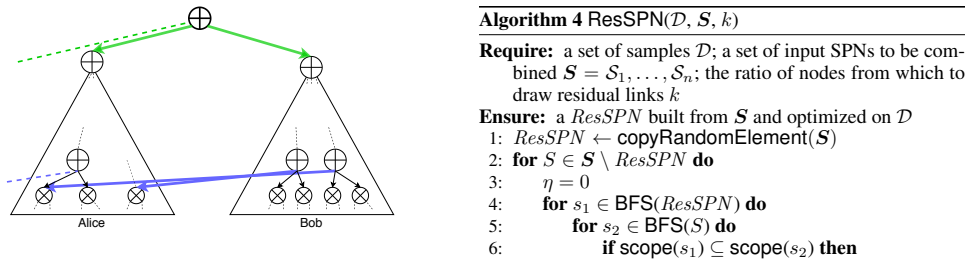
- [Section 4, Algorithm 4] The pseudocode does not restrict the type of node s1 when adding a residual link. The condition scope(s1) ⊆ scope(s2) can be satisfied by product nodes and leaves. Adding a child to a product node with a scope that overlaps the scopes of existing children violates the decomposability requirement, and adding a child to a leaf is syntactically invalid for a univariate distribution. The surrounding prose ('We add Alice’s product node as a child to Bob’s sum node') suggests the intended operation is limited to sum nodes as parents, but the algorithm as written permits arbitrary node types. Since the ResSPN likelihoods in Tables 2, 4, and 5 depend on the resulting network being a valid, normalized SPN, this gap is load-bearing. The authors should either restrict s1 to sum nodes in Algorithm 4, or provide a proof that adding links to product nodes and leaves preserves decomposability, or re-run the experiments with an implementation that enforces the restriction.
- [Section 5.1, Table 2] The LearnSPN and ID-SPN baseline numbers are taken from [Rooshenas and Lowd, 2014] rather than re-computed with the same code, preprocessing, and train/validation/test splits used for the proposed methods. The manuscript does not report standard deviations, confidence intervals, or significance tests for any of the average test log-likelihoods, so it is unclear whether the observed differences (e.g., -6.046 vs. -6.040 for RSPF vs. ResSPN on NLTCS) are meaningful. This undermines the abstract's claim that ResSPNs are 'competitive with commonly used structure learning methods.' The authors should either rerun the baselines in SPFlow, report variance estimates, or soften the comparative claims.
minor comments (6)
- [Algorithm 4] The prose says the BFS traversal excludes the root, but the pseudocode in Algorithm 4 does not show this exclusion. Please clarify the discrepancy.
- [Section 5.2] The 'best ExtraSPN' is selected using test-set likelihood; this should be based on a validation set to avoid potential bias, even though the direction of the bias appears to favor the ensemble.
- [Section 5.4] The statement that InfoResSPN 'achieves overall better accuracy than ResSPN' is not directly supported by a table comparing the two; Table 5 compares InfoResSPN to RSPF. Please add a direct comparison or explicitly note that the claim is based on comparing Table 5 with Table 2.
- [Conclusion] The conclusion uses 'RSPNs' where 'RSPFs' is meant ('RSPNs and ResSPNs can be seen as general schemas'). Please correct this typo.
- [Table 4] The 'wins' row is not labeled; it appears to count pairwise comparisons between ResSPN and RSPF of the same ensemble size. Please add a caption or explanatory note to make the row self-explanatory.
- [Section 4] The term 'residual link' may be misleading because the implementation adds a child to a sum node, which corresponds to a mixture, not an additive residual. The conceptual connection to ResNets is only loose; consider acknowledging this explicitly to avoid overclaiming the analogy.
Circularity Check
No significant circularity: RSPF/ResSPN claims are empirical evaluations against external baselines, not derivations that fold target results into inputs.
full rationale
The paper's central claims—RSPFs improve over their ExtraSPN components and residual links further improve RSPFs—are established by held-out test log-likelihood comparisons (Tables 2, 4, and 5) against external baselines, including LearnSPN and ID-SPN as reported by Rooshenas and Lowd (2014). The construction algorithms (Algs. 2–4) take a set of input SPNs and combine, mix, or add residual links to them; no parameter is fitted to a subset of data and then reported as a prediction of that same subset. The only tuning choices, such as the residual-link ratio k in [0.1, 0.2] and the number of ensemble components, are selected on a validation set, which is standard model selection rather than circular reasoning. The self-citations to Peharz et al. (2019) and Stelzner et al. (2019) appear as background motivation for random SPNs and prior applications; they are not used as evidence for the paper's own improvement claims. The skeptical concern that Algorithm 4 may add residual links to product nodes or leaves and thereby violate decomposability is a correctness and model-validity issue, not a circularity issue; under the stated circularity criteria, no load-bearing step reduces by construction to its own inputs.
Assumptions & free parameters
free parameters (5)
- beta =
0.6
- mu range factor gamma =
5
- residual link ratio k =
0.1 or 0.2 (searched)
- ensemble size n =
10 (main results); 3, 5, 10 in Table 4
- EM iterations =
up to 1000
assumptions (3)
- standard math SPNs with decomposable product nodes and complete sum nodes encode valid probability distributions.
- domain assumption Adding a marginalized, scope-matching node from another SPN as a new child of a sum node preserves the validity of the SPN.
- domain assumption The benchmark splits and preprocessing used for LearnSPN and ID-SPN baselines in [Rooshenas and Lowd, 2014] are identical to those in this paper's Table 1.
invented entities (1)
-
residual link
Cite this review
Pith. "Pith review of Random Sum-Product Forests with Residual Links." pith.science (2026). https://pith.science/paper/OR4Y23OR
@misc{pith2026190803250,
  author       = {Pith},
  title        = {Pith review of: Random Sum-Product Forests with Residual Links},
  year         = {2026},
  howpublished = {\url{https://pith.science/paper/OR4Y23OR}},
  note         = {Machine review of arXiv:1908.03250}
}
read the original abstract
Tractable yet expressive density estimators are a key building block of probabilistic machine learning. While sum-product networks (SPNs) offer attractive inference capabilities, obtaining structures large enough to fit complex, high-dimensional data has proven challenging. In this paper, we present random sum-product forests (RSPFs), an ensemble approach for mixing multiple randomly generated SPNs. We also introduce residual links, which reference specialized substructures of other component SPNs in order to leverage the context-specific knowledge encoded within them. Our empirical evidence demonstrates that RSPFs provide better performance than their individual components. Adding residual links improves the models further, allowing the resulting ResSPNs to be competitive with commonly used structure learning methods.
Figures
Reference graph
Works this paper leans on
-
[1]
Learning the structure of sum-product networks via an svd-based algorithm
[Adel et al., 2015] Tameem Adel, David Balduzzi, and Ali Ghodsi. Learning the structure of sum-product networks via an svd-based algorithm. In Proceedings of UAI,
work page 2015
-
[3]
Random forests
[Breiman, 2001] Leo Breiman. Random forests. Machine Learning, 45(1):5–32,
2001
-
[12]
Markov network structure learning: A randomized feature generation approach
[Haaren and Davis, 2012] Jan Van Haaren and Jesse Davis. Markov network structure learning: A randomized feature generation approach. In Proceedings of AAAI,
work page 2012
-
[14]
[Hoffman, 2017] Matthew D. Hoffman. Learning deep la- tent Gaussian models with Markov chain Monte Carlo. In Proceedings of ICML, pages 1510–1519,
work page 2017
-
[15]
Learning deep ResNet blocks sequentially using boosting theory
[Huang et al., 2018] Furong Huang, Jordan Ash, John Lang- ford, and Robert Schapire. Learning deep ResNet blocks sequentially using boosting theory. In Proceedings of ICML, pages 2058–2067,
work page 2018
-
[16]
Online algorithms for sum-product networks with continuous variables
[Jaini et al., 2016] Priyank Jaini, Abdullah Rashwan, Han Zhao, Yue Liu, Ershad Banijamali, Zhitang Chen, and Pas- cal Poupart. Online algorithms for sum-product networks with continuous variables. In Proceedings of PGMs,
work page 2016
- [17]
-
[18]
[Kingma and Dhariwal, 2018] D. P. Kingma and P. Dhari- wal. Glow: Generative flow with invertible 1x1 convolu- tions. In Proceedings of NIPS, pages 10236–10245,
work page 2018
Show all 42 references
-
[19]
[Kingma and Welling, 2014] D. P. Kingma and M. Welling. Auto-encoding variational Bayes. InProceedings of ICLR,
2014
-
[20]
The Neural Autoregressive Distribution Estima- tor
[Larochelle and Murray, 2011] Hugo Larochelle and Iain Murray. The Neural Autoregressive Distribution Estima- tor. In Proceedings of AISTATS, pages 29–37,
2011
-
[22]
Learning Markov network structure with decision trees
[Lowd and Davis, 2010] Daniel Lowd and Jesse Davis. Learning Markov network structure with decision trees. In Proceedings of IEEE ICDM, pages 334–343,
2010
-
[24]
Poisson sum-product networks: A deep architecture for tractable multivariate poisson distri- butions
[Molina et al., 2017] Alejandro Molina, Sriraam Natarajan, and Kristian Kersting. Poisson sum-product networks: A deep architecture for tractable multivariate poisson distri- butions. In Proceedings of AAAI,
2017
-
[25]
Mixed sum-product networks: A deep architecture for hybrid domains
[Molina et al., 2018] Alejandro Molina, Antonio Vergari, Nicola Di Mauro, Sriraam Natarajan, Floriana Esposito, and Kristian Kersting. Mixed sum-product networks: A deep architecture for hybrid domains. In Proceedings of AAAI, pages 3828–3835,
2018
-
[26]
Spflow: An easy and extensible library for deep prob- abilistic learning using sum-product networks
[Molina et al., 2019] Alejandro Molina, Antonio Ver- gari, Karl Stelzner, Robert Peharz, Pranav Subramani, Nicola Di Mauro, Pascal Poupart, and Kristian Kersting. Spflow: An easy and extensible library for deep prob- abilistic learning using sum-product networks. CoRR, abs/1901.03704,
2019 arXiv
-
[29]
Modeling speech with sum-product networks: Application to bandwidth exten- sion
[Peharz et al., 2014] Robert Peharz, Georg Kapeller, Pejman Mowlaee, and Franz Pernkopf. Modeling speech with sum-product networks: Application to bandwidth exten- sion. In Proceedings of ICASSP,
2014
-
[30]
Random Sum-Product Net- works: A Simple and Effective Approach to Probabilistic Deep Learning
[Peharz et al., 2019] Robert Peharz, Antonio Vergari, Karl Stelzner, Alejandro Molina, Martin Trapp, Kristian Kerst- ing, and Zoubin Ghahramani. Random Sum-Product Net- works: A Simple and Effective Approach to Probabilistic Deep Learning. Proceedings of UAI,
2019
-
[31]
Foundations of Sum-Product Networks for Probabilistic Modeling
[Peharz, 2015] Robert Peharz. Foundations of Sum-Product Networks for Probabilistic Modeling . PhD thesis, Graz University of Technology, SPSC,
2015
-
[32]
Sum-Product Networks: a New Deep Architecture
[Poon and Domingos, 2011] Hoifung Poon and Pedro Domingos. Sum-Product Networks: a New Deep Architecture. Proceedings of UAI,
2011
-
[33]
Merging strategies for sum-product networks: From trees to graphs
[Rahman and Gogate, 2016] Tahrima Rahman and Vibhav Gogate. Merging strategies for sum-product networks: From trees to graphs. In Proceedings of UAI,
2016
-
[34]
Discriminative non-parametric learning of arithmetic circuits
[Ramanan et al., 2019] Nandini Ramanan, Mayukh Das, Kristian Kersting, and Sriraam Natarajan. Discriminative non-parametric learning of arithmetic circuits. In Working Notes of the ICML Workshop on Tractable Probabilistic Models (TPM)
2019
-
[35]
Black box variational inference
[Ranganath et al., 2014] Rajesh Ranganath, Sean Gerrish, and David Blei. Black box variational inference. In Pro- ceedings of AISTATS, pages 814–822,
2014
-
[36]
Sum-product networks for structured pre- diction: Context-specific deep conditional random fields
[Ratajczak et al., 2014] Martin Ratajczak, S Tschiatschek, and F Pernkopf. Sum-product networks for structured pre- diction: Context-specific deep conditional random fields. Proceedings of the ICML Workshop on Learning Tractable Probabilistic Models, pages 1–10,
2014
-
[37]
[Rezende et al., 2014] D. J. Rezende, S. Mohamed, and D. Wierstra. Stochastic backpropagation and approximate inference in deep generative models. In Proceedings of ICML, pages 1278–1286,
2014
-
[38]
Learning Sum-Product Networks with Direct and Indirect Variable Interactions
[Rooshenas and Lowd, 2014] Amirmohammad Rooshenas and Daniel Lowd. Learning Sum-Product Networks with Direct and Indirect Variable Interactions. In Proceedings of ICML,
2014
-
[39]
Faster attend-infer-repeat with tractable probabilistic models
[Stelzner et al., 2019] Karl Stelzner, Robert Peharz, and Kristian Kersting. Faster attend-infer-repeat with tractable probabilistic models. In Proceedings of ICML,
2019
-
[40]
Wilber, and Serge J
[Veit et al., 2016] Andreas Veit, Michael J. Wilber, and Serge J. Belongie. Residual networks behave like ensem- bles of relatively shallow networks. In Proceedings of NIPS, pages 550–558,
2016
-
[41]
Simplifying, Regularizing and Strengthening Sum-Product Network Structure Learning
[Vergariet al., 2015] Antonio Vergari, Nicola Di Mauro, and Floriana Esposito. Simplifying, Regularizing and Strengthening Sum-Product Network Structure Learning. In Proceedings of ECML-PKDD,
2015
-
[42]
Modeling spatial layout for scene image understanding via a novel multiscale sum-product network
[Yuan et al., 2016] Zehuan Yuan, Hao Wang, Limin Wang, Tong Lu, Shivakumara Palaiahnakote, and Chew Lim Tan. Modeling spatial layout for scene image understanding via a novel multiscale sum-product network. Proceedings of Expert Systems with Applications, 63:231 – 240, 2016
2016
-
[1998]
Greedy Part-Wise Learning of Sum- Product Networks
[Peharz et al., 2013] Robert Peharz, Bernhard Geiger, and Franz Pernkopf. Greedy Part-Wise Learning of Sum- Product Networks. InProceedings of ECML-PKDD,
2013
-
[2001]
Efficient principled learning of thin junction trees
[Chechetka and Guestrin, 2008] Anton Chechetka and Car- los Guestrin. Efficient principled learning of thin junction trees. In Proceedings of NIPS, pages 273–280
2008
-
[2006]
[Goodfellow et al., 2014] I. J. Goodfellow, J. Pouget- Abadie, M. Mirza, B. Xu, D. Warde-Farley, S. Ozair, A. Courville, and Y . Bengio. Generative adversarial nets. In Proceedings of NIPS, pages 2672–2680,
2014
-
[2008]
Language modeling with Sum-Product Networks
[Cheng et al., 2014] Wei-Chen Cheng, Stanley Kok, Hoai Vu Pham, Hai Leong Chieu, and Kian Ming Adam Chai. Language modeling with Sum-Product Networks. In Proceedings of INTERSPEECH , pages 2098–2102,
2014
-
[2010]
Learning Markov networks with arithmetic circuits
[Lowd and Rooshenas, 2013] Daniel Lowd and Amirmo- hammad Rooshenas. Learning Markov networks with arithmetic circuits. In Proceedings of AISTATS , pages 406–414,
2013
-
[2011]
Liang, J
[Liang et al., 2017] Y . Liang, J. Bekker, and G. Van den Broeck. Learning the structure of probabilistic sentential decision diagrams. In Proceedings of UAI,
2017
-
[2012]
Deep residual learning for image recog- nition
[He et al., 2016] Kaiming He, Xiangyu Zhang, Shaoqing Ren, and Jian Sun. Deep residual learning for image recog- nition. In Proceedings of CVPR, pages 770–778,
2016
-
[2013]
Extremely randomized trees
[Geurts et al., 2006] Pierre Geurts, Damien Ernst, and Louis Wehenkel. Extremely randomized trees. Machine Learn- ing, 63(1):3–42,
2006
-
[2014]
Di Mauro, A
[Di Mauro et al., 2017] N. Di Mauro, A. Vergari, T. Basile, and F. Esposito. Fast and accurate density estimation with extremely randomized cutset networks. In Proceedings of ECML/PKDD, pages 203–219,
2017
-
[2015]
Sum product networks for activity recognition
[Amer and Todorovic, 2015] Mohamed Amer and Sinisa Todorovic. Sum product networks for activity recognition. IEEE Transactions on Pattern Analysis and Machine In- telligence,
2015
-
[2016]
Learning the Structure of Sum-Product Networks
[Gens and Domingos, 2013] Robert Gens and Pedro Domin- gos. Learning the Structure of Sum-Product Networks. In Proceedings of the ICML, pages 873–880,
2013
-
[2017]
Ventola, and Antonio Vergari
[Di Mauro et al., 2018] Nicola Di Mauro, Floriana Esposito, Fabrizio G. Ventola, and Antonio Vergari. Sum-product network structure learning by efficient product nodes dis- covery. Intelligenza Artificiale, 12(2):143–159,
2018
-
[2018]
[Dinh et al., 2016] L. Dinh, J. Sohl-Dickstein, and S. Ben- gio. Density estimation using real NVP. arXiv preprint arXiv:1605.08803,
2016 arXiv
-
[2019]
Newman, Blake D.J., and C.J
[Newman et al., 1998] C.L. Newman, Blake D.J., and C.J. Merz. UCI repository of machine learning databases,
1998
Reviewed August 14, 2026 · model on record in the stance chip above.
Discussion (0). Continue with ORCID to comment.