REVIEW 1 major objections 5 minor 29 references
Gravitational wave detection beyond the standard quantum limit using a negative-mass spin system and virtual rigidity
T0 review · 1 major / 5 minor · reviewed 2026-08-14 · deepseek-v4-flash
Pith's one-line read Phase choices ease the spin requirement for beating the quantum limit
desk verdict A solid theoretical extension showing how virtual rigidity can relax the spin-system cooperativity requirements, but the predicted 6–7 dB gain rests on a zero-point-noise assumption for a 46-Hz spin oscillator that is not justified. read the letter →
The pith
A machine-rendered reading of the paper's core claim, the machinery that carries it, and where it could break.
The reading
What carries the argument
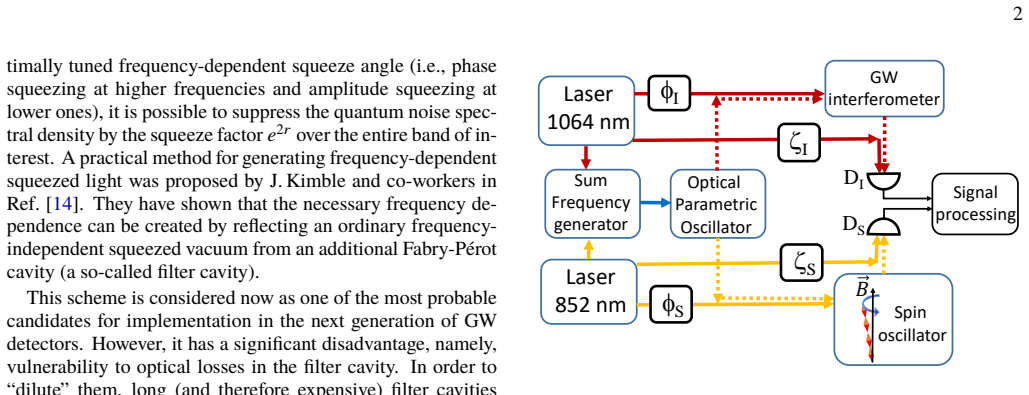
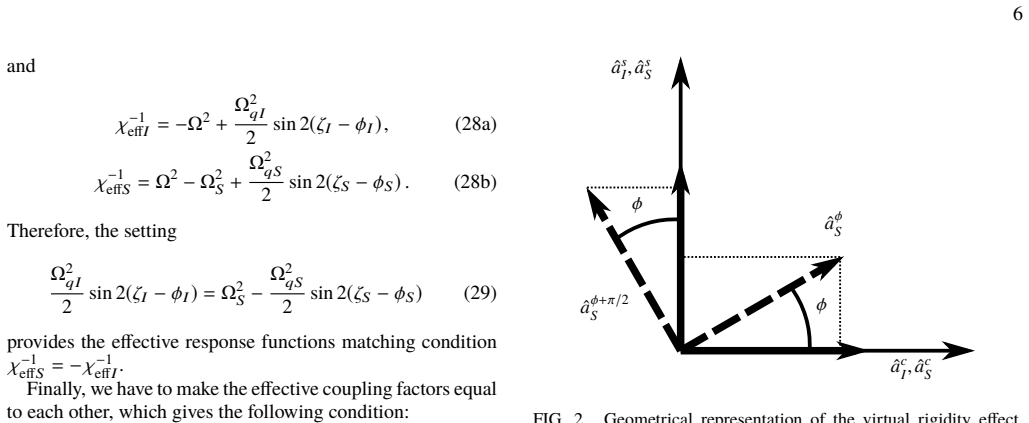
The load-bearing object is the virtual rigidity effect, expressed by the effective susceptibility $\chi_{\mathrm{eff}}^{-1} = \chi^{-1} + (\Omega_q^2/2)\sin 2(\zeta-\varphi)$, where $\zeta$ is the homodyne angle and $\varphi$ the carrier phase. This frequency-independent term acts like an extra spring, shifting the resonance of the probed oscillator, and it is what lets the spin oscillator's effective susceptibility cancel the interferometer's free-mass response. The matching also requires the antisymmetric homodyne condition $\zeta_I+\zeta_S=\pi n$, equal effective readout rates, and the phase relation fixing $\Omega_S^2 = \frac{\sin\zeta\,\sin\varphi}{\sin(\zeta+\varphi)}\,\Omega_{qI}^2$. The analysis is carried out in the bad-cavity limit $\Omega\ll\gamma$, and the central sensitivity result is the closed-form gain formula, Eq. (57), which expresses the gain in terms of optical losses, the spin decay rate $\gamma_S$, and the squeezing parameter $r$.
What would settle it
Measure the spin system's thermal force noise spectral density $\sigma_T$ near $\Omega_S\approx 2\pi\times 46$ Hz after the proposed ground-state initialization; if it exceeds $2\gamma_S\Omega$, the equality assumed in Eq. (40) fails, condition (50) is violated, and the predicted broadband gain cannot appear. A tabletop measurement of the combined noise with two-mode-squeezed input would show the discrepancy directly.
Extended reading notes
Core claim
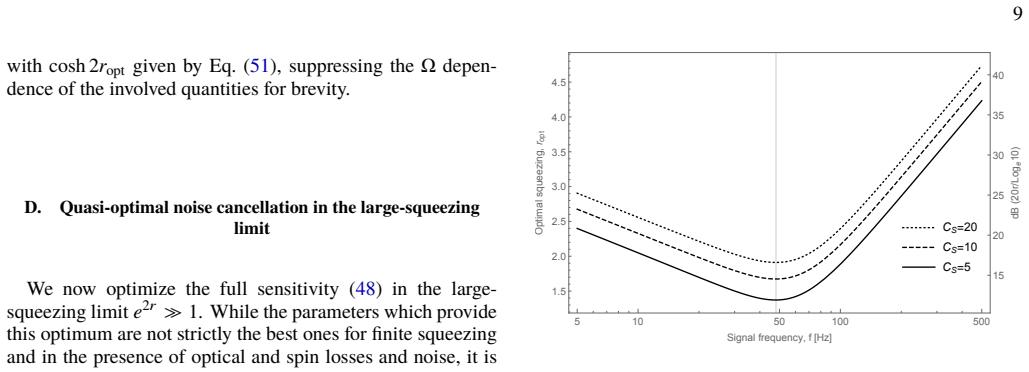
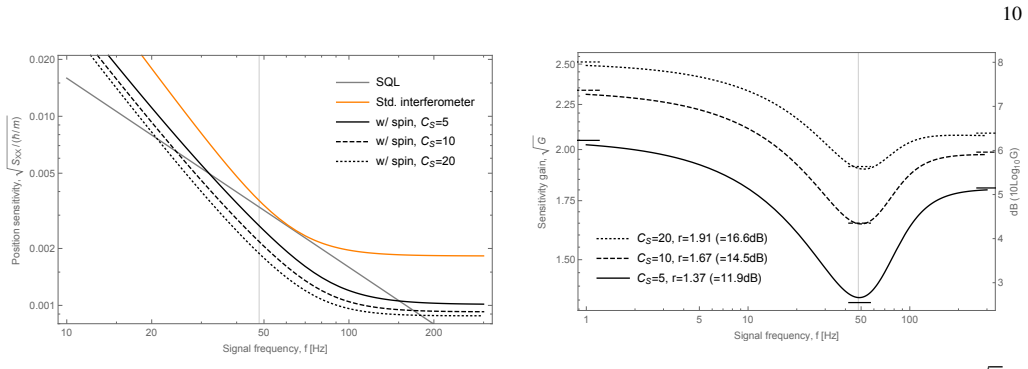
The central discovery is that virtual rigidity—a real, frequency-independent shift in a probed system's effective susceptibility that comes from choosing the probe and homodyne phases—can make the effective response of a negative-mass spin oscillator equal and opposite to the free-mass response of an interferometer, even when the spin oscillator's bare resonance frequency is not small. In the quasi-optimal configuration (homodyne angle $\zeta=\pi/2$, relative probe phase $\varphi=\pi/6$), the required bare spin resonance and readout rate become $\Omega_S=\Omega_{qI}/3^{1/4}$ and $\Gamma_S=\Omega_{qI}/3^{3/4}$, which minimizes spin decay for a given cooperativity and lowers the requirement to $C_S\sim 10$. Including optical losses, spin damping, and finite squeezing, the paper derives a closed-form expression for the gain, Eq. (57), showing exactly how these imperfections limit the improvement. For state-of-the-art interferometer parameters, the scheme gives a broadband gain of $6$ to $7$ dB relative to a standard interferometer and sub-SQL sensitivity over a broad band.
Load-bearing premise
The calculation assumes the collective spin oscillator starts at its quantum ground state, so its only thermal noise is the zero-point level; if the spin mode is warmer, the extra noise can invalidate the cancellation condition and the predicted 6–7 dB gain is not reached.
Editorial extensions
If this is right
- With the cooperativity reduced to $C_S\sim 10$, the spin system can be built as a small-finesse cavity or a cavityless through-path setup, avoiding the large optical losses that cavity-based proposals suffer.
- The predicted 6–7 dB broadband gain over a standard interferometer increases the detectable event rate roughly as $G^{3/2}$, since a detector's sensitive volume grows with the third power of the sensitivity gain.
- The squeezing levels used in the estimates, about 12–17 dB, are attainable with a parametric amplifier pumped at or below about half its threshold power, so the scheme does not demand unrealistic light sources.
- At low and high signal frequencies the gain is controlled mainly by optical losses rather than by the spin oscillator, through the approximate formulas Eqs. (61) and (62), so the broadband improvement is insensitive to fine details of the spin system once the thermal-noise condition holds.
Reading between the lines
- A tabletop proof-of-principle could test the core mechanism without a full gravitational-wave detector: run only the spin channel with a two-mode-squeezed input and measure the combined noise spectrum, checking whether the dip around $\Omega_S\approx 2\pi\times 46$ Hz has the width and depth predicted by Eq. (57).
- The same effective-susceptibility matching could plausibly be transplanted to other second-meter or speedmeter designs, easing their requirements on filter cavities or additional readout paths as well.
- Because the paper fixes the phase $\varphi=\pi/6$ to minimize spin decay, a natural next step would be to re-optimize $\zeta$ and $\varphi$ jointly under realistic finite losses and finite squeezing, which may shift the optimum away from this quasi-optimal point.
- If ground-state initialization of the spin mode proves hard, one could compensate by increasing the cooperativity or squeezing partway; measuring the spin thermal noise spectral density directly at the resonance would tell which operating point is actually reachable.
Signed reviews
Editorial analysis
A structured set of objections, weighed in public.
Referee Report
Summary. The paper proposes a scheme for broadband quantum noise evasion in gravitational wave detectors by entangling the interferometer with a negative-mass spin oscillator. The new ingredient is the use of the virtual rigidity effect to match the effective susceptibilities of the two systems, which relaxes the required spin cooperativity from ~10^2 to ~10. The authors derive the matching conditions (32), a full input-output model with optical losses and spin dissipation (Eqs. (39)-(48)), an approximate closed-form gain formula (Eq. (57)), and numerical estimates showing a broadband sensitivity gain of 6-7 dB relative to a standard interferometer and sub-SQL sensitivity over a broad band.
Significance. If the scheme works as claimed, it offers a relatively unintrusive and low-cost upgrade path for existing GW detectors, avoiding long filter cavities or modifications to the core optics. The derivation is systematic and self-contained: the effective susceptibility transformation (18) is exact in the lossless case, the matching conditions follow from basic trigonometry, and the approximate gain formula (57) provides clear design insight. The paper also provides a geometrical interpretation of the virtual rigidity effect and a full treatment of optical losses and spin dissipation. However, the quantitative significance of the proposal depends crucially on an assumption about the spin oscillator being at zero-point noise, which is not validated in the manuscript.
major comments (1)
- [III.A, Eq. (40), Eq. (45b), condition (50)] The central quantitative claim of a 6-7 dB broadband gain rests on the assumption that the spin system noise is at the zero-point level, sigma_T = 2 gamma_S Omega (equality in Eq. (40), Sec. IIIA). This assumption is load-bearing: the spin thermal-noise term 2 sigma_T / (K_S eta_iS) enters <S in Eq. (45b), and condition (50) must be satisfied for squeezing to improve sensitivity. For the quasi-optimal parameters of Sec. IV (Omega_S ~ 2 pi x 46 Hz, gamma_S ~ 2 pi x 3.6 Hz for C_S = 10 and gamma_S0 = 2 pi x 1 Hz), the zero-point value is smaller than the thermal value at room temperature by a factor of about 10^10, so <S becomes much larger than unity and condition (50) is dramatically violated; the optimal-squeezing formula (51) then has no positive solution and the gain in Eq. (57) collapses to unity. The manuscript does not provide a mechanism for ground-state initialization of a 46-Hz collective spin oscillator, and the assumption is not derived from the parameters in Table I. The authors should either demonstrate that such ground-state initialization is feasible with state-of-the-art techniques, or include the thermal-noise term in the sensitivity analysis and characterize the parameter regime in which a meaningful gain survives at realistic spin temperatures.
minor comments (5)
- [II.A] After Eq. (22), the phrase 'it is easy to see see' contains a duplicated word; please remove the repeated 'see'.
- [II.D / Fig. 2] The equation numbering around Fig. 2 is inconsistent: the text refers to 'Eq. (27b)' where Eq. (28b) is meant, and Eq. (33) appears both in the main text and in the figure caption with different content. Please renumber for clarity.
- [III.D, Eq. (57)] Eq. (57) as typeset has unclear bracketing in the denominator; please rewrite with unambiguous parentheses so that the reader can identify the ordering of the two terms and the addition of <_I and <_{S,opt}.
- [Table I / III.A] Table I does not list the effective spin temperature or the assumed initialization procedure, even though the ground-state noise assumption is crucial for the gain estimate. Please add this information or an explicit statement that zero-point noise is assumed.
- [V] In the conclusion, the statement that the sensitivity gain 'could reach 6-7 dB' should be qualified to indicate that this is conditional on the ground-state spin-noise assumption (40).
Circularity Check
No significant circularity: the sensitivity gain is obtained from a self-contained analytic derivation with no fitted or renamed inputs.
full rationale
The paper's central derivation is algebraic and self-contained. The matching conditions for effective susceptibilities and readout rates are derived in Eqs. (20)-(32) from the standard input-output relations (11) and the two-mode-squeezing correlation structure (19), not from any fitted quantity. The virtual-rigidity shift in Eq. (18) is derived in the text rather than imported unexamined, so the citation to Ref. [5] is contextual only. The baseline scheme of Ref. [23] is a starting point, but the present paper rederives and generalizes the matching conditions; the 6-7 dB gain is a computed output for the quasi-optimal parameter choice, not a target used to fix parameters. The key closed-form gain formula, Eq. (57), follows by substituting the loss and dissipation model of Eqs. (39)-(48) into the gain definition (56) under stated approximations; it is not equivalent to an input by construction. The only non-derived physical input is the explicit assumption of zero-point spin noise, stated as equality in Eq. (40) ('We assume that this noise is ground-state noise'). Whether that assumption is experimentally valid is a correctness and feasibility concern, not a circularity: the assumption is declared, not smuggled in as a prediction. The parameters in Table I are taken from external benchmarks or explicitly stated estimates, and no parameter is fit to the claimed gain. Therefore the derivation chain does not reduce to its own inputs.
Assumptions & free parameters
free parameters (2)
- Spin probe phase φ =
π/6
- Interferometer homodyne and probe combination ζ =
π/2
assumptions (5)
- domain assumption Two-mode squeezed light with the quadrature statistics of Eqs. (19) can be generated at the required wavelengths (1064 nm and 852 nm) with sufficient pump power.
- standard math The bad-cavity approximation Ω ≪ γ (Eq. 10) holds for the entire frequency band of interest.
- domain assumption The atomic ensemble behaves as a negative-mass harmonic oscillator with susceptibility (9)/(38) within the Holstein-Primakoff approximation.
- domain assumption The spin system thermal noise is at the zero-point level, equality in Eq. (40).
- domain assumption Optical losses are accounted for only through input and output quantum efficiencies η_i, η_o = 0.95; intra-cavity losses are neglected.
Cite this review
Pith. "Pith review of Gravitational wave detection beyond the standard quantum limit using a negative-mass spin system and virtual rigidity." pith.science (2026). https://pith.science/paper/JVGANIHL
@misc{pith2026190803416,
  author       = {Pith},
  title        = {Pith review of: Gravitational wave detection beyond the standard quantum limit using a negative-mass spin system and virtual rigidity},
  year         = {2026},
  howpublished = {\url{https://pith.science/paper/JVGANIHL}},
  note         = {Machine review of arXiv:1908.03416}
}
abstract
Gravitational wave detectors (GWDs), which have brought about a new era in astronomy, have reached such a level of maturity that further improvement necessitates quantum-noise-evading techniques. Numerous proposals to this end have been discussed in the literature, e.g., invoking frequency-dependent squeezing or replacing the current Michelson interferometer topology by that of the quantum speedmeter. Recently, a proposal based on the linking of a standard interferometer to a negative-mass spin system via entangled light has offered an unintrusive and small-scale new approach to quantum noise evasion in GWDs [Phys. Rev. Lett. $\mathbf{121}$, 031101 (2018)]. The solution proposed therein does not require modifications to the highly refined core optics of the present GWD design and, when compared to previous proposals, is less prone to losses and imperfections of the interferometer. In the present article, we refine this scheme to an extent that the requirements on the auxiliary spin system are feasible with state-of-the-art implementations. This is accomplished by matching the effective (rather than intrinsic) susceptibilities of the interferometer and spin system using the virtual rigidity concept, which, in terms of implementation, requires only suitable choices of the various homodyne, probe, and squeezing phases.
Figures
Figures from the paper (1 more)
Reference graph
Works this paper leans on
-
[1]
https://www.ligo.caltech.edu
-
[2]
http://www.virgo-gw.eu
- [3]
-
[4]
V. B. Braginsky and F. Ya. Khalili,Quantum Measurement, Cambridge University Press, 1992
work page 1992
-
[5]
S. L. Danilishin and F. Y. Khalili, Living Reviews in Relativity 15, 5 (2012)
2012
-
[6]
S. L. Danilishin, F. Y. Khalili, and H. Miao, Living Reviews in Relativity22, 2 (2019)
work page 2019
-
[7]
https://twitter.com/LIGO
-
[8]
C. M. Caves, Phys. Rev. D23, 1693 (1981)
1981
Show all 29 references
-
[9]
Abadieet al., Nature Physics7, 962 (2011)
J. Abadieet al., Nature Physics7, 962 (2011)
2011
-
[10]
Groteet al., Phys
H. Groteet al., Phys. Rev. Lett.110, 181101 (2013)
2013
-
[11]
V. B. Braginskii, Sov.Phys.JETP26, 831 (1968)
1968
-
[12]
double-sided
We use the “double-sided” convention for the spectral densities inthispaper;ourmainresult,namelythevalueofthesensitivity gain G, evidently does not depend on this choice
-
[13]
W. G. Unruh, Quantum noise in the interferometer detector, in Quantum Optics, Experimental Gravitation, and Measurement Theory,editedbyP.MeystreandM.O.Scully,page647,Plenum Press, New York, 1983
1983
-
[14]
H. J. Kimble, Yu. Levin, A. B. Matsko, K. S. Thorne and S. P. Vyatchanin, Phys. Rev. D65, 022002 (2001)
2001
-
[15]
Evans, L
M. Evans, L. Barsotti, P. Kwee, J. Harms, and H. Miao, Phys. Rev. D88, 022002 (2013)
2013
-
[16]
P. Kwee, J. Miller, T. Isogai, L. Barsotti, and M. Evans, Phys. Rev. D90, 062006 (2014)
2014
-
[17]
Maet al., Nature Physics13, 776 (2017)
Y. Maet al., Nature Physics13, 776 (2017)
2017
-
[18]
Julsgaard, A
B. Julsgaard, A. Kozhekin, and E. S. Polzik, Nature413, 400 (2001)
2001
-
[19]
Wasilewskiet al., Phys
W. Wasilewskiet al., Phys. Rev. Lett.104, 133601 (2010)
2010
-
[20]
E. S. Polzik and K. Hammerer, Annalen der Physik527, A15 (2015)
2015
-
[21]
K.Hammerer,M.Aspelmeyer,E.S.Polzik,andP.Zoller, Phys. Rev. Lett.102, 020501 (2009)
2009
-
[22]
C. B. Mølleret al., Nature547, 191 (2017)
2017
-
[23]
F. Y. Khalili and E. S. Polzik, Phys. Rev. Lett.121, 031101 (2018)
2018
-
[24]
J.Aasi etal., ClassicalandQuantumGravity 32,074001(2015)
2015
-
[25]
M. V. Balabaset al., Opt. Express18, 5825 (2010)
2010
-
[26]
82, 1041 (2010)
K.Hammerer,A.S.Sørensen,andE.S.Polzik, Rev.Mod.Phys. 82, 1041 (2010)
2010
-
[27]
F. Y. Khalili and S. L. Danilishin, Progress in Optics61, 113 (2016)
2016
-
[28]
C.M.CavesandB.L.Schumaker, Phys.Rev.A 31,3068(1985)
1985
-
[29]
E. S. Polzik, J. Carri, and H. J. Kimble, Appl. Phys. B55, 279 12 (1992)
1992
Reviewed August 14, 2026 · model on record in the stance chip above.
Discussion (0). Continue with ORCID to comment.