REVIEW 2 major objections 4 minor 44 references
Composable and Finite Computational Security of Quantum Message Transmission
T0 review · 2 major / 4 minor · reviewed 2026-08-14 · deepseek-v4-flash
Pith's one-line read Quantum message transmission can be given finite, composable, computational security by defining a scheme as a construction that turns an insecure channel plus a shared key into an ideal secure channel; the paper proves explicit bounds…
desk verdict Genuinely useful finite composable security definitions for quantum message transmission, with a real proof gap in the PMCC construction (Theorem 2) that must be fixed before publication. read the letter →
The pith
A machine-rendered reading of the paper's core claim, the machinery that carries it, and where it could break.
The reading
What carries the argument
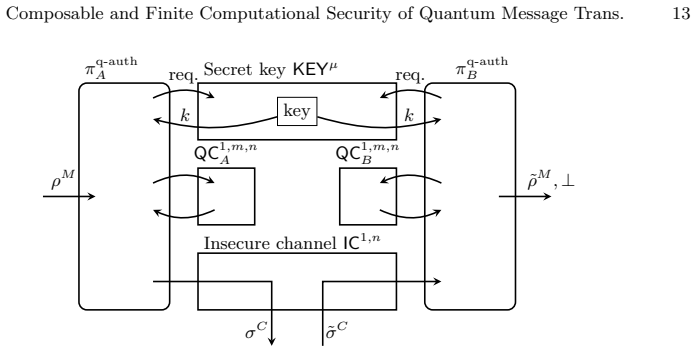
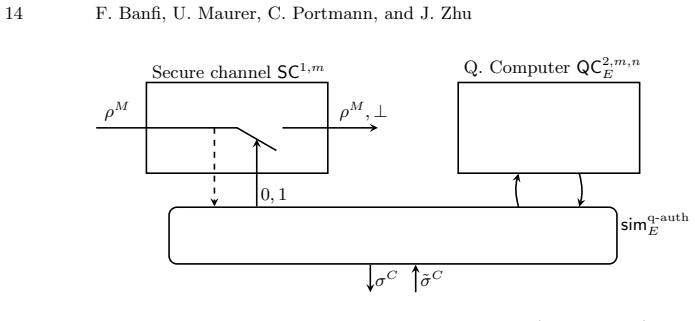
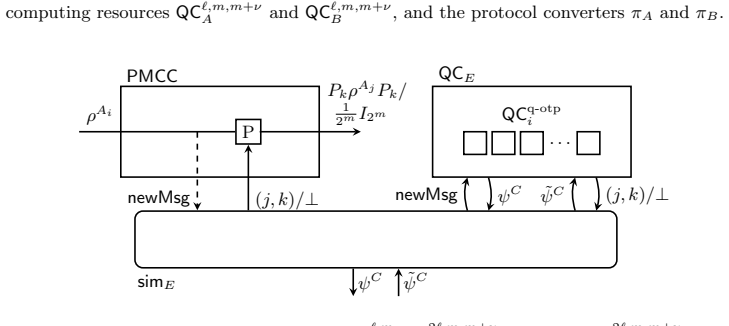
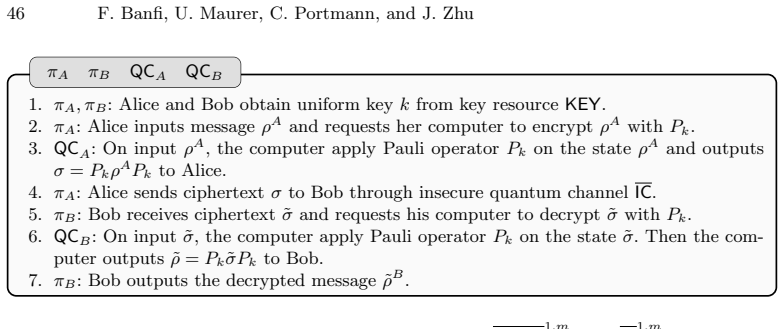
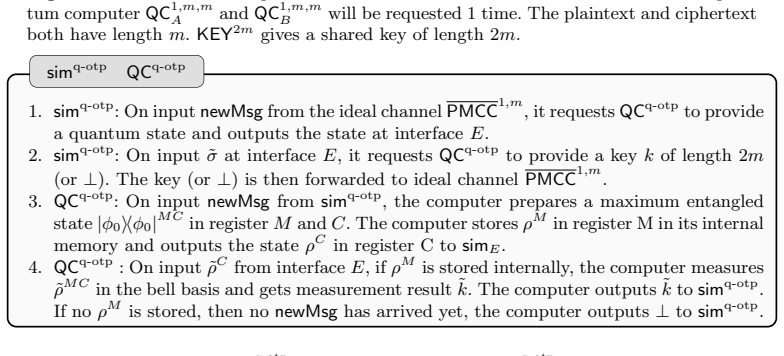
The load-bearing object is the construction statement $R \xrightarrow{\pi,\epsilon} S$: converter protocols $\pi_A,\pi_B$ transform a real resource $R$ into an ideal resource $S$ such that for every distinguisher $D$, $d_D(\pi_{AB}R, \mathrm{sim}_E S) \le \epsilon(D)$, where $d_D$ is the distinguisher advantage under the pseudo-metric generated by $D$. Resources are instantiated as quantum combs, i.e., causal CPTP maps over sequential message inputs. The central identity used in the Pauli-malleable construction is the twirl identity $\sum_k P_k \rho P_k = 2^m I \otimes \rho_E$ (up to normalization), which makes the one-time pad with random Pauli keys produce a fully mixed state on Bob's side. The composition theorem (errors add) and hybrid arguments carry the multi-message proofs.
What would settle it
Choose any fixed parameters and a candidate PRF family, and run the real and ideal systems of the OSC construction; if a distinguisher achieves advantage strictly greater than $\epsilon_{\mathrm{PRF}}(DC) + \ell \, \epsilon_{\mathrm{q\text{-}auth}}$, then the paper's bound is false.
Extended reading notes
Core claim
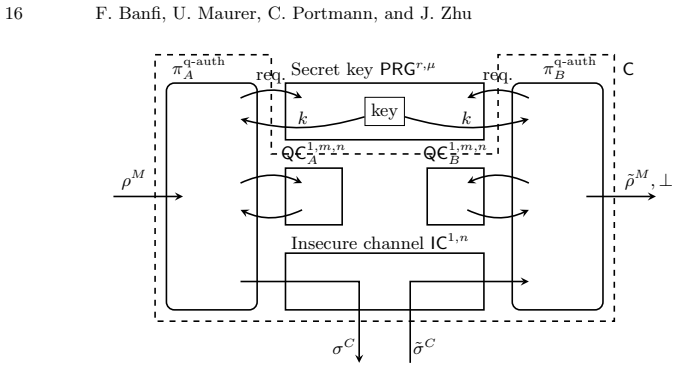
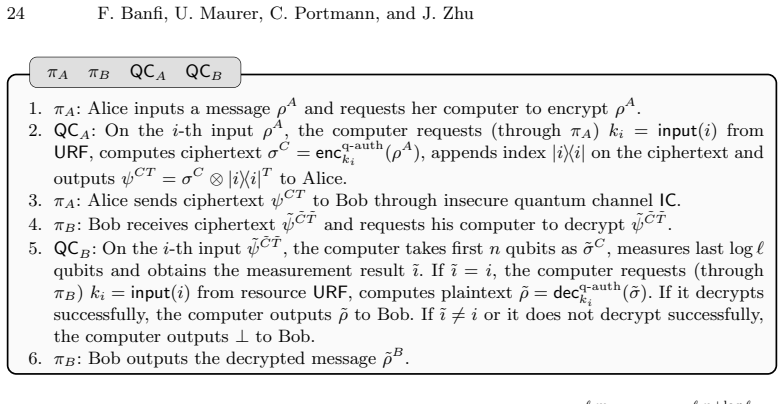
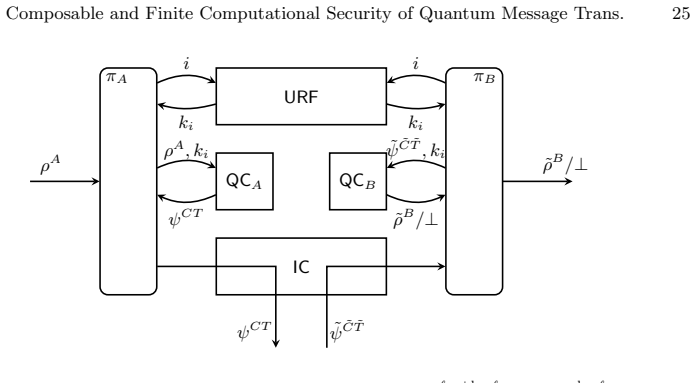
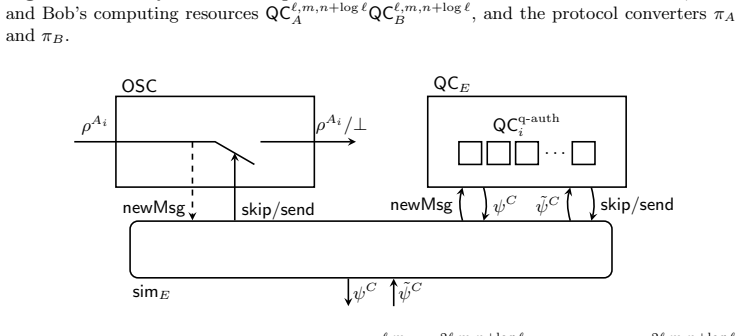
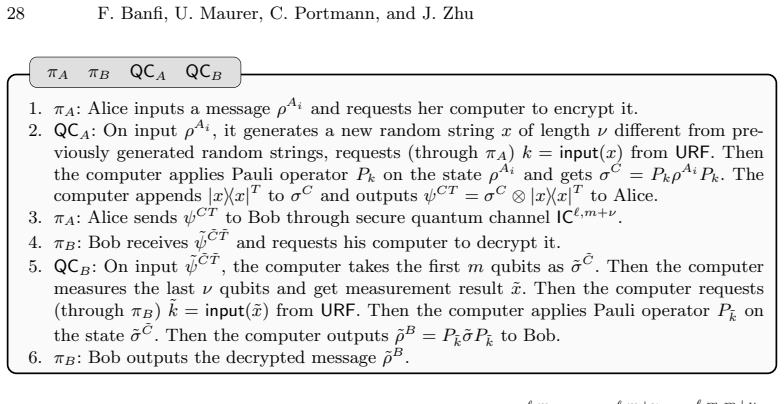
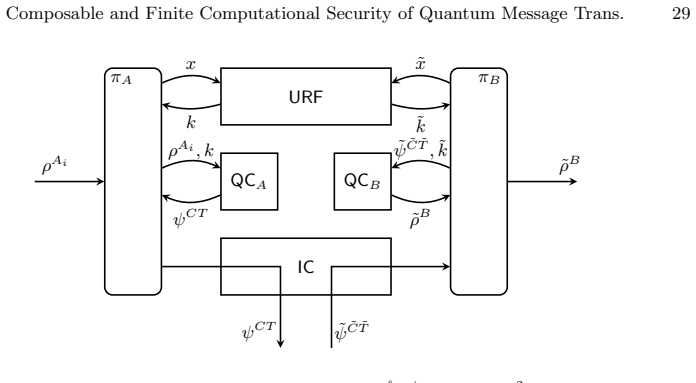
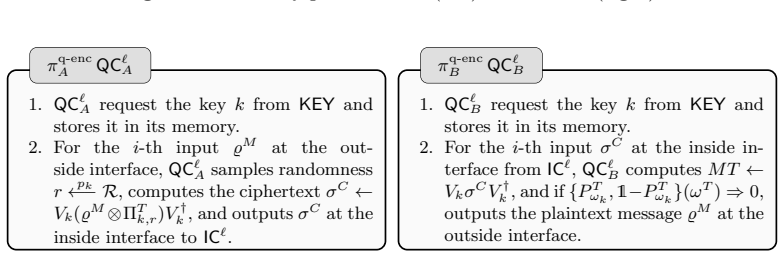
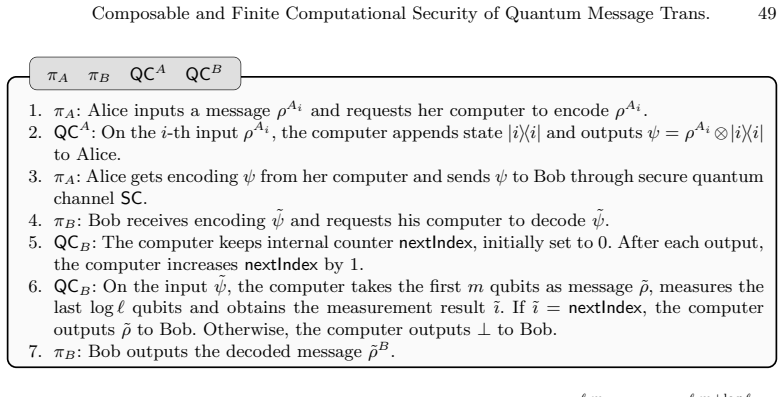
The central discovery is that computational security for quantum message transmission can be stated without games or oracles, as a resource construction with a finite reduction. For any fixed distinguisher, the real protocol—the insecure channel, Alice's and Bob's converters, and their explicit quantum-computing resources—must be within a stated advantage of an ideal channel connected to a simulator. The strongest channel constructed is an ordered secure quantum channel (OSC), where Eve can only send 'send' or 'skip' for each message; the proof uses a hybrid argument over $\ell$ one-time authenticated transmissions and yields $d_D(\mathrm{real}, \mathrm{ideal}) \le \epsilon_{\mathrm{PRF}}(DC) + \ell \, \epsilon_{\mathrm{q\text{-}auth}}$. A second construction yields a Pauli-malleable confidential channel (PMCC) with error $\ell^2 / 2^{\nu}$ plus the PRF term. From these, the paper derives that the game-based security notions of quantum authenticated encryption and QCCA2 are strictly stronger than constructing a secure (or non-malleable) channel, reproducing the classical append-a-bit separation.
Load-bearing premise
The load-bearing premise is that a concrete pseudo-random function family exists for the chosen fixed seed, input, and output lengths with a small proven distinguishing advantage; without such a finite instantiation, the bounds for the PRF-based protocols are conditional.
Editorial extensions
If this is right
- For any fixed choice of parameters, the construction error is an explicit number, so a concrete implementation can check whether the PRF advantage and authentication error meet its requirement.
- The constructed channels compose: if one resource is used inside another protocol, the total error is at most the sum of the individual construction errors.
- Existing protocols for quantum encryption and authentication, with minor modifications, satisfy composable finite security under the stated assumptions.
- Adding a counter to each message upgrades a secure channel to an ordered secure channel at zero additional error.
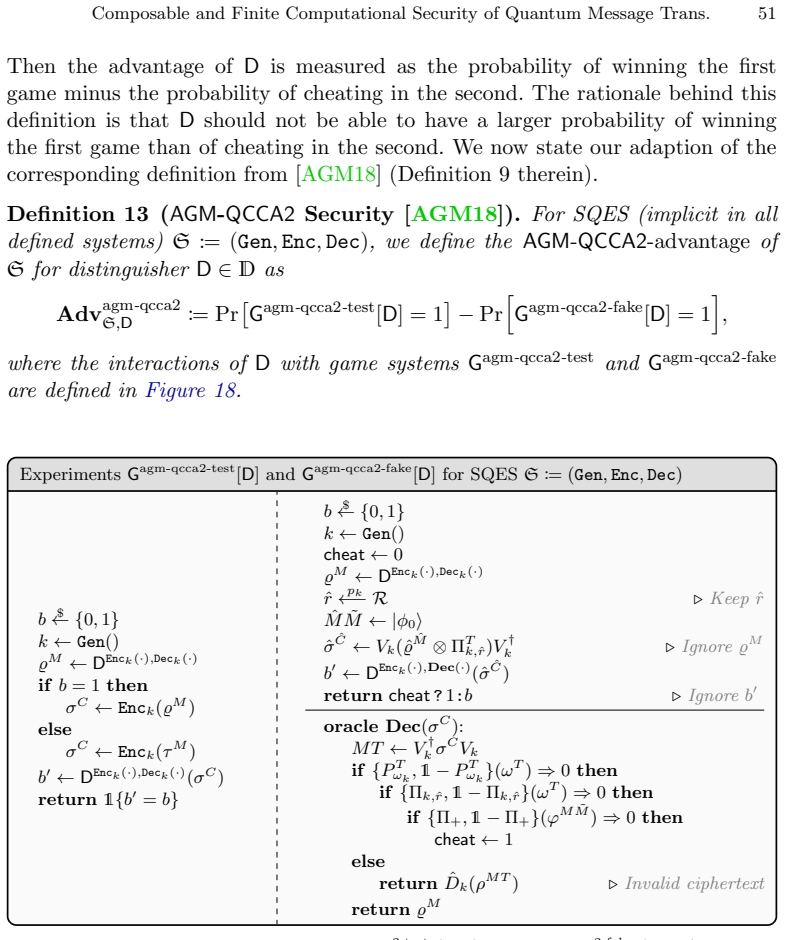
- QAE and QCCA2, as defined in prior work, reject schemes that still construct the intended secure or non-malleable channel, so game-based security is a sufficient but not necessary benchmark.
Reading between the lines
- Because the finite statements are parameter-relative, instantiating the PRF with a specific candidate and proving a finite bound on its distinguishing advantage would turn the corollaries into unconditional, checkable bounds for that implementation.
- The sequential-scheduling restriction excludes superpositions of causal orders; extending the same definitions to such settings would require a more general system model than quantum combs.
- The same resource-construction template could be applied to other quantum primitives, such as key distribution or delegated computation, to obtain finite composable statements wherever a one-shot subroutine with an explicit error is available.
Signed reviews
Editorial analysis
A structured set of objections, weighed in public.
Referee Report
Summary. The paper proposes a finite, composable, computational-security framework for quantum message transmission in the Abstract & Constructive Cryptography paradigm, instantiated with quantum combs. It defines channel resources (OSC, SC, NMCC, PMCC) and proves that a tagged, PRF-based variant of a one-time quantum authentication protocol constructs an OSC within l·ε_q-auth plus a PRF error (Theorem 1 and Corollary 3), and that a Pauli-pad-style protocol constructs a PMCC within l^2·2^{−ν} plus a PRF error (Theorem 2 and Corollary 4). It then shows that QAE security implies, but is strictly stronger than, constructing a secure channel (Theorem 3), and introduces RRC-QCCA2 and RRO-QCCA2, proving that RRO-QCCA2 (and, for a restricted class of schemes, RRC-QCCA2) implies constructing a non-malleable confidential channel, again with strict separation (Section 4.3, Theorem 4 and Corollaries 7–8).
Significance. If the results hold, this is a valuable step toward placing computational security of quantum message transmission on a composable, finite footing: the definitions are operational, the reductions are explicit, and the game-based comparison clarifies the over-strength of QAE and QCCA2. The OSC construction (Theorem 1), the composition theorem, and the QAE/RRO-QCCA2 implications are supported by explicit hybrids and reductions. However, the proof of the PMCC construction (Theorem 2) contains a load-bearing gap concerning the overline resources and the reduction to the one-message lemma; until that is repaired, the second construction and its corollary are not established. The PRF-based bounds are also conditional on an assumed finite PRF advantage rather than an instantiated finite PRF.
major comments (2)
- [Section 3.4, Theorem 2 and Eq. (13)] The proof introduces overline resources R̄_l and S̄_l by requiring that 'IC and PMCC will reject any input from interface A if it contains the same tag x as previous input from interface E', but this condition is not well-defined for the ideal resource PMCC_{l,m}: interface A of PMCC_{l,m} receives untagged m-qubit messages, so there is no tag to compare with previous E inputs. Tags exist only in the real-world ciphertexts and in the simulator's outputs at interface E. Consequently S̄_l is not a legitimate quantum comb, and the asserted bound dD(R_l,S_l) ≤ dD(R̄_l,S̄_l) + l^2/2^ν is unsupported. The claimed reduction to Lemma 7 is also not explicit: Lemma 7 concerns one-message overline channels that reject an A input after any E input, without tags and with message length m, whereas Theorem 2's overline channels are tag-dependent and have message length m+ν. No converter or hybrid argument is supplied to bridge this gap. The PMCC construction is therefore not proven as stated.
- [Section 3.4, proof of Theorem 2 (paragraph after Eq. (13))] Even apart from the definitional issue above, the step 'Following from a standard hybrid argument, if a distinguisher D can distinguish R̄_l and S̄_l, it can be used to construct a distinguisher in the one-message scenario' is not backed by an explicit construction. One would need to show that the multi-message protocol with overline channels decomposes into l independent one-message instances under a converter that routes ciphertexts by their tags; because the tags are chosen freshly by Alice's computer and can be replayed by Eve, such a routing converter must be stateful and must keep track of the tag-to-instance mapping. This is exactly the point at which the missing tag in PMCC_{l,m} becomes relevant. Until this hybrid is supplied, the equality dD(R̄_l,S̄_l)=0 does not follow from Lemma 7.
minor comments (4)
- [Section 3.1 and Corollaries 3–4] The finite security statements are conditional on an assumed finite bound ε_PRF(D) for a concrete PRF family. The reference to [Zha12] provides an asymptotic construction, not an explicit finite bound for a specific PRF. Please state explicitly that the reductions are conditional on a finite PRF assumption and discuss how such a bound could be obtained, or provide an instantiation.
- [Section 2.4] The results are proved in the sequential-scheduling quantum-combs model, which excludes superpositions of causal orders. The authors note that the Causal Boxes model [PMM+17] covers such settings; the paper should state prominently that the composability claims are limited to sequential scheduling.
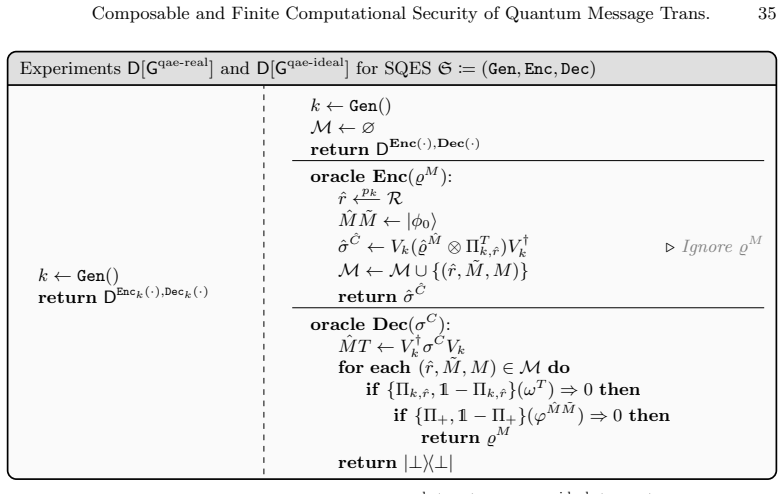
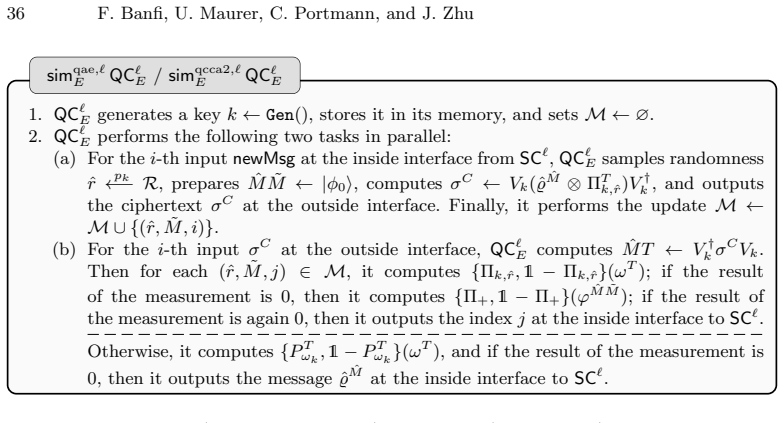
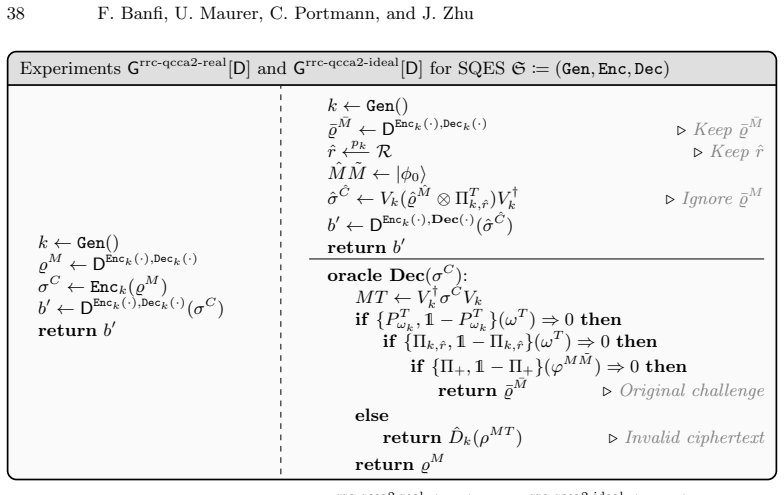
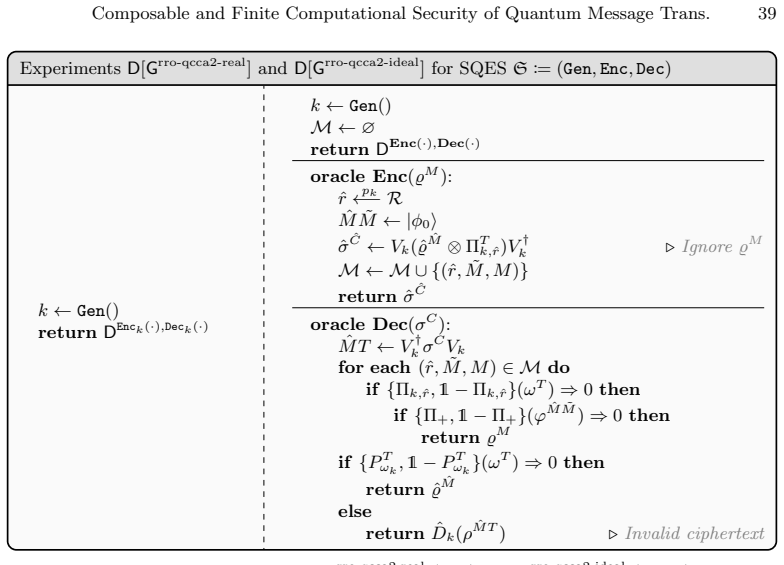
- [Section 4.3, proof of Theorem 4 and Corollaries 7–8] In the proof of Theorem 4 the ideal system is written as simqae_E [NMCC_l, QC_l_E], but it should be simqcca2_E; also the computing resource QCqcca2,l_E used in Corollaries 7 and 8 is not formally defined. Please fix the notation.
- [Section 4.2, QAE separation] The bit-appending separation argument should spell out that the appended bit is part of the ciphertext state checked by the ideal decryption oracle, so flipping it causes the ideal oracle to return ⊥; as written, a reader might think the bit is ignored before the ideal game's matching step.
Circularity Check
No significant circularity: the security theorems are finite reductions to independent q-auth and PRF/URF assumptions; self-citations frame the model but do not determine the conclusions.
full rationale
The paper's central derivation works as a genuine resource-construction reduction: the real systems (protocol converters plus insecure channel and key/URF resources) are shown to approximate independently defined ideal channels (OSC, PMCC, SC, NMCC), with explicit distinguisher-dependent error bounds. Theorem 1 relies on Lemma 1, which is taken from Portmann's external, information-theoretically proven purity-testing authentication bound, and the multi-message argument is a standard hybrid over one-message subsystems. Corollary 3 then applies the PRF assumption of Eq. (12) as an explicit finite reduction, not as a disguised restatement of the target result. Theorem 2 and Appendix C reduce the multi-message Pauli-malleable construction to the quantum one-time-pad statement of Lemma 7, and Lemma 7 is proved in this paper by direct Choi-state calculation, not merely assumed or imported from a self-citation. The QAE and QCCA2 comparisons in Section 4 are formal implication proofs with explicitly constructed reductions and simulators; the game-based notions are not used to define the constructive notions, so those results are also not circular. The authors do cite their own prior framework (Maurer-Renner constructive cryptography and quantum combs), but the needed definitions are restated in Section 2 and the composition theorem is proved in Appendix B, so the self-citations supply vocabulary rather than the load-bearing conclusion. Two genuine concerns remain, but they are not circularity: in Section 3.4 the barred resources used around Eq. (13) are under-specified for the ideal PMCC (interface A receives untagged messages, so the 'reject if same tag' condition is not a well-defined comb), making the step dD(R_bar, S_bar) = 0 via Lemma 7 not fully explicit; and the finite security bounds are conditional because only asymptotic PRF constructions are cited from [Zha12]. These are proof gaps and missing finite instantiations, not cases where a prediction reduces to its inputs.
Assumptions & free parameters
assumptions (4)
- domain assumption Quantum combs and their composition and pseudo-metric properties (from Gutoski-Watrous, Chiribella et al.) are a valid model for sequential quantum communication and allow the composition theorems in Appendix B.
- domain assumption There exists a one-time quantum authentication scheme with error bound max{2^(m-n), epsilon} for any purity-testing code (Lemma 1, from Portmann [Por17]).
- domain assumption There exists a pseudo-random function family that is indistinguishable from a uniform random function for fixed parameters, with a finite bound epsilon_PRF, against quantum distinguishers (Definition 3 and Eq. (12), citing Zhandry [Zha12]).
- domain assumption Sequential scheduling, where the party to whom a message is sent is given by classical information, captures the relevant attack models for the constructed channels.
Cite this review
Pith. "Pith review of Composable and Finite Computational Security of Quantum Message Transmission." pith.science (2026). https://pith.science/paper/VRFQA4YB
@misc{pith2026190803436,
  author       = {Pith},
  title        = {Pith review of: Composable and Finite Computational Security of Quantum Message Transmission},
  year         = {2026},
  howpublished = {\url{https://pith.science/paper/VRFQA4YB}},
  note         = {Machine review of arXiv:1908.03436}
}
read the original abstract
Recent research in quantum cryptography has led to the development of schemes that encrypt and authenticate quantum messages with computational security. The security definitions used so far in the literature are asymptotic, game-based, and not known to be composable. We show how to define finite, composable, computational security for secure quantum message transmission. The new definitions do not involve any games or oracles, they are directly operational: a scheme is secure if it transforms an insecure channel and a shared key into an ideal secure channel from Alice to Bob, i.e., one which only allows Eve to block messages and learn their size, but not change them or read them. By modifying the ideal channel to provide Eve with more or less capabilities, one gets an array of different security notions. By design these transformations are composable, resulting in composable security. Crucially, the new definitions are finite. Security does not rely on the asymptotic hardness of a computational problem. Instead, one proves a finite reduction: if an adversary can distinguish the constructed (real) channel from the ideal one (for some fixed security parameters), then she can solve a finite instance of some computational problem. Such a finite statement is needed to make security claims about concrete implementations. We then prove that (slightly modified versions of) protocols proposed in the literature satisfy these composable definitions. And finally, we study the relations between some game-based definitions and our composable ones. In particular, we look at notions of quantum authenticated encryption and QCCA2, and show that they suffer from the same issues as their classical counterparts: they exclude certain protocols which are arguably secure.
Figures
Figures from the paper (15 more)
Reference graph
Works this paper leans on
-
[1]
Computational security of quantum encryption
Gorjan Alagic, Anne Broadbent, Bill Fefferman, Tommaso Gagliardoni, Christian Schaffner, and Michael St Jules. Computational security of quantum encryption. In International Conference on Information Theoretic Security , pages 47--71. Springer, 2016
work page 2016
-
[2]
Unforgeable Quantum Encryption
Gorjan Alagic, Tommaso Gagliardoni, and Christian Majenz. Unforgeable quantum encryption. In Jesper Buus Nielsen and Vincent Rijmen, editors, Advances in Cryptology -- EUROCRYPT 2018, Proceedings, Part III , volume 10822 of Lecture Notes in Computer Science , pages 489--519. Springer, 2018. [ 10.1007/978-3-319-78372-7_16 , arxiv 1709.06539 ]
work page Pith review arXiv 2018
-
[3]
Authentication of quantum messages
Howard Barnum, Claude Cr \'e peau, Daniel Gottesman, Adam Smith, and Alain Tapp. Authentication of quantum messages. In Proceedings of the 43rd Symposium on Foundations of Computer Science, FOCS '02 , pages 449--458. IEEE, 2002. [ 10.1109/SFCS.2002.1181969 , arxiv quant-ph/0205128 ]
arXiv 2002
-
[4]
A concrete security treatment of symmetric encryption
Mihir Bellare, Anand Desai, Eron Jokipii, and Phillip Rogaway. A concrete security treatment of symmetric encryption. In Proceedings of the 38th Annual Symposium on Foundations of Computer Science , FOCS '97, pages 394--403. IEEE Computer Society, 1997. [ 10.1109/SFCS.1997.646128 ]
-
[5]
Relations among notions of security for public-key encryption schemes
Mihir Bellare, Anand Desai, David Pointcheval, and Phillip Rogaway. Relations among notions of security for public-key encryption schemes. In Advances in Cryptology -- CRYPTO '98 , pages 26--45. Springer, 1998. [ 10.1007/BFb0055718 ]
-
[6]
The universal composable security of quantum key distribution
Michael Ben-Or , Micha Horodecki, Debbie Leung, Dominic Mayers, and Jonathan Oppenheim. The universal composable security of quantum key distribution. In Theory of Cryptography, Proceedings of TCC 2005 , volume 3378 of Lecture Notes in Computer Science , pages 386--406. Springer, 2005. [ 10.1007/978-3-540-30576-7_21 , arxiv quant-ph/0409078 ]
arXiv 2005
-
[7]
Quantum homomorphic encryption for circuits of low t-gate complexity
Anne Broadbent and Stacey Jeffery. Quantum homomorphic encryption for circuits of low t-gate complexity. In Rosario Gennaro and Matthew Robshaw, editors, Advances in Cryptology -- CRYPTO 2015 , pages 609--629. Springer, 2015. [ 10.1007/978-3-662-48000-7_30 ]
-
[8]
Authenticated encryption: Relations among notions and analysis of the generic composition paradigm
Mihir Bellare and Chanathip Namprempre. Authenticated encryption: Relations among notions and analysis of the generic composition paradigm. In Advances in Cryptology -- ASIACRYPT 2000 , volume 1976 of Lecture Notes in Computer Science , pages 531--545. Springer, 2000. [ 10.1007/3-540-44448-3_41 ]
Show all 44 references
-
[9]
A general composition theorem for secure reactive systems
Michael Backes, Birgit Pfitzmann, and Michael Waidner. A general composition theorem for secure reactive systems. In Theory of Cryptography, Proceedings of TCC 2004 , volume 2951 of Lecture Notes in Computer Science , pages 336--354. Springer, 2004. [ 10.1007/978-3-540-24638-1_19 ]
2004 doi
-
[10]
The reactive simulatability ( RSIM ) framework for asynchronous systems
Michael Backes, Birgit Pfitzmann, and Michael Waidner. The reactive simulatability ( RSIM ) framework for asynchronous systems. Information and Computation , 205(12):1685--1720, 2007. Extended version of PW01 . [ 10.1016/j.ic.2007.05.002 , cryptoeprint 2004/082 ]
2007 doi
-
[11]
Universally composable security: A new paradigm for cryptographic protocols
Ran Canetti. Universally composable security: A new paradigm for cryptographic protocols. In Proceedings of the 42nd Symposium on Foundations of Computer Science, FOCS '01 , pages 136--145. IEEE, 2001. [ 10.1109/SFCS.2001.959888 ]
2001
-
[12]
Universally composable security: A new paradigm for cryptographic protocols
Ran Canetti. Universally composable security: A new paradigm for cryptographic protocols. Cryptology ePrint Archive, Report 2000/067, 2013. Updated version of Can01 . [ cryptoeprint 2000/067 ]
2000
-
[13]
Theoretical framework for quantum networks
Giulio Chiribella, Giacomo Mauro D'Ariano, and Paolo Perinotti. Theoretical framework for quantum networks. Physical Review A , 80:022339, August 2009. [ 10.1103/PhysRevA.80.022339 , arxiv 0904.4483 ]
2009 arXiv
-
[14]
Universally composable security with global setup
Ran Canetti, Yevgeniy Dodis, Rafael Pass, and Shabsi Walfish. Universally composable security with global setup. In Theory of Cryptography, Proceedings of TCC 2007 , volume 4392 of Lecture Notes in Computer Science , pages 61--85. Springer, 2007. [ 10.1007/978-3-540-70936-7_4 ...
2007 doi
-
[15]
Ran Canetti, Hugo Krawczyk, and Jesper B. Nielsen. Relaxing chosen-ciphertext security. In Dan Boneh, editor, Advances in Cryptology -- CRYPTO 2003 , pages 565--582. Springer, 2003. [ 10.1007/978-3-540-45146-4_33 ]
2003 doi
-
[16]
Constructing confidential channels from authenticated channels---public-key encryption revisited
Sandro Coretti, Ueli Maurer, and Bj \"o rn Tackmann. Constructing confidential channels from authenticated channels---public-key encryption revisited. In Kazue Sako and Palash Sarkar, editors, Advances in Cryptology -- ASIACRYPT 2013 , pages 134--153. Springer, 2013. [ 10.1007...
2013 doi
-
[17]
Fitzsimons, Christopher Portmann, and Renato Renner
Vedran Dunjko, Joseph F. Fitzsimons, Christopher Portmann, and Renato Renner. Composable security of delegated quantum computation. In Advances in Cryptology -- ASIACRYPT 2014, Proceedings, Part II , volume 8874 of Lecture Notes in Computer Science , pages 406--425. Springer, ...
2014 arXiv
-
[18]
On a measure of distance for quantum strategies
Gus Gutoski. On a measure of distance for quantum strategies. Journal of Mathematical Physics , 53(3):032202, 2012. [ 10.1063/1.3693621 , arxiv 1008.4636 ]
2012 arXiv
-
[19]
Toward a general theory of quantum games
Gus Gutoski and John Watrous. Toward a general theory of quantum games. In Proceedings of the 39th Symposium on Theory of Computing, STOC '07 , pages 565--574. ACM, 2007. [ 10.1145/1250790.1250873 , arxiv quant-ph/0611234 ]
2007
-
[20]
Reformulating and reconstructing quantum theory
Lucien Hardy. Reformulating and reconstructing quantum theory. Eprint, 2011. [ arxiv 1104.2066 ]
2011 arXiv
-
[21]
The operator tensor formulation of quantum theory
Lucien Hardy. The operator tensor formulation of quantum theory. Philosophical Transactions of the Royal Society of London A: Mathematical, Physical and Engineering Sciences , 370(1971):3385--3417, 2012. [ 10.1098/rsta.2011.0326 , arxiv 1201.4390 ]
1971
-
[22]
Quantum theory with bold operator tensors
Lucien Hardy. Quantum theory with bold operator tensors. Philosophical Transactions of the Royal Society of London A: Mathematical, Physical and Engineering Sciences , 373(2047), 2015. [ 10.1098/rsta.2014.0239 ]
2015
-
[23]
The order of encryption and authentication for protecting communications (or: How secure is SSL ?)
Hugo Krawczyk. The order of encryption and authentication for protecting communications (or: How secure is SSL ?). In Advances in Cryptology -- CRYPTO 2001 , volume 2139 of Lecture Notes in Computer Science , pages 310--331. Springer, 2001. [ 10.1007/3-540-44647-8_19 ]
2001 doi
-
[24]
Small accessible quantum information does not imply security
Robert K\"onig, Renato Renner, Andor Bariska, and Ueli Maurer. Small accessible quantum information does not imply security. Physical Review Letters , 98:140502, April 2007. [ 10.1103/PhysRevLett.98.140502 , arxiv quant-ph/0512021 ]
2007 arXiv
-
[25]
Characterization of security notions for probabilistic private-key encryption
Jonathan Katz and Moti Yung. Characterization of security notions for probabilistic private-key encryption. Journal of Cryptology , 19(1):67--95, January 2006. [ 10.1007/s00145-005-0310-8 ]
2006 doi
-
[26]
Indistinguishability of random systems
Ueli Maurer. Indistinguishability of random systems. In International Conference on the Theory and Applications of Cryptographic Techniques , pages 110--132. Springer, 2002
2002
-
[27]
Constructive cryptography---a new paradigm for security definitions and proofs
Ueli Maurer. Constructive cryptography---a new paradigm for security definitions and proofs. In Proceedings of Theory of Security and Applications, TOSCA 2011 , volume 6993 of Lecture Notes in Computer Science , pages 33--56. Springer, 2012. [ 10.1007/978-3-642-27375-9_3 ]
2011 doi
-
[28]
Indistinguishability amplification
Ueli Maurer, Krzysztof Pietrzak, and Renato Renner. Indistinguishability amplification. In Annual International Cryptology Conference , pages 130--149. Springer, 2007
2007
-
[29]
Abstract cryptography
Ueli Maurer and Renato Renner. Abstract cryptography. In Proceedings of Innovations in Computer Science, ICS 2011 , pages 1--21. Tsinghua University Press, 2011
2011
-
[30]
From indifferentiability to constructive cryptography (and back)
Ueli Maurer and Renato Renner. From indifferentiability to constructive cryptography (and back). In Theory of Cryptography, Proceedings of TCC 2016-B, Part I , volume 9985 of Lecture Notes in Computer Science , pages 3--24. Springer, 2016. [ 10.1007/978-3-662-53641-4_1 , crypt...
2016 doi
-
[31]
u edlinger, and Bj \
Ueli Maurer, Andreas R \"u edlinger, and Bj \"o rn Tackmann. Confidentiality and integrity: A constructive perspective. In Ronald Cramer, editor, Theory of Cryptography , pages 209--229, Berlin, Heidelberg, 2012. Springer Berlin Heidelberg. [ 10.1007/978-3-642-28914-9_12 ]
2012 doi
-
[32]
On the soundness of authenticate-then-encrypt: Formalizing the malleability of symmetric encryption
Ueli Maurer and Bj\"orn Tackmann. On the soundness of authenticate-then-encrypt: Formalizing the malleability of symmetric encryption. In Proceedings of the 17th ACM Conference on Computer and Communication Security , pages 505--515. ACM, 2010
2010
-
[33]
Causal boxes: Quantum information-processing systems closed under composition
Christopher Portmann, Christian Matt, Ueli Maurer, Renato Renner, and Bj\"orn Tackmann. Causal boxes: Quantum information-processing systems closed under composition. IEEE Transactions on Information Theory , 63(5):3277--3305, May 2017. [ 10.1109/TIT.2017.2676805 , arxiv 1512.02240 ]
2017
-
[34]
Quantum authentication with key recycling
Christopher Portmann. Quantum authentication with key recycling. In Advances in Cryptology -- EUROCRYPT 2017, Proceedings, Part III , volume 10212 of Lecture Notes in Computer Science , pages 339--368. Springer, 2017. [ 10.1007/978-3-319-56617-7_12 , arxiv 1610.03422 ]
2017 arXiv
-
[35]
Cryptographic security of quantum key distribution
Christopher Portmann and Renato Renner. Cryptographic security of quantum key distribution. Eprint, 2014. [ arxiv 1409.3525 ]
2014 arXiv
-
[36]
Composition and integrity preservation of secure reactive systems
Birgit Pfitzmann and Michael Waidner. Composition and integrity preservation of secure reactive systems. In Proceedings of the 7th ACM Conference on Computer and Communications Security, CSS '00 , pages 245--254. ACM, 2000. [ 10.1145/352600.352639 ]
-
[37]
A model for asynchronous reactive systems and its application to secure message transmission
Birgit Pfitzmann and Michael Waidner. A model for asynchronous reactive systems and its application to secure message transmission. In IEEE Symposium on Security and Privacy , pages 184--200. IEEE, 2001. [ 10.1109/SECPRI.2001.924298 ]
2001
-
[38]
Security of Quantum Key Distribution
Renato Renner. Security of Quantum Key Distribution . PhD thesis, Swiss Federal Institute of Technology (ETH) Zurich, September 2005. [ arxiv quant-ph/0512258 ]
2005 arXiv
-
[39]
Cerf, Miloslav Du s s ek, Norbert L\"utkenhaus, and Momtchil Peev
Valerio Scarani, Helle Bechmann-Pasquinucci, Nicolas J. Cerf, Miloslav Du s s ek, Norbert L\"utkenhaus, and Momtchil Peev. The security of practical quantum key distribution. Reviews of Modern Physics , 81:1301--1350, September 2009. [ 10.1103/RevModPhys.81.1301 , arxiv 0802.4155 ]
2009 arXiv
-
[40]
A characterization of authenticated-encryption as a form of chosen-ciphertext security
Tom Shrimpton. A characterization of authenticated-encryption as a form of chosen-ciphertext security. IACR Cryptology ePrint Archive , 2004:272, 2004
2004
-
[41]
A largely self-contained and complete security proof for quantum key distribution
Marco Tomamichel and Anthony Leverrier. A largely self-contained and complete security proof for quantum key distribution. Quantum , 1:14, July 2017. [ 10.22331/q-2017-07-14-14 , arxiv 1506.08458 ]
2017 arXiv
-
[42]
Universally composable quantum multi-party computation
Dominique Unruh. Universally composable quantum multi-party computation. In Advances in Cryptology -- EUROCRYPT 2010 , volume 6110 of Lecture Notes in Computer Science , pages 486--505. Springer, 2010. [ 10.1007/978-3-642-13190-5_25 , arxiv 0910.2912 ]
2010 arXiv
-
[43]
Vilasini, Christopher Portmann, and L\'idia del Rio
V. Vilasini, Christopher Portmann, and L\'idia del Rio. Composable security in relativistic quantum cryptography. Eprint, 2017. [ arxiv 1708.00433 ]
2017 arXiv
-
[44]
How to construct quantum random functions
Mark Zhandry. How to construct quantum random functions. In Proceedings of the 43rd Symposium on Foundations of Computer Science, FOCS '12 , pages 679--687. IEEE, 2012. [ cryptoeprint 2012/182 ]
2012
Reviewed August 14, 2026 · model on record in the stance chip above.
Discussion (0). Continue with ORCID to comment.