REVIEW 1 major objections 5 minor 35 references
Many-body work distributions
T0 review · 1 major / 5 minor · reviewed 2026-08-14 · deepseek-v4-flash
Pith's one-line read A product formula gives exact work distributions for non-interacting driven many-body oscillator systems, including moving boundaries.
desk verdict A useful but overclaimed single-oscillator result; the 'arbitrary switching function' promise needs a G(0)=0 caveat. read the letter →
The pith
A machine-rendered reading of the paper's core claim, the machinery that carries it, and where it could break.
The reading
What carries the argument
The key object is the characteristic function $G_k(\nu,t)$ of a single driven oscillator, computed in the two-point measurement scheme as a trace over the initial state. The algebraic engine is a displacement operator $\hat D_k(\xi)=e^{\xi a_k^\dagger-\xi^* a_k}$: it removes the linear driving term from $H_k(t)$ at the cost of a state-dependent energy shift $-\hbar G^2(t)|F(k)|^2/\omega_k(t)$, and it converts the transition amplitudes into overlap matrix elements of coherent states with number states. The factorization identity $G(\nu,t)=\prod_k G_k(\nu,t)=\exp(\sum_k \ln G_k(\nu,t))$ then lets every many-body work statistic be assembled from single-mode data.
What would settle it
Prepare a single oscillator with $\omega_k(t)=\omega_0$ constant, $F(k)=1$, and $G(t)=g$ for all $t\ge0$, so $G(0)\neq0$, initialize in the exact ground state of the full Hamiltonian $H(0)$, and compare the two-point-measurement work distribution with Eq. (24). Since Eq. (24) assumes the undriven number-state basis at $t=0$, the predicted weights will disagree with the displaced-oscillator exact result; a quantitative match to the calculation that keeps $G(0)\neq0$ would show the assumption is load-bearing.
Extended reading notes
Core claim
For the Hamiltonian $H(t)=\sum_k [\hbar\omega_k(t)(a_k^\dagger a_k+\tfrac12)+\hbar G(t)(F^*(k)a_k+F(k)a_k^\dagger)]$, the paper proves that the characteristic function of the two-point-measurement work distribution is $G(\nu,t)=\mathrm{Tr}[e^{-i\nu H_0(0)}U^\dagger(t)e^{i\nu H(t)}U(t)\rho(0)]$, and that because the modes are independent this trace factorizes into a product over $k$ of single-mode characteristic functions. It then evaluates each factor exactly for number, thermal, and coherent initial states, giving closed-form expressions whose inverse Fourier transform yields the work distribution $P(W,t)$, its moments and cumulants, and the quantum Jarzynski equality $G(i\beta,\tau)=Z(\tau)/Z(0)=e^{-\beta\Delta F}$. The time-dependent frequencies cover moving boundaries, and the boundary-only case produces a delta-peaked work distribution whose mean is the Casimir energy for parallel conducting plates.
Load-bearing premise
The derivation assumes the switching function is off at the initial time, $G(0)=0$, so the initial energy eigenstates are the undriven oscillator number states; this condition is used in Eqs. (24), (34), and the total product formula but is not stated in the definition of $G(t)$.
Editorial extensions
If this is right
- For any non-interacting many-body oscillator system, the work distribution is the product of single-mode distributions, so mode-resolved measurements of transition probabilities determine the full many-body work statistics.
- When only boundaries move and external sources are off, the characteristic function reduces to Eq. (35), yielding a delta-shaped work distribution whose mean is the total zero-point energy change; for parallel plates this reproduces the Casimir energy formula.
- The thermal formula (34) gives closed-form moments and cumulants, and because cumulants add over modes, the variance and skewness of total work can be computed mode by mode.
- Setting $\beta=i\nu$ in the general characteristic function recovers the Jarzynski equality and provides the free-energy difference between different boundary configurations, including temperature corrections to Casimir energies.
Reading between the lines
- Protocols that start with the source already switched on have displaced initial number states, so the same displacement-operator method should yield an equally closed-form but different characteristic function, separate from the one derived here.
- The product structure suggests a direct experimental test: drive each mode independently in a multi-mode oscillator platform and check that the total work distribution's cumulants are the sum of single-mode cumulants; a violation would signal residual inter-mode couplings outside the model.
- Because the boundary-only case gives a sharp work value, the spread of the work distribution under moving boundaries could serve as a diagnostic for genuine mode coupling or non-adiabaticity in a real confined gas.
Signed reviews
Editorial analysis
A structured set of objections, weighed in public.
Referee Report
Summary. The paper considers a non-interacting many-body system of driven harmonic oscillators described by the Hamiltonian H = Σ_k [ħω_k(t)(a†_k a_k + 1/2) + ħG(t)(F*(k)a_k + F(k)a†_k)], with time-dependent frequencies to model moving boundaries and a switching function G(t) controlling the duration of the external sources. It derives the two-point-measurement work characteristic function for a single mode for number, thermal, and coherent initial states (Eqs. (24), (34), (45)), states that the total characteristic function factorizes over modes (Eqs. (50)–(51)), computes moments and cumulants, and discusses the zero-temperature/Casimir limit and the Jarzynski equality. The central formal claim is that Eq. (51) combined with Eq. (24) or Eq. (34) gives an exact closed-form characteristic function for arbitrary coupling functions F(k) and an arbitrary switching function G(t).
Significance. The result is a clean analytic extension of the known single-oscillator work distribution [32] to a many-body setting with time-dependent frequencies and general source couplings. Strengths include the detailed algebraic derivations in the appendices, the explicit proof of the factorization (50), and the closed-form moment/cumulant expressions; no parameters are fitted and no numerical input is used for the main formula. The Casimir discussion and the Jarzynski check are useful consistency illustrations, although the Casimir energy itself is imported from the literature rather than derived within the framework. If the initial-condition qualification below is added, the formulas are likely to be useful for quantum-thermodynamics studies of confined fields and fluctuation-induced forces.
major comments (1)
- [§4, Eq. (22), Eqs. (23) and (32), with Eq. (2)] The derivation of the characteristic function assumes that the energy eigenstates |E_i⟩ of H_k(0) used in the two-point protocol are the Fock states |n⟩ of H_k^0(0). This is only true if G(0)=0, because by Eq. (16) the eigenstates of H_k(0) are displaced Fock states D_k(α_k(0))|n⟩ when G(0)≠0. The switching function in Eq. (2) is not required to vanish at t=0, so the abstract's claim of 'arbitrary switching function' overreaches. Concretely, for n=0 and G(0)≠0, Eq. (24) gives G_0(ν,0)=exp(-iνħω|α|²) exp(|α|²(e^{iνħω}-1))≠1, which is inconsistent with a zero-duration process. Please add the assumption G(0)=0 (and G(t)=0 for t≤0) to the model; with that boundary condition, the formulas are valid for arbitrary switching functions satisfying it. A similar boundary clarification is needed for the final-time replacement H(τ)→H0(τ) in Eq. (69).
minor comments (5)
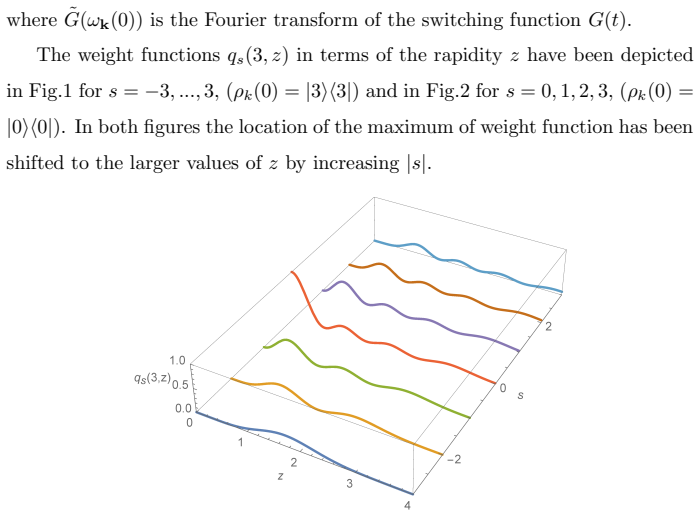
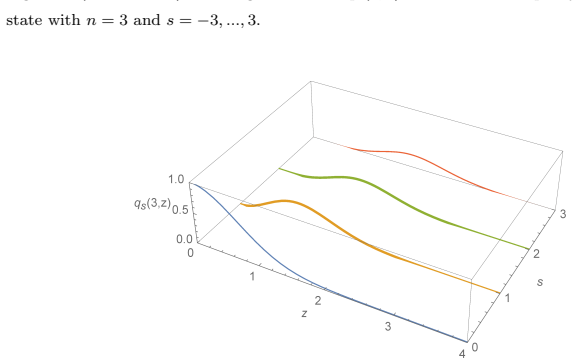
- [Eq. (30)] The definition of z is inconsistent as written: the text gives z=|η_k|=|ξ_k(τ)|²=|F(k)|²|∫ G dt|², whereas Eq. (31) and the weight functions in Eq. (29) require z=|η_k|². Please correct the missing square.
- [Eq. (2)] The switching function is not defined for t<0; please state explicitly that G(t)=0 for t<0 and G(0)=0, in line with the initial-state requirement raised in the major comment.
- [§6.1, Eq. (68)] The Casimir energy in Eq. (68) is quoted from the literature [33] rather than obtained from the characteristic-function formalism; the derivation stops at W=Σ_k ħΔω_k(t)/2. Please state clearly that the regularized mode sum is an external input, or derive it, so that the abstract's claim of linking the characteristic function to fluctuation-induced energies is not overstated.
- [Eq. (69)] The Jarzynski equality as written replaces H(τ) by H0(τ) in the free-energy ratio; this requires either measuring after the source is switched off (t>τ) or imposing G(τ)=0. Please specify the final measurement time.
- [Appendices and text] There are several small typographical errors: Eq. (C.9) has 'e^{η_k|²(...)}' instead of 'e^{|η_k|²(...)}'; Eq. (28) has a missing closing parenthesis in '(26'; Eq. (63) writes C(ν,n) instead of C(ν,t); and §5 says 'easily proof' instead of 'easily prove'.
Circularity Check
No circularity: the characteristic-function derivation is self-contained from the model Hamiltonian; the G(0) caveat is a consistency gap, not a circular step.
full rationale
The paper's derivation chain is self-contained: the evolution operator (11) is constructed from the Heisenberg solution (5), the single-subsystem characteristic function is evaluated directly in Appendices C and D, and the total-system product formula (50) is proven in Appendix E from the assumed non-interacting decomposition. No parameter is fitted and then renamed as a prediction, no load-bearing conclusion rests on a self-citation, and no ansatz is imported solely from prior work by the same author. The Casimir-energy example imports the standard result (68) from an external reference only as an illustration, not as an input to the central derivation. The most notable concern in the paper is the unstated requirement G(0)=0: the initial eigenstates used in Eqs. (23) and (32) are eigenstates of H_k^0(0), which equals H_k(0) only when the drive vanishes at t=0, whereas Eq. (2) defines G(t) only for t>tau and does not enforce G(0)=0. That is an assumption-consistency or correctness issue, not circularity, because the claimed result does not feed back into its own inputs. Accordingly, the circularity score is 0.
Assumptions & free parameters
assumptions (4)
- domain assumption The total system Hamiltonian is a sum of commuting single-mode Hamiltonians, so the total characteristic function factorizes as a product.
- domain assumption Work is defined via the two-point measurement scheme using eigenstates of the full time-dependent Hamiltonian including the interaction energy.
- ad hoc to paper The switching function G(t) satisfies G(0)=0, so the initial state is diagonal in the undriven basis, although this is never stated.
- domain assumption Moving boundaries are represented by a time-dependent frequency for each fixed mode with no mode mixing.
Cite this review
Pith. "Pith review of Many-body work distributions." pith.science (2026). https://pith.science/paper/LZBVSTQG
@misc{pith2026190803445,
  author       = {Pith},
  title        = {Pith review of: Many-body work distributions},
  year         = {2026},
  howpublished = {\url{https://pith.science/paper/LZBVSTQG}},
  note         = {Machine review of arXiv:1908.03445}
}
read the original abstract
The work distribution function for a non-relativistic, non-interacting quantum many-body system interacting with classical external sources is investigated. Exact expressions for the characteristic function corresponding to the work distribution function is obtained for arbitrary switching function and coupling functions. The many-body frequencies are assumed to be generally time-dependent in order to take into account the possibility of moving the boundaries of the system in a predefined process linking the characteristic function to the fluctuation-induced energies in confined geometries. Some limiting cases are considered and discussed.
Figures
Reference graph
Works this paper leans on
-
[32]
Sekhar Burada, and Peter H¨ anggi, Phys
Peter Talkner, P. Sekhar Burada, and Peter H¨ anggi, Phys. Rev. E 78, 011115 (2008). 23
work page 2008
- [33]
-
[1]
Jarzynski, Phys
C. Jarzynski, Phys. Rev. Lett. 78, 2690 (1997)
1997
- [2]
-
[3]
G. N. Bochkov and Yu. E. Kuzovlev, Sov. Phys. JETP 45, 125 (1977)
work page 1977
-
[4]
D. J. Evans, E. G. D. Cohen, and G. P. Morriss, Phys. Rev. Lett. 71, 2401 (1993)
1993
-
[5]
Jarzynski, Annu
C. Jarzynski, Annu. Rev. Condens. Matter Phys. 2, 329 (2011)
2011
- [6]
Show all 35 references
-
[7]
G. E. Crooks, Phys. Rev. E 60, 2721 (1999)
1999
-
[8]
Collin, F
D. Collin, F. Ritort, C. Jarzynski, S. B. Smith, I. Tinoco, and C. Bus- tamante, Nature (London) 437, 231 (2005); A. N. Gupta, A. Vincent, K. Neupane, H. Yu, F. Wang, and M. T. Woodside, Nat. Phys. 7, 631 (2011)
2005
-
[9]
Douarche, S
F. Douarche, S. Ciliberto, A. Petrosyan, and I. Rabbiosi, Europhys. Lett. 70, 593 (2005)
2005
-
[10]
Bustamante, J
C. Bustamante, J. Liphardt, and F. Ritort, Phys. Today 58 7, 43 (2005)
2005
-
[11]
Blickle, T
V. Blickle, T. Speck, L. Helden, U. Seifert, and C. Bechinger, Phys. Rev. Lett. 96, 070603 (2006)
2006
- [12]
-
[13]
Mukamel, Phys
S. Mukamel, Phys. Rev. Lett. 90, 170604 (2003)
2003
-
[14]
De Roeck and C
W. De Roeck and C. Maes, Phys. Rev. E 69, 026115 (2004)
2004
-
[15]
Esposito and S
M. Esposito and S. Mukamel, Phys. Rev. E 73, 046129 (2006)
2006
-
[16]
Talkner and P
P. Talkner and P. Hnggi, J. Phys. A 40, F569 (2007). 22
2007
-
[17]
Talkner, P
P. Talkner, P. Hnggi, and M. Morillo, Phys. Rev. E 77, 051131 (2008)
2008
-
[18]
Deffner and E
S. Deffner and E. Lutz, Phys. Rev. E 77, 021128 (2008)
2008
-
[19]
Campisi, P
M. Campisi, P. H¨ anggi, and P. Talkner, Rev. Mod. Phys. 83, 771 (2011)
2011
-
[20]
Talkner, E
P. Talkner, E. Lutz, and P. H¨ anggi, Phys. Rev. E 75, 050102 (R) (2007)
2007
-
[21]
Esposito, U
M. Esposito, U. Harbola, and S. Mukamel, Rev. Mod. Phys. 81, 1665 (2009)
2009
-
[22]
Redhead, Found
M. Redhead, Found. Phys. 25, 123 (1995)
1995
-
[23]
R. D. Sorkin, arXiv:gr-qc/9302018
- [24]
-
[25]
D. M. T. Benincasa, L. Borsten, M. Buck, and F. Dowker, Classical Quan- tum Gravity 31, 075007 (2014)
2014
-
[26]
T. B. Batalho, A. M. Souza, L. Mazzola, R. Auccaise, R. S. Sarthour, I. S. Oliveira, J. Goold, G. De Chiara, M. Paternostro, and R. M. Serra, Phys. Rev. Lett. 113, 140601 (2014)
2014
-
[27]
Ortega, E
A. Ortega, E. McKay, ´A. M. Alhambra and E. Mart´ ın-Mart´ ınez, Phys. Rev. Lett. 122, 240604 (2019)
2019
-
[28]
Dorner, S
R. Dorner, S. R. Clark, L. Heaney, R. Fazio, J. Goold, and V. Vedral, Phys. Rev. Lett. 110, 230601 (2013)
2013
-
[29]
Mazzola, G
L. Mazzola, G. D. Chiara, and M. Paternostro, Int. J. Quantum. Inform. 12, 1461007 (2014)
2014
-
[30]
Husimi, Prog
K. Husimi, Prog. Theor. Phys. 9, 381 (1953)
1953
-
[31]
Seifert, J
U. Seifert, J. Phys. A 37, L517 (2004)
2004
-
[34]
L. S. Gradshteyn and I. M. Ryzhik, Table of Integrals, Series and Products (Academic, San Diego, 2000)
2000
-
[35]
Wolfram Research, Inc., Mathematica, Version 12.0, Champaign, IL (2019). 24
2019
Reviewed August 14, 2026 · model on record in the stance chip above.
Discussion (0). Continue with ORCID to comment.