REVIEW 2 major objections 5 minor 47 references
Quantum hydrodynamics of a single particle
T0 review · 2 major / 5 minor · reviewed 2026-08-14 · deepseek-v4-flash
Pith's one-line read A single photon from a quantum dot becomes a propagating polariton whose scattering from a defect maps its own interference pattern in two dimensions.
desk verdict First 2D mapping of single-polariton self-interference from a QD source; one missing g2 measurement on the output, but the core result holds up. read the letter →
The pith
A machine-rendered reading of the paper's core claim, the machinery that carries it, and where it could break.
The reading
What carries the argument
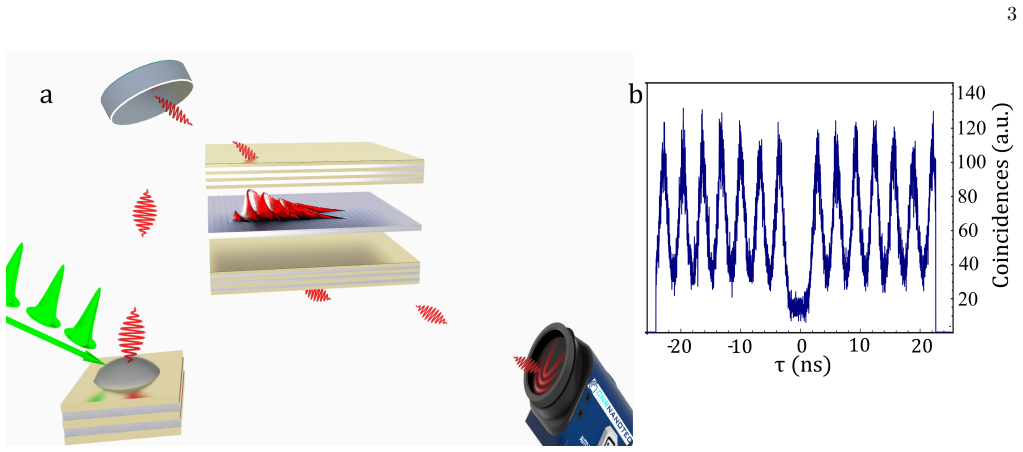
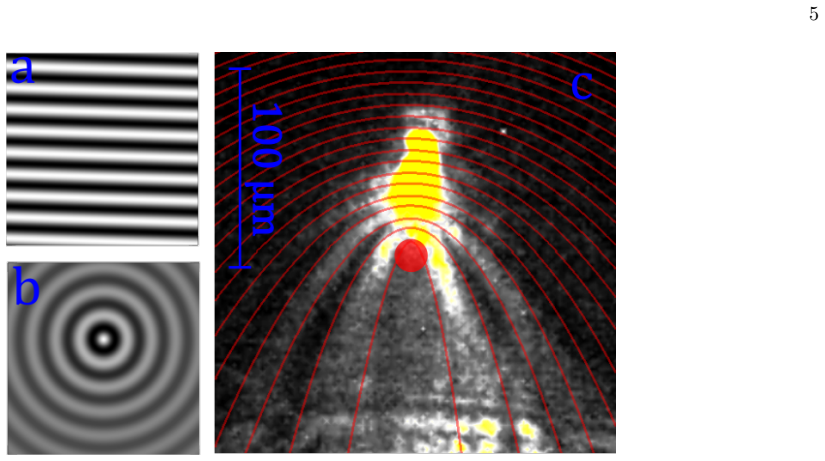
The central mechanism is resonant injection of a single photon into the lower polariton branch of a planar microcavity. A GaAs quantum dot with a strongly antibunched emission line is tuned so that one exciton transition matches the lower polariton branch at a chosen in-plane momentum; the photon is then converted into a single exciton-polariton, a hybrid light-matter quasiparticle, which propagates with a known group velocity until it decays and emits. The scattering pattern is modeled by a simple superposition: an incoming plane wave representing the propagating polariton plus a circular wave radiated by a point-like structural defect whose radius is much smaller than the in-plane wavelength. This two-wave model is what connects the observed fringes to the self-interference of one particle's wavefunction; the defect-size simulations show that a finite obstacle would imprint higher-order fringes absent from the data.
What would settle it
Measure the second-order correlation function $g^{(2)}(0)$ of the light emitted by the polaritons in the transmission configuration; if the emitted light is not antibunched, or if a weak coherent laser field at the same repetition rate produces the identical fringe pattern, the claim that the fringes are single-polariton self-interference would lose its experimental support.
Extended reading notes
Core claim
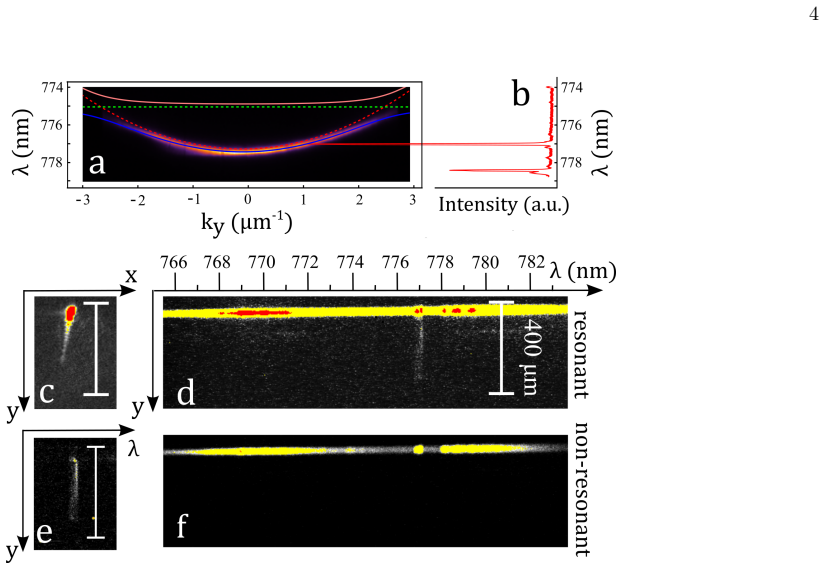
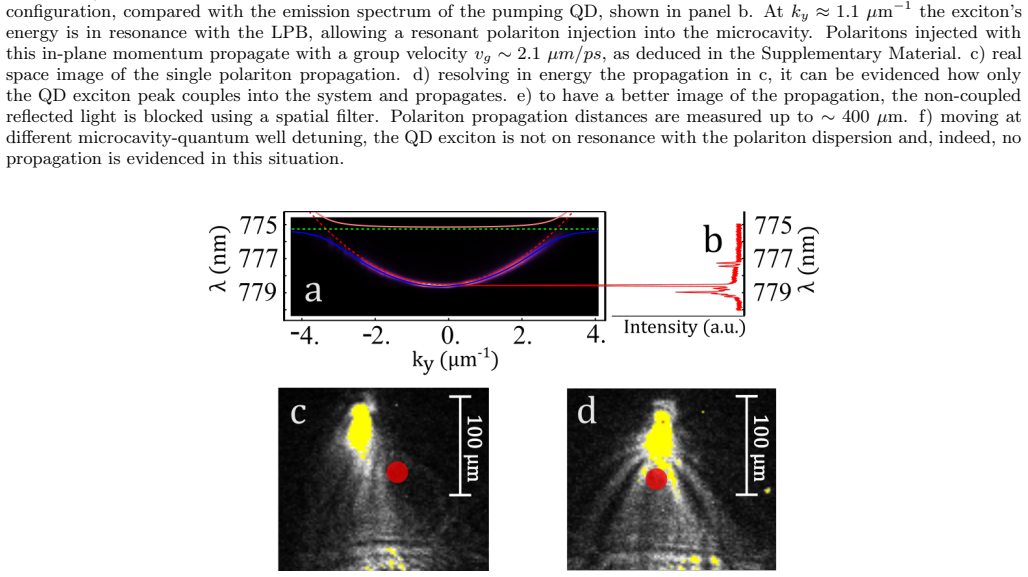
The central claim is that a single photon can be converted into a single propagating polariton, and that the polariton's own wavefunction produces the observed interference. The experiment uses a GaAs quantum dot with $g^{(2)}(0)=0.16\pm0.05$ to resonantly pump the lower polariton branch; from the exponential decay of the real-space intensity profile and the group velocity deduced from the dispersion, the polariton lifetime is estimated at about $25\,\mathrm{ps}$. In the presence of a defect whose size is much smaller than the in-plane wavelength $\lambda_\parallel \approx 20\,\mu\mathrm{m}$, the measured fringes, including fringes ahead of the obstacle, are matched by a superposition of the incoming plane wave and a circular wave scattered from a point-like defect. Because the pulse period exceeds the polariton lifetime by more than $285{,}000$ times, only one polariton is in the cavity at any instant, so the authors argue that no interference between different photons can explain the pattern; the fringes must come from the self-interference of a single particle's wavefunction.
Load-bearing premise
The load-bearing premise is that the field propagating inside the microcavity really is a single polariton: the input source is antibunched and the pulses are sparse, but the light emitted by the polaritons after propagation is not itself tested for antibunching, so the single-particle interpretation rests on the source statistics and on the assumption that linear resonant injection preserves them.
Editorial extensions
If this is right
- Single polaritons can be created on demand by resonant single-photon injection, providing a building block for integrated polaritonic quantum circuits.
- Because polariton emission is exponential in time, each injected particle maps its own propagation across the full two-dimensional plane rather than only at a detection screen.
- The shared GaAs/AlGaAs materials basis of the quantum dot and the microcavity points toward fully integrated single-polariton devices on one chip.
- Extending the same imaging to multiple polaritons could bring nonlocal and few-particle quantum effects into real-space view.
Reading between the lines
- Editorial inference: the spatial fringe pattern alone would also be produced by a weak coherent field, so a verification of antibunching on the polariton-emitted light would make the single-particle interpretation self-contained rather than inherited from the source.
- Editorial inference: the same point-defect model could be turned around and used as a real-space probe of microcavity disorder, since defects of finite size would imprint higher-order interferences with phase discontinuities.
- Editorial inference: inserting a controllable phase or path marker after the defect could turn this geometry into a delayed-choice test, because the full field ahead of the obstacle remains visible while the decision is made.
Signed reviews
Editorial analysis
A structured set of objections, weighed in public.
Referee Report
Summary. The paper reports an experiment in which photons from a single GaAs quantum dot, with a measured g(2)(0) = 0.16 ± 0.05, are resonantly injected into a planar microcavity polariton system in both reflection and transmission geometries. The authors image the real-space propagation of the resulting polaritons over distances up to about 400 µm, estimate a polariton lifetime of about 25 ps and group velocities from the dispersion, and observe, in the presence of a structural defect, an interference pattern that they model as the superposition of an incoming plane wave and a spherical wave scattered from a point-like defect. The abstract claims that this imaging, together with the source antibunching, constitutes the first spatial mapping of the self-interference of a single quantum particle hitting an obstacle.
Significance. The experiment targets an interesting and timely goal: bringing polariton hydrodynamics to the single-quantum level and interfacing a deterministic QD single-photon source with a polariton microcavity. The strengths are the clean resonance control (Fig. 2f), the measured source antibunching, the use of the measured in-plane momentum in the interference model, and the finite-defect simulations in Fig. S4 that support the point-like scatterer assumption. If the single-polariton field were directly characterized, this would be a valuable step toward single-polariton quantum devices. As it stands, the central quantum-mechanical claim rests on an inference from source statistics rather than on a measurement of the propagating field, so the significance is conditional.
major comments (2)
- [Results – transmission configuration; Fig. 3d and Fig. 4] The central claim that the fringes in Fig. 3d map the self-interference of a single quantum particle is not directly established, because the observable shown is a first-order intensity image. For a single-photon Fock state and a weak coherent state with the same spatial mode, the intensity I(r) ∝ ⟨E^(−)(r)E^(+)(r)⟩ is identical, so the interference pattern by itself cannot certify single-particle character. The antibunching measurement g(2)(0) = 0.16 ± 0.05 is performed on the QD source before injection (Fig. 1b and Fig. S6), and no g(2) measurement is reported on the light emitted by the polaritons after propagation. Since the linear injection process is assumed to preserve the single-photon character but is not checked, the abstract's 'first demonstration' claim is stronger than the data warrant. The authors should either provide a g(2) measurement of the polariton-emitted light, or explicitly temper the title and abstract to state that the single-particle character is inferred from the source statistics and linearity rather than directly demonstrated.
- [Discussion and abstract – 'single-particle self-interference' claim] The interference model in Fig. 4 is a linear wave-optics calculation: a plane wave plus a spherical wave. Agreement with this model is a useful consistency check, but it cannot distinguish quantum from classical statistics, because a weak coherent field would produce the same first-order interference pattern. The sentence in the abstract that the imaging 'together with a measurement of antibunching' constitutes a demonstration of single-particle self-interference therefore overreaches: the antibunching is a property of the input source, not of the polariton field that produces the fringes. A post-propagation nonclassicality witness, such as g(2) < 1 on the polariton-emitted light or a heralded single-event measurement, is needed to make the claimed distinction.
minor comments (5)
- [Results – '285,000 lifetimes' sentence] The statement that each polariton is separated from the next by more than 285,000 lifetimes is consistent with the stated average single-photon rate of about 140,000 per second and a 25 ps lifetime (mean interval ≈ 7.1 µs ≈ 285,000 lifetimes), but the wording 'repetition rate' is confusing because the laser repetition rate is 320 MHz while the relevant rate is the average single-photon arrival rate. Please clarify this in the text.
- [Fig. 4 caption and Methods] The relative amplitude of the plane wave and circular wave used in the interference model is not stated. Please specify the exact parameters, or state explicitly that the red contour lines are isointensity lines of a normalized sum with no additional adjustable amplitude.
- [Supplementary S5 – partial scattering model] The tilted momentum direction in the partial-scattering simulation (approximately 45°) appears to be an adjustable parameter. Please state explicitly which quantities are fixed by the experiment and which are chosen for consistency, so that the fit's evidentiary weight can be assessed.
- [Discussion – fringes ahead of the obstacle] The phrase about the polariton 'not yet supposed to know that an obstacle lays ahead' is misleading; since the image integrates over emission times, the interference ahead of the obstacle can be understood as overlap between the forward component and the backscattered component at different times. Please rephrase to avoid the appearance of retrocausality.
- [Throughout] Minor typographical issues include 'Enhaced Charged Coupled Device' (should be 'enhanced charge-coupled device'), 'an thus' (should be 'and thus'), 'developement' (should be 'development'), and 'Unviversity' (should be 'University').
Circularity Check
No circular derivation: the interference model is an independent consistency check and the single-polariton premise rests on an externally measured source g(2).
full rationale
The paper's central claim is an experimental observation (spatial mapping of the self-interference of a single polariton), not a derived prediction. The interference fringes are modeled by superposing a plane wave and a spherical wave (Fig. 4 and SI S4, S5) using the independently measured in-plane wavevector k ≈ 0.28 µm−1; no parameter is fitted to the fringe pattern itself, and the model is checked against simulated defect-size patterns and the free-propagation image. This is a consistency check with standard wave optics rather than a reduction of the conclusion to its inputs. The single-particle character is imported from the quantum dot source, where g(2)(0) = 0.16 ± 0.05 is measured with a Hanbury Brown and Twiss setup (Results, Fig. 1b) and repeated after each pulse-rate doubling (SI S6), not from the fringes; the inference that resonant injection preserves that character is supported by prior experiments [27, 28] by overlapping authors, but those are external, falsifiable measurements rather than an unverified self-citation chain. The absence of a downstream g(2) measurement and the arithmetic slip about '285,000 lifetimes' (with a 320 MHz repetition rate and a 25 ps lifetime, the separation is about 125 lifetimes, not 285,000) are evidence and correctness concerns rather than circularity: a weak coherent field would produce identical fringes, but this does not make any equation equal to its own input. No step in the paper's derivation chain is equivalent by definition or by construction to its conclusion.
Assumptions & free parameters
free parameters (2)
- In-plane momentum k (transmission) =
0.28 µm^-1
- Tilted momentum direction for partial-scattering simulation =
approximately 45 degrees
assumptions (4)
- standard math A single quantum particle's wavefunction interferes with itself, so the time-integrated spatial intensity of many single-particle emissions forms an interference pattern.
- domain assumption Linear resonant coupling of a single-photon Fock state to the cavity mode produces a single-polariton excitation, preserving the single-particle sector.
- domain assumption The structural defect acts as a point-like scatterer with radius much smaller than the polariton in-plane wavelength of about 20 µm.
- domain assumption Polaritons emit photons continuously along their propagation with an exponential decay, so the EMCCD image maps the spatial probability distribution of the propagating wavefunction.
Cite this review
Pith. "Pith review of Quantum hydrodynamics of a single particle." pith.science (2026). https://pith.science/paper/JOBPPTDL
@misc{pith2026190803472,
  author       = {Pith},
  title        = {Pith review of: Quantum hydrodynamics of a single particle},
  year         = {2026},
  howpublished = {\url{https://pith.science/paper/JOBPPTDL}},
  note         = {Machine review of arXiv:1908.03472}
}
read the original abstract
Semiconductor devices are strong competitors in the race for the development of quantum com-putational systems. In this work, we interface two semiconductor building blocks of different di-mensionality and with complementary properties: (1) a quantum dot hosting a single exciton andacting as a nearly ideal single-photon emitter and (2) a quantum well in a 2D microcavity sustain-ing polaritons, which are known for their strong interactions and unique hydrodynamics propertiesincluding ultrafast real-time monitoring of their propagation and phase-mapping. In the presentexperiment we can thus observe how the injected single particles propagate and evolve inside themicrocavity, giving rise to hydrodynamics features typical of macroscopic systems despite their in-trinsic genuine quantum nature. In the presence of a structural defect, we observe the celebratedquantum interference of a single particle that produces fringes reminiscent of a wave propagation.While this behaviour could be theoretically expected, our imaging of such an interference pattern,together with a measurement of antibunching, constitutes the first demonstration of spatial mappingof the self-interference of a single quantum particle hitting an obstacle.
Figures
Figures from the paper (1 more)
Reference graph
Works this paper leans on
-
[1]
Integrated solution for quantum technologies
Rachel Won. Integrated solution for quantum technologies. Nature Photonics, 13(2):77–79, jan 2019
work page 2019
-
[2]
Daniel Huber, Marcus Reindl, Johannes Aberl, Armando Rastelli, and Rinaldo Trotta. Semiconductor quantum dots as an ideal source of polarization-entangled photon pairs on-demand: A review, 2018
work page 2018
-
[3]
Elshaari, Iman Esmaeil Zadeh, Andreas Fognini, Michael E
Ali W. Elshaari, Iman Esmaeil Zadeh, Andreas Fognini, Michael E. Reimer, Dan Dalacu, Philip J. Poole, Val Zwiller, and Klaus D. Jns. On-chip single photon filtering and multiplexing in hybrid quantum photonic circuits. Nature Communications, 8(1), aug 2017
work page 2017
-
[4]
Paul G. Kwiat, Edo Waks, Andrew G. White, Ian Appelbaum, and Philippe H. Eberhard. Ultrabright source of polarization-entangled photons. Phys. Rev. A, 60:R773–R776, Aug 1999
work page 1999
-
[5]
A wavelength-tunable fiber-coupled source of narrowband entangled photons
Alessandro Fedrizzi, Thomas Herbst, Andreas Poppe, Thomas Jennewein, and Anton Zeilinger. A wavelength-tunable fiber-coupled source of narrowband entangled photons. Opt. Express, 15(23):15377–15386, Nov 2007
work page 2007
-
[6]
Lixing You, Hao Li, Weijun Zhang, Xiaoyan Yang, Lu Zhang, Sijing Chen, Hui Zhou, Zhen Wang, and Xiaoming Xie. Superconducting nanowire single-photon detector on dielectric optical films for visible and near infrared wavelengths. Superconductor Science and Technology, 2017
work page 2017
-
[7]
Elshaari, Gabriele Bulgarini, Johannes W
Ronan Gourgues, Iman Esmaeil Zadeh, Ali W. Elshaari, Gabriele Bulgarini, Johannes W. N. Los, Julien Zichi, Dan Dalacu, Philip J. Poole, Sander N. Dorenbos, and Val Zwiller. Controlled integration of selected detectors and emitters in photonic integrated circuits. Optics Express, 27(3):3710, feb 2019
work page 2019
-
[8]
Portalupi, Konstantin llin, Michael Jetter, Michael Siegel, and Peter Michler
Mario Schwartz, Ekkehart Schmidt, Ulrich Rengstl, Florian Hornung, Stefan Hepp, Simone L. Portalupi, Konstantin llin, Michael Jetter, Michael Siegel, and Peter Michler. Fully on-chip single-photon Hanbury-Brown and Twiss experiment on a monolithic semiconductorsuperconductor platform. Nano Letters, 18(11):6892–6897, 2018
work page 2018
Show all 47 references
-
[9]
Carolan, C
J. Carolan, C. Harrold, C. Sparrow, E. Martin-Lopez, N. J. Russell, J. W. Silverstone, P. J. Shadbolt, N. Matsuda, M. Oguma, M. Itoh, G. D. Marshall, M. G. Thompson, J. C. F. Matthews, T. Hashimoto, J. L. O’Brien, and A. Laing. Universal linear optics. Science, 349(6249):711–7...
2015
-
[10]
Sharapova, Raimund Ricken, Torsten Meier, Harald Her- rmann, and Christine Silberhorn
Kai-Hong Luo, Sebastian Brauner, Christof Eigner, Polina R. Sharapova, Raimund Ricken, Torsten Meier, Harald Her- rmann, and Christine Silberhorn. Nonlinear integrated quantum electro-optic circuits. Science Advances, 5(1):eaat1451, jan 2019
2019
-
[11]
Moss, Roberto Morandotti, Alexander L
David J. Moss, Roberto Morandotti, Alexander L. Gaeta, and Michal Lipson. New CMOS-compatible platforms based on silicon nitride and hydex for nonlinear optics. Nature Photonics, 7(8):597–607, aug 2013
2013
-
[12]
H. Jin, F. M. Liu, P. Xu, J. L. Xia, M. L. Zhong, Y. Yuan, J. W. Zhou, Y. X. Gong, W. Wang, and S. N. Zhu. On-chip generation and manipulation of entangled photons based on reconfigurable lithium-niobate waveguide circuits. Physical Review Letters, 113(10), sep 2014
2014
-
[13]
Integrated photonic quantum gates for polarization qubits
Andrea Crespi, Roberta Ramponi, Roberto Osellame, Linda Sansoni, Irene Bongioanni, Fabio Sciarrino, Giuseppe Vallone, and Paolo Mataloni. Integrated photonic quantum gates for polarization qubits. Nature Communications, 2(1), sep 2011
2011
-
[14]
Politi, M
A. Politi, M. J. Cryan, J. G. Rarity, S. Yu, and J. L. O’Brien. Silica-on-silicon waveguide quantum circuits. Science, 320(5876):646–649, may 2008
2008
-
[15]
Experimental Boson sampling
Max Tillmann, Borivoje Daki´ c, Ren´ e Heilmann, Stefan Nolte, Alexander Szameit, and Philip Walther. Experimental Boson sampling. Nature Photonics, 7(7):540–544, may 2013
2013
-
[16]
Advances in quantum metrology
Vittorio Giovannetti, Seth Lloyd, and Lorenzo Maccone. Advances in quantum metrology. Nature Photonics, 5(4):222–229, apr 2011. 8
2011
-
[17]
Sanvitto and S
D. Sanvitto and S. K´ ena-Cohen. The road towards polaritonic devices. Nature Materials, 15(10):1061–1073, Jul 2016
2016
-
[18]
Ballarini, M
D. Ballarini, M. De Giorgi, E. Cancellieri, R. Houdr´ e, E. Giacobino, R. Cingolani, A. Bramati, G. Gigli, and D. Sanvitto. All-optical polariton transistor. Nature Communications, 4(1), apr 2013
2013
-
[19]
Leyder, T
C. Leyder, T. C. H. Liew, A. V. Kavokin, I. A. Shelykh, M. Romanelli, J. Ph. Karr, E. Giacobino, and A. Bramati. Interference of coherent polariton beams in microcavities: Polarization-controlled optical gates. Physical Review Letters, 99(19), nov 2007
2007
-
[20]
Carusotto and C
I. Carusotto and C. Ciuti. Quantum fluids of light. Rev. Mod. Phys., 85:299–366, Feb 2013
2013
-
[21]
Quantum statistics of polariton parametric interactions
Mathias Sassermann, Zoltn Vrs, Mohsen Razavi, Wolfgang Langbein, and Gregor Weihs. Quantum statistics of polariton parametric interactions. arXiv:1808.01127v1, 2018
2018 arXiv
-
[22]
Boulier, M
T. Boulier, M. Bamba, A. Amo, C. Adrados, A. Lemaitre, E. Galopin, I. Sagnes, J. Bloch, C. Ciuti, E. Giacobino, and A. Bramati. Polariton-generated intensity squeezing in semiconductor micropillars. Nature Communications, 5(1), feb 2014
2014
-
[23]
Bunching visibility of optical parametric emission in a semiconductor microcavity
Vincenzo Ardizzone, Marco Abbarchi, Aristide Lemaitre, Isabelle Sagnes, Pascale Senellart, Jacqueline Bloch, Claude Delalande, Jerome Tignon, and Philippe Roussignol. Bunching visibility of optical parametric emission in a semiconductor microcavity. Physical Review B, 86(4), jul 2012
2012
-
[24]
Towards polariton blockade of confined exciton-polaritons
Delteil Aymeric, Fink Thomas, Schade Anne, H¨ ofling Sven, Schneider Christian, and Imamo˘ glu Ata. Towards polariton blockade of confined exciton-polaritons. Nature Materials, 18(3):219222, 2019
2019
-
[25]
Emer- gence of quantum correlations from interacting fibre-cavity polaritons
Mu˜ noz-Matutano Guillermo, Wood Andrew, Johnsson Mattias, Vidal Xavier, Baragiola Ben Q., Reinhard Andreas, Lema- tre Aristide, Bloch Jacqueline, Amo Alberto, Nogues Gilles, Besga Benjamin, Richard Maxime, and Volz Thomas. Emer- gence of quantum correlations from interacting ...
2019
-
[26]
Quantum nonlinearities at the single-particle level
Gerace Dario, Laussy Fabrice, and Sanvitto Daniele. Quantum nonlinearities at the single-particle level. Nature Materials, 18(3):200201, 2019
2019
-
[27]
J. C. L´ opez Carre˜ no, C. S’anchez Mu˜ noz, D. Sanvitto, E. Del Valle, and F. P. Laussy. Exciting Polaritons with Quantum Light. Physical Review Letters, 2015
2015
-
[28]
´Alvaro Cuevas, Juan Camilo L´ opez Carre˜ no, Blanca Silva, Milena De Giorgi, Daniel G. Su´ arez-Forero, Carlos S´ anchez Mu˜ noz, Antonio Fieramosca, Filippo Cardano, Lorenzo Marrucci, Vittorianna Tasco, Giorgio Biasiol, Elena Del Valle, Lorenzo Dominici, Dario Ballarini, Gi...
2018
-
[29]
Johnsen, Deny R
Piotr Kolenderski, Carmelo Scarcella, Kelsey D. Johnsen, Deny R. Hamel, Catherine Holloway, Lynden K. Shalm, Simone Tisa, Alberto Tosi, Kevin J. Resch, and Thomas Jennewein. Time-resolved double-slit interference pattern measurement with entangled photons. Scientific Reports, 4...
2014
-
[30]
The Feynman Lectures on Physics - Volume 3: Quantum mechanics
Feynman. The Feynman Lectures on Physics - Volume 3: Quantum mechanics. Addison-Wesley, 2010
2010
-
[31]
Aspden, Peter A
Paul-Antoine Moreau, Ermes Toninelli, Thomas Gregory, Reuben S. Aspden, Peter A. Morris, and Miles J. Padgett. Imaging bell-type nonlocal behavior. Science Advances, 5(7):eaaw2563, jul 2019
2019
-
[32]
A wavelength-tunable fiber-coupled source of narrowband entangled photons
Alessandro Fedrizzi, Thomas Herbst, Andreas Poppe, Thomas Jennewein, and Anton Zeilinger. A wavelength-tunable fiber-coupled source of narrowband entangled photons. Optics Express, 2007
2007
-
[33]
J¨ ons, Katharina D
Lucas Schweickert, Klaus D. J¨ ons, Katharina D. Zeuner, Saimon Filipe Covre da Silva, Huiying Huang, Thomas Lettner, Marcus Reindl, Julien Zichi, Rinaldo Trotta, Armando Rastelli, and Val Zwiller. On-demand generation of background-free single photons from a solid-state sourc...
2018
-
[34]
Strain-Tunable GaAs Quantum Dot: A Nearly Dephasing-Free Source of Entangled Photon Pairs on Demand
Daniel Huber, Marcus Reindl, Saimon Filipe Covre Da Silva, Christian Schimpf, Javier Martn-Snchez, Huiying Huang, Giovanni Piredda, Johannes Edlinger, Armando Rastelli, and Rinaldo Trotta. Strain-Tunable GaAs Quantum Dot: A Nearly Dephasing-Free Source of Entangled Photon Pair...
2018
-
[35]
Baumberg, Guillaume Malpuech, and Fabrice P
Alexey Kavokin, Jeremy J. Baumberg, Guillaume Malpuech, and Fabrice P. Laussy. Microcavities. Oxford Science, second edition, 2008
2008
-
[36]
Wildmann, Oliver G
Daniel Huber, Marcus Reindl, Yongheng Huo, Huiying Huang, Johannes S. Wildmann, Oliver G. Schmidt, Armando Rastelli, and Rinaldo Trotta. Highly indistinguishable and strongly entangled photons from symmetric GaAs quantum dots. Nature Communications, 2017
2017
-
[37]
Moon, Jong Lam Lee, and Hyung Mo Yoo
Eun A. Moon, Jong Lam Lee, and Hyung Mo Yoo. Selective wet etching of GaAs on AlxGa1-xAs for Al- GaAs/InGaAs/AlGaAs pseudomorphic high electron mobility transistor. Journal of Applied Physics, 1998
1998
-
[38]
Weber, Daniel Huber, Christian Schimpf, Saimon F
Marcus Reindl, Jonas H. Weber, Daniel Huber, Christian Schimpf, Saimon F. Covre da Silva, Simone L. Portalupi, Rinaldo Trotta, Peter Michler, and Armando Rastelli. Highly indistinguishable single photons from incoherently and coherently excited GaAs quantum dots. arXiv e-print...
1901 arXiv
-
[39]
Wave-particle duality for single photons
Alain Aspect and Philippe Grangier. Wave-particle duality for single photons. Hyperfine Interactions, 37(1):1–17, Dec 1987
1987
-
[40]
Tonomura, J
A. Tonomura, J. Endo, T. Matsuda, T. Kawasaki, and H. Ezawa. Demonstration of singleelectron buildup of an interference pattern. American Journal of Physics, 1989
1989
-
[41]
Ebbesen, Alexandre Baron, Jean-Claude Rodier, Jean-Paul Hugonin, Philippe Lalanne, Jean-Jacques Greffet, Ga´ etan Messin, and Fran¸ cois Marquier
Marie-Christine Dheur, Elo¨ ıse Devaux, Thomas W. Ebbesen, Alexandre Baron, Jean-Claude Rodier, Jean-Paul Hugonin, Philippe Lalanne, Jean-Jacques Greffet, Ga´ etan Messin, and Fran¸ cois Marquier. Single-plasmon interferences. Science Advances, 2016
2016
-
[42]
Aspden, Miles J
Reuben S. Aspden, Miles J. Padgett, and Gabriel C. Spalding. Video recording true single-photon double-slit interference. American Journal of Physics, 84(9):671–677, sep 2016. 9
2016
-
[43]
Anton Zeilinger, Roland Ghler, C. G. Shull, Wolfgang Treimer, and Walter Mampe. Single- and double-slit diffraction of neutrons. Reviews of Modern Physics, 60(4):1067–1073, oct 1988
1988
-
[44]
Wave–particle duality of c60 molecules
Markus Arndt, Olaf Nairz, Julian Vos-Andreae, Claudia Keller, Gerbrand van der Zouw, and Anton Zeilinger. Wave–particle duality of c60 molecules. Nature, 401(6754):680–682, oct 1999
1999
-
[45]
Jacques, E
V. Jacques, E. Wu, F. Grosshans, F. Treussart, P. Grangier, A. Aspect, and J.-F. Roch. Experimental realization of Wheeler’s delayed-choice Gedanken experiment. Science, 315:966, 2007
2007
-
[46]
Goswami, C
K. Goswami, C. Giarmatzi, M. Kewming, F. Costa, C. Branciard, J. Romero, and A.G. White. Indefinite causal order in a quantum switch. Phys. Rev. Lett., 121:090503, 2018
2018
-
[47]
Cilibrizzi, H
P. Cilibrizzi, H. Ohadi, T. Ostatnicky, A. Askitopoulos, W. Langbein, and P. Lagoudakis. Linear wave dynamics explains observations attributed to dark solitons in a polariton quantum fluid. Phys. Rev. Lett., 113:103901, Sep 2014. i Supporting Information DEDUCTION OF THE POLARI...
2014
Reviewed August 14, 2026 · model on record in the stance chip above.
Discussion (0). Continue with ORCID to comment.