REVIEW 2 major objections 4 minor 1 cited by
Evolution of atmospheric escape in close-in giant planets and their associated Ly$\alpha$ and H$\alpha$ transit predictions
T0 review · 2 major / 4 minor · reviewed 2026-08-14 · deepseek-v4-flash
Pith's one-line read A close-in Saturn-mass giant can lose 20% of its mass to escape, while a Jupiter twin loses at most 1%.
desk verdict Useful evolutionary escape predictions with a real caveat: the headline 20% and 1.2-Gyr boundary are lower limits, not robust values. read the letter →
The pith
A machine-rendered reading of the paper's core claim, the machinery that carries it, and where it could break.
The reading
What carries the argument
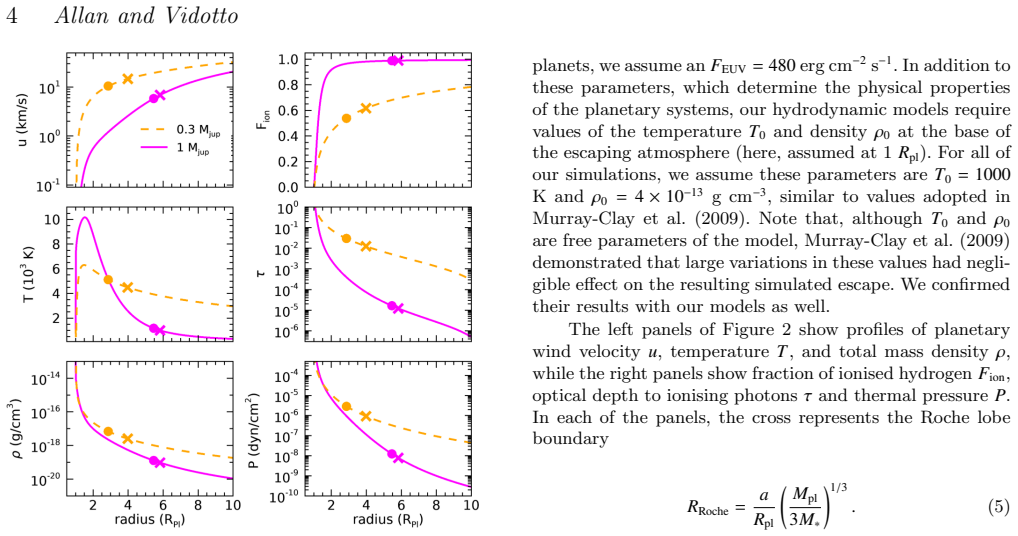
The carrying mechanism is a one-dimensional, spherically symmetric hydrodynamic escape model for a hydrogen atmosphere, with photoionization heating from stellar EUV, Ly$\alpha$ radiative cooling, ionisation balance, and conservation of mass, momentum (including a tidal term), and energy; the transonic outflow is solved by a shooting method. Two evolutionary inputs drive the time dependence: stellar EUV flux following slow, intermediate, and fast rotator tracks, and radius-contraction curves for the $1$ and $0.3$ Jupiter-mass planets. For transits, the outflow density, temperature, and velocity are mapped onto a 3D grid and ray-traced with Voigt line profiles for Ly$\alpha$ and H$\alpha$, with the $\mathrm{n}=2$ hydrogen fraction computed from statistical equilibrium; this is what produces the grounded prediction that H$\alpha$ absorption nearly disappears after about $1.2$ Gyr.
What would settle it
Observe a 0.3-Jupiter-mass planet near 0.045 au around a solar-type star older than about 1.2 Gyr and measure its H-alpha transit: the model predicts essentially zero excess absorption, so a secure detection of more than 1% excess would contradict the ground-state domination prediction. Conversely, finding a substantial population of such planets at old ages would weaken the claim that escape removes most of their mass.
Extended reading notes
Core claim
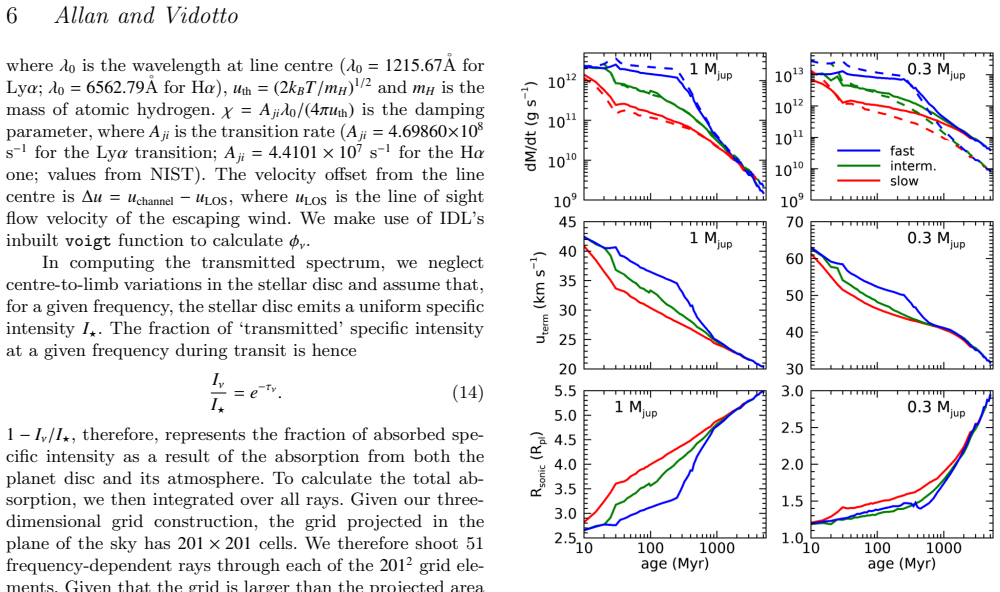
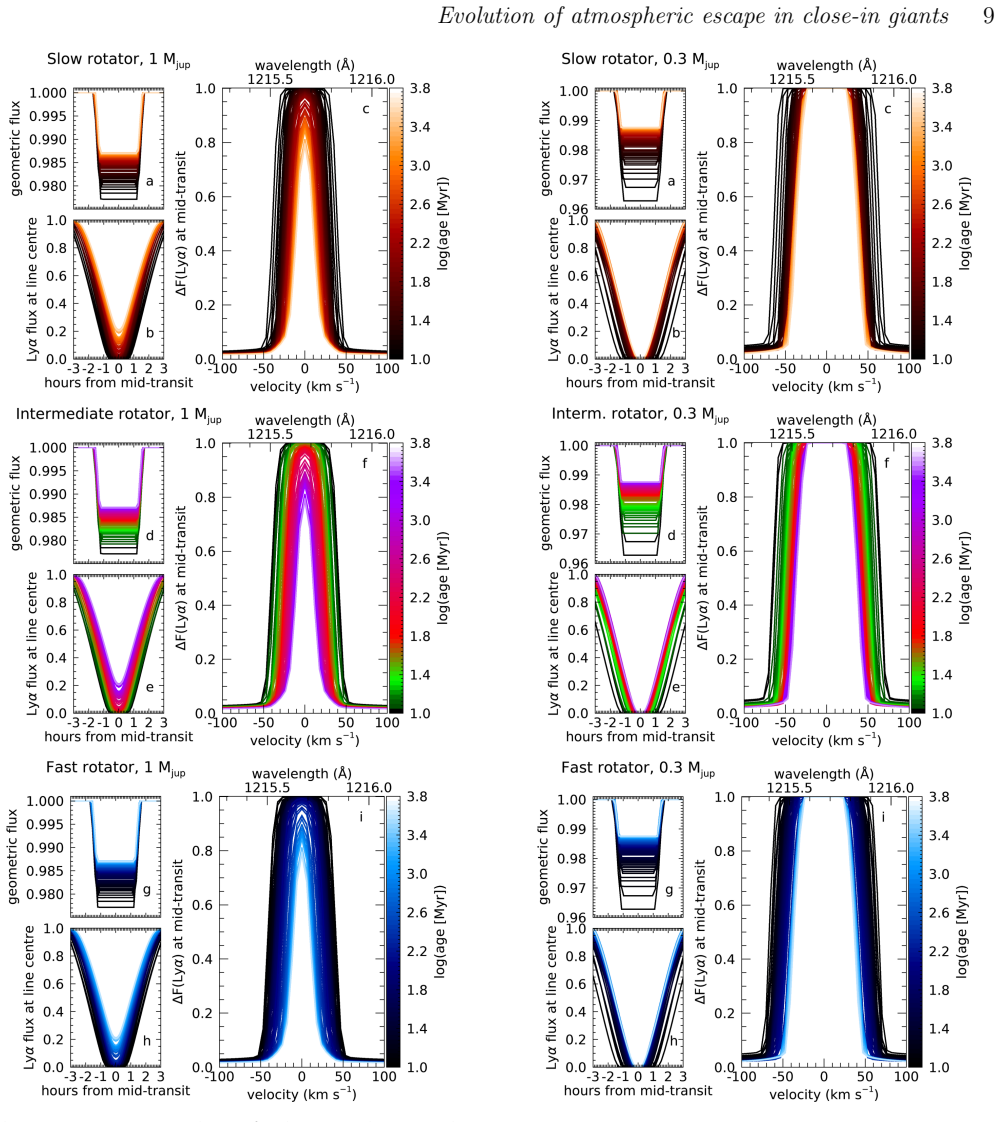
On its own terms, the paper claims that the mass-loss history of a close-in giant is set by two competing evolutions: stellar EUV flux declines with age (faster for slow rotators), while the planet contracts and its gravity strengthens. Combining these inputs in a one-dimensional hydrodynamic wind model yields mass-loss rates of roughly $10^9$--$10^{12}$ g/s for the Jupiter-mass planet and $10^{10}$--$10^{13}$ g/s for the $0.3$ Jupiter-mass planet, declining steeply with age. Integrating these rates gives the headline numbers: at most $1\%$ of the initial mass lost for the $1\,\mathrm{M_{Jup}}$ case and more than $20\%$ for the $0.3\,\mathrm{M_{Jup}}$ case, with the exact fraction depending on whether the host star was born a slow or fast rotator. The same outflows, rendered with ray tracing, produce saturated Ly$\alpha$ at line center for young planets and H$\alpha$ excesses of at most $3\text{--}4\%$ that fade to nothing after about $1.2$ Gyr, because the $\mathrm{n}=2$ hydrogen population needed for H$\alpha$ becomes negligible while the ground-state population that drives Ly$\alpha$ remains large.
Load-bearing premise
The radius and mass evolution are taken from contraction tracks that do not include the mass being lost, so for the 0.3-Jupiter-mass planet the gravity used at late ages is too strong; including the lost mass would raise escape and could change the quoted 20% and 1.2 Gyr H-alpha boundary.
Editorial extensions
If this is right
- Over 5 Gyr, a Jupiter-mass planet at 0.045 au keeps at least 99% of its mass, so hot-Jupiter mass loss is negligible for the planet's overall evolution.
- A 0.3-Jupiter-mass planet at the same orbit can lose more than a fifth of its mass, making hydrodynamic escape a viable sculptor of the Neptunian desert.
- H-alpha transits are a young-planet phenomenon: excess depths of 3-4% occur only at the youngest ages, and excess absorption drops below 1% after roughly 200 Myr (or 600 Myr around fast rotators).
- After about 1.2 Gyr, H-alpha absorption vanishes even where Ly-alpha remains strong or saturated, so joint H-alpha and Ly-alpha observations can distinguish young escaping atmospheres from old quiescent ones.
- The power-law fits for mass-loss rate and terminal velocity let observers estimate escape rates from age and host-star rotation alone, without recomputing hydrodynamics.
Reading between the lines
- If mass loss is as strong as claimed for the 0.3-Jupiter-mass case, then including the lost mass in the radius evolution would weaken gravity at late ages and likely push the total lost fraction above 20%; the quoted numbers should be read as lower bounds.
- The same machinery, run for lower-mass planets or shorter orbits, could quantify whether some close-in rocky planets are fully stripped cores of former Neptunes, an endpoint the paper explicitly gestures toward.
- Because stellar activity mimics H-alpha variability, the model's prediction of stronger H-alpha at young ages could be tested by targeting young, inactive stars in clusters precisely where activity is lowest.
- The predicted disappearance of H-alpha after about 1.2 Gyr offers a direct observational test of EUV evolution models: a detected H-alpha excess around an old, low-gravity giant would require either higher EUV than assumed or additional excitation mechanisms.
Signed reviews
Editorial analysis
A structured set of objections, weighed in public.
Referee Report
Summary. This paper presents one-dimensional hydrodynamic escape simulations for 0.3- and 1-Mjup planets at 0.045 au around a solar-mass star, evolved from 10 Myr to 5 Gyr under three stellar EUV evolution tracks (slow, intermediate, fast rotators). The authors compute mass-loss rates, integrate them to obtain total mass loss, and then use a three-dimensional ray-tracing model with Voigt profiles to predict Ly-alpha and H-alpha transit depths and equivalent widths. The main claims are that the 0.3-Mjup planet can lose up to 20% of its initial mass, supporting a mass-loss origin of the Neptunian desert, and that H-alpha absorption nearly disappears after about 1.2 Gyr because the outflowing hydrogen is predominantly in the ground state.
Significance. If the quantitative results hold, the paper provides an interesting evolutionary framework: it shows that escape can be dynamically important for low-gravity giants, gives specific predictions for H-alpha and Ly-alpha transit evolution, and offers analytical fits to mass-loss rates as an alternative to energy-limited formulas. The model is transparent in its limitations (4-pi isotropic upper limit, fixed mass), and the comparison with the energy-limited approximation is instructive. The predictions are falsifiable with observations of young systems, and the inclusion of three stellar rotation tracks is a strength. However, because the headline mass-loss fraction and the H-alpha disappearance age rest on the unquantified fixed-mass assumption, the robustness of these conclusions is not yet established.
major comments (2)
- [Section 4 and 4.1] The integrated total mass loss of more than 20% for the 0.3-Mjup planet is obtained by integrating mass-loss rates that are computed using a fixed planetary mass and radius tracks from Fortney & Nettelmann (2010) that do not include mass loss, as stated in Sections 2 and 4. For a planet that loses more than 20% of its mass, the gravitational potential at late ages is overestimated, and the paper's assertion that this effect is 'minor' compared to radius variation (Section 4) is not demonstrated. Since the mass-loss rate in this model scales with the effective gravitational potential, the self-consistent mass-loss fraction could be substantially larger. The authors should quantify this by a sensitivity test, for example by repeating the evolution with a mass that decreases according to the computed Mdot, or by providing an analytic estimate of the fractional change in Mdot when Mpl is reduced by 20%.
- [Section 5.2, Figure 8] The prediction that H-alpha absorption nearly disappears after ~1.2 Gyr for the 0.3-Mjup planet is derived from atmospheric structures computed with the same fixed-mass approximation. Because the planet has already lost a significant fraction of its mass by that age in the authors' own integration, the late-age wind density, temperature, and n=2 population may be misrepresented. The 1.2-Gyr boundary should therefore be presented as a lower limit or as model-dependent until the mass-feedback effect is assessed; as written, this prediction is not robust to the stated limitation.
minor comments (4)
- [Section 3.3, Eq. (13)] The Voigt profile expression includes a variable xi that is never defined; please define it (or remove it) for completeness.
- [Section 2] The normalization of the Johnstone et al. (2015c) EUV curves by dividing by 6.7 is described in a footnote; it would be clearer to state in the main text that the entire evolutionary track is scaled by a constant factor to match the Ribas et al. (2005) solar-age value.
- [Section 5.2] The comparison to HD189733b and KELT-9b would benefit from a brief statement of the model ages or EUV fluxes that correspond to the quoted observed transit depths, since the paper's own predictions are age-dependent.
- [Abstract and Figure 8] The abstract says H-alpha absorption 'nearly disappears' after ~1.2 Gyr; Figure 8 shows that for the 0.3-Mjup planet the excess flux goes to zero, while for the 1-Mjup planet it remains at fractions of a percent. The wording should distinguish these cases.
Circularity Check
No significant circularity: the mass-loss and transit predictions follow from external EUV/radius tracks and published physical models; self-citations are methodological only.
full rationale
The derivation chain is self-contained relative to its inputs. Mass-loss rates are obtained by solving the hydrodynamic equations (Eqs. 1-4) with EUV flux tracks from Johnstone et al. (2015c) and radius tracks from Fortney & Nettelmann (2010); neither input is fitted to the predicted Ly-alpha or H-alpha transits, nor to the total mass-loss fractions. The 1% and 20% mass-loss claims in Section 4.1 are time integrals of the computed Mdot curves, not quantities imposed by construction. The disappearance of H-alpha absorption after about 1.2 Gyr follows from the computed neutral-hydrogen n=2 population via CHIANTI statistical-equilibrium calculations using the model's own temperature and electron-density profiles, so it is a derived output. Citations to Vidotto & Jatenco-Pereira (2006) and Vidotto et al. (2018) are methodological, covering the numerical shooting method and the ray-tracing code; they do not supply the conclusions, because the transit predictions are generated by those codes rather than assumed by them. Appendix A power-law fits are post-hoc summaries of already-computed outputs and are not used as inputs to the evolution calculation. The stated neglect of mass loss in the adopted radius evolution (Sections 2 and 4) is a physical limitation affecting the robustness of the 20% figure and the age boundary, but it is not circularity: the prediction is not equivalent to an input by definition, and the sign and magnitude of the neglected feedback are quantified uncertainties rather than logical identities.
Assumptions & free parameters
free parameters (3)
- Base temperature T0 =
1000 K
- Base mass density rho0 =
4e-13 g cm^-3
- EUV flux normalization factor =
1/6.7
assumptions (9)
- domain assumption The escaping atmosphere is collisional (Kn << 1), steady, spherically symmetric, and described by the fluid equations in a co-rotating frame.
- domain assumption EUV heating is monochromatic at 20 eV with efficiency epsilon = 0.32, and the photoionization cross-section is from Spitzer (1978).
- domain assumption Cooling is dominated by Ly-alpha collisional excitation with the given volumetric cooling rate, and recombination is case B.
- ad hoc to paper The stellar EUV evolution follows Johnstone et al. (2015c) slow, intermediate, and fast rotator tracks, normalized by dividing by 6.7 to match Ribas et al. (2005).
- domain assumption Planetary radius evolution follows Fortney & Nettelmann (2010) no-core models that do not include the effect of mass loss.
- domain assumption The substellar-point hydrodynamic solution is applied over 4pi steradians, making the escape rate an upper limit.
- domain assumption The n=2 hydrogen population is computed in the CHIANTI coronal-model approximation, with only direct excitation from n=1 and no radiative pumping.
- domain assumption Transit observables assume a uniform stellar disc, impact parameter b=0, and Voigt line profiles with NIST oscillator strengths and transition rates.
- standard math The tidal term in the momentum equation (3GM*r/a^3) represents effective gravity in the co-rotating frame.
Cite this review
Pith. "Pith review of Evolution of atmospheric escape in close-in giant planets and their associated Ly$\alpha$ and H$\alpha$ transit predictions." pith.science (2026). https://pith.science/paper/E6KHERSZ
@misc{pith2026190803510,
  author       = {Pith},
  title        = {Pith review of: Evolution of atmospheric escape in close-in giant planets and their associated Ly$\alpha$ and H$\alpha$ transit predictions},
  year         = {2026},
  howpublished = {\url{https://pith.science/paper/E6KHERSZ}},
  note         = {Machine review of arXiv:1908.03510}
}
read the original abstract
Strong atmospheric escape has been detected in several close-in exoplanets. As these planets consist mostly of hydrogen, observations in hydrogen lines, such as Ly-alpha and H-alpha, are powerful diagnostics of escape. Here, we simulate the evolution of atmospheric escape of close-in giant planets and calculate their associated Ly-alpha and H-alpha transits. We use a one-dimensional hydrodynamic escape model to compute physical properties of the atmosphere and a ray-tracing technique to simulate spectroscopic transits. We consider giant (0.3 and 1M_jup) planets orbiting a solar-like star at 0.045au, evolving from 10 to 5000 Myr. We find that younger giants show higher rates of escape, owing to a favourable combination of higher irradiation fluxes and weaker gravities. Less massive planets show higher escape rates (1e10 -- 1e13 g/s) than those more massive (1e9 -- 1e12 g/s) over their evolution. We estimate that the 1-M_jup planet would lose at most 1% of its initial mass due to escape, while the 0.3-M_jup planet, could lose up to 20%. This supports the idea that the Neptunian desert has been formed due to significant mass loss in low-gravity planets. At younger ages, we find that the mid-transit Ly-alpha line is saturated at line centre, while H-alpha exhibits transit depths of at most 3 -- 4% in excess of their geometric transit. While at older ages, Ly-alpha absorption is still significant (and possibly saturated for the lower mass planet), the H-alpha absorption nearly disappears. This is because the extended atmosphere of neutral hydrogen becomes predominantly in the ground state after ~1.2 Gyr.
Figures

Figures from the paper (4 more)



Forward citations
Cited by 1 Pith paper
-
A Self-Consistent 3D Hydrodynamic Model for Helium Transit Signatures in Evaporating Hot Jupiters
A 3D hydrodynamic model with self-consistent hydrogen-helium chemistry shows stellar winds compress escaping hot-Jupiter atmospheres and suppress the 1083 nm helium triplet signal, while a young star's strong XUV flux...
Reference graph
Works this paper leans on
-
[1]
Allart R., et al., 2019, @doi [ ] 10.1051/0004-6361/201834917 , https://ui.adsabs.harvard.edu/abs/2019A&A...623A..58A 623, A58
-
[2]
He I $\lambda$ 10830 \r{A} in the transmission spectrum of HD 209458 b
Alonso-Floriano F. J., et al., 2019, arXiv e-prints, https://ui.adsabs.harvard.edu/abs/2019arXiv190713425A p. arXiv:1907.13425
work page Pith review arXiv 2019
-
[3]
Barnes J. R., Haswell C. A., Staab D., Anglada-Escud \'e G., 2016, @doi [ ] 10.1093/mnras/stw1713 , https://ui.adsabs.harvard.edu/abs/2016MNRAS.462.1012B 462, 1012
-
[4]
Ben-Jaffel L., 2008, @doi [apj] 10.1086/592101 , http://adsabs.harvard.edu/abs/2008ApJ...688.1352B 688, 1352
-
[5]
Bourrier V., Lecavelier des Etangs A., Ehrenreich D., Tanaka Y. A., Vidotto A. A., 2016, @doi [ ] 10.1051/0004-6361/201628362 , http://adsabs.harvard.edu/abs/2016A
-
[6]
Carolan S., Vidotto A., Loesch C., Coogan P., 2019, , in press
work page 2019
-
[7]
Catling D. C., Kasting J. F., 2017, Atmospheric Evolution on Inhabited and Lifeless Worlds
work page 2017
-
[8]
Cauley P. W., Redfield S., Jensen A. G., Barman T., Endl M., Cochran W. D., 2015, @doi [ ] 10.1088/0004-637X/810/1/13 , http://adsabs.harvard.edu/abs/2015ApJ...810...13C 810, 13
Show all 61 references
-
[9]
W., Redfield S., Jensen A
Cauley P. W., Redfield S., Jensen A. G., 2017, @doi [ ] 10.3847/1538-3881/aa6a15 , https://ui.adsabs.harvard.edu/abs/2017AJ....153..217C 153, 217
2017 doi
-
[10]
W., Shkolnik E
Cauley P. W., Shkolnik E. L., Ilyin I., Strassmeier K. G., Redfield S., Jensen A., 2019, @doi [ ] 10.3847/1538-3881/aaf725 , https://ui.adsabs.harvard.edu/abs/2019AJ....157...69C 157, 69
2019 doi
-
[11]
M., Noyes R
Charbonneau D., Brown T. M., Noyes R. W., Gilliland R. L., 2002, @doi [ ] 10.1086/338770 , https://ui.adsabs.harvard.edu/abs/2002ApJ...568..377C 568, 377
2002 doi
-
[12]
Cloutier R., et al., 2018, @doi [ ] 10.3847/1538-3881/aaa54e , http://adsabs.harvard.edu/abs/2018AJ....155...93C 155, 93
2018 doi
-
[13]
R., 2019, @doi [ ] 10.1093/mnras/sty3310 , https://ui.adsabs.harvard.edu/abs/2019MNRAS.483.2600D 483, 2600
Daley-Yates S., Stevens I. R., 2019, @doi [ ] 10.1093/mnras/sty3310 , https://ui.adsabs.harvard.edu/abs/2019MNRAS.483.2600D 483, 2600
2019 doi
-
[14]
G., Fossati L., McCann J., Murray-Clay R., 2019, arXiv e-prints, https://ui.adsabs.harvard.edu/abs/2019arXiv190600075D p
Debrecht A., Carroll-Nellenback J., Frank A., Blackman E. G., Fossati L., McCann J., Murray-Clay R., 2019, arXiv e-prints, https://ui.adsabs.harvard.edu/abs/2019arXiv190600075D p. arXiv:1906.00075
2019 arXiv
-
[15]
E., 2018, @doi [Living Reviews in Solar Physics] 10.1007/s41116-018-0015-3 , https://ui.adsabs.harvard.edu/abs/2018LRSP...15....5D 15, 5
Del Zanna G., Mason H. E., 2018, @doi [Living Reviews in Solar Physics] 10.1007/s41116-018-0015-3 , https://ui.adsabs.harvard.edu/abs/2018LRSP...15....5D 15, 5
2018 doi
-
[16]
P., Del Zanna G., Young P
Dere K. P., Del Zanna G., Young P. R., Landi E., Sutherland R. S., 2019, @doi [ ] 10.3847/1538-4365/ab05cf , https://ui.adsabs.harvard.edu/abs/2019ApJS..241...22D 241, 22
2019 doi
-
[17]
Ehrenreich D., D \'e sert J.-M., 2011, @doi [ ] 10.1051/0004-6361/201016356 , http://adsabs.harvard.edu/abs/2011A
2011 doi
-
[18]
Ehrenreich D., et al., 2015, @doi [ ] 10.1038/nature14501 , http://adsabs.harvard.edu/abs/2015Natur.522..459E 522, 459
2015 doi
-
[19]
V., Kulikov Y
Erkaev N. V., Kulikov Y. N., Lammer H., Selsis F., Langmayr D., Jaritz G. F., Biernat H. K., 2007, @doi [Astronomy & Astrophysics] 10.1051/0004-6361:20066929 , 472, 329
2007 doi
-
[20]
A., Krapp L., 2019, @doi [ ] 10.1093/mnras/stz1725 , https://ui.adsabs.harvard.edu/abs/2019MNRAS.487.5788E 487, 5788
Esquivel A., Schneiter M., Villarreal D'Angelo C., Sgr \'o M. A., Krapp L., 2019, @doi [ ] 10.1093/mnras/stz1725 , https://ui.adsabs.harvard.edu/abs/2019MNRAS.487.5788E 487, 5788
2019 doi
-
[21]
T., et al., 2017, in Society of Photo-Optical Instrumentation Engineers (SPIE) Conference Series
Fleming B. T., et al., 2017, in Society of Photo-Optical Instrumentation Engineers (SPIE) Conference Series. p. 103971A, @doi 10.1117/12.2276138
2017 doi
-
[22]
J., Nettelmann N., 2010, @doi [Space Science Reviews] 10.1007/s11214-009-9582-x , 152, 423
Fortney J. J., Nettelmann N., 2010, @doi [Space Science Reviews] 10.1007/s11214-009-9582-x , 152, 423
2010 doi
-
[23]
Fossati L., et al., 2010, @doi [ ] 10.1088/0004-637X/720/1/872 , http://adsabs.harvard.edu/abs/2010ApJ...720..872F 720, 872
2010 doi
-
[24]
Gallet F., Bouvier J., 2013, @doi [ ] 10.1051/0004-6361/201321302 , http://adsabs.harvard.edu/abs/2013A
2013 doi
-
[25]
Garc \' a Mu \ n oz A., 2007, @doi [planss] 10.1016/j.pss.2007.03.007 , http://adsabs.harvard.edu/abs/2007P
2007 doi
-
[26]
G., Wood K., 2006, @doi [mnras] 10.1111/j.1365-2966.2005.09995.x , http://adsabs.harvard.edu/abs/2006MNRAS.367..917J 367, 917
Jardine M., Collier Cameron A., Donati J.-F., Gregory S. G., Wood K., 2006, @doi [mnras] 10.1111/j.1365-2966.2005.09995.x , http://adsabs.harvard.edu/abs/2006MNRAS.367..917J 367, 917
2006
-
[27]
G., Redfield S., Endl M., Cochran W
Jensen A. G., Redfield S., Endl M., Cochran W. D., Koesterke L., Barman T., 2012, @doi [ ] 10.1088/0004-637X/751/2/86 , http://adsabs.harvard.edu/abs/2012ApJ...751...86J 751, 86
2012 doi
-
[28]
G., Cauley P
Jensen A. G., Cauley P. W., Redfield S., Cochran W. D., Endl M., 2018, @doi [ ] 10.3847/1538-3881/aadca7 , https://ui.adsabs.harvard.edu/#abs/2018AJ....156..154J 156, 154
2018 doi
-
[29]
P., Guedel M., Brott I., L \"u ftinger T., 2015a, @doi [ ] 10.1051/0004-6361/201425301 , http://adsabs.harvard.edu/abs/2015A
Johnstone C. P., Guedel M., Brott I., L \"u ftinger T., 2015a, @doi [ ] 10.1051/0004-6361/201425301 , http://adsabs.harvard.edu/abs/2015A
-
[31]
P., et al., 2015c, @doi [Astrophysical Journal Letters] 10.1088/2041-8205/815/1/L12 , 815, 1
Johnstone C. P., et al., 2015c, @doi [Astrophysical Journal Letters] 10.1088/2041-8205/815/1/L12 , 815, 1
-
[32]
F., Whitmire D
Kasting J. F., Whitmire D. P., Reynolds R. T., 1993, @doi [Icarus] 10.1006/icar.1993.1010 , http://adsabs.harvard.edu/abs/1993Icar..101..108K 101, 108
1993
-
[33]
L., Shaikhislamov I
Khodachenko M. L., Shaikhislamov I. F., Lammer H., Prokopov P. A., 2015, @doi [ ] 10.1088/0004-637X/813/1/50 , http://adsabs.harvard.edu/abs/2015ApJ...813...50K 813, 50
2015 doi
-
[34]
G., et al., 2014, @doi [ ] 10.1051/0004-6361/201322933 , http://adsabs.harvard.edu/abs/2014A
Kislyakova K. G., et al., 2014, @doi [ ] 10.1051/0004-6361/201322933 , http://adsabs.harvard.edu/abs/2014A
2014 doi
-
[35]
Kubyshkina D., et al., 2018, @doi [aap] 10.1051/0004-6361/201833737 , http://adsabs.harvard.edu/abs/2018A
2018 doi
-
[36]
R., France K., Linsky J., Loyd R
Kulow J. R., France K., Linsky J., Loyd R. O. P., 2014, @doi [ ] 10.1088/0004-637X/786/2/132 , http://adsabs.harvard.edu/abs/2014ApJ...786..132K 786, 132
2014 doi
-
[37]
Lammer H., et al., 2009, @doi [ ] 10.1007/s00159-009-0019-z , http://adsabs.harvard.edu/abs/2009A
2009 doi
-
[38]
Lavie B., et al., 2017, @doi [ ] 10.1051/0004-6361/201731340 , http://adsabs.harvard.edu/abs/2017A
2017 doi
-
[39]
Lecavelier des Etangs A., et al., 2012, @doi [aap] 10.1051/0004-6361/201219363 , http://adsabs.harvard.edu/abs/2012A
2012 doi
-
[40]
Mazeh T., Holczer T., Faigler S., 2016, @doi [ ] 10.1051/0004-6361/201528065 , http://adsabs.harvard.edu/abs/2016A
2016 doi
-
[41]
A., Kratter K., Krumholz M
McCann J., Murray-Clay R. A., Kratter K., Krumholz M. R., 2019, @doi [ ] 10.3847/1538-4357/ab05b8 , https://ui.adsabs.harvard.edu/abs/2019ApJ...873...89M 873, 89
2019 doi
-
[42]
A., Chiang E
Murray-Clay R. A., Chiang E. I., Murray N., 2009, @doi [Astrophysical Journal] 10.1088/0004-637X/693/1/23 , 693, 23
2009 doi
-
[43]
Nortmann L., et al., 2018, @doi [Science] 10.1126/science.aat5348 , https://ui.adsabs.harvard.edu/abs/2018Sci...362.1388N 362, 1388
2018 doi
-
[44]
E., Ferland G
Osterbrock D. E., Ferland G. J., 2006, Astrophysics of gaseous nebulae and active galactic nuclei
2006
-
[45]
E., Wu Y., 2013, @doi [ ] 10.1088/0004-637X/775/2/105 , http://adsabs.harvard.edu/abs/2013ApJ...775..105O 775, 105
Owen J. E., Wu Y., 2013, @doi [ ] 10.1088/0004-637X/775/2/105 , http://adsabs.harvard.edu/abs/2013ApJ...775..105O 775, 105
2013 doi
-
[46]
N., 1958, @doi [ ] 10.1086/146579 , http://adsabs.harvard.edu/abs/1958ApJ...128..664P 128, 664
Parker E. N., 1958, @doi [ ] 10.1086/146579 , http://adsabs.harvard.edu/abs/1958ApJ...128..664P 128, 664
1958 doi
-
[47]
Quirrenbach A., et al., 2014, in Ground-based and Airborne Instrumentation for Astronomy V. p. 91471F, @doi 10.1117/12.2056453
2014 doi
-
[48]
F., Guedel M., Audard M., 2005, @doi [ ] 10.1086/427977 , http://adsabs.harvard.edu/abs/2005ApJ...622..680R 622, 680
Ribas I., Guinan E. F., Guedel M., Audard M., 2005, @doi [ ] 10.1086/427977 , http://adsabs.harvard.edu/abs/2005ApJ...622..680R 622, 680
2005 doi
-
[49]
C., Czesla S., Schmitt J
Salz M., Schneider P. C., Czesla S., Schmitt J. H. M. M., 2016a, @doi [Astronomy & Astrophysics] 10.1051/0004-6361/201527042 , 2, 1
-
[50]
C., Schmitt J
Salz M., Czesla S., Schneider P. C., Schmitt J. H. M. M., 2016b, @doi [Astronomy & Astrophysics] 10.1051/0004-6361/201526109 , 586, A75
-
[51]
Skumanich A., 1972, @doi [ ] 10.1086/151310 , http://adsabs.harvard.edu/abs/1972ApJ...171..565S 171, 565
1972 doi
-
[52]
Spitzer L., 1978, Physical processes in the interstellar medium , @doi 10.1002/9783527617722
1978 doi
-
[53]
J., Hummer D
Storey P. J., Hummer D. G., 1995, @doi [mnras] 10.1093/mnras/272.1.41 , http://adsabs.harvard.edu/abs/1995MNRAS.272...41S 272, 41
1995 doi
-
[54]
P., Guedel M., Lammer H., 2015, @doi [ ] 10.1051/0004-6361/201526146 , http://adsabs.harvard.edu/abs/2015A
Tu L., Johnstone C. P., Guedel M., Lammer H., 2015, @doi [ ] 10.1051/0004-6361/201526146 , http://adsabs.harvard.edu/abs/2015A
2015 doi
-
[55]
E., Ferlet R., H \'e brard G., Mayor M., 2003, @doi [ ] 10.1038/nature01448 , http://adsabs.harvard.edu/abs/2003Natur.422..143V 422, 143
Vidal-Madjar A., Lecavelier des Etangs A., D \'e sert J.-M., Ballester G. E., Ferlet R., H \'e brard G., Mayor M., 2003, @doi [ ] 10.1038/nature01448 , http://adsabs.harvard.edu/abs/2003Natur.422..143V 422, 143
2003 doi
-
[56]
A., Jatenco-Pereira V., 2006, @doi [ ] 10.1086/499329 , http://adsabs.harvard.edu/abs/2006ApJ...639..416V 639, 416
Vidotto A. A., Jatenco-Pereira V., 2006, @doi [ ] 10.1086/499329 , http://adsabs.harvard.edu/abs/2006ApJ...639..416V 639, 416
2006 doi
-
[57]
A., et al., 2014, @doi [ ] 10.1093/mnras/stu728 , http://adsabs.harvard.edu/abs/2014MNRAS.441.2361V 441, 2361
Vidotto A. A., et al., 2014, @doi [ ] 10.1093/mnras/stu728 , http://adsabs.harvard.edu/abs/2014MNRAS.441.2361V 441, 2361
2014 doi
-
[58]
A., et al., 2018, @doi [ ] 10.1093/mnras/sty2130 , http://adsabs.harvard.edu/abs/2018MNRAS.481.5296V 481, 5296
Vidotto A. A., et al., 2018, @doi [ ] 10.1093/mnras/sty2130 , http://adsabs.harvard.edu/abs/2018MNRAS.481.5296V 481, 5296
2018 doi
-
[59]
A., 2018, @doi [ ] 10.1093/mnras/sty1544 , https://ui.adsabs.harvard.edu/#abs/2018MNRAS.479.3115V 479, 3115
Villarreal D'Angelo C., Esquivel A., Schneiter M., Sgr \'o M. A., 2018, @doi [ ] 10.1093/mnras/sty1544 , https://ui.adsabs.harvard.edu/#abs/2018MNRAS.479.3115V 479, 3115
2018 doi
-
[60]
J., Donahue T
Watson A. J., Donahue T. M., Walker J. C. G., 1981, @doi [icarus] 10.1016/0019-1035(81)90101-9 , http://adsabs.harvard.edu/abs/1981Icar...48..150W 48, 150
1981 doi
-
[61]
E., M \"u ller H.-R., Zank G
Wood B. E., M \"u ller H.-R., Zank G. P., Linsky J. L., 2002, @doi [ ] 10.1086/340797 , http://adsabs.harvard.edu/abs/2002ApJ...574..412W 574, 412
2002 doi
-
[62]
Yan F., Henning T., 2018, @doi [Nature Astronomy] 10.1038/s41550-018-0503-3 , https://ui.adsabs.harvard.edu/abs/2018NatAs...2..714Y 2, 714
2018 doi
Reviewed August 14, 2026 · model on record in the stance chip above.
Discussion (0). Continue with ORCID to comment.