REVIEW 4 major objections 4 minor 150 references
A self-consistent 3D model of evaporating hot Jupiters shows that stellar wind strength, not just XUV flux, controls the density of metastable helium and therefore the depth of the 1083 nm transit, with triplet fractions dropping by more th
Reviewed by Pith at T0; open to challenge. T0 means a machine referee read the full paper against a public rubric. the ladder, T0–T4 →
T0 review · deepseek-v4-flash
2026-08-01 15:42 UTC pith:UPDJBREE
load-bearing objection Genuine step forward in 3D H-He escape modeling, but the headline spectra numbers—especially the 3.3x young-star depth—are provisional until the plane-parallel radiation bias is addressed. the 4 major comments →
A Self-Consistent 3D Hydrodynamic Model for Helium Transit Signatures in Evaporating Hot Jupiters
The pith
A machine-rendered reading of the paper's core claim, the machinery that carries it, and where it could break.
Core claim
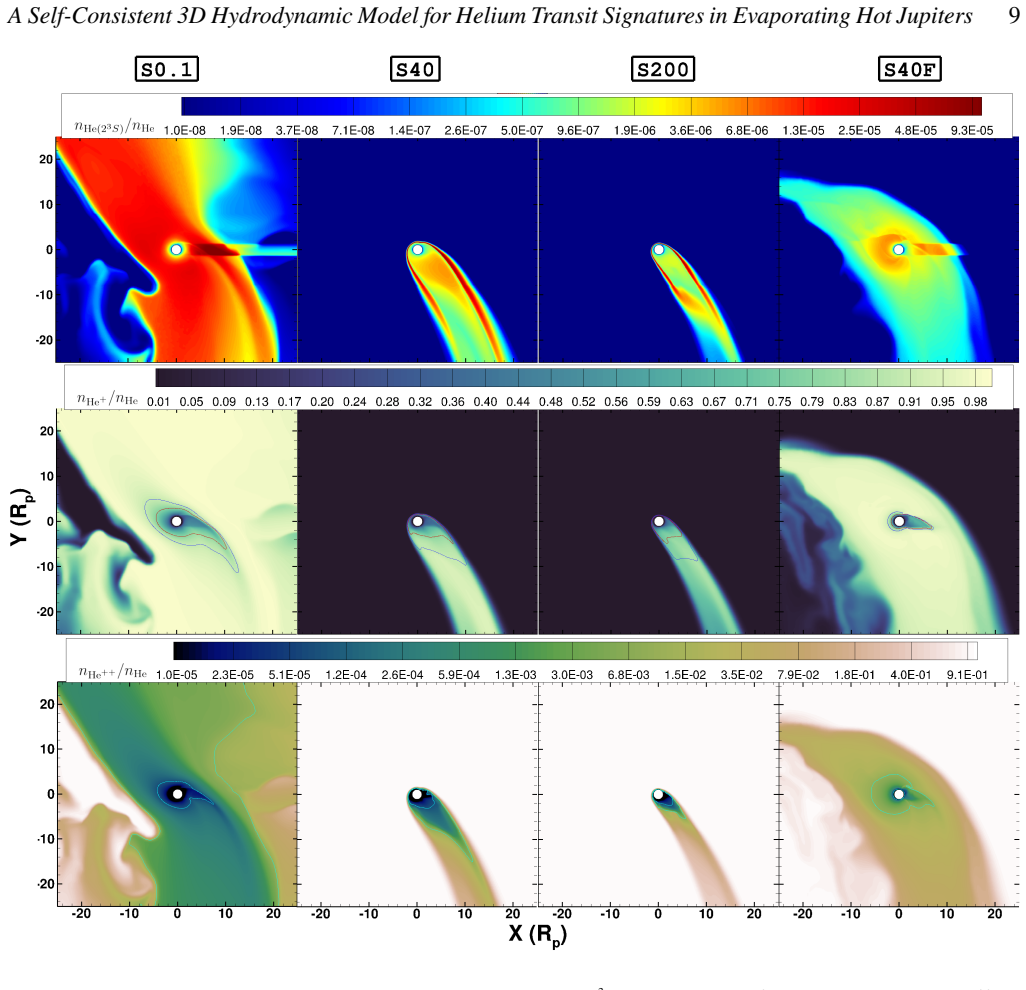
We present a 3D hydrodynamic model of atmospheric escape that self-consistently couples the equations of mass, momentum, and energy conservation to a six-species hydrogen/helium chemical network. Running this model for a hot Jupiter at 0.05 AU under stellar winds from 1/40 to 50 times the solar mass-loss rate, and for an old and a young host star, we find that the metastable helium triplet density decreases by more than an order of magnitude as the wind strengthens, because a stronger wind confines the escaping atmosphere, reducing optical depth, heating the gas, and suppressing the recombination channel that populates the triplet. With fixed wind, switching to a young, high-XUV star increas
What carries the argument
The central mechanism is the self-consistent population-chemistry solver: six continuity equations for H0, H+, He singlet, He triplet, He+, and He++ are solved simultaneously with the hydrodynamic equations, with photoionization, recombination, collisional excitation/de-excitation, charge exchange, and radiative decay rates coupled through the local optical depth and temperature. The triplet population is balanced mainly by recombination of He+ and collisional de-excitation; wind-wind shocks and advection of He+ into the nightside are what sustain or deplete it.
Load-bearing premise
The fixed inner boundary state at the planet's base - density 3 x 10^-13 g/cm^3, temperature 1000 K, helium fraction 1/9 - is taken unchanged from 1D models and never varied; all quoted numbers scale from this launch condition.
What would settle it
Run the same 3D model with the base density halved and doubled while holding everything else fixed; if the synthetic helium transit depths or equivalent widths move by more than the spread between the weakest and strongest wind cases, then the claimed wind-strength control is not robust. Observationally, measure the helium equivalent width of a known evaporating hot Jupiter across a stellar activity cycle; a variation far larger than the model's wind-strength effect would indicate missing physics.
If this is right
- Stronger stellar winds (10 to 50 times solar) reduce helium triplet density by more than an order of magnitude and cut peak transit absorption from about 2.8% to under 1%.
- A young, high-XUV host star deepens the helium transit and extends absorption into pre-transit, with a 25 times higher escape rate and a 3.3 times deeper transit than an old star under identical wind.
- Post-transit absorption from a comet-like tail appears in every modeled case; pre-transit absorption requires either a weak wind or strong XUV flux.
- The three helium triplet lines behave differently depending on wind strength: strong winds keep them unblended, while weak winds merge them and produce blue- and redshifted features.
- Observed non-detections of helium transits could be explained by strong stellar winds combined with lower He/H ratios, without requiring the absence of atmospheric escape.
Where Pith is reading between the lines
- If stellar wind variability across a star's activity cycle modulates the helium transit depth, repeated observations of a single planet at different epochs should show equivalent-width variations similar to the spread between the S40 and S200 models (roughly a factor of 1.3 in EW, up to 3 times in peak absorption); this is a testable forecast.
- The models sensitivity to fixed base boundary conditions implies that connecting a 1D lower atmosphere to the 3D outflow may dominate quantitative predictions; a promising extension is to sample a grid of base densities to map how transit depth and EW scale.
- The paper's advection test suggests that post-processing static chemistry in 3D wind models can mislead, over-estimating triplet density inside about 2 planetary radii and under-estimating it beyond; future models that neglect advection should be re-examined.
- For systems with measured stellar wind mass-loss rates (for example, from astrospheric absorption), the model offers a direct calibration that can be checked against observed helium equivalent widths.
Editorial analysis
A structured set of objections, weighed in public.
Referee Report
Summary. The paper presents a 3D hydrodynamic model of an evaporating hot Jupiter with self-consistent hydrogen and helium chemistry, coupled to a four-band photoionization/heating scheme, and uses ray tracing to produce synthetic 1083 nm He I triplet transmission spectra. The authors simulate a hot Jupiter exposed to an old, moderate-XUV star with stellar wind mass-loss rates from 1/40 to 50 times the solar value, plus a young, high-XUV star at one wind strength. They report that stronger stellar winds compress the outflow and reduce the He(2^3S) density and transit depth, while the high-XUV case produces an extended outflow with a much larger escape rate and a deeper helium transit. The paper also documents pre- and post-transit absorption morphology and includes an appendix testing the importance of advection in the triplet population balance.
Significance. If the quantitative results are accepted, this is a valuable step forward: it brings a multi-species H-He chemical network into 3D hydrodynamic escape simulations with stellar-wind interaction and computes synthetic helium transits from the resulting triplet distribution. The central physical trend — stronger stellar winds reduce the metastable helium density and transit depth — is plausible and supported by the simulations. The paper is not circular: the outputs are derived from an input parameter grid rather than fitted to observations. The authors also provide useful self-criticism, including a direct comparison of advective versus post-processed triplet populations (Appendix D) and an explicit discussion of grid-resolution artifacts.
major comments (4)
- [Section 3.2 / Table 1 / Abstract] The abstract and Section 3.2 state that the young-star model S40F has escape rates about 25 times higher than the old-star model S40 at the same stellar wind strength. Table 1 lists Mdot_p = 24.6 x 10^10 g/s for S40F and 2.0 x 10^10 g/s for S40, which is a factor of 12.3, not 25. If the comparison is intended to be with S0.1 (1.1 x 10^10 g/s), the ratio is about 22x but the wind strength is not the same. This is a quantitative inconsistency in a headline number; please correct it and state the exact basis for the comparison.
- [Section 2.3, Eqs. (12)-(14); Table 2; Fig. 8] The photoionization and heating are computed under a plane-parallel ray approximation. The text acknowledges that this 'can have non-physical effects on the extension of the photoionization and heating deposition' and cites Yan et al. (2022) showing that plane-parallel models can produce enhanced absorption features. The headline result that the high-XUV spectrum makes the helium transit 3.3 times deeper (S40F vs S40) is derived from the triplet distribution obtained with this approximation, and no correction or sensitivity test is applied. Because the S40F outflow is much more extended, the bias is unlikely to cancel in the ratio; it may preferentially inflate the extended-outflow spectrum. The authors should either provide a quantitative estimate of this effect or restrict the central claim to the hydrodynamic escape-rate comparison.
- [Section 5.2 / Fig. C5] The paper explicitly reports a 'shadow of the grid' in the He(2^3S) net rates, with discontinuities at y = ±7.5 R_p, and notes that in steady-state mode the triplet population is sensitive to grid-resolution changes. The triplet density is the quantity that directly controls the synthetic spectra; without an estimate of how these grid artifacts affect the resulting column densities and equivalent widths, the quantitative transit depths (e.g., 0.8-3.8% peaks) are not fully supported. Please quantify the effect (e.g., by comparing with a finer-resolution run or by masking the affected region) or state how the remaining artifact propagates into the reported observables.
- [Section 2.5] The inner boundary conditions — base density rho0 = 3e-13 g cm^-3, temperature T_p = 1000 K, and [He/H]_p = 1/9 — are taken from 1D models and are not varied. All computed mass-loss rates, triplet fractions, and synthetic transit quantities scale from this launch state. While the relative trend with stellar wind strength may be robust, the absolute values (e.g., the 3.3x deeper transit, EW values, and non-detection interpretation) depend on this choice. A sensitivity test or an explicit discussion of how plausible changes in the base state would shift the results is needed.
minor comments (4)
- [Section 2.2, Eq. (7)] The equation labeled (7) appears to have a typo: it reads "[S−𝔖]_{H0} = −[S−𝔖]_{H+}" but should presumably be "[S−𝔖]_{H+} = −[S−𝔖]_{H0}".
- [Section 2.1] In the text following Eq. (2), 'the acceleration due to the plane’s gravity' should be 'planet’s gravity'.
- [Figure 8 / Figure 9] The colorbars and line labels in these figures are small and can be difficult to read when printed; increasing font sizes or using distinct line styles would improve clarity.
- [Section 4.1] The ray-tracing setup is described as using a 'null impact parameter'; please clarify whether this means the rays pass through the planet center and whether an impact-parameter-averaged stellar disc is used.
Circularity Check
No significant circularity: the helium triplet and transit predictions emerge from the coupled 3D HD/chemistry simulation; the cited prior-group boundary values set inputs, not target outputs.
full rationale
The paper's derivation chain is self-contained rather than circular. The model solves coupled hydrodynamic equations (Eqs. 1-3) and hydrogen/helium population balance equations (Eqs. 5-11) with photoionization, recombination, collisional, and charge-exchange rates (Table A1). The stellar XUV fluxes, stellar wind mass-loss rates, and planetary parameters are fixed inputs (Table 1); the inner-boundary density, temperature, and He/H ratio (Section 2.5) are taken from prior 1D models by the same group (Allan et al. 2023), but these are boundary conditions, not constants fitted to the predicted helium transits. The claimed outputs—decreasing triplet fraction with stronger stellar wind, 25x higher escape rate for the young-star model, and 3.3x deeper transit—are emergent results of integrating the coupled equations, not restatements of the inputs. The synthetic spectra (Section 4) are produced by ray-tracing the simulated triplet density using NIST line data, so the transit depths are computed, not imposed. The only self-citation of note is the adoption of the helium-reaction framework from Allan et al. (2023), but that framework is presented with its own physical rate references and the present model couples it self-consistently to 3D hydrodynamics. The paper also explicitly tests the advection assumption (Appendix D) rather than assuming it away. The acknowledged plane-parallel radiation approximation is a modeling caveat that could affect absolute absorption depths (Section 2.3, citing Yan et al. 2022); this is a correctness/robustness concern, not a circularity, because the approximation is disclosed and is not used to re-inject the paper's own conclusions. No fitted parameter is renamed as a prediction, no uniqueness theorem from the authors' prior work is used to force the result, and no known empirical pattern is merely relabeled. The central scientific claim therefore has independent content beyond its inputs.
Axiom & Free-Parameter Ledger
free parameters (7)
- Stellar wind mass-loss rate Mdot_star =
0.1, 1.6, 8, 40, 200 × 5e-15 M_sun/yr
- Stellar wind temperature T_star =
1e6 K
- Planetary base density rho0 =
3e-13 g/cm3
- Planetary base temperature T_p =
1000 K
- Planetary He/H ratio [He/H]_p =
1/9 = 0.111
- Stellar wind He/H ratio [He/H]_star =
0.068
- Planet parameters (Mp, Rp, a) =
0.67 M_J, 1.37 R_J, 0.05 AU
axioms (7)
- domain assumption Single-fluid approximation: all species share one velocity and temperature
- domain assumption Plane-parallel ray approximation for photoionization optical depths
- domain assumption He(2^1S) and He(2^1P) states decay instantly and are not tracked
- domain assumption Reaction rates are switched off in cells that are ≳98% stellar wind
- domain assumption Stellar wind is a 1D isothermal Parker wind injected at the -x boundary
- domain assumption No magnetic fields and no molecules (H2, HeH+)
- standard math Ideal hydrodynamic closure with gamma = 5/3
read the original abstract
The HeI triplet line (1083 nm), together with hydrodynamic models, can be used to characterize atmospheric escape of exoplanets. However, most of the available models cannot capture the three dimensional (3D) physics of escaping atmospheres, such as tidal forces and the interaction with stellar winds. To investigate how 3D effects affect the helium transit signature, we update our 3D atmospheric evaporation model to self-consistently solve the hydrodynamic equations together with the atomic hydrogen and helium populations. We also produce synthetic helium transits. Our atmospheric escape models assume a Hot Jupiter interacting with stellar wind of ranging mass-loss rates and two XUV fluxes, representative of an old and a young star. Models considering an old star show a decrease of helium triplet density with increasing stellar wind strength, which occurs for two reasons. First, stronger winds reduce the volume of the escaping atmosphere, which decreases obscuration of atmospheric transits. Secondly, as a consequence of a less extended atmosphere, optical depth is reduced, impacting both photoionization and heating, which in turn affect the gas temperature of planetary material, reducing the density of helium triplet. The model assuming a younger star shows an extended outflow, with escape rates 25 times higher. For the same stellar wind strength, the helium transit is 3.3 times deeper than when assuming the XUV of an older star. Weaker stellar winds and/or strong XUV flux allow for pre-transit helium absorption, while all scenarios show (different levels of) post-transit absorptions, described by the presence of a comet-like tail.
Figures




Reference graph
Works this paper leans on
-
[1]
ApJ , fjournal=
Fournier, Paul , title=. ApJ , fjournal=
-
[2]
An important paper , journal=
-
[3]
Another Unreal Paper , journal=
-
[4]
Space Science Reviews , volume=
Dynamical theory of the solar wind , author=. Space Science Reviews , volume=. 1965 , publisher=
1965
-
[5]
Carolan, S and Vidotto, A A and Hazra, G and Villarreal D’Angelo, C and Kubyshkina, D , title =. , volume =. 2021 , month =. doi:10.1093/mnras/stab2947 , url =
-
[6]
Allan, Andrew P and Vidotto, Aline A and Villarreal D’Angelo, Carolina and Dos Santos, Leonardo A and Driessen, Florian A , title =. , volume =. 2023 , month =. doi:10.1093/mnras/stad3432 , url =
-
[7]
Effects of the stellar wind on the Ly transit of close-in planets. , keywords =. doi:10.1093/mnras/staa3431 , archivePrefix =. 2010.15094 , primaryClass =
Pith/arXiv arXiv 2010
-
[8]
doi:https://doi.org/10.18434/T4W30F , url =
NIST Atomic Spectra Database (version 5.12). doi:https://doi.org/10.18434/T4W30F , url =
-
[9]
Stellar-wind sputtered exospheres in rocky planets b & c
Characterization of the HD 219134 multi-planet system II. Stellar-wind sputtered exospheres in rocky planets b & c. , keywords =. doi:10.1093/mnras/sty2130 , archivePrefix =. 1808.00404 , primaryClass =
-
[10]
Evolution of atmospheric escape in close-in giant planets and their associated Ly and H transit predictions. , keywords =. doi:10.1093/mnras/stz2842 , archivePrefix =. 1908.03510 , primaryClass =
Pith/arXiv arXiv 1908
-
[11]
Morphology of Hydrodynamic Winds: A Study of Planetary Winds in Stellar Environments. , keywords =. doi:10.3847/1538-4357/ab05b8 , archivePrefix =. 1811.09276 , primaryClass =
-
[12]
The MUSCLES Treasury Survey. I. Motivation and Overview. , keywords =. doi:10.3847/0004-637X/820/2/89 , archivePrefix =. 1602.09142 , primaryClass =
-
[13]
The active lives of stars: A complete description of the rotation and XUV evolution of F, G, K, and M dwarfs. , keywords =. doi:10.1051/0004-6361/202038407 , archivePrefix =. 2009.07695 , primaryClass =
Pith/arXiv arXiv 2009
-
[14]
Dearth of short-period Neptunian exoplanets: A desert in period-mass and period-radius planes. , keywords =. doi:10.1051/0004-6361/201528065 , archivePrefix =. 1602.07843 , primaryClass =
-
[15]
The California-Kepler Survey. III. A Gap in the Radius Distribution of Small Planets. , keywords =. doi:10.3847/1538-3881/aa80eb , archivePrefix =. 1703.10375 , primaryClass =
-
[16]
A New Window into Escaping Exoplanet Atmospheres: 10830 A Line of Helium. , keywords =. doi:10.3847/2041-8213/aaada9 , archivePrefix =. 1711.05269 , primaryClass =
Pith/arXiv arXiv 2041
-
[17]
Spectrally resolved helium absorption from the extended atmosphere of a warm Neptune-mass exoplanet. Science , keywords =. doi:10.1126/science.aat5879 , archivePrefix =. 1812.02189 , primaryClass =
-
[18]
Ground-based detection of an extended helium atmosphere in the Saturn-mass exoplanet WASP-69b. Science , keywords =. doi:10.1126/science.aat5348 , archivePrefix =. 1812.03119 , primaryClass =
-
[19]
Helium in the eroding atmosphere of an exoplanet. , keywords =. doi:10.1038/s41586-018-0067-5 , archivePrefix =. 1805.01298 , primaryClass =
-
[20]
High-resolution confirmation of an extended helium atmosphere around WASP-107b. , keywords =. doi:10.1051/0004-6361/201834917 , archivePrefix =. 1901.08073 , primaryClass =
Pith/arXiv arXiv 1901
-
[21]
He I 10 830 A in the transmission spectrum of HD209458 b. , keywords =. doi:10.1051/0004-6361/201935979 , archivePrefix =. 1907.13425 , primaryClass =
Pith/arXiv arXiv 1907
-
[22]
The GAPS programme at TNG. XXII. The GIARPS view of the extended helium atmosphere of HD 189733 b accounting for stellar activity. , keywords =. doi:10.1051/0004-6361/202037644 , archivePrefix =. 2005.05676 , primaryClass =
Pith/arXiv arXiv 2005
-
[23]
Confirmation of WASP-107b's Extended Helium Atmosphere with Keck II/NIRSPEC. , keywords =. doi:10.3847/1538-3881/ab6e66 , archivePrefix =. 2001.07667 , primaryClass =
Pith/arXiv arXiv 2001
-
[24]
The Posttransit Tail of WASP-107b Observed at 10830 A. , keywords =. doi:10.3847/1538-3881/ac178a , archivePrefix =. 2107.08999 , primaryClass =
-
[25]
Nondetection of Helium in the Upper Atmospheres of TRAPPIST-1b, e, and f. , keywords =. doi:10.3847/1538-3881/ac0d57 , archivePrefix =. 2106.11444 , primaryClass =
-
[26]
The GAPS Programme at TNG. XXXII. The revealing non-detection of metastable He I in the atmosphere of the hot Jupiter WASP-80b. , keywords =. doi:10.1051/0004-6361/202142336 , archivePrefix =. 2112.11179 , primaryClass =
-
[27]
No Escaping Helium from 55 Cnc e. , keywords =. doi:10.3847/1538-3881/abe382 , archivePrefix =. 2012.02198 , primaryClass =
Pith/arXiv arXiv 2012
-
[28]
Proceedings of the International Astronomical Union , author=
Observations of planetary winds and outflows , volume=. Proceedings of the International Astronomical Union , author=. 2021 , pages=. doi:10.1017/S1743921322004239 , number=
-
[29]
Theoretical Transmission Spectra during Extrasolar Giant Planet Transits. , keywords =. doi:10.1086/309088 , archivePrefix =. astro-ph/9912241 , primaryClass =
-
[30]
Helium in Exoplanet Exospheres: Orbital and Stellar Influences. , keywords =. doi:10.3847/1538-3881/ad5441 , archivePrefix =. 2403.15575 , primaryClass =
-
[31]
Kepler Planets: A Tale of Evaporation. , keywords =. doi:10.1088/0004-637X/775/2/105 , archivePrefix =. 1303.3899 , primaryClass =
-
[32]
The MOPYS project: A survey of 70 planets in search of extended He I and H atmospheres: No evidence of enhanced evaporation in young planets. , keywords =. doi:10.1051/0004-6361/202449411 , archivePrefix =. 2404.16732 , primaryClass =
-
[33]
Atmospheric escape from the TRAPPIST-1 planets and implications for habitability , journal =
Chuanfei. Atmospheric escape from the TRAPPIST-1 planets and implications for habitability , journal =. 2018 , doi =. https://www.pnas.org/doi/pdf/10.1073/pnas.1708010115 , abstract =
-
[34]
International Journal of Astrobiology , author=
Physical constraints on the likelihood of life on exoplanets , volume=. International Journal of Astrobiology , author=. 2018 , pages=. doi:10.1017/S1473550417000179 , number=
-
[35]
Evaporation of the planet HD 189733b observed in H I Lyman-. , keywords =. doi:10.1051/0004-6361/200913347 , archivePrefix =. 1003.2206 , primaryClass =
-
[36]
Temporal variations in the evaporating atmosphere of the exoplanet HD 189733b. , keywords =. doi:10.1051/0004-6361/201219363 , archivePrefix =. 1206.6274 , primaryClass =
-
[37]
A Detection of H in an Exoplanetary Exosphere. , keywords =. doi:10.1088/0004-637X/751/2/86 , archivePrefix =. 1203.4484 , primaryClass =
-
[38]
Hubble Space Telescope detection of oxygen in the atmosphere of exoplanet HD 189733b. , keywords =. doi:10.1051/0004-6361/201221014 , archivePrefix =. 1303.4232 , primaryClass =
-
[39]
Grid of upper atmosphere models for 1-40 M _ planets: application to CoRoT-7 b and HD 219134 b,c. , keywords =. doi:10.1051/0004-6361/201833737 , archivePrefix =. 1809.06645 , primaryClass =
-
[40]
Aeronomical constraints to the minimum mass and maximum radius of hot low-mass planets. , keywords =. doi:10.1051/0004-6361/201629716 , archivePrefix =. 1612.05624 , primaryClass =
-
[41]
How Thermal Evolution and Mass-loss Sculpt Populations of Super-Earths and Sub-Neptunes: Application to the Kepler-11 System and Beyond. , keywords =. doi:10.1088/0004-637X/761/1/59 , archivePrefix =. 1205.0010 , primaryClass =
-
[42]
Atmospheric Loss of Exoplanets Resulting from Stellar X-Ray and Extreme-Ultraviolet Heating. , keywords =. doi:10.1086/380815 , adsurl =
-
[43]
Indriolo, Nick and Hobbs, L. M. and Hinkle, K. H. and McCall, Benjamin J. , year=. INTERSTELLAR METASTABLE HELIUM ABSORPTION AS A PROBE OF THE COSMIC-RAY IONIZATION RATE , volume=. , publisher=. doi:10.1088/0004-637x/703/2/2131 , number=
-
[44]
Studying the variability of the He triplet to understand the detection limits of evaporating exoplanet atmospheres. , keywords =. doi:10.1051/0004-6361/202452856 , archivePrefix =. 2507.21290 , primaryClass =
-
[45]
, year = 2004, month = jul, volume =
Aeronomy of extra-solar giant planets at small orbital distances. , year = 2004, month = jul, volume =. doi:10.1016/j.icarus.2004.02.008 , adsurl =
-
[46]
Atmospheric Escape From Hot Jupiters. , keywords =. doi:10.1088/0004-637X/693/1/23 , archivePrefix =. 0811.0006 , primaryClass =
-
[47]
Streams and Bubbles: Tidal Shaping of Hydrodynamic Planetary Outflows. , keywords =. doi:10.3847/1538-4357/ade0b7 , adsurl =
-
[48]
Classification of magnetized star-planet interactions: bow shocks, tails, and inspiraling flows. , keywords =. doi:10.1051/0004-6361/201425593 , archivePrefix =. 1503.03551 , primaryClass =
-
[49]
Modeling tails of escaping gas in exoplanet atmospheres with Harmonica. arXiv e-prints , keywords =. doi:10.48550/arXiv.2508.14846 , archivePrefix =. 2508.14846 , primaryClass =
-
[50]
The dynamics of a rapidly escaping atmosphere: Applications to the evolution of Earth and Venus. , keywords =. doi:10.1016/0019-1035(81)90101-9 , adsurl =
-
[51]
On the environment surrounding close-in exoplanets. , keywords =. doi:10.1093/mnras/stv618 , archivePrefix =. 1503.05711 , primaryClass =
-
[52]
Winds of Stars and Exoplanets , year = 2023, editor =
The origin of planetary winds. Winds of Stars and Exoplanets , year = 2023, editor =. doi:10.1017/S1743921322004598 , adsurl =
-
[53]
Vidotto, Aline A. , year=. The evolution of the solar wind , volume=. Living Reviews in Solar Physics , publisher=. doi:10.1007/s41116-021-00029-w , number=
-
[54]
Star Planet Interactions: A Computational View. , keywords =. doi:10.1146/annurev-astro-021225-030604 , archivePrefix =. 2506.00470 , primaryClass =
-
[55]
Krolikowski, Daniel M. and Kraus, Adam L. and Tofflemire, Benjamin M. and Morley, Caroline V. and Mann, Andrew W. and Vanderburg, Andrew , date =. The Strength and Variability of the Helium 10830 Å Triplet in Young Stars, with Implications for Exosphere Detection , url =. doi:10.3847/1538-3881/ad0f22 , journal =
-
[56]
Variability of the He I line at 10 830 A
The CARMENES search for exoplanets around M dwarfs. Variability of the He I line at 10 830 A. , keywords =. doi:10.1051/0004-6361/202038279 , archivePrefix =. 2006.09372 , primaryClass =
Pith/arXiv arXiv 2006
-
[57]
Stellar Wind Confinement of Evaporating Exoplanet Atmospheres and Its Signatures in 1083 nm Observations. , keywords =. doi:10.3847/1538-4357/ac46ce , archivePrefix =. 2107.07534 , primaryClass =
-
[58]
GJ 436b and the stellar wind interaction: simulations constraints using Ly and H transits. , keywords =. doi:10.1093/mnras/staa3867 , archivePrefix =. 2012.05128 , primaryClass =
Pith/arXiv arXiv 2012
-
[59]
Comparative 3D study of TOI-942 and TOI-421 systems
Atmospheric mass-loss and stellar wind effects in young and old systems - I. Comparative 3D study of TOI-942 and TOI-421 systems. , keywords =. doi:10.1093/mnras/stab3594 , archivePrefix =. 2112.04815 , primaryClass =
-
[60]
Stellar wind effect on the atmospheric escape of hot Jupiters and their Ly and H transits. , keywords =. doi:10.1093/mnras/stac556 , archivePrefix =. 2111.00471 , primaryClass =
-
[61]
Stellar wind impact on early atmospheres around unmagnetized Earth-like planets. , keywords =. doi:10.1093/mnras/stae1267 , archivePrefix =. 2405.10641 , primaryClass =
-
[62]
Metastable Helium Absorptions with 3D Hydrodynamics and Self-consistent Photochemistry. II. WASP-107b, Stellar Wind, Radiation Pressure, and Shear Instability. , keywords =. doi:10.3847/1538-4357/abf1ed , archivePrefix =. 2101.00045 , primaryClass =
-
[63]
Metastable Helium Absorptions with 3D Hydrodynamics and Self-consistent Photochemistry. I. WASP-69b, Dimensionality, X-Ray and UV Flux Level, Spectral Types, and Flares. , keywords =. doi:10.3847/1538-4357/abf1ee , archivePrefix =. 2101.00042 , primaryClass =
-
[64]
Evaporation of Low-mass Planet Atmospheres: Multidimensional Hydrodynamics with Consistent Thermochemistry. , keywords =. doi:10.3847/1538-4357/aac1c0 , archivePrefix =. 1710.03826 , primaryClass =
-
[65]
Oklopčić, Antonija , year=. Helium Absorption at 1083 nm from Extended Exoplanet Atmospheres: Dependence on Stellar Radiation , volume=. , publisher=. doi:10.3847/1538-4357/ab2f7f , number=
-
[66]
A He I upper atmosphere around the warm Neptune GJ 3470 b. , keywords =. doi:10.1051/0004-6361/202037719 , archivePrefix =. 2004.12812 , primaryClass =
Pith/arXiv arXiv 2004
-
[67]
Radiative braking in the extended exosphere of GJ 436 b. , keywords =. doi:10.1051/0004-6361/201526894 , archivePrefix =. 1508.06634 , primaryClass =
-
[68]
Three-dimensional Gas Dynamic Simulation of the Interaction between the Exoplanet WASP-12b and its Host Star. , keywords =. doi:10.1088/0004-637X/764/1/19 , archivePrefix =. 1212.2779 , primaryClass =
-
[69]
Hot planetary winds near a star: dynamics, wind-wind interactions, and observational signatures. , keywords =. doi:10.1093/mnras/stw3307 , archivePrefix =. 1604.08532 , primaryClass =
-
[70]
Global 3D Hydrodynamic Modeling of In-transit Ly Absorption of GJ 436b. , keywords =. doi:10.3847/1538-4357/ab46a4 , archivePrefix =. 1910.10403 , primaryClass =
Pith/arXiv arXiv 1910
-
[71]
Detectability of Emission from Exoplanet Outflows Calculated by pyTPCI, a New 1D Radiation-hydrodynamic Code. , keywords =. doi:10.3847/1538-4357/ada6ab , archivePrefix =. 2501.04834 , primaryClass =
-
[72]
Using helium 10 830 A transits to constrain planetary magnetic fields. , keywords =. doi:10.1093/mnras/stad3528 , archivePrefix =. 2302.10947 , primaryClass =
-
[73]
Magnetically Controlled Outflows from Hot Jupiters. , keywords =. doi:10.1088/0004-637X/730/1/27 , archivePrefix =. 1101.4234 , primaryClass =
-
[74]
Simulated Photoevaporative Mass Loss from Hot Jupiters in 3D. , keywords =. doi:10.1088/0004-637X/808/2/173 , archivePrefix =. 1506.06759 , primaryClass =
-
[75]
Stellar wind effects on the atmospheres of close-in giants: a possible reduction in escape instead of increased erosion. , keywords =. doi:10.1093/mnras/staa852 , archivePrefix =. 2003.10272 , primaryClass =
Pith/arXiv arXiv 2003
-
[76]
A Multispecies Atmospheric Escape Model with Excited Hydrogen and Helium: Application to HD209458b. , keywords =. doi:10.3847/1538-4357/ade3c9 , archivePrefix =. 2506.08232 , primaryClass =
-
[77]
Helium escape signatures are generally strongest during younger ages but this age dependence is lost in the diversity of observed exoplanets. , keywords =. doi:10.1093/mnras/staf566 , archivePrefix =. 2504.02578 , primaryClass =
-
[78]
Understanding what helium absorption tells us about atmospheric escape from exoplanets. , keywords =. doi:10.1093/mnras/staf073 , archivePrefix =. 2501.06149 , primaryClass =
-
[79]
Irradiation-driven escape of primordial planetary atmospheres. I. The ATES photoionization hydrodynamics code. , keywords =. doi:10.1051/0004-6361/202141497 , archivePrefix =. 2106.10294 , primaryClass =
-
[80]
Irradiation-driven escape of primordial planetary atmospheres. II. Evaporation efficiency of sub-Neptunes through hot Jupiters. , keywords =. doi:10.1051/0004-6361/202142763 , archivePrefix =. 2112.00744 , primaryClass =
discussion (0)
Sign in with ORCID, Apple, or X to comment. Anyone can read and Pith papers without signing in.