REVIEW 2 major objections 3 minor 24 references
Hidden Nambu mechanics II: Quantum/semiclassical dynamics
T0 review · 2 major / 3 minor · reviewed 2026-08-14 · deepseek-v4-flash
Pith's one-line read The paper argues that some quantum and semiclassical dynamics are Nambu mechanics in disguise.
desk verdict A modest but genuine extension of hidden Nambu mechanics to quantum expectation values; the worked examples are exact and clean, while the general procedure remains conditional. read the letter →
The pith
A machine-rendered reading of the paper's core claim, the machinery that carries it, and where it could break.
The reading
What carries the argument
The machinery is the Nambu bracket, the $N$-ary Jacobian determinant that generalizes the Poisson bracket, together with the hidden-Nambu construction: start from a classical Hamiltonian system, choose composite variables as a Nambu $N$-plet, and impose consistency conditions so that the Poisson-bracket evolution of the enlarged set becomes a Nambu equation. For quantum and semiclassical systems the $N$-plet is replaced by expectation values of the corresponding operators; the constraints $G_c$ become nonzero constants of motion representing quantum fluctuations, while $F$ is determined by rewriting $\langle\hat{H}\rangle$ in terms of the chosen variables, using the zero-cumulant approximation (ignoring connected fluctuations) when the multiplet is not complete. The identity carrying the argument is the Jacobian expansion (12), which converts the sum over pairwise Poisson brackets into the $N$-bracket with the induced constraints.
What would settle it
Take a one-dimensional anharmonic oscillator, for example with $V(q)=q^4$, and prepare a non-Gaussian state such as a superposition of two Gaussian packets. Compute the exact Ehrenfest evolution of $\langle\hat{q}\rangle$, $\langle\hat{p}\rangle$, $\langle\hat{q}^2\rangle$, and $\langle\hat{p}^2\rangle$ and check whether $\langle\hat{p}^2\rangle-\langle\hat{p}\rangle^2$ stays constant in time. If it varies appreciably, the fixed-constraint $N=4$ Nambu equations cannot be exact for that state, showing the hidden structure holds only under the frozen-Gaussian or zero-cumulant approximation.
Extended reading notes
Core claim
The central claim is that the dynamics of a suitably chosen set of expectation values can be cast in the Nambu form $d x_i/dt = \{x_i, F, G_1,\dots,G_{N-2}\}_{\mathrm{NB}}$ whenever the set closes under the evolution and the functions $F$ and $G_c$ are constants of motion. For the harmonic oscillator this is exact: with $x_1=\langle\hat{q}^2\rangle$, $x_2=\langle\hat{p}^2\rangle$, $x_3=\langle(\hat{q}\hat{p})_s\rangle$, the Nambu Hamiltonians $F=\langle\hat{H}\rangle$ and $G=2x_3^2-2x_1x_2$ reproduce the exact quantum equations (42). For nonlinear one-dimensional systems the same structure is shown for the semiclassical frozen Gaussian wave packet on $(\langle\hat{q}\rangle,\langle\hat{p}\rangle,\langle\hat{q}^2\rangle,\langle\hat{p}^2\rangle)$; the constraints $G_1=x_3-x_1^2$ and $G_2=x_4-x_2^2$ equal $\sigma^2$ and $\hbar^2/(4\sigma^2)$, and solving them reduces the Nambu flow to the effective Hamiltonian dynamics of the wave-packet center. The many-degree-of-freedom extension is written down but is anomalous: interacting Nambu $N$-plets violate the fundamental identity, so the hidden Nambu mechanics lacks a canonical structure even though it reduces to ordinary Hamiltonian dynamics when the constraints are solved.
Load-bearing premise
The construction depends on the chosen set of expectation values closing under the time evolution while the energy-like function and the constraint functions all stay constant; for nonlinear systems this is enforced only by an approximation that ignores connected fluctuations, so its error is not controlled.
Editorial extensions
If this is right
- For the harmonic oscillator, every quantum state obeys the same three-variable Nambu equations, with the constraint $G=2x_3^2-2x_1x_2$ as a conserved nonzero quantity; the exact quantum evolution is therefore a volume-preserving Nambu flow on $(\langle\hat{q}^2\rangle,\langle\hat{p}^2\rangle,\langle(\hat{q}\hat{p})_s\rangle)$.
- Semiclassical frozen-Gaussian dynamics in one dimension is equivalent to four-variable hidden Nambu mechanics, and the zero-point energy enters through the constraints $\langle\hat{q}^2\rangle-\langle\hat{q}\rangle^2=\sigma^2$ and $\langle\hat{p}^2\rangle-\langle\hat{p}\rangle^2=\hbar^2/(4\sigma^2)$.
- The nonzero constraints shift the effective potential of the wave-packet center, so the Nambu equations can describe tunneling that the classical trajectory misses.
- In interacting many-degree-of-freedom systems the formalism extends, but the Nambu fundamental identity fails; the resulting hidden Nambu mechanics is anomalous as Nambu dynamics yet reduces to well-defined Hamiltonian dynamics on the constraints.
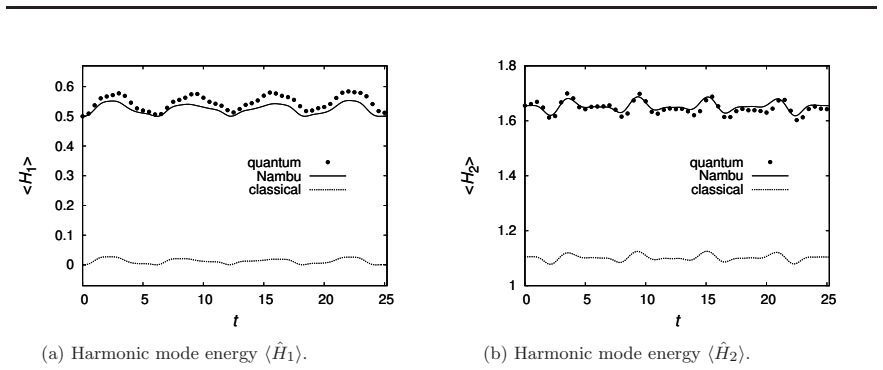
- Numerical solutions of the Nambu equations for the metastable cubic and simplified Henon–Heiles models track the quantum energy exchange and tunneling noticeably better than classical mechanics, mainly because the constraints carry the zero-point energy.
Reading between the lines
- Beyond the paper: the same close-the-multiplet, find-conserved-constraints, rewrite-as-an-$N$-bracket recipe could be tested on higher-moment sets such as $\langle\hat{q}^n\hat{p}^m\rangle$, where the zero-cumulant closure would be replaced by exact operator identities and the constraints would encode genuine non-Gaussianity.
- Beyond the paper: because the constants $C_c$ in the replacement $G_c=0\to G_c=C_c$ depend on the model and initial state, the paper's scheme is not a universal quantization rule; a complete quantization of hidden Nambu mechanics would need a state-dependent rule for determining the $C_c$.
- Beyond the paper: the failure of the fundamental identity in the two-oscillator example means that long-time many-degree-of-freedom Nambu integration may still preserve phase-space volume but will not preserve the canonical structure, so symplectic-style integrators and canonical diagnostics are not guaranteed to behave as in Hamiltonian systems.
Signed reviews
Editorial analysis
A structured set of objections, weighed in public.
Referee Report
Summary. The paper extends the authors' previous 'hidden Nambu mechanics' construction to quantum and semiclassical systems. The central idea is to take as a Nambu multiplet the expectation values of quantum operators, including composite operators such as ⟨q^2⟩, ⟨p^2⟩, and the symmetrized product (q̂p̂)_s, and to ask whether the exact or approximate equations of motion for these expectation values coincide with Nambu equations generated by a Hamiltonian F and constraint functions G_c. The authors give a five-step procedure: start from a classical N-plet, determine the constraints from Poisson-bracket consistency conditions, replace variables by expectation values, construct F by the zero-cumulant approximation if needed, and then verify that F and the G_c are conserved. Detailed examples are worked out: the exact harmonic-oscillator case with N = 3 and the frozen-Gaussian semiclassical case with N = 4. The many-degree-of-freedom extension is discussed, with the acknowledged caveat that the generalized Nambu bracket fails to satisfy the fundamental identity when degrees of freedom interact. Numerical comparisons for a metastable cubic potential and a simplified Henon–Heiles model illustrate the formalism.
Significance. If the central claims hold, the paper demonstrates that certain quantum and semiclassical expectation-value dynamics admit an exact reformulation as volume-preserving Nambu flow. The worked examples are internally consistent: the Nambu equations match the stated quantum and semiclassical ODEs, and the numerical tunneling and energy-exchange results reproduce known semiclassical behavior. A further strength is that the construction is not circular: the Nambu equations are derived from the original ODEs, and the dependence of the constraint constants on the initial state is explicitly acknowledged. The main limitations are the conditional and approximate character of the general procedure, since the zero-cumulant closure is uncontrolled away from Gaussian states, and the fact that the many-degree-of-freedom bracket violates the fundamental identity. These limitations are disclosed in the text, but they need to be made more prominent in the presentation of the general procedure.
major comments (2)
- [Sec. 3.2, Step (5)] The statement that if F and G1,...,G_{N-2} are all conserved, then the dynamics of the Nambu N-plet can be cast into the Nambu form of Eq. (11) is not justified by the preceding construction. Conservation of these functions is necessary but not sufficient for the time derivatives of the N-plet to equal the Nambu vector field generated by them; a vector field can preserve F and the G_c without being the unit Nambu vector field. In the worked examples the equivalence is established by direct comparison (Eqs. (42) and (45) versus Eqs. (21) and (31)), so the examples are unaffected. The general procedure, however, needs either a proof of the sufficiency claim under explicit hypotheses on the closure of the N-plet, or a reformulation of Step (5) as a verification to be performed after the Nambu equations are derived, rather than as a condition that alone guarantees the Nambu form.
- [Sec. 3.3(b), Eqs. (44)-(45); Sec. 5.1-5.2] The assertion 'We can see that all of F, G1, and G2 are conserved in the following approximated dynamics' is load-bearing because it is precisely the Step-(5) hypothesis, but no derivation is given. For the one-mode case, dG1/dt and dG2/dt follow immediately from the second and third equations in Eq. (45), and dF/dt follows from the identity f̃(x1,x3) = -∂Ṽ/∂x1 - 2x1 ∂Ṽ/∂x3; the two-mode case in Eqs. (70)-(71) requires an analogous check. The paper should include these elementary conservation identities, or state them as a lemma, rather than leaving them to the reader. The same comment applies to the conservation of G in Sec. 3.3(a), Eqs. (38)-(42), where conservation of G is also asserted rather than shown.
minor comments (3)
- [Sec. 3.3(b), text after Eq. (46)] The definitions x3 = q_c^2 - σ^2 and x4 = p_c^2 - ℏ^2/(4σ^2) are inconsistent with the stated values G1 = σ^2 and G2 = ℏ^2/(4σ^2); with the minus signs one would obtain G1 = -σ^2 and G2 = -ℏ^2/(4σ^2). The plus-sign versions are used in Sec. 5, Eqs. (62) and (72), and are required for the effective potential Vc in Eq. (63). Please correct the signs in Sec. 3.3(b).
- [Sec. 5.2, first paragraph] The phrase 'a one-dimensional quantum system of two oscillators' is misleading; the model has two degrees of freedom. Please rephrase, for example as 'a quantum system of two coupled oscillators'.
- [Abstract and Sec. 6] The abstract and conclusions could be misread as claiming that the Nambu representation is exact for the full nonlinear quantum dynamics. A sentence clarifying that the nonlinear examples are exact only for the chosen Gaussian trial (frozen-Gaussian) dynamics, while the exact Heisenberg evolution is approximated, would help readers.
Circularity Check
No significant circularity: the Nambu reformulation is derived by explicit equivalence to Heisenberg and TDVP equations, with no fitted parameters or load-bearing self-citation.
full rationale
The paper's central claim is a reformulation result, and the derivation is self-contained. Section 2.3 re-derives the classical hidden-Nambu construction (Eqs. (9)-(12)) rather than importing it from Ref. [13], so the self-citation is contextual, not load-bearing. For the harmonic oscillator, the Nambu equations (21) are checked directly against the exact Heisenberg equations (42) with F=<H> and G=2x3^2-2x1x2; both are conserved by the dynamics, and the equivalence is displayed equation-by-equation. For the semiclassical examples, the zero-cumulant rule (36) is an explicit approximation with no fitted parameters; the Nambu equations (31) are algebraically identical to the stated semiclassical equations (45), (61), and (70). The constraints G1=x3-x1^2=sigma^2 and G2=x4-x2^2=hbar^2/(4 sigma^2) are conserved quantities evaluated from the initial Gaussian state, not parameters tuned to reproduce trajectories. The paper explicitly disclaims any stronger predictive role, noting that the constants 'in general depend on the models and the initial conditions' and that the procedure is 'not for quantizing the Nambu mechanics, but just for finding the hidden Nambu structures.' Section 5 benchmarks the resulting dynamics against independent quantum and classical calculations. The unproved 'highest order' representation rule in Sec. 2.4 is a regularity condition for choosing Gc, not a circular input, and the sign slip in Sec. 3.3(b) is a typo that does not affect the derivation, which uses the consistent plus-sign expressions in Sec. 5.
Assumptions & free parameters
assumptions (4)
- domain assumption The expectation value dynamics is governed by the Ehrenfest equation, d<A>/dt = (1/i hbar) <[A,H]> (Eq. 34).
- ad hoc to paper The Poisson brackets in the consistency conditions (Eq. 10) must be expressed using variables of the highest order possible (Sec. 2.4 comments, Sec. 3.2 Step 1).
- ad hoc to paper The zero-cumulant approximation (Eq. 36) is used to reduce expectation values of operators not in the multiplet to functions of the multiplet.
- domain assumption In the examples, F and G_c are conserved under the semiclassical dynamics; this is asserted with 'we can see' in Sec. 3.3(b) rather than proven generally.
Cite this review
Pith. "Pith review of Hidden Nambu mechanics II: Quantum/semiclassical dynamics." pith.science (2026). https://pith.science/paper/XPIM73PG
@misc{pith2026190803567,
  author       = {Pith},
  title        = {Pith review of: Hidden Nambu mechanics II: Quantum/semiclassical dynamics},
  year         = {2026},
  howpublished = {\url{https://pith.science/paper/XPIM73PG}},
  note         = {Machine review of arXiv:1908.03567}
}
read the original abstract
Nambu mechanics is a generalized Hamiltonian dynamics characterized by an extended phase space and multiple Hamiltonians. In a previous paper [Prog. Theor. Exp. Phys. 2013, 073A01 (2013)] we revealed that the Nambu mechanical structure is hidden in Hamiltonian dynamics, that is, the classical time evolution of variables including redundant degrees of freedom can be formulated as Nambu mechanics. In the present paper we show that the Nambu mechanical structure is also hidden in some quantum or semiclassical dynamics, that is, in some cases the quantum or semiclassical time evolution of expectation values of quantum mechanical operators, including composite operators, can be formulated as Nambu mechanics. We present a procedure to find hidden Nambu structures in quantum/semiclassical systems of one degree of freedom, and give two examples: the exact quantum dynamics of a harmonic oscillator, and semiclassical wave packet dynamics. Our formalism can be extended to many-degrees-of-freedom systems; however, there is a serious difficulty in this case due to interactions between degrees of freedom. To illustrate our formalism we present two sets of numerical results on semiclassical dynamics: from a one-dimensional metastable potential model and a simplified Henon--Heiles model of two interacting oscillators.
Figures

Reference graph
Works this paper leans on
- [1]
- [2]
-
[3]
G. Dito, M. Flato, D. Sternheimer, and L. Takhtajan, Comm un. Math. Phys. 183, 1 (1997)
work page 1997
- [4]
- [5]
-
[6]
M. Axenides, E. G. Floratos, and S. Nicolis, J. Phys. A: Ma th. Theor. 42, 275201 (2009)
work page 2009
-
[7]
J. A. de Azcarraga and J. M. Izquierdo, J. Phys. A: Math. Th eor. 43, 293001 (2010)
work page 2010
-
[8]
S. Mongkolsakulvong, P. Chaikhan, and T. D. Frank, Eur. P hys. J. B 85, 90 (2012)
work page 2012
Show all 24 references
-
[9]
Blender and V
R. Blender and V. Lucarini Physica D 243, 86 (2013)
2013
-
[10]
Saitou, K
M. Saitou, K. Bamba, and A. Sugamoto, Prog. Theor. Exp. P hys. 2014, 103B03 (2014)
2014
-
[11]
Ho and Y
P.-M. Ho and Y. Matsuo, Prog. Theor. Exp. Phys. 2016, 06A104 (2016)
2016
-
[12]
Yoneya, Prog
T. Yoneya, Prog. Theor. Exp. Phys. 2017, 023A01 (2017)
2017
-
[13]
Horikoshi and Y
A. Horikoshi and Y. Kawamura, Prog. Theor. Exp. Phys. 2013, 073A01 (2013)
2013
-
[14]
E. J. Heller, J. Chem. Phys. 75, 2923 (1981)
1981
-
[15]
Sato and Z
N. Sato and Z. Yoshida, Phys. Rev. E 97, 022145 (2018)
2018
-
[16]
O. V. Prezhdo and Y. V. Pereverzev, J. Chem. Phys. 113, 6557 (2000)
2000
-
[17]
O. V. Prezhdo, J. Chem. Phys. 117, 2995 (2002)
2002
-
[18]
Feldmeier and J
H. Feldmeier and J. Schnack, Rev. Mod. Phys. 72, 655 (2000)
2000
-
[19]
Modin, J
K. Modin, J. Gen. Lie Theory Appl. 3, 39 (2009)
2009
-
[20]
Watanabe and M
N. Watanabe and M. Tsukada, Phys. Rev. E 62, 2914 (2000)
2000
-
[21]
Ohsawa and M
T. Ohsawa and M. Leok, J. Phys. A: Math. Theor. 46, 405201 (2013)
2013
-
[22]
E. J. Heller, E. B. Stechel, and M. J. Davis, J. Chem. Phys . 73, 4720 (1980)
1980
-
[23]
A. M. Bloch, J. E. Marsden, and D. V. Zenkov, Not. AMS 52, 320 (2005)
2005
- [24]
Reviewed August 14, 2026 · model on record in the stance chip above.
Discussion (0). Continue with ORCID to comment.