REVIEW 3 major objections 5 minor 47 references
Vortex Majorana braiding in a finite time
T0 review · 3 major / 5 minor · reviewed 2026-08-14 · deepseek-v4-flash
Pith's one-line read Moving one vortex a short distance around a triangle realizes Majorana braiding in finite time, with a gate that stays exact despite small parameter variations.
desk verdict Solid finite-time braiding protocol with an elegant analytic result, but the abstract overstates robustness by omitting the C3 symmetry requirement. read the letter →
The pith
A machine-rendered reading of the paper's core claim, the machinery that carries it, and where it could break.
The reading
What carries the argument
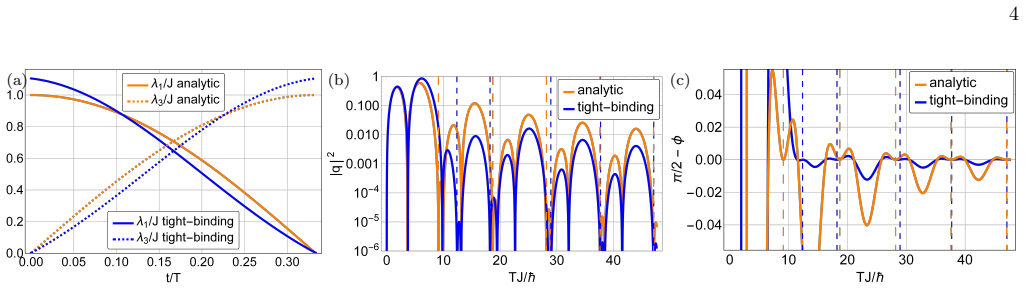
The argument rests on the low-energy four-Majorana Hamiltonian $H(t)=iJ[\lambda_1(t)\gamma_1+\lambda_2(t)\gamma_2+\lambda_3(t)\gamma_3]\gamma_m$, where the $\lambda_i(t)$ are time-dependent hybridization strengths and $J$ is the maximal hybridization energy. Along one edge of the path, with $\lambda_1(t)=\sin(3\pi t/2T)$, $\lambda_2(t)=\cos(3\pi t/2T)$, $\lambda_3(t)=0$, the time-evolution operator has the closed form $U_{j,k}(t)=e^{-\gamma_j\gamma_k\,3\pi t/4T}e^{\gamma_j\gamma_m Jt/\hbar+\gamma_j\gamma_k\,3\pi t/4T}$, which becomes the braiding operator $B_{i,j}$ at the times $T_n=3\pi\sqrt{n^2-1/16}\,\hbar/J$. For a general protocol respecting mirror and C3 symmetry, the one-edge evolution is $U^g_{j,k}(T)=b_1+b_2\gamma_j\gamma_m+b_3\gamma_m\gamma_k+b_4\gamma_k\gamma_j$ with real $b_i$, and the full-loop quasiparticle excitation amplitude is $q^g(T)=\sqrt{2}e^{i\pi/4}(b_4(T)-b_1(T))(1-(\sum_i b_i(T))^2)$. Because this is a product of real polynomials, the zeros of $|q|^2$ are robust: small variations shift them without lifting them, which is what makes the finite-time braiding gate stable.
What would settle it
Measure the probability $|q|^2$ of leaving the ground-state manifold as the central vortex completes the triangular path in total time $T$: the claim predicts exact zeros at every $T_n=3\pi\sqrt{n^2-1/16}\,\hbar/J$ together with the finite-time Berry phase $\varphi=\pi/2$. A nonzero minimum at any predicted $T_n$, or a measured $\varphi\neq\pi/2$ at the zero, would refute the central claim.
Extended reading notes
Core claim
The central claim is that Majorana braiding can be realized in finite time without physically exchanging the Majoranas. In the proposed geometry, three exterior vortex Majoranas $\gamma_1,\gamma_2,\gamma_3$ sit at the corners of an equilateral triangle, decoupled from each other by the special distances $r_j=\pi(j-3/4)/k_F$, and a fourth movable vortex Majorana $\gamma_m$ traverses a path that keeps it at distance $r_4$ from the exterior ones. Moving $\gamma_m$ once around this path in total time $T$ yields, up to a phase, the braiding gate $B_{1,3}$, with perfect fidelity at the times $T_n=3\pi\sqrt{n^2-1/16}\,\hbar/J$: the probability $|q|^2$ of leaving the ground-state manifold vanishes and the finite-time Berry phase $\varphi$ equals $\pi/2$. The robustness proof uses the general symmetry-respecting time evolution along one edge, which gives $q^g\propto (b_4-b_1)(1-(\sum_i b_i)^2)$ with real $b_i$, a product of real polynomials whose single zeros are stable against small perturbations. The analytic solution of the exactly solvable Hamiltonian $H(t)=iJ\sum_i\lambda_i(t)\gamma_i\gamma_m$ at the same times reproduces the braiding operator exactly.
Load-bearing premise
The robustness proof assumes the four vortices behave exactly as the four-Majorana low-energy model and that their arrangement keeps mirror and threefold-rotation symmetry for the entire motion.
Editorial extensions
If this is right
- Majorana braiding can be executed at gigahertz rates, with total times as short as about 0.24 ns for FeTe$_{0.55}$Se$_{0.45}$, removing the need for minute-long adiabatic paths that suffer quasiparticle poisoning and flux-line instabilities.
- The braiding gate is realized without physically exchanging the Majoranas, so the twisted flux lines that destabilize adiabatic vortex braiding never form.
- Small sample-to-sample variations in material parameters, or a non-constant local speed of the vortex, do not destroy the gate; they merely shift the perfect-braiding times slightly.
- The scheme transfers directly to Y-junctions of one-dimensional topological superconductors, because it relies only on tunable hybridization between a central and three peripheral Majorana modes.
- At each protected zero of $|q|^2$, the finite-time Berry phase equals exactly $\pi/2$, providing an experimental signature of successful braiding that can be checked by phase-sensitive readout.
Reading between the lines
- If the polynomial robustness extends beyond the C3-symmetric manifold, the protocol might tolerate small positional disorder that breaks C3, but the paper's own Fig. S5 shows the protected zeros lift when C3 is broken; a practical implementation would need to actively maintain the symmetry or recalibrate the braiding time.
- The discrete set of perfect-braiding times $T_n$ gives a practical knob: since different $n$ correspond to different total times, the same physical path can implement the braiding gate at a chosen speed, or, away from the zeros, act as a phase gate—the appendix notes each zero realizes another phase gate, including a $\pi/4$ magic gate.
- The exact solvability of the one-edge evolution suggests that more complicated multi-vortex networks—hexagons or ladders of Majoranas—might admit similar closed-form alternating solutions, provided the hybridization functions follow sine/cosine profiles and the geometry preserves enough symmetry.
- A direct experimental test of the protocol could use the LDOS evolution predicted in Fig. 1(c): the moving vortex should never show a zero-bias peak, while the zero-bias peaks at the exterior vortices permute according to the protocol.
Signed reviews
Editorial analysis
A structured set of objections, weighed in public.
Referee Report
Summary. The manuscript proposes a finite-time Majorana braiding protocol in which a movable vortex Majorana γm is driven along a short triangular path around three static vortex Majoranas γ1, γ2, γ3 arranged as an equilateral triangle. The authors present a low-energy Hamiltonian H(t)=iJΣλi(t)γiγm, solve it exactly for a specific sinusoidal driving protocol, and show that at discrete times Tn=3π√(n^2−1/16)ℏ/J the time evolution equals the braiding operator B1,3 with zero quasiparticle excitation probability |q|2=0 and finite-time phase φ=π/2. They argue that the excitation amplitude factorizes into a product of real polynomials, so its zeros are robust to small variations in material parameters and braiding speed. The proposal is supported by a realistic tight-binding simulation for FeTe0.55Se0.45, by a detailed experimental calibration protocol based on STM manipulation and LDOS measurements, and by an appendix that verifies the analytic solution by explicit substitution.
Significance. If the central claim holds, this is a significant step toward practical Majorana braiding: it avoids long adiabatic paths and the associated coherence and flux-line twisting problems, and it predicts nanosecond-scale gate times for an experimentally accessible iron-based superconductor. The analytic solution is a genuine strength, and the explicit verification in the appendix plus the realistic tight-binding simulation give the central result nontrivial support. The paper also contains a falsifiable experimental recipe and a clear generalization to Y-junctions and adatom-tuned Majorana couplings. However, the advertised robustness is narrower than the abstract suggests, because the analytic proof assumes exact C3 and mirror symmetry; the supplement itself shows that breaking C3 lifts the protected zeros and introduces an uncompensated dynamic phase. That caveat is load-bearing for the practical claim and must be addressed.
major comments (3)
- [Main text Eqs. (6)-(8); Supplement Sec. 2, Fig. S5] The robustness statement that the zeros of |q|2 are 'shifted but not lifted' by small variations rests on the factorization of qg as a product of real polynomials, which in turn requires the three edge evolutions to have the same real coefficients b1,...,b4 and therefore requires exact C3 and mirror symmetry. The supplement's own Fig. S5 shows that when C3 is slightly broken, the protected zeros of |q|2 lift (green curve), so the unqualified abstract claim of robustness 'against variations in material specific parameters' is not supported by the analytical proof. Since the stated positioning precision of 0.1 nm breaks C3 in a real experiment, the practical robustness of the protocol requires either a numerical study of symmetry-breaking disorder or a clear restatement of the claim as robustness within the symmetry-preserving class of perturbations.
- [Main text Eqs. (8)-(10); Supplement Sec. 2, Fig. S5(b)] Perfect braiding requires both vanishing quasiparticle excitation (q=0) and the correct gate phase (φ=π/2). The analytical proof and the factorization argument address only q; the phase φ is not protected by the same polynomial argument. The supplement explicitly states that residual couplings introduce a time-dependent additional phase and shows numerically that φ deviates from π/2 once the ground-state degeneracy is lifted, even when C3 is maintained. Therefore the main-text statement that perfect finite-time braiding is achieved at Tn, together with the claim that the protocol is robust against material parameter variations, conflates two different properties. The paper should specify precisely which quantities (|q|2, φ, or the full gate) remain exact under which classes of perturbations.
- [Main text, braiding validation paragraph and Eq. (8)] The statement that a single zero of q is shifted but not lifted by small deviations assumes the zero is simple. The authors do not prove simplicity of the zeros of the realistic qg, and the supplement's numerical evidence for the C3-broken case shows that zeros can indeed disappear. While the analytic model's zeros at Tn are simple, the transfer of this property to the realistic tight-binding model is asserted rather than proven. A short argument or a numerical scan over the parameter region of interest would make the robustness claim quantitatively reliable.
minor comments (5)
- [Main text, paragraph after Eq. (9)] The phrase 'where b1(T)=b4(T) in Eq. (9)' appears to refer to the coefficients introduced in Eq. (6), not to quantities defined in Eq. (9); please correct the cross-reference.
- [Reference [40]] Reference [40] contains the placeholder '[url] will be inserted by the publisher'; the Supplemental Material should have a stable reference or DOI so that the reader can access the verification and the numerical details.
- [Main text, Eq. (10) and surrounding discussion] The term 'finite-time Berry phase' is used before it is defined; since φ is a phase difference between two parity sectors rather than a standard Berry phase, a more explicit definition and a note on its gauge dependence would improve rigor.
- [Main text, setup paragraph] The statement that a deviation of about 0.1 nm from the perfect positions 'does not crucially affect the protocol' should be reconciled with the supplement's finding that residual couplings shift φ by a time-dependent phase; the quali-fication 'crucially' needs a quantitative definition.
- [Fig. 1(c) caption] Please specify what quantity is plotted in each panel and identify the four vortices unambiguously; the current caption does not explain the color coding or the axes.
Circularity Check
No circular derivation: the finite-time braiding gate and its zero-excitation times are solved from the assumed Hamiltonian; self-citations are ancillary and the C3 caveat is disclosed.
full rationale
I traced the derivation chain from Eq. (2) to Eqs. (4), (5), (8), and (10). The low-energy Hamiltonian H(t)=iJΣλ_i(t)γ_iγ_m is the stated modeling input, not a restatement of the target braiding gate. Eq. (4) is presented as an exact solution for the chosen λ_i(t), and the Appendix verifies it in an explicit four-Majorana representation; the braiding times T_n=3π√(n^2−1/16)ℏ/J in Eq. (5) are zeros of the solution's trigonometric factors, not fitted parameters. The general edge evolution U^g_{j,k}(T)=b1+b2γ_jγ_m+b3γ_mγ_k+b4γ_kγ_j in Eq. (6) is justified by mirror/C3 symmetry and by the allowed couplings in the geometry; Eq. (8), q_g=√2 e^{iπ/4}(b4−b1)(1−(Σb_i)^2), is a direct trace evaluation, not an imposition of the braiding condition φ=π/2. Thus the factorization into real polynomials, and the statement that single zeros shift without lifting under small symmetry-preserving perturbations, is a mathematical consequence of the symmetry ansatz rather than a prediction equivalent to its input. The material-specific tight-binding model is cited from the authors' prior work (Ref. [39]) and used only to calibrate J, r4, r6, and residual couplings; those numbers are not adjusted to make |q|^2 or φ vanish. The same-author supplement (Ref. [40]) verifies the closed form and is reproduced in the Appendix, so no load-bearing argument reduces to an unverified self-citation. The main text's broad phrase 'robust against variations in material specific parameters' is qualified in the supplement: Fig. S5 shows that breaking C3 lifts the protected zeros and that residual couplings add a time-dependent phase ('residual couplings introduce a time-dependent additional phase'). That is an accuracy/scope caveat, not a circular step. No equation in the paper reduces, by construction, to the claimed result.
Assumptions & free parameters
free parameters (3)
- Maximum hybridization energy J =
≈25 µeV
- Edge length r6 (exterior vortex separation) =
77.3 nm
- Central-vortex distance r4 / start distance γ2γm =
51.1 nm (continuum), 38 nm (tight-binding start)
assumptions (6)
- standard math Majorana algebra {γi,γj} = δij, γi^2=1/4 (per the explicit representation in Eq. S15)
- domain assumption The four-vortex system is described by H(t)=iJΣλ_i(t)γ_iγ_m with no direct exterior-exterior couplings (Eq. 2)
- domain assumption The two-vortex hybridization amplitude is proportional to cos(kFr+π/4)e^{-r/ξ}/√r, so vortices decouple at r_j = π(j−3/4)/kF (Eq. 1)
- domain assumption C3 and mirror symmetry hold during the whole braiding protocol; tight-binding data are symmetrized accordingly
- domain assumption Hybridization strength depends only on the absolute distance between the two vortices, so γm can be moved while keeping γ1γm constant
- domain assumption Material parameters for FeTe0.55Se0.45: µ=5 meV, νF=25 nm·meV, ∆=1.8 meV, λ=500 nm
Cite this review
Pith. "Pith review of Vortex Majorana braiding in a finite time." pith.science (2026). https://pith.science/paper/6VLRRQJA
@misc{pith2026190803576,
  author       = {Pith},
  title        = {Pith review of: Vortex Majorana braiding in a finite time},
  year         = {2026},
  howpublished = {\url{https://pith.science/paper/6VLRRQJA}},
  note         = {Machine review of arXiv:1908.03576}
}
read the original abstract
Abrikosov vortices in Fe-based superconductors are a promising platform for hosting Majorana zero modes. Their adiabatic exchange is a key ingredient for Majorana-based quantum computing. However, the adiabatic braiding process can not be realized in state-of-the-art experiments. We propose to replace the infinitely slow, long-path braiding by only slightly moving vortices in a special geometry without actually physically exchanging the Majoranas, like a Majorana carousel. Although the resulting finite-time gate is not topologically protected, it is robust against variations in material specific parameters and in the braiding-speed. We prove this analytically. Our results carry over to Y-junctions of Majorana wires.
Figures

Reference graph
Works this paper leans on
-
[1]
A. Y. Kitaev, Physics Uspekhi 44, 131 (2001)
work page 2001
-
[2]
Alicea, Y
J. Alicea, Y. Oreg, G. Refael, F. von Oppen, and M. P. A. Fisher, Nat. Phys. 7, 412 (2011)
2011
-
[3]
S. R. Elliott and M. Franz, Rev. Mod. Phys. 87, 137 (2015)
2015
-
[4]
Nayak, S
C. Nayak, S. H. Simon, A. Stern, M. Freedman, and S. Das Sarma, Rev. Mod. Phys. 80, 1083 (2008)
2008
-
[5]
J. C. Budich, S. Walter, and B. Trauzettel, Phys. Rev. B 85, 121405(R) (2012)
work page 2012
-
[6]
F. L. Pedrocchi and D. P. DiVincenzo, Phys. Rev. Lett. 115, 120402 (2015)
work page 2015
-
[7]
Mourik, K
V. Mourik, K. Zuo, S. M. Frolov, S. R. Plissard, E. P. A. M. Bakkers, and L. P. Kouwenhoven, Science 336, 1003 (2012)
2012
-
[8]
A. Das, Y. Ronen, Y. Most, Y. Oreg, M. Heiblum, and H. Shtrikman, Nat. Phys. 8, 887 (2012)
2012
Show all 47 references
-
[9]
H. Kim, A. Palacio-Morales, T. Posske, L. R´ ozsa, K. Palot´ as, L. Szunyogh, M. Thorwart, and R. Wiesen- danger, Science Advances 4 (2018)
2018
-
[10]
D. A. Ivanov, Phys. Rev. Lett. 86, 268 (2001)
2001
-
[11]
Fu and C
L. Fu and C. L. Kane, Phys. Rev. Lett. 100, 096407 (2008)
2008
-
[12]
D. Wang, L. Kong, P. Fan, H. Chen, S. Zhu, W. Liu, L. Cao, Y. Sun, S. Du, J. Schneeloch, R. Zhong, G. Gu, L. Fu, H. Ding, and H.-J. Gao, Science 362, 333 (2018)
2018
-
[13]
J. X. Yin, Z. Wu, J. H. Wang, Z. Y. Ye, J. Gong, X. Y. Hou, L. Shan, A. Li, X. J. Liang, X. X. Wu, J. Li, C. S. Ting, Z. Q. Wang, J. P. Hu, P. H. Hor, H. Ding, and S. H. Pan, Nat. Phys. 11, 543 (2015)
2015
-
[14]
Q. Liu, C. Chen, T. Zhang, R. Peng, Y.-J. Yan, C.-H.- P. Wen, X. Lou, Y.-L. Huang, J.-P. Tian, X.-L. Dong, G.-W. Wang, W.-C. Bao, Q.-H. Wang, Z.-P. Yin, Z.-X. Zhao, and D.-L. Feng, Phys. Rev. X 8, 041056 (2018)
2018
-
[15]
Zhang, K
P. Zhang, K. Yaji, T. Hashimoto, Y. Ota, T. Kondo, K. Okazaki, Z. Wang, J. Wen, G. D. Gu, H. Ding, and S. Shin, Science 360, 182 (2018)
2018
-
[16]
Machida, Y
T. Machida, Y. Sun, S. Pyon, S. Takeda, Y. Kohsaka, T. Hanaguri, T. Sasagawa, and T. Tamegai, Nature Ma- terials (2019), 10.1038/s41563-019-0397-1
2019 doi
-
[17]
Y. Yuan, J. Pan, X. Wang, Y. Fang, C. Song, L. Wang, K. He, X. Ma, H. Zhang, F. Huang, W. Li, and Q.-K. Xue, Nat. Phys. 18, 811 (2019)
2019
-
[18]
S. Zhu, L. Kong, L. Cao, H. Chen, M. Papaj, S. Du, Y. Xing, W. Liu, D. Wang, C. Shen, F. Yang, J. Schnee- loch, R. Zhong, G. Gu, L. Fu, Y.-Y. Zhang, H. Ding, and H.-J. Gao, Science 367, 189 (2020)
2020
-
[20]
Karzig, Y
T. Karzig, Y. Oreg, G. Refael, and M. H. Freedman, Phys. Rev. B 99, 144521 (2019)
2019
-
[21]
Karzig, C
T. Karzig, C. Knapp, R. M. Lutchyn, P. Bonderson, M. B. Hastings, C. Nayak, J. Alicea, K. Flensberg, S. Plugge, Y. Oreg, C. M. Marcus, and M. H. Freed- man, Phys. Rev. B 95, 235305 (2017)
2017
-
[22]
Karzig, Y
T. Karzig, Y. Oreg, G. Refael, and M. H. Freedman, Phys. Rev. X 6, 031019 (2016)
2016
-
[23]
B. I. Halperin, Y. Oreg, A. Stern, G. Refael, J. Alicea, and F. von Oppen, Phys. Rev. B 85, 144501 (2012)
2012
-
[24]
Vijay, T
S. Vijay, T. H. Hsieh, and L. Fu, Phys. Rev. X 5, 041038 (2015)
2015
-
[25]
B. H. November, J. D. Sau, J. R. Williams, and J. E. Hoffman, arXiv e-prints , arXiv:1905.09792 (2019), arXiv:1905.09792
2019 arXiv
-
[26]
I. Roy, S. Dutta, A. N. Roy Choudhury, S. Basistha, I. Maccari, S. Mandal, J. Jesudasan, V. Bagwe, C. Castel- lani, L. Benfatto, and P. Raychaudhuri, Phys. Rev. Lett. 122, 047001 (2019)
2019
-
[27]
Jiang, X
K. Jiang, X. Dai, and Z. Wang, Phys. Rev. X 9, 011033 (2019)
2019
-
[28]
H. Kim, C. Martin, R. T. Gordon, M. A. Tanatar, J. Hu, B. Qian, Z. Q. Mao, R. Hu, C. Petrovic, N. Salovich, R. Giannetta, and R. Prozorov, Phys. Rev. B 81, 180503 (2010)
2010
-
[29]
Klein, D
T. Klein, D. Braithwaite, A. Demuer, W. Knafo, G. Lapertot, C. Marcenat, P. Rodi` ere, I. Sheikin, P. Stro- bel, A. Sulpice, and P. Toulemonde, Phys. Rev. B 82, 184506 (2010)
2010
-
[30]
E. W. J. Straver, J. E. Hoffman, O. M. Auslaender, D. Rugar, and K. A. Moler, Appl. Phys. Lett. 93, 172514 (2008)
2008
-
[31]
Polshyn, T
H. Polshyn, T. Naibert, and R. Budakian, arXiv e-prints , arXiv:1905.06303 (2019), arXiv:1905.06303
2019 arXiv
-
[32]
J.-Y. Ge, V. N. Gladilin, J. Tempere, C. Xue, J. T. Devreese, J. van de Vondel, Y. Zhou, and V. V. Moshchalkov, Nat. Comm. 7, 13880 (2016)
2016
-
[33]
J. D. Sau, D. J. Clarke, and S. Tewari, Phys. Rev. B 84, 094505 (2011)
2011
-
[34]
Meidan, T
D. Meidan, T. Gur, and A. Romito, Phys. Rev. B 99, 205101 (2019)
2019
-
[35]
Vijay and L
S. Vijay and L. Fu, Phys. Rev. B 94, 235446 (2016)
2016
-
[36]
Cheng, R
M. Cheng, R. M. Lutchyn, V. Galitski, and S. Das Sarma, Phys. Rev. Lett. 103, 107001 (2009)
2009
-
[37]
Cheng, R
M. Cheng, R. M. Lutchyn, V. Galitski, and S. Das Sarma, Phys. Rev. B 82, 094504 (2010)
2010
-
[38]
R. V. Mishmash, B. Bauer, F. von Oppen, and J. Alicea, arXiv e-prints , arXiv:1911.02582 (2019), arXiv:1911.02582 [cond-mat.mes-hall]
2019 arXiv
-
[39]
C.-K. Chiu, T. Machida, Y. Huang, T. Hanaguri, and F.-C. Zhang, arXiv e-prints , arXiv:1904.13374 (2019)
2019 arXiv
-
[40]
Posske, C.-K
T. Posske, C.-K. Chiu, and M. Thorwart, (2019), sup- plemental material [url] will be inserted by the publisher
2019
-
[41]
C.-X. Liu, D. E. Liu, F.-C. Zhang, and C.-K. Chiu, Phys- ical Review Applied 12, 054035 (2019), arXiv:1901.06083 [cond-mat.mes-hall]
2019 arXiv
-
[42]
Plugge, A
S. Plugge, A. Rasmussen, R. Egger, and K. Flens- berg, New Journal of Physics 19, 012001 (2017), arXiv:1609.01697 [cond-mat.mes-hall]
2017 arXiv
-
[43]
C.-K. Chiu, M. M. Vazifeh, and M. Franz, EPL (Eu- rophysics Letters) 110, 10001 (2015), arXiv:1403.0033 [cond-mat.mes-hall]
2015 arXiv
-
[44]
Pekker, C.-Y
D. Pekker, C.-Y. Hou, V. E. Manucharyan, and E. Dem- ler, Phys. Rev. Lett. 111, 107007 (2013)
2013
-
[45]
T. Kato, J. Phys. Soc. Jpn. 5, 435 (1950)
1950
-
[46]
Berry, Proc
M. Berry, Proc. R Soc. A 392, 45 (1984)
1984
-
[47]
C.-K. Chiu, M. M. Vazifeh, and M. Franz, EPL 110 (2014)
2014
-
[48]
P. Fan, F. Yang, G. Qian, H. Chen, Y.-Y. Zhang, G. Li, Z. Huang, Y. Xing, L. Kong, W. Liu, K. Jiang, C. Shen, S. Du, J. Schneeloch, R. Zhong, G. Gu, Z. Wang, H. Ding, and H.-J. Gao, arXiv e-prints , arXiv:2001.07376 (2020), arXiv:2001.07376 [cond-mat.supr-con]. 6 Appendix In t...
2020 arXiv
Reviewed August 14, 2026 · model on record in the stance chip above.
Discussion (0). Continue with ORCID to comment.