REVIEW 3 major objections 3 minor 51 references
Radiative parton energy loss and baryon stopping in $AA$ collisions
T0 review · 3 major / 3 minor · reviewed 2026-08-14 · deepseek-v4-flash
Pith's one-line read Radiative energy loss of fast diquarks can partly fill the midrapidity dip in net-proton yields at sqrt(s) ~ 10 GeV.
desk verdict A competent first calculation of radiative diquark energy loss in baryon stopping that deserves refereeing, but the central convolution in Eq. (14) is underspecified and the gluon-mass sensitivity is unresolved. read the letter →
The pith
A machine-rendered reading of the paper's core claim, the machinery that carries it, and where it could break.
The reading
What carries the argument
The engine of the calculation is the light-cone path integral (LCPI) formula for the x-distribution of induced gluon emission from a fast parton: the emission spectrum is expressed through a Green's function of a two-dimensional Schrödinger equation whose imaginary potential is set by the three-body dipole cross section. In the quadratic approximation for the dipole cross section, sigma_qqbar = C2 $rho^{2}$, the in-medium Hamiltonian becomes an oscillator with complex frequency, and the spectrum can be evaluated with the piecewise expression for the oscillator parameter gamma. This allows the author to go beyond the frozen-size approximation, which underestimates the energy loss by a factor of 1.6-1.7 at mg = 400 MeV. The radiative correction to the diquark distribution is obtained by folding the gluon spectrum with the initial diquark density, and the net-proton rapidity distribution follows from diquark fragmentation.
What would settle it
Measure the centrality dependence of the midrapidity net-proton yield in Pb+Pb at 40 GeV: the radiative correction should grow with path length, so if the excess over the no-radiation string model does not increase from peripheral to central collisions, the mechanism is ruled out. Also, a measurement of the kurtosis of the net-proton distribution in |y| < 0.5 at sqrt(s) ~ 10 GeV that deviates from the binomial expectation would falsify the fluctuation claim.
Extended reading notes
Core claim
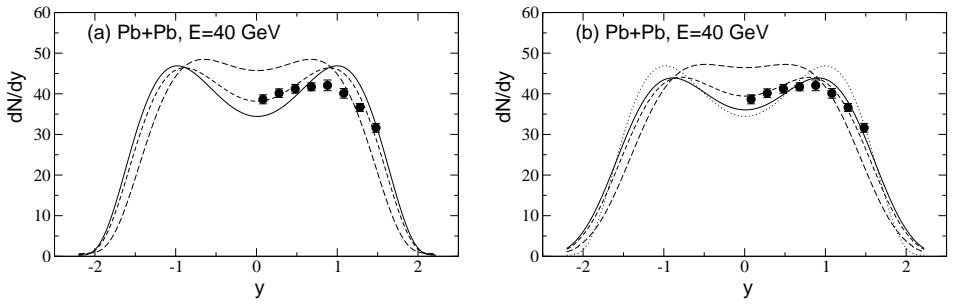
The central discovery is that induced gluon emission, previously studied for partons produced inside a quark-gluon plasma, also acts on the diquarks that carry baryon number as they traverse nuclear matter, and at sqrt(s) ~ 10 GeV this radiative energy loss is large enough to matter for baryon stopping. In the calculation, the radiative correction enhances the midrapidity net-proton yield by factors of about 1.35 for mg = 400 MeV and 1.12 for mg = 750 MeV in central Pb+Pb collisions at 40 GeV; the 400 MeV curve overshoots the data, while the 750 MeV curve stays closer to it. Independently of the gluon-mass uncertainty, the paper argues that the observed dip in the net-proton rapidity distribution implies the baryon diffusion width is well below one unit of rapidity, so net-proton fluctuations at |y|<0.5 should reflect the initial fluctuation of the proton flow, roughly binomial, rather than a critical regime.
Load-bearing premise
The numerical size of the radiative correction hinges on the effective gluon mass mg used as the infrared cutoff: if the true value sits near the 750 MeV end rather than near 400 MeV, the radiative effect is too small to fill the dip, and the paper's quantitative conclusion about baryon stopping loses force.
Editorial extensions
If this is right
- Radiative energy loss must be added to the quark-gluon string model description of baryon stopping at sqrt(s) ~ 10 GeV; at higher energies its contribution is too small to compete with the string-junction mechanism.
- The midrapidity dip in the net-proton rapidity distribution is partly filled by radiative energy loss, so extractions of diquark distributions and Regge intercepts from the data should account for this correction.
- At sqrt(s) ~ 10 GeV, net-proton fluctuations in a |y| < 0.5 window are expected to be close to binomial, dominated by initial proton-flow fluctuations rather than by critical-point physics.
- The observed absence of a strong critical-point signal in net-proton fluctuations at low collision energies is consistent with this picture, which predicts that the relevant rapidity window is too narrow relative to the diffusion width for a grand-canonical critical regime to appear.
- The diquark picture of baryon-number transport is favored over a quark-only picture by the observed binomial/Poissonian character of net-proton fluctuations.
Reading between the lines
- The centrality dependence of the midrapidity net-proton yield provides a clean discriminator: because radiative energy loss scales with the nuclear path length, the excess over the standard string model should grow from peripheral to central collisions, whereas the string-junction mechanism has a different centrality trend.
- The same machinery could be applied to net-Lambda and net-Xi production, since strange baryons come from different fragmentation functions; a radiative stopping signal would appear at different rapidities and could be checked against existing data.
- The binomial-fluctuation argument is logically separable from the radiative-energy-loss calculation: even if the gluon mass turns out high and the radiative effect is weak, the observed dip already implies the diffusion width is small, which independently suppresses critical-point fluctuations in a |y| < 0.5 window.
- If future low-energy heavy-ion programs confirm the radiative contribution, models of baryon stopping would need to treat the radiated gluon as a kink on the string rather than as an additional cut Pomeron, changing how multiplicity and baryon number are correlated.
Signed reviews
Editorial analysis
A structured set of objections, weighed in public.
Referee Report
Summary. The paper studies whether radiative energy loss of valence diquarks traversing cold nuclear matter can enhance baryon stopping and partially fill the midrapidity dip in the net proton rapidity distribution in AA collisions at sqrt(s_NN) ~ 8.76 GeV. Using the LCPI light-cone path integral formalism, the authors compute the induced gluon spectrum for diquarks and quarks, evaluate the radiative correction to the QGSM diquark distribution via Eq. (14), and compare the resulting net proton rapidity distributions with NA49 Pb+Pb data at E = 40 GeV. They report midrapidity enhancement factors of about 1.35 for mg = 400 MeV and 1.12 for mg = 750 MeV. They further argue that at these energies net proton fluctuations should be binomial, dominated by initial fluctuations of the proton flow, which would make observation of the QCD critical point via |y| < 0.5 net-proton fluctuations questionable.
Significance. If valid, the result would identify a new mechanism contributing to baryon stopping at NICA and BES energies and would have implications for interpreting net-proton fluctuation data. The paper is honest about the strong dependence on the gluon mass, which is the main limitation; the two adopted values bracket the effect from 'strong' to 'weak'. Strengths include the use of an established formalism with explicit formulas, a clear comparison with NA49 data, and a transparent statement that this is a preliminary study. The central quantitative claim, however, is not robust to the unconstrained infrared cutoff and to the undefined energy at which the induced spectrum is evaluated in the convolution; these issues need to be resolved before the comparison with data can be considered quantitative.
major comments (3)
- [Sec. 3, Eq. (14)] The convolution in Eq. (14) is not well defined because the induced-gluon spectrum dP/dz in Eq. (1) depends on the initial parton energy E_a through L_f and M(x) in Eqs. (1)-(2). For the gain term, the diquark that ends with fraction x had initial fraction x' = x/(1-z), so dP/dz should be evaluated at E_a = x E_N/(1-z); for the loss term, dP/dz should be evaluated at E_a = x E_N. The text does not state which E_a is used, and using a single spectrum at E_N would overestimate the correction because the typical diquark energies at midrapidity (x ~ 0.24, E_a ~ 10 GeV) are in the rising part of Fig. 1. Please specify the implementation and, if possible, quantify the difference between the correct convolution and a fixed-energy approximation.
- [Sec. 3, Figs. 1-2 and Summary] The central conclusion that radiative energy loss can 'fill in partly' the midrapidity dip is realized only for mg = 400 MeV, the lower edge of the adopted 400-800 MeV range; for mg = 750 MeV the effect is weak and the enhancement factor is only 1.12. Since mg is an external input and the paper does not provide an uncertainty or likelihood over this range, the abstract and summary should either carry the mg condition explicitly or be accompanied by a sensitivity analysis, for example a curve for mg = 600 MeV and a statement of how the transport coefficient qhat and the quadratic dipole approximation affect the result.
- [Sec. 4] The binomial-fluctuation claim is asserted rather than derived. The text states that for the diquark mechanism the net proton fluctuations 'should be binomial' and that initial proton-flow fluctuations dominate, but no model for the event-by-event distribution of the initial flow or for the effect of diquark fragmentation is given. Because this claim is used to question the observability of the QCD critical point via STAR net-proton fluctuations, it needs at least a schematic model calculation or a clearly labeled conjecture rather than a plausibility argument.
minor comments (3)
- [Abstract and Sec. 1] There are several typos: 'The analyses is performed' and 'proton st opping' in the abstract, 'Calculate the the diquark' in Sec. 1, 'Note the the situation' and 'Glaber model' in Sec. 3, and 'cannot not be close' in Sec. 4.
- [Sec. 3, Fig. 2] The relation between the x-distribution in Eq. (11) and the rapidity distributions shown in Fig. 2 is not stated; please give the kinematic mapping used (e.g., x = m_T/sqrt(s) e^{-y} or the equivalent) and the transverse-mass assumptions.
- [Sec. 3, Eq. (14)] The notation xmin is used in Eq. (14) but is not defined for this context; it should be defined consistently with Eq. (10) and with the energy dependence discussed in the major comments.
Circularity Check
No significant circularity: the radiative correction is computed from an established LCPI formalism with parameters fixed to independent observables, not fitted to the midrapidity dip.
full rationale
The central claim is that the induced-gluon spectrum (8), computed in the LCPI approach with parameters fixed in Sec. 3 (alpha_s=0.5, qhat=0.01 GeV^3, m_q=m_D=300 MeV, m_g=400/750 MeV), when inserted into the convolution (14), produces a positive radiative correction that partially fills the midrapidity dip in the QGSM net-proton spectrum. None of these inputs is fitted to the NA49 net-proton y-distribution or to the dip: m_g comes from low-x F2 and Dyson-Schwinger calculations, qhat from the double-gluon dipole formula of the author's earlier work, the Regge intercepts from standard QGSM, k from charged-particle multiplicities, and S/L from the measured p/Λ ratio. The LCPI formulas (1)-(9) are written out in the paper rather than imported as a black box; citations to the author's prior papers provide the framework and parameter estimates, not a uniqueness theorem that forces the conclusion. The radiative correction is therefore a genuine model output, not an input renamed as a prediction. The sensitivity to m_g is explicitly acknowledged and bracketed by two values, which is parameter uncertainty rather than circularity. The binomial-fluctuation argument is an independent inference from the size of the measured dip and STAR's binomial observation. The unstated energy at which dP/dz in Eq. (14) is evaluated is a formal ambiguity that should be clarified, but it does not make the result circular.
Assumptions & free parameters
free parameters (5)
- Gluon mass mg (infrared cutoff) =
400 MeV and 750 MeV
- Transport coefficient qhat =
0.01 GeV^3
- Quark and diquark masses mq = mD =
300 MeV
- Strange suppression S/L =
0.367
- Diquark distribution exponent k =
k = nu + <kN> - 1, <kN> ~ 1.65
assumptions (6)
- domain assumption The light-cone path integral approach gives the correct induced gluon spectrum for partons crossing nuclear matter.
- domain assumption The dipole cross section can be approximated as quadratic, sigma_qbarq = C2 rho^2.
- domain assumption Scalar and vector ud diquarks can be treated as pointlike for induced gluon emission.
- domain assumption Projectile nucleons radiate independently; collective effects inside the projectile nucleus are small.
- ad hoc to paper The induced gluon emission mechanism is absent from the ordinary QGSM and can be added without double counting.
- domain assumption Baryon diffusion in the hot matter is described by Gaussian smearing with width sigma_d ~ 0.3 from a random walk estimate.
Cite this review
Pith. "Pith review of Radiative parton energy loss and baryon stopping in $AA$ collisions." pith.science (2026). https://pith.science/paper/RQ6TAM5I
@misc{pith2026190803723,
  author       = {Pith},
  title        = {Pith review of: Radiative parton energy loss and baryon stopping in $AA$ collisions},
  year         = {2026},
  howpublished = {\url{https://pith.science/paper/RQ6TAM5I}},
  note         = {Machine review of arXiv:1908.03723}
}
abstract
We study the radiative energy loss contribution to proton stopping in $AA$ collisions. The analyses is performed within the light-cone path integral approach to induced gluon emission. We have found that the radiative correction can fill in partly the midrapidity dip in the net proton rapidity distribution in $AA$ collisions at $\sqrt{s}\sim 10$ GeV. We argue that at $\sqrt{s}\sim 10$ GeV the net proton fluctuations at midrapidity may be dominated by the initial fluctuations of the proton flow, which, to a good accuracy, should be binomial.
Figures

Reference graph
Works this paper leans on
-
[1]
The baryon stopping in hadron and nucleus collisions has attracted much attention for a long time. But up to now, there is no consensus yet on the mechanism of the baryon number t ransfer over a large rapidity interval (which is also closely related to the mechanism of B ¯B-annihilation). Presently, there is no answer to the most basic ques tion about the...
-
[2]
It has a formfactor F (Q2) ≈ 1/ [1 + Q2/Q 2 0] with Q2 0 ≈ 10 GeV 2 [20]
The scalar ud diquark, which dominates in the nucleon wave function [20–22], is a ra ther compact object. It has a formfactor F (Q2) ≈ 1/ [1 + Q2/Q 2 0] with Q2 0 ≈ 10 GeV 2 [20]. The typical virtuality scale for the induced gluon emission in the nuclear matter ( ∼ m2 g ∼< 0. 5 GeV 2) is much smaller than Q2
-
[3]
For this reason the induced gluon radiation from scalar diquarks can be calculated as for a point like par ticle. This approximation should be reasonable even for the less compact vector ud and uu diquarks, for which Q2 0 ≈ 2 GeV 2 [20]. We will treat nuclei as uniform spheres. We consider AA collisions in the rest frame of one (target) of the colliding n...
-
[4]
For numerical calculations we take α s = 0 . 5. We use the value ˆ q = 0 . 01 GeV 3, supported by calculations of the coefficient C2 using the double gluon formula for the dipole cross section [17]. For th e quark and diquark masses we take mq = mD = 300 MeV. However, the radiative energy loss is only weakly depende nt on the specific choice of the mass of t...
-
[5]
12 for mg = 400 and 750 MeV, respectively
35 and 1 . 12 for mg = 400 and 750 MeV, respectively. Thus, we conclude that for mg = 750 MeV the radiative effect is relatively weak. For mg = 400 MeV the radiative effect is quite strong, and the theoretical s pectrum overshoot the data at y ∼ 0. Of course, one can improve agreement with the data by changing the QGSM parton distributions, which have not s...
- [6]
- [7]
-
[8]
The analyses is based on the LCPI app roach [16, 17] to the induced gluon emission
In summary, we have studied, for the first time, the radiative ene rgy loss contribution to the proton stopping in AA collisions in the energy region √s ∼ 10 GeV which is of interest in connection with the future experiments at NICA and the BES program at RHIC. The analyses is based on the LCPI app roach [16, 17] to the induced gluon emission. Calculation ...
Show all 51 references
-
[9]
Rossi and G
G.C. Rossi and G. Veneziano, Nucl. Phys. B 123, 507 (1977)
1977
-
[10]
Veneziano, Phys
G. Veneziano, Phys. Lett. B 52, 220 (1974)
1974
-
[11]
Veneziano, Nucl.Phys
G. Veneziano, Nucl.Phys. B 117, 519 (1976)
1976
-
[12]
Cohen-Tannoudji, A.E
G. Cohen-Tannoudji, A.E. Hassouni, J. Kalinowski, and R .B. Peschanski, Phys. Rev. D 19, 3397 (1979)
1979
-
[13]
Capella and J
A. Capella and J. Tran Thanh Van, Phys. Lett. B 114, 450 (1982)
1982
-
[14]
Asakawa and M
M. Asakawa and M. Kitazawa, Prog. Part. Nucl. Phys. 90, 299 (2016) [arXiv:1512.05038]
2016 arXiv
-
[15]
Asakawa, U.W
M. Asakawa, U.W. Heinz, and B. Muller, Phys. Rev. Lett. 85, 2072 (2000) [hep-ph/0003169]
2000 arXiv
-
[16]
Alper et al
B. Alper et al. , Nucl. Phys. B 100, 237 (1975)
1975
-
[17]
Capella, A
A. Capella, A. Kaidalov, A.K. Akil, C. Merino, and J. Tran Thanh Van, Z. Phys. C 70, 507 (1996) [hep-ph/9507250]
1996 arXiv
-
[18]
Capella and C.A
A. Capella and C.A. Salgado, Phys. Rev. C 60, 054906 (1999) [hep-ph/9903414]
1999 arXiv
-
[19]
Kopeliovich and B.G
B.Z. Kopeliovich and B.G. Zakharov, Z. Phys. C 43, 241 (1989)
1989
-
[20]
Capella and B.Z
A. Capella and B.Z. Kopeliovich, Phys. Lett. B 381, 325 (1996) [hep-ph/9603279]
1996 arXiv
- [21]
-
[22]
C. Chen, B. El-Bennich, C.D. Roberts, S.M. Schmidt, J. S egovia, and S. Wan, Phys. Rev. D 97, 034016 (2018) [arXiv:1711.03142]
2018 arXiv
-
[23]
Nikolaev, B.G
N.N. Nikolaev, B.G. Zakharov, and V.R. Zoller, JETP Let t. 59, 6 (1994) [hep-ph/9312268]
1994 arXiv
- [24]
- [25]
- [26]
-
[27]
Anticic et al
T. Anticic et al. [NA49 Collaboration], Phys. Rev. C 83, 014901 (2011) [arXiv:1009.1747]. 7
2011 arXiv
-
[28]
Anselmino, E
M. Anselmino, E. Predazzi, S. Ekelin, S. Fredriksson, a nd D.B. Lichtenberg, Rev. Mod. Phys. 65, 1199 (1993)
1993
-
[29]
Kim, Mod
V.T. Kim, Mod. Phys. Lett. A 3, 909 (1988)
1988
- [30]
-
[31]
Aguilar, D
A.C. Aguilar, D. Binosi, J. Papavassiliou, and J. Rodri guez-Quintero, Phys. Rev. D 80, 085018 (2009) [arXiv:0906.2633]
2009 arXiv
-
[32]
Nikolaev, G
N.N. Nikolaev, G. Piller, and B.G. Zakharov, J. Exp. The or. Phys. 81, 851 (1995) [hep-ph/9412344]
1995 arXiv
-
[33]
Kovchegov, A.H
Y.V. Kovchegov, A.H. Mueller, Nucl. Phys. B 529, 451 (1998) [hep-ph/9802440]
1998 arXiv
-
[34]
Baier, Y.L
R. Baier, Y.L. Dokshitzer, A.H. Mueller, S. Peign´ e and D. Schiff, Nucl. Phys. B 483, 291 (1997) [hep-ph/9607355]
1997 arXiv
- [35]
-
[36]
Nikolaev and B.G
N.N. Nikolaev and B.G. Zakharov, Phys. Lett. B 327, 149 (1994) [hep-ph/9402209]
1994 arXiv
-
[37]
Roberts, and D.J
Si-xue Qin, Lei Chang, Yu-xin Liu, C.D. Roberts, and D.J . Wilson, Phys. Rev. C 84, 042202 (2011) [arXiv:1108.0603]
2011 arXiv
-
[38]
Afanasiev et al
S.V. Afanasiev et al. [NA49 Collaboration], Phys. Rev. C 66, 054902 (2002) [nucl-ex/0205002]
2002 arXiv
-
[39]
Borsanyi, G
S. Borsanyi, G. Endrodi, Z. Fodor, A. Jakovac, S.D. Katz , S. Krieg, C. Ratti, and K.K. Szabo, JHEP 1011, 077 (2010) [arXiv:1007.2580]
2010 arXiv
-
[40]
one obtains ⟨∆ yd(τf )2⟩1/ 2 ≈ 0. 3. To illustrate the magnitude of the diffusion correction, in Fig. 2b we show the prediction obtained with the Gaussian smearing with the width σd = 0 . 3. One sees that the smearing partly fills in the minimum. From Figs. 2a, b one can see tha...
-
[41]
For the diquark mechanism of the baryon flow, to a good accuracy, these fluctuations should be 6 binomial
is not surprising. For the diquark mechanism of the baryon flow, to a good accuracy, these fluctuations should be 6 binomial. This agrees with the STAR observation [41] that the net pro ton fluctuations are close to binomial/Poissonian at √s ∼ 10 GeV, where the antiproton yield b...
-
[42]
Capella and E.G
A. Capella and E.G. Ferreiro, Eur. Phys. J. C 72, 1936 (2012) [arXiv:1110.6839]
2012 arXiv
-
[43]
Bialas, M
A. Bialas, M. Bleszynski, and W. Czyz, Nucl. Phys. B 111, 461 (1976)
1976
- [44]
-
[45]
Arakelian, A
G.H. Arakelian, A. Capella, A.B. Kaidalov, and Yu.M. Sh abelski, Eur. Phys. J. C 26, 81 (2002) [hep-ph/0103337]
2002 arXiv
-
[46]
Anticic et al
T. Anticic et al. [NA49 Collaboration], Phys. Rev. Lett. 93, 022302 (2004) [nucl-ex/0311024]
2004 arXiv
-
[47]
M¨ uller and K
B. M¨ uller and K. Rajagopal, Eur. Phys. J. C 43, 15 (2005) [arXiv:hep-ph/0502174]
2005 arXiv
-
[48]
S.A. Bass, A. Dumitru, M. Bleicher, L. Bravina, E. Zabro din, H. Stoecker, and W. Greiner, Phys. Rev. C 60, 021902 (1999) [nucl-th/9902062]
1999 arXiv
-
[49]
Adamczyk et al
L. Adamczyk et al. [STAR Collaboration], Phys. Rev. Lett. 112, 032302 (2014) [arXiv:1309.5681]
2014 arXiv
-
[50]
Albacete, Y.V
J.L. Albacete, Y.V. Kovchegov, Nucl. Phys. A 781, 122 (2007) [hep-ph/0605053]
2007 arXiv
-
[51]
Andersson, G
B. Andersson, G. Gustafson, G. Ingelman, and T. Sjostra nd, Phys. Rept. 97, 31 (1983)
1983
Reviewed August 14, 2026 · model on record in the stance chip above.
Discussion (0). Continue with ORCID to comment.