REVIEW 3 major objections 4 minor 37 references
Thermodynamics and weak cosmic censorship conjecture with pressure in the rotating BTZ black holes
T0 review · 3 major / 4 minor · reviewed 2026-08-14 · deepseek-v4-flash
Pith's one-line read A near-extremal charged rotating BTZ black hole can lose its horizon when the AdS radius is treated as a pressure variable.
desk verdict The no-pressure half is a sound incremental result, but the claimed WCCC violation with pressure rests on an unphysical free parameter dl and an incorrect entropy formula, so the central new claim is not established. read the letter →
The pith
A machine-rendered reading of the paper's core claim, the machinery that carries it, and where it could break.
The reading
What carries the argument
The load-bearing object is the horizon function $F(r)=-M+r^2/l^2-\frac{1}{2}Q^2\ln(r/l)+J^2/(4r^2)$ of the charged rotating BTZ black hole: horizons are its zeros, so the conjecture holds exactly when its minimum $F(r_m)=\delta\le 0$ stays non-positive after absorption. The argument computes the shift $dF_m$ under absorption by combining the fermion's horizon radial momentum $p^r_+= \omega+eA_t(r_+)-j\Omega_+$ (derived from the Dirac equation with the fermion's spin) with energy, charge, and angular-momentum conservation, using $r_+=r_m+\varepsilon$ and keeping terms through $O(\varepsilon^2)$. The new element in the pressure case is the independent variation $dl$ of the AdS radius, which enters $dF_m$ as $8dl/l^3\,\varepsilon^2$ and supplies the positive contribution that can flip $\bar{F}$ from negative to positive.
What would settle it
Check whether the Einstein equations allow a nonzero $dl$ for an infalling fermion: solve the constraint for the spacetime with the fermion's stress-energy tensor added and see if $l$ can vary; if the only consistent solution has $dl=0$, then Eq. (77) reduces to the no-pressure case and $\bar{F}$ is negative for the parameter ranges in Figs. 4-5, settling against the violation. Alternatively, compute the maximum $dl$ permitted by energy conservation for $l=Q=1$, $dQ=0.5$ and compare it with $dl_c$ from Eq. (78).
Extended reading notes
Core claim
The paper's central claim is that the weak cosmic censorship conjecture can fail for near-extremal charged rotating BTZ black holes once the cosmological constant is treated as a thermodynamic pressure. After a charged spinning fermion is absorbed, the minimum of the horizon function shifts by an amount whose sign is fixed by Eq. (77): $\bar{F}=8dl/l^3 + Q(dQ r_m - dr_m Q)/r_m^3 - 4/l^2 + Q^2/(2r_m^2)$. Because the initial gap $\delta$ is itself of order $\varepsilon^2$ (with $\varepsilon=r_+-r_m$), this second-order coefficient cannot be dropped, and for $dl$ larger than the critical value in Eq. (78) it becomes positive. A positive minimum of $F(r)$ means $F(r)=0$ has no real solution, so the final spacetime has no horizon and the singularity is naked. Without pressure, the same expansion gives a coefficient that is negative for the parameter ranges considered, so censorship survives.
Load-bearing premise
The load-bearing assumption is that a single absorbed fermion can change the AdS radius $l$ by an independent amount $dl$ even though a falling test particle supplies no mechanism to alter the cosmological constant; setting $dl=0$ removes the positive term in Eq. (77) and the claimed violation disappears.
Editorial extensions
If this is right
- For charged rotating BTZ black holes without pressure, both the first and second laws of thermodynamics and the weak cosmic censorship conjecture remain intact, including near-extremal holes when second-order corrections are retained.
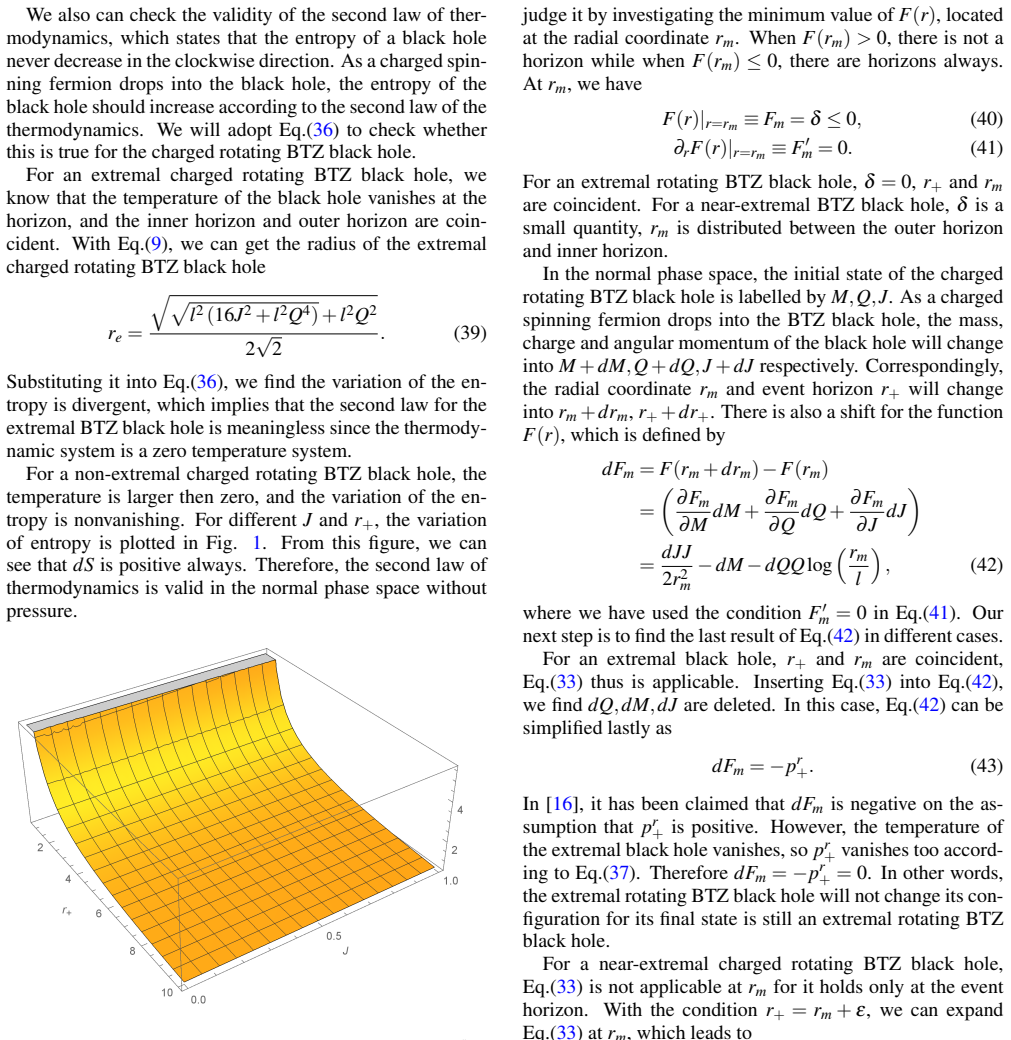
- With pressure, the second law of thermodynamics can fail: the entropy variation in Eq. (66) is negative for some parameter values.
- With pressure, near-extremal charged rotating BTZ black holes can be transformed into naked singularities: for $dl>dl_c$, the horizon function's minimum is positive.
- Extremal charged rotating BTZ black holes are stable in both settings: after absorption they remain extremal, with $dF_m=0$.
- The first law of thermodynamics, in its extended form $dM=T dS+\Phi dQ+\Omega_+ dJ+V dP$, survives the absorption process.
Reading between the lines
- The violation hinges on $dl$ being an independent, freely chosen parameter; an infalling fermion's stress-energy tensor has not been shown to produce a change in the cosmological constant, so if consistency forces $dl=0$, the positive $8dl/l^3$ term disappears and censorship is restored.
- The same second-order $\varepsilon$-expansion with a variable AdS radius could be applied to other rotating black holes in anti-de Sitter space; wherever $\delta$ is $O(\varepsilon^2)$ and a $dl$ term enters $dF_m$, a naked-singularity window may open.
- A direct way to test the scenario is to couple the fermion to the cosmological constant through the field equations and compute the maximum $dl$ an absorbed particle can induce; comparing that maximum with $dl_c$ for $l=Q=1$, $dQ=0.5$ would determine whether the predicted violation is physically realizable.
- If the violation is real, it suggests that treating the cosmological constant as a thermodynamic variable in particle-absorption gedankenexperiments is not equivalent to holding it fixed: thermodynamics alone does not determine whether a horizon remains.
Editorial analysis
A structured set of objections, weighed in public.
Referee Report
Summary. The paper studies a charged spinning fermion falling into a charged rotating BTZ black hole and tests the first law, second law, and weak cosmic censorship conjecture (WCCC) both without and with pressure. In the normal phase space (fixed cosmological constant), the authors derive the energy-momentum relation from the Dirac equation, recover the first law, argue that the entropy variation is positive for non-extremal black holes, and show through a second-order expansion that the minimum of the horizon function remains negative, so WCCC holds. In the extended phase space with pressure, they find that the first law is still valid but that the entropy variation may become negative and that the minimum of the horizon function may become positive for near-extremal black holes, depending on the charge, angular momentum, AdS radius, and especially on the independent variation dl of the AdS radius. The central new claim is that WCCC can be violated in the extended phase space.
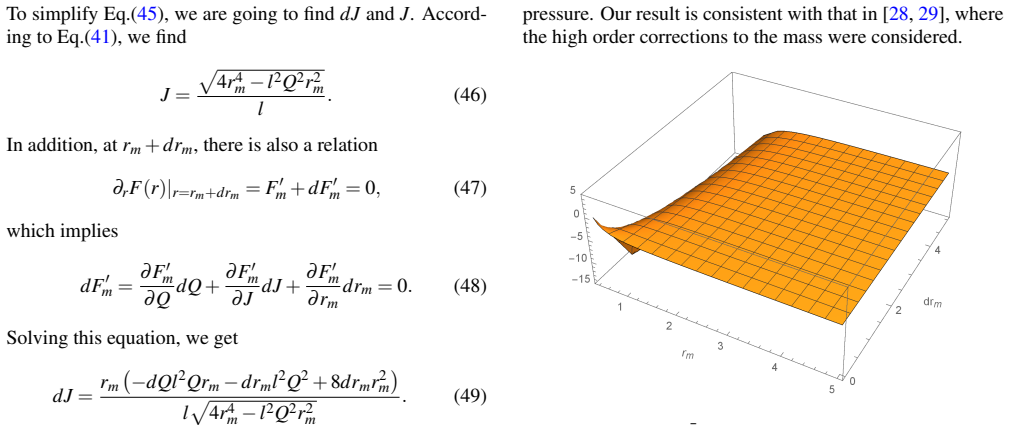
Significance. If the central claim were established, it would be a notable addition to the literature on WCCC in extended phase space, where previous works reported that pressure does not allow horizon destruction. The no-pressure part of the paper is a competently executed check: the Dirac-equation derivation is self-contained, the first law is recovered, and the second-order treatment echoes Sorce-Wald-type results. However, the pressure-dependent WCCC violation is not established because the decisive term in Eq. (77) is controlled by an unphysical free parameter dl. With dl = 0, the result reduces to the no-pressure case and the claimed violation disappears, as shown by the paper's own Figs. 2 and 4. The paper therefore does not provide a definite prediction of naked singularity formation; it provides an artifact of an ad hoc variation.
major comments (3)
- [Section V, Eqs. (56)-(59), (77)] The variation dl of the AdS radius is introduced as an independent free parameter with no physical source. The fermion's conserved energy is set to dU = d(M - PV) in Eq. (56), and charge and angular momentum conservation give e = dQ and j = dJ, but no equation of motion or conservation law determines dl. A test particle falling into a fixed BTZ background has no mechanism to change the cosmological constant or the pressure. Equation (77) contains the term 8dl/l^3, which is the only term that can make the final minimum of F positive for the reported parameter choices; setting dl = 0 reduces Eq. (77) to the no-pressure expression whose negativity is shown in Fig. 2. Hence the central claim that WCCC is violated in the extended phase space is not a definite consequence of the absorption process but an artifact of an arbitrary parameter.
- [Section V, Eq. (66)] The claimed violation of the second law in the extended phase space is likewise controlled by the unconstrained quantities dl and dQ. Equation (66) shows that dS can be negative for some values of dl, but because dl is not fixed by any physical condition, this does not establish that a charged spinning fermion absorption can decrease entropy. It merely restates that a function of an arbitrary parameter can be negative. A physical derivation of dl, or of the relation between dl and the other conserved charges, is required before the second-law violation can be claimed.
- [Section V, Eq. (78) and Figs. 4-5] The critical value dl_c in Eq. (78) is not a prediction but a sign-change condition for a free parameter. The paper does not show that any fermion with the stated charge, spin, and energy can produce such a dl, nor that such a variation is compatible with the Einstein field equations or with the equations of motion used to derive Eq. (31). Without this, Figs. 4 and 5 do not provide evidence that a physical process can destroy the horizon.
minor comments (4)
- [Introduction and outline] The outline references 'Section IV' twice, and the paper actually has Section III on the energy-momentum relation and Sections IV and V on thermodynamics; the outline should be corrected to match the section numbering.
- [Fig. 1 caption] The caption writes 'the case pr h = l = Q = 1', but the radial momentum has been denoted p_r^+ elsewhere; the notation should be made uniform and the quantity defined.
- [Equation (60) and surrounding text] The sentence 'we can delete dJ, dQ, dl, and dM' is misleading: the horizon condition (58) is a single equation, and the subsequent solution for dr+ follows only after using Eq. (59) and the definitions of P and V. The logical steps should be stated more explicitly.
- [General presentation] The paper would benefit from a short discussion, in Section VI, of why the second-order treatment that invalidates the earlier neglect of O(epsilon^2) does not also require a full accounting of the backreaction of the fermion on the spacetime; the test-particle approximation is otherwise assumed throughout.
Circularity Check
No significant circularity: the derivation is self-contained; the dl-dependence is a physical-assumption concern, not a circular one.
full rationale
The derivation chain is not circular. The energy-momentum relation is obtained from the Dirac equation in the dragging frame, Eq. (31), and the conservation identifications in Eqs. (32) and (56) are explicit physical assumptions, not restatements of the conclusions. The first law is recovered algebraically in both the normal and extended phase spaces (Eqs. (38) and (65)) by combining the horizon condition with the energy-momentum relation, rather than being imposed as an input. The weak cosmic censorship analysis is an independent computation: without pressure, the high-order expansion gives a nonzero correction and the authors explicitly show that the final horizon function remains non-positive (Eq. (54), Fig. 2); with pressure, the final expression Eq. (77) contains an 8dl/l^3 term, and the claimed violation appears only when dl is chosen large enough (e.g., dl = 0.6 in Fig. 5, with critical value in Eq. (78)). This is a free-parameter or physical-consistency issue: a falling fermion provides no mechanism to change the AdS radius, and with dl = 0 the pressure-dependent violation disappears. But that is a concern about the validity of an input assumption, not circular reasoning, because the paper does not define its conclusion in terms of the chosen dl; it explicitly reports that the result depends on dl and other variations. The self-citations are to the authors' earlier extended-phase-space studies and are used for context and benchmark comparisons, not as a load-bearing argument that forces the present result. There is no imported uniqueness theorem, no ansatz smuggled in by citation, and no fitted parameter renamed as a prediction. Thus no step reduces to its own input by construction.
Assumptions & free parameters
free parameters (1)
- dl (variation of AdS radius) =
not fixed; examples dl=0.1 and 0.6 are used
assumptions (5)
- domain assumption The extended phase space first law dM = T dS + Omega dJ + Phi dQ + V dP is used to describe a single absorption process, with P and l treated as dynamical variables that can change during absorption.
- domain assumption The energy of the absorbed particle is identified with dU = d(M-PV) rather than dM when pressure is present.
- standard math The weak cosmic censorship criterion is that the minimum of F(r) must be non-positive after absorption.
- standard math The Dirac equation in the BTZ background gives the radial momentum |p^r_+| = omega + eAt - jOmega+ at the horizon.
- domain assumption Near-extremal expansions in epsilon = r+ - rm are controlled and terms beyond O(epsilon^2) can be discarded.
Cite this review
Pith. "Pith review of Thermodynamics and weak cosmic censorship conjecture with pressure in the rotating BTZ black holes." pith.science (2026). https://pith.science/paper/P7NKDSEB
@misc{pith2026190803845,
  author       = {Pith},
  title        = {Pith review of: Thermodynamics and weak cosmic censorship conjecture with pressure in the rotating BTZ black holes},
  year         = {2026},
  howpublished = {\url{https://pith.science/paper/P7NKDSEB}},
  note         = {Machine review of arXiv:1908.03845}
}
read the original abstract
As a charged spinning fermion drops into a charged rotating BTZ black hole, we investigate the laws of thermodynamics and weak cosmic censorship conjecture with and without pressure respectively. For the case without pressure, the first law, second law, as well as the weak cosmic censorship are found to be valid. While for the case with pressure, though the first law is still valid, the second law and the weak cosmic censorship conjecture are found to be violable, depending on the charge, angular momentum, AdS radius, and their variations. In addition, in both cases, the configurations of the extremal black holes are found to be stable since the final states of the extremal black holes are still extremal black holes. While for the near-extremal black holes, their configurations are not stable.
Figures

Figures from the paper (2 more)


Reference graph
Works this paper leans on
-
[1]
S. W. Hawking and R. Penrose, Proc. Roy. Soc. Lond. A 314, 529 (1970)
1970
-
[2]
Penrose, Riv
R. Penrose, Riv. Nuovo Cim. 1, 252 (1969)
1969
-
[3]
T. Crisford and J. E. Santos, Phys. Rev. Lett. 118, 181101 (2017) [arXiv:1702.05490 [hep-th]]
arXiv 2017
- [4]
-
[5]
Wald, Annals Phys
R. Wald, Annals Phys. 82, 548 (1974)
1974
-
[6]
T. Jacobson and T. P. Sotiriou, Phys. Rev. Lett. 103, 141101 (2009) [arXiv:0907.4146 [gr-qc]]
arXiv 2009
- [7]
-
[8]
E. Barausse, V . Cardoso and G. Khanna, Phys. Rev. Lett.105, 261102 (2010) [arXiv:1008.5159 [gr-qc]]
arXiv 2010
Show all 37 references
-
[9]
Colleoni and L
M. Colleoni and L. Barack, Phys. Rev. D 91, 104024 (2015) [arXiv:1501.07330 [gr-qc]]
2015 arXiv
-
[10]
P. Wang, H. Wu and H. Yang, Eur. Phys. J. C 79, no. 7, 572 (2019)
2019
-
[11]
F. C. Eperon, B. Ganchev and J. E. Santos, arXiv:1906.11257 [gr-qc]
1906 arXiv
- [12]
-
[13]
Liang, S
B. Liang, S. W. Wei and Y . X. Liu, Mod. Phys. Lett. A34, no. 05, 1950037 (2019)
2019
-
[14]
Isoyama, N
S. Isoyama, N. Sago and T. Tanaka, Phys. Rev. D 84, 124024 (2011)
2011
-
[15]
Gwak and B
B. Gwak and B. H. Lee, Phys. Lett. B 755, 324 (2016)
2016
-
[16]
Gwak, JHEP 1711, 129 (2017) [arXiv:1709.08665 [gr-qc]]
B. Gwak, JHEP 1711, 129 (2017) [arXiv:1709.08665 [gr-qc]]
2017 arXiv
-
[17]
X. X. Zeng and H. Q. Zhang, arXiv:1901.04247 [hep-th]
1901 arXiv
-
[18]
P. Wang, H. Wu and H. Yang, arXiv:1904.12365 [gr-qc]
1904 arXiv
-
[19]
Y . W. Han, X. X. Zeng and Y . Hong, Eur. Phys. J. C 79, 252 (2019)
2019
-
[20]
X. X. Zeng, Y . W. Han and D. Y . Chen, arXiv:1901.08915 [gr-qc]
1901 arXiv
-
[21]
Y . W. Han, X. H. Hu, M. J. Lan, arXiv:1903.03764 [gr-qc]
1903 arXiv
-
[22]
X. X. Zeng and H. Q. Zhang, arXiv:1905.01618 [gr-qc]
1905 arXiv
-
[23]
D. Chen, X. X. Zeng and W. Yang, arXiv:1901.05140 [hep- th]
1901 arXiv
-
[24]
X. X. Zeng, X. Y . Hu and K. J. He, arXiv:1905.07750 [hep-th]
1905 arXiv
-
[25]
K. J. He, X. Y . Hu and X. X. Zeng, arXiv:1906.10531 [gr-qc]
1906 arXiv
- [26]
- [27]
-
[28]
Kerr-Newman black holes cannot be over- charged or over-spun,
R. M. Wald, “Kerr-Newman black holes cannot be over- charged or over-spun,” Int. J. Mod. Phys. D 27, 1843003 (2018)
2018
-
[29]
Sorce and R
J. Sorce and R. M. Wald, Phys. Rev. D 96, 104014 (2017) [arXiv:1707.05862 [gr-qc]]
2017 arXiv
-
[30]
B. Ge, Y . Mo, S. Zhao and J. Zheng, Phys. Lett. B 783, 440 (2018) [arXiv:1712.07342 [hep-th]]
2018 arXiv
-
[31]
J. An, J. Shan, H. Zhang and S. Zhao, Phys. Rev. D97, no. 10, 104007 (2018) [arXiv:1711.04310 [hep-th]]
2018 arXiv
-
[32]
Banados, C
M. Banados, C. Teitelboim and J. Zanelli, Phys. Rev. Lett. 69, 1849 (1992) [hep-th/9204099]
1992 arXiv
-
[33]
Sadeghi and A
J. Sadeghi and A. S. Kubeka, Int. J. Theor. Phys. 55, no. 5, 2455 (2016)
2016
-
[34]
D. C. Zou, Y . Liu, B. Wang and W. Xu, Phys. Rev. D 90, no. 10, 104035 (2014) [arXiv:1408.2419 [hep-th]]
2014 arXiv
-
[35]
A. Ejaz, H. Gohar, H. Lin, K. Saifullah and S. T. Yau, Phys. Lett. B 726, 827 (2013) [arXiv:1306.6380 [hep-th]]
2013 arXiv
-
[36]
X. X. Zeng, J. S. Hou and S. Z. Yang, Pramana70, 409 (2008)
2008
-
[37]
Christodoulou, Phys
D. Christodoulou, Phys. Rev. Lett. 25, 1596 (1970). 8
1970
Reviewed August 14, 2026 · model on record in the stance chip above.
Discussion (0). Continue with ORCID to comment.