REVIEW 3 major objections 4 minor 26 references
Many-body dynamical localization and thermalization
T0 review · 3 major / 4 minor · reviewed 2026-08-14 · deepseek-v4-flash
Pith's one-line read Two weakly coupled chaotic quantum subsystems can retain memory of their initial state, so quantum thermalization is suppressed by nontrivial dynamical localization.
desk verdict Careful numerical study of initial-condition memory in coupled chaotic trimers; the localization signal is real, but the non-perturbative claim leans on an averaged participation number and N=24 without scaling. read the letter →
The pith
A machine-rendered reading of the paper's core claim, the machinery that carries it, and where it could break.
The reading
What carries the argument
The key object is the coupled double-trimer Hamiltonian, with the energy imbalance between the two trimers as the reaction coordinate for energy exchange and an effective Planck constant set by the inverse particle number per trimer. The argument runs through the exact quantum saturation profile obtained by diagonalization without time propagation, so the absence of ergodicity is a property of the eigenstates rather than a finite-time simulation effect. Localization is then judged by intrinsic ergodicity measures: the overlap between the saturation profile and the ergodic distribution, and especially the dependence of the mean absolute imbalance on the initial condition. The participation number is used to separate nontrivial localization, with large participation, from perturbative localization, where only about two states participate. What carries the argument is that the same saturation-profile machinery is applied to classical clouds and to quantum states, allowing a direct comparison that does not presuppose a classical limit.
What would settle it
One decisive check is exact diagonalization at larger subsystem sizes, such as 30, 40, and 50 particles per trimer, with the same parameters: if the saturation profile becomes independent of the initial imbalance and the overlap measure drops toward the semiclassical value as the particle number grows, the many-body dynamical localization is a finite-size effect rather than a genuine phenomenon.
Extended reading notes
Core claim
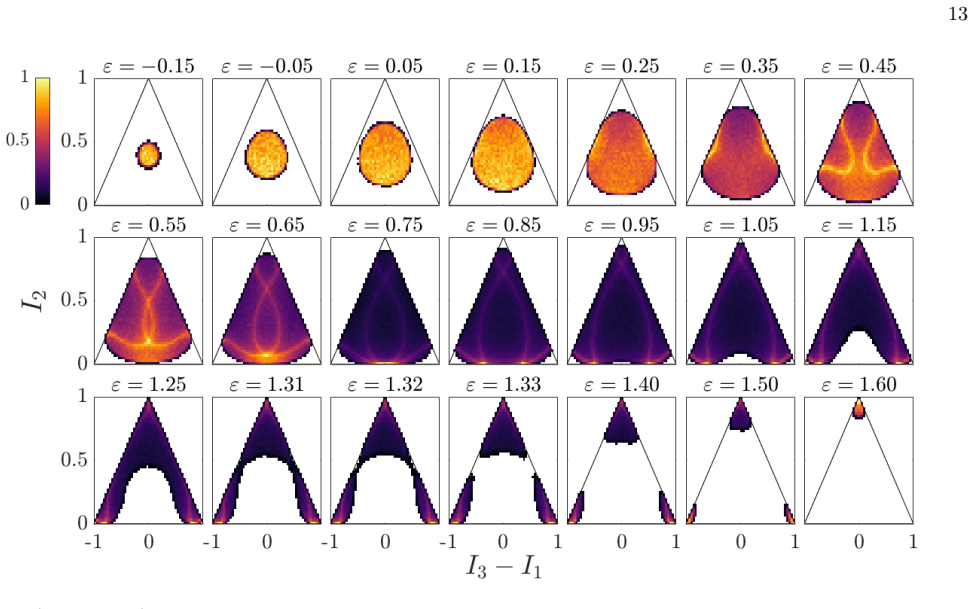
On its own terms, the paper's central discovery is that in a double trimer with inter-trimer coupling that is classically weak but quantum mechanically large, the quantum saturation profile remains dependent on the initial energy imbalance, while the semiclassical cloud ergodizes. The quantum memory is quantified by the overlap measure between the saturation profile and the microcanonical distribution, and by the dependence of the mean absolute imbalance on the initial condition. This memory persists for participation numbers much larger than 2, ruling out trivial perturbative localization. The boundary between a small central region of near independence from the initial condition and the localized periphery forms a mobility edge in the energy-imbalance plane. The paper therefore claims to demonstrate a quantum mechanical loss of intrinsic ergodicity despite non-perturbative quantum mixing, an effect it distinguishes from self-trapping, from classical localization due to phase-space barriers, and from perturbative localization.
Load-bearing premise
The load-bearing premise is that the memory of the initial state seen for 24 particles per trimer persists at larger particle numbers; the paper asserts the thermodynamic limit is not an issue, but shows no scaling test to back that claim.
Editorial extensions
If this is right
- If the central claim is right, weak coupling between chaotic subsystems is not a sufficient condition for thermalization; quantum memory can persist inside the chaotic sea.
- The mobility edge in the energy-imbalance plane means that, for a fixed total energy, only central initial imbalances ergodize, so the outcome of a thermalization experiment depends on preparation.
- Because the effect is defined intrinsically by initial-condition memory, the same criterion can be applied to systems with no meaningful classical limit, provided a saturation profile can be computed.
- The effect is distinct from disorder-driven many-body localization: it arises from interaction-induced chaos in a clean, finite system, and the paper asserts that the thermodynamic limit is not an issue for this mechanism.
Reading between the lines
- Beyond the paper: the intrinsic memory measure could be used as an order parameter for a disorder-free many-body localization transition in longer chains of weakly coupled chaotic trimers, since it requires no comparison with classical dynamics.
- Beyond the paper: the near-degeneracy timescale suggests a two-stage relaxation, with spreading followed by slow mirror-image tunneling, that could be observed as a plateau in the survival probability before final saturation; the paper does not exploit this as a standalone signature.
- Beyond the paper: if finite-size scaling were performed, a testable expectation is that the width of the small ergodic central region grows with subsystem size; a power-law or logarithmic growth would distinguish a true dynamical localization from a pure finite-size effect.
Signed reviews
Editorial analysis
A structured set of objections, weighed in public.
Referee Report
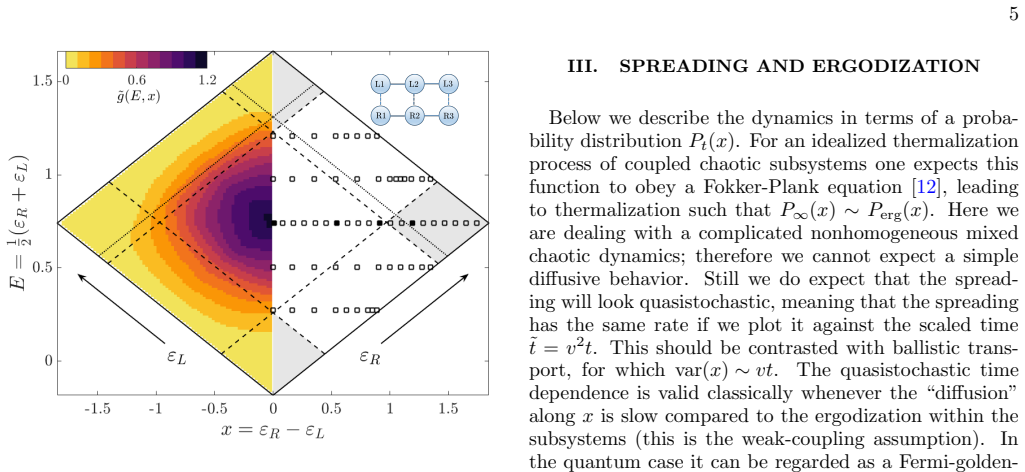
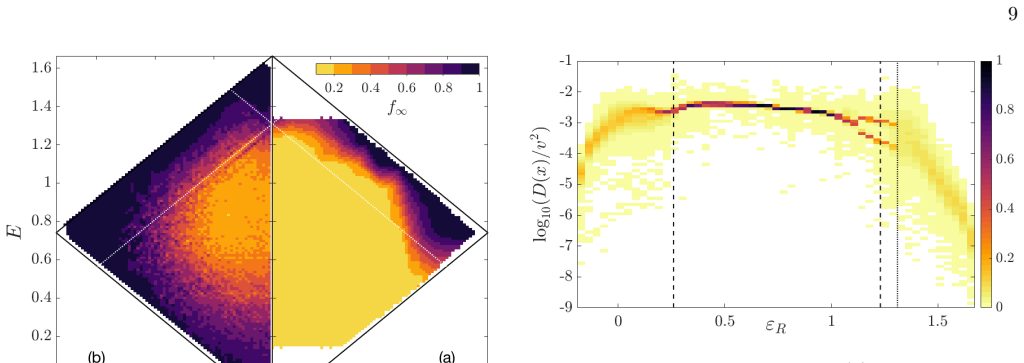
Summary. The paper studies dynamical localization in a closed system of two weakly coupled Bose-Hubbard trimers, each of which is classically chaotic in a substantial part of its spectrum. The authors define ergodicity intrinsically, as the loss of memory of the initial trimer energy imbalance x0 in the long-time saturation profile, and propose this as a notion of quantum localization that does not require comparison with classical dynamics. Using exact diagonalization for N=24 particles per trimer, they find that quantum saturation profiles retain x0 memory in most of the chaotic sea, even when the participation number M of Eq. (18) is large. The central claim, stated in Section VII, is that this constitutes a nontrivial many-body dynamical localization, distinct from perturbative localization (M≈2), from classical self-trapping, and from classical KAM-type localization. The paper also derives a semiclassical diffusion coefficient D(x) in Eq. (17) and validates it against independent semiclassical simulations in Fig. 10.
Significance. If established, the result would provide a correspondence-free, intrinsic diagnostic of quantum dynamical localization in a high-dimensional composite chaotic system, and would support the relevance of such localization for thermalization in larger arrays of weakly coupled chaotic subunits. The paper has clear strengths: the classical diffusion coefficient in Eq. (17) is a parameter-free prediction that is checked against semiclassical simulations in Fig. 10; the quantum saturation profiles are obtained from exact diagonalization via Eq. (14), avoiding uncertainties of finite-time averaging; and the use of an initial-condition-memory measure is a principled way to avoid trivializing quantum-to-classical correspondence failures. However, the headline distinction from perturbative localization rests primarily on the participation number M, which is computed from locally averaged saturation profiles, and all quantum results are obtained at a single system size. Both points need to be addressed before the central claim can be considered established.
major comments (3)
- [Section VI A, Fig. 8(a)] The participation number M in Eq. (18) is evaluated from saturation profiles that are locally averaged over states within E=E0±0.02 and x=x0±0.025, as stated in the captions of Figs. 5 and 8. If each individual initial state is perturbatively localized, its single-state saturation profile is peaked at its own x0 and, by parity, at -x0, giving M close to 2. Averaging over the x0 window mixes such peaks from different initial states into one broader distribution, and the resulting M can be substantially larger than 2 even though no non-perturbative mixing occurred. Since the x0-window width 0.025 is not negligible compared with the claimed quantum-ergodic interval |x0|<0.25, this artifact could affect exactly the region used to conclude non-perturbative behavior. The paper should present M computed separately for each single initial state, without the x0-window averaging, and show that M is large for those individual states before claiming non-perturbative quantum mixing.
- [Section I and Section II, Fig. 5] All quantum simulations are performed with NL=NR=24 particles, and the effective Planck constant is ℏ_eff=1/Nα=2/N. The paper states in Section I that 'the thermodynamic limit is not an issue' for this interaction-induced dynamical localization, but no finite-size scaling is provided. Without varying N (for example, N=18, 24, 30, 36), one cannot exclude the possibility that the observed x0-memory and the small quantum-ergodic region diminish or disappear as ℏ_eff decreases, which would change the interpretation of the result as a robust many-body effect. Given that the title and abstract generalize beyond N=24, a finite-size analysis of M, f∞, and the size of the x0-independent region is necessary.
- [Section VI B and Section VII] The conclusion that the observed localization is nontrivial rests on the statement that M is large while x0-memory persists (Fig. 8 and Section VII). Section VI B explicitly states that the break-time analysis is not repeated for the double-trimer system, so there is no independent semiclassical argument that rules out an averaging artifact in M. The paper should supply a direct diagnostic of non-perturbative mixing that does not depend on the locally averaged profiles—for example, the overlap of the coupled-system eigenstates with the unperturbed product basis for a single initial state, or the spreading of a single-state saturation profile in x—so that the distinction from perturbative localization is established by the data rather than by an unverified expectation.
minor comments (4)
- [Throughout] The phrase 'Fokker-Plank' appears twice and should be 'Fokker-Planck'.
- [Section VI C] There is a typographical error in 'Whenever the the initial state' on page 10; it should read 'Whenever the initial state'.
- [Appendix D] In the definition of the combined subspaces, 'A = As + As' appears to be a typo; based on the four representations Ss, Sa, As, and Aa introduced earlier, it should likely read 'A = As + Aa'.
- [Eq. (15)] The definition of ft in Eq. (15) is missing a closing brace or a display alignment; the formula should be typeset so that ft = sum over positive Δt(x) is unambiguous.
Circularity Check
The M>2 criterion for non-perturbative localization is generated by the x0-window averaging itself, so the central nontrivial claim is partially circular.
-
self definitional
[Sec. VI A (Eq. 18) and Fig. 8(a) caption; Sec. VII Summary]
"For this purpose, we calculate and display in Fig.8(a) the x-basis participation number: M ≡ [Σ_x P(x)^2]^{-1}. ... The participation number for the quantum saturation profile, locally averaged over states within E = E0 ± 0.02 and x = x0 ± 0.025. ... However, we do observe clear signs of quantum localization even when the coupling is not trivially small, so that M is large."
The M used to rule out perturbative localization is not computed from a single-state saturation profile. The caption states that the profile is 'locally averaged over states within E = E0 ± 0.02 and x = x0 ± 0.025' before Eq. (18) is applied. In the perturbative regime each exact initial state saturates to a narrow mirrored double peak at ±x0, so the un-averaged participation number is M ≈ 2. Averaging over an x0-window of width 0.025 merges many such narrow peaks into a broader distribution, so M > 2 follows from the window width alone. The summary then infers 'the coupling is not trivially small' from this M. Thus the quantitative criterion separating nontrivial from perturbative localization has the answer built into the averaging procedure; no single-state M check is provided.
full rationale
The paper is otherwise largely self-contained: the quantum saturation profiles come from exact diagonalization via Eq. (14), the classical diffusion coefficient in Eq. (17) is a parameter-free Fermi-golden-rule expression tested against independent semiclassical propagation, and the central observation of x0-memory is a numerical finding rather than a derivation from an assumed conclusion. The self-citation to the authors' previous paper [13] for break-time phenomenology is supportive rather than load-bearing, because the break-time argument is also attributed to the external Chirikov/Shepelyansky line and the present observation is numerical. The one genuine circular step is the M diagnostic: M > 2 is used to define the non-perturbative regime, but M is evaluated on x0-window-averaged profiles, making large M an artifact of the averaging in the very central region (|x0| < 0.25) where the non-perturbative claim is made. This compromises the headline distinction from trivial perturbative localization, even though the raw memory-of-initial-conditions observation remains a valid numerical finding.
Assumptions & free parameters
free parameters (2)
- chaos border threshold =
0.458
- semiclassical simulation time =
tilde_t = 450
assumptions (3)
- standard math Level spacing statistics (GOE vs Poisson) indicate the extent of classical chaos in the trimer spectrum.
- domain assumption The classical limit of the Bose-Hubbard model is obtained by c-number substitution with effective Planck constant hbar_eff = 1/N_alpha.
- domain assumption Weak inter-trimer coupling justifies a Fokker-Planck / Fermi-golden-rule picture with quasistochastic scaling in v^2 t.
Cite this review
Pith. "Pith review of Many-body dynamical localization and thermalization." pith.science (2026). https://pith.science/paper/N7FTJ434
@misc{pith2026190803868,
  author       = {Pith},
  title        = {Pith review of: Many-body dynamical localization and thermalization},
  year         = {2026},
  howpublished = {\url{https://pith.science/paper/N7FTJ434}},
  note         = {Machine review of arXiv:1908.03868}
}
read the original abstract
We show that a quantum dynamical localization effect can be observed in a generic thermalization process of two weakly-coupled chaotic subsystems. Specifically, our model consists of the minimal experimentally relevant subsystems that exhibit chaos, which are 3-site Bose-Hubbard units. Due to the high dimensionality of the composite 6-site system, the quantum localization effect is weak and can not be resolved merely by the breakdown of quantum-to-classical correspondence. Instead, we adopt an intrinsic definition of localization as the memory of initial conditions, that is not related to the underlying classical dynamics. We discuss the dynamics in the chaotic sea, and in the vicinity of the mobility edge, beyond which ergodization is suppressed.
Figures


Figures from the paper (6 more)




Reference graph
Works this paper leans on
-
[1]
Fishman, D
S. Fishman, D. R. Grempel, and R. E. Prange, Phys. Rev. Lett. 49, 509 (1982)
1982
-
[2]
We can define operators which anni- hilate a particle in one of these orbitals, ˆasym = 1 2(ˆa1 + √ 2ˆa2 + ˆa3) , ˆaanti = 1 2(ˆa1− √ 2ˆa2 + ˆa3) , ˆadark = 1√ 2(ˆa1− ˆa3) , (A3) Using the corresponding occupation operators n =a†a the many-body Hamiltonian can be rewritten as Htrimer = ω0(ˆnanti− ˆnsym) . (A4) The classical values nj/Nα, or the quantum exp...
- [3]
-
[4]
B. V. Chirikov, Phys. Rep. 52, 263 (1979)
1979
- [5]
- [6]
- [7]
-
[8]
D. L. Shepelyansky, Physica D 28, 103 (1987)
work page 1987
Show all 26 references
-
[9]
V. M. Kenkre and D. K. Campbel, Phys. Rev. B 34, 4959(R) (1986)
1986
-
[10]
For a review see, e.g., M. V. Berry, in Topics in Nonlinear Mechanics, ed. S. Jorna, Am. Inst. Phys. Conf. Proc. (AIP, New York 1978), Vol. 46, p.16
1978
-
[11]
E. J. Heller, Phys. Rev. A 35, 1360 (1987)
1987
-
[12]
Tikhonenkov, A
I. Tikhonenkov, A. Vardi, J. Anglin, and D. Cohen, Phys. Rev. Lett. 110, 050401 (2013)
2013
-
[13]
Khripkov, A, Vardi, and D
C. Khripkov, A, Vardi, and D. Cohen, Phys. Rev. E 97, 022127 (2018)
2018
-
[14]
Basko, Ann
D.M. Basko, Ann. Phys. 326, 1577 (2011)
2011
-
[15]
I. L. Aleiner, B. L. Altshuler, and G. V. Shlyapnikov, Nature Physics 6, 900 (2010)
2010
-
[16]
Dutta, M
O. Dutta, M. Gajda, P. Hauke, M. Lewenstein, D. S. L¨ uhman, B. A. Malomed, T. Sowinski, and J. Za- krzewski, Rep. Prog. Phys. 78, 066001 (2015)
2015
-
[17]
D. M. Basko, I. L. Aleiner, and B. L. Altshuler, Annals of Physics 321, 1126 (2006)
2006
-
[18]
Lahaye, C
T. Lahaye, C. Menotti C, L. Santos, M. Lewenstein, and T. Pfau, Rep. Prog. Phys. 72, 126401 (2009)
2009
-
[19]
Trefzger, C
C. Trefzger, C. Menotti, B. Capogrosso-Sansone, and M. Lewenstein, J. Phys. B 44, 193001 (2011)
2011
-
[20]
coherent state
by replacing the field operators ˆ aαj by c-numbers aαj = √ NαIαjeiϕαj, where the normalized occupations Iαj∈ [0, 1] and the phases ϕαj∈ [0, 2π) are canonical action-angle variables. Since the bosonic Hamiltonian is formally equivalent to that of a coupled-oscillators sys- tem,...
-
[21]
Dey and A
A. Dey and A. Vardi, Phys. Rev. A 95, 033630 (2017)
2017
-
[22]
is typically violated, because vast regions of the en- ergy shell are not accessible. Even if the classical dynam- ics is ergodic on very long time scales, the quantum will fail to penetrate peripheral regions due to the dynamical or perturbative localization effect, and theref...
2019
-
[23]
Mossmann and C
S. Mossmann and C. Jung, Phys. Rev. A 74, 033601 (2006)
2006
-
[24]
Haake, Quantum signatures of chaos (Springer-Verlag, Berlin, Heidelberg, 2000), 2nd edition, pp.37–43
F. Haake, Quantum signatures of chaos (Springer-Verlag, Berlin, Heidelberg, 2000), 2nd edition, pp.37–43
2000
-
[25]
Rigol, V
M. Rigol, V. Dunjko, and M. Olshanii, Nature 452, 854 (2008)
2008
-
[26]
Oganesyan and D
V. Oganesyan and D. A. Huse, Phys. Rev. B 75, 155111 (2007)
2007
Reviewed August 14, 2026 · model on record in the stance chip above.
Discussion (0). Continue with ORCID to comment.