REVIEW 1 major objections 3 minor 26 references
Limit cycles in periodically driven open quantum systems
T0 review · 1 major / 3 minor · reviewed 2026-08-14 · deepseek-v4-flash
Pith's one-line read The paper proves that a periodically driven open quantum system has a unique limit cycle whenever the dissipative terms connect all subspaces at every instant of some finite interval within each drive period.
desk verdict Genuinely new and useful theorem, but the proof's WLOG constant-dimension step is unjustified and load-bearing; worth refereeing with revision. read the letter →
The pith
A machine-rendered reading of the paper's core claim, the machinery that carries it, and where it could break.
The reading
What carries the argument
The key object is a norm on the traceless Hermitian subspace, $\|X\|_\infty = \max\{|\langle Y,X\rangle| : \|Y\|_1 = 1, Y \in S'\}$, together with Lemma 3, which bounds the $\infty$-norm of an adjoint superoperator by the trace-norm of the original superoperator. This norm converts Spohn's trace-norm contraction for each dissipative time slice into a strict contraction of the traceless part of observables under the adjoint one-period propagator. The propagator is decomposed into time slices via an ordered exponential, each slice has a block triangular matrix form in a basis containing the identity, and the Lie product formula combines the slice bounds into the global contraction $e^{-\Lambda \tau}$.
What would settle it
Compute the one-period (Floquet) map of a candidate periodic Lindblad generator on the traceless subspace, restricting to the component orthogonal to the identity; if any eigenvalue has modulus greater than or equal to one, the theorem's contraction claim is contradicted.
Extended reading notes
Core claim
The central claim is a theorem: if a periodic Lindblad generator is continuous on an interval of positive length within each period, and if at every instant of that interval the span of the Lindblad operators is self-adjoint and irreducible, then all initial states converge to the same periodic limit cycle with the same period as the drive. The proof works in the Heisenberg picture, showing that every observable becomes a multiple of the identity at long times. Over the strongly dissipative interval, the traceless part of any observable contracts by a factor at most $e^{-\Lambda \tau}$, where $\tau$ is the interval length and $\Lambda$ is a uniformly positive rate obtained from the diagonal part of the dissipator; over the rest of the cycle, the contraction can only weaken, never reverse. The theorem is not constructive: it proves existence and uniqueness of the limit cycle but does not give a general way to find it.
Load-bearing premise
The proof assumes that during the interval where the dissipation is strong its algebraic structure keeps a constant dimension and a strictly positive relaxation rate, and that the rest of the cycle never pushes states away from the eventual cycle; if either fails, the contraction factor has not been established.
Editorial extensions
If this is right
- Any periodic Lindblad master equation whose dissipation is self-adjoint and irreducible during a finite interval of each period has a unique limit cycle, and every initial state approaches it.
- The approach to the limit cycle is exponentially fast in the number of periods, with the average rate bounded below by $\Lambda \tau / T$.
- The same contraction argument yields a relaxation criterion for non-periodic driving: if $\int_0^\infty \lambda_t\, dt = \infty$, the long-time state is independent of the initial condition.
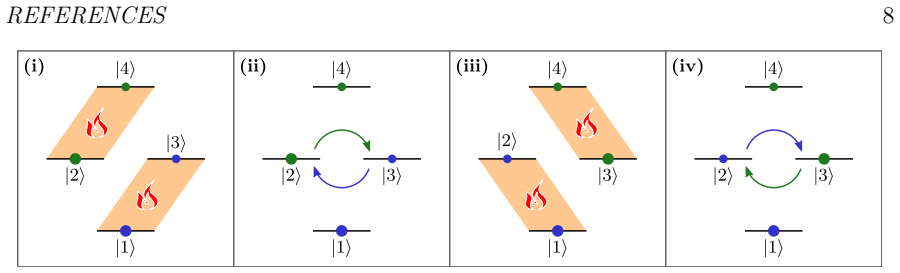
- Merely requiring the union of the Lindblad spans over a full period to be irreducible is not enough; a four-level counterexample exhibits multiple asymptotic cycles under such a weaker condition.
- The limit cycle cannot generally be constructed explicitly, so its properties must be studied by other means for specific systems.
Reading between the lines
- The paper leaves implicit that its criterion makes steady-state thermodynamics of driven devices well-defined: with a unique limit cycle, cycle-averaged heat, work, and efficiency become properties of the drive rather than of the initial preparation.
- Because only one interval per period is needed, the argument should apply to stroboscopic or pulsed driving schemes where dissipation acts briefly and unitary evolution dominates the rest of the cycle.
- The explicit contraction rate $\Lambda \tau/T$ suggests a quantitative experimental probe: transients of a driven dissipative qubit or oscillator should decay no slower than $e^{-\Lambda \tau/T}$ per period, allowing a direct measurement of $\Lambda$ from the transient.
- The gap continuity assumption hints that near a transition where the Lindblad span changes dimension, the convergence time may diverge; testing such a driven system near that transition could reveal the boundaries of the theorem.
Signed reviews
Editorial analysis
A structured set of objections, weighed in public.
Referee Report
Summary. This manuscript studies the long-time behavior of solutions of periodically driven Gorini-Kossakowski-Sudarshan-Lindblad master equations. The main result, Theorem 2, asserts that if the span A_t of the Lindblad operators is self-adjoint and irreducible for every t in an interval [0,τ] of positive length on which the generator is continuous, then every initial condition converges to a unique T-periodic limit cycle. The proof works in the Heisenberg picture, splits the propagator over [0,τ] into short time slices, and uses Spohn's algebraic argument to show that each slice contracts the traceless part of an observable by a factor exp(-λ_t Δt); a uniform contraction e^{-Λτ} per period then gives convergence. The paper also sketches a corollary for nonperiodic driving and gives a four-level counterexample showing that irreducibility of the union of the A_t over one period is insufficient.
Significance. If Theorem 2 is established, it provides a clean and useful extension of Spohn's condition to Floquet open quantum systems: only a short, arbitrarily small fraction of the driving period needs to mix all subspaces, and the proof yields a bound Λτ/T on the convergence rate. The derivation is essentially self-contained, sketches Spohn's theorem rather than quoting it opaquely, and contains no fitted parameters. The four-level counterexample and the discussion of possible weakenings are valuable. However, the main theorem currently rests on an unjustified regularity step, so the correctness of the central claim is not yet established.
major comments (1)
- [Section 4, after Eq. (20)] Equation (21): the step "we can assume without loss of generality that dim A_t is constant" immediately before Eq. (21) is not justified and is load-bearing for Theorem 2. Continuity of L_t and pointwise self-adjointness and irreducibility of A_t do not imply that dim A_t is constant on any subinterval. For instance, on a qutrit take A_t = span{S_x, S_y, S_z, φ(t)Q}, where Q is Hermitian and not in the span of the spin operators and φ is a continuous function that vanishes on a fat Cantor set and is positive on its complement; this family is continuous, self-adjoint and irreducible for every t, yet dim A_t is 3 on the zero set and 4 elsewhere. The subsequent continuity of the basis F_α(t), of the diagonal generator L_{d,t}, and of λ_t, and hence the positivity of Λ in (21), is therefore not established by the stated assumptions. The theorem should either include an explicit hypothesis that the relevant dimension and spectral gap are uniform on [0,τ], or the proof should be replaced by a compactness or spectral-continuity argument that avoids the WLOG step. This issue also affects the rate bound Λτ/T advertised in Section 5.
minor comments (3)
- [Section 3, Eq. (12)] The subscripts in the Lie product formula in Eq. (12) appear garbled; the two factors should presumably be the diagonal and remainder generators L'_d and L'_r.
- [Section 4, Eq. (22)] The composition order in the definition of X_T after Eq. (22) appears reversed: with the notation used for adjoint propagators, X_T should be V†_{T,τ} V†_{τ,0} X_0. The norm bound itself is unaffected, but the expression should be corrected.
- [Section 4, around Eq. (22)] The contractivity of the propagator over [τ,T] on the traceless subspace is asserted without proof. A short justification is available: any traceless Hermitian operator is a scalar multiple of the difference of two density operators, and completely positive trace-preserving maps contract the trace distance.
Circularity Check
No circularity: Theorem 2 is an autonomous proof extending Spohn's external theorem, with no fitted inputs or load-bearing self-citations.
full rationale
The paper's central claim, Theorem 2, is derived by a self-contained contraction argument that builds on Spohn's algebraic condition, which is cited as an external mathematical result (Ref. [20]) and restated as Theorem 1. No model parameter is fitted to data, and no quantity called a prediction is obtained from a fit. The proof of the periodic case uses the time-independent spectral gap bound (12), the new Lemma 3, and the contractivity of Lindblad propagators; these are proven or standard, not assumed from the desired conclusion. The only self-citation, Ref. [21] by co-author Brandner and Seifert, appears as physical motivation and as examples of explicitly solvable limit cycles, not as a premise of the contraction argument or as an authority invoked to forbid alternatives. The passage 'we can assume without loss of generality that dim A_t is constant' on [0,τ] is a potential regularity gap in the proof, but it is a correctness or rigor concern, not circularity: the theorem's conclusion is not being fed back into its assumptions by definition or by fitting. Similarly, the unproved contractivity statement for the rest of the period is not circular because it is a known property of completely positive trace-preserving maps. Accordingly, no step in the derivation chain reduces to its own inputs, and the appropriate circularity score is 0.
Assumptions & free parameters
assumptions (6)
- domain assumption The GKSL master equation (1) is a valid description of the driven open system.
- domain assumption Finite-dimensional Hilbert space (N-level system).
- domain assumption Coupling rates γ^µ_t are positive.
- ad hoc to paper L_t is continuous on [0,τ] and dim A_t can be taken constant, allowing a continuous choice of F_α(t).
- standard math Trace-norm contractivity of CPTP maps on the traceless subspace.
- standard math Trotter-Lie product formula for bounded generators.
Cite this review
Pith. "Pith review of Limit cycles in periodically driven open quantum systems." pith.science (2026). https://pith.science/paper/V3Z223EG
@misc{pith2026190803900,
  author       = {Pith},
  title        = {Pith review of: Limit cycles in periodically driven open quantum systems},
  year         = {2026},
  howpublished = {\url{https://pith.science/paper/V3Z223EG}},
  note         = {Machine review of arXiv:1908.03900}
}
read the original abstract
We investigate the long-time behavior of quantum N-level systems that are coupled to a Markovian environment and subject to periodic driving. As our main result, we obtain a general algebraic condition ensuring that all solutions of a periodic quantum master equation with Lindblad form approach a unique limit cycle. Quite intuitively, this criterion requires that the dissipative terms of the master equation connect all subspaces of the system Hilbert space during an arbitrarily small fraction of the cycle time. Our results provide a natural extension of Spohn's algebraic condition for the approach to equilibrium to systems with external driving.
Figures
Reference graph
Works this paper leans on
-
[1]
Breuer and F
H.-P. Breuer and F. Petruccione, The Theory of Open Quantum Systems (Oxford University Press, 2002)
2002
- [2]
-
[3]
Lindblad, On the generators of quantum dynamical semigroups, Commun
G. Lindblad, On the generators of quantum dynamical semigroups, Commun. Math. Phys. 48, 119 (1976)
1976
-
[4]
D. Chru´ sci´ nski and A. Kossakowski,Markovianity criteria for quantum evolution, J. Phys. B 45, 154002 (2012)
work page 2012
-
[5]
´A. Rivas and S. F. Huelga, Open Quantum Systems. An Introduction , SpringerBriefs in Physics (Springer, 2012)
work page 2012
-
[6]
M. O. Scully and M. S. Zubairy, Quantum Optics (Cambridge University Press, 1997)
1997
-
[7]
M. A. Nielsen and I. L. Chuang, Quantum Computation and Quantum Information (Cambridge University Press, 2000)
2000
- [8]
Show all 26 references
-
[9]
Kosloff, Quantum Thermodynamics: A Dynamical Viewpoint , Entropy 15, 2100 (2013)
R. Kosloff, Quantum Thermodynamics: A Dynamical Viewpoint , Entropy 15, 2100 (2013). REFERENCES 9
2013
-
[10]
Vinjanampathy and J
S. Vinjanampathy and J. Anders, Quantum thermodynamics , Contemp. Phys. 57, 545 (2016)
2016
-
[11]
Benenti, G
G. Benenti, G. Casati, K. Saito, and R. S. Whitney, Fundamental aspects of steady-state conversion of heat to work at the nanoscale , Phys. Rep. 694, 1 (2017)
2017
-
[12]
J. P. Pekola, Towards quantum thermodynamics in electronic circuits, Nat. Phys. 11, 118 (2015)
2015
-
[13]
Gorini, A
V. Gorini, A. Frigerio, M. Verri, A. Kossakowski, and E. C. G. Sudarshan, Properties of quantum Markovian master equations , Rep. Math. Phys. 13, 149 (1978)
1978
-
[14]
Spohn, Entropy production for quantum dynamical semigroups , J
H. Spohn, Entropy production for quantum dynamical semigroups , J. Math. Phys. 19, 1227 (1978)
1978
-
[15]
Alicki and M
R. Alicki and M. Fannes, Dilations of quantum dynamical semigroups with classical Brownian motion, Commun.Math. Phys. 108, 353 (1987)
1987
-
[16]
Alicki and K
R. Alicki and K. Lendi, Quantum Dynamical Semigroups and Applications, Lecture Notes in Physics, Vol. 717 (Springer, Berlin, Heidelberg, 2007)
2007
-
[17]
S. G. Schirmer and X. Wang, Stabilizing open quantum systems by Markovian reservoir engineering, Phys. Rev. A 81, 062306 (2010)
2010
-
[18]
V. V. Albert, B. Bradlyn, M. Fraas, and L. Jiang,Geometry and Response of Lindbladians, Phys. Rev. X 6, 041031 (2016)
2016
-
[19]
Breuer, E.-M
H.-P. Breuer, E.-M. Laine, J. Piilo, and B. Vacchini, Non-Markovian dynamics in open quantum systems, Rev. Mod. Phys. 88, 021002 (2016)
2016
-
[20]
Spohn, An algebraic condition for the approach to equilibrium of an open N-level system, Lett
H. Spohn, An algebraic condition for the approach to equilibrium of an open N-level system, Lett. Math. Phys 2, 33 (1977)
1977
-
[21]
Brandner and U
K. Brandner and U. Seifert, Periodic thermodynamics of open quantum systems , Phys. Rev. E 93, 062134 (2016)
2016
-
[22]
F. M. Gambetta, F. Carollo, A. Lazarides, I. Lesanovsky, and J. P. Garrahan, Classical Stochastic Discrete Time Crystals , arXiv:1905.08826 [cond-mat.stat-mech] (2019)
2019 arXiv
-
[23]
Reed and B
M. Reed and B. Simon, Functional Analysis, Methods of Modern Mathematical Physics No. 1 (Academic Press, 1981)
1981
-
[24]
Feldmann and R
T. Feldmann and R. Kosloff, Characteristics of the limit cycle of a reciprocating quantum heat engine, Phys. Rev. E 70, 046110 (2004)
2004
-
[25]
Kosloff and Y
R. Kosloff and Y. Rezek, The Quantum Harmonic Otto Cycle , Entropy 19, 136 (2017)
2017
-
[26]
Scopa, G
S. Scopa, G. T. Landi, and D. Karevski, Lindblad-Floquet description of finite-time quantum heat engines , Phys. Rev. A 97, 062121 (2018)
2018
Reviewed August 14, 2026 · model on record in the stance chip above.
Discussion (0). Continue with ORCID to comment.