REVIEW 4 major objections 4 minor 38 references
GAN-Tree: An Incrementally Learned Hierarchical Generative Framework for Multi-Modal Data Distributions
T0 review · 4 major / 4 minor · reviewed 2026-08-14 · deepseek-v4-flash
Pith's one-line read A tree of GANs repeatedly splits one mode into two semantically cohesive child modes.
desk verdict Real hierarchical GAN contribution with an under-tested mode-split; deserves peer review with requests for missing hyperparameters and a root-split purity analysis. read the letter →
The pith
A machine-rendered reading of the paper's core claim, the machinery that carries it, and where it could break.
The reading
What carries the argument
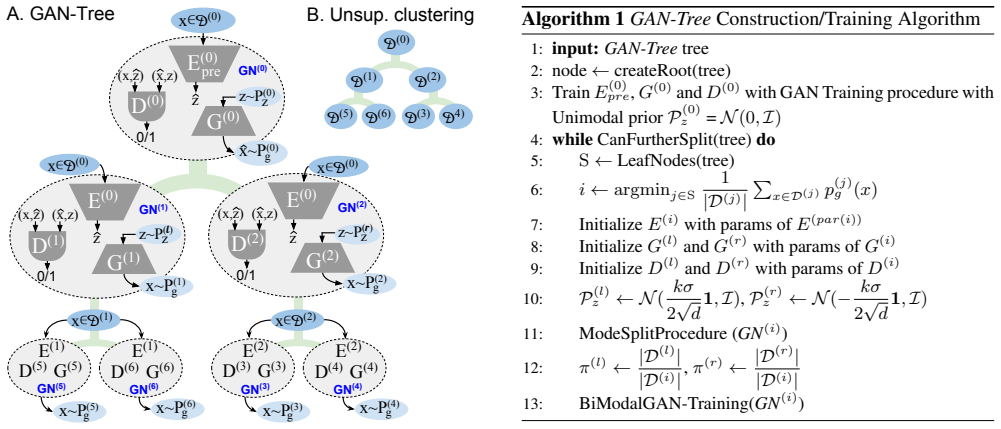
The central mechanism is the mode-split procedure combined with a binary tree of GNode building blocks. A GNode is one GAN equipped with an encoder, generator, and discriminator, and the encoder is shared by the two child nodes. Mode-split fixes the child priors as two Gaussian distributions whose means are separated by a chosen $k\sigma$ distance along one axis, then iteratively moves parent samples from an unassigned bag to an assigned bag according to which Gaussian is more likely for their encoded codes, while a reconstruction loss keeps each sample's semantics intact. This turns the question 'how many modes?' into a sequence of binary separability questions in the learned latent space.
What would settle it
Take a Gaussian mixture with three well-separated modes arranged so every Gaussian-likelihood threshold in the latent space must either merge two modes or split one mode across both children, for example three modes at the vertices of an equilateral triangle. Train the root GAN and run the mode-split algorithm; if no binary split produces two children each containing exactly whole modes, the assumed latent separability fails. A second check: on a dataset with three or five true classes, a GAN-Tree's leaf labels should never place images of one class in two different leaf clusters; any such fragmentation is direct evidence against the split.
Extended reading notes
Core claim
The paper's central claim is that a data distribution with many disconnected modes is better modeled not by one generator with many modes or many independent generators, but by a full binary tree of GANs, each trained on the samples routed to it by its parent. Starting from a root GAN trained on all data with a unimodal prior, the mode-split algorithm inspects the latent codes produced by the shared parent encoder and assigns each sample to one of two fixed, well-separated Gaussian priors, jointly training child encoders, generators, and discriminators so that the two children cover the parent's samples with no overlap and no gap. Repeating the split only on nodes that model the data least well yields a hierarchy that, the authors report, matches or improves on prior multi-modal GANs across synthetic mixtures, MNIST and compositional-MNIST, Face-Bed, CIFAR-10, and ImageNet, with the reported numbers including a CIFAR-10 FID of 21.9 and an ImageNet FID of 27.1 using five generator nodes. The same traversal also produces unsupervised cluster labels and hierarchical categorization as a byproduct.
Load-bearing premise
The mode-split procedure assumes that at every parent node the true modes are separable in the learned latent space by the likelihood threshold between two fixed Gaussian priors, so that each binary split gathers one semantically cohesive cluster per child; if a real mode straddles that threshold, the split fragments or merges categories and the tree structure is wrong.
Editorial extensions
If this is right
- Users can trade quality against diversity by selecting a GAN-Set: the root node alone favors diverse but lower-fidelity samples, while terminal leaf nodes favor high-fidelity but more specialized samples.
- The framework removes the need to fix the number of modes before training; the tree grows by splitting the leaf whose assigned samples have the lowest mean likelihood under its generative model.
- New data categories can be added incrementally without retraining the entire model: only the branch on the path from the insertion point to the root is updated, using generated samples from the existing terminal GAN-Set as training data.
- Unsupervised cluster labels and hierarchical categorization of test samples come for free by routing each sample down the tree through the maximum-likelihood child at every node.
- The reported quantitative results indicate that a GAN-Set with fewer generators can beat prior multi-generator models with more generators on CIFAR-10 and ImageNet FID and inception score.
Reading between the lines
- Editorial inference: the binary split is effectively a linear separability test in the learned latent space, so the tree's granularity depends on the geometry the parent encoder learns, not on a predefined notion of 'true' mode; two datasets with the same class count could produce trees of different depths.
- Editorial inference: the same mode-split objective — likelihood under fixed priors plus reconstruction — could be lifted out of GANs and used as a divisive clustering routine for any encoder-decoder, which would make the hierarchy testable as a clustering method independent of generation quality.
- Editorial inference: because the stopping criterion is based on likelihood improvement, applying GAN-Tree to a smoothly varying continuous distribution may keep splitting until leaves approximate small patches of the manifold; the paper's 'modes' are therefore best read as pragmatic clusters, not intrinsic categories.
- Editorial inference: a direct test would be to run the mode-split on mixtures whose true modes violate Gaussian-likelihood separability, such as an XOR arrangement of four clusters; if the tree fragments or merges them, the failure would pinpoint the assumption, not the training procedure.
Signed reviews
Editorial analysis
A structured set of objections, weighed in public.
Referee Report
Summary. The paper proposes GAN-Tree, a hierarchical generative framework in which each node is a GAN with an encoder, organized as a full binary tree. The root GAN is trained on the full dataset; a mode-split procedure then partitions the parent's samples into two children using likelihoods of encoder embeddings under two fixed Gaussian priors; the children are trained with a bi-modal adversarial objective. A GAN-Set is any collection of nodes whose generated distributions are mutually exclusive and exhaustive, and iGAN-Tree extends a trained tree to new data by inserting a leaf and updating the affected branch. Experiments cover synthetic 2D data, MNIST/Fashion-MNIST, compositional-MNIST, Face-Bed, CIFAR-10, and ImageNet, with metrics including JS divergence, FID, and Inception score.
Significance. The GAN-Tree idea addresses a real limitation of GANs on discontinuous, multi-modal data, and the incremental branch-update scheme is elegant. The unsupervised divisive approach, with no need to preset the number of modes, is a potentially valuable contribution. The algorithms are specified at pseudocode level and the authors promise to release code. However, the central claim of semantically cohesive hierarchy is supported mainly by qualitative examples and a single MNIST ablation; the key separability assumption underlying the mode-split procedure is not quantitatively validated. If the mode-split and incremental procedures are clarified and the comparisons are made controlled, this could be a useful contribution.
major comments (4)
- [§3.2, Algorithm 2]
- [§3.2, §3.5, Algorithms 2 and 4]
- [§4, Table 3]
- [§3.5, Algorithms 3 and 4]
minor comments (4)
- [Algorithm 2, line 10]
- [Algorithm 4, lines 5-6]
- [Table 2]
- [Figure 4B]
Circularity Check
No significant circularity: the mode-split algorithm is an unsupervised clustering/training loop, and the paper's headline numbers are measured against external benchmarks and independent baselines.
full rationale
The paper's central claim is that a hierarchical divisive procedure, GAN-Tree, can split a parent mode into semantically cohesive children without labels and supports incremental additions. I looked for a reduction of a 'prediction' to its own inputs. The mode-split procedure (Algorithm 2) assigns samples to children by likelihood under two fixed Gaussian priors in the parent encoder's latent space, then trains the child generators and the shared encoder to fit those assignments. This is a self-consistent clustering loop (like k-means: assign, then update), but not a circular derivation: the assignment is not a fitted parameter renamed as a prediction, and the semantic-cohesion claim is verified externally (e.g., 96% MNIST test-set accuracy in the supplementary, and the qualitative Face/CIFAR/ImageNet splits). The acknowledged sentence 'Performance of GAN-Tree highly depends on the initial binary split performed at the root node' is an honest limitation about robustness/initialization, not an indication that the result is equivalent to its inputs by construction. Citations are to the prior multi-modal GAN literature (MAD-GAN, DMWGAN, AdaGAN, ALI, etc.); the only author-overlap citation (DeliGAN [15]) is used descriptively in related work and is not load-bearing for any derivation. No uniqueness theorem or ansatz is imported from the authors' prior work. The external FID/IS comparisons in Table 3 are measured on CIFAR-10 and ImageNet against independent baselines, so the headline empirical claims are self-contained. Concerns about linear separability of the learned latent space or unspecified hyperparameters (k, gamma_0, n_0) are correctness/robustness risks, not circularity.
Assumptions & free parameters
free parameters (5)
- k (child prior separation)
- gamma_0 (hard assignment threshold)
- d_sigma_0 (incremental insertion threshold) =
4 and 9 in Fig 4D
- GAN-Set size / tree depth =
3 or 5 nodes in Table 3
- n0 (mode-split minibatch iterations)
assumptions (4)
- domain assumption The target distribution is a mixture of disjoint modes that can be recursively bisected by linear separators in the latent space of an ALI-trained encoder.
- domain assumption A single continuous generator cannot adequately approximate a discontinuous multimodal distribution, so a mixture of generators over a hierarchical partition is necessary.
- domain assumption The IRC-based stopping criterion from speaker diarization transfers to latent embedding spaces for deciding the number of modes.
- domain assumption The ALI framework provides a consistent inference encoder E and generator G after adversarial training for each node.
Cite this review
Pith. "Pith review of GAN-Tree: An Incrementally Learned Hierarchical Generative Framework for Multi-Modal Data Distributions." pith.science (2026). https://pith.science/paper/XZY3J3FQ
@misc{pith2026190803919,
  author       = {Pith},
  title        = {Pith review of: GAN-Tree: An Incrementally Learned Hierarchical Generative Framework for Multi-Modal Data Distributions},
  year         = {2026},
  howpublished = {\url{https://pith.science/paper/XZY3J3FQ}},
  note         = {Machine review of arXiv:1908.03919}
}
read the original abstract
Despite the remarkable success of generative adversarial networks, their performance seems less impressive for diverse training sets, requiring learning of discontinuous mapping functions. Though multi-mode prior or multi-generator models have been proposed to alleviate this problem, such approaches may fail depending on the empirically chosen initial mode components. In contrast to such bottom-up approaches, we present GAN-Tree, which follows a hierarchical divisive strategy to address such discontinuous multi-modal data. Devoid of any assumption on the number of modes, GAN-Tree utilizes a novel mode-splitting algorithm to effectively split the parent mode to semantically cohesive children modes, facilitating unsupervised clustering. Further, it also enables incremental addition of new data modes to an already trained GAN-Tree, by updating only a single branch of the tree structure. As compared to prior approaches, the proposed framework offers a higher degree of flexibility in choosing a large variety of mutually exclusive and exhaustive tree nodes called GAN-Set. Extensive experiments on synthetic and natural image datasets including ImageNet demonstrate the superiority of GAN-Tree against the prior state-of-the-arts.
Figures


Figures from the paper (5 more)


Reference graph
Works this paper leans on
-
[1]
Towards principled meth- ods for training generative adversarial networks
Martin Arjovsky and L ´eon Bottou. Towards principled meth- ods for training generative adversarial networks. In Interna- tional Conference on Learning Representations, 2017
work page 2017
-
[2]
Wasserstein generative adversarial networks
Martin Arjovsky, Soumith Chintala, and L ´eon Bottou. Wasserstein generative adversarial networks. In Interna- tional Conference on Machine Learning, 2017
work page 2017
-
[3]
High quality bidirec- tional generative adversarial networks
Duhyeon Bang and Hyunjung Shim. High quality bidirec- tional generative adversarial networks. InInternational Con- ference on Machine Learning, 2018
work page 2018
-
[4]
Shane Barratt and Rishi Sharma. A note on the inception score. arXiv preprint arXiv:1801.01973, 2018
arXiv 2018
-
[5]
Began: boundary equilibrium generative adversarial networks.arXiv preprint arXiv:1703.10717, 2017
David Berthelot, Thomas Schumm, and Luke Metz. Began: boundary equilibrium generative adversarial networks.arXiv preprint arXiv:1703.10717, 2017
arXiv 2017
-
[6]
Large scale gan training for high fidelity natural image synthesis
Andrew Brock, Jeff Donahue, and Karen Simonyan. Large scale gan training for high fidelity natural image synthesis. In International Conference on Learning Representations , 2019
work page 2019
-
[7]
Mode regularized generative adversarial net- works
Tong Che, Yanran Li, Athul Paul Jacob, Yoshua Bengio, and Wenjie Li. Mode regularized generative adversarial net- works. In International Conference on Learning Represen- tations, 2017
work page 2017
-
[8]
Xi Chen, Yan Duan, Rein Houthooft, John Schulman, Ilya Sutskever, and Pieter Abbeel. Infogan: Interpretable repre- sentation learning by information maximizing generative ad- versarial nets. In Advances in neural information processing systems, 2016
work page 2016
Show all 38 references
-
[9]
Deep unsupervised clustering with gaussian mixture variational autoencoders
Nat Dilokthanakul, Pedro AM Mediano, Marta Garnelo, Matthew CH Lee, Hugh Salimbeni, Kai Arulkumaran, and Murray Shanahan. Deep unsupervised clustering with gaussian mixture variational autoencoders. arXiv preprint arXiv:1611.02648, 2016
2016 arXiv
-
[10]
Ad- versarial feature learning
Jeff Donahue, Philipp Kr ¨ahenb¨uhl, and Trevor Darrell. Ad- versarial feature learning. In International Conference on Learning Representations, 2017
2017
-
[11]
Making data structures persistent
James R Driscoll, Neil Sarnak, Daniel D Sleator, and Robert E Tarjan. Making data structures persistent. Jour- nal of computer and system sciences, 38(1):86–124, 1989
1989
-
[12]
Adversarially learned inference
Vincent Dumoulin, Ishmael Belghazi, Ben Poole, Olivier Mastropietro, Alex Lamb, Martin Arjovsky, and Aaron Courville. Adversarially learned inference. In International Conference on Learning Representations, 2017
2017
-
[13]
Multi-agent diverse generative adversarial networks
Arnab Ghosh, Viveka Kulharia, Vinay Namboodiri, Philip HS Torr, and Puneet K Dokania. Multi-agent diverse generative adversarial networks. In The IEEE Conference on Computer Vision and Pattern Recognition (CVPR), 2018
2018
-
[14]
Generative adversarial nets
Ian Goodfellow, Jean Pouget-Abadie, Mehdi Mirza, Bing Xu, David Warde-Farley, Sherjil Ozair, Aaron Courville, and Yoshua Bengio. Generative adversarial nets. In Advances in Neural Information Processing Systems, 2014
2014
-
[15]
Deligan: Generative adversarial net- works for diverse and limited data
Swaminathan Gurumurthy, Ravi Kiran Sarvadevabhatla, and R Venkatesh Babu. Deligan: Generative adversarial net- works for diverse and limited data. In The IEEE Conference on Computer Vision and Pattern Recognition (CVPR), 2017
2017
-
[16]
A robust stop- ping criterion for agglomerative hierarchical clustering in a speaker diarization system
Kyu J Han and Shrikanth S Narayanan. A robust stop- ping criterion for agglomerative hierarchical clustering in a speaker diarization system. In Eighth Annual Conference of the International Speech Communication Association, 2007
2007
-
[17]
Gans trained by a two time-scale update rule converge to a local nash equilib- rium
Martin Heusel, Hubert Ramsauer, Thomas Unterthiner, Bernhard Nessler, and Sepp Hochreiter. Gans trained by a two time-scale update rule converge to a local nash equilib- rium. In Advances in Neural Information Processing Sys- tems, pages 6626–6637, 2017
2017
-
[18]
Mgan: Training generative adversarial nets with multiple generators
Quan Hoang, Tu Dinh Nguyen, Trung Le, and Dinh Phung. Mgan: Training generative adversarial nets with multiple generators. In International Conference on Learning Rep- resentations, 2018
2018
-
[19]
Multilayer feedforward networks are universal approxima- tors
Kurt Hornik, Maxwell Stinchcombe, and Halbert White. Multilayer feedforward networks are universal approxima- tors. Neural networks, 2(5):359–366, 1989
1989
-
[20]
Batch normalization: Accelerating deep network training by reducing internal co- variate shift
Sergey Ioffe and Christian Szegedy. Batch normalization: Accelerating deep network training by reducing internal co- variate shift. arXiv preprint arXiv:1502.03167, 2015
2015 arXiv
-
[21]
Disconnected manifold learning for generative adver- sarial networks
Mahyar Khayatkhoei, Maneesh Singh, and Ahmed Elgam- mal. Disconnected manifold learning for generative adver- sarial networks. arXiv preprint arXiv:1806.00880, 2018
2018 arXiv
-
[22]
Adam: A method for stochastic optimization
Diederik Kingma and Jimmy Ba. Adam: A method for stochastic optimization. arXiv preprint arXiv:1412.6980 , 2014
2014 arXiv
-
[23]
Auto-encoding varia- tional bayes
Diederik P Kingma and Max Welling. Auto-encoding varia- tional bayes. arXiv preprint arXiv:1312.6114, 2013
2013 arXiv
-
[24]
Autoencoding beyond pixels using a learned similarity metric
Anders Boesen Lindbo Larsen, Søren Kaae Sønderby, Hugo Larochelle, and Ole Winther. Autoencoding beyond pixels using a learned similarity metric. In International Confer- ence on Machine Learning, 2016
2016
-
[25]
Adversarial autoencoders
Alireza Makhzani, Jonathon Shlens, Navdeep Jaitly, and Ian Goodfellow. Adversarial autoencoders. In International Conference on Learning Representations, 2016
2016
-
[26]
Unrolled generative adversarial networks
Luke Metz, Ben Poole, David Pfau, and Jascha Sohl- Dickstein. Unrolled generative adversarial networks. arXiv preprint arXiv:1611.02163, 2016
2016 arXiv
-
[27]
Spectral normalization for generative ad- versarial networks
Takeru Miyato, Toshiki Kataoka, Masanori Koyama, and Yuichi Yoshida. Spectral normalization for generative ad- versarial networks. arXiv preprint arXiv:1802.05957, 2018
2018 arXiv
-
[28]
Clustergan: Latent space clustering in generative adversarial networks
Sudipto Mukherjee, Himanshu Asnani, Eugene Lin, and Sreeram Kannan. Clustergan: Latent space clustering in generative adversarial networks. In Proceedings of the AAAI Conference on Artificial Intelligence, volume 33, pages 4610–4617, 2019
2019
-
[29]
Plug & play generative networks: Conditional iterative generation of images in latent space
Anh Nguyen, Jeff Clune, Yoshua Bengio, Alexey Dosovit- skiy, and Jason Yosinski. Plug & play generative networks: Conditional iterative generation of images in latent space. In The IEEE Conference on Computer Vision and Pattern Recognition (CVPR), 2017
2017
-
[30]
Un- supervised representation learning with deep convolu- tional generative adversarial networks
Alec Radford, Luke Metz, and Soumith Chintala. Un- supervised representation learning with deep convolu- tional generative adversarial networks. arXiv preprint arXiv:1511.06434, 2015
2015 arXiv
-
[31]
Imagenet large scale visual recognition challenge
Olga Russakovsky, Jia Deng, Hao Su, Jonathan Krause, San- jeev Satheesh, Sean Ma, Zhiheng Huang, Andrej Karpathy, Aditya Khosla, Michael Bernstein, et al. Imagenet large scale visual recognition challenge. International journal of computer vision, 115(3):211–252, 2015
2015
-
[32]
Improved techniques for training gans
Tim Salimans, Ian Goodfellow, Wojciech Zaremba, Vicki Cheung, Alec Radford, and Xi Chen. Improved techniques for training gans. In Advances in Neural Information Pro- cessing Systems, 2016
2016
-
[33]
Veegan: Reducing mode collapse in gans using implicit variational learning
Akash Srivastava, Lazar Valkoz, Chris Russell, Michael U Gutmann, and Charles Sutton. Veegan: Reducing mode collapse in gans using implicit variational learning. In Ad- vances in Neural Information Processing Systems , pages 3308–3318, 2017
2017
-
[34]
Deepclus- ter: A general clustering framework based on deep learn- ing
Kai Tian, Shuigeng Zhou, and Jihong Guan. Deepclus- ter: A general clustering framework based on deep learn- ing. In Joint European Conference on Machine Learning and Knowledge Discovery in Databases , pages 809–825. Springer, 2017
2017
-
[35]
Adagan: Boosting generative models
Ilya O Tolstikhin, Sylvain Gelly, Olivier Bousquet, Carl- Johann Simon-Gabriel, and Bernhard Sch ¨olkopf. Adagan: Boosting generative models. In Advances in Neural Infor- mation Processing Systems, 2017
2017
-
[36]
Self-attention generative adversarial networks
Han Zhang, Ian Goodfellow, Dimitris Metaxas, and Augus- tus Odena. Self-attention generative adversarial networks. arXiv preprint arXiv:1805.08318, 2018
2018 arXiv
-
[37]
Energy- based generative adversarial network
Junbo Zhao, Michael Mathieu, and Yann LeCun. Energy- based generative adversarial network. In International Con- ference on Learning Representations, 2017
2017
-
[38]
Generative visual manipulation on the nat- ural image manifold
Jun-Yan Zhu, Philipp Kr ¨ahenb¨uhl, Eli Shechtman, and Alexei A Efros. Generative visual manipulation on the nat- ural image manifold. In European Conference on Computer Vision, pages 597–613. Springer, 2016
2016
Reviewed August 14, 2026 · model on record in the stance chip above.
Discussion (0). Continue with ORCID to comment.