REVIEW 3 major objections 8 minor 31 references
TAPER: Time-Aware Patient EHR Representation
T0 review · 3 major / 8 minor · reviewed 2026-08-14 · deepseek-v4-flash
Pith's one-line read A time-aware multimodal patient vector improves ICU prediction tasks.
desk verdict Useful multimodal EHR recipe with public code, but the 1-2% margins over baselines and over the supervised control are within one standard deviation; the central superiority and pretraining claims do not survive the paper's own numbers. read the letter →
The pith
A machine-rendered reading of the paper's core claim, the machinery that carries it, and where it could break.
The reading
What carries the argument
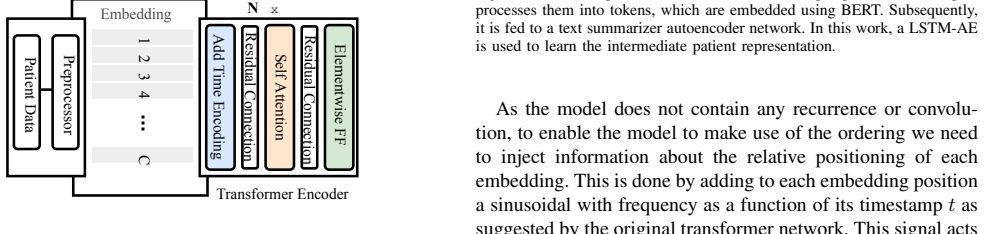
The central object is the patient-visit representation $Z_t = [E_t^c; E_t^U; d_t]$, the concatenation of a code embedding, a text embedding, and demographics. The code embedding $E_t^c$ is produced by a transformer encoder trained with the skip-gram objective on visit sequences; time is injected with a sinusoidal positional encoding and with a causal triangular mask that prevents a visit from attending to future visits. The text embedding $E_t^U$ is produced by a pretrained bidirectional transformer language model (BERT), fine-tuned on clinical text, followed by a bidirectional GRU autoencoder with a self-attention head that summarizes all sentence embeddings from a visit. The mechanism is designed so a simple two-layer classifier can consume $Z_t$ directly for downstream prediction tasks.
What would settle it
Rerun the original released implementations of the starred baseline methods on the same preprocessed MIMIC-III cohort and task splits; if TAPER's 1–2% margin over those original implementations shrinks to statistical noise, the central claim of superior performance is not supported.
Extended reading notes
Core claim
The central claim is that a time-aware multimodal representation, TAPER, outperforms code-only, text-only, and earlier joint methods on three MIMIC-III tasks. The code half is a transformer trained with a skip-gram objective over sequences of visits, with a causal mask so each visit only attends to earlier visits; the text half is a pretrained bidirectional transformer language model followed by an attention-based GRU autoencoder that summarizes all notes in a visit. The final vector is the concatenation of the two plus demographics. In the paper's comparisons, TAPER reaches 67.42% AUROC and 68.03% PR-AUC for readmission, 63.42% and 65.65% for mortality, and 25.57% top-1 accuracy for length of stay, a 1–2% margin over the best baselines, while an ablation shows that text, codes, and demographics each contribute and their combination is best.
Load-bearing premise
The 1–2% margin over baselines rests on the assumption that the authors' best-effort reimplementations of ClinicalBERT, Joint-Skipgram, MCE, Deepr, and Patient2Vec match the performance of the original published methods; if those reimplementations are undertuned, the comparison could reflect implementation quality rather than the method.
Editorial extensions
If this is right
- Combining text, codes, and demographics improves all three tasks over any single modality in the paper's ablations.
- Unsupervised pretraining on codes and notes, followed by frozen representations, beats jointly supervised training without pretraining.
- The causal masking makes the code representation usable in settings where predictions must be made before a visit ends.
- Code-only recall@k on next-visit diagnosis and procedure prediction improves over Med2Vec, MCE, Joint-Skipgram, Deepr, and Patient2Vec.
- The same fixed representation supports binary, multiclass, and high-dimensional prediction tasks without task-specific architecture changes.
Reading between the lines
- Outside the paper's scope, the same two-stage recipe could be tested on outpatient EHR data with longer and more irregular visit intervals; the sinusoidal time encoding should transfer, but the causal mask would need revisit windows defined by clinical practice.
- Because the text and code modules are trained separately and only concatenated, the fusion may miss cross-modal interactions; a jointly fine-tuned variant would reveal whether the 1–2% gain comes from independent signals or from their alignment.
- The paper's caveat that MIMIC-III codes are recorded at discharge means the reported gains apply to retrospective prediction; a direct test of in-visit actionability would require a dataset where codes are updated continuously during a stay.
- The text summarizer's fixed bottleneck at 128 dimensions may lose information from very long notes; an extension could vary the bottleneck with note length or add a hierarchical attention over note types.
Signed reviews
Editorial analysis
A structured set of objections, weighed in public.
Referee Report
Summary. The paper proposes TAPER, a patient representation model for EHR data that combines a transformer-based code embedding module with a BERT-based text summarization module, then concatenates the two (plus demographics) into a single visit-level vector for downstream prediction. The code module uses a causal-masked transformer trained with a skip-gram objective on sequences of patient visits, augmented with a sinusoidal time encoding. The text module uses BioBERT-initialized BERT to embed sentences from clinical notes, followed by a GRU autoencoder with attention to produce a text summary. The patient representation is evaluated on MIMIC-III for 30-day readmission, in-hospital mortality, and length-of-stay classification, plus a code prediction task measured with recall@k. The authors report that TAPER outperforms several baselines (Med2Vec, ClinicalBERT, Patient2Vec, Deepr, Joint-Skipgram, MCE, SGcode+SGtext) and an ablation that removes the proposed pretraining, concluding that the method shows superior performance and that unsupervised pretraining is useful.
Significance. If the empirical claims held, the paper would provide a reasonably straightforward recipe for combining structured codes and unstructured text in EHR representation learning, with a publicly available implementation (the GitHub link). The ablation study is a useful check on component contributions, and the causal time-masking in the code transformer is a sensible design choice for sequential clinical data. However, the reported performance margins are small relative to the error bars, and the key comparison that isolates the proposed pretraining is insufficiently specified. As presented, the evidence does not establish superiority over baselines or the benefit of the proposed unsupervised pretraining; these are fixable with a more rigorous evaluation protocol.
major comments (3)
- [V.B.4 and Table V] The central claim that TAPER 'outperforms others by a 1-2% margin' and that this 'demonstrates the usefulness of unsupervised pre-training' is not supported by the reported statistics. Every pairwise difference in Table V is smaller than the reported standard deviations (e.g., mortality AUC-ROC 63.42±0.6 vs MCE 62.72±2.1; readmission PR-AUC 68.03±1.5 vs ClinicalBert 67.71±1.3; LOS accuracy 25.57±2.7 vs SGcode+SGtext 24.54±0.4). The paper reports no significance tests or confidence intervals for these differences. To substantiate the abstract's claim of 'superior performance and generalization,' the authors should report paired hypothesis tests (e.g., McNemar or bootstrap) or effect sizes with confidence intervals for the differences in Table V, and temper the wording if the differences are not statistically significant.
- [IV.E and V.B.4] The 'Ours - Supervised' baseline is described as 'trained jointly on downstream tasks without pretraining,' but it is not specified whether the BERT module is randomly initialized or still initialized from BioBERT, and whether the transformer code module and GRU summarizer are trained from scratch. If the supervised arm retains the BioBERT initialization, then the comparison to 'Ours' does not isolate the effect of the proposed unsupervised pretraining, because both arms share a pretrained language model. Please specify the initialization and pretraining status of every component in both arms, and if necessary annotate the 'without pretraining' statement to say which pretraining is removed.
- [V.A and IV.B] The text 'as most patients have 3 hospital visits after filtering to atleast 2 visits' conflicts with the earlier cohort statistic of an average of 1.29 visits per patient (Section IV.B). If the recall@k experiments in Table I are run on a filtered subcohort of patients with at least two visits, that subcohort should be described with its size and admission counts; otherwise the comparison in Table I is not reproducible and the superiority claim for the code representation is uninterpretable.
minor comments (8)
- [Equation (1)] The skip-gram objective is written in a vector-scalar form that is not well-defined because c_t is a binary vector but the expression c^T_{t+j} log(ĉ_t) appears to mix a vector and a scalar; please rewrite it as a proper cross-entropy over the code vocabulary (e.g., -sum over codes).
- [III.A] The sinusoidal time encoding is described only as 'sinusoidal with frequency as a function of its timestamp t'; please give the exact formula, including how raw timestamps are scaled or normalized before encoding.
- [III.B] The procedure for obtaining a single sentence embedding from BERT (e.g., using the [CLS] token, mean pooling, or max pooling) is not stated; please specify it.
- [IV.D and Table IV] The evaluation section states k=7 fold, while Table IV's header says '5-FOLD CROSS VALIDATION'; please reconcile this inconsistency because it changes the effective test-set size (≈15% vs 20%).
- [Abstract and Section V] The word 'generalization' is used although the evaluation is on a single public dataset (MIMIC-III); please either add an external validation or soften the wording.
- [Tables II and III] Ablation results are reported without standard deviations, unlike Table V; adding error bars would make the ablation conclusions more robust.
- [Section II] The related work section contains an unresolved citation placeholder '[?]'; please complete the reference.
- [Throughout] There are minor typos: 'avaialble' in the abstract, 'preempted' in the introduction (likely 'prompted' or 'preempted' intended?), and 'as consequently' in the opening paragraph of Section V; please proofread.
Circularity Check
No significant circularity: TAPER's representation is derived from standard self-supervised code and text objectives, and its downstream evaluation is benchmarked against external baselines rather than constructed from its own fitted values.
full rationale
TAPER's code representation is trained with a skip-gram objective (Eq. 1) plus a transformer encoder with causal masking, while the text representation uses BioBERT-initialized embeddings summarized by a GRU autoencoder, and the patient vector is a concatenation of code, text, and demographics. These components are fitted to the MIMIC-III corpus, but the downstream mortality, readmission, and length-of-stay predictions are evaluated on held-out patient splits against external baselines (ClinicalBERT, Med2Vec, MCE, Deepr, Patient2Vec, Joint-Skipgram, SGcode+SGtext), so the central claim is an empirical benchmark result, not a quantity that equals its own input by construction. The 'Ours - Supervised' row is a legitimate ablation of pretraining, even though the reported 1-2% differences overlap with the error bars and no paired significance tests are given; that is a statistical-evidence weakness, not circular reasoning. The Table V footnote, 'Methods marked * is our best-effort re-implementation due to unavailability of source,' acknowledges a baseline-fidelity threat, but this affects the strength of the empirical comparison rather than the derivation chain. The paper contains one self-citation ([26]) in a list of autoencoder references, but the actual text summarizer is a GRU autoencoder and the cited denoising-autoencoder work is not used to define or justify the result, so the self-citation is not load-bearing. No uniqueness theorem, ansatz, or fitted parameter is imported from the authors' prior work, and no prediction is renamed from a fit. Accordingly the derivation chain is self-contained with respect to circularity, and the appropriate score is at the low end of the scale.
Assumptions & free parameters
free parameters (12)
- code embedding dimension dcode =
128
- number of transformer encoder layers =
2
- attention heads nhead =
8
- attention head dimension dhead =
64
- skip-gram context window w =
2
- transformer initial learning rate =
0.00025
- text summarizer hidden dimension denc =
128
- teacher forcing ratio =
0.5
- text summarizer initial learning rate =
0.001 with step decay 0.1 every 50 epochs
- code frequency filter threshold =
5
- CCS grouping granularity =
231 diagnosis categories, 704 procedure categories
- cross-validation fold count =
7 for main tasks, 5 reported for LOS
assumptions (7)
- standard math Transformer self-attention and backpropagation provide sound learning machinery for sequences.
- domain assumption BioBERT weights pretrained on biomedical text transfer to MIMIC-III clinical notes.
- domain assumption MIMIC-III codes are recorded at discharge, so excluding current-visit codes avoids label leakage.
- domain assumption Codes filtered by frequency and grouped by CCS retain enough signal for prediction.
- ad hoc to paper The skip-gram objective with a causal mask yields a useful patient code representation.
- ad hoc to paper The GRU autoencoder reconstruction loss yields a useful text representation for classification.
- ad hoc to paper Sinusoidal time encoding from timestamps captures irregular visit intervals.
Cite this review
Pith. "Pith review of TAPER: Time-Aware Patient EHR Representation." pith.science (2026). https://pith.science/paper/5TVNOQZH
@misc{pith2026190803971,
  author       = {Pith},
  title        = {Pith review of: TAPER: Time-Aware Patient EHR Representation},
  year         = {2026},
  howpublished = {\url{https://pith.science/paper/5TVNOQZH}},
  note         = {Machine review of arXiv:1908.03971}
}
read the original abstract
Effective representation learning of electronic health records is a challenging task and is becoming more important as the availability of such data is becoming pervasive. The data contained in these records are irregular and contain multiple modalities such as notes, and medical codes. They are preempted by medical conditions the patient may have, and are typically jotted down by medical staff. Accompanying codes are notes containing valuable information about patients beyond the structured information contained in electronic health records. We use transformer networks and the recently proposed BERT language model to embed these data streams into a unified vector representation. The presented approach effectively encodes a patient's visit data into a single distributed representation, which can be used for downstream tasks. Our model demonstrates superior performance and generalization on mortality, readmission and length of stay tasks using the publicly available MIMIC-III ICU dataset. Code avaialble at https://github.com/sajaddarabi/TAPER-EHR
Figures


Figures from the paper (1 more)

Reference graph
Works this paper leans on
-
[1]
Validation of the mortality prediction model for icu patients
D. Teres, S. Lemeshow, J. S. Avrunin, and H. Pastides, “Validation of the mortality prediction model for icu patients.” Critical care medicine, vol. 15, no. 3, pp. 208–213, 1987
work page 1987
-
[2]
Predicting death and readmission after intensive care discharge,
A. J. Campbell, J. A. Cook, G. Adey, and B. H. Cuthbertson, “Predicting death and readmission after intensive care discharge,” British journal of anaesthesia, vol. 100, no. 5, pp. 656–662, 2008
work page 2008
-
[3]
Representation learning: A review and new perspectives,
Y . Bengio, A. Courville, and P. Vincent, “Representation learning: A review and new perspectives,” IEEE transactions on pattern analysis and machine intelligence , vol. 35, no. 8, pp. 1798–1828, 2013
2013
-
[4]
Distributed representations of words and phrases and their compositionality,
T. Mikolov, I. Sutskever, K. Chen, G. S. Corrado, and J. Dean, “Distributed representations of words and phrases and their compositionality,” in Advances in Neural Information Processing Systems 26 , C. J. C. Burges, L. Bottou, M. Welling, Z. Ghahramani, and K. Q. Weinberger, Eds. Curran Associates, Inc., 2013, pp. 3111–3119. [Online]. Available: http://p...
work page 2013
-
[6]
Medical Concept Embedding with Time-Aware Attention
——, “Medical concept embedding with time-aware attention,” arXiv preprint arXiv:1806.02873, 2018
work page Pith review arXiv 2018
-
[7]
Neural machine translation by jointly learning to align and translate,
D. Bahdanau, K. Cho, and Y . Bengio, “Neural machine translation by jointly learning to align and translate,” arXiv preprint arXiv:1409.0473, 2014
arXiv 2014
-
[8]
Effective ap- proaches to attention-based neural machine translation,
M.-T. Luong, H. Pham, and C. D. Manning, “Effective ap- proaches to attention-based neural machine translation,” arXiv preprint arXiv:1508.04025, 2015
arXiv 2015
-
[9]
Attention is all you need,
A. Vaswani, N. Shazeer, N. Parmar, J. Uszkoreit, L. Jones, A. N. Gomez, Ł. Kaiser, and I. Polosukhin, “Attention is all you need,” in Advances in neural information processing systems , 2017, pp. 5998–6008
2017
Show all 31 references
-
[10]
Learning representations by back-propagating errors,
D. E. Rumelhart, G. E. Hinton, R. J. Williams et al. , “Learning representations by back-propagating errors,” Cognitive modeling, vol. 5, no. 3, p. 1, 1988. 8 TABLE V COMPARISON WITH OTHER WORK ON DOWNSTREAM TASKS . Method Readmisison Mortality LOS ROC PR-AUC ROC PR-AUC ACC Ou...
1988
-
[11]
Methods marked * is our best-effort re-implementation due to unavailability of source
-
[12]
A neural proba- bilistic language model,
Y . Bengio, R. Ducharme, P. Vincent, and C. Jauvin, “A neural proba- bilistic language model,” Journal of machine learning research , vol. 3, no. Feb, pp. 1137–1155, 2003
2003
-
[13]
Multi-layer representation learning for med- ical concepts,
E. Choi, M. T. Bahadori, E. Searles, C. Coffey, M. Thompson, J. Bost, J. Tejedor-Sojo, and J. Sun, “Multi-layer representation learning for med- ical concepts,” in Proceedings of the 22nd ACM SIGKDD International Conference on Knowledge Discovery and Data Mining . ACM, 2016, p...
2016
-
[14]
Deepr: a convolutional net for medical records,
P. Nguyen, T. Tran, N. Wickramasinghe, and S. Venkatesh, “ Deepr: a convolutional net for medical records,” IEEE journal of biomedical and health informatics, vol. 21, no. 1, pp. 22–30, 2016
2016
-
[15]
Gram: Graph-based attention model for healthcare representation learning,
E. Choi, M. T. Bahadori, L. Song, W. F. Stewart, and J. Sun, “Gram: Graph-based attention model for healthcare representation learning,” in Proceedings of the 23rd ACM SIGKDD International Conference on Knowledge Discovery and Data Mining , ser. KDD ’17. New York, NY , USA: AC...
2017
-
[16]
Patient2vec: A personalized interpretable deep representation of the longitudinal electronic health record,
J. Zhang, K. Kowsari, J. H. Harrison, J. M. Lobo, and L. E. Barnes, “Patient2vec: A personalized interpretable deep representation of the longitudinal electronic health record,” IEEE Access, vol. 6, pp. 65 333– 65 346, 2018
2018
-
[17]
Mime: Multilevel medical embedding of electronic health records for predictive healthcare,
E. Choi, C. Xiao, W. Stewart, and J. Sun, “Mime: Multilevel medical embedding of electronic health records for predictive healthcare,” in Advances in Neural Information Processing Systems 31 , S. Bengio, H. Wallach, H. Larochelle, K. Grauman, N. Cesa-Bianchi, and R. Garnett, E...
2018
-
[18]
Investigating the challenges of temporal relation extraction from clinical text,
D. Galvan, N. Okazaki, K. Matsuda, and K. Inui, “Investigating the challenges of temporal relation extraction from clinical text,” in Proceedings of the Ninth International Workshop on Health Text Mining and Information Analysis . Brussels, Belgium: Association for Computation...
2018
-
[19]
Learning patient representations from text,
D. Dligach and T. A. Miller, “Learning patient representations from text,” CoRR, vol. abs/1805.02096, 2018. [Online]. Available: http://arxiv.org/abs/1805.02096
2018 arXiv
-
[20]
Deep ehr: Chronic disease prediction using medical notes,
J. Liu, Z. Zhang, and N. Razavian, “Deep ehr: Chronic disease prediction using medical notes,” arXiv preprint arXiv:1808.04928 , 2018
2018 arXiv
-
[22]
Clinicalbert: Modeling clinical notes and predicting hospital readmission,
K. Huang, J. Altosaar, and R. Ranganath, “Clinicalbert: Modeling clinical notes and predicting hospital readmission,” arXiv:1904.05342, 2019
1904 arXiv
-
[23]
Ehr phenotyping via jointly embedding medical concepts and words into a unified vector space,
T. Bai, A. K. Chanda, B. L. Egleston, and S. Vucetic, “Ehr phenotyping via jointly embedding medical concepts and words into a unified vector space,” BMC medical informatics and decision making , vol. 18, no. 4, p. 123, 2018
2018
-
[24]
Ex- plainable prediction of medical codes from clinical text,
J. Mullenbach, S. Wiegreffe, J. Duke, J. Sun, and J. Eisenstein, “Ex- plainable prediction of medical codes from clinical text,” arXiv preprint arXiv:1802.05695, 2018
2018 arXiv
-
[25]
BERT: pre-training of deep bidirectional transformers for language understanding,
J. Devlin, M. Chang, K. Lee, and K. Toutanova, “BERT: pre-training of deep bidirectional transformers for language understanding,” CoRR, vol. abs/1810.04805, 2018. [Online]. Available: http://arxiv.org/abs/ 1810.04805
2018 arXiv
-
[26]
Extract- ing and composing robust features with denoising autoencoders,
P. Vincent, H. Larochelle, Y . Bengio, and P.-A. Manzagol, “Extract- ing and composing robust features with denoising autoencoders,” in Proceedings of the 25th international conference on Machine learning . ACM, 2008, pp. 1096–1103
2008
-
[27]
Dynamic feature acquisition using denoising autoencoders,
M. Kachuee, S. Darabi, B. Moatamed, and M. Sarrafzadeh, “Dynamic feature acquisition using denoising autoencoders,” CoRR, vol. abs/1811.01249, 2018. [Online]. Available: http://arxiv.org/abs/ 1811.01249
2018 arXiv
-
[28]
Biobert: pre-trained biomedical language representation model for biomedical text mining,
J. Lee, W. Yoon, S. Kim, D. Kim, S. Kim, C. H. So, and J. Kang, “Biobert: pre-trained biomedical language representation model for biomedical text mining,” arXiv preprint arXiv:1901.08746 , 2019
1901 arXiv
-
[29]
Mimic-iii, a freely accessible critical care database,
A. E. Johnson, T. J. Pollard, L. Shen, H. L. Li-wei, M. Feng, M. Ghas- semi, B. Moody, P. Szolovits, L. A. Celi, and R. G. Mark, “Mimic-iii, a freely accessible critical care database,”Scientific data, vol. 3, p. 160035, 2016
2016
-
[30]
Adam: A method for stochastic optimization,
D. P. Kingma and J. Ba, “Adam: A method for stochastic optimization,” arXiv preprint arXiv:1412.6980 , 2014
2014 arXiv
-
[31]
Publicly available clinical bert embeddings,
E. Alsentzer, J. R. Murphy, W. Boag, W.-H. Weng, D. Jin, T. Naumann, and M. McDermott, “Publicly available clinical bert embeddings,” arXiv preprint arXiv:1904.03323, 2019
1904 arXiv
-
[32]
Professor forcing: A new algorithm for training recurrent networks,
A. M. Lamb, A. G. A. P. Goyal, Y . Zhang, S. Zhang, A. C. Courville, and Y . Bengio, “Professor forcing: A new algorithm for training recurrent networks,” inAdvances In Neural Information Processing Systems, 2016, pp. 4601–4609
2016
-
[33]
Automatic differentiation in PyTorch,
A. Paszke, S. Gross, S. Chintala, G. Chanan, E. Yang, Z. DeVito, Z. Lin, A. Desmaison, L. Antiga, and A. Lerer, “Automatic differentiation in PyTorch,” in NIPS Autodiff Workshop, 2017
2017
Reviewed August 14, 2026 · model on record in the stance chip above.
Discussion (0). Continue with ORCID to comment.