REVIEW 3 major objections 4 minor 20 references
Self-supervised Data Bootstrapping for Deep Optical Character Recognition of Identity Documents
T0 review · 3 major / 4 minor · reviewed 2026-08-14 · deepseek-v4-flash
Pith's one-line read An iterative self-supervised bootstrapping loop lets an OCR character classifier for identity documents improve itself from a seed of synthetic data, raising average class-wise accuracy on 74 classes from 58.1% to 99.4%.
desk verdict The headline 99.4% character accuracy is likely a training-set evaluation; the held-out DS2 pipeline result is the real contribution, but it needs a proper evaluation. read the letter →
The pith
A machine-rendered reading of the paper's core claim, the machinery that carries it, and where it could break.
The reading
What carries the argument
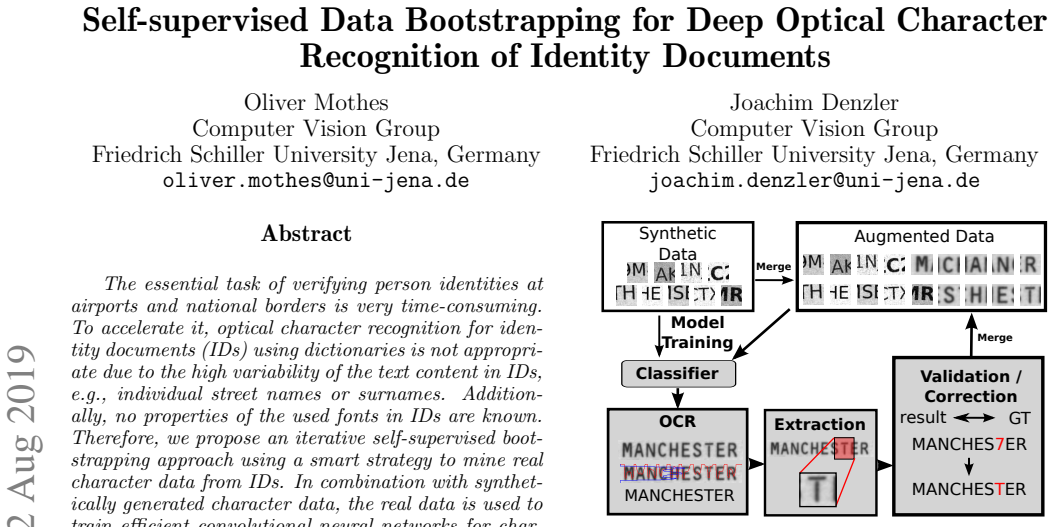
The load-bearing mechanism is the bootstrapping cycle. A synthetic character generator renders $64 \times 64$ images of a centered character flanked by two random neighbors, with random fonts, background speckle, translation, and rotation; a compact CNN (LeNet, CifarNet, ResNet-10, or ResNet-20) is trained on this data. The OCR pipeline then binarizes scanned document fields, separates lines and strings, and segments character patches using projection analyses and a contour-search algorithm. Each patch is classified by the current model, and the prediction is corrected against the ground-truth string of the text field. Corrected patches are augmented with affine and gray-value transformations, merged with a decreasing percentage of synthetic data, and used to fine-tune the model for the next iteration. This loop is the mechanism that adapts the classifier from synthetic rendering to the real document distribution.
What would settle it
Train the same architecture on the real character patches extracted at the final stage, but with labels taken directly from the ground-truth field strings rather than from the classifier's corrected predictions; if this oracle-labeled model matches the 99.4% accuracy without running the iterative correction loop, then the bootstrapping step itself is not contributing beyond providing more real training data.
Extended reading notes
Core claim
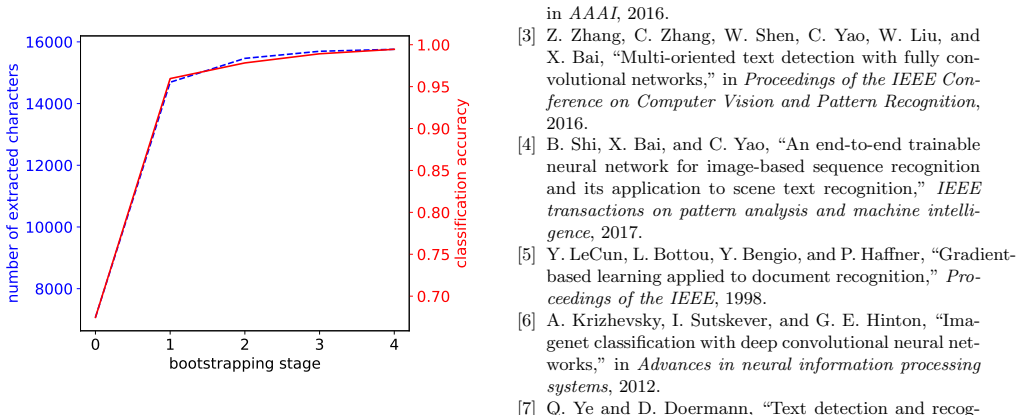
The central discovery is that the bootstrapping cycle converts raw character patches mined from real document images into a supervised character-training signal. In each iteration the current model segments text fields into character patches and classifies them; the predicted labels are then corrected with the ground-truth field strings, and the corrected patches are augmented and merged with synthetic data for fine-tuning. On 74 classes covering digits, letters, and special characters found on IDs, the extracted real data grows from 7,069 characters at the first stage to 14,871 by stage 4, while average class-wise accuracy climbs from 58.1% (synthetic only) to 99.4%. The same trend holds at the field level: the full OCR pipeline correctly reads 85.3% of 320 held-out text fields, versus 18.4% for the open-source OCR baseline. The paper also shows that compact CNNs meet the target runtime of 50 ms per character, while a linear SVM baseline with HOG features is both slower and less accurate.
Load-bearing premise
The cycle relies on having accurate ground-truth text strings for real document fields, because those strings are used to correct the labels of the extracted character patches; without that field-level ground truth, the self-training loop would feed mislabeled characters back into the model.
Editorial extensions
If this is right
- A character classifier trained through four bootstrapping stages outperforms the same architecture trained on synthetic data alone, so mining real document characters is what drives the accuracy gain.
- The full pipeline—binarization, line/string separation, character segmentation, classification, and field-level post-correction—reads 85.3% of unseen text fields exactly, a level the paper argues is suitable for industrial identity-document verification.
- Because field-level OCR error grows exponentially with string length, moving character accuracy from 58.1% to 99.4% is what makes long fields such as surnames and addresses readable in practice.
- The approach needs no dictionaries and no prior knowledge of document fonts, since classification is character-wise and context-free, which suits the highly variable strings on IDs.
- The final ResNet-20 model runs at 43 ms per character, below the 50 ms target, so the accuracy gain does not sacrifice the runtime needed for practical deployment.
Reading between the lines
- The same decreasing-synthetic-data schedule should transfer to other variable-content OCR domains, such as forms, envelopes, or labels, as long as field-level ground-truth strings are available; the paper itself only demonstrates identity documents.
- The label-correction step inherits any errors from character segmentation: if the segmentation merges or splits characters, the corrected labels can still be wrong even when the field string is correct, a failure mode the paper does not quantify.
- A control experiment that trains on the same extracted character patches with oracle labels from the field strings would isolate how much of the gain comes from the self-correction loop versus simply accumulating more real data; the paper does not run this control.
- The fixed rule of halving the synthetic-data fraction each stage is a design choice; an optimal annealing schedule might reach the same accuracy in fewer iterations, but the paper does not test alternatives.
Signed reviews
Editorial analysis
A structured set of objections, weighed in public.
Referee Report
Summary. The paper proposes an iterative bootstrapping method for character-level OCR on identity documents. A CNN is first trained on synthetically rendered characters; the OCR pipeline then extracts real character patches from document text-field images, corrects patch labels using the field-level ground truth, merges the real data with synthetic data, and fine-tunes the model over several iterations. The authors report 99.4% average class-wise character accuracy after four stages versus 58.1% for a synthetic-only model, and a full-pipeline result of 85.3% correctly read text fields on a held-out document dataset versus 18.4% for Tesseract. The paper also compares several CNN architectures under a 50 ms per-character runtime constraint.
Significance. If the reported gains are real and the evaluation is clean, the contribution is practically useful: it addresses a realistic data-scarcity problem in domain-specific OCR and provides a concrete bootstrapping recipe with a runtime-aware model comparison. The paper is transparent about many experimental details, including the synthetic generator, the merge schedule, and the use of real documents from multiple countries. However, the central quantitative evidence currently rests on a character-level evaluation whose test set may coincide with the final bootstrapping extraction, and the pipeline comparison against Tesseract does not control for training-data differences. The DS2 pipeline result is an important independent check, but it is not sufficient by itself to validate the headline character-accuracy claim. The method also requires field-level ground-truth text for the bootstrapping documents, which weakens the 'self-supervised' framing. With a corrected evaluation and a fairer baseline comparison, the paper would be a solid applied contribution.
major comments (3)
- [Section 5, 'Bootstrapping Evaluation' (Figure 2)] The 'test set with 14871 character patches extracted from dataset DS1' used for the 99.4% versus 58.1% comparison appears to be identical to the stage-4 extraction that is used to fine-tune the final model. The paper specifies a 90/10 class-wise training/test split only for the initial stage and does not state that a disjoint held-out character set was reserved from DS1 for later stages. If the 14,871 patches are the same ones used for stage-4 fine-tuning, the 99.4% figure is a training-set accuracy, and the comparison with the synthetic-only model on that same set is invalid because the synthetic-only model was not trained on those patches while the final model was. Please clarify the exact split, state how many of the 14,871 patches were seen during fine-tuning, and report accuracy on a held-out character set that was not used in any bootstrapping stage.
- [Section 5, 'OCR Pipeline'] The comparison between the proposed pipeline and Tesseract is not controlled: Tesseract uses its default model, which was not trained on identity-document data, while the proposed pipeline is trained on real data from DS1, and DS2 is drawn from the same document domain. The 85.3% versus 18.4% result therefore conflates method quality with training-data advantage. To support the claim that the proposed pipeline 'outperforms an established open-source framework,' either fine-tune Tesseract on the same DS1 field-level ground truth (or otherwise give it comparable training data) or clearly state that the comparison is against an out-of-the-box baseline. At a minimum, report confidence intervals or statistical significance over the 320 text fields.
- [Section 4, 'Bootstrapping Cycle'] The label-correction step uses the ground-truth text of each real text-field patch: the text says 'the results are evaluated with the ground truth of the text region patch' and misclassified patches have their labels corrected. This means the method requires field-level annotations for every document used in bootstrapping, not merely document images. The claim of 'self-supervised' data bootstrapping should therefore be qualified, and the paper should state clearly whether the method can operate when only document images are available and no field-level ground truth exists. If such ground truth is required, the scope of the contribution is narrower than the abstract suggests, and the practical preconditions should be stated explicitly.
minor comments (4)
- [Abstract and Section 4 title] The abstract contains 'a iterative' and should read 'an iterative'; the Section 4 heading 'Boostrapping Evaluation' has a typo and should read 'Bootstrapping Evaluation'.
- [Section 5, 'Bootstrapping Evaluation'] The sentence 'If no characters could be extracted for a single class, they are generated completely synthetically' is ambiguous: it should specify whether this means the class receives only synthetic samples in that stage and whether the number of synthetic samples is balanced across classes.
- [Section 2 and Section 5] The paper would benefit from stating the total number of character patches per class in DS1 and DS2 and from reporting per-class accuracies, especially for rare classes such as special characters, since the reported metric is 'average class-wise accuracy.'
- [Section 5, 'OCR Model Comparison'] The sentence 'the classification accuracy and runtime is important' should read 'are important'; also, for reproducibility, the exact hyperparameters of the fine-tuning stages (learning rate, number of epochs, batch size) should be reported.
Circularity Check
The headline 99.4%-vs-58.1% character accuracy is a training-set comparison: the 14,871-patch 'test set' is the same DS1 extraction set used to fine-tune the stage-4 model, with no held-out split described.
-
fitted input called prediction
[Section 5, 'Bootstrapping Evaluation' paragraph; Figure 2]
"We validate the accuracy of bootstrapping stage 4 on the test set with 14871 character patches extracted from dataset DS1. While the initial models achieve an accuracy of 58.1%, the fine-tuned model reaches an accuracy of 99.4%."
The stage-4 model is updated with 'a higher number of extracted real data' and reaches 99.4%; Figure 2 reports stage-4 extraction at 14,871 characters. The evaluation 'validate[s] the accuracy of bootstrapping stage 4 on the test set with 14871 character patches extracted from dataset DS1.' The numbers coincide, and the only described split (90/10 class-wise) is for the initial stage; a 90/10 split of 14,871 would give ~1,487 test patches, not 14,871. Thus the final model is tested on the patches used to fine-tune it, making the 99.4%-vs-58.1% comparison a training-set comparison. The DS2 pipeline test is genuinely held out and mitigates overall circularity, but the headline character-level claim is not independent.
full rationale
The paper's central character-level evidence for bootstrapping, the jump from 58.1% (synthetic-only) to 99.4% (stage-4 model), is undermined by a train/test overlap: the reported 14,871-patch test set is exactly the DS1 extraction count associated with stage 4, and no held-out split for later bootstrapping stages is described. The 58.1% figure is measured on the same patches, which the synthetic-only model never saw but the fine-tuned model was trained on, so that comparison is not an independent prediction. However, the DS2 full-pipeline experiment (85.3% vs 18.4% for Tesseract, and 50.3% for the synthetic-only model) is an external held-out evaluation and provides real, non-circular support for the bootstrapping approach. There is no load-bearing self-citation or imported uniqueness theorem; the circularity is localized to the character-accuracy evaluation rather than the entire method. Hence a moderate score of 5 is appropriate.
Assumptions & free parameters
free parameters (4)
- Synthetic-to-real data ratio schedule =
50% initially, halved each stage
- Number of bootstrapping stages =
4
- Character image size =
64 x 64 pixels
- Training/validation split for fine-tuning =
90% / 10% per class
assumptions (4)
- domain assumption Ground-truth text strings for real document fields are available during training and are used to correct character labels.
- domain assumption The document database provides accurate region information and text formats for each document type, enabling text field extraction.
- domain assumption The synthetic character generator is representative enough to pretrain the model, so bootstrapping starts from a usable classifier.
- domain assumption The 14,871-character test set extracted from DS1 is representative and can support the reported accuracy without leakage from fine-tuning data.
Cite this review
Pith. "Pith review of Self-supervised Data Bootstrapping for Deep Optical Character Recognition of Identity Documents." pith.science (2026). https://pith.science/paper/KPNZHTTW
@misc{pith2026190804027,
  author       = {Pith},
  title        = {Pith review of: Self-supervised Data Bootstrapping for Deep Optical Character Recognition of Identity Documents},
  year         = {2026},
  howpublished = {\url{https://pith.science/paper/KPNZHTTW}},
  note         = {Machine review of arXiv:1908.04027}
}
read the original abstract
The essential task of verifying person identities at airports and national borders is very time consuming. To accelerate it, optical character recognition for identity documents (IDs) using dictionaries is not appropriate due to high variability of the text content in IDs, e.g., individual street names or surnames. Additionally, no properties of the used fonts in IDs are known. Therefore, we propose an iterative self-supervised bootstrapping approach using a smart strategy to mine real character data from IDs. In combination with synthetically generated character data, the real data is used to train efficient convolutional neural networks for character classification serving a practical runtime as well as a high accuracy. On a dataset with 74 character classes, we achieve an average class-wise accuracy of 99.4 %. In contrast, if we would apply a classifier trained only using synthetic data, the accuracy is reduced to 58.1 %. Finally, we show that our whole proposed pipeline outperforms an established open-source framework
Figures
Reference graph
Works this paper leans on
-
[1]
Deep features for text spotting,
M. Jaderberg, A. Vedaldi, and A. Zisserman, “Deep features for text spotting,” in European conference on computer vision. Springer, 2014
work page 2014
-
[2]
Reading scene text in deep convolutional sequences
P. He, W. Huang, Y. Qiao, C. C. Loy, and X. Tang, “Reading scene text in deep convolutional sequences.” in AAAI, 2016
work page 2016
-
[3]
Multi-oriented text detection with fully con- volutional networks,
Z. Zhang, C. Zhang, W. Shen, C. Yao, W. Liu, and X. Bai, “Multi-oriented text detection with fully con- volutional networks,” in Proceedings of the IEEE Con- ference on Computer Vision and Pattern Recognition , 2016
work page 2016
-
[4]
B. Shi, X. Bai, and C. Yao, “An end-to-end trainable neural network for image-based sequence recognition and its application to scene text recognition,” IEEE transactions on pattern analysis and machine intelli- gence, 2017
work page 2017
-
[5]
Gradient- based learning applied to document recognition,
Y. LeCun, L. Bottou, Y. Bengio, and P. Haffner, “Gradient- based learning applied to document recognition,” Pro- ceedings of the IEEE , 1998
work page 1998
-
[6]
Ima- genet classification with deep convolutional neural net- works,
A. Krizhevsky, I. Sutskever, and G. E. Hinton, “Ima- genet classification with deep convolutional neural net- works,” in Advances in neural information processing systems, 2012
work page 2012
-
[7]
Text detection and recog- nition in imagery: A survey,
Q. Ye and D. Doermann, “Text detection and recog- nition in imagery: A survey,” IEEE transactions on pattern analysis and machine intelligence , 2015
work page 2015
-
[8]
Long short-term memory,
S. Hochreiter and J. Schmidhuber, “Long short-term memory,” Neural computation, 1997
1997
Show all 20 references
-
[9]
Synthetic data for text localisation in natural images,
A. Gupta, A. Vedaldi, and A. Zisserman, “Synthetic data for text localisation in natural images,” in Pro- ceedings of the IEEE Conference on Computer Vision and Pattern Recognition, 2016
2016
-
[10]
Dif- ference of boxes filters revisited: Shadow suppression and efficient character segmentation,
E. Rodner, H. Se, W. Ortmann, and J. Denzler, “Dif- ference of boxes filters revisited: Shadow suppression and efficient character segmentation,” in IAPR Work- shop on Document Analysis Systems , 2008
2008
-
[11]
Topological structural analysis of dig- itized binary images by border following,
S. Suzuki et al., “Topological structural analysis of dig- itized binary images by border following,” Computer vision, graphics, and image processing , 1985
1985
-
[12]
Learning multiple lay- ers of features from tiny images,
A. Krizhevsky and G. Hinton, “Learning multiple lay- ers of features from tiny images,” Citeseer, Tech. Rep., 2009
2009
-
[13]
Imagenet pre- trained models with batch normalization,
M. Simon, E. Rodner, and J. Denzler, “Imagenet pre- trained models with batch normalization,”arXiv preprint arXiv:1612.01452, 2016
2016 arXiv
-
[14]
Deep resid- ual learning for image recognition,
K. He, X. Zhang, S. Ren, and J. Sun, “Deep resid- ual learning for image recognition,” in Proceedings of the IEEE conference on computer vision and pattern recognition, 2016
2016
-
[15]
Fast r-cnn,
R. Girshick, “Fast r-cnn,” in Proceedings of the IEEE international conference on computer vision , 2015
2015
-
[16]
Binary codes capable of correcting deletions, insertions, and reversals,
V. I. Levenshtein, “Binary codes capable of correcting deletions, insertions, and reversals,” in Soviet physics doklady, 1966
1966
-
[17]
Support-vector networks,
C. Cortes and V. Vapnik, “Support-vector networks,” Machine learning, 1995
1995
-
[18]
Histograms of oriented gra- dients for human detection,
N. Dalal and B. Triggs, “Histograms of oriented gra- dients for human detection,” in Computer Vision and Pattern Recognition, 2005. CVPR 2005. IEEE Com- puter Society Conference on . IEEE, 2005
2005
-
[19]
An overview of the tesseract ocr engine,
R. Smith, “An overview of the tesseract ocr engine,” in Document Analysis and Recognition, 2007. ICDAR
2007
-
[2007]
IEEE, 2007
Ninth International Conference on . IEEE, 2007
2007
Reviewed August 14, 2026 · model on record in the stance chip above.
Discussion (0). Continue with ORCID to comment.