REVIEW 3 major objections 3 minor 39 references
Implementing Binarized Neural Networks with Magnetoresistive RAM without Error Correction
T0 review · 3 major / 3 minor · reviewed 2026-08-14 · deepseek-v4-flash
Pith's one-line read Binarized neural networks tolerate weight bit error rates up to 0.1%, so ST-MRAM can be used without error correction and with roughly half the programming energy.
desk verdict A credible extension of BNN error-tolerance results to ImageNet, but the energy-saving claim relies on an i.i.d. error model that is never connected to the correlated ST-MRAM errors the paper's own physics suggests. read the letter →
The pith
A machine-rendered reading of the paper's core claim, the machinery that carries it, and where it could break.
The reading
What carries the argument
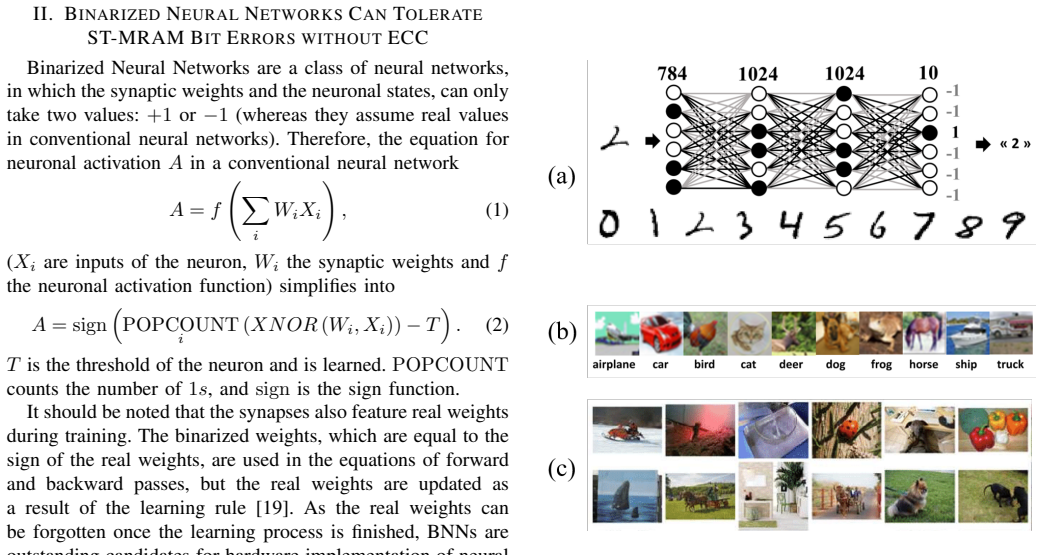
The mechanism is the redundancy of binarized networks combined with a physical ST-MRAM programming model. BNN inference replaces multiplications with XNOR and popcount operations, and the learned threshold of each neuron absorbs small random flips in the binarized weights. The ST-MRAM side uses Sun's mean switching time formula and a gamma distribution for stochastic switching times to compute the bit error rate as a function of programming conditions, allowing the paper to translate an acceptable accuracy loss into a concrete energy saving.
What would settle it
Measure the accuracy of the same three BNNs when weights are corrupted by structured error patterns at the same aggregate BER, for example all flips in one direction or errors concentrated in a single layer; if any such pattern at 0.1% drops accuracy noticeably more than the reported curves, the independence assumption fails. A complementary check would be to program real ST-MRAM arrays with the proposed low-energy conditions, record the actual error map, and inject that measured error map into the networks to compare against the simulated BER curves.
Extended reading notes
Core claim
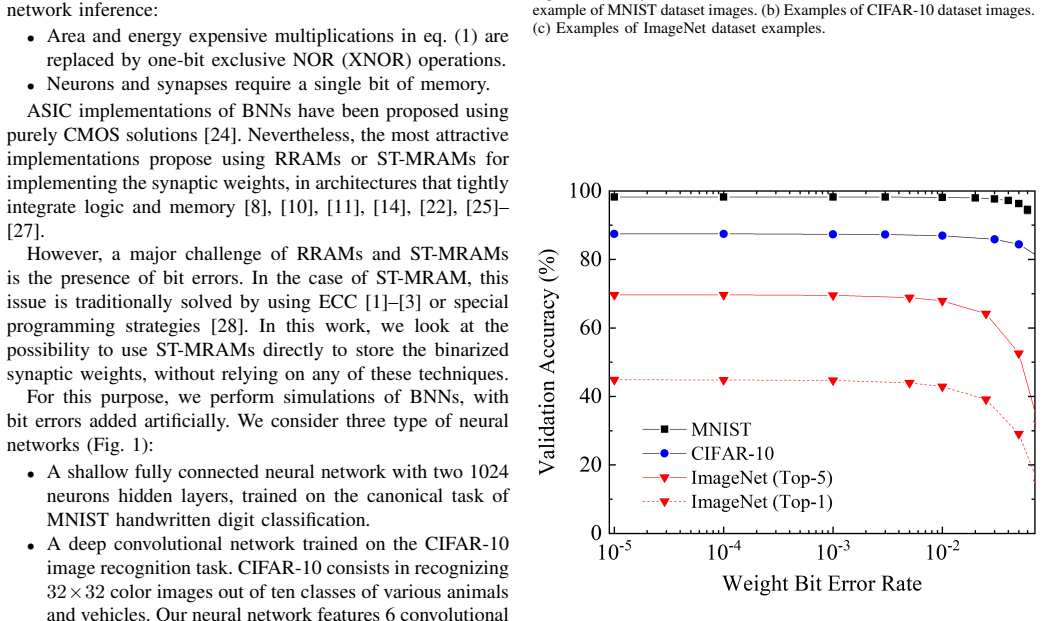
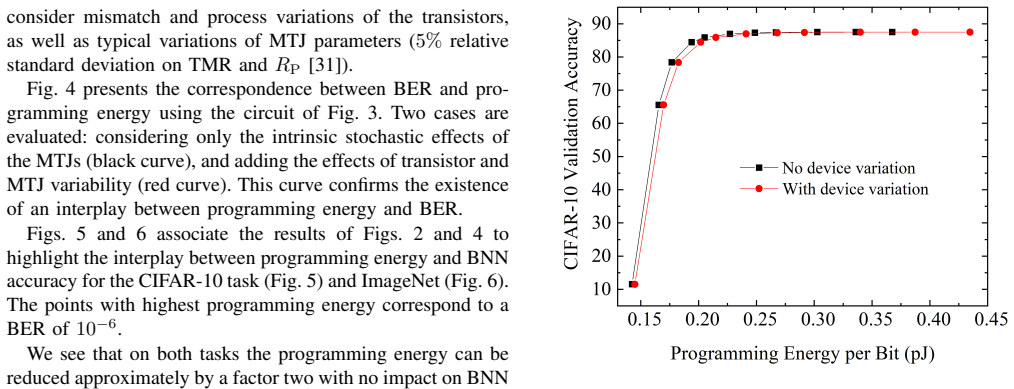
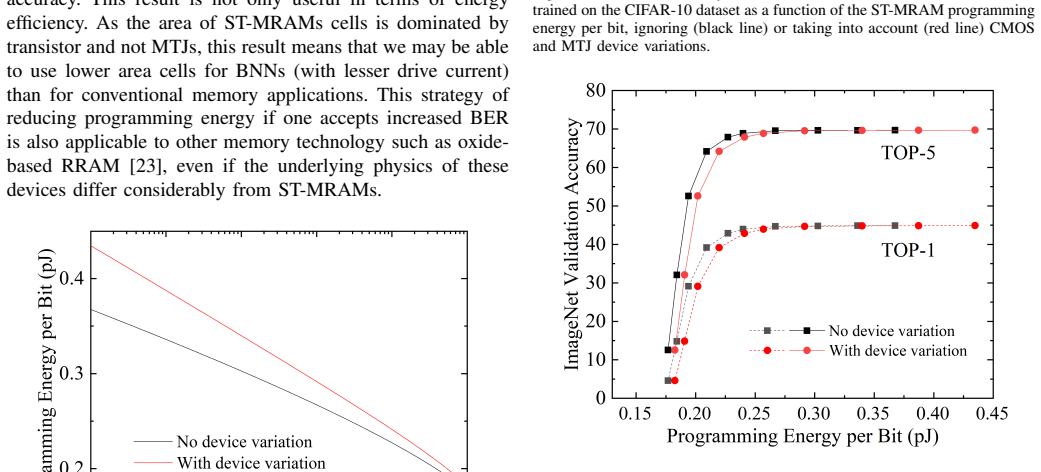
The central claim is that bit error rates up to $10^{-3}$ are harmless for BNN inference accuracy, demonstrated on MNIST, CIFAR-10, and ImageNet, where the ImageNet Top-5 accuracy drops only from 69.7% to 69.5%. At a BER of $10^{-4}$ no effect on accuracy is visible at all. The paper establishes a direct mapping from programming voltage and timing to BER, and then from BER to network accuracy, showing that the programming energy per bit can be reduced by approximately a factor two with no accuracy penalty. It concludes that ST-MRAM for BNN inference can be operated without error correcting codes and with deliberately relaxed, low-energy programming conditions.
Load-bearing premise
The results assume bit errors in the stored weights are independent and uniformly random at a fixed probability; if real ST-MRAM write errors are clustered, asymmetric between 0-to-1 and 1-to-0 flips, or stuck-at faults, the tolerance could be smaller.
Editorial extensions
If this is right
- Inference accelerators using ST-MRAM for BNN weights can drop error-correcting codes and the associated area, latency, and energy overhead entirely.
- A roughly two-fold reduction in ST-MRAM programming energy per bit is achievable on CIFAR-10 and ImageNet without changing recognition accuracy.
- Because the required drive current falls when higher BER is accepted, smaller access transistors can be used, potentially shrinking the area of ST-MRAM cells.
- The same relaxed-BER strategy naturally extends to other binary-weight neural networks and likely to other resistive memory technologies with intrinsic write errors.
Reading between the lines
- The reported tolerance probably relies on network overparameterization, so smaller or pruned BNNs may need a lower BER than $10^{-3}$; this is a testable extension, not a paper claim.
- Because the paper models errors as independent and uniform, treating 0-to-1 and 1-to-0 flips separately with measured device asymmetries would reveal whether the 0.1% threshold shifts in real hardware.
- The energy-BER tradeoff curve could be combined with voltage scaling or cell-size reduction to produce savings beyond the reported factor two, assuming the error model remains valid.
Signed reviews
Editorial analysis
A structured set of objections, weighed in public.
Referee Report
Summary. The paper investigates the tolerance of binarized neural networks (BNNs) to bit errors in ST-MRAM synaptic weights. By artificially injecting independent random bit flips into the weights of three networks (an MLP on MNIST, a CNN on CIFAR-10, and AlexNet on ImageNet), the authors show that bit error rates up to 10^-3 have negligible impact on recognition accuracy. They then propose to exploit this tolerance by programming ST-MRAM cells with shorter, lower-energy write pulses, accepting a higher intrinsic BER that would normally require error correction. Using a physical compact model of ST-MRAM switching (Sun's mean switching time plus a gamma distribution of switching times) and a Cadence Spectre simulation of the programming circuit, they compute a programming-energy-versus-BER curve. Combining this curve with the BNN accuracy-versus-BER data, they claim that programming energy can be reduced by approximately a factor of two with no loss in accuracy, and that ECC can be omitted entirely.
Significance. If the energy-saving claim holds, the paper makes a valuable contribution: it identifies a simple, compelling route to energy-efficient BNN inference on ST-MRAM without error correction, and it provides the first demonstration of BNN resilience to weight errors on ImageNet. The i.i.d. error-injection study is straightforward, clearly described, and reproducible, and the authors are appropriately explicit that their results are simulation-based. The physical model is taken from prior work and is used in a standard way. The main significance lies in the quantitative connection between device-level write conditions and system-level accuracy, a connection that is useful for memory architects and device engineers alike.
major comments (3)
- [Section III, Figs. 4-6] The central mapping from physical BER to BNN accuracy implicitly assumes that ST-MRAM write errors are independent and uniformly random, as modeled in Section II. However, the physical model in Section III produces errors that are not i.i.d.: cell-to-cell variations in TMR and RP (5% standard deviation) give weak cells persistently higher error probabilities, and the gamma-distributed switching times mean that a fixed write pulse fails more often on slow-switching cells; errors may also be asymmetric between the 0-to-1 and 1-to-0 directions. The paper never simulates BNN inference with error masks sampled from this physical model, so the factor-two energy saving at BER ~10^-3 is not demonstrated for realistic error patterns. I request that the authors either run BNN simulations with error masks drawn from the ST-MRAM model (e.g., by using the Verilog-A model to generate spatially varying, state-dependent error rates) or, at a minimum, inject structured error patterns (e.g., a fixed subset of always-failing cells, or asymmetric flip rates) to show the tolerance claim is robust.
- [Abstract and Section III] The abstract claims 'energy savings at the system level can reach a factor two,' but the analysis in Section III computes only the programming energy per bit. It does not account for read energy, sensing and peripheral circuitry, or the area and energy consequences of removing ECC. If programming is only a fraction of total inference energy, the system-level saving will be smaller than a factor of two; conversely, removing ECC could bring additional area savings. The claim should be restricted to 'programming energy per bit can be reduced by a factor of two,' or the authors should provide a more complete system-level energy model that includes the dominant components of an inference pass.
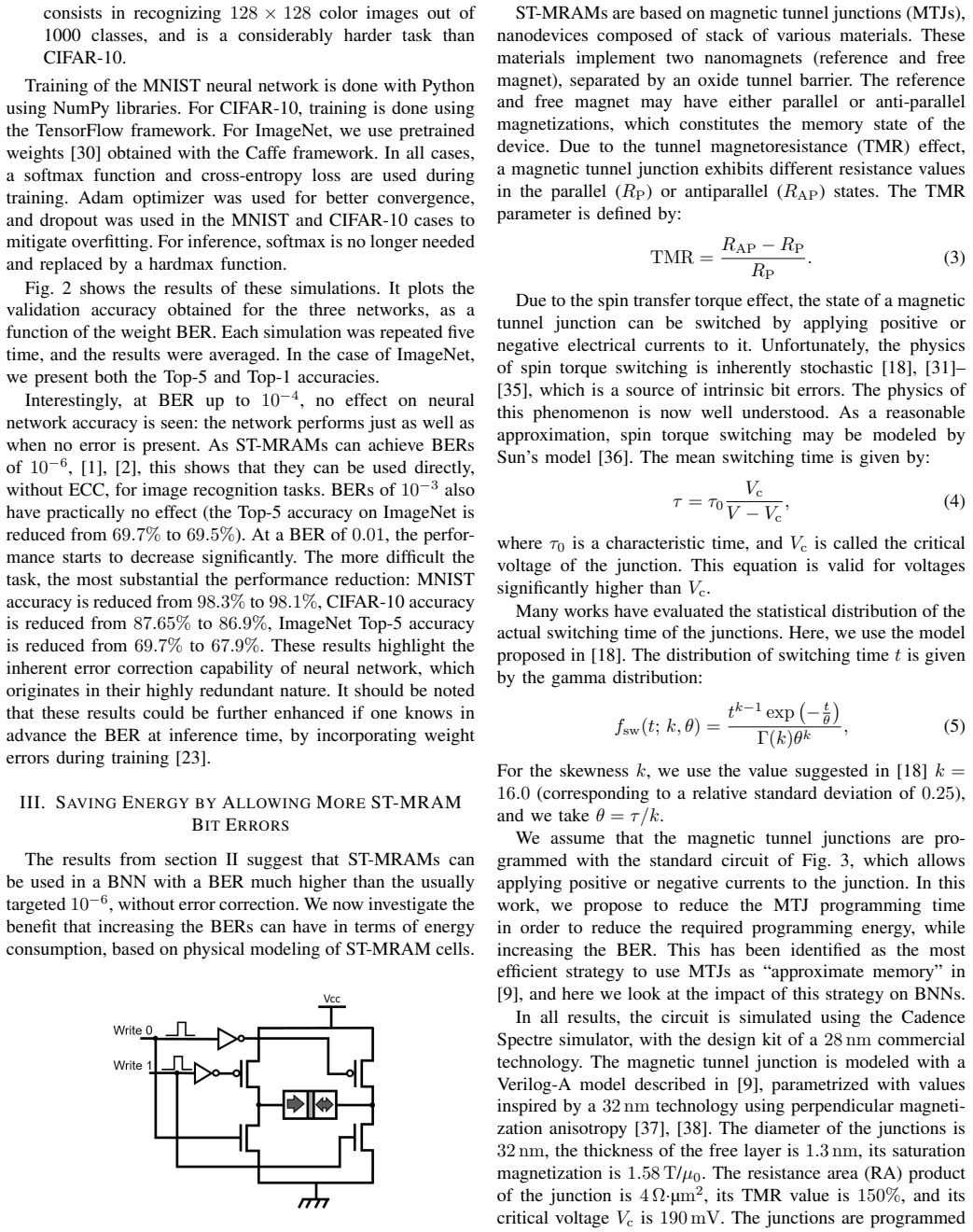
- [Section III, Eq. (5) and Fig. 4] The energy-BER curve is generated for a single programming voltage (2.0 x Vc) and a single gamma-distribution shape parameter (k = 16). The factor-two saving may be sensitive to these choices; for instance, a larger programming voltage could reduce the energy difference between low-BER and high-BER operation, while a different k would change the shape of the BER-versus-energy curve. The authors should include a brief sensitivity analysis over a plausible range of V/Vc and k, or at least state how sensitive the factor-two result is to the model parameters.
minor comments (3)
- [Introduction, first paragraph] There is a typo: 'Theses networks' should be 'These networks.'
- [Section III, first paragraph] The phrase 'we look at the impact of this strategy on BNNs' is slightly ambiguous; the strategy is reducing programming time, but the paper does not directly simulate time-reduced programming in a BNN. The text could be clarified to say that the impact is assessed through the BER-energy-accuracy chain.
- [Fig. 2 caption] The caption states 'Each experiment was repeated five times,' but the text in Section II does not describe how the random seed or the training/validation split was handled across repetitions. A brief note on the experimental protocol would improve reproducibility.
Circularity Check
No significant circularity: BNN accuracy-vs-BER and ST-MRAM energy-vs-BER are measured independently and then composed.
full rationale
The derivation chain is non-circular. Section II establishes BNN tolerance by direct simulation: "For this purpose, we perform simulations of BNNs, with bit errors added artificially." The accuracy-versus-BER curves in Fig. 2 are direct measurements of network performance under injected noise; no ST-MRAM parameter is fitted to these curves, and no BNN accuracy result is defined in terms of the ST-MRAM model. Section III separately constructs the programming-energy-versus-BER curve using a circuit-level Monte Carlo simulation whose stochastic switching-time distribution comes from the published gamma model in [18]: "the distribution of switching time t is given by the gamma distribution ... For the skewness k, we use the value suggested in [18] k = 16.0." This device model is parameter-free with stated assumptions, is not fitted to the BNN data, and does not contain the target tolerance claim as an input. The factor-two energy saving is obtained by composing these two independent curves in Figs. 5 and 6, so no prediction is equivalent by construction to a fitted input. The self-citations to [9], [18], [22], and [23] provide prior device models and prior BNN resilience work, but they are independent support rather than circular justification: [18] is a published macrospin switching-time model, and [9] is used to motivate the low-energy programming strategy, not to force the BNN result. The paper's known weakness is that the simulated errors are artificial and i.i.d. rather than state-dependent or correlated ST-MRAM write errors; that is a realism and robustness limitation, not a circularity. Under the hard rules, no quote-and-reduction exhibit of a circular step is available, so the appropriate score is 0.
Assumptions & free parameters
free parameters (3)
- Gamma distribution shape parameter k =
16.0
- MTJ relative variability (TMR, RP) =
5% standard deviation
- Programming voltage factor =
2.0 x Vc
assumptions (5)
- domain assumption Spin-torque switching of the MTJ follows Sun's model (Eq. 4) with the cited parameters.
- domain assumption The switching time distribution is a gamma distribution with shape parameter k=16 (Eq. 5), as suggested in [18].
- domain assumption Bit errors on binarized synaptic weights are independent and uniformly random with probability BER.
- domain assumption The pretrained XNOR-Net AlexNet weights from [30] provide a valid binarized network for ImageNet.
- domain assumption The Cadence Spectre circuit simulation with the Verilog-A MTJ model from [9] accurately predicts programming energy.
Cite this review
Pith. "Pith review of Implementing Binarized Neural Networks with Magnetoresistive RAM without Error Correction." pith.science (2026). https://pith.science/paper/67SPJZUG
@misc{pith2026190804085,
  author       = {Pith},
  title        = {Pith review of: Implementing Binarized Neural Networks with Magnetoresistive RAM without Error Correction},
  year         = {2026},
  howpublished = {\url{https://pith.science/paper/67SPJZUG}},
  note         = {Machine review of arXiv:1908.04085}
}
read the original abstract
One of the most exciting applications of Spin Torque Magnetoresistive Random Access Memory (ST-MRAM) is the in-memory implementation of deep neural networks, which could allow improving the energy efficiency of Artificial Intelligence by orders of magnitude with regards to its implementation on computers and graphics cards. In particular, ST-MRAM could be ideal for implementing Binarized Neural Networks (BNNs), a type of deep neural networks discovered in 2016, which can achieve state-of-the-art performance with a highly reduced memory footprint with regards to conventional artificial intelligence approaches. The challenge of ST-MRAM, however, is that it is prone to write errors and usually requires the use of error correction. In this work, we show that these bit errors can be tolerated by BNNs to an outstanding level, based on examples of image recognition tasks (MNIST, CIFAR-10 and ImageNet): bit error rates of ST-MRAM up to 0.1% have little impact on recognition accuracy. The requirements for ST-MRAM are therefore considerably relaxed for BNNs with regards to traditional applications. By consequence, we show that for BNNs, ST-MRAMs can be programmed with weak (low-energy) programming conditions, without error correcting codes. We show that this result can allow the use of low energy and low area ST-MRAM cells, and show that the energy savings at the system level can reach a factor two.
Figures
Figures from the paper (2 more)
Reference graph
Works this paper leans on
-
[1]
Mram as embedded non-volatile memory solution for 22ffl finfet technology,
O. Golonzka, J.-G. Alzate, U. Arslan, M. Bohr, P. Bai, J. Brockman, B. Buford, C. Connor, N. Das, B. Doyle et al. , “Mram as embedded non-volatile memory solution for 22ffl finfet technology,” in 2018 IEEE International Electron Devices Meeting (IEDM) . IEEE, 2018, pp. 18–1
work page 2018
-
[2]
Embedded stt-mram in 28-nm fdsoi logic process for industrial mcu/iot application,
Y . K. Lee et al. , “Embedded stt-mram in 28-nm fdsoi logic process for industrial mcu/iot application,” in IEEE Symp. VLSI Technol. IEEE, 2018, pp. 181–182
work page 2018
-
[3]
Y .-C. Shih et al. , “Logic process compatible 40-nm 16-mb, embedded perpendicular-mram with hybrid-resistance reference, sub- µa sensing resolution, and 17.5-ns read access time,” IEEE Journal of Solid-State Circuits, 2019
work page 2019
-
[4]
St-mram fundamentals, challenges, and outlook,
T. Andre, S. M. Alam, D. Gogl, J. Barkatullah, J. Qi, H. Lin, X. Zhang, W. Meadows, F. Neumeyer, G. Viot et al. , “St-mram fundamentals, challenges, and outlook,” in 2017 IEEE International Memory Workshop (IMW). IEEE, 2017, pp. 1–4
work page 2017
-
[5]
Synchronous non-volatile logic gate design based on resistive switching memories,
W. Zhao, M. Moreau, E. Deng, Y . Zhang, J.-M. Portal, J.-O. Klein, M. Bocquet, H. Aziza, D. Deleruyelle, C. Muller et al. , “Synchronous non-volatile logic gate design based on resistive switching memories,” IEEE Transactions on Circuits and Systems I: Regular Papers , vol. 61, no. 2, pp. 443–454, 2014
work page 2014
-
[6]
Deep learning,
Y . LeCun, Y . Bengio, and G. Hinton, “Deep learning,” Nature, vol. 521, no. 7553, p. 436, 2015
2015
-
[7]
Big data needs a hardware revolution,
Editorial, “Big data needs a hardware revolution,” Nature, vol. 554, no. 7691, p. 145, Feb. 2018
work page 2018
-
[8]
Design of mtj-based nonvolatile logic gates for quantized neural networks,
M. Natsui, T. Chiba, and T. Hanyu, “Design of mtj-based nonvolatile logic gates for quantized neural networks,” Microelectronics journal , vol. 82, pp. 13–21, 2018
work page 2018
Show all 39 references
-
[9]
Use of magnetoresistive random-access memory as approximate memory for training neural networks,
N. Locatelli, A. F. Vincent, and D. Querlioz, “Use of magnetoresistive random-access memory as approximate memory for training neural networks,” in 2018 25th IEEE International Conference on Electronics, Circuits and Systems (ICECS) . IEEE, 2018, pp. 553–556
2018
-
[10]
A multilevel cell stt-mram-based computing in-memory accelerator for binary convolutional neural network,
Y . Pan, P. Ouyang, Y . Zhao, W. Kang, S. Yin, Y . Zhang, W. Zhao, and S. Wei, “A multilevel cell stt-mram-based computing in-memory accelerator for binary convolutional neural network,” IEEE Transactions on Magnetics , no. 99, pp. 1–5, 2018
2018
-
[11]
Accelerating low bit-width deep convolu- tion neural network in mram,
Z. He, S. Angizi, and D. Fan, “Accelerating low bit-width deep convolu- tion neural network in mram,” in 2018 IEEE Computer Society Annual Symposium on VLSI (ISVLSI) . IEEE, 2018, pp. 533–538
2018
-
[12]
S. G. Ramasubramanian, R. Venkatesan, M. Sharad, K. Roy, and A. Raghunathan, in Proc. ISLPED. ACM, 2014, pp. 15–20
2014
-
[13]
In-memory computing with resistive switching devices,
D. Ielmini and H.-S. P. Wong, “In-memory computing with resistive switching devices,” Nature Electronics, vol. 1, no. 6, p. 333, 2018
2018
-
[14]
Neuro-inspired computing with emerging nonvolatile memorys,
S. Yu, “Neuro-inspired computing with emerging nonvolatile memorys,” Proc. IEEE, vol. 106, no. 2, pp. 260–285, 2018
2018
-
[15]
Bioinspired programming of memory devices for implementing an inference engine,
D. Querlioz, O. Bichler, A. F. Vincent, and C. Gamrat, “Bioinspired programming of memory devices for implementing an inference engine,” Proc. IEEE, vol. 103, no. 8, pp. 1398–1416, 2015
2015
-
[16]
Role of synaptic variability in resistive memory-based spiking neural networks with unsupervised learning,
D. R. B. Ly, A. Grossi, C. Fenouillet-Beranger, E. Nowak, D. Querlioz, and E. Vianello, “Role of synaptic variability in resistive memory-based spiking neural networks with unsupervised learning,”J. Phys. D: Applied Physics, 2018
2018
-
[17]
Spin-transfer torque switching in magnetic tunnel junctions and spin-transfer torque random access memory,
Z. Diao, Z. Li, S. Wang, Y . Ding, A. Panchula, E. Chen, L.-C. Wang, and Yiming Huai, “Spin-transfer torque switching in magnetic tunnel junctions and spin-transfer torque random access memory,” J. Phys. Cond. Mat. , vol. 19, no. 16, p. 165209, 2007
2007
-
[18]
Analytical Macrospin Modeling of the Stochastic Switching Time of Spin-Transfer Torque Devices,
A. F. Vincent, N. Locatelli, J.-O. Klein, W. Zhao, S. Galdin-Retailleau, and D. Querlioz, “Analytical Macrospin Modeling of the Stochastic Switching Time of Spin-Transfer Torque Devices,”IEEE Trans. Electron Dev., vol. 62, no. 1, pp. 164–170, Jan. 2015
2015
-
[19]
Binarized neural networks: Training deep neural networks with weights and activations constrained to+ 1 or-1,
M. Courbariaux, I. Hubara, D. Soudry, R. El-Yaniv, and Y . Ben- gio, “Binarized neural networks: Training deep neural networks with weights and activations constrained to+ 1 or-1,” arXiv preprint arXiv:1602.02830, 2016
2016 arXiv
-
[20]
Xnor-net: Imagenet classification using binary convolutional neural networks,
M. Rastegari, V . Ordonez, J. Redmon, and A. Farhadi, “Xnor-net: Imagenet classification using binary convolutional neural networks,” in Proc. ECCV. Springer, 2016, pp. 525–542
2016
-
[21]
Towards accurate binary convolutional neural network,
X. Lin, C. Zhao, and W. Pan, “Towards accurate binary convolutional neural network,” in Proc. NIPS, 2017, pp. 345–353
2017
-
[22]
In-memory and error-immune differential rram implementation of binarized deep neural networks,
M. Bocquet, T. Hirztlin, J.-O. Klein, E. Nowak, E. Vianello, J.-M. Portal, and D. Querlioz, “In-memory and error-immune differential rram implementation of binarized deep neural networks,” in IEDM Tech. Dig. IEEE, 2018, p. 20.6.1
2018
-
[23]
Outstanding bit error tolerance of resistive ram-based binarized neural networks,
T. Hirtzlin, M. Bocquet, J.-O. Klein, E. Nowak, E. Vianello, J.-M. Portal, and D. Querlioz, “Outstanding bit error tolerance of resistive ram-based binarized neural networks,” arXiv preprint arXiv:1904.03652 , 2019
1904 arXiv
-
[24]
Brein memory: A 13-layer 4.2 k neuron/0.8 m synapse binary/ternary reconfigurable in-memory deep neural network accelerator in 65 nm cmos,
K. Ando et al. , “Brein memory: A 13-layer 4.2 k neuron/0.8 m synapse binary/ternary reconfigurable in-memory deep neural network accelerator in 65 nm cmos,” in Proc. VLSI Symp. on Circuits . IEEE, 2017, p. C24
2017
-
[25]
X. Sun, X. Peng, P.-Y . Chen, R. Liu, J.-s. Seo, and S. Yu, “Fully parallel rram synaptic array for implementing binary neural network with (+ 1,-
-
[26]
weights and (+ 1, 0) neurons,” in Proc. ASP-DAC . IEEE Press, 2018, pp. 574–579
2018
-
[27]
Xnor-rram: A scalable and parallel resistive synaptic architecture for binary neural networks,
X. Sun, S. Yin, X. Peng, R. Liu, J.-s. Seo, and S. Yu, “Xnor-rram: A scalable and parallel resistive synaptic architecture for binary neural networks,” algorithms, vol. 2, p. 3, 2018
2018
-
[28]
Binary convolutional neural network on rram,
T. Tang, L. Xia, B. Li, Y . Wang, and H. Yang, “Binary convolutional neural network on rram,” in Proc. ASP-DAC. IEEE, 2017, pp. 782–787
2017
-
[29]
Self-enabled error-free switching circuit for spin transfer torque mram and logic,
Y . Lakys, W. S. Zhao, T. Devolder, Y . Zhang, J.-O. Klein, D. Ravelosona, and C. Chappert, “Self-enabled error-free switching circuit for spin transfer torque mram and logic,” IEEE Transactions on Magnetics , vol. 48, no. 9, pp. 2403–2406, 2012
2012
-
[30]
Imagenet classification with deep convolutional neural networks,
A. Krizhevsky, I. Sutskever, and G. E. Hinton, “Imagenet classification with deep convolutional neural networks,” in Proc. NIPS , 2012, pp. 1097–1105
2012
-
[31]
Xnor-net-pytorch,
J. Yue, “Xnor-net-pytorch,” https://github.com/jiecaoyu/ XNOR-Net-PyTorch, 2017
2017
-
[32]
Switching distributions and write reliability of perpendicular spin torque MRAM,
D. Worledge et al. , “Switching distributions and write reliability of perpendicular spin torque MRAM,” in IEDM Tech. Dig. , 2010, pp. 12.5.1–12.5.4, 00018
2010
-
[33]
Bit error rate investigation of spin-transfer-switched magnetic tunnel junctions,
Z. Wang, Y . Zhou, J. Zhang, and Y . Huai, “Bit error rate investigation of spin-transfer-switched magnetic tunnel junctions,” Appl. Phys. Lett. , vol. 101, no. 14, p. 142406, Oct. 2012
2012
-
[34]
Spin-transfer torque magnetic memory as a stochastic memristive synapse for neuromorphic systems,
A. F. Vincent et al. , “Spin-transfer torque magnetic memory as a stochastic memristive synapse for neuromorphic systems,” IEEE T. Biomed. Circ. S. , vol. 9, no. 2, pp. 166–174, 2015
2015
-
[35]
Approximate storage for energy efficient spintronic memories,
A. Ranjan, S. Venkataramani, X. Fong, K. Roy, and A. Raghunathan, “Approximate storage for energy efficient spintronic memories,” inProc. DAC, Jun. 2015, pp. 1–6, 00002
2015
-
[36]
Approximation-aware Multi-Level Cells STT-RAM cache architecture,
F. Sampaio et al. , “Approximation-aware Multi-Level Cells STT-RAM cache architecture,” in Proc. CASES, 2015, pp. 79–88
2015
-
[37]
Spin-current interaction with a monodomain magnetic body: A model study,
J. Z. Sun, “Spin-current interaction with a monodomain magnetic body: A model study,” Phys. Rev. B, vol. 62, no. 1, pp. 570–578, 2000, 00656
2000
-
[38]
Basic principles of STT-MRAM cell operation in memory arrays,
Khvalkovskiy et al. , “Basic principles of STT-MRAM cell operation in memory arrays,” J. Phys. D , vol. 46, no. 7, p. 074001, Feb. 2013
2013
-
[39]
A Scaling Roadmap and Performance Evaluation of In-Plane and Perpendicular MTJ Based STT-MRAMs for High-Density Cache Memory,
K. C. Chun et al., “A Scaling Roadmap and Performance Evaluation of In-Plane and Perpendicular MTJ Based STT-MRAMs for High-Density Cache Memory,” IEEE JSSC , vol. 48, no. 2, pp. 598–610, 2013
2013
Reviewed August 14, 2026 · model on record in the stance chip above.
Discussion (0). Continue with ORCID to comment.