REVIEW 2 major objections 6 minor 47 references
Low-energy type-II Dirac fermions and spin-polarized topological surface states in transition-metal dichalcogenide NiTe$_2$
T0 review · 2 major / 6 minor · reviewed 2026-08-14 · deepseek-v4-flash
Pith's one-line read NiTe2 is shown to be a type-II Dirac semimetal whose bulk Dirac nodes lie just above the Fermi energy, within about 20 meV, with spin-polarized topological surface states.
desk verdict Solid spin-ARPES plus DFT study confirming NiTe2 as a type-II Dirac semimetal, but the headline '20 meV above EF' is an extrapolation, not a direct measurement. read the letter →
The pith
A machine-rendered reading of the paper's core claim, the machinery that carries it, and where it could break.
The reading
What carries the argument
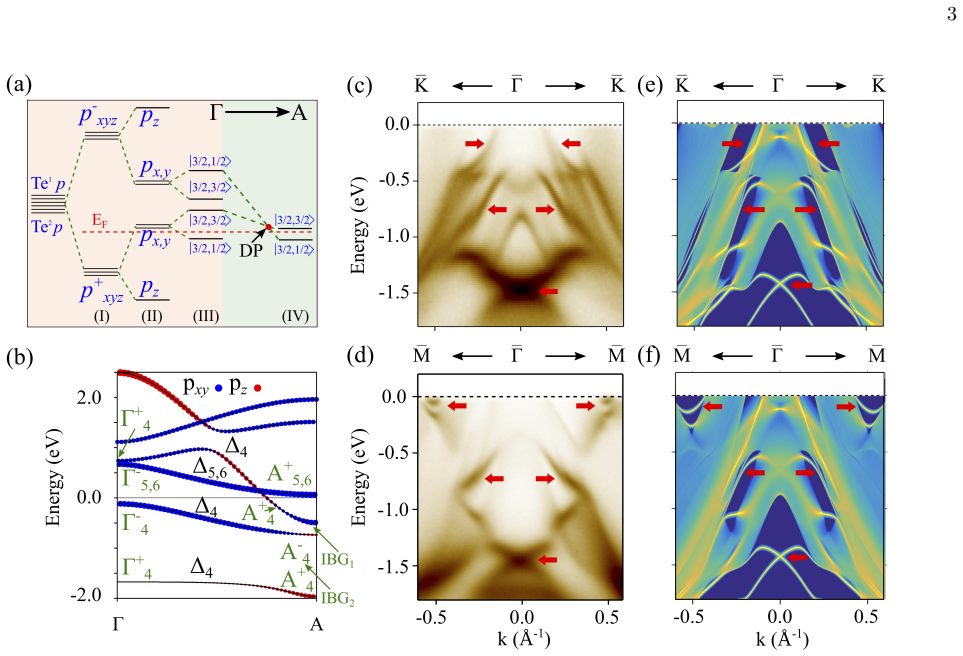
The central mechanism is the Te 5p orbital manifold in a trigonal CdI2-type structure, acted on by intra-layer hybridization, trigonal crystal-field splitting, and spin-orbit coupling. This produces the orbital sequence that ends in a tilted (type-II) Dirac crossing along the $C_3$ rotation axis: the crossing bands $\Delta_4$ and $\Delta_{5,6}$ are doubly degenerate and have opposite $C_3$ rotation eigenvalues, so they cannot hybridize and the node stays gapless. On the surface, the band inversions from the same manifold give topological surface states whose spin-momentum locking is read out by spin-resolved ARPES.
What would settle it
A direct measurement of the bulk band dispersion at the photon energy tuned to $k_z = 0.35c^*$, the DFT location of the Dirac point, with energy resolution better than 20 meV, would settle whether the two bands actually cross just above the Fermi energy. Alternatively, bulk-sensitive probes such as high-resolution X-ray ARPES or quantum oscillations on the electron and hole pockets could locate the node; if the crossing appears at a binding energy differing from the claimed about 20 meV above $E_F$ by more than the experimental uncertainty, the central claim fails.
Extended reading notes
Core claim
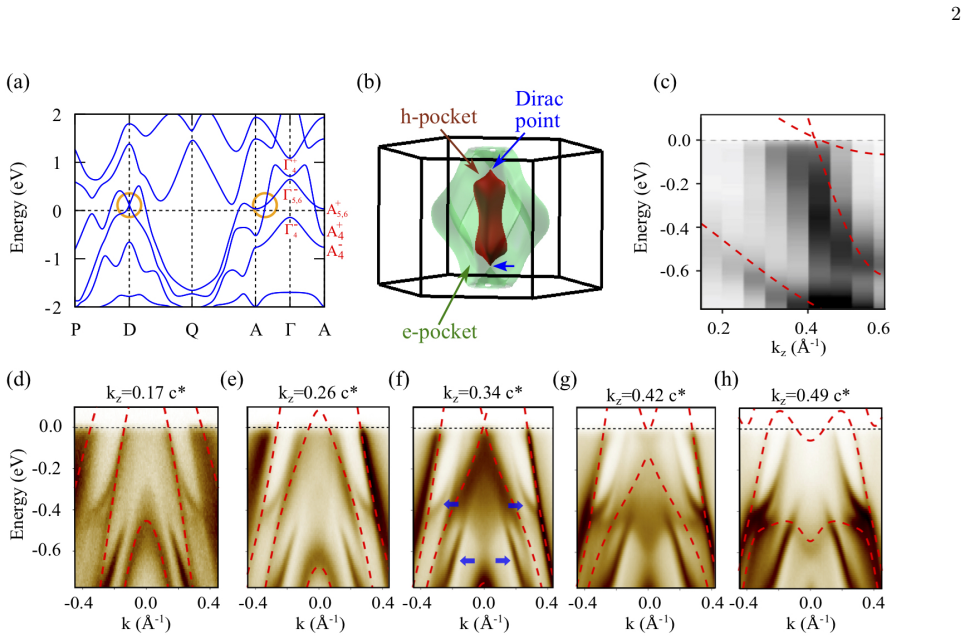
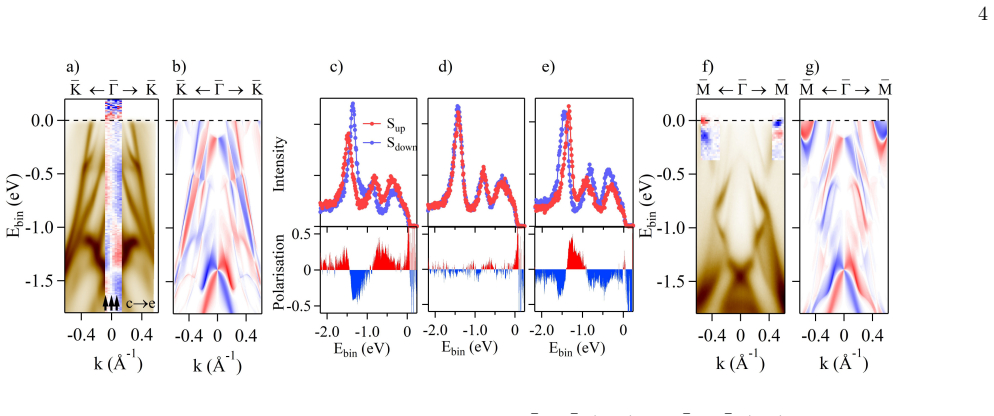
On the paper's own terms, the discovery is that NiTe2 realizes a type-II Dirac semimetal state with the Dirac point in close vicinity of the Fermi level. The bulk Dirac node, located just above (about 20 meV) the Fermi energy along the $\Gamma$–$A$ direction, is a quadruply degenerate tilted crossing of the $\Delta_4$ and $\Delta_{5,6}$ bands, protected by $C_3$ rotation symmetry because the two bands carry opposite rotation characters; inversion and time-reversal symmetry keep the crossing doubly degenerate. Below the Fermi level the same Te 5p orbital manifold creates a ladder of inverted band gaps at the $A$ point, and one of these inversions supports a Dirac cone in the surface states at about $-$1.4 eV binding energy. Spin-ARPES shows the surface bands are spin polarized perpendicular to the momentum direction, with opposite polarizations crossing at the surface Dirac point and reaching nearly 50% polarization, confirming the helical spin-momentum locking expected for topological surface states.
Load-bearing premise
The near-Fermi position of the Dirac node rests on a rigid 100 meV downward shift applied to the DFT bands to match the ARPES data; the bulk node itself lies just above the Fermi level and is not directly resolved, so if the shift or the calculated unoccupied bands are wrong, the node could sit further from the Fermi energy than claimed.
Editorial extensions
If this is right
- Because the bulk Dirac node sits within about 20 meV of $E_F$, low-energy excitations in NiTe2 are governed by type-II Dirac fermions, unlike PtTe2, PtSe2, and PdTe2 where the node lies 0.6–1.2 eV below.
- The surface Dirac cone at about $-$1.4 eV with nearly 50% spin polarization provides a source of spin-polarized carriers with helicity locked to momentum.
- The ladder of band inversions below and above $E_F$ produces topological surface states over a wide energy window, extending the topological-ladder family of Pt/PdTe2 to NiTe2.
- These properties make NiTe2 a candidate for spintronic devices, THz plasmonics, and ultrafast optoelectronics based on Dirac fermions.
- Potassium surface doping moves only the surface states, indicating that bulk doping rather than surface deposition is needed to shift the bulk Dirac point relative to $E_F$.
Reading between the lines
- A testable extension is to tune the Dirac-node energy with strain or interlayer spacing, since the same Te 5p mechanism governs related transition-metal dichalcogenides; if the orbital picture is right, modest perturbations should move the node through $E_F$.
- The tilted electron and hole pockets that touch at a type-II node usually produce distinct magnetotransport and optical signatures, so measuring the plasma edge or Landau-level spectrum could independently confirm the type-II character without relying on the rigid band shift.
- If the rigid-shift uncertainty is resolved by better data, NiTe2 could serve as a tunable testbed for comparing type-I and type-II Dirac physics in one material family.
Signed reviews
Editorial analysis
A structured set of objections, weighed in public.
Referee Report
Summary. The manuscript reports a combined spin- and angle-resolved photoemission spectroscopy (spin-ARPES) and density functional theory (DFT) study of the layered transition-metal dichalcogenide NiTe2. The authors claim that NiTe2 hosts a pair of type-II Dirac nodes along the Γ–A direction located just above (within ~20 meV) the Fermi energy, in contrast to PtTe2, PdTe2, and PtSe2 where the Dirac nodes lie deep in the valence band. They further report a ladder of band inversions below the Fermi level, one of which gives rise to a Dirac cone in the surface states, and they present spin-resolved ARPES data showing a chiral spin texture with polarization up to ~50%. The evidence combines photon-energy-dependent ARPES for kz dispersion, surface-state measurements along two high-symmetry directions, spin-resolved data, and DFT slab calculations.
Significance. If the central claims hold, NiTe2 would be a rare example of a type-II Dirac semimetal with the Dirac node very close to the Fermi energy, making it qualitatively more promising for transport and optical applications than the previously studied Pt/Pd dichalcogenides. The paper's strengths include the direct observation of spin-polarized topological surface states with substantial polarization, the consistency between the measured and calculated surface-state dispersions, and the orbital-based explanation of the band inversions. The spin-resolved ARPES data and the surface-state analysis are convincing and constitute a useful experimental contribution. However, the headline quantitative claim that the Dirac node lies only ~20 meV above the Fermi energy is not directly measured, because the node is an unoccupied state; this claim rests on an extrapolation of a rigidly shifted DFT band structure, and the manuscript provides no uncertainty analysis for that shift.
major comments (2)
- [Fig. 2(c) and text near 'Extrapolating the fitted DFT band structure'] The central claim that the Dirac node lies 'just above (~20 meV) the Fermi energy' is based on extrapolation of DFT bands that have been rigidly shifted downward by 100 meV to match occupied ARPES bands. The Dirac node at kz = 0.35 c* is an unoccupied state and is never directly resolved in the ARPES data; the closest measured kz (0.34 c*) still shows only occupied bands. Because the rigid shift is calibrated on occupied states, its validity at the unoccupied Dirac node is an assumption, and an error of tens of meV in this extrapolation would change the 20 meV figure substantially. The authors should either provide a quantitative estimate of the systematic uncertainty in the extrapolated node energy (e.g., from the photon-energy calibration, kz mapping, or functional dependence of the unoccupied bands) or soften the abstract and main-text claims to state that the node is near the Fermi energy within the accuracy of the shifted DFT calculation.
- [Fig. 3 caption and potassium-doping paragraph] The surface-state calculations use an additional empirical surface potential of -0.14 eV to match ARPES, and the text reports that potassium deposition affects only the surface states while 'bulk doping is needed to shift the bulk bands.' Thus no experimental probe directly accesses the bulk Dirac node energy. The manuscript should explicitly acknowledge that the 20 meV proximity claim is a theory-extrapolated value with unknown systematic error, and should discuss how the two empirical adjustments (the 100 meV bulk shift and the -0.14 eV surface potential) affect the reliability of the near-Fermi-energy conclusion. As written, the abstract presents the 20 meV value as an established fact rather than as a DFT-based extrapolation.
minor comments (6)
- [Fig. 1(c) caption] The phrase 'six-fold symmetry along along the (001) direction' contains a duplicated 'along'; please remove the repetition.
- [Fig. 1(d) caption] The word 'Briluoin' is a typo and should be 'Brillouin'.
- [Main text, paragraph on crystal structure] The phrase 'weak van der Walls force' should read 'weak van der Waals force'.
- [Potassium-doping paragraph] The sentence 'Bulk doing is needed to shift the bulk bands' contains a typo; it should read 'Bulk doping is needed to shift the bulk bands.'
- [Reference [45]] The supplementary material is cited only by a bit.ly link; please provide a stable URL or DOI for archival purposes.
- [Abstract and main-text wording] The phrase 'in close vicinity of the Fermi energy' is vague; given that the quantitive value is an extrapolation, the authors should specify in the abstract that the node is unoccupied and that its exact energy is determined from a shifted DFT calculation.
Circularity Check
No significant circularity: the central claims are supported by ab initio DFT plus independent ARPES/spin-ARPES measurements, with empirical shifts used only as calibration.
full rationale
The paper's central claims—type-II Dirac nodes, their approximate energy position, band inversions, and chiral surface spin texture—are not derived by fitting the target conclusions. The bulk Dirac node position is obtained from DFT band structure including SOC, and the 100 meV rigid downward shift is calibrated to match the measured occupied ARPES dispersion (Fig. 2 caption: 'for matching with the experimental data, we have shifted the DFT band structure downward by 100 meV'). This shift is constrained by occupied bands; it does not by itself enforce the unoccupied Dirac node to sit at +20 meV, which instead follows from the calculated band shape after the global shift. Similarly, the -0.14 eV surface potential in Fig. 3 is used to match surface-state ARPES data and is not the source of the bulk node conclusion. The spin texture is measured by spin-ARPES and compared with calculations, so the topological surface-state claim has independent experimental content. The paper cites prior works with overlapping authors (e.g., [32,33,46]) for general context—such as the role of the Te 5p orbital manifold in group-X TMDs—but the NiTe2-specific DFT orbital analysis and ARPES data are presented in this paper and do not reduce to those citations. The major weakness is that the near-Fermi-energy Dirac node is unoccupied and therefore inferred by extrapolation after a rigid shift, but that is an accuracy/verification concern, not a circularity. No step in the derivation chain is equivalent to its own input by construction.
Assumptions & free parameters
free parameters (2)
- DFT rigid band shift =
-100 meV
- surface potential for slab calculation =
-0.14 eV
assumptions (3)
- domain assumption DFT with the chosen exchange-correlation functional correctly describes the band ordering and the type-II Dirac node in NiTe2 after a rigid shift.
- standard math C3 rotation symmetry protects the Dirac node from gap opening.
- ad hoc to paper A uniform rigid shift of all DFT bands by -100 meV is a valid approximation for matching ARPES.
Cite this review
Pith. "Pith review of Low-energy type-II Dirac fermions and spin-polarized topological surface states in transition-metal dichalcogenide NiTe$_2$." pith.science (2026). https://pith.science/paper/OZNFALJY
@misc{pith2026190804099,
  author       = {Pith},
  title        = {Pith review of: Low-energy type-II Dirac fermions and spin-polarized topological surface states in transition-metal dichalcogenide NiTe$_2$},
  year         = {2026},
  howpublished = {\url{https://pith.science/paper/OZNFALJY}},
  note         = {Machine review of arXiv:1908.04099}
}
abstract
Using spin- and angle- resolved photoemission spectroscopy (spin-ARPES) together with ${\it ab~initio}$ calculations, we demonstrate the existence of a type-II Dirac semimetal state in NiTe$_2$. We show that, unlike PtTe$_2$, PtSe$_2$, and PdTe$_2$, the Dirac node in NiTe$_2$ is located in close vicinity of the Fermi energy. Additionally, NiTe$_2$ also hosts a pair of band inversions below the Fermi level along the $\Gamma-A$ high-symmetry direction, with one of them leading to a Dirac cone in the surface states. The bulk Dirac nodes and the ladder of band inversions in NiTe$_2$ support unique topological surface states with chiral spin texture over a wide range of energies. Our work paves the way for the exploitation of the low-energy type-II Dirac fermions in NiTe$_2$ in the fields of spintronics, THz plasmonics and ultrafast optoelectronics.
Figures

Figures from the paper (1 more)
Reference graph
Works this paper leans on
-
[1]
Colloquium : Topological band theory,
A. Bansil, Hsin Lin, and Tanmoy Das, “ Colloquium : Topological band theory,” Rev. Mod. Phys. 88, 021004 (2016)
work page 2016
-
[2]
Colloquium: Topological insulators,
M. Z. Hasan and C. L. Kane, “Colloquium: Topological insulators,” Rev. Mod. Phys. 82, 3045–3067 (2010)
2010
-
[3]
Weyl and dirac semimetals in three-dimensional solids,
N. P. Armitage, E. J. Mele, and Ashvin Vishwanath, “Weyl and dirac semimetals in three-dimensional solids,” Rev. Mod. Phys. 90, 015001 (2018)
2018
-
[4]
Desheng Kong and Yi Cui, “Opportunities in chemistry and materials science for topological insulators and their nanostructures,” Nat. Chem. 3, 845 (2011)
work page 2011
-
[5]
Beyond dirac and weyl fermions: Unconventional quasi- particles in conventional crystals,
Barry Bradlyn, Jennifer Cano, Zhijun Wang, M. G. Vergniory, C. Felser, R. J. Cava, and B. Andrei Bernevig, “Beyond dirac and weyl fermions: Unconventional quasi- particles in conventional crystals,” Science 353, 6299 (2016)
work page 2016
-
[6]
Discovery of a weyl fermion semimetal and topological fermi arcs,
Su-Yang Xu, Ilya Belopolski, Nasser Alidoust, Mad- hab Neupane, Guang Bian, Chenglong Zhang, Raman Sankar, Guoqing Chang, Zhujun Yuan, Chi-Cheng Lee, Shin-Ming Huang, Hao Zheng, Jie Ma, Daniel S. Sanchez, BaoKai Wang, Arun Bansil, Fangcheng Chou, Pavel P. Shibayev, Hsin Lin, Shuang Jia, and M. Zahid Hasan, “Discovery of a weyl fermion semimetal and topolo...
work page 2015
-
[7]
A weyl fermion semimetal with surface fermi arcs in the transition metal monopnictide TaAs class,
Shin-Ming Huang, Su-Yang Xu, Ilya Belopolski, Chi- Cheng Lee, Guoqing Chang, BaoKai Wang, Nasser Ali- doust, Guang Bian, Madhab Neupane, Chenglong Zhang, Shuang Jia, Arun Bansil, Hsin Lin, and M. Zahid Hasan, “A weyl fermion semimetal with surface fermi arcs in the transition metal monopnictide TaAs class,” Nature Com- munications 6, 7373 (2015)
work page 2015
-
[8]
Experimen- tal discovery of weyl semimetal TaAs,
B. Q. Lv, H. M. Weng, B. B. Fu, X. P. Wang, H. Miao, J. Ma, P. Richard, X. C. Huang, L. X. Zhao, G. F. Chen, Z. Fang, X. Dai, T. Qian, and H. Ding, “Experimen- tal discovery of weyl semimetal TaAs,” Phys. Rev. X 5, 031013 (2015)
work page 2015
Show all 47 references
-
[9]
Discovery of a weyl fermion state with fermi arcs in niobium arsenide,
Su-Yang Xu, Nasser Alidoust, Ilya Belopolski, Zhu- jun Yuan, Guang Bian, Tay-Rong Chang, Hao Zheng, Vladimir N. Strocov, Daniel S. Sanchez, Guoqing Chang, Chenglong Zhang, Daixiang Mou, Yun Wu, Lunan Huang, Chi-Cheng Lee, Shin-Ming Huang, BaoKai Wang, Arun Bansil, Horng-Tay Je...
2015
-
[10]
Multi-weyl topological semimetals stabilized by point group symmetry,
Chen Fang, Matthew J. Gilbert, Xi Dai, and B. Andrei Bernevig, “Multi-weyl topological semimetals stabilized by point group symmetry,” Phys. Rev. Lett. 108, 266802 (2012)
2012
-
[11]
Weyl semimetal phase in noncen- trosymmetric transition-metal monophosphides,
Hongming Weng, Chen Fang, Zhong Fang, B. Andrei Bernevig, and Xi Dai, “Weyl semimetal phase in noncen- trosymmetric transition-metal monophosphides,” Phys. Rev. X 5, 011029 (2015)
2015
-
[12]
Topological electronic struc- ture and weyl semimetal in the TlBiSe2 class of semicon- ductors,
Bahadur Singh, Ashutosh Sharma, H. Lin, M. Z. Hasan, R. Prasad, and A. Bansil, “Topological electronic struc- ture and weyl semimetal in the TlBiSe2 class of semicon- ductors,” Phys. Rev. B 86, 115208 (2012)
2012
-
[13]
Type-ii symmetry- protected topological dirac semimetals,
Tay-Rong Chang, Su-Yang Xu, Daniel S. Sanchez, Wei- Feng Tsai, Shin-Ming Huang, Guoqing Chang, Chuang- Han Hsu, Guang Bian, Ilya Belopolski, Zhi-Ming Yu, Shengyuan A. Yang, Titus Neupert, Horng-Tay Jeng, Hsin Lin, and M. Zahid Hasan, “Type-ii symmetry- protected topological di...
2017
-
[14]
Discovery of lorentz-violating type II weyl fermions in LaAlGe,
Su-Yang Xu, Nasser Alidoust, Guoqing Chang, Hong Lu, Bahadur Singh, Ilya Belopolski, Daniel S. Sanchez, Xiao Zhang, Guang Bian, Hao Zheng, Marious-Adrian Hu- sanu, Yi Bian, Shin-Ming Huang, Chuang-Han Hsu, Tay- Rong Chang, Horng-Tay Jeng, Arun Bansil, Titus Neu- pert, Vladimir...
2017 doi
-
[15]
Ob- servation of three-component fermions in the topologi- cal semimetal molybdenum phosphide,
B. Q. Lv, Z. L. Feng, Q. N. Xu, X. Gao, J. Z. Ma, L. Y. Kong, P. Richard, Y. B. Huang, V. N. Strocov, C. Fang, H. M. Weng, Y. G. Shi, T. Qian, and H. Ding, “Ob- servation of three-component fermions in the topologi- cal semimetal molybdenum phosphide,” Nature 546, 627 (2017)
2017
-
[16]
A possible candidate for triply degenerate point fermions in trigonal layered PtBi2,
Wenshuai Gao, Xiangde Zhu, Fawei Zheng, Min Wu, Jin- glei Zhang, Chuanying Xi, Ping Zhang, Yuheng Zhang, Ning Hao, Wei Ning, et al. , “A possible candidate for triply degenerate point fermions in trigonal layered PtBi2,” Nature communications 9 (2018)
2018
-
[17]
Triple point topological met- als,
Ziming Zhu, Georg W. Winkler, QuanSheng Wu, Ju Li, and Alexey A. Soluyanov, “Triple point topological met- als,” Phys. Rev. X 6, 031003 (2016)
2016
-
[18]
Model hamiltonian and time reversal breaking topological phases of antiferromagnetic half-heusler materials,
Jiabin Yu, Binghai Yan, and Chao-Xing Liu, “Model hamiltonian and time reversal breaking topological phases of antiferromagnetic half-heusler materials,” Phys. Rev. B 95, 235158 (2017)
2017
-
[19]
Triple point fermions in a minimal symmorphic model,
I. C. Fulga and Ady Stern, “Triple point fermions in a minimal symmorphic model,” Phys. Rev. B 95, 241116 (2017)
2017
-
[20]
Prediction of triple point fermions in simple half-heusler topological insula- tors,
Hao Yang, Jiabin Yu, Stuart S. P. Parkin, Claudia Felser, Chao-Xing Liu, and Binghai Yan, “Prediction of triple point fermions in simple half-heusler topological insula- tors,” Phys. Rev. Lett. 119, 136401 (2017). 6
2017
-
[21]
Prediction of ideal topolog- ical semimetals with triply degenerate points in the NaCu3Te2 family,
Jianfeng Wang, Xuelei Sui, Wujun Shi, Jinbo Pan, Shengbai Zhang, Feng Liu, Su-Huai Wei, Qimin Yan, and Bing Huang, “Prediction of ideal topolog- ical semimetals with triply degenerate points in the NaCu3Te2 family,” Phys. Rev. Lett. 119, 256402 (2017)
2017
-
[22]
Dirac semimetal in three di- mensions,
S. M. Young, S. Zaheer, J. C. Y. Teo, C. L. Kane, E. J. Mele, and A. M. Rappe, “Dirac semimetal in three di- mensions,” Phys. Rev. Lett. 108, 140405 (2012)
2012
-
[23]
Dirac semimetals in two dimensions,
Steve M. Young and Charles L. Kane, “Dirac semimetals in two dimensions,” Phys. Rev. Lett.115, 126803 (2015)
2015
-
[24]
Double dirac semimetals in three dimen- sions,
Benjamin J. Wieder, Youngkuk Kim, A. M. Rappe, and C. L. Kane, “Double dirac semimetals in three dimen- sions,” Phys. Rev. Lett. 116, 186402 (2016)
2016
-
[25]
Discovery of a three- dimensional topological dirac semimetal, Na3Bi,
Z. K. Liu, B. Zhou, Y. Zhang, Z. J. Wang, H. M. Weng, D. Prabhakaran, S.-K. Mo, Z. X. Shen, Z. Fang, X. Dai, Z. Hussain, and Y. L. Chen, “Discovery of a three- dimensional topological dirac semimetal, Na3Bi,” Science 343, 864–867 (2014)
2014
-
[26]
A stable three- dimensional topological dirac semimetal Cd 3As2,
Z. K. Liu, J. Jiang, B. Zhou, Z. J. Wang, Y. Zhang, H. M. Weng, D. Prabhakaran, S-K. Mo, H. Peng, P. Dudin, T. Kim, M. Hoesch, Z. Fang, X. Dai, Z. X. Shen, D. L. Feng, Z. Hussain, and Y. L. Chen, “A stable three- dimensional topological dirac semimetal Cd 3As2,” Na- ture Mater...
2014
-
[27]
Observation of a three-dimensional topological dirac semimetal phase in high-mobility Cd3As2,
Madhab Neupane, Su-Yang Xu, Raman Sankar, Nasser Alidoust, Guang Bian, Chang Liu, Ilya Belopolski, Tay- Rong Chang, Horng-Tay Jeng, Hsin Lin, Arun Bansil, Fangcheng Chou, and M. Zahid Hasan, “Observation of a three-dimensional topological dirac semimetal phase in high-mobility...
2014
-
[28]
Experimental realization of a three-dimensional dirac semimetal,
Sergey Borisenko, Quinn Gibson, Danil Evtushinsky, Volodymyr Zabolotnyy, Bernd B¨ uchner, and Robert J. Cava, “Experimental realization of a three-dimensional dirac semimetal,” Phys. Rev. Lett. 113, 027603 (2014)
2014
-
[29]
Dirac semimetal and topological phase transitions in A 3Bi (a = Na, K, Rb),
Zhijun Wang, Yan Sun, Xing-Qiu Chen, Cesare Fran- chini, Gang Xu, Hongming Weng, Xi Dai, and Zhong Fang, “Dirac semimetal and topological phase transitions in A 3Bi (a = Na, K, Rb),” Phys. Rev. B 85, 195320 (2012)
2012
-
[30]
Three-dimensional dirac semimetal and quantum transport in Cd 3As2,
Zhijun Wang, Hongming Weng, Quansheng Wu, Xi Dai, and Zhong Fang, “Three-dimensional dirac semimetal and quantum transport in Cd 3As2,” Phys. Rev. B 88, 125427 (2013)
2013
-
[31]
Lorentz-violating type-ii dirac fermions in tran- sition metal dichalcogenide PtTe2,
Mingzhe Yan, Huaqing Huang, Kenan Zhang, Eryin Wang, Wei Yao, Ke Deng, Guoliang Wan, Hongyun Zhang, Masashi Arita, Haitao Yang, Zhe Sun, Hong Yao, Yang Wu, Shoushan Fan, Wenhui Duan, and Shuyun Zhou, “Lorentz-violating type-ii dirac fermions in tran- sition metal dichalcogenid...
2017
-
[32]
Ubiquitous formation of bulk dirac cones and topological surface states from a single orbital manifold in transition-metal dichalcogenides,
M. S. Bahramy, O. J. Clark, B. J. Yang, J. Feng, L. Baw- den, J. M. Riley, I. Markovi´ c, F. Mazzola, V. Sunko, D. Biswas, S. P. Cooil, M. Jorge, J. W. Wells, M. Lean- dersson, T. Balasubramanian, J. Fujii, I. Vobornik, J. E. Rault, T. K. Kim, M. Hoesch, K. Okawa, M. Asakawa, ...
2017
-
[33]
3d dirac plasmons in the type-ii dirac semimetal PtTe 2,
Antonio Politano, Gennaro Chiarello, Barun Ghosh, Kr- ishanu Sadhukhan, Chia-Nung Kuo, Chin Shan Lue, Vit- torio Pellegrini, and Amit Agarwal, “3d dirac plasmons in the type-ii dirac semimetal PtTe 2,” Phys. Rev. Lett. 121, 086804 (2018)
2018
-
[34]
Experimental evidence for type- ii dirac semimetal in PtSe 2,
Kenan Zhang, Mingzhe Yan, Haoxiong Zhang, Huaqing Huang, Masashi Arita, Zhe Sun, Wenhui Duan, Yang Wu, and Shuyun Zhou, “Experimental evidence for type- ii dirac semimetal in PtSe 2,” Phys. Rev. B 96, 125102 (2017)
2017
-
[35]
Experimental realization of type-ii dirac fermions in a PdTe 2 superconductor,
Han-Jin Noh, Jinwon Jeong, En-Jin Cho, Kyoo Kim, B. I. Min, and Byeong-Gyu Park, “Experimental realization of type-ii dirac fermions in a PdTe 2 superconductor,” Phys. Rev. Lett. 119, 016401 (2017)
2017
-
[36]
Nontrivial berry phase and type-ii dirac transport in the layered material PdTe2,
Fucong Fei, Xiangyan Bo, Rui Wang, Bin Wu, Juan Jiang, Dongzhi Fu, Ming Gao, Hao Zheng, Yulin Chen, Xuefeng Wang, Haijun Bu, Fengqi Song, Xiangang Wan, Baigeng Wang, and Guanghou Wang, “Nontrivial berry phase and type-ii dirac transport in the layered material PdTe2,” Phys. Re...
2017
-
[37]
Topologi- cal type-ii dirac fermions approaching the fermi level in a transition metal dichalcogenide NiTe 2,
Chunqiang Xu, Bin Li, Wenhe Jiao, Wei Zhou, Bin Qian, Raman Sankar, Nikolai D. Zhigadlo, Yanpeng Qi, Dong Qian, Fang-Cheng Chou, and Xiaofeng Xu, “Topologi- cal type-ii dirac fermions approaching the fermi level in a transition metal dichalcogenide NiTe 2,” Chemistry of Materi...
2018
-
[38]
Magnetic properties of nickel telluride,
Enji Uchida and Hisamoto Kondoh, “Magnetic properties of nickel telluride,” Journal of the Physical Society of Japan 11, 21–27 (1956)
1956
-
[39]
Thermo- dynamic properties of nickel-tellurium alloys,
M. Ettenberg, K.L. Komarek, and E. Miller, “Thermo- dynamic properties of nickel-tellurium alloys,” Journal of Solid State Chemistry 1, 583 – 592 (1970)
1970
-
[40]
Study of the electronic structures of ni-group metal ditellurides: NiTe 2, PdTe2 and PtTe2 by the self-consistent LMTO-ASA method,
G Y Guo and W Y Liang, “Study of the electronic structures of ni-group metal ditellurides: NiTe 2, PdTe2 and PtTe2 by the self-consistent LMTO-ASA method,” Journal of Physics C: Solid State Physics 19, 5365–5380 (1986)
1986
-
[41]
Angle-resolved photoemission from the valence bands of NiTe 2, PdTe 2 and PtTe2,
P J Orders, J Liesegang, R C G Leckey, J G Jenkin, and J D Riley, “Angle-resolved photoemission from the valence bands of NiTe 2, PdTe 2 and PtTe2,” Journal of Physics F: Metal Physics 12, 2737–2753 (1982)
1982
-
[42]
Synthesis and microstructure of NiTe 2,
Joo Frederico Haas Leandro Monteiro, Mariana Braga Marciniak, Alcione Roberto Jurelo, Ezequiel Costa Siqueira, Fbio Teixeira Dias, and Jorge Luiz Pimentel Jnior, “Synthesis and microstructure of NiTe 2,” Journal of Crystal Growth 478, 129 – 133 (2017)
2017
-
[43]
Synthetic control of two-dimensional NiTe2 single crys- tals with highly uniform thickness distributions,
Bei Zhao, Weiqi Dang, Yuan Liu, Bo Li, Jia Li, Jun Luo, Zhengwei Zhang, Ruixia Wu, Huifang Ma, Guangzhuang Sun, Yu Huang, Xidong Duan, and Xiangfeng Duan, “Synthetic control of two-dimensional NiTe2 single crys- tals with highly uniform thickness distributions,” Jour- nal of t...
2018
-
[44]
Nontopological origin of the planar hall effect in the type-ii dirac semimetal NiTe 2,
Qianqian Liu, Fucong Fei, Bo Chen, Xiangyan Bo, Boyuan Wei, Shuai Zhang, Minhao Zhang, Faji Xie, Muhammad Naveed, Xiangang Wan, Fengqi Song, and Baigeng Wang, “Nontopological origin of the planar hall effect in the type-ii dirac semimetal NiTe 2,” Phys. Rev. B 99, 155119 (2019)
2019
-
[45]
Supplementary material detailing 1) Sample prepara- tion and characterization, 2) computational details, 3) ARPES measurements, 4) Topological band inversions and 5) ARPES measurements with potassium doping, is available at https://bit.ly/2YWZf1o
-
[46]
A general route to form topologically-protected surface and bulk dirac fermions along high-symmetry lines,
O J Clark, F Mazzola, I Markovi´ c, J M Riley, J Feng, B-J Yang, K Sumida, T Okuda, J Fujii, I Vobornik, T K Kim, K Okawa, T Sasagawa, M S Bahramy, and P D C 7 King, “A general route to form topologically-protected surface and bulk dirac fermions along high-symmetry lines,” El...
2019
-
[47]
Fermiology and superconductivity of topological surface states in PdTe 2,
O. J. Clark, M. J. Neat, K. Okawa, L. Bawden, I. Markovi´ c, F. Mazzola, J. Feng, V. Sunko, J. M. Ri- ley, W. Meevasana, J. Fujii, I. Vobornik, T. K. Kim, M. Hoesch, T. Sasagawa, P. Wahl, M. S. Bahramy, and P. D. C. King, “Fermiology and superconductivity of topological surfac...
2018
Reviewed August 14, 2026 · model on record in the stance chip above.
Discussion (0). Continue with ORCID to comment.